

Your Atlanta team is probably in one of two situations right now. Either the network and phone environment still works, but it's getting harder to support, harder to secure, and harder to justify. Or a larger change is already underway, such as a cloud migration, office move, carrier renewal, contact center upgrade, or site consolidation, and the telecom stack has become the bottleneck.
That's where most enterprise telecom projects go sideways. Companies shop circuits, voice platforms, and managed services before they've defined what the business needs to protect. In Atlanta, that mistake gets expensive fast because the wrong design doesn't just create monthly waste. It creates cutover risk, support friction, stranded equipment, and a pile of old telecom hardware nobody planned to remove properly.
The better approach is to treat enterprise telecom solutions in Atlanta as a full lifecycle decision. Procurement matters. Architecture matters. Carrier diversity matters. But so do migration planning, asset tracking, secure decommissioning, and final disposition of retired routers, switches, PBXs, firewalls, and handsets.
Laying the Groundwork Your Telecom Requirements
Start with business outcomes, not carrier quotes. The enterprise telecom services market reached USD 760.19 billion in 2023 and is projected to reach USD 1,197.67 billion by 2030 at a 6.7% CAGR, driven by cloud integration, 5G adoption, and remote work, according to Grand View Research's enterprise telecom services market analysis. That growth mirrors what Atlanta enterprises are dealing with on the ground. More cloud dependency, more remote users, and more pressure on networks that were designed for a different operating model.
Define what the business can't afford to lose
A strong requirements document answers questions that finance, operations, compliance, and IT all care about.
- Which workflows are business-critical: Trading desks, patient communications, dispatch operations, call center queues, ERP access, and site-to-site application traffic shouldn't be lumped together.
- Where latency or outages hurt most: A warehouse, clinic, branch office, and headquarters all fail differently.
- Which users need guaranteed experience: Executives, customer service teams, field staff, and remote employees often need different service levels.
- What must stay compliant: Healthcare, finance, education, and government buyers usually need tighter controls around call handling, recording, retention, and vendor access.
If you skip this step, vendors fill the gap with generic bundles. That usually means buying somebody else's template.
Practical rule: If your requirements are only user counts, bandwidth estimates, and “need better phones,” you're not ready to compare providers.
Translate needs into technical criteria
Once the business priorities are clear, turn them into testable requirements. That means documenting current circuits, contract dates, handoff types, failover methods, firewall dependencies, voice workflows, contact center integrations, and every application that depends on the WAN.
Use questions like these in your internal discovery:
- Which offices need diverse physical paths, not just two bills from two carriers?
- Which applications break first when packet loss rises?
- Are remote workers using a secure and consistent access method, or a patchwork?
- Which legacy systems still need to stay live during migration?
- What hardware is already near end of support?
A lot of Atlanta teams also forget to inventory what will become obsolete after the cutover. That matters early, not later. If a new voice platform retires an on-prem PBX or old SIP gateways, those assets need a documented exit path.
A useful checkpoint is comparing your list against practical buying frameworks used by local telecom companies and service categories in Atlanta. Not to copy a vendor package, but to confirm you've covered connectivity, collaboration, security, and support requirements in one document.
Build success metrics before the RFP
Decide what “better” means before proposals arrive.
A short scorecard works:
| Requirement area | What to measure |
|---|---|
| User experience | Call quality, application responsiveness, help desk volume |
| Reliability | Failover behavior, outage recovery process, circuit diversity |
| Security | Access control alignment, logging, segmentation, vendor admin controls |
| Operations | Ease of moves, adds, changes, and site onboarding |
| Financial control | Visibility into recurring charges, implementation costs, and retired assets |
That scorecard keeps your procurement grounded. It also prevents a polished demo from overtaking the operational realities your team will live with for years.
Navigating Modern Network Architecture Options
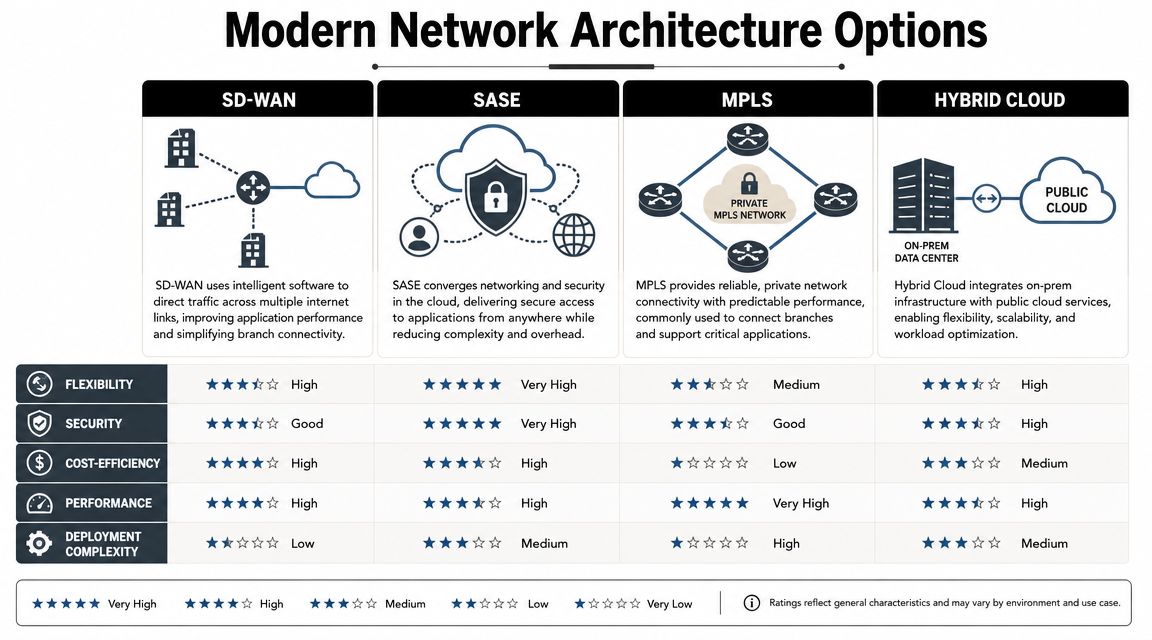
The architectural decision usually comes down to control, flexibility, and how much complexity your team can operate. The telecom market is moving away from legacy voice and toward data-centric connectivity, and the Data/Internet Service segment is projected to grow at a 4.2% CAGR through 2030, according to Research and Markets coverage of enterprise telecom. That tracks with what Atlanta enterprises are buying now. They're prioritizing application performance, cloud access, and integrated platforms over standalone voice.
Where MPLS still fits
MPLS still has a place when an enterprise wants predictable routing, controlled traffic paths, and a tightly managed branch model. It's often useful for sites with stable application patterns, strict performance requirements, or operational teams that prefer a conventional carrier-managed framework.
Its downside is rigidity. It can become expensive to scale across changing site footprints, cloud-heavy traffic, or temporary locations. For hybrid work, MPLS by itself often leaves too much traffic hairpinning through legacy paths.
Why SD-WAN changed the buying conversation
SD-WAN gives IT teams more control over path selection, policy, and application-aware traffic handling. It usually fits enterprises that need to blend fiber, broadband, wireless, and existing contracts into one operating model.
What works well:
- Branch flexibility: New sites and temporary locations are easier to bring online.
- Transport mix: Teams can use different circuit types without redesigning the whole WAN.
- Cloud alignment: Traffic can follow the application instead of a legacy hub design.
What doesn't work well:
- Weak underlay planning: SD-WAN doesn't rescue bad circuits.
- Policy sprawl: Poorly governed policies become hard to troubleshoot.
- Overbuying features: Some enterprises pay for a broad platform when they only need a narrower set of controls.
Buy the architecture your team can operate at 2:00 a.m., not the one that looked smartest in a workshop.
UCaaS and the reality of voice modernization
Unified Communications as a Service solves a different problem. It's less about branch routing and more about moving calling, meetings, messaging, and sometimes contact center functions into a managed cloud platform.
That can simplify support, especially when your Atlanta workforce is spread across headquarters, home offices, field teams, and satellite sites. It also reduces dependence on aging PBXs and site-based voice gear. But UCaaS doesn't replace a network strategy. If the WAN, internet edge, or remote access model is unstable, the voice platform still suffers.
A practical comparison
| Option | Best fit | Main trade-off |
|---|---|---|
| MPLS | Stable, controlled branch environments | Less flexible for cloud-heavy traffic |
| SD-WAN | Multi-site enterprises with mixed circuits | Requires strong policy and transport design |
| UCaaS | Organizations replacing PBX-centric voice | Depends heavily on network quality |
| Hybrid model | Enterprises balancing legacy and cloud | More moving parts to govern |
In Atlanta, the strongest designs are often hybrid. A business might keep private transport for specific workloads, use SD-WAN for branch control, and move calling to UCaaS. That blend usually performs better than forcing one product to solve every problem.
Mastering the Atlanta Carrier and Facility Landscape
Buying telecom in Atlanta isn't only about service catalogs. It's also about where your facilities sit, how carriers reach them, and whether your “redundancy” is real or just administrative.

Downtown Atlanta and Alpharetta come up often in enterprise planning because of carrier density, colocation options, and the concentration of business infrastructure. That doesn't automatically mean your site has good options. The local issue is always the last mile. A building can sit in a strong market and still have limited entrance paths, shared conduit exposure, or awkward handoff constraints.
Path diversity is not the same as vendor diversity
A common procurement mistake is assuming two providers means two independent paths. Sometimes both carriers use the same building entry, the same conduit corridor, or the same upstream dependency for part of the route.
Ask for route detail in practical terms:
- Building entry: Where does each circuit physically enter?
- Conduit separation: Are primary and backup using different paths into the property?
- Carrier hotel or colocation dependence: Does traffic rely on the same upstream facility?
- Failover testing: Has anyone validated the backup under live load?
That local diligence matters because network incidents remain one of the leading causes of downtime. A 2025 Uptime Institute survey found 54% of data center operators experienced an outage in the prior three years that cost more than $100,000, as summarized by Enterprise Telecom's outage and resilience discussion. For Atlanta enterprises, resilience is not a theoretical design preference. It's a financial control.
Facility strategy changes the telecom strategy
Some organizations should look beyond office connectivity and consider colocating edge workloads or interconnection points near Atlanta carrier hubs. Others are better served by simplifying branch dependence and pushing more services into managed cloud platforms.
The decision often turns on three questions:
| Question | If yes | If no |
|---|---|---|
| Do you need low-latency interconnection to multiple providers? | Colocation may help | Direct internet and branch design may be enough |
| Do you operate many sites with uneven support coverage? | Standardized managed edge is often better | Site-by-site optimization may work |
| Do you need independent failover across critical locations? | Demand physical path proof | Basic circuit redundancy may suffice |
For organizations evaluating telecom and infrastructure together, Atlanta's Tech Village and nearby business technology ecosystem can be a useful local reference point for understanding how connectivity, facility access, and growth planning intersect.
The backup circuit only counts if it survives the same backhoe, the same building riser issue, and the same carrier handoff problem.
The Strategic RFP and Vendor Selection Playbook
A telecom RFP should force clarity. If it doesn't, vendors answer with polished language, bundled assumptions, and pricing that looks comparable until implementation starts.
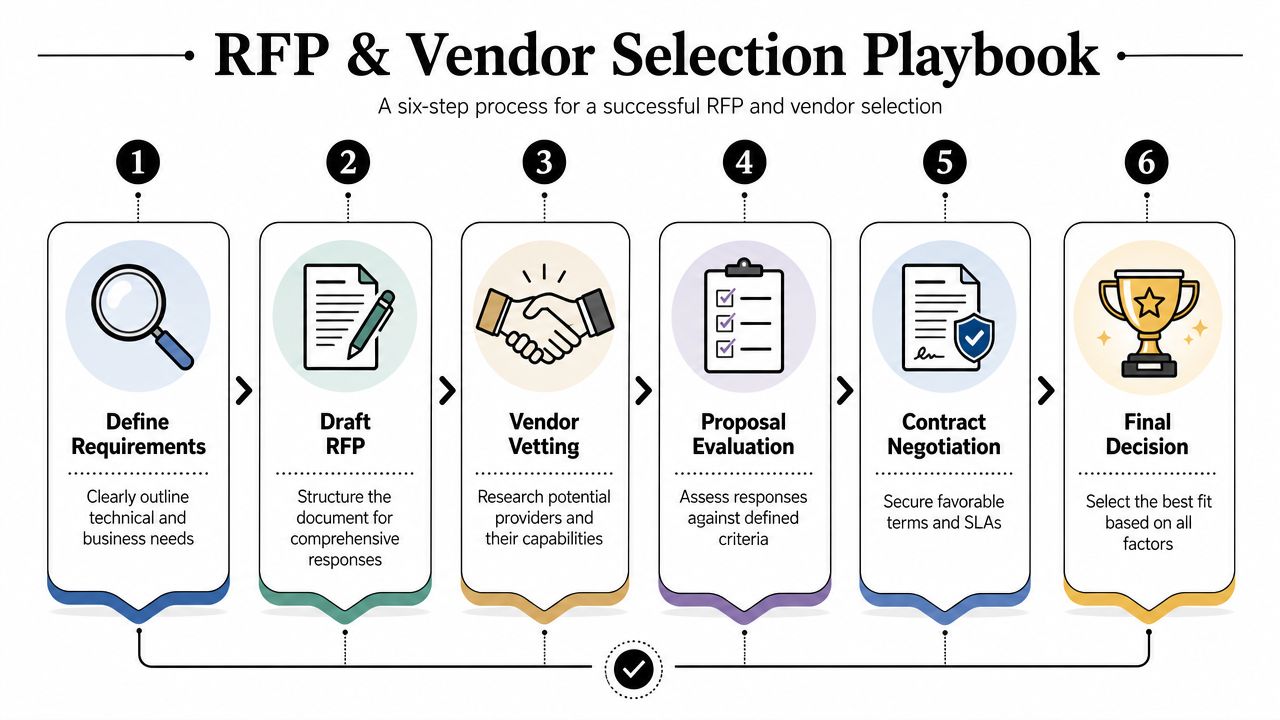
One of the most useful operating ideas in telecom is that strong providers treat delivery as an orchestration problem, not just a connectivity sale. The better model is to standardize around customer use cases, then integrate partner technologies where needed, as described in the referenced telecom enterprise approach. Your RFP should be built to expose whether a vendor can do that.
What the RFP must include
Don't ask broad questions like “describe your solution.” Ask for structured responses.
Include these elements:
Current-state environment
List sites, existing circuits, voice systems, edge hardware, dependencies, and contract milestones.Required future state
Specify what must change. Branch redesign, cloud access, contact center migration, survivability, security controls, and reporting.Support model expectations
Define escalation paths, local versus centralized support, implementation ownership, and cutover responsibilities.Commercial response format
Require recurring charges, one-time fees, assumptions, third-party dependencies, and non-recurring project costs in separate fields.
Questions that reveal weak vendors
Use your Q&A period to uncover the gaps hidden behind demos.
- How do you handle components you don't provide directly? A strong answer explains integration and ownership boundaries.
- What has to remain in place from the legacy environment during transition? Weak vendors gloss over coexistence.
- What triggers a change order? If the answer is vague, budget control will suffer.
- Who owns carrier coordination and site readiness? Many delays frequently begin at this stage.
- How are old edge devices, PBXs, and voice gateways removed from service? If there's no plan, the project is incomplete.
A practical internal reference for this process is IT vendor management best practices for enterprise procurement. It helps teams evaluate not only technical fit, but also accountability after the contract is signed.
Score proposals the way operations will experience them
A telecom proposal should be judged by more than monthly spend.
Selection lens: The cheapest quote often becomes the most expensive environment to support.
Use weighted criteria such as:
- Architecture fit: Does it solve the actual use case?
- Operational maturity: Can the provider support migration, incidents, and changes?
- Transparency: Are fees, assumptions, and exclusions easy to identify?
- Interoperability: Can the vendor integrate with security, cloud, and collaboration tools already in place?
- Exit discipline: Is there a documented path for retiring replaced services and hardware?
That last point is often missing. It shouldn't be. If a provider can't speak clearly about coexistence, cutover, decommissioning, and post-project cleanup, they're selling a product, not managing a business transition.
Planning for Integration Security and a Smooth Cutover
A contract award doesn't lower risk. It shifts the risk into execution.

Take a typical Atlanta financial services firm. Its headquarters is moving from a legacy voice system to a cloud platform, while two branch offices are shifting to a new WAN model. Compliance teams care about call handling and access controls. Operations cares about Monday-morning continuity. The executive team cares about one thing: no surprises.
What the cutover weekend should already have solved
By Friday afternoon, the hard decisions should be behind the team. Security policies must already be mapped to the new environment. Admin roles should be limited and documented. Legacy dependencies need to be identified, especially anything tied to recordings, alarms, fax replacements, branch survivability, or specialized lines.
The cleanest transitions usually include:
- A phased user rollout: Pilot groups first, then high-dependence teams.
- Documented rollback steps: Not a promise to “switch back,” but an actual sequence.
- Parallel validation: Test inbound, outbound, failover, voicemail, and application behavior.
- User-specific communication: Front desk staff, call queue supervisors, and remote workers need different instructions.
Security and user readiness decide whether the cutover feels smooth
Many telecom projects fail socially before they fail technically. Users don't know what's changing. Help desks don't know which tickets belong to whom. Network engineers and voice teams assume the other group is watching a dependency.
A short runbook prevents that. So does good media sanitization planning for anything being retired. For enterprises that need a recognized data sanitization framework tied to decommissioned equipment, NIST SP 800-88 guidance and practical interpretation is a useful operational reference.
On a well-run cutover, every team knows three things before the window opens: what changes, how success is verified, and when rollback starts if validation fails.
Monday morning is part of the project
The first business day after cutover tells you whether the migration was complete. Monitor call flows, ticket types, authentication issues, branch stability, and any systems that were left in temporary coexistence mode.
The firms that handle this well don't treat cutover as a finish line. They treat it as the start of a short stabilization phase with daily review, tight ownership, and a deadline for shutting down replaced systems cleanly.
Completing the Lifecycle Secure Asset Disposition
A telecom project isn't done when users can make calls and branches are online. It's done when the old environment is fully removed, documented, and secured.
That's the piece many organizations miss. A 2024 survey found 91% of enterprise tech leaders say legacy system complexity slows innovation, as cited in TeleCo's Atlanta technology discussion. In practice, that complexity isn't only software and process. It's physical. Old PBXs in closets, switches stacked in branch cabinets, retired firewalls with saved configs, routers still holding credentials, and handsets nobody owns anymore.
Why old telecom gear creates real risk
Retired hardware tends to linger because nobody budgeted time, chain-of-custody, or disposal ownership. Then it becomes a hidden liability.
The risks are straightforward:
- Data exposure: Config files, stored credentials, call data, and local logs may remain on devices.
- Asset leakage: Equipment disappears during office moves, consolidations, or landlord turnover.
- Audit trouble: Regulated organizations need proof of handling, not assumptions.
- Project drag: Legacy gear left in place keeps contracts, support questions, and internal confusion alive.
Build disposition into procurement, not afterthought cleanup
This should be written into the original project scope. Every telecom modernization effort needs an end-of-life workstream covering asset inventory, removal sequencing, data sanitization, packing, transport, certificates, and final recycling or remarketing.
For Atlanta enterprises replacing telecom infrastructure, one practical option is telecom equipment disposal in Atlanta, which addresses business hardware such as phone systems, modules, switches, and related network equipment as part of an ITAD process. The important point isn't the vendor name. It's that the provider can document custody, sanitize data-bearing devices, and close the loop on what was removed from service.
If the old hardware still exists in storage, your telecom migration is only partially complete.
Treat disposition as part of operational risk management. The same discipline you apply to selecting carriers and planning cutover should apply to removing retired infrastructure. That's how enterprises avoid paying twice. Once for the new environment, and again for the mess the old one leaves behind.
If your organization is evaluating enterprise telecom solutions in Atlanta, include end-of-life planning from day one. Beyond Surplus supports businesses with secure IT asset disposition, telecom equipment disposal, data destruction, and documented chain-of-custody so retired network and voice hardware doesn't become the last unresolved risk in an otherwise successful modernization project.