
When a company starts searching for telecom solutions for businesses near me, it's usually because something is already breaking. Calls sound rough. Remote staff keep blaming the VPN. The conference room works for one team and fails for the next. Finance wants lower costs, operations wants fewer outages, and IT gets stuck in the middle.
I've seen the same pattern repeatedly. Teams rush into provider demos before they've documented what they truly need, then discover too late that the core problem wasn't just the carrier. It was the whole lifecycle: assessment, procurement, migration, support, and the cleanup nobody plans for at the end.
Starting Your Search for a New Telecom Provider
The business telecom market gives buyers options, but it also creates noise. IBISWorld projects 1,288 wireless telecommunications carrier businesses in the U.S. in 2025 and 1,344 in 2026, a 4.3% year-over-year increase. That matters because a local search rarely returns one simple provider type. You're comparing carriers, resellers, brokers, MSPs, and firms that package someone else's network under their own support model.

Start with business pain, not vendor categories
A strong search begins with the failures users already feel:
- Voice instability: Dropped calls, jitter, or one-way audio
- Remote work friction: Staff can connect, but performance is inconsistent
- Site expansion issues: New offices or warehouses need service faster than the current provider can deliver
- Support gaps: Nobody owns the issue when voice, network, and hardware overlap
That's why I prefer treating this as an infrastructure review, not a phone-system shopping trip. If the team starts by searching broad terms like telecom providers near me, the next move should be narrowing the field based on service model, escalation quality, and migration capability.
Practical rule: If a provider can describe plans and pricing but can't explain how they handle cutovers, billing disputes, and hardware retirement, they're selling a package, not solving your operating problem.
Build a shortlist the hard way
Don't let a polished local landing page drive the decision. Ask each provider three things early:
| Question | Why it matters |
|---|---|
| Who owns implementation? | Sales teams often disappear after contract signature. |
| What services are delivered directly? | Some vendors outsource more than buyers realize. |
| How do they support multi-site environments? | Branch offices expose weak processes quickly. |
The practical upside of a crowded market is advantage. Buyers can negotiate cleaner terms, better migration planning, and clearer accountability. The downside is that weak vendors hide inside vague bundles.
Assessing Your Business's True Telecom Needs
Most telecom projects fail in the requirements stage. Not because teams skip it entirely, but because they reduce the exercise to seat counts and internet speed. That's not enough. You need a working picture of users, traffic, locations, dependencies, and old equipment that still carries business risk.
Audit what you already have
Start with a real inventory. Not a spreadsheet someone updated last year. Build a current list of circuits, desk phones, conference devices, routers, switches, firewalls, cellular lines, softphone licenses, and any legacy PBX hardware still online.
Then gather operating detail:
- Call patterns: Which teams handle high inbound or outbound volume
- Location needs: Headquarters, branch offices, warehouses, clinics, or temporary sites
- Application dependencies: CRM dialing, call recording, paging, contact center tools, or mobile apps
- Mobility requirements: Hybrid staff, field teams, and executives who need consistent access across devices
A useful internal reference point is your current ticket history. If users report “phone issues,” separate true carrier faults from LAN congestion, Wi-Fi dead zones, misconfigured handsets, and aging switches.
Interview departments separately
Sales, customer support, operations, and finance usually want different things. That's normal. What matters is turning those requests into requirements instead of opinions.
Ask focused questions:
- What breaks most often?
- What outage would stop work immediately?
- Which numbers, hunt groups, or call flows are business critical?
- What can't change during migration?
- Which locations need onsite support during cutover?
Business telecom services near me should mean more than local availability. It should mean the provider can map real business workflows to a supportable design.
The best requirements documents are specific enough to reject the wrong vendor quickly.
Write the requirement set in layers
I usually separate needs into three buckets:
Must-have operational needs
Core calling, site connectivity, uptime expectations, support coverage, and compliance constraints.Workflow needs
Auto attendants, mobile access, video meetings, contact center routing, and integrations.Lifecycle needs
Procurement support, hardware staging, migration planning, spare equipment strategy, and end-of-life handling.
This keeps the project grounded. Teams that skip the lifecycle bucket often create their next problem while solving the current one.
Mapping Your Needs to Specific Telecom Services
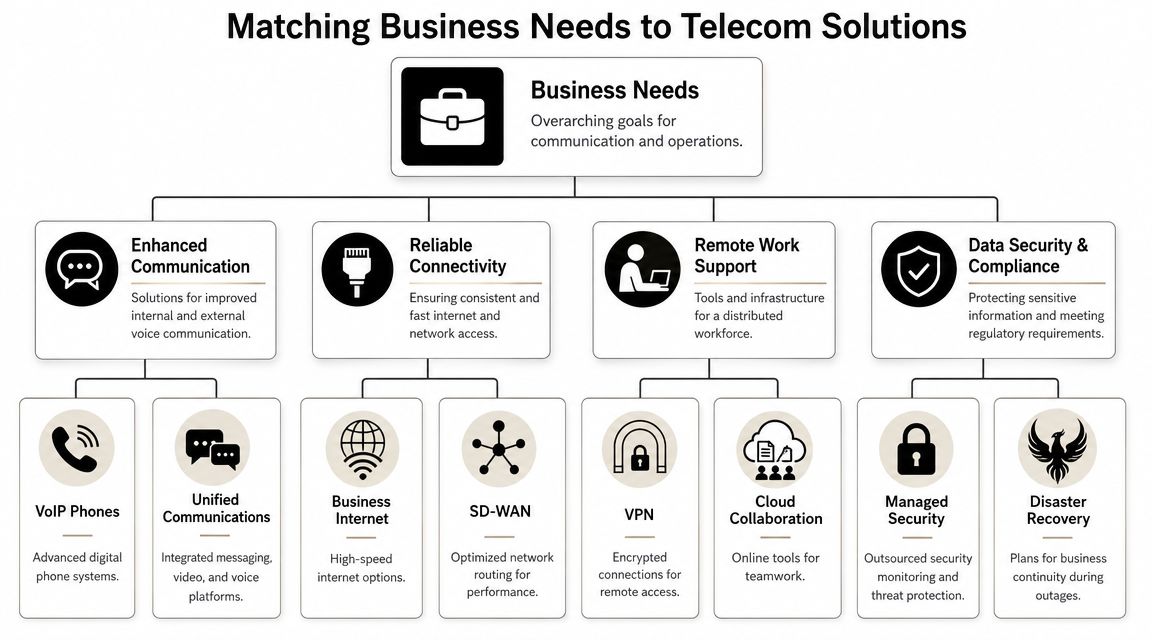
Once the requirement set is solid, the service stack gets easier to evaluate. That's where many buyers discover that “local” telecom is usually built on a much larger footprint. The University of Colorado Denver notes that major providers support business solutions in more than 200 countries, and that modern telecom now includes cloud communications, business internet, managed networking, and security services. So the provider down the road may still depend on a national or international backbone.
Match service type to operating reality
A simple way to break it down:
| Need | Usually points to |
|---|---|
| Replacing an aging phone system | Hosted VoIP or hosted PBX |
| Keeping existing PBX features while modernizing connectivity | SIP trunking |
| Standardizing calling, chat, and meetings | UCaaS |
| Linking multiple sites with policy control | SD-WAN or managed networking |
| Supporting remote users securely | VPN, cloud collaboration, managed security |
The mistake I see most often is piecing these together from separate vendors without deciding who owns the user experience. If voice comes from one provider, internet from another, and support from a third, someone still has to manage the overlap.
Decide where flexibility matters
Not every business needs the same stack. A single office with stable workflows may do well with hosted voice and business internet. A distributed operation usually needs stronger network design, more explicit failover planning, and better vendor coordination.
For teams evaluating temporary numbers, regional reach, or app-based calling in specific workflows, SMS Activate virtual phone solutions can help frame where virtual number tools fit and where they don't. They're useful in defined cases, but they don't replace core enterprise telecom architecture.
Enterprise telecom solutions in Atlanta is a useful example of how buyers should think about this category. Not as separate products, but as a combined operating environment that has to work under pressure.
Buy the service model that matches your escalation path, not the one with the longest feature list.
Creating Your Vendor RFP and Evaluation Checklist
A weak RFP invites vague promises. A strong one forces comparability. If vendors can answer your document in generic language, the document is too soft.
What the RFP must require
At minimum, ask for written responses on these points:
- Network delivery model: Direct carrier, aggregator, reseller, or managed overlay
- Implementation ownership: Who handles planning, provisioning, testing, and issue tracking
- Support workflow: Hours, escalation paths, onsite capability, and account management
- Contract terms: Auto-renewals, change orders, termination language, and service credits
- Billing format: Circuit-level detail, taxes, one-time charges, and dispute handling
Then ask for a sample invoice and a sample service-level document. Sales decks hide operational mess. Documents expose it.
Billing deserves line-by-line scrutiny
One industry analysis reported that 85% of telecom invoices contained billing errors, with leakage estimated at 12-20% of total telecom spend. It also identified duplicate charges, post-disconnection billing, and incorrect rate application as common problems. That's why I never treat billing accuracy as an afterthought.
Use a scorecard that includes:
| Category | What to check |
|---|---|
| Pricing clarity | Are recurring and one-time charges easy to separate? |
| Contract hygiene | Are renewals and notice periods explicit? |
| Inventory alignment | Do quoted services map to your actual sites and users? |
| Billing controls | Can they support monthly reconciliation against contracted terms? |
Local telecom companies often look similar at first glance. They stop looking similar when you compare invoice structure, contract language, and who owns support after go-live.
Put governance into the evaluation, not just cost
Price matters. It just isn't the only thing that matters. I'd rather work with a vendor that answers hard questions clearly than one that wins by hiding effort inside later change orders.
If the proposal can't tell finance what will appear on the bill, it can't tell IT what will happen in production.
Evaluating Security Compliance and Service Uptime
Security and uptime can't sit in the “we'll figure that out later” bucket. Telecom now touches voice, messaging, authentication flows, remote access, and customer-facing operations. An outage isn't just a phone problem. It can stall revenue, service delivery, and internal coordination at the same time.

Ask for resilience details, not marketing claims
A useful resilience review covers:
- Carrier diversity: What happens if the primary connection fails
- Failover design: How inbound and outbound calling continue during an outage
- Monitoring: Who sees faults first, and how they escalate
- SLA language: What is guaranteed, and what only sounds guaranteed
- Compliance support: How the provider handles regulated environments and access controls
The neglected issue here is continuity. A practical review of the topic notes that resilience and uptime during outages are underserved in local telecom content, even though service disruptions remain common and costly.
Read the SLA like a contract, not a brochure
Look for definitions. “High availability” is marketing language unless the agreement explains thresholds, exclusions, response commitments, and credits. Also ask whether the provider supports backup connectivity, alternate call routing, and documented business continuity procedures.
Plainly put, if your phones die when your primary internet line drops, you don't have a resilient design. You have a dependency you haven't modeled yet.
Planning a Seamless Transition and Go-Live
The migration is where nice proposals meet real infrastructure. Number porting slips. Handsets arrive unconfigured. Firewall rules get missed. The cutover window shrinks while users expect a perfect Monday morning.
Sequence the move carefully
A practical migration plan includes parallel workstreams:
Circuit and service ordering
Confirm lead times, handoff dates, and who owns carrier follow-up.Configuration and staging
Build users, extensions, call flows, devices, and site profiles before touching production.Testing
Run user acceptance tests, validate call routing, confirm voicemail, and verify failover behavior.Training
Give reception, support teams, and managers role-specific guidance, not just a generic quick-start PDF.
Tune the network before users blame the phones
That means go-live prep should include:
- QoS policy review: Voice must take priority over lower-value traffic
- Hardware validation: Old switches and weak edge devices often become hidden bottlenecks
- Wi-Fi review: Coverage matters if handsets or softphones rely on wireless connectivity
- Rollback planning: Define exactly how to revert if a cutover fails
A calm go-live usually reflects weeks of disciplined prep, not luck on deployment day.
Responsible Decommissioning of Old Telecom Hardware
Once the new platform is live, most companies still have a closet full of retired gear. Desk phones. Routers. Firewalls. PBX appliances. Expansion cards. Conference units. Sometimes they sit for months because nobody wants to decide what to do with them.
That's a mistake. Old telecom hardware can hold credentials, call logs, configuration files, and storage media. It also creates asset-tracking and environmental risk if facilities or operations disposes of it informally.

Treat retirement as part of the project closeout
A clean decommissioning process should include:
- Asset reconciliation: Match removed hardware to your inventory so nothing disappears into a storage room
- Segregation: Separate reusable gear, resale candidates, and true end-of-life equipment
- Data handling: Sanitize or destroy storage-bearing equipment under documented chain of custody
- Recycling records: Keep certificates and disposition records for audit and compliance use
Use a specialist for the last mile
An ITAD partner integrates into the workflow. For example, telecom decommissioning services can support removal, secure data destruction, recycling, and documentation for retired business telecom hardware. That's the operational end of the telecom lifecycle, and it should be planned before the first handset gets unplugged.
A provider selection process isn't complete until old equipment is off the books, off the floor, and out of risk.
When you're replacing telecom infrastructure, don't stop at circuits, handsets, and contracts. Close the loop with secure retirement of the equipment you just replaced. Contact Beyond Surplus for certified electronics recycling and secure IT asset disposal for business telecom hardware.