

When your Alabama business upgrades its technology, managing the old equipment is more than just clearing out storage space. Improperly disposing of old computers, servers, or hard drives creates a significant risk to your company’s sensitive data and hard-earned reputation. For this reason, professional Alabama electronics recycling and IT Asset Disposition (ITAD) services are not just a best practice—they are a critical component of modern corporate risk management.
Beyond Surplus provides a secure, compliant, and responsible solution for handling retired IT equipment. We specialize in commercial and enterprise services, ensuring your company’s digital assets are managed with the highest standards of security and environmental responsibility.
A Guide to Commercial Electronics Recycling in Alabama
Managing the end-of-life cycle for corporate technology is a strategic challenge. Unlike residential e-waste, business electronics are repositories of confidential information, including employee records, financial reports, and proprietary client data. A misstep in their disposal is not a minor oversight—it is a direct threat to your entire operation, potentially leading to data breaches and severe compliance penalties.
This guide provides a roadmap for businesses navigating the complexities of commercial Alabama electronics recycling. We will move beyond simple drop-off programs to explore the specialized services modern businesses require, turning a necessary operational task into a strategic advantage that protects your company.
Key Focus Areas for Alabama Businesses
A comprehensive ITAD program is built on several core pillars, each designed to address a specific business need. Understanding these is the first step toward a secure and efficient electronics disposal plan.
- Certified Data Destruction: This is non-negotiable. Any service you engage must meet or exceed federal standards, such as those from the Department of Defense (DoD), to guarantee that sensitive data can never be recovered.
- Environmental Compliance: Your partner must be certified to process all materials according to strict environmental laws. This ensures that hazardous components found in electronics are managed responsibly and never end up in a landfill.
- Chain-of-Custody Documentation: From the moment a device leaves your facility, you require an ironclad, auditable paper trail proving it was handled securely at every stage of the process.
- Logistical Coordination: Professionals manage all logistics, including secure, scheduled pickups directly from your location, whether you’re in downtown Birmingham or a more rural part of the state.
A key principle behind smart business recycling is understanding how to reduce e-waste and extend your device’s life. This proactive mindset shifts asset disposal from a reactive chore to an integral part of your IT lifecycle management.
Ultimately, the goal is to partner with a provider who can manage this entire process seamlessly. For Alabama companies seeking a complete solution, engaging specialized ITAD services is the clearest path to securing data, maintaining compliance, and fulfilling environmental commitments.
The Hidden Risks in Your Retired IT Equipment
Imagine leaving a company file cabinet unlocked on the sidewalk, filled with employee records and sensitive client contracts. This is precisely the risk your Alabama business takes when it improperly disposes of retired IT equipment. Old servers, computers, and even printers are not just clutter; they are digital vaults holding a detailed history of your operations.
Failing to properly sanitize these devices before they leave your control is an open invitation for a data breach. A single discarded hard drive can contain enough information to cause devastating financial and reputational harm, exposing your company to liability, lawsuits, and a complete loss of client trust.
The Financial and Legal Fallout
The consequences of a data breach extend far beyond negative publicity. For businesses in regulated industries like healthcare and finance, the stakes are incredibly high. Federal laws and industry standards impose severe penalties for non-compliance. These regulations are not suggestions; they are mandates that dictate how you must protect sensitive information throughout its lifecycle, including disposal.
- Health Insurance Portability and Accountability Act (HIPAA): Any organization handling protected health information (PHI) faces massive fines for breaches, which can easily result from improperly discarded medical equipment or office computers.
- Sarbanes-Oxley Act (SOX): Publicly traded companies must adhere to strict financial reporting and data integrity rules. A breach from retired IT assets could compromise these records, leading to regulatory investigations and penalties.
- Gramm-Leach-Bliley Act (GLBA): Financial institutions are required to safeguard consumer financial information, and improper asset disposal is a direct violation of these protective measures.
Failing to meet these standards can result in fines that cripple a business, in addition to the immense cost of remediation and legal battles. You can learn more about the hidden dangers of improper electronics disposal to understand the full scope of these risks.
Alabama’s Critical E-Waste Challenge
Beyond data security, there is a pressing environmental issue that directly impacts our state. While e-waste may seem small compared to other waste streams, its toxic impact is disproportionately large. Alabama faces significant e-waste challenges and has been identified as a critical area for toxic waste management. Nationally, e-waste accounts for just 2% of America’s landfill trash but contributes a staggering 70% of the overall toxic waste.
“Improperly discarded electronics leach hazardous materials like lead, mercury, and cadmium into the soil and groundwater. For businesses, this is not just an environmental issue—it’s a liability issue that can damage a brand’s reputation and connect it to local pollution.”
This reality elevates Alabama electronics recycling from a simple “green” initiative into a fundamental component of modern corporate risk management. Protecting your data and protecting the local environment are two sides of the same coin, both essential for safeguarding the brand and community you’ve worked so hard to build. Partnering with a certified ITAD provider is the only way to ensure both are handled with the seriousness they demand.
Navigating Alabama’s E-Waste Compliance Rules
It’s a common misconception that because Alabama lacks a single, state-wide e-waste law for businesses, the regulations are lax. The truth is that companies here must navigate a complex web of federal and industry-specific regulations governing how retired IT assets are handled. Ignoring these obligations is not an option and can lead to serious financial and legal consequences.
Understanding this framework is the first step toward building a disposal strategy that protects your business from risk.
Federal Regulations with Local Impact
The most significant federal law impacting Alabama electronics recycling for businesses is the Resource Conservation and Recovery Act (RCRA). This law governs the proper disposal of solid and hazardous waste. Since many electronics, particularly older models, contain hazardous materials like lead and mercury, they often fall under RCRA’s strict guidelines. This means discarding them in a dumpster is not just irresponsible—it can be a federal offense.
Furthermore, data privacy laws drive compliance. Federal rules like HIPAA for healthcare and GLBA for the financial sector do not cease to apply when a device is unplugged. These laws mandate that sensitive data be protected throughout its entire lifecycle, up to the point of destruction. A data breach from a carelessly discarded hard drive can trigger crippling fines. For a closer look at these requirements, our guide on navigating electronics recycling regulations is an excellent resource.
Key Compliance Areas for Alabama Business E-Waste
This table highlights the critical regulatory areas that every Alabama business must consider when managing its electronic assets.
| Compliance Area | Governing Body/Law | Business Implication | Mitigation Strategy |
|---|---|---|---|
| Hazardous Waste | EPA (RCRA) | Electronics with lead, mercury, etc., are considered hazardous waste, making improper disposal illegal. | Partner with a certified recycler who properly manages and documents the disposal of hazardous components. |
| Data Security | HIPAA, GLBA, FACTA | Failure to destroy sensitive data before disposal can lead to massive fines and reputational damage. | Use a certified ITAD vendor providing auditable Certificates of Data Destruction for all storage media. |
| Environmental Liability | CERCLA (Superfund) | Companies can be held liable for cleanup costs if their e-waste contaminates a site, even if a third party handled disposal. | Maintain a clear chain-of-custody and work only with R2 or e-Stewards certified recyclers. |
| Asset Tracking | Internal/Financial Audits | Inaccurate tracking of retired assets can lead to “ghost assets” on company books and security vulnerabilities. | Implement a robust IT asset disposition (ITAD) program with detailed reporting and inventory reconciliation. |
Navigating these requirements is a matter of due diligence. Choosing the right partner not only ensures you meet these standards but also provides the documentation to prove it.
The Importance of Auditable Documentation
How can a business prove its compliance with these complex rules? The answer is clear: get it in writing. A certified recycling partner provides an auditable paper trail that becomes your best defense in any inquiry. This documentation is more than a simple receipt; it consists of specific, legally recognized documents.
- Certificates of Data Destruction: This is your proof that all data was wiped or physically destroyed according to federal standards like those from NIST. It is a legally binding document.
- Certificates of Recycling: This document confirms your assets were processed in an environmentally sound manner, compliant with laws like RCRA.
- Chain-of-Custody Records: These detailed logs track your equipment from the moment it leaves your building, ensuring total accountability every step of the way.
Think of this documentation as your compliance insurance policy. Should you ever face an audit, these records prove you performed your due diligence, protecting your business from fines and liability.
Core Services for Corporate IT Asset Disposition
When it’s time to retire your company’s technology, you are managing more than just old hardware—you are handling matters of security, compliance, and even potential revenue. Professional IT Asset Disposition (ITAD) is the comprehensive process that manages this entire lifecycle, ensuring all equipment is handled securely and responsibly. For any business in Alabama, understanding these core services is key to protecting sensitive data and avoiding major risks.
ITAD is about control and verification. It transforms a potential liability into a managed, documented process from start to finish.
The Gold Standard in Data Destruction
The single most critical piece of the ITAD puzzle is ensuring all data on retired storage media is permanently destroyed. Simply deleting files or reformatting a drive is insufficient, as data can often be recovered. Professional services utilize methods that meet or exceed strict NSA and Department of Defense (DoD) standards.
- Data Wiping: Specialized software overwrites every sector of a drive with random characters, often multiple times. This process renders the original data completely unrecoverable but allows the physical drive to be safely reused.
- Degaussing: This hardware-based approach uses a powerful magnetic field to instantly scramble the magnetic domains on traditional hard drives and backup tapes, permanently erasing all data and rendering the drive unusable.
- Physical Shredding: For the ultimate guarantee, industrial shredders grind hard drives, SSDs, and other media into tiny, unrecognizable pieces, making data retrieval impossible.
Upon completion, you receive a Certificate of Data Destruction, a legal document that serves as official proof that you took the necessary steps to protect your company’s sensitive information.
Certifications That Guarantee Compliance
How can you be certain your ITAD partner is adhering to the highest standards? The answer lies in industry certifications. These are not merely accolades; they represent proof of rigorous, ongoing audits that hold a recycler to the highest standards for environmental safety and data security. For businesses focused on Alabama electronics recycling, two certifications stand out as the gold standard:
- R2 (Responsible Recycling): This certification ensures a facility follows best practices for environmental protection, worker health and safety, and data security throughout the recycling process.
- e-Stewards: Often considered one of the most stringent standards, e-Stewards focuses heavily on preventing the illegal export of hazardous e-waste and guarantees that no toxic materials end up in local landfills.
Working with an R2 or e-Stewards certified partner is the best way to protect your company from downstream liability. To better understand the entire framework, it helps to know what IT asset disposition is and why it is so vital for modern businesses.
Turning Retired IT into Revenue
Not all of your retired equipment is waste. Newer, functional assets like servers, laptops, and networking gear can often be refurbished and resold on the secondary market. This is where IT Asset Value Recovery (ITAVR) comes in.
An effective ITAVR program can generate a significant financial return for your company, helping to offset the costs of recycling and data destruction. In many cases, it can even result in a net profit.
The process involves a skilled team testing, grading, and remarketing your viable equipment through established sales channels. A reputable ITAD partner will provide completely transparent reporting, sharing the revenue with your business and transforming a cost center into a new source of income. These services scale to handle projects of any size, from a few assets to a full-scale data center decommissioning or professional office decommissioning.
Your Step-by-Step Business Recycling Process
Ever wonder what actually happens to your old IT equipment after it leaves your facility? The journey from a retired liability to a fully documented, securely recycled asset is a structured process built for security, transparency, and efficiency. This walkthrough outlines each stage of the professional Alabama electronics recycling process from the client’s perspective.
Initial Inventory and Service Quote
The process begins with an inventory of the assets you plan to retire. This can be a general count of items like servers, laptops, desktops, and networking equipment. Based on this list, a certified ITAD partner will provide a transparent, no-obligation quote. This proposal will clearly outline any potential costs for services like logistics and data destruction, as well as the potential return from an IT Asset Value Recovery (ITAVR) program if your equipment has resale value.
Secure Logistics and Pickup
Once you approve the quote, the next step is scheduling the pickup. A professional logistics team will coordinate with you to collect the assets from your Alabama facility at a convenient time. This is not a standard shipping service; it involves trained technicians, secure transport vehicles, and a strict chain-of-custody protocol to protect your equipment from the moment it leaves your building.
Processing at a Secure Facility
Upon arrival at the certified recycling facility, your assets are sorted and triaged. Items identified for remarketing are thoroughly tested and graded. All devices containing data are moved to a secure, access-controlled area for complete sanitization using methods that meet or exceed Department of Defense and NIST standards.
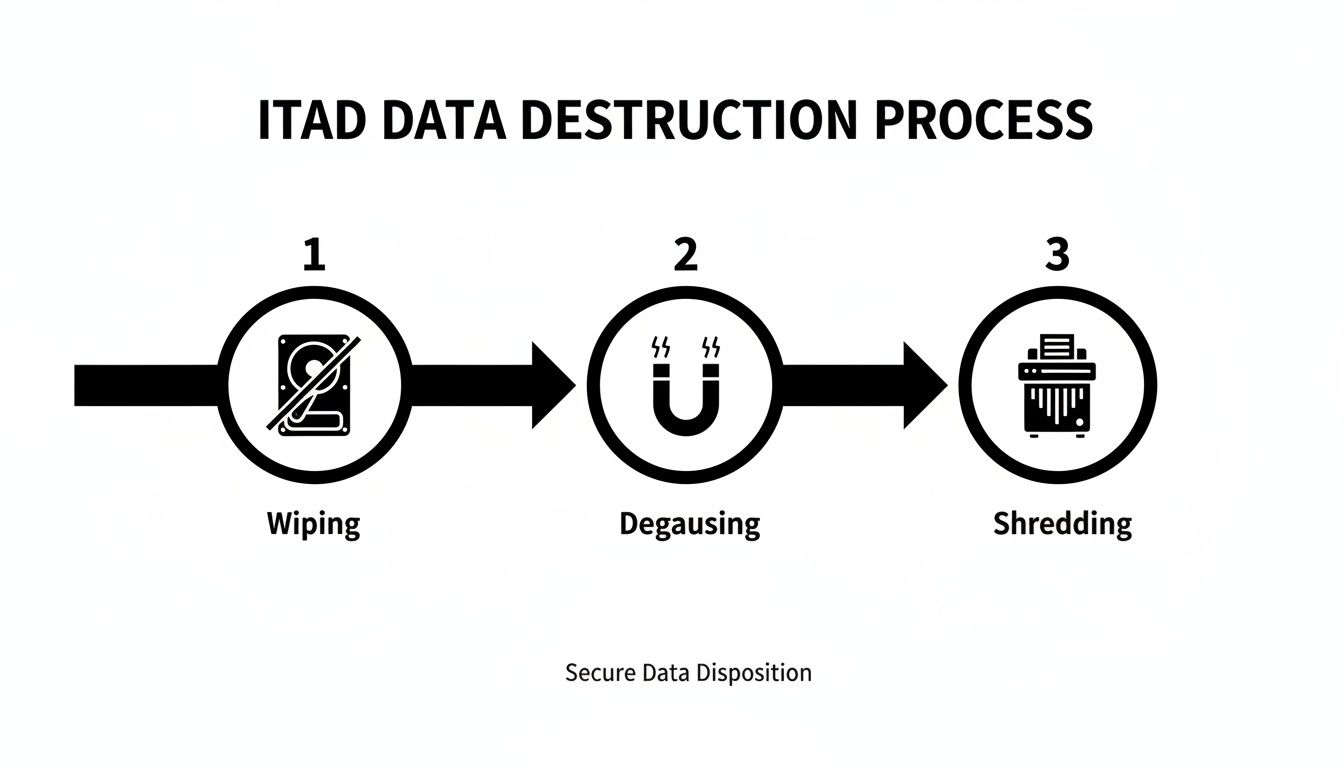
This multi-pronged approach ensures that whether through software-based wiping, magnetic degaussing, or physical shredding, your sensitive information is rendered completely unrecoverable. Equipment with no resale value is carefully de-manufactured, and the base commodities are sent for responsible recycling. You can learn more about what happens to recycled electronics in our detailed guide.
The final and most critical step is documentation. A professional ITAD provider doesn’t just recycle your equipment; they provide proof that it was all done correctly.
This paperwork is your shield against liability and your proof of compliance. You will receive:
- A Certificate of Data Destruction, listing every serialized drive that was sanitized.
- A Certificate of Recycling, confirming that all materials were processed in an environmentally responsible manner.
- A Detailed Settlement Report, reconciling the final inventory and outlining any value recovery returns paid to you.
This complete, auditable trail provides total peace of mind, officially transferring liability away from your organization and closing the loop on your IT asset lifecycle.
Why Partnering With a Certified Recycler Matters
Choosing who handles your retired electronics is a critical business decision. While it may be tempting to select the lowest bidder or attempt to manage the process in-house, these approaches are fraught with hidden risks. Partnering with a certified ITAD provider is a strategic move that protects your company’s security, bottom line, and reputation.
Mitigating Risk and Ensuring Security
The primary concern with retired technology is the data it contains. Uncertified vendors often have vague, unverified processes for data destruction, leaving your company exposed to a potential breach. A certified partner, however, operates under strict security protocols. They provide a documented, auditable chain of custody and issue official Certificates of Data Destruction, legally transferring liability from your organization to theirs. This documentation is your ironclad proof of compliance and due diligence.
Financial Gains and Operational Efficiency
IT disposal should not be viewed as a mere expense. A professional ITAD strategy can generate revenue through IT Asset Value Recovery (ITAVR), where functional equipment is tested, refurbished, and sold. This revenue often offsets or exceeds the cost of recycling. Partnering with a specialist also frees up your internal team to focus on core business functions and reclaims valuable facility space.
Enhancing Corporate Social Responsibility
How your company manages its environmental impact is a significant part of your brand identity. Choosing a certified partner for your Alabama electronics recycling is a powerful, tangible demonstration of your commitment to corporate social responsibility. It proves you are keeping toxic materials out of local landfills and ensuring valuable resources are recovered and reused. This proactive stance resonates with customers, employees, and investors who value environmental stewardship. You can explore more about the impact of these local collection efforts to see the difference responsible recycling makes.
Professional ITAD vs. In-House Disposal Comparison
| Feature | Professional ITAD Service | In-House / Uncertified Disposal |
|---|---|---|
| Data Security | Certified data destruction with legal documentation. | High risk of data breaches; processes are often unverified. |
| Legal Compliance | Guaranteed compliance with environmental & data privacy laws. | Potential for violations, fines, and downstream liability. |
| Financial Return | Value recovery through remarketing of functional assets. | No revenue generation; often a pure cost center. |
| Operational Focus | Frees up internal IT staff and facility space. | Drains internal resources and time from core business tasks. |
| Environmental Impact | Ensures responsible recycling and commodity recovery. | High risk of improper disposal and landfill contamination. |
| Chain of Custody | Secure, documented, and auditable tracking of all assets. | No formal tracking, leaving assets vulnerable to theft or loss. |
Ultimately, while an in-house or uncertified approach might seem cheaper upfront, the potential costs from a data breach, compliance fine, or damaged reputation are far greater. A certified partner provides a level of security and peace of mind that cannot be achieved independently.
Common Questions About Alabama Electronics Recycling
When it comes to retiring old IT assets, Alabama businesses often have questions about security, logistics, and cost. Getting clear answers is essential for making an informed decision. Here are answers to some of the most common questions we receive.
What Types of Business Equipment Do You Accept for Recycling in Alabama?
We handle a comprehensive range of commercial IT assets, from standard office equipment like computers, servers, and laptops to complex data center hardware, including server racks, UPS systems, and networking equipment. We also possess specialized experience in recycling medical and laboratory equipment. Our service is designed exclusively as a complete, end-of-life solution for corporate technology; we do not accept electronics from residential customers.
Is Our Company Data Secure During the Recycling Process?
Absolutely. Data security is the foundation of our services. We offer multiple levels of data destruction that meet or exceed stringent NSA and Department of Defense standards, including multi-pass data wiping, degaussing, and physical shredding of hard drives and other storage media. A strict chain of custody is maintained from pickup to final processing, and we issue official Certificates of Data Destruction to provide legally defensible proof of compliance.
Do You Provide Pickup Services Outside of Major Alabama Cities?
Yes. Our secure logistics network covers the entire state of Alabama, not just major metropolitan areas like Birmingham, Montgomery, Mobile, or Huntsville. Regardless of your facility’s location, we can develop a customized pickup plan to transport your assets securely and efficiently to our processing center.
A common misconception is that professional ITAD services are only for large enterprises in big cities. We provide scalable solutions that meet the needs of businesses of all sizes, anywhere in Alabama. Contact us to discuss your specific logistical requirements.
What Is the Cost for Commercial Electronics Recycling in Alabama?
The final cost depends on factors such as the volume and type of equipment, the required level of data destruction, and logistics. However, our IT Asset Value Recovery (ITAVR) program often helps offset or even eliminate these costs. If your retired equipment has resale value on the secondary market, you may receive a financial return. We provide a transparent, no-obligation quote after assessing your inventory, turning a potential expense into a revenue opportunity.
Partner with Beyond Surplus for certified electronics recycling and secure IT asset disposal across Alabama. Contact us today to schedule a pickup or request a quote.


