Unused routers and switches usually sit in a rack room longer than they should. A network refresh finishes, the old gear gets stacked on a cart, and then nobody wants to touch it because resale feels messy, security feels risky, and the internal paperwork never seems worth the effort.
That hesitation costs money and creates compliance exposure. To sell used routers and switches well, you need a process that treats them like enterprise assets, not random surplus hardware. The organizations that recover the most value usually do the same few things well: they document exactly what they have, remove stored configurations properly, choose the right sales channel, and keep the chain of custody tight from pickup through final disposition.
Building Your Asset Inventory and Condition Report
A network refresh often stalls at the same point. The new gear is live, the old routers and switches are piled in staging, and finance wants recovery numbers before anyone has verified exactly what is in the lot. If the inventory is loose, every later step gets harder. Buyers lower offers, receiving teams flag exceptions, and internal approval drags because nobody trusts the count or condition.
An accurate inventory does more than support pricing. It creates the record you will use for approval, shipment reconciliation, compliance files, and any post-sale dispute. In enterprise ITAD work, I treat the asset list and condition report as the control document for the whole disposition.
Record what a buyer and your compliance team both need
Start with the fields that determine identity, value, and chain of custody:
- Exact model number. Record the full chassis or product ID, not a family name.
- Serial number. Capture each unit individually, even in large lots of the same model.
- Asset tag and hardware revision. These help reconcile internal records against what leaves the site.
- Included components. List power supplies, supervisor modules, line cards, optics, rack ears, faceplates, and removable storage if present.
- Visible physical issues. Note bent ports, cracked housings, corrosion, missing blanks, broken latches, or damaged power connectors.
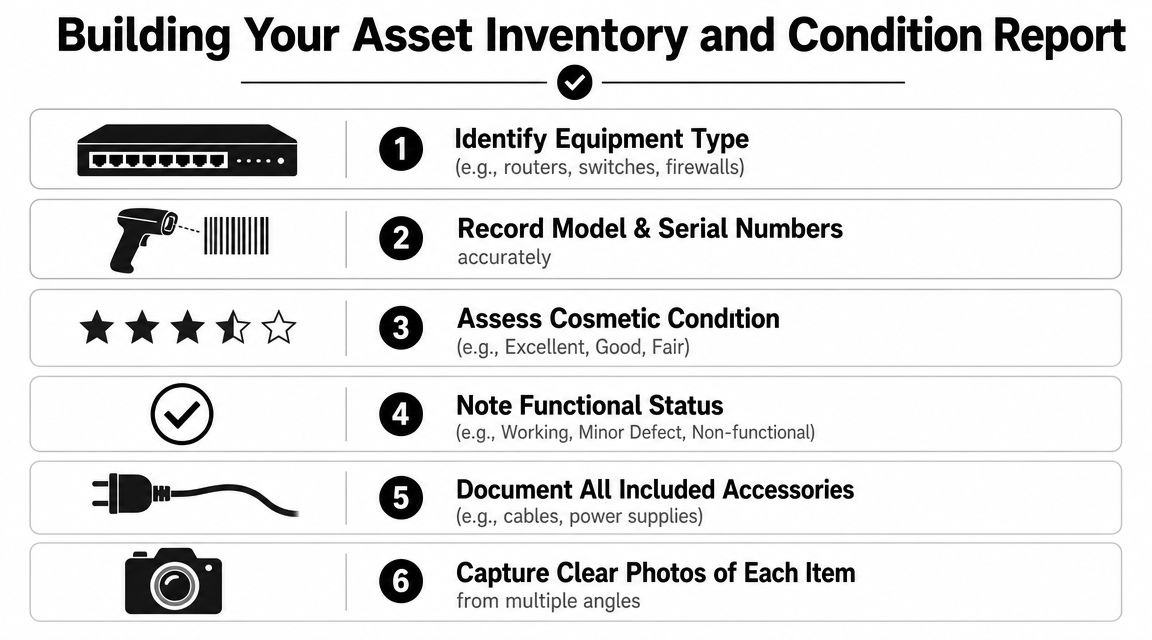
Skip vague entries like "Cisco switch, qty 12." They force the buyer to price defensively because too much is unknown. A precise list lets the purchasing team check support status, secondary market demand, and completeness before pickup. It also gives your legal, security, and finance teams a document they can sign off on without guessing what is being transferred.
Practical rule: If a receiving technician cannot match the spreadsheet to the physical unit in under a minute, the inventory needs more work.
Separate appearance from working condition
Condition disputes usually start because teams combine cosmetic notes with functional status. Keep them separate.
A switch with rack rash may still pass testing and hold strong resale value. A clean router may boot with errors, have failed fan modules, or show damage on management ports. Those are different issues and buyers treat them differently. Cosmetic wear changes marketability. Functional defects change liquidation value and channel fit.
Use a simple condition structure your team can apply consistently:
| Field | What to record |
|---|---|
| Cosmetic grade | Excellent, Good, Fair |
| Functional status | Working, Minor defect, Non-functional |
| Boot status | Boots normally, boots with issue, no boot |
| Port condition | All ports appear intact, some damaged, unverified |
Photos close the gap between your notes and the buyer's inspection. Capture the front, rear, top label, serial label, and every visible defect. Those images protect your organization if there is a disagreement after delivery, and they reduce the chance that a buyer reprices the lot on receipt.
Decide which units belong in resale and which belong in recycling
Inventory work should sort assets, not just count them.
Some units justify full resale handling because they are complete, supported, and in working order. Others are better moved as parts harvest, scrap recovery, or certified recycling because the labor required to test, identify missing components, and market them will exceed the likely return. That triage step is where experienced teams save time.
Support status matters. Parts completeness matters. Clean identification matters. Environmental pressure matters too. The Global E-waste Monitor 2024 from the United Nations Institute for Training and Research and ITU shows the waste stream is still growing, which means more organizations are trying to separate remarketable network gear from equipment that should go straight to downstream recycling.
For larger projects, the inventory process also determines how you lot the material. High-value supported gear should not be mixed into gaylords of obsolete telecom scrap. If you are clearing cages, closets, or full data rooms, large-scale telecom equipment liquidation services can help identify the resale candidates, isolate low-value units, and document the lot before anything leaves the site.
Executing Secure Data and Configuration Removal
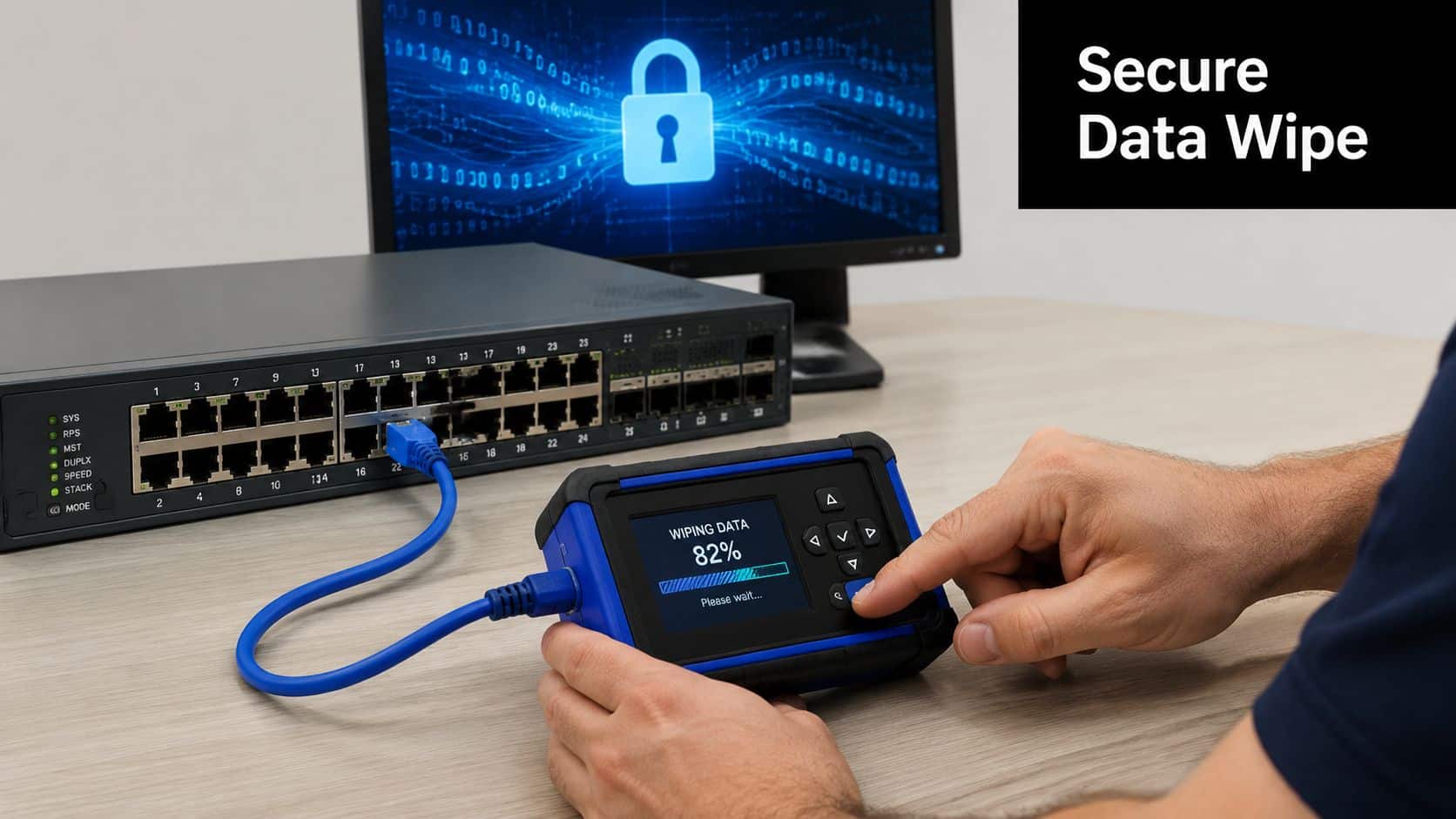
A factory reset isn't enough for enterprise network hardware. Routers and switches can retain configuration data, stored credentials, logs, VPN settings, and other operational details that expose how your network was built. If you're selling infrastructure gear, that information matters as much as the hardware itself.
The biggest technical risk in enterprise disposition is data security and compliance, not packing a box correctly. ITAD providers commonly add onsite packaging, secure data sanitization, and recycling. Some certify wiping or destruction and provide a certificate that transfers liability. A major mistake is treating network gear like ordinary consumer electronics, because enterprise buyers often require proof of sanitization according to this enterprise IT equipment disposition guidance.
What needs to be removed
On network gear, the risk isn't limited to user files. The sensitive material is often operational:
- Saved configurations that reveal VLAN structure, routing policy, naming conventions, and internal architecture
- Local credentials and keys stored for administrative access
- VPN and remote access settings that expose connection methods
- System logs that may contain usernames, device names, and event history
- Embedded flash or removable storage that still holds old startup data
A buyer who knows enterprise environments will ask whether those items were sanitized. If your team can't answer clearly, the deal slows down or the buyer discounts the lot to cover risk.
Why documented sanitization matters
Security work only protects you if you can prove it happened. That's why standards-based wiping and formal documentation matter more than verbal assurance.
For organizations with internal policy requirements, NIST SP 800-88 data sanitization practices give procurement, IT, and compliance teams a common reference point. The goal isn't just technical erasure. It's auditability.
A resale transaction should end with the same confidence as a controlled disposal event. Chain of custody, sanitization record, and final disposition document all need to line up.
When to wipe and when to destroy
Not every unit belongs in the resale stream. If a device is too old, degraded, or unreliable, destruction or certified recycling may be the safer route than trying to recover marginal value.
Use a simple decision model:
- Resell if the unit is supported, functional, and can be sanitized cleanly.
- Evaluate further if the hardware has resale potential but the storage or config state is uncertain.
- Destroy or recycle if the gear is damaged, obsolete, or you can't document sanitization to your compliance standard.
Experienced ITAD handling earns its keep. The vendor isn't just moving hardware. They're helping you close a security and liability loop correctly.
Accurately Valuing Your Network Assets
A router that cost thousands on the original PO can be worth very little in the secondary market if support has lapsed, the optics are missing, or the model was just displaced by a newer refresh cycle. I see the opposite problem too. IT teams rush a lot out the door at scrap-like pricing because they want the racks cleared this week. Both mistakes leave money on the table.
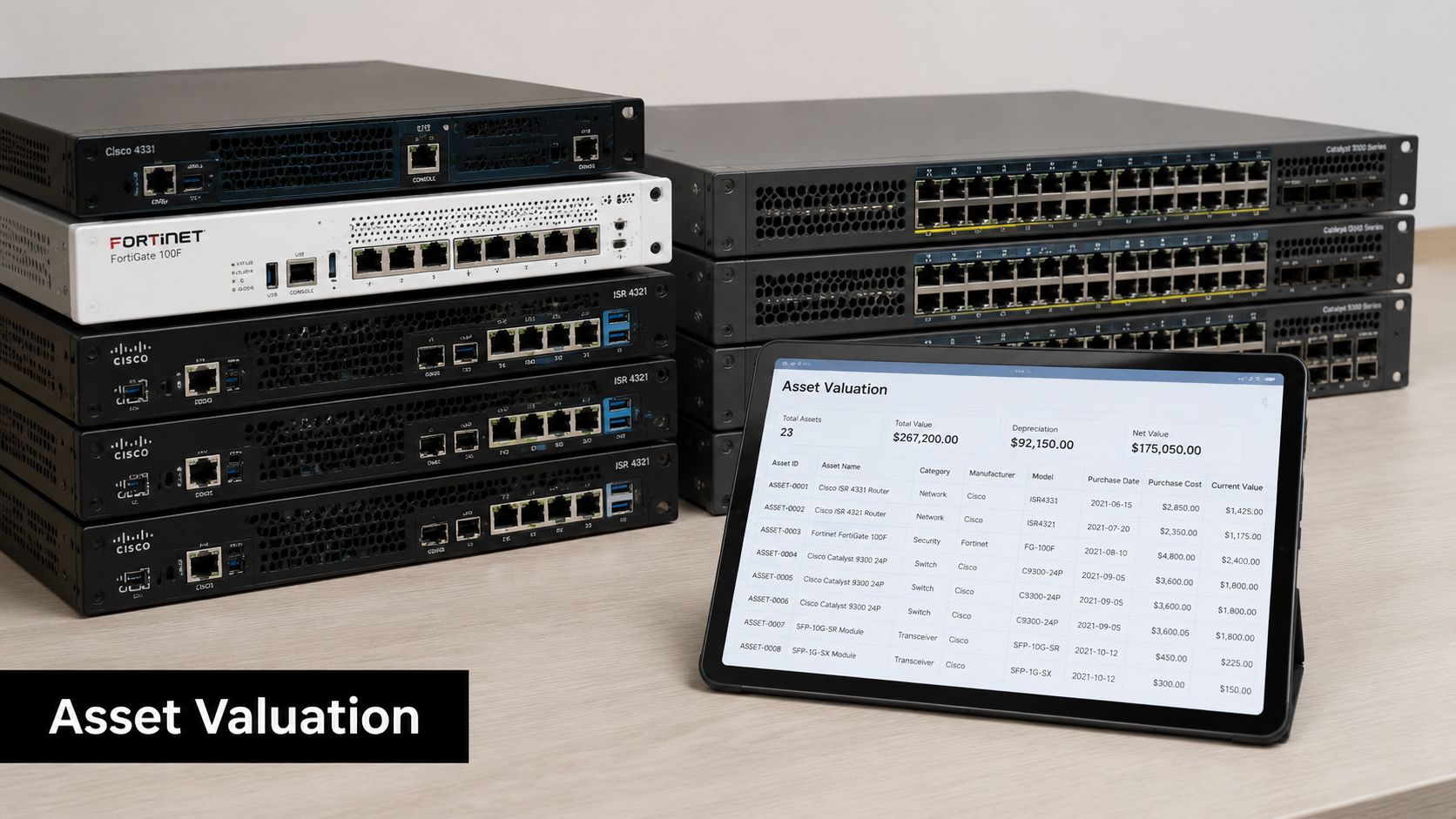
Valuation starts with market reality. The job is to establish a number you can defend internally, use in buyer conversations, and tie back to the condition report your team already built.
Build value from market evidence
Use completed sales data, current buyer demand, and your own test results. Asking prices are easy to find, but they routinely overstate what equipment clears for. A clean valuation uses sold comps first, then adjusts for the specifics of your lot.
Start with four inputs:
- Recent sold comps for the exact model, not just the product family
- Verified condition based on power-on testing, port checks, and cosmetic grade
- Completeness including power supplies, uplink modules, licenses, rails, and transceivers
- Sale format because one boxed switch sold individually prices differently than fifty mixed units sold in one bulk transaction
If your finance or procurement team needs a neutral framework for documenting this work, this fair market value guide is a useful reference for turning scattered market data into a supportable range.
What actually changes the number
Buyers price risk, resale velocity, and effort. The model number matters, but it is only the starting point.
| Value driver | Effect on offer |
|---|---|
| OEM support status | Supported and still-deployed models usually attract broader buyer interest |
| Test status | Fully tested units command stronger offers than untested pulls |
| Cosmetic condition | Heavy wear, broken tabs, and bent ears lower resale confidence |
| Configuration and reset status | Cleanly reset hardware is easier for buyers to process and remarket |
| Missing components | Absent PSUs, fan trays, SSDs, or optics reduce value quickly |
| Lot composition | Homogeneous lots are easier to price and move than mixed leftovers |
One trade-off matters more than many teams expect. The highest per-unit price is often available only if you break the lot apart, list items individually, answer technical questions, and manage packaging and claims. That can work for a small batch of high-demand gear. It usually does not work for a large decommission where labor, delay, and reconciliation cost matter.
Use quote spread to understand buyer assumptions
A wide spread between offers is normal in this market. It usually means the buyers are looking at the lot through different operating models, not that one number is automatically wrong.
One buyer may bid aggressively on current-generation Cisco and pass on everything else. Another may take the full lot, but discount older units because they expect low resale velocity. A third may offer a higher headline number subject to receiving inspection, with deductions for failed units or missing parts. Read the assumptions before comparing the totals.
That is why I recommend collecting multiple quotes and lining them up against the same inventory and condition file. If you want an early benchmark, reviewing how network equipment buyers in the USA evaluate enterprise switches, routers, and mixed lots can help your team gauge where specialist demand exists.
A sound valuation does more than support pricing. It helps with approval workflows, sets realistic recovery expectations, and reduces disputes after receipt because the commercial terms match the actual condition of the hardware.
Choosing the Right Sales Channel for Your Business
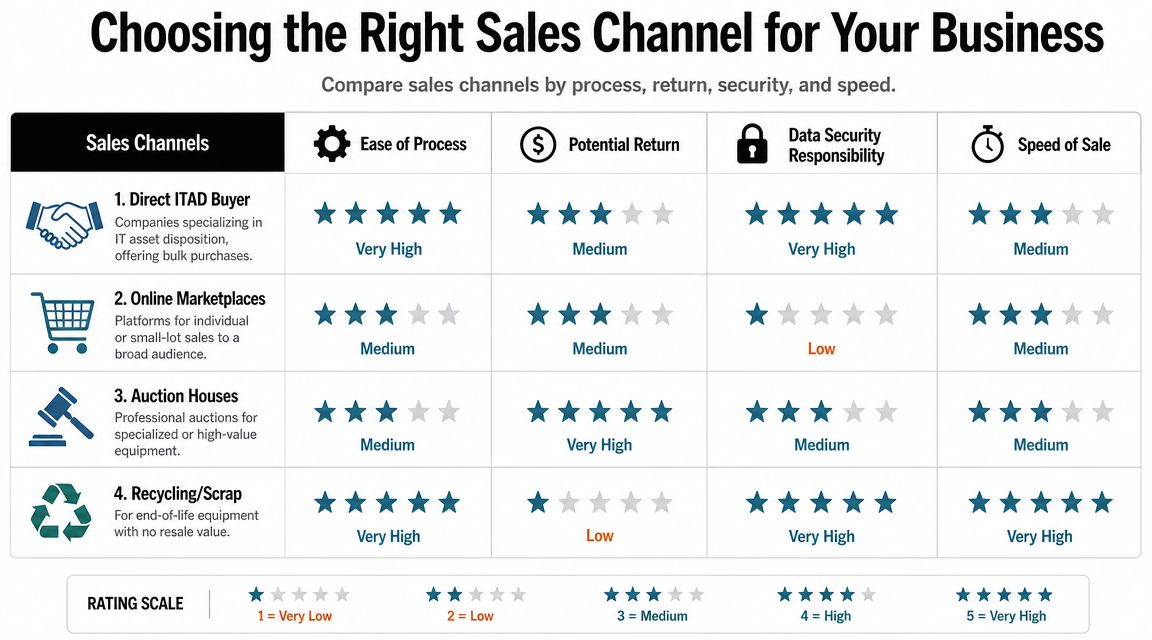
The best place to sell used routers and switches depends on what you're optimizing for. Some teams want the highest possible recovery on a few clean units. Others want one pickup, one reconciliation process, and one clean compliance file. Those are different objectives, and they lead to different channels.
The common choices are online marketplaces, specialized resellers, auction-style sales, direct ITAD buyers, and recycling for end-of-life units. Each has a place. The mistake is using the same channel for every lot.
What each channel is good at
Online marketplaces work best when you have a small quantity of clearly identified, easy-to-ship units and someone on your team can manage listings, buyer questions, payment disputes, and packing. You may capture more value on select pieces, but you also keep more operational burden.
Specialized resellers fit organizations with recognizable enterprise gear that still has active secondary-market demand. They usually understand model families better than general marketplaces and can move faster on technical evaluation.
Direct ITAD buyers are often the best fit for larger lots, mixed conditions, and environments where security and documentation matter as much as price. Some organizations use bulk telecom equipment buyers when they need one commercial path for routers, switches, modules, and peripheral network hardware rather than managing separate buyers by category.
Auction houses can make sense for niche or high-interest equipment, but they introduce timing uncertainty. Recycling or scrap is the right endpoint when the gear no longer belongs in a resale pipeline.
If your lot includes supported equipment, unsupported equipment, missing accessories, and gear that still needs sanitization proof, a simple marketplace listing won't stay simple for long.
Sales Channel Comparison ITAD vs. Reseller vs. Marketplace
| Attribute | ITAD Partner (e.g., Beyond Surplus) | Specialized Reseller | Online Marketplace (e.g., eBay) |
|---|---|---|---|
| Process effort | Lower internal effort for bulk and mixed lots | Moderate effort | Highest internal effort |
| Return profile | Often strongest for full-project execution and mixed assets | Strong for targeted product lines | Can be strongest on select individual units |
| Security responsibility | Often supports documented sanitization and chain of custody | Varies by buyer | Stays mostly on seller |
| Speed of sale | Fast for organized enterprise lots | Moderate to fast | Unpredictable |
| Logistics handling | Commonly coordinated by buyer | Often partial | Seller-managed |
| Fit for regulated industries | Strong if documentation is required | Depends on process maturity | Usually weak |
How to match the channel to the situation
Use the channel that matches your internal constraints, not just your price target.
- Choose a marketplace when the lot is small, your staff can manage fulfillment, and the units are straightforward.
- Choose a specialized reseller when the hardware is in a brand or model family with established buyer demand.
- Choose an ITAD path when chain of custody, sanitization proof, bulk pickup, and mixed-asset handling matter.
- Choose recycling when the unit no longer has realistic resale value.
There's no universal winner. The right answer depends on labor availability, compliance requirements, lot composition, and how quickly the assets need to leave the building.
Managing Logistics, Contracts, and Compliance Documentation
A sale isn't finished when someone agrees to buy the equipment. The true test comes after approval, when the gear must leave your facility without damage, your records must stay intact, and liability must transfer cleanly.
Logistics, contracting, and compliance are no longer separate tasks. They form one control system. If any part is weak, the whole transaction gets harder to defend later.
Handle movement like a controlled transfer
Used routers and switches are easy to undervalue operationally. A unit that looked resale-ready in your storage area can arrive with broken ports, bent rack ears, or loose modules if pickup and packaging are sloppy.
For larger moves, it helps to align with enterprise freight practices rather than ad hoc parcel shipping. If your logistics team is comparing transport options, Upfreights' shipping services overview is a useful reference point for thinking through freight coordination and handling requirements.
A sound transfer process usually includes:
- Pre-pickup reconciliation so shipped quantities match the approved asset list
- Protective packing by lot type rather than mixed loose loading
- Scheduled handoff records with signatures or other receipt evidence
- Exception handling for damaged, missing, or nonconforming units
The cleanest resale project is the one where receiving, accounting, and compliance all review the same paper trail and reach the same conclusion.
Put the commercial terms in writing
A purchase order or sales agreement should answer practical questions before the truck arrives. Who is responsible if quantities don't match? What happens if testing results differ from the declared condition? When does title transfer? When does liability transfer? How are partial rejections handled?
Those points matter more in network hardware than many teams expect because acceptance often depends on post-receipt verification. A vague agreement invites disputes.
Internal vendor review helps here. A structured vendor due diligence checklist can help procurement and IT align on insurance, documentation standards, downstream handling, and operational controls before assets leave your site.
Keep the documents that protect you later
A key challenge in this market is proving chain of custody, sanitization, and legal liability transfer, especially for regulated industries. Organizations in healthcare, finance, and government need documentation for audits. Best-practice frameworks involving NIST 800-88 wiping and destruction certificates are becoming differentiators for ITAD buyers, as described in this compliance-focused guidance for selling used Cisco equipment.
The paperwork that matters most is usually simple:
- Chain-of-custody form showing who controlled the assets and when
- Certificate of data destruction or sanitization record tied to the lot
- Certificate of recycling or destruction for non-resale units
- Final settlement record showing what was accepted, adjusted, or rejected
Without that set, you may still complete the sale. You just won't have much protection if an auditor, customer, or internal reviewer asks what happened to the assets after they left.
Maximize Your Return with Beyond Surplus
A router refresh often stalls at the same point. The old gear is off the rack, finance wants recovery, security wants proof of erasure, and nobody wants a dispute over missing units, rejected equipment, or unclear liability after pickup.
The process only works when value recovery, documentation, and downstream handling stay tied together. Splitting those tasks across multiple vendors can create gaps in chain of custody, settlement, and audit records.
This is the integrated approach Beyond Surplus provides. The company handles IT asset disposition, electronics recycling, secure data destruction, logistics coordination, and resale support for business equipment, including used routers and switches. For an IT team, that usually means one project scope, one pickup process, and one final settlement package instead of piecing the job together across separate providers.
That matters because the highest return is not always the highest offer on day one. A buyer may quote aggressively, then discount the lot after testing, reject units over condition disputes, or leave you with weak documentation on sanitization and disposition. A coordinated ITAD partner can reduce those failure points while still giving resale-eligible hardware a path back into the market.
The financial result matters. So does the paper trail.
When an organization can show where assets went, how data was removed, what was resold, what was recycled, and when liability transferred, the project closes faster and holds up better under internal review or an external audit.
If your organization needs to sell used routers and switches without taking on unnecessary security, logistics, or compliance risk, contact Beyond Surplus for secure IT asset disposition, certified data destruction, and business-ready equipment liquidation support.