

Your network refresh is approved. New switches are arriving. Legacy routers, servers, PBX hardware, and storage-heavy telecom gear are stacked on pallets in a staging room. At that point, disposal stops being a housekeeping task and becomes a compliance decision.
Telecom assets create a different kind of end-of-life risk than general office electronics. A monitor mostly raises material-handling questions. A router, firewall appliance, call system, or storage array can hold configurations, credentials, logs, cached data, and embedded flash you may not see at first glance. If the recycler treats that load like generic scrap, your organization inherits avoidable exposure.
That's why certified e-waste telecom recycling matters. It combines secure data handling, documented chain of custody, and controlled downstream processing for equipment that often moves through multiple facilities before final disposition.
The Strategic Importance of Certified Telecom Recycling
An IT manager usually sees the problem first during a migration, office closure, or telecom upgrade. The equipment is old, but the risk is current. Network hardware often sits outside normal endpoint disposal workflows, especially when gear comes from closets, branch locations, call centers, and data rooms rather than user desks.
The global scale of the problem makes that risk harder to ignore. The world generated 62 million metric tonnes of e-waste in 2022, and only 22.3% was formally collected and recycled, according to the UN Global E-waste Monitor 2024. For enterprises replacing network gear, certified recyclers are the practical route for keeping recoverable materials in circulation, reducing hazardous disposal, and maintaining an audit-ready chain of custody.
Telecom disposal also tends to overlap with broader facility change. If your project includes furniture removal, phased move-outs, or site shutdown work, planning disposal alongside expert office cleanouts can prevent telecom assets from being mixed into general liquidation streams before data-bearing components are identified.
Why telecom gear is different
A retired laptop is easy to recognize as a data device. A retired switch often isn't. That's where companies get into trouble.
- Hidden storage risk means embedded flash, removable drives, and retained configuration backups can be overlooked.
- Mixed material loads are common. A single pickup may include cabling, batteries, rack equipment, phones, boards, and metal chassis.
- Multi-site logistics complicate accountability when assets move from branch offices to a central warehouse before recycling.
Practical rule: If a telecom asset ever touched credentials, traffic, logs, or customer communications, treat it like a data-bearing asset until proven otherwise.
A specialized workflow matters more than a generic pickup service. Companies evaluating providers often start with a focused service scope such as sustainable telecom equipment recycling so the chain of custody matches the equipment type from the start.
Understanding E-Waste Certifications like R2 and e-Stewards
“Certified” shouldn't mean “we recycle responsibly” on a sales sheet. In this market, it should mean an independent standard, outside audits, documented processes, and traceable downstream controls.
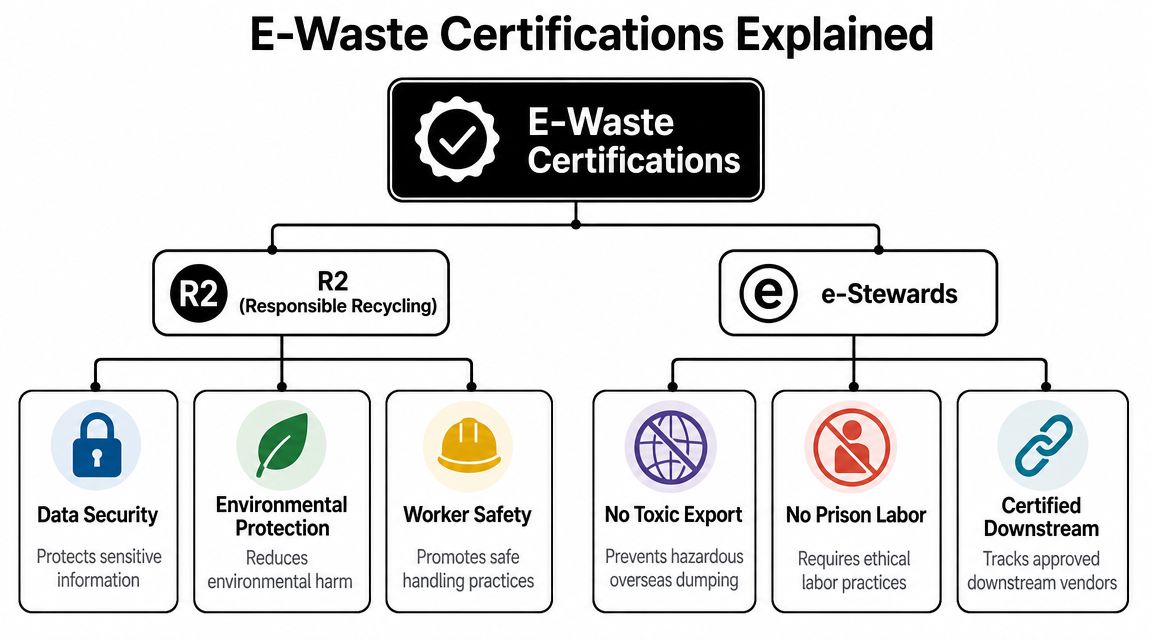
Think of R2 and e-Stewards the way corporate teams think about ISO in manufacturing or SOC 2 in cloud operations. The certification itself isn't the service. It's the proof that the service is being run against a defined control framework.
What those standards signal
NSF describes R2 as a leading standard for electronics repair and recycling, and notes that there are more than 1,000 certified facilities across 41 nations. That global reach matters in telecom because equipment can pass through several logistics points before final processing. In that setting, certification acts as a consistent trust signal across the chain, as outlined by NSF's overview of e-waste recycling certification.
A real certification review focuses on operational controls, not marketing language. Auditors want evidence that the facility can show what came in, what happened to it, where it went next, and how sensitive or hazardous components were managed.
The core controls to look for
A useful way to evaluate certification is to ask what problem each control solves:
| Control area | Why it matters for telecom assets |
|---|---|
| Data security | Prevents exposure from hidden or removable media |
| Traceability | Shows asset movement and final disposition |
| Environmental management | Keeps hazardous components out of improper disposal streams |
| Worker safety | Reduces risk during dismantling and handling |
| Downstream accountability | Extends oversight beyond the first facility |
A certificate on the wall matters less than the records behind it.
If you want a concise breakdown of how R2 is commonly applied in ITAD environments, what R2 certification means is a useful starting point. The important takeaway is simple: certification is the baseline, not the bonus feature.
The Critical Link Between Compliance and Data Security
For telecom equipment, the compliance question usually becomes a data question. A decommissioned switch may still hold startup configs. A voice platform may retain call-related information. A server pulled from a network edge deployment may include drives you expected someone else to remove.
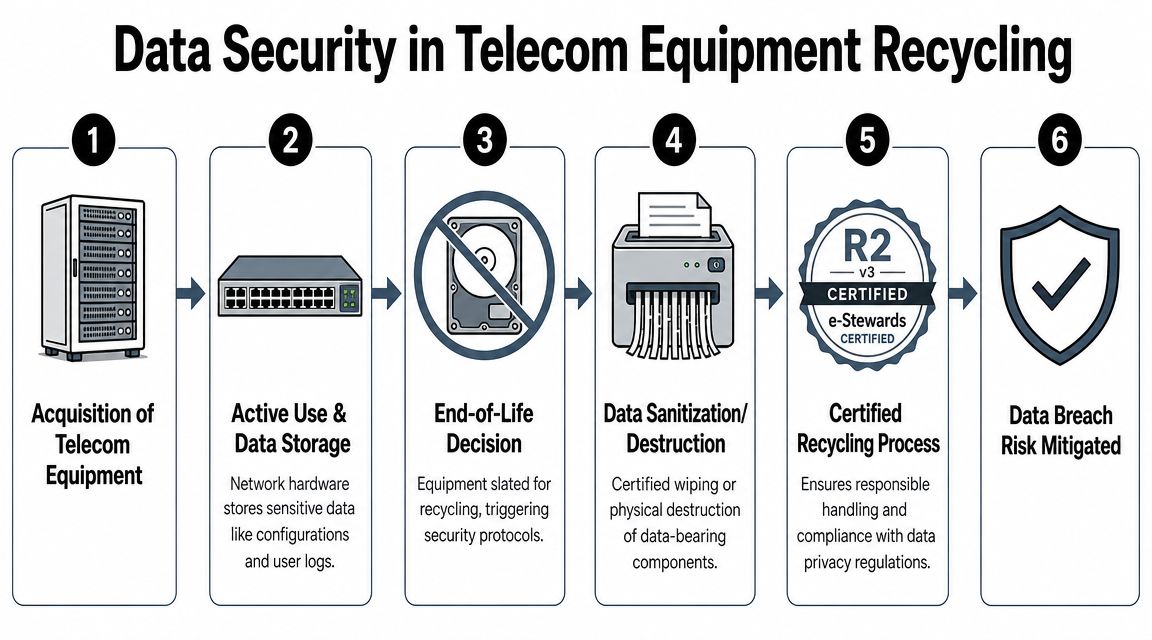
The EPA-recognized R2 framework requires certified recyclers to address data security and downstream due diligence, and the practical control for IT operators is to require a recycler that can prove asset-level traceability and issue certificates of destruction so liability transfers only after final sanitization is verified, as the EPA explains in its guidance on certified electronics recyclers.
What a defensible workflow looks like
A solid telecom recycling process usually follows a sequence:
Inventory capture
The recycler records model, serial, quantity, and asset type before material starts moving.Segregation of data-bearing items
Routers, switches, firewalls, servers, arrays, and removable media are separated from non-data material.Sanitization decision
The asset is routed to wiping, degaussing, or physical destruction based on media type and reuse status.Verification and documentation
The recycler records the method used and ties it back to the specific asset record.Final disposition
Reusable equipment goes to approved recovery channels. Non-reusable material moves to controlled recycling streams.
Where managers get confused
The common mistake is assuming “recycled” also means “sanitized.” It doesn't. Material processing and data destruction are related, but they aren't interchangeable controls.
Another point of confusion is liability timing. Liability doesn't meaningfully transfer when the truck leaves your site. It transfers when the documented destruction or verified sanitization step is complete and the records support that claim.
Keep the legal record tied to the asset, not just the pickup.
That's why many IT teams require serialized audit reporting and a certificate of destruction as part of the closeout package. For organizations aligning disposal with recognized sanitization practices, NIST SP 800-88 guidance is often part of the internal policy framework.
Why this is a compliance function
If your environment touches regulated data, end-of-life handling belongs in the same risk conversation as retention, access control, and incident response. Disposal records may become the only proof that a retired telecom asset was handled correctly. Without that proof, the equipment may be gone, but the exposure remains.
Handling Unique Telecom Equipment and Materials
General office e-waste programs often assume predictable devices such as desktops, displays, and printers. Telecom environments rarely look like that. Loads are heavier, more mixed, and more likely to contain hidden storage or specialized material streams.
Routers switches and embedded storage
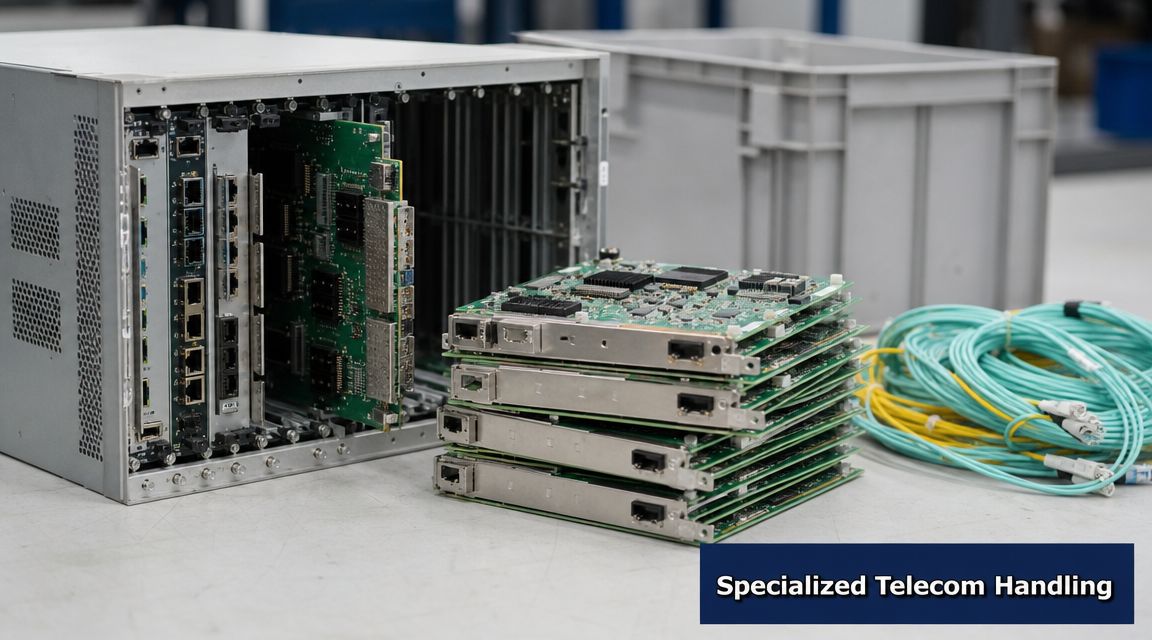
Many network devices don't look like traditional data repositories, but they can retain system images, credentials, logs, and saved configurations. That means intake staff must know how to identify embedded flash, removable modules, and attached storage before dismantling begins.
A recycler handling telecom gear should be able to separate cosmetic metal recovery from data-bearing component control. If they can't explain that distinction clearly, they're treating the asset like scrap.
Servers racks and structured decommissioning
Telecom refreshes often include rack servers, blades, appliances, and cabinet infrastructure removed under deadline pressure. The operational challenge isn't only recycling. It's coordinated de-installation, staging, labeling, and preserving chain of custody while hardware is coming out fast.
Specialized data center and telecom equipment recycling becomes useful. The service scope needs to match the environment, especially when network hardware and server infrastructure are being retired together.
Batteries cabling and mixed streams
Telecom rooms frequently contain UPS batteries, power distribution components, copper cabling, optics, and plastics in the same outbound load. These materials can't be treated as one undifferentiated pile.
Key handling questions include:
- Battery isolation so energy storage components don't move through standard scrap channels
- Cable separation because copper-heavy material has different recovery value and processing needs
- Board recovery controls for printed circuit assemblies and mixed-metal components
- Optics and accessories that may be reusable if tested and tracked correctly
Older telecom equipment often has low resale value as a complete unit but meaningful recovery value once the materials are sorted correctly.
The difference between a telecom-capable recycler and a generic hauler often shows up right here. One sees a pallet of “old electronics.” The other sees multiple controlled streams that must be documented and processed differently.
Your Checklist for Evaluating a Certified Recycling Provider
Vendor due diligence should be direct. If a recycler can't answer specific questions about telecom assets, chain of custody, and downstream processing, you've learned something important before signing anything.
SERI notes that a key differentiator is a facility's ability to process equipment in-house. R2-certified facilities with Appendix E for Materials Recovery can perform dismantling, separation, and recovery on-site, which reduces transport risk, limits third-party handoffs, and improves recovery efficiency, according to SERI's R2 program information.
Questions worth asking before pickup day
- What current certifications do you hold and can you provide current proof?
- Do you issue asset-level documentation for destruction and recycling, or only a general pickup receipt?
- Which telecom items do you process in-house and which do you send downstream?
- How do you identify hidden or embedded storage in routers, switches, and telecom appliances?
- Can you support on-site or witnessed destruction when policy requires it?
What strong answers sound like
A capable provider should be able to describe process, not just promise outcome. Listen for specifics around intake logging, serial capture, segregation, sanitization method, and final certificates.
A weak answer stays high level. A strong one sounds operational.
Ask where the equipment is processed, who touches it, and what record you receive at the end.
You should also ask how the provider handles mixed loads. Telecom projects rarely involve only one device type, and your recycler needs a workflow that can accommodate batteries, rack hardware, phones, boards, and cabling without creating documentation gaps.
For procurement and compliance teams, a practical vendor due diligence checklist helps standardize these reviews so disposal decisions don't rely on verbal assurances alone.
How Beyond Surplus Delivers Certified Telecom Recycling Solutions
A common telecom closeout looks simple at first. A team decommissions switches, routers, phones, and rack gear across multiple sites, schedules a pickup, and expects the recycler to take it from there. The risk appears later, when audit, security, or procurement asks for proof of what happened to each asset, which devices held data, and whether anything in the load needed special handling.
Beyond Surplus provides electronics recycling and IT asset disposition services for business clients, including telecom equipment processing, secure data destruction, certificates of recycling, and certificates of data destruction. For a corporate IT manager, that matters because telecom disposal is rarely a basic haul-away project. It is a chain-of-custody project with mixed equipment types, data-bearing components, and records that may need to stand up months later.
Telecom assets behave more like a mixed parts inventory than a standard office cleanout. One pallet can contain network appliances with embedded flash storage, removable modules, batteries, cabling, metal chassis, and units with little resale demand but strict documentation requirements. A certified recycling solution has to sort those paths correctly from the start, or the paperwork at the end will not match the inherent risk in the load.
What that looks like in practice
A workable process usually includes coordinated pickup from offices, data rooms, or decommissioned facilities, followed by intake controls that keep telecom equipment identifiable through processing. Data-bearing assets need a defined sanitization or destruction path based on device type and policy. Equipment with reuse potential needs evaluation before it is broken down for commodity recovery. Assets with no remarketing value still need documented final disposition.
That operating model helps solve a problem many general e-waste programs miss. Telecom equipment is often dense, modular, and inconsistent. A desk phone, a core switch, and a carrier appliance should not move through the same workflow in the same way, even if they arrive on the same truck.
Some organizations require on-site destruction for selected media. Others use centralized processing because it fits cost, logistics, and reporting needs better. The right choice depends on your security policy, the types of telecom assets being retired, and the level of documentation your internal stakeholders expect.
What matters is process discipline. A provider should be able to explain how telecom gear is identified, how storage-bearing devices are separated, how downstream handling is controlled, and what records you receive at closeout. For telecom recycling, those details are the difference between equipment leaving the building and the project being complete.
Frequently Asked Questions About Telecom E-Waste
Is telecom recycling different from standard computer recycling
Yes. Telecom gear often contains hidden storage, removable modules, batteries, dense mixed metals, and configuration data that generic office electronics workflows may miss. The handling process needs to reflect that.
Can older telecom equipment still have value
Sometimes. A complete unit may have little resale demand, while tested components, usable optics, or recoverable material streams may still support value recovery. That's why triage matters before bulk shredding or scrap processing.
When does liability transfer during recycling
From a compliance standpoint, the critical moment is after documented sanitization or destruction is completed and the supporting records are issued. Pickup alone isn't enough.
Should every telecom asset be physically destroyed
Not always. Some media can be sanitized for reuse, while others should be degaussed or physically destroyed based on your policy and the device type. What matters is that the method is appropriate, verified, and documented.
If your organization is retiring routers, switches, servers, phones, or mixed telecom infrastructure, contact Beyond Surplus for certified electronics recycling and secure IT asset disposal with audit-ready documentation.


