
A lot of surplus fiber gear doesn't look valuable at first glance. It looks like old field kits, retired OTDRs, fusion splicers with worn cases, shelves of SFPs, patch panels, and boxes of accessories no one wants to inventory.
That's where companies lose money. They either let usable assets sit until support lapses and value drops further, or they send everything to scrap without separating remarketable gear from true end-of-life material. Used fiber optic equipment buyers exist for a reason. The secondary market is active, but it rewards preparation, accurate valuation, and risk control.
Your Surplus Fiber Optic Gear Could Be a Hidden Asset
If your team recently upgraded a backbone, replaced field test kits, or cleaned out a telecom room, you may be sitting on equipment that still has resale demand. That's especially true for test gear, splicers, cleavers, OTDR units, and related accessories that still work and can support maintenance or secondary deployments.
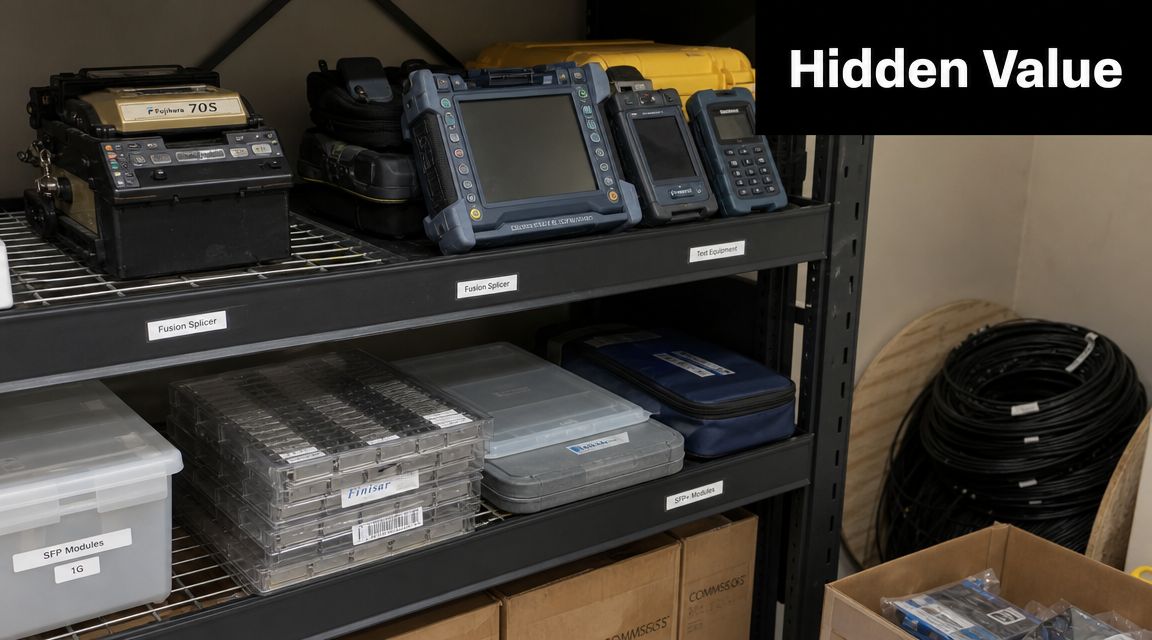
The broader market helps explain why. The fiber optics market is projected to grow from USD 3.18 billion in 2024 to USD 6.8 billion by 2029, a 16.4% CAGR, with demand tied to data centers and 5G infrastructure according to MarketsandMarkets fiber optics market projections. When operators and integrators modernize networks, they release older but still usable assets into circulation. That creates opportunity for sellers who know how to package and position surplus correctly.
A storage room full of retired gear isn't automatically a liquidation win. Some items belong in a resale channel. Some should be bundled. Some should go straight to certified recycling. The mistake is treating all fiber assets the same.
What usually still moves
- Test equipment: OTDRs, light sources, power meters, and inspection scopes often attract the most serious buyers.
- Field tools: Fusion splicers, cleavers, and support kits can hold value if complete and functional.
- Modules and telecom components: These can sell, but demand depends heavily on model relevance and support status.
Practical rule: Separate “works and can be verified” from “untested” before you contact buyers. That one step changes who will quote, how fast they respond, and how much risk they build into the offer.
If you're evaluating a larger telecom refresh, it helps to review a structured telecom equipment liquidation process before sending out bid requests.
Prepare Your Assets for Maximum Value
Most disappointing offers start with a weak inventory sheet. If the list says “misc fiber tools” or “assorted modules,” buyers assume risk, and they price accordingly. A disciplined prep process fixes that.
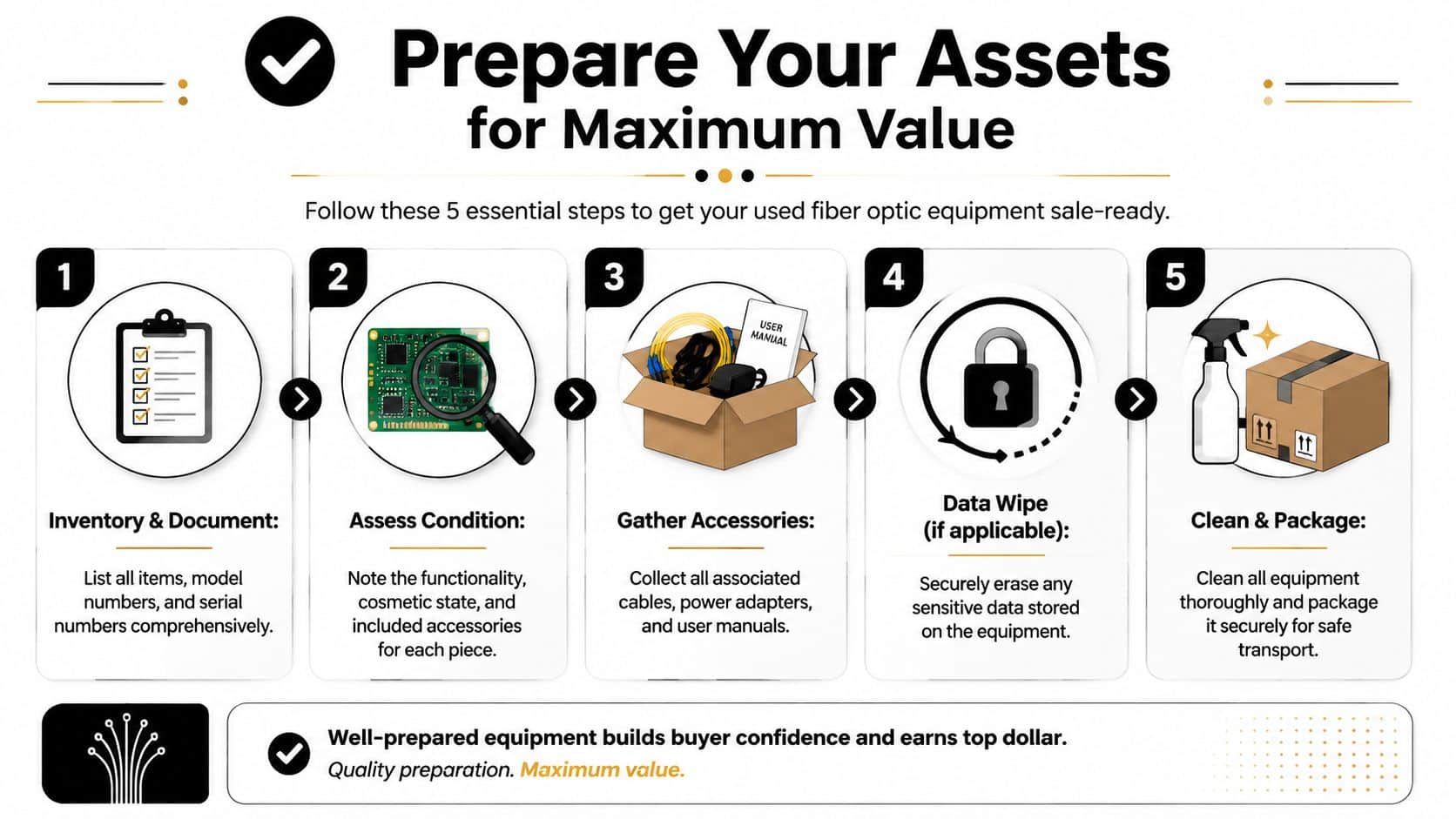
Build an inventory a buyer can actually use
Start with the basics:
- Make and model
- Serial number
- Functional status
- Calibration status if applicable
- Included accessories
- Cosmetic condition
- Photos of front, rear, screen, ports, and case
For fiber equipment, completeness matters. A fusion splicer without key accessories is a different asset than a full kit with charger, battery, cleaver, case, and manuals. The same goes for an OTDR with current calibration records versus one that powers on but has no supporting documentation.
Sort by resale path
Don't put everything into one lot by default. A key strategic decision is whether to sell equipment as a lot or part it out. Payouts differ dramatically between high-demand test gear like new-generation OTDRs and obsolete network components, and depreciation gets steep once models lose vendor support, as noted by Equipt's overview of fiber optics resale considerations.
A simple internal sort usually works:
| Category | Best disposition |
|---|---|
| Recent, working, high-demand test gear | Quote individually |
| Complete field kits with moderate demand | Small grouped lots |
| Older accessories and low-value tools | Bulk lot |
| Broken, unsupported, or obsolete gear | Recycle or harvest parts |
Document what's missing
This matters more than many sellers expect.
- Missing adapters: Buyers discount for replacement cost and uncertainty.
- Dead batteries: Usually not fatal, but note it upfront.
- Cracked cases or damaged screens: These can shift an item from resale to parts.
- Unknown passwords or locked menus: Treat that as a real issue, not a footnote.
A clean, honest inventory gets better engagement than an inflated one. Buyers can work with cosmetic wear. They won't pay top dollar for surprises.
Prepare for shipping before the quote is accepted
Serious buyers want confidence that the equipment they price is the equipment they'll receive. That means anti-static protection where appropriate, shock-resistant packaging, and item-level labeling. If gear arrives damaged because it was loosely boxed with power supplies and loose hand tools, the dispute starts before inspection.
For larger projects, a practical guide on how to sell surplus telecom hardware can help teams standardize inventory, lotting, and pickup readiness across multiple sites.
Determine the Fair Market Value of Your Equipment
The original purchase price is usually the least useful number in the room. Used fiber optic equipment buyers care about current demand, model relevance, condition, calibration, and how fast they can resell or redeploy the unit.
The strongest pricing tends to follow function, not sentiment. A recently used OTDR that passes testing and includes accessories may command real attention. A once-expensive transceiver from an older platform may not.
Why some categories stay liquid
The global fiber optic test equipment market was valued at USD 935.5 million in 2024 and is expected to reach USD 1.36 billion by 2030. Within that market, OTDRs are projected to represent 38.4% of demand, which is a useful signal for sellers because OTDRs remain among the more liquid items in the secondary market according to Grand View Research on fiber optic test equipment.
That doesn't mean every OTDR gets a strong offer. It means buyers are more familiar with that category, there's an established resale path, and well-documented units are easier to move.
The variables that move an offer
A buyer will usually price around these factors:
- Calibration status: Current or recent calibration can materially improve confidence.
- Accessory completeness: Cases, launch reels, chargers, adapters, and manuals help.
- Functional verification: “Powers on” is weaker than tested ports and usable screen condition.
- Brand and model relevance: Recognized platforms are easier to place.
- Firmware and supportability: Unsupported models often fall sharply.
What sellers get wrong
Many teams anchor to replacement cost. That's understandable, but it slows deals. The market doesn't pay for what the item used to be worth. It pays for what a buyer believes they can remarket with acceptable risk.
If two units are cosmetically similar but only one has calibration records, complete accessories, and no menu lock, they are not equal assets.
For larger refreshes, especially where sites hold mixed-value inventory, large-scale telecom equipment liquidation planning can help separate premium units from bulk lots before value gets diluted.
Evaluate Your Options for Used Fiber Optic Equipment Buyers
A common selling mistake happens before the first quote comes in. A team sends the same lot list to a broker, a recycler, and an ITAD firm, then compares the responses as if they solve the same problem. They do not. The right channel depends on the equipment mix, the condition of the assets, the presence of stored data, and how much operational risk your organization is willing to carry.
Buyer type changes both the payout and the amount of work left on your side.
How buyer types differ in practice
Brokers usually perform best with clean, remarketable inventory. If you have current-model OTDRs, fusion splicers, or branded test sets with accessories and documentation, a broker may produce the highest offer on those specific units. The trade-off is scope. Many brokers are not set up to handle serial-level audit trails, data sanitization verification, packaging standards across multiple sites, or the low-value remainder that still has to leave the building.
E-waste recyclers solve a different problem. They are a fit for obsolete, damaged, incomplete, or low-demand gear where resale is unlikely to justify the effort. That route reduces storage burden and can satisfy disposition requirements, but it usually caps recovery at scrap value or a service-credit model. If working instruments get pushed into a recycling stream too early, you give up recoverable value.
ITAD partners sit between those two options and often make the most sense for mixed lots. That includes projects where some fiber equipment can be resold, some units require verified data destruction, and some items belong in a certified recycling stream. A firm with resale, logistics, and downstream disposition capabilities can keep the lot together, which usually cuts internal handling and reduces disputes over what happened to each asset. For equipment that has no resale path, use a provider with certified e-waste recycling for telecom equipment so the nonperforming portion of the project is documented properly.
The practical question is simple. Are you trying to maximize price on a few good units, or close out the whole project with control and documentation intact?
Comparing buyer types
| Criteria | Equipment Broker | E-Waste Recycler | ITAD Partner (e.g., Beyond Surplus) |
|---|---|---|---|
| Best for | High-demand remarketable gear | Obsolete or broken gear | Mixed lots with resale and compliance needs |
| Financial return | Often strongest on select items | Usually limited to scrap value or service offset | Balanced recovery across resale plus proper recycling |
| Data handling | Usually limited | Varies | Typically structured and documented |
| Testing and certification | May be selective | Rarely central | Common part of process |
| Logistics support | Varies by buyer | Usually available | Usually integrated |
| Chain of custody | Often basic | Varies | Typically stronger |
| Fit for enterprise compliance | Limited unless supplemented | Better for destruction than resale | Best fit when documentation matters |
Which route works best
Choose a broker when the lot is small, well-documented, and concentrated in models with clear secondary-market demand.
Choose a recycler when the equipment is beyond economic repair, missing key components, or old enough that remarketing effort would exceed likely recovery.
Choose an ITAD provider when the project includes multiple sites, mixed-value inventory, equipment that may retain job or network data, or internal stakeholders who need one accountable vendor. Beyond Surplus is one example of a provider that can handle buyback, secure data destruction, logistics coordination, and certified recycling in the same workflow.
A bad channel decision does more than lower the check. It can leave your team with extra freight moves, inconsistent records, disputed grading, and avoidable compliance exposure.
Ensure Data Security and Regulatory Compliance
Fiber optic gear is often treated as harmless hardware. That assumption creates avoidable risk. Many instruments can store test histories, site identifiers, network settings, user information, and asset records. If those devices leave your control without proper sanitization, you may have a compliance issue, not just an asset disposition issue.
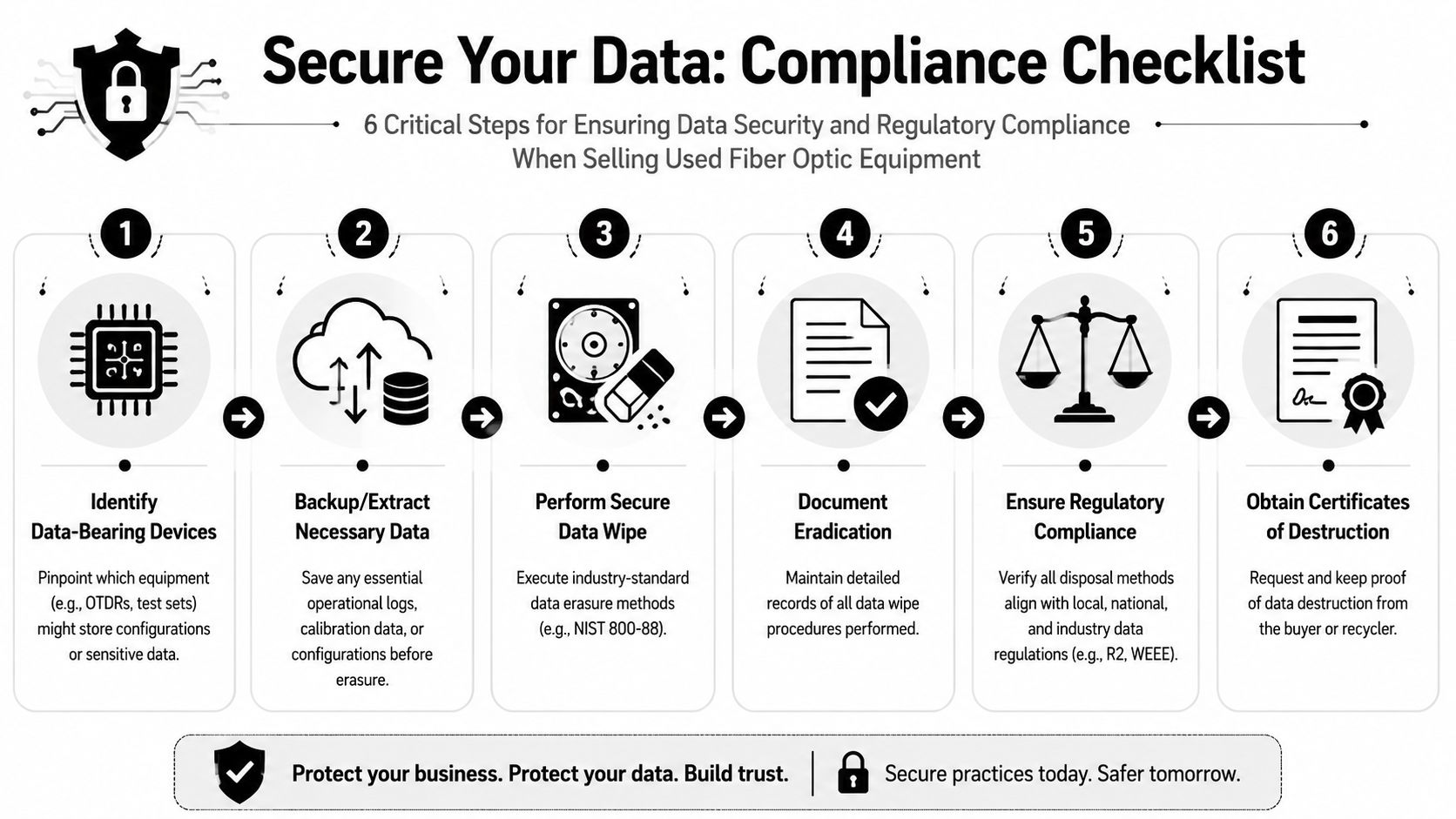
A major gap in the market is guidance on data security for used fiber optic equipment. Many buyers focus on hardware condition but don't address whether devices retain sensitive configuration data or customer records, which can expose sellers to compliance risk under rules such as the FTC Disposal Rule discussed in this fiber equipment resale article.
Which devices deserve extra scrutiny
Focus first on equipment with screens, internal memory, export functions, user profiles, or job history.
That usually includes:
- OTDR units
- Multifunction test sets
- Inspection and certification platforms
- Splicers with stored job data
- Any device tied to customer sites or asset databases
What secure handling actually looks like
A proper process isn't just “factory reset and ship.”
It should include:
- Identification of data-bearing assets
- Extraction of any records you need to keep
- Secure sanitization
- Documented chain of custody
- Final certificates showing what happened
If your organization operates in healthcare, finance, education, or government, auditable proof matters as much as the wipe itself. Internal policy, legal review, and vendor due diligence should line up before the equipment leaves the building.
Some of the highest-risk assets in a telecom room are the ones no one thinks of as computers.
Compliance is partly a paperwork discipline
Even a solid technical wipe can become hard to defend if no one can prove when custody transferred, who handled the device, and what method was used. That's why chain-of-custody records and certificates are operational documents, not optional extras.
For organizations combining resale with secure downstream recycling, certified telecom e-waste recycling services are worth reviewing before approving any pickup or shipment.
Navigate Negotiations and Finalize the Transaction
Once inventory is ready and you've chosen a buyer type, the deal moves into execution. At this point, vague assumptions become expensive.
The standard workflow is straightforward. Sellers submit an equipment list for quote, arrange secure shipping with chain-of-custody, and the buyer performs inbound inspection and testing before final payment. Buyers often require functional units and may return failed items, as outlined by DT Services on selling networking and cable equipment.
Terms that matter more than headline price
A strong offer isn't just a number. Review these terms closely:
- Inspection window: How long does the buyer have to test and reject?
- Shipping responsibility: Who pays, who packs, who bears transit risk?
- Condition variance language: What happens if the item arrives different from the listing?
- Payment timing: On receipt, after test, or after resale?
- Return rights: If rejected, who covers return logistics?
Protect your side of the transaction
Use photos and serialized packing lists. If possible, record what goes into each box or pallet. For high-value instruments, note accessories at the item level. “One OTDR with case” is weaker than “OTDR serial X with charger, SC adapter set, launch cable, manual, and hard case.”
A clean handoff package should include:
| Document | Why it matters |
|---|---|
| Inventory list | Confirms expected contents |
| Serial log | Supports dispute resolution |
| Packing detail | Ties items to boxes or pallets |
| Custody record | Shows transfer responsibility |
| Quote acceptance | Locks commercial terms |
Closing advice: Negotiate the process, not just the payout. A slightly lower offer with clear inspection terms and documented custody is often the safer deal.
If you're moving larger volumes, working with bulk telecom equipment buyers can simplify freight coordination and reduce item-by-item friction.
Common Questions When Selling Surplus Fiber Gear
A seller often reaches this stage after the easy questions are already answered. The inventory is counted, the first offers are in, and the true issues start to surface. Which pieces deserve resale, which ones belong in scrap, and who should handle gear that may store network settings, customer labels, or test records?
Which fiber optic equipment usually holds value best
Complete, working test gear usually brings the strongest resale interest. OTDRs, fusion splicers, power meters, light sources, inspection scopes, and certification units tend to perform well when the model is still supported and the kit includes chargers, cases, adapters, and leads.
Value drops fast when key accessories are missing or the unit cannot be verified. Calibration status matters for some buyers. Battery health matters for others. A broker may still place older gear into a secondary market, but unsupported modules, low-demand transceivers, and mixed passive components often need a different channel than premium instruments.
Should you sell to an international buyer
Sometimes. International demand can improve recovery on specialized fiber gear, especially when domestic buyers are thin for a certain brand or model. The trade-off is more process risk. Customs descriptions, export documentation, transit insurance, inspection timing, and payment release all need to be defined before the shipment leaves your dock.
If your team is not used to cross-border freight, review how the provider handles support questions before you commit. The structured Q&A on AUSFF support is a useful example of how clear communication reduces avoidable confusion during technical shipments.
What should you do with broken or obsolete equipment
Start with triage. Some damaged units still have resale value for parts. Some have no resale market but still require controlled disposition because of stored configuration data, asset tags, or regulated disposal rules. Some should go straight to an electronics recycler with proper downstream controls.
Seller margin is often lost when good equipment gets dragged down by dead stock, and dead stock gets misclassified as resale. Separate likely resale, parts-only, and recycle-only material before you choose a buyer.
Is a quick online quote enough
A quick quote is only a starting point for enterprise lots.
Serious buyers need model numbers, quantities, photos, condition notes, and enough detail to tell the difference between clean resale inventory and a lot that will need testing, harvesting, or scrap handling. If the equipment includes intelligent devices, ask how the buyer verifies data removal and whether they document that work. For higher-value lots, a proper valuation process usually produces better net recovery than a fast blanket offer.
What's the biggest seller mistake
Using one disposition path for everything.
A specialist broker may get better pricing on current test instruments. An ITAD provider is often the safer choice when data-bearing equipment, chain of custody, and reporting matter. A recycler is the right endpoint for material with no economic resale path. Matching the asset type to the right outlet usually does more for total return than pushing every item toward the highest headline offer.
If your organization needs a secure, documented path for selling or recycling surplus telecom and fiber assets, Beyond Surplus provides IT asset recovery, certified data destruction, and compliant disposition support.