For any business in California, managing end-of-life IT equipment is far more than a simple disposal task. It's a complex intersection of legal compliance, data security, and environmental stewardship. The challenge isn't just disposing of outdated hardware; it's ensuring sensitive corporate data is irretrievably destroyed, adhering to strict regulations like the Electronic Waste Recycling Act, and recovering residual value from retired assets. For businesses in California, a certified IT Asset Disposition (ITAD) program isn't a recommendation—it's a necessity.
Transforming E-Waste from a Liability into an Asset
This guide is designed for IT managers and business owners navigating the complexities of California electronics recycling. We will outline a clear, actionable framework for transforming e-waste from a compliance risk into a secure, streamlined, and potentially profitable component of your IT lifecycle management. The objective is to provide a step-by-step plan for building a compliant ITAD program, ensuring every server, laptop, and device is managed correctly from the moment it is decommissioned.
The Inherent Risks of Inaction
That storeroom of obsolete equipment represents more than just clutter; it's a significant liability. Each forgotten device is a potential data breach, and under California law, improper disposal can result in substantial financial penalties. A proactive approach is essential for mitigating these risks.
Here’s why a formal ITAD strategy is critical:
- Regulatory Compliance: Adherence to state and federal regulations, including California's Electronic Waste Recycling Act and the FTC Disposal Rule, is mandatory.
- Data Security: The primary responsibility is to protect proprietary company data and sensitive customer information from unauthorized access.
- Environmental Responsibility: Proper recycling prevents hazardous materials like lead and mercury from contaminating soil and water, aligning with corporate sustainability goals.
- Value Recovery: A significant portion of retired IT hardware retains residual value. Professional remarketing and buyback programs can convert these assets into revenue.
This guide will provide practical steps for building a program that addresses each of these core areas.
Key Compliance Areas for Business E-Waste in California
| Compliance Area | What It Means for Your Business | Required Action |
|---|---|---|
| Data Security & Privacy | Every device with storage (laptops, servers, phones) holds sensitive data that must be permanently destroyed. | Implement certified data destruction (wiping or physical shredding) for all media. Receive a Certificate of Data Destruction. |
| State & Federal Laws | California has strict rules (like the E-Waste Recycling Act) governing how "covered electronic devices" must be handled and recycled. | Partner with a certified e-waste recycler. Never dispose of electronics in regular trash. |
| Environmental Protection | Electronics contain hazardous materials (lead, mercury) that can harm the environment if they end up in landfills. | Ensure your recycler processes materials responsibly to prevent pollution. |
| Chain of Custody | You are responsible for your e-waste from the moment it leaves your facility until its final disposal. | Obtain documentation (like a Certificate of Recycling) that tracks the assets and transfers liability to the recycler. |
This table serves as the foundation of a comprehensive risk-management strategy. Mastering these four areas protects your business from fines, data breaches, and reputational harm.
Building Your Compliant ITAD Program
A successful e-waste management program is more than a simple pickup service; it requires a structured process that guarantees security and accountability at every stage. This reverse logistics chain demands precision and documentation to shield your organization from downstream risk.
The most critical component of a compliant program is an unbroken chain of custody. This documented audit trail proves proper transfer of liability and verifies that every asset was managed according to legal and security standards.
Understanding the disposition journey is fundamental. To see the full process, explore our detailed overview of what happens to recycled electronics. We will now cover the core components of a compliant ITAD framework, ensuring every server, computer, and piece of laboratory equipment is managed responsibly.
Decoding California's E-Waste Laws for Businesses
For any business in California, navigating the state's electronics recycling regulations can be a formidable challenge. The rules are specific and rigorously enforced, with a clear objective: divert hazardous materials from landfills and recover valuable resources. Understanding these laws is a critical component of corporate risk management.
The cornerstone of these regulations is the Electronic Waste Recycling Act of 2003 (SB 20/SB 50). This landmark legislation established the framework for how your business must manage its electronic waste.
The Electronic Waste Recycling Act Explained
The Act focuses on "Covered Electronic Devices" (CEDs), which primarily include devices with screens larger than four inches, such as computer monitors and TVs. The law is unequivocal: it is illegal to dispose of these items in municipal solid waste destined for a landfill.
This is a strict mandate, not a guideline. Non-compliance can lead to significant penalties. The legal responsibility falls upon the "generator" of the waste—your business—to ensure these devices are transferred to a state-approved or certified electronics recycler.
The moment your company decommissions a monitor, you become legally accountable for its final disposition. Discarding it in a dumpster does not absolve your organization of this responsibility; it creates a serious compliance risk.
Partnering with a certified recycler is the most effective defense. A vendor like Beyond Surplus provides the necessary processes and documentation—typically a Certificate of Recycling—to formally transfer liability from your company to the recycler.
Understanding Universal Waste
California classifies most business-generated e-waste—including computers, laptops, printers, and phones—as "universal waste." This is a specific category of hazardous waste containing materials like lead, mercury, and cadmium.
The universal waste regulations are designed to facilitate safe and efficient recycling. For your business, the rules require the following:
- No Landfill Disposal: It is illegal to dispose of universal waste in the trash.
- Use a Certified Handler: You must use a certified recycler or an authorized handler for collection and processing.
- Proper On-Site Storage: While awaiting pickup, you must label containers and ensure they prevent breakage or leakage.
The state created this regulated pathway to streamline the management of common hazardous materials while upholding environmental safety standards.
Beyond Monitors: New and Emerging Regulations
California’s e-waste laws are dynamic, evolving alongside technology. Recent regulations have expanded to address the proliferation of products with embedded batteries, such as tablets, laptops, and other portable electronics.
These updates mean your company's ITAD program must encompass all electronic assets, not just traditional CEDs. Furthermore, federal regulations like the FTC Disposal Rule add another layer of complexity, mandating "reasonable" measures to destroy sensitive customer information on retired devices. This convergence makes environmental compliance and data security inseparable.
California's Covered Electronic Waste Recycling Program has set a national standard for success. Since its inception, Californians have recycled over 2 billion pounds of covered electronic devices. In 2010, California's cell phone recycling rate was 21%, recovering 3.7 million of the 18 million phones sold—more than double the national average of 10% at the time. You can discover more insights about California's groundbreaking e-waste laws and their impact. This history underscores the state's long-standing commitment to a circular economy for electronics.
Making Data Destruction Your Top Priority
Before addressing the logistics of California electronics recycling, businesses must prioritize a more critical issue: data security risk. Every retired server, laptop, and hard drive is not merely obsolete hardware; it is a potential data breach. Secure data destruction is the non-negotiable first step in any responsible IT Asset Disposition (ITAD) plan.
Simply deleting files or reformatting a drive is insufficient for protecting sensitive information. Data recovery tools can easily restore "deleted" files, exposing proprietary company information, customer lists, and financial records. True security requires a certified method that renders data permanently unrecoverable.
Choosing the Right Destruction Method
For businesses in California, the optimal data destruction method depends on security requirements, compliance mandates (e.g., HIPAA, CCPA), and the potential resale value of the storage devices. The two primary, industry-accepted methods are data wiping and physical shredding.
-
Data Wiping (Sanitization): This process uses specialized software to overwrite the entire drive with random data, often in multiple passes, making the original information irretrievable. This is the ideal choice for newer, functional hard drives that can be refurbished and resold, allowing for value recovery.
-
Physical Shredding (Destruction): This is the definitive solution for data security. The hard drive is physically destroyed in an industrial shredder, which grinds it into small, unrecognizable fragments. This method offers the highest level of security for end-of-life drives or those containing highly sensitive data, guaranteeing it can never be accessed.
Understanding the technical standards is crucial. The NIST 800-88 data sanitization guidelines provide a clear framework for secure media disposition and represent the industry's gold standard.
The Power of Proper Documentation
Selecting a destruction method is only part of the process. The most critical component from a legal standpoint is obtaining the correct documentation. Any professional ITAD partner must provide a Certificate of Data Destruction. This document is your legal proof of compliance.
A Certificate of Data Destruction is your shield against liability. It meticulously lists the serial numbers of every sanitized or shredded device, creating an auditable paper trail that proves you took the necessary steps to protect sensitive information. Without it, you have no verifiable defense in the event of a data breach investigation.
This certificate, combined with a complete chain of custody record, demonstrates that your organization acted with due diligence. It proves you identified the risks and engaged a certified expert to mitigate them, protecting your business from the catastrophic financial and reputational consequences of a data breach.
How to Streamline Your E-Waste Pickup and Logistics
Managing the removal of bulk IT equipment can become a significant logistical challenge, especially during an office relocation, data center decommissioning, or routine technology refresh. A proper disposition process requires meticulous planning, secure asset handling, and an unbroken chain of custody to protect your company from downstream liability.
A disorganized pickup can lead to lost assets, data breaches, and compliance violations. From the moment a server or laptop leaves your facility, you must have complete visibility and assurance of its security. This is where a professional ITAD provider becomes an indispensable partner for any California business.
The Professional ITAD Pickup Process
A seamless pickup begins long before a truck arrives. A true partner collaborates with you to develop a customized plan that minimizes disruption to your daily operations. This is not simply a removal service; it is a coordinated strategy to manage risk and maintain accountability.
A structured pickup process includes:
- Initial Inventory Assessment: Your ITAD partner helps catalog all assets slated for disposition, identifying items that require special handling or on-site data destruction.
- Secure On-Site Packing: Trained technicians arrive at your location to safely pack and palletize all equipment, using appropriate materials to prevent damage and preserve resale value.
- Scheduled and Secure Transport: Logistics are managed by vetted transport partners or the ITAD provider’s own fleet, ensuring a secure, timely pickup that aligns with your schedule.
- Serialized Asset Tracking: Each piece of equipment is tagged with a unique serial number, creating a digital audit trail from your facility to the processing center.
This systematic approach transforms a potentially chaotic project into a controlled, fully auditable process.
The single greatest advantage of a professional ITAD service is the end-to-end chain of custody. This documented trail, tracking every serialized asset, is your legal proof that you transferred liability correctly and that every single device was accounted for on its journey.
Why On-Site Services Are a Game Changer
For many organizations, the internal resources required to pack and move sensitive equipment are substantial. Professional ITAD services solve this by bringing expert technicians directly to your facility. They can manage everything from de-racking servers and disconnecting workstations to securely palletizing hundreds of devices.
This frees your internal IT staff to focus on core business functions. This level of service is invaluable for large-scale projects, particularly in the busy commercial hubs across California. While some companies may consider self-transport, the complexities involved typically outweigh any perceived cost savings.
While various electronics drop-off locations exist, for bulk enterprise assets, a professional pickup service is the undisputed industry standard for security and efficiency.
Ultimately, streamlining your pickup and logistics is about risk management. Entrusting the process to a certified partner ensures every piece of equipment is packed, transported, and tracked to the highest industry standards, providing the peace of mind that comes from a secure and fully documented disposition process.
Finding the Hidden Value in Your Retired IT Assets
A common misconception about California electronics recycling is that it is purely a cost center. This overlooks a significant opportunity: IT Asset Value Recovery (ITAVR). A strategic ITAD program can transform disposal expenses into a revenue stream.
This strategy focuses on unlocking the residual financial value in your retired equipment. Many businesses are surprised to learn that their decommissioned assets can generate a substantial return, turning a compliance-driven task into a strategic financial advantage.
Unlocking Your ITAVR Potential
Not all retired electronics are scrap. A significant amount of enterprise-grade hardware retains considerable market value, especially if it is only a few generations old. The first step in a profitable IT retirement strategy is identifying these valuable assets.
Equipment with the highest potential for buyback value includes:
- Recent-Model Servers: Enterprise servers from leading manufacturers have a robust secondary market.
- Networking Gear: Switches, routers, and firewalls from major brands are consistently in demand.
- Enterprise Laptops and Desktops: Bulk quantities of business-class computers can yield a significant return.
- Specialized Equipment: High-end laboratory, medical, or data center hardware often retains high value.
The key is to partner with an ITAD vendor that has deep expertise in the global secondary market and can accurately assess, test, and remarket this equipment.
The Value Recovery Process Explained
Converting retired hardware into revenue is a transparent, systematic process that begins the moment your assets arrive at a certified processing facility. Each item is meticulously audited and evaluated to determine its fair market value.
This workflow provides a clear visual of how your assets are managed, from your facility to their final destination, ensuring a secure and transparent chain of custody throughout the process.
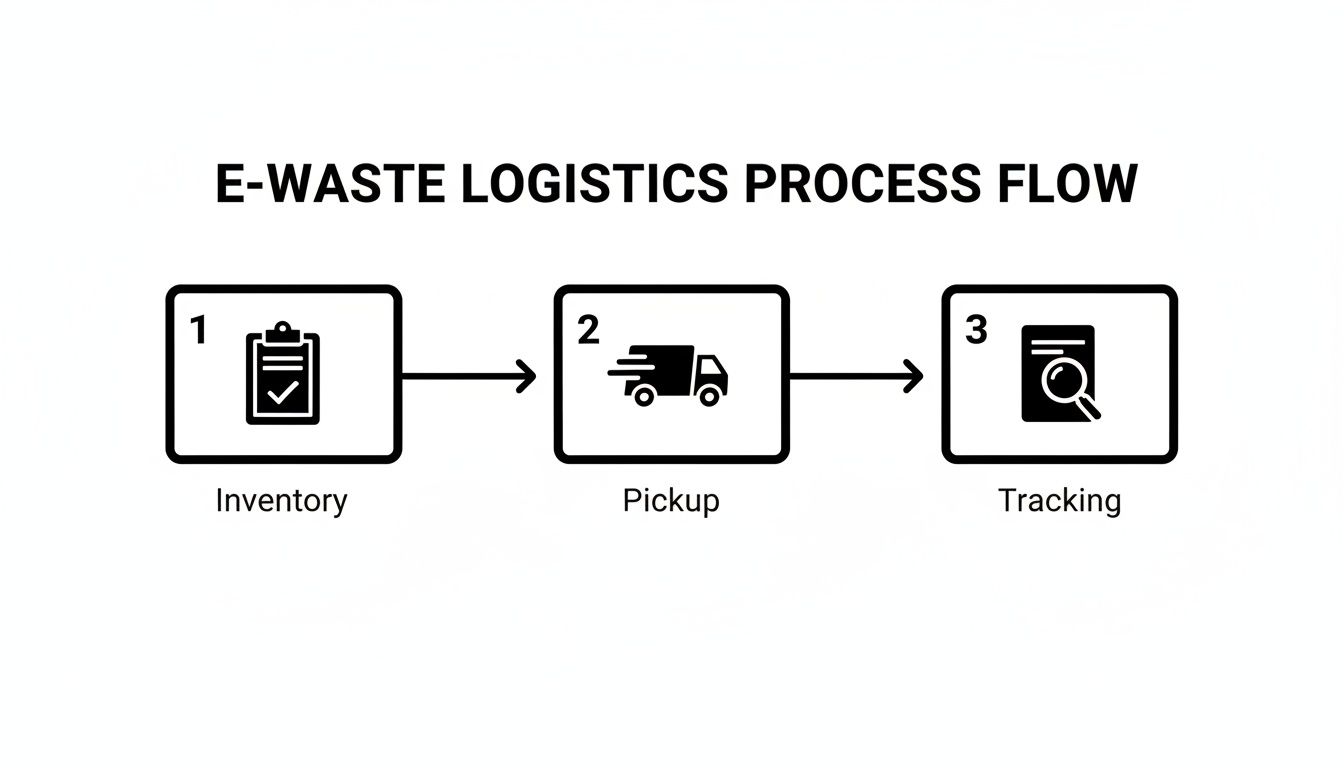
This structured approach is the foundation of any successful value recovery program, guaranteeing every asset is inventoried, securely transported, and meticulously tracked.
The process typically includes these steps:
- Auditing and Inventory: Each asset is logged by make, model, configuration, and serial number.
- Testing and Grading: Technicians test for full functionality and assess cosmetic condition.
- Data Destruction: All storage media undergoes a certified data wipe according to strict NIST 800-88 standards.
- Valuation: Based on the audit, we determine a fair market value and provide a detailed report.
This transforms ITAD from a simple recycling task into a strategic financial decision that lowers the total cost of technology ownership. A robust ITAD program should provide a clear financial return, helping your organization maximize its initial technology investment. For a deeper look at this comprehensive approach, you can learn more about what IT asset disposition entails.
By viewing retired equipment as a potential asset rather than a liability, you fundamentally change the economics of your IT lifecycle management. This simple shift in perspective can transform a cost center into a source of revenue for your IT budget.
For businesses aiming to maximize hardware potential, implementing robust IT Asset Management provides a framework to track assets from procurement to retirement, making value recovery a seamless part of your overall strategy.
Why California Businesses Trust Beyond Surplus
For businesses in California, disposing of end-of-life electronics is a high-stakes endeavor, requiring adherence to some of the nation's strictest laws while navigating complex logistics and data security risks. Engaging a certified ITAD partner transforms this potential liability into a secure, streamlined, and compliant process.
Our nationwide logistics network is specifically designed to meet these challenges. We understand California's rigorous regulatory landscape, and our services are engineered to ensure your business is not just compliant, but confidently so.
A Single Partner for Comprehensive ITAD Services
Choosing Beyond Surplus eliminates the need to manage multiple vendors for pickups, data destruction, and recycling. We provide a single point of accountability for the entire disposition process, from on-site asset cataloging to the delivery of final certification documents.
This integrated approach provides:
- Guaranteed Compliance: We ensure every device is managed in strict accordance with California’s Electronic Waste Recycling Act and federal regulations like the FTC Disposal Rule.
- Ironclad Data Security: Our certified methods, from NIST 800-88 compliant wiping to physical shredding, guarantee the permanent destruction of sensitive data.
- California-Wide Logistics: Our dedicated fleet and logistics partners can schedule secure pickups anywhere in the state, from a data center in Silicon Valley to an office in Los Angeles.
We do not offer one-size-fits-all solutions. Whether you are decommissioning a data center or refreshing corporate laptops, our team develops a customized plan that is efficient, secure, and minimizes disruption to your operations.
The core of our service is providing undeniable proof of compliance. We deliver Certificates of Data Destruction and Recycling—the official documentation required for internal controls and audits, serving as your definitive proof of due diligence.
Keeping Pace with California’s Evolving Technology Landscape
As technology evolves, so do the regulations governing it. California's e-waste program has adapted rapidly. A few years ago, cathode ray tube (CRT) monitors and TVs were the primary items collected, constituting 84% of all recycled units.
Today, the landscape has completely shifted. Laptops, tablets, and other flat-screen devices now account for 89% of collections, while CRTs have fallen to just 11%. This reflects the industry's rapid transition to smaller, battery-powered technology. Learn more about the state's evolving e-waste program and its findings.
Beyond Surplus stays ahead of these trends, ensuring our processes are optimized for modern IT assets. Our comprehensive California ITAD services are designed to manage the full spectrum of business technology, from legacy servers to the latest mobile devices. We handle the complexities of compliance and security so you can focus on your core business.
Answering California's Top E-Waste Questions
When managing technology disposition, California businesses frequently have questions about legal obligations, data security, and value recovery. Here, we address the most common concerns for IT and facility managers.
Does My Business Really Have to Recycle Its Electronics in California?
Yes, absolutely. Under California's Electronic Waste Recycling Act, it is illegal for businesses to dispose of most electronic devices in municipal solid waste. These items are classified as universal waste and require specialized handling.
This is a legal mandate, not a recommendation. To avoid significant fines and environmental liability, you are required by law to partner with a certified or registered recycler for the proper disposal of all covered electronics, from monitors and laptops to servers and printers.
What's the Difference: Data Wiping vs. Physical Shredding?
Understanding the distinction between these two data destruction methods is crucial for protecting your company’s sensitive data and determining the optimal disposition path for your retired assets.
- Data Wiping: This is a software-based sanitization process. We use specialized tools to overwrite every sector of a hard drive according to rigorous NIST 800-88 standards. This renders the original data irretrievable while preserving the drive for safe reuse. It is the ideal choice for newer equipment with residual value.
- Physical Shredding: This method involves the complete physical destruction of the hard drive. The device is fed into an industrial shredder that reduces it to small, destroyed fragments. Shredding provides the ultimate guarantee of data destruction and is best for end-of-life drives or those containing highly sensitive information.
How Can I Prove My Company Handled E-Waste and Data the Right Way?
Proof of compliance is provided through official documentation from your certified ITAD partner. The two essential documents are a Certificate of Data Destruction and a Certificate of Recycling. The data destruction certificate should include the serial numbers of the specific devices that were sanitized or destroyed.
These certificates are your legal defense during compliance audits. They provide an undeniable, auditable record that you fulfilled your due diligence, satisfying both data privacy regulations and California's environmental laws.
Can My Business Get Paid for Our Old IT Equipment?
Yes. If your equipment retains market value, an IT Asset Value Recovery (ITAVR) or buyback program can convert these retired assets into revenue. We frequently purchase recent-model servers, laptops, networking equipment, and other enterprise-grade hardware.
This recovered value can help offset or even exceed the costs of recycling and data destruction, transforming a compliance requirement into a financial benefit.
It is also important to note that California's e-waste regulations are expanding. Senate Bill 1215 is poised to bring products with embedded batteries into the Covered Electronic Waste Recycling Program, acknowledging the need for specialized handling. You can learn more about California's recycling programs for electronics on the CalRecycle website.
For California businesses seeking a certified partner for comprehensive ITAD services, Beyond Surplus offers complete solutions for compliant electronics recycling and secure data destruction. Contact us today to schedule a pickup or get a quote.