

You've got the name, the service, maybe even your first customers lined up. What usually slows Atlanta founders down isn't the idea. It's the stack of decisions that come right after it. Entity choice, city licensing, occupancy approval, payroll setup, insurance, and the operational details that generic startup content skips.
That matters more in Atlanta than many first-time owners expect. The city is friendly to growth, but it's not forgiving about compliance mistakes. If you're launching a services firm, warehouse operation, healthcare support company, electronics recycling business, IT equipment disposal company, computer recycling operation, data center decommissioning service, medical equipment disposal business, laptop disposal program, laboratory equipment disposal firm, or product destruction company, your setup has to work on paper and in practice.
Modern businesses also need an IT lifecycle plan from day one. That includes secure e-waste management, IT asset recovery, electronic waste pickup planning, and documented data destruction when devices leave service. A lot of Atlanta founders handle banking and branding early, then leave technology disposition for later. That's backwards if you'll hold client data, employee devices, retired servers, or regulated equipment.
Your Atlanta Business Blueprint
A founder signs a small lease in West Midtown, orders laptops, hires a contractor, and starts pitching clients. Two weeks later, the opening date slips because the use of the space needs confirmation, the banking setup is still tied to a personal account, and nobody has decided how retired devices, client records, or damaged equipment will be tracked and destroyed. That sequence is common in Atlanta, and it gets expensive fast.
Atlanta is a strong market for disciplined operators, especially in business services, healthcare support, logistics, and technology-connected companies. Founders entering that market need more than a filing checklist. They need an operating plan that holds up under city review, customer scrutiny, and basic risk management. For a useful read on regional growth drivers, see why businesses are relocating to Metro Atlanta.
What a serious launch requires
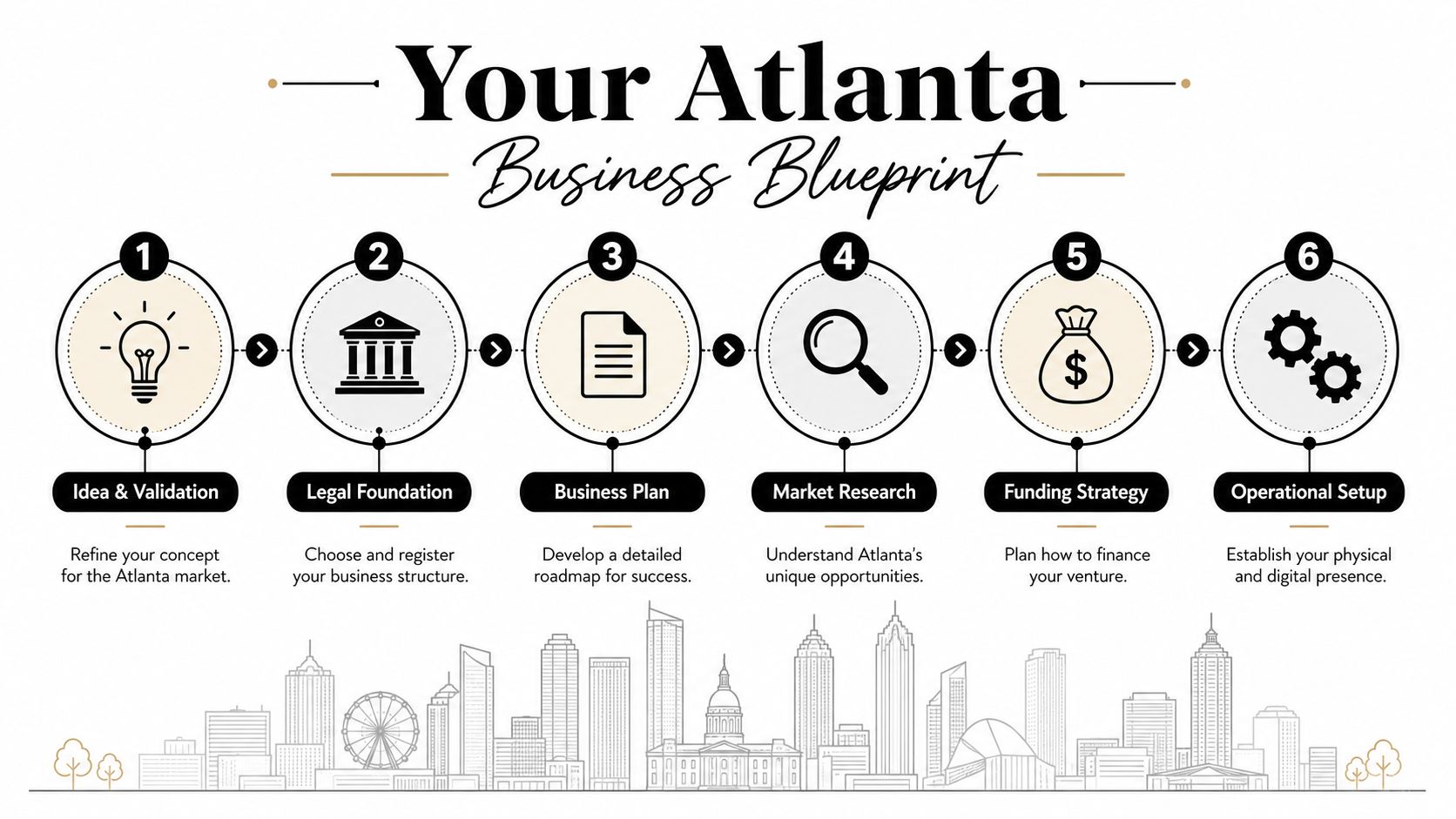
A clean launch usually follows this order:
- Validate the offer: Confirm that Atlanta buyers will pay for the service, at a margin that supports staffing, rent, insurance, and software.
- Set the legal structure: Choose the entity before signing contracts, taking deposits, or committing to a lease.
- Confirm local approvals: Licensing, zoning, occupancy, and site use questions can delay revenue even when the business model is sound.
- Install financial controls: Open dedicated accounts, set up bookkeeping, define who approves spending, and prepare for payroll and sales tax obligations.
- Build the operating system: Assign ownership for hardware, software, vendors, inventory, records, and customer data.
- Plan end-of-life handling early: If the business uses computers, phones, servers, medical devices, lab equipment, or client-owned electronics, create a written process for collection, storage, sanitization, destruction, and recycling before those assets start piling up.
That last point is where many startup guides fall short. In Atlanta, a modern business blueprint should include IT asset disposition, secure data destruction, and e-waste handling from day one if the company will touch regulated information or retired equipment. The risk is not theoretical. A discarded drive, undocumented chain of custody, or careless electronics disposal decision can create legal exposure, contract problems, and reputational damage long before the company reaches scale.
The City of Atlanta's business startup guidance covers core setup expectations. Founders in higher-liability categories should go further and document how equipment leaves service, who approves destruction, which vendor handles pickup, and what certificate or audit trail is retained. That discipline matters for tech firms, healthcare support operations, managed service providers, recyclers, product destruction companies, and any business that stores client or employee data.
Laying the Legal Foundation
The legal structure you choose affects taxes, liability, banking, and how easy it is to grow. Founders often rush this step because filing an entity feels administrative. It isn't. It changes how risk lands on you.
Choosing the right entity
For most Atlanta startups, the practical choices are sole proprietorship, LLC, or corporation.
A sole proprietorship is simple, but it gives you the least separation between business risk and personal assets. That can work for very low-risk solo work. It's usually a poor fit if you'll sign leases, hire staff, hold client equipment, store records, or manage regulated materials.
An LLC is the usual starting point because it's flexible and easier to run than a corporation. Many service businesses choose it because it creates a cleaner liability boundary and works well for early growth.
A corporation can make sense if you expect outside investors, more complex ownership, or a specific tax strategy. It also creates more formal governance. If you don't need that structure yet, don't add complexity just to sound bigger.
The basic filing sequence
Most founders should move in this order:
- Pick a legally usable business name
- Register the entity with Georgia
- Get a federal EIN
- Open a dedicated business bank account
- Align contracts and invoices with the legal entity name
Practical rule: Don't sign a commercial lease or client agreement in your personal name if the business will operate through an LLC or corporation.
What works and what doesn't
What works is matching the structure to your actual risk. A founder with field technicians, company laptops, product destruction work, or electronics handling needs more than a low-friction filing. They need legal separation and operational discipline.
What doesn't work is copying another founder's setup without checking your own exposure. The right entity for a freelance designer may be the wrong one for a company handling retired servers or warehouse inventory.
Operationally, founders in electronics, resale, recycling, and device-heavy service businesses should also review Atlanta e-waste laws and business compliance early. It's easier to design compliant workflows now than retrofit them after your first client audit.
Navigating Atlanta's Local Compliance Maze
A founder signs a lease for a small warehouse near Atlanta, orders furniture, schedules internet install, and starts hiring. Then the city flags the use, the Certificate of Occupancy is not in place, and the business license stalls. That delay is expensive because rent, payroll planning, and launch commitments keep moving even when approvals do not.

Atlanta compliance is mostly a sequencing problem. State formation gives you a legal entity. City approval depends on whether your address, business activity, occupancy status, and tax registration all line up.
Start with the property, not the paperwork stack
Before you commit to office, retail, industrial, or mixed-use space, confirm that the site supports your actual operation. The City of Atlanta requires a Certificate of Occupancy for new uses and many tenant changes, and that approval ties back to zoning, building, and fire requirements through the city's permitting process, as outlined by the City of Atlanta Office of Buildings and permitting resources.
Landlord assurances are not enough. A space that worked for a prior tenant may still be wrong for your use if you add storage, customer traffic, device staging, light assembly, repair intake, or other activity that changes occupancy or code requirements.
That point matters more for modern service companies than founders expect. Atlanta has plenty of businesses that look administrative on the surface but operate like light industrial shops once equipment, packing stations, returned devices, or inventory enter the picture.
Handle local compliance in the right order
Use a written process and assign ownership. Founders lose time when everyone assumes someone else filed the city piece.
A practical sequence looks like this:
- Confirm zoning and approved use for the exact address
- Verify whether a new or updated Certificate of Occupancy is required
- Register for the City of Atlanta business license through the Office of Revenue
- Keep the entity name, trade name, address, and business activity description identical across filings
- Calendar annual renewals and tax deadlines in a shared compliance system
For deadlines, use primary sources. The Georgia Secretary of State requires annual registrations for corporations and LLCs between January 1 and April 1 each year through its annual registration filing guidance. At the city level, Atlanta business licenses are renewed through the Office of Revenue, and founders should confirm current billing and due dates directly with the City of Atlanta business licensing page.
Where new businesses get stuck
The common problems are predictable.
A founder uses one address on the state filing, another on insurance, and a third on the city application. A lease says “office use,” but the company receives pallet shipments and stores client equipment. A business submits for licensing before confirming occupancy status. None of those mistakes are unusual. All of them can slow approval.
The state also removes guesswork on renewal risk. Georgia's Corporations Division publishes annual administrative dissolution lists for entities that fail to maintain required filings, which is a useful reminder that missed compliance deadlines are routine, not rare, according to the Georgia Secretary of State business search and compliance records. Treat renewals like accounts payable. Put them on a calendar with backup reminders and a named owner.
Founders who plan to raise capital later should also keep their local compliance file clean. Investors, lenders, and larger customers look for gaps in good standing, licensing, tax status, and occupancy history during diligence. For a broader view of how Atlanta founders line up capital with operating discipline, review these Atlanta startup funding trends for entrepreneurs.
Compliance in Atlanta includes operational reality
City approval is only part of the picture. Your filings need to match how the business will run.
If you expect client audits, regulated customers, field technicians, inventory handling, or a device-heavy workflow, set those controls early. Document who receives equipment, where assets are stored, who has access, and which records must be retained. Secure IT asset disposition and certified data destruction belong in your operating plan, but the detailed facility and disposal setup belongs at the headquarters stage, where it can be tied to space design, vendor controls, and chain-of-custody procedures.
Securing Funding and Setting Up Finances
A common Atlanta startup mistake happens before the first sale. The founder opens a business bank account, gets a credit card, buys laptops, subscribes to software, and starts pitching customers. Six months later, the books are messy, sales tax treatment is unclear, equipment ownership is undocumented, and no one can prove what happened to the first batch of retired devices. That is a funding problem as much as an operations problem, because lenders, investors, and larger clients all look for control.
Atlanta rewards businesses that can show a clean operating model. That matters for software companies, but it also matters for service firms, logistics operators, managed IT providers, healthcare vendors, and compliance-driven businesses. If your company handles client data, employee devices, payment information, or regulated records, your financial setup should account for asset tracking, replacement cycles, and certified disposal from day one.

Pick the right funding path
The best capital source depends on the business model, margin profile, and speed of growth.
A solo consulting firm or specialized local service business usually does better with owner capital, retained earnings, and strict cash discipline than with investor money. An equipment-heavy company often needs a bank relationship early, because spreading purchases over time protects working capital. A tech-enabled B2B company with repeatable sales may have a case for outside investors, but only after it can show demand, delivery capacity, and reliable reporting.
Use this lens:
| Business type | Usually better first move |
|---|---|
| Solo or small service firm | Owner capital plus disciplined cash management |
| Equipment-heavy operation | Bank relationship and structured purchasing |
| Scalable B2B platform | Investor conversations after proof of demand |
| Compliance-focused service company | Strategic clients and retained earnings |
The trade-off is simple. Fast capital increases pressure for fast results. Slower capital gives you more control, but it demands tighter execution.
For a broader local view, review Atlanta startup funding trends for entrepreneurs.
Build the finance stack early
Separate personal and business money immediately. That is basic housekeeping, but it is also a credibility test.
At minimum, set up:
- Business checking: Route all revenue and expenses through one business account.
- Bookkeeping software: Reconcile every week so errors stay small.
- Tax reserves: Set aside money for federal, state, and local obligations as revenue comes in.
- Approval controls: Define who can buy equipment, sign contracts, issue refunds, or approve vendor payments.
- Asset records: Track laptops, phones, drives, and other devices by user, location, and retirement status.
That last point gets missed. In Atlanta, many new businesses rely on device-heavy operations from the start. If you buy computers and mobile equipment without an asset log, you create accounting issues, security gaps, and disposal risk later. If a device stores customer files or employee data, retirement is not just an IT task. It affects legal exposure, client trust, and sometimes contract compliance.
Operator advice: A banker or buyer should be able to understand your records quickly.
Budget for labor and overhead with margin in mind
Payroll usually becomes the largest fixed cost earlier than founders expect. The exact number will vary by role and business type, so the key is to avoid chasing a national average. It is building a budget that can carry wages, payroll taxes, software, insurance, equipment replacement, and downtime without starving the business.
If you plan to hire technical staff, operations managers, logistics coordinators, or compliance-minded administrators, budget for the full employment cost, not just salary. The same rule applies to technology purchases. A laptop is not only a one-time expense. It also creates setup time, support needs, security obligations, and an end-of-life disposal requirement.
Strong finance setup supports funding conversations later. It also protects the business now. Clean books, controlled spending, documented assets, and a clear policy for secure data destruction give Atlanta founders a tighter operation and fewer surprises.
Building Your Team and Managing Risk
Your first employee can solve a bottleneck or create three new ones.
I see this early in Atlanta companies all the time. A founder hires a salesperson before setting up payroll controls, or brings in an operations lead without defining who approves purchases, tracks equipment, or documents incidents. Growth follows for a while. Then missed filings, access problems, damaged devices, or weak recordkeeping start costing real money.
Hire for control as much as output
Early hires should reduce risk, not just add capacity. In practice, that means looking for people who can follow process, document their work, and handle sensitive information without improvising.
Atlanta employers are hiring in a competitive market, so pay planning needs to be grounded in actual role requirements and total employment cost. Salary is only part of the number. Payroll tax, benefits, software access, equipment, training time, and replacement coverage belong in the same calculation. If the role includes handling customer data or company devices, add onboarding controls and end-of-employment offboarding steps on day one.
Different roles create different pressure points:
- Administrative hires: Focus on accuracy, file handling, scheduling discipline, and follow-through with state and local deadlines.
- Technical hires: Prioritize process ownership, security habits, and documentation quality, not just technical skill.
- Client-facing staff: Hire for judgment. One careless promise to a customer can create delivery, staffing, and compliance problems.
- Operations staff: Look for people who can maintain logs, manage vendors, and keep chain-of-custody records when equipment or data-bearing assets move.
A founder does not need a large team first. A founder needs a team that can be audited.
Set up employer compliance before the first day of work
Do not wait until the week of first payroll to figure out registrations, withholding, onboarding forms, and reporting workflows. That delay creates preventable errors, and the correction work always takes longer than setting it up properly the first time.
Before hiring, confirm who will own each of these tasks:
- payroll processing and tax withholding
- new hire reporting
- I-9 and supporting document retention
- employee handbook distribution and policy acknowledgment
- benefits enrollment, if offered
- device assignment and recovery records
- offboarding, account shutdown, and access removal
If your team is starting small and hybrid, using one of the best coworking spaces in Atlanta for growing businesses can keep overhead flexible. It also creates a new management requirement. You need clear rules for badge access, equipment storage, shared Wi-Fi use, and who is allowed to take company devices offsite.
Insurance should match the actual exposure
Cheap coverage often turns into expensive exclusions.
A serious risk plan usually includes:
- General liability insurance: Covers common third-party claims tied to day-to-day operations.
- Professional liability or E&O: Important if clients rely on your advice, technical work, or recommendations.
- Workers' compensation: Required once your Georgia staffing level triggers the rule.
- Commercial property or equipment coverage: Important for companies that depend on tools, laptops, phones, inventory, or specialized hardware.
- Cyber liability or data breach coverage: Worth examining if staff handle customer records, payment information, login credentials, or managed devices.
Policy selection should reflect how the business runs. A consulting firm with no inventory has a different risk profile than an Atlanta company staging laptops, collecting retired devices, or handling data-bearing equipment for clients.
Assign ownership for risk controls
Risk management fails when responsibility is vague.
Someone on the team should own renewals, incident logs, vendor certificates, claim documentation, and policy updates. If your company handles electronics, assign responsibility for asset tracking, secure storage, data destruction records, and e-waste disposition too. Those jobs are often treated like back-office cleanup. They belong in core operations because they affect legal exposure, customer trust, and contract performance.
For Atlanta businesses operating in a tech-heavy environment, this is not just an IT issue. It is part of hiring, training, insurance, and daily management. A strong team structure includes clear accountability for what happens to company data and hardware from deployment through retirement.
Establishing Your Operational Headquarters
Monday morning in Atlanta. The keys are in hand, the internet installer is booked, and the first shipment of laptops is on the way. By Friday, a founder can still be stuck on basic operating problems: no secure receiving area, no asset log, no written wipe procedure for returned devices, and no clear record of who touched what. That is how a new headquarters starts creating risk before it creates revenue.
Choose a space that fits the work
Rent is only one line item. Workflow matters more.
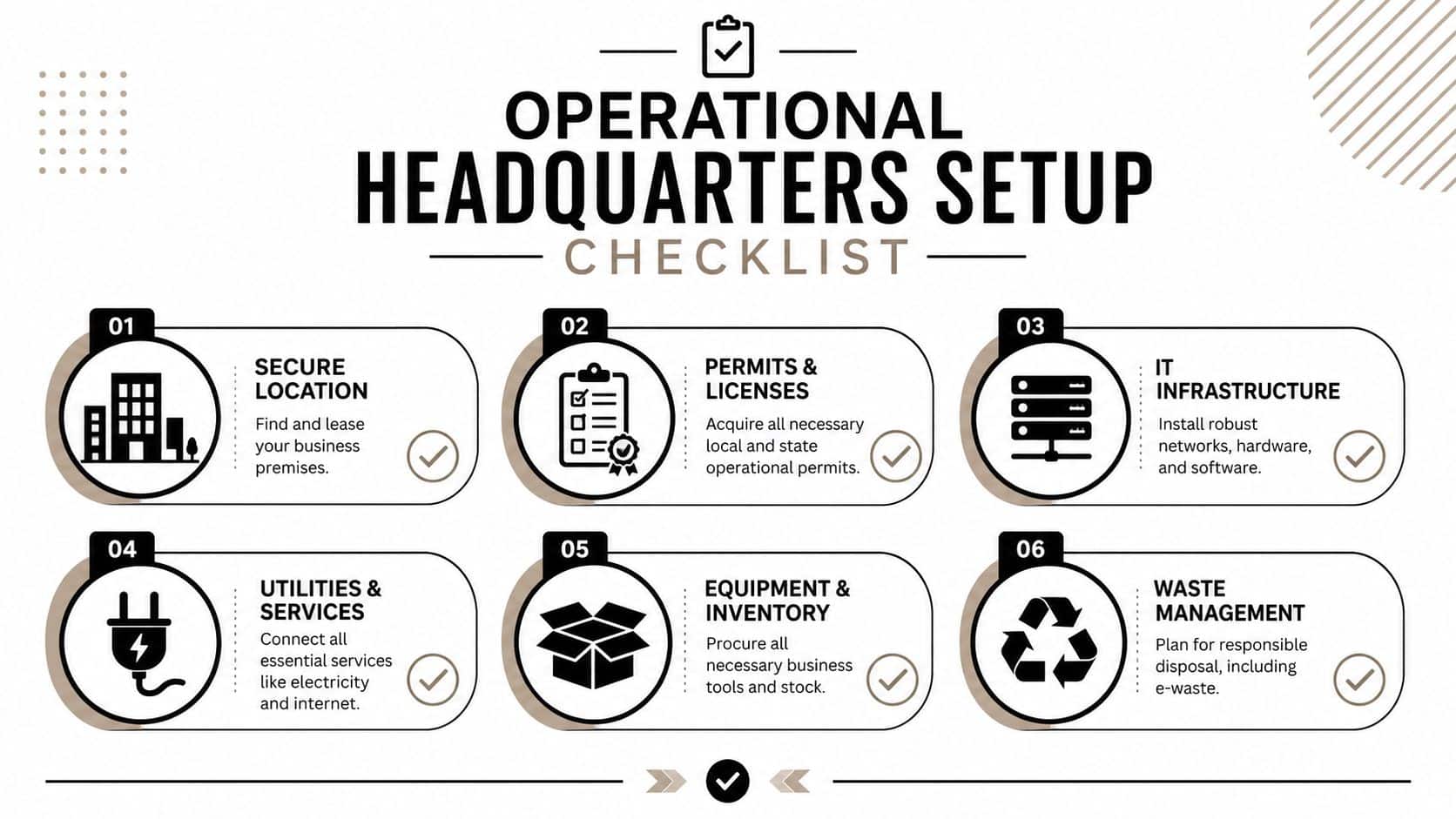
A founder setting up a consulting office has different needs than a company receiving retired laptops, staging replacement hardware, or storing client devices before pickup. Ask practical questions before signing. Can deliveries arrive without blocking operations? Is there locked storage for data-bearing equipment? Do staff need separate areas for active inventory, quarantine, and end-of-life assets? If clients or vendors visit the site, is there controlled access and camera coverage in the right places?
Coworking can work for lean service firms, early sales teams, and operators testing demand before taking on a warehouse or office lease. Teams comparing flexible options can review the best coworking spaces in Atlanta for growing businesses before committing to a larger footprint.
Set up operations and IT together
Physical setup and technical setup should happen on the same timeline. Waiting until after move-in usually creates gaps that are expensive to fix later.
Start with a short operating checklist:
- Asset inventory rules: Record laptops, desktops, phones, drives, and peripherals from purchase through retirement.
- User access controls: Limit system, storage, and admin access by role.
- Network and endpoint standards: Define Wi-Fi security, device configuration, patching, backup, and mobile device management before staff start using equipment.
- Retention and destruction procedures: Document what records and devices are kept, when they are retired, and how data is destroyed.
- Vendor files: Keep service contracts, certificates, pickup records, and disposal documentation in one place.
For Atlanta companies handling client hardware, retired electronics, or regulated data, IT asset disposition belongs in the opening plan. It is an operating control, not a cleanup task for later.
Handle the compliance layer before the first pickup or install
The official side is straightforward. Confirm that the property use matches the business activity, that local approvals are in place where required, and that utility, internet, alarm, and delivery access are aligned with your opening date.
The overlooked issue is equipment leaving the business.
The Federal Trade Commission explains under the Disposal Rule guidance that businesses handling consumer report information must dispose of it so the data cannot be read or reconstructed. Even if your company is not directly subject to every data disposal rule, the operating standard is still clear. If a workstation, drive, phone, or copier leaves your control without documented wiping or destruction, you are carrying avoidable legal and client risk.
Build the end-of-life process before you need it
Founders usually plan for procurement. They do not plan for retirement.
That gap shows up fast in Atlanta's tech-heavy sectors, where businesses cycle through laptops, networking gear, POS hardware, lab devices, and medical equipment on a regular schedule. Without a written chain of custody, equipment can sit in a closet for months, leave with no transfer record, or get recycled with no proof of destruction. That creates audit problems and weakens client trust.
Set a process that covers:
- Chain of custody: Who received the asset, where it was stored, and when it changed hands
- Segregation of equipment streams: Reuse, resale, destruction, and recycling should each follow a separate path
- Certificates and reporting: Keep recycling and destruction records for customers, insurers, and contract files
- Special handling procedures: Medical, laboratory, and enterprise equipment often require tighter controls than standard office electronics
For companies offering electronics recycling, IT equipment disposal, computer recycling, data center decommissioning, medical equipment disposal, laptop disposal, laboratory equipment disposal, product destruction, or electronic waste pickup, the operating model is part of the service. Clients are not only buying removal. They are buying documented risk control.
Launching and Growing in the Atlanta Market
Atlanta rewards companies that show up consistently and solve operational problems clearly. The launch phase isn't just about getting noticed. It's about proving you can be trusted.
Go local before you go broad
Start with channels that create direct commercial visibility:
- Targeted local SEO: Use city-intent phrases that match your actual service footprint and buyer needs.
- Google Business and service pages: Make sure your business categories and service descriptions are precise.
- Industry networking: Atlanta buyers still respond to real introductions and local reputation.
- Partnership marketing: Accountants, commercial brokers, MSPs, facility teams, and procurement contacts can become strong referral sources.
For B2B companies, generic visibility is weaker than specific relevance. “We help Atlanta organizations retire and document end-of-life technology” lands better than broad claims about innovation.
Make compliance part of the pitch
A lot of founders think compliance is internal. Buyers often see it as a differentiator.
If your company can show secure handling, sustainability discipline, documented chain of custody, and reliable records, you reduce buyer friction. That matters with healthcare groups, finance teams, manufacturers, schools, and government-related customers.
Growth gets easier when your operations help the client's audit trail instead of adding work to it.
For broader market positioning ideas, review Atlanta small business growth strategies for 2026.
Atlanta is a strong place to build, but it favors founders who respect process. Get the legal structure right. Handle local approvals in sequence. Set up clean finances. Hire carefully. And treat secure technology disposition as a foundation, not an afterthought. That's how a new company stays open long enough to become established.
If your business needs a reliable partner for secure IT asset disposal, certified data destruction, electronics recycling, product destruction, or data center equipment removal, contact Beyond Surplus. They help organizations manage end-of-life technology with documented chain of custody, environmentally responsible processing, and commercial service support across Atlanta and nationwide.


