

Only 22.3% of the world's e-waste was formally collected and recycled in an environmentally sound manner in 2022, while 62 billion kilograms were generated. Nationwide ITAD services give enterprise organizations the control, documentation, and logistics structure needed to manage retired technology across distributed locations.
That gap changes how IT leaders should evaluate disposal. Electronics recycling is only one part of the assignment. A workable program must also identify every asset, protect data during transport, apply media-appropriate sanitization, document final disposition, and recover value where reuse makes sense.
For organizations operating offices, campuses, data centers, clinics, branches, and remote-work locations across the United States, local arrangements often create inconsistent results. One recycler may issue a basic receipt, another may use a different wiping process, and a third may rely on downstream partners the enterprise has never reviewed. A national program replaces that patchwork with defined workflows and one accountable operating model.
Table of Contents
- Why Nationwide ITAD Services Matter for Enterprise Organizations
- Core ITAD Service Offerings Explained
- Data Sanitization Methods and Compliance Requirements
- On-Site Versus Off-Site ITAD Program Models
- Chain-of-Custody Documentation and Liability Transfer
- Vendor Selection Checklist for Nationwide ITAD Programs
- Cost Considerations and Value Recovery Strategies
- Common ITAD Misconceptions That Put Enterprises at Risk
Why Nationwide ITAD Services Matter for Enterprise Organizations
The global e-waste stream contained 31 billion kilograms of valuable metals worth about USD 91 billion in 2022, according to the International Telecommunication Union's e-waste data. Formal recycling during that year also helped avoid the extraction of 900 million tonnes of primary ore and prevented 93 million tonnes of CO2-equivalent emissions. Those figures show why responsible electronics recycling matters, but they don't solve the operational problem by themselves.
Enterprise IT managers must first capture equipment reliably. Assets sitting in branch closets, employee homes, loading docks, data halls, and storage rooms can bypass the approved process unless the organization has scheduled pickups, standardized intake, serialized tracking, and clear ownership. The bottleneck is often reverse logistics and visibility, not the availability of a recycling outlet.
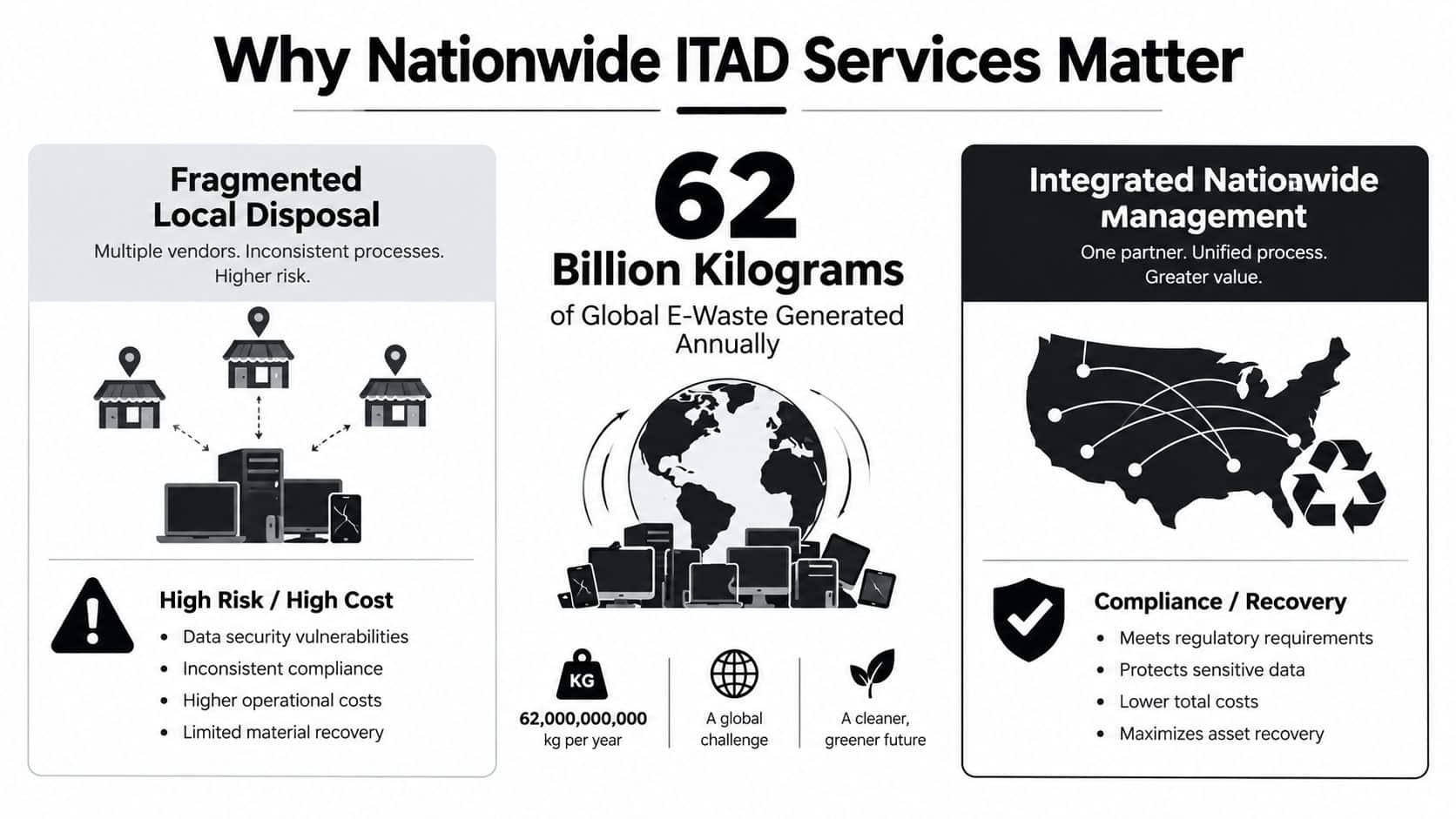
What separates national programs from local recycling
A local recycler may be suitable for a controlled, single-site load. A nationwide ITAD program must coordinate pickup windows, transportation partners, regional processing, data destruction, reuse decisions, and certificates across state lines. It also needs escalation procedures for missing assets, damaged equipment, unexpected media types, and urgent decommissioning work.
The commercial market supports this scale. The global ITAD market is projected to reach USD 26.46 billion in 2026, rising from USD 24.4 billion in 2025, and is projected to reach USD 39.66 billion by 2031 at an 8.45% CAGR from 2026 through 2031, according to Mordor Intelligence market estimates. North America is forecast to grow from USD 5.35 billion in 2026 to USD 8.71 billion by 2031, representing a 10.26% CAGR.
| Feature | Local Recycling | Nationwide ITAD |
|---|---|---|
| Coverage | One facility or nearby region | Multiple states and distributed sites |
| Documentation | May vary by vendor | Standardized manifests and certificates |
| Data handling | Process depends on local operator | Defined media-specific sanitization workflow |
| Logistics | Customer often coordinates transport | Central scheduling and transportation control |
| Value recovery | May be limited to material recycling | Reuse, remarketing, buyback, and recycling paths |
A national provider should make the program easier to audit, not merely easier to schedule. Review the requirements and service scope offered through nationwide computer recycling services before treating geographic coverage as proof of operational maturity.
Core ITAD Service Offerings Explained
A complete enterprise program has several connected service components. Removing one usually pushes risk or cost into another part of the lifecycle.
Secure data destruction
The provider should separate data-bearing equipment before processing. Certified data wiping can preserve resale potential when the media and security requirements support reuse. On-site hard drive shredding is more appropriate when the organization requires immediate physical destruction, the media is damaged, or recovery must be infeasible.
The right decision depends on media type, confidentiality, device condition, and intended disposition. A wiping certificate without a reliable asset identifier isn't strong evidence, and shredding without a documented inventory can leave gaps about what was destroyed.
Pickup and transportation
Nationwide logistics involves more than sending a carrier to collect boxes. Large programs need pickup scheduling, loading procedures, secure staging, packaging guidance, route coordination, and exception handling. A provider may use its own fleet, transportation partners, or both. The enterprise should know who controls the handoff and how the shipment remains associated with the original manifest.
Chain-of-custody control
Chain of custody connects the asset record to each transfer. The workflow should capture the location, serial number or other identifier, custody event, processing decision, and final disposition. This record supports audits and gives procurement, security, facilities, and finance teams a shared source of truth.
Recycling and remarketing
Recycling is the correct path for equipment that can't be reused economically or safely. Remarketing can produce more value from functional computers, servers, networking equipment, and peripherals, but it requires verified sanitization, testing, grading, channel management, and transparent accounting. Not every retired asset has resale value.
Buyback and recovery
A buyback program should explain how valuations are determined, which costs are deducted, when payment occurs, and how non-value assets are handled. Compare offers using the full program economics, including removal, packing, testing, data destruction, freight, and recycling charges.
| Service Component | Enterprise Use Case | Compliance Relevance |
|---|---|---|
| Data destruction | Retired laptops, servers, drives, and mobile devices | Supports defensible handling of sensitive information |
| Logistics coordination | Multi-site refreshes and facility closures | Documents controlled movement between locations |
| Asset tracking | Distributed inventory and decommissioning projects | Links physical equipment to disposition evidence |
| Recycling | Non-reusable electronics and mixed hardware | Supports responsible downstream processing |
| Remarketing and buyback | Functional equipment with recoverable value | Creates an auditable financial outcome |
The strongest providers integrate these services rather than treating them as unrelated add-ons. A pickup that reaches a warehouse without an accurate manifest has already weakened the later certificate package.
Data Sanitization Methods and Compliance Requirements
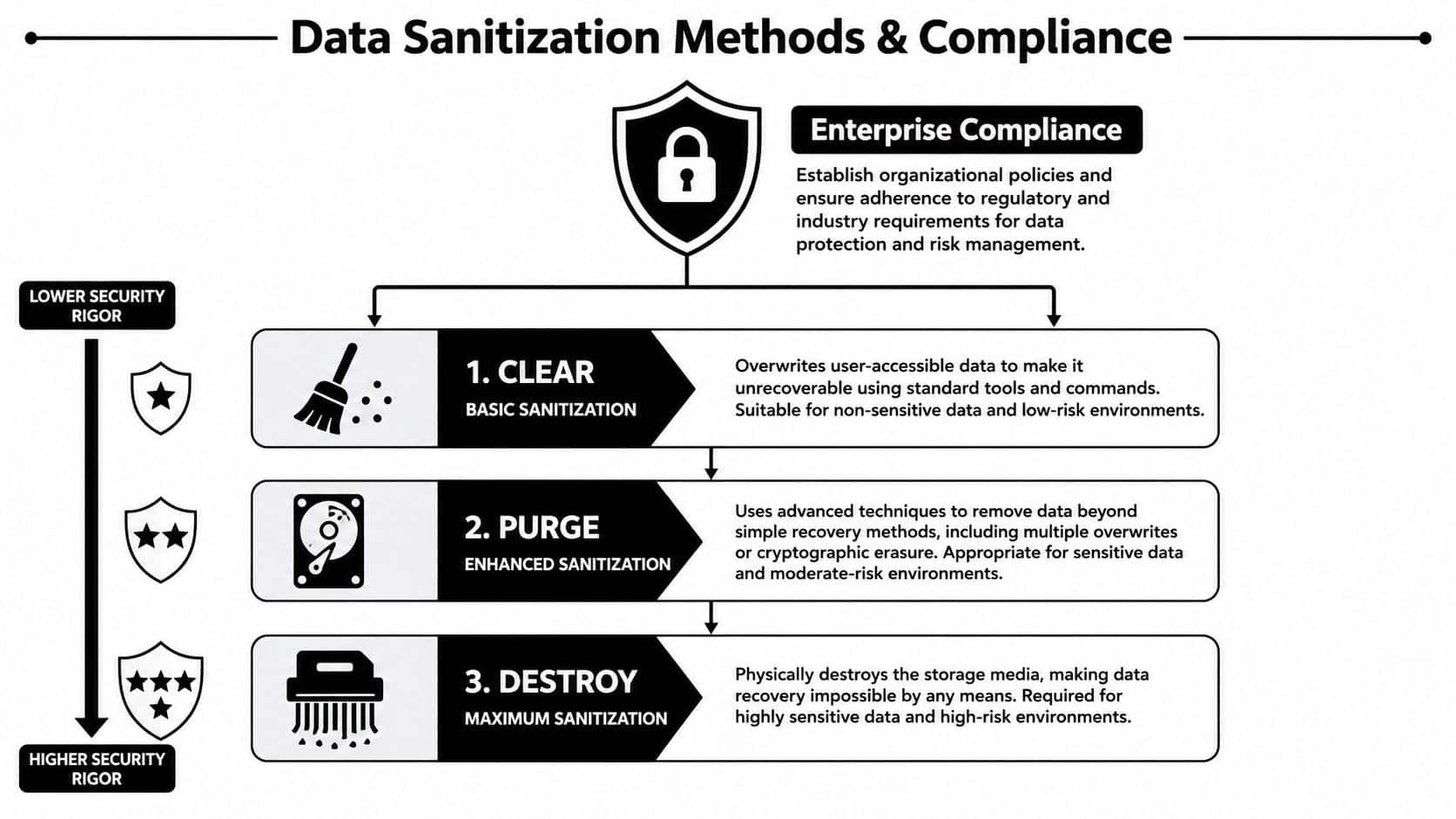
Deleting files, reinstalling an operating system, or formatting a drive isn't the same as making data access infeasible. NIST SP 800-88 defines media sanitization around that objective and identifies three methods, Clear, Purge, and Destroy, in its media sanitization guidance.
Match the method to the media
Clear applies logical techniques that address ordinary access through standard interfaces. It may support reuse in lower-risk situations, but the organization must confirm that the method fits the media and its security policy.
Purge uses techniques intended to make recovery substantially more difficult while preserving the device for reuse where possible. The process must account for how the device stores data. SSDs, for example, can handle data differently from conventional hard disk drives, so a generic wiping instruction may not be sufficient.
Destroy physically renders the media unusable and should make recovery infeasible even with state-of-the-art laboratory techniques. It is the clearest choice for highly sensitive data, failed media, or equipment that won't be remarketed.
Mobile devices and embedded storage create additional complications. Enterprise teams should define how smartphones, tablets, removable media, and devices with encrypted storage are assessed, rather than applying a single rule to every item.
Build evidence into the process
NIST's control model includes documentation, certificates of sanitization, assigned roles, personnel training, and equipment calibration or maintenance. The certificate should identify the asset, media, method, date, verification outcome, and final disposition. If the provider can't explain how it verifies the result, the enterprise can't properly assess the residual risk.
The FTC Disposal Rule requires reasonable and appropriate practices to prevent unauthorized access to consumer-report information, including destruction or erasure of electronic files and media so information can't be read or reconstructed. A nationwide provider should therefore preserve a defensible custody record from pickup through final processing. Organizations subject to healthcare, financial, government, or international privacy requirements should map the ITAD workflow to their own retention, breach, and audit obligations.
| Method | Applicable Media | Verification Required |
|---|---|---|
| Clear | Suitable reusable media in lower-risk workflows | Method, asset identity, and outcome recorded |
| Purge | Reusable media requiring stronger logical or technical sanitization | Media-specific verification and certificate |
| Destroy | Failed, highly sensitive, or non-reusable media | Physical destruction evidence and final disposition |
For a practical interpretation of the standard, review NIST 800-88 data destruction standards alongside your internal security policy.
On-Site Versus Off-Site ITAD Program Models
The on-site and off-site models solve different operational problems. Choosing between them based only on price usually produces a poor fit.
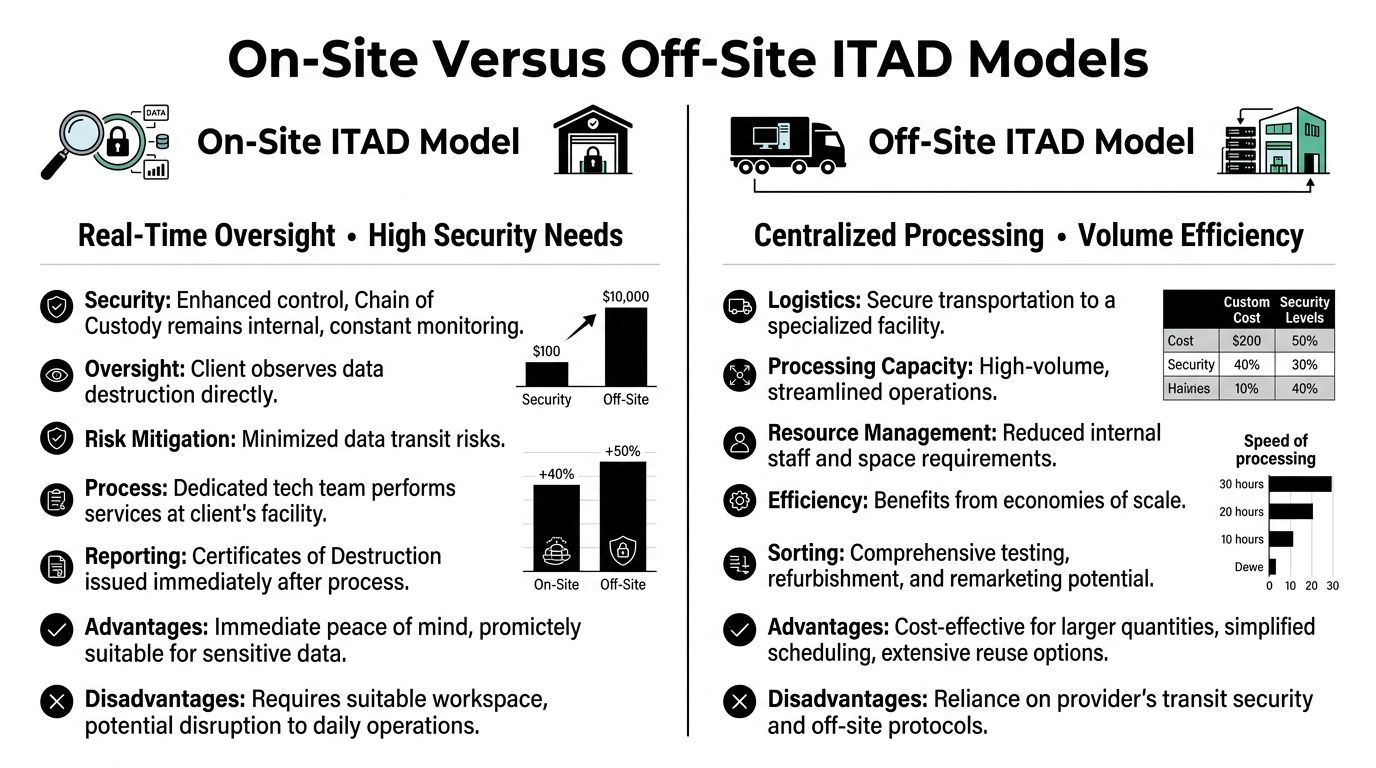
On-site destruction brings equipment and technicians to the enterprise facility. It gives security staff direct visibility, reduces the time that sensitive media remains in transit, and can provide immediate confirmation that designated drives were destroyed. That model is useful for high-sensitivity projects, secure areas, urgent closures, and locations where transport presents an unacceptable concern.
Off-site processing moves equipment to a controlled facility for centralized sorting, testing, wiping, remarketing, and recycling. It usually fits higher-volume projects, recurring refresh cycles, and remote locations without enough space or equipment for destruction. Centralization can also improve consistency, but the provider must demonstrate secure transport and strong receipt controls.
Use a decision matrix
| Factor | On-Site Model | Off-Site Model |
|---|---|---|
| Security preference | Immediate oversight and physical confirmation | Controlled transport with facility-based processing |
| Best operational fit | Sensitive media, secure rooms, urgent projects | Consistent volume, broad inventories, remote sites |
| Space requirement | Requires staging and equipment access | Requires prepared loading and transport access |
| Reuse workflow | May be limited at the pickup location | Supports centralized testing and remarketing |
| Chain of custody | Fewer transport steps before destruction | More transfer points require documentation |
A hybrid program often works best. An enterprise might destroy certain drives on-site, send reusable laptops to a regional facility for certified wiping, and route obsolete laboratory equipment through a specialized recycling stream. The policy should specify which assets qualify for each path before the project begins.
Ask vendors how they handle failed equipment, mixed pallets, after-hours pickups, and a site that changes its schedule. The operational answer matters more than a general claim of nationwide coverage. A useful comparison of the models is available in on-site versus off-site ITAD services.
Chain-of-Custody Documentation and Liability Transfer
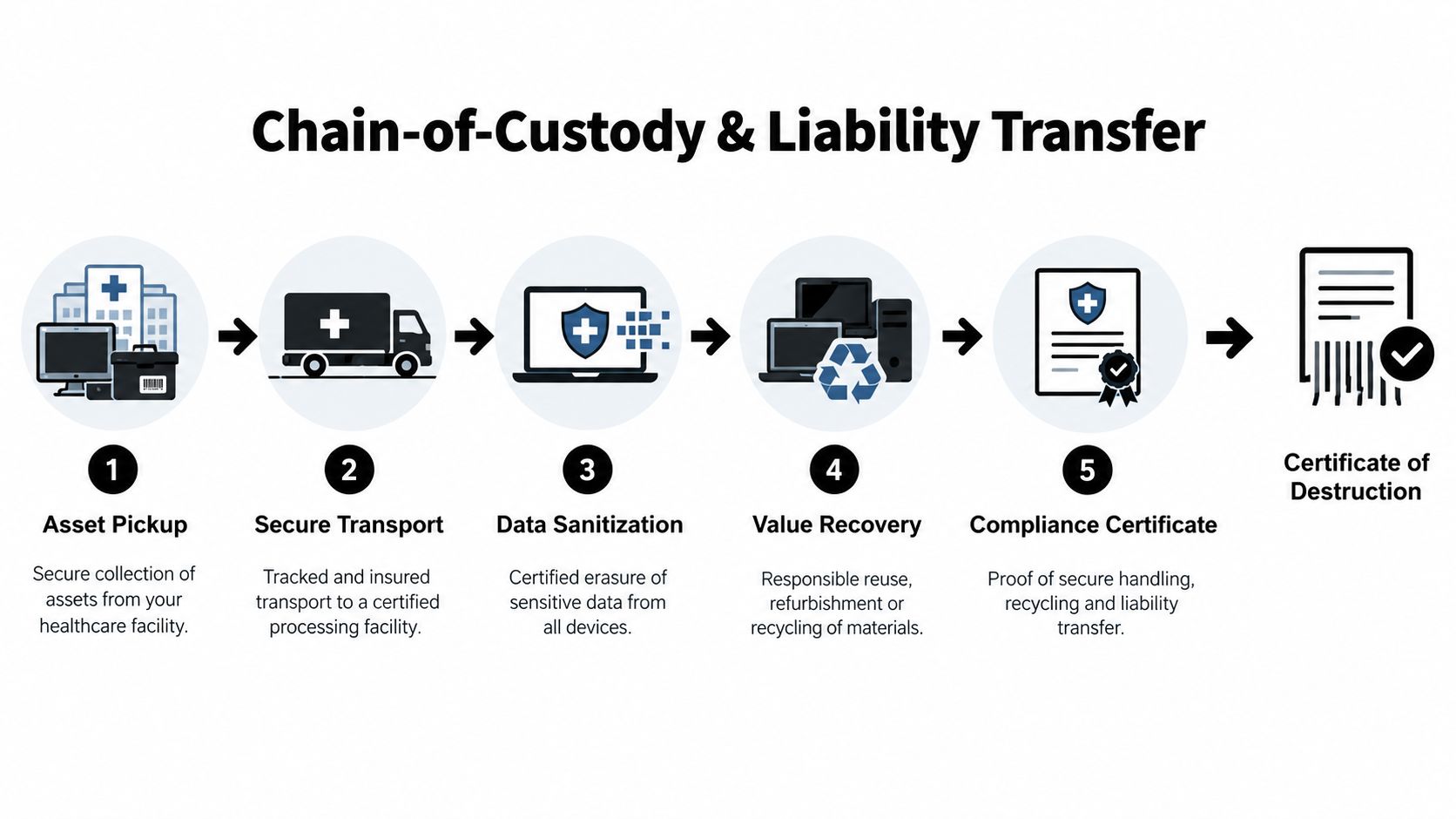
A healthcare system with facilities in multiple locations may have separate IT contacts, storage practices, and pickup schedules at each site. Consider a fictional hospital network managing retired workstations, laptops, servers, diagnostic peripherals, and removable media across twelve locations. Its risk doesn't disappear because each facility uses the same approved vendor name.
The program starts with a pickup manifest. Staff record the equipment identifier, originating location, media status, and custody handoff. The transporter then confirms the shipment, the receiving facility reconciles it, and the processing team records whether each asset was wiped, destroyed, remarketed, or recycled.
What the record should show
A defensible file should contain:
- Pickup manifest: The assets released, originating site, date, and authorized contact.
- Asset tracking log: Identifiers, condition, custody events, and processing status.
- Sanitization certificate: Method used, verification result, media information, and date.
- Final recycling certificate: Downstream disposition for equipment routed to material recovery.
- Exception record: Missing, damaged, unidentifiable, or rejected assets and the resolution.
The healthcare example becomes difficult when one location reports a missing laptop after the shipment has left. A serial-linked manifest and receiving reconciliation can narrow the discrepancy to a specific custody event. A generic weight ticket can't provide that level of control.
Treat certificates as evidence, not decoration
The FTC Disposal Rule centers on reasonable and appropriate disposal practices. Documentation doesn't replace secure handling, but it helps the organization demonstrate what happened and who controlled the asset at each stage. IRS media-sanitization guidance also emphasizes retaining records that identify the media, when and how it was sanitized, whether verification occurred, and the final disposition. Organizations should establish retention periods through their legal, privacy, and records-management teams rather than accepting a vendor's default.
| Stage | Required Document | Retention Period |
|---|---|---|
| Site release | Authorized pickup manifest | Organization's records policy |
| Transport | Handoff and delivery confirmation | Organization's records policy |
| Processing | Asset tracking and sanitization record | Security and regulatory policy |
| Destruction or recycling | Certificate of destruction or recycling | Compliance retention schedule |
| Exception handling | Investigation and resolution record | Legal and incident policy |
The documentation standard should appear in the contract, statement of work, and acceptance criteria. Guidance on building that evidence trail is available through chain-of-custody documentation.
Vendor Selection Checklist for Nationwide ITAD Programs
A vendor's coverage map isn't enough. Procurement teams should test whether the provider can execute the same controlled process at a headquarters, a rural branch, a data center, and a temporary project site.
Validate the operating model
Ask these questions before signing:
- Certification scope: Does the provider maintain relevant R2v3 or e-Stewards credentials, and do they cover the actual facilities and processes used for your assets?
- Sanitization control: Which methods are available for HDDs, SSDs, mobile devices, and failed media? How is each result verified?
- Geographic execution: Which locations are served directly, and where are carriers or subcontractors involved?
- Tracking technology: Can the system report asset identity, custody events, processing status, certificates, and exceptions?
- Downstream visibility: Who receives recycled or remarketed equipment, and can the provider identify downstream processors?
- Financial transparency: How are testing, freight, destruction, recycling, and buyback values calculated?
- References: Can the vendor provide references from organizations with comparable compliance and geographic complexity?
A facility visit can reveal more than a sales presentation. Look for controlled receiving, segregated data-bearing media, documented access, calibrated destruction equipment, inventory reconciliation, and orderly outbound staging. Ask to review sample certificates with identifying information removed.
Watch for procurement red flags
A low per-unit price may exclude transport, packing, certificates, failed-device handling, or downstream charges. A vendor that refuses to describe subcontractors, provides only weight-based receipts, or can't explain an exception process creates avoidable exposure.
Don't award a national contract without a pilot. Use representative assets and locations, then measure manifest accuracy, pickup performance, certificate completeness, reconciliation quality, and response to exceptions. A detailed vendor due diligence checklist can help security, facilities, procurement, and finance evaluate the same evidence.
Cost Considerations and Value Recovery Strategies
The cheapest disposal quote rarely represents the lowest total cost. Compare transportation, labor, packaging, storage, inventory work, sanitization, certificates, recycling charges, and account management alongside the provider's stated unit price.
Value recovery depends on condition, age, configuration, market demand, and the cost of preparing an asset for resale. A functional laptop with verified data sanitization may follow a remarketing path, while damaged equipment or obsolete laboratory hardware may be routed to recycling. The program should never force reuse when security or environmental controls make destruction the sounder decision.
Improve the economics through process design
Consolidated pickups can reduce handling and transport complexity. Scheduled refresh waves are easier to staff than emergency removals. Standardized disposition rules also prevent local teams from sending similar equipment through inconsistent channels.
Track at least three categories of performance:
- Financial outcome: Gross and net recovery by asset category.
- Risk control: Certificate completeness, reconciliation results, and audit findings.
- Operational efficiency: Pickup cycle time, exception resolution, and inventory accuracy.
Finance and procurement teams evaluating remarketed equipment can also consult these used technology buying tips to understand the condition and verification questions that influence secondary-market value. That perspective helps buyers and sellers assess the same assets realistically.
A strong ITAD program creates two forms of return. It recovers money from suitable equipment, and it reduces the internal effort required to prove that every non-reusable asset reached an appropriate final disposition.
Common ITAD Misconceptions That Put Enterprises at Risk
Deleting files equals destroying data. It doesn't. Logical deletion can leave recoverable information, and different media types require different sanitization decisions. Use a documented Clear, Purge, or Destroy process that matches the asset and risk.
Recycling alone is the complete ITAD service. Material recovery handles only one outcome. Enterprise programs also need inventory capture, secure logistics, data destruction, remarketing controls, and certificates tied to individual assets.
Remote workers can manage returns informally. Distributed employees create custody gaps when devices go straight to a local drop-off point or remain in home storage. Provide approved packaging, return instructions, serialized tracking, and escalation for lost or damaged equipment.
A certification logo proves everything. Certification can be relevant, but buyers still need to confirm scope, facility coverage, downstream arrangements, media handling, and certificate content. Ask how the provider applies its controls to your actual workflow.
The lowest quote is the best value. A low price can omit freight, destruction, reporting, or exception management. Compare complete program costs and risk controls, not just the recycling line item.
ITAD can wait until the end of a refresh. Waiting creates crowded storage areas, uncertain ownership, and rushed decisions. Define disposition rules during procurement and decommissioning planning, then schedule collection as assets leave service.
Practical rule: If your team can't identify where an asset is, who last controlled it, and what final action occurred, the ITAD process isn't complete.
Beyond Surplus coordinates nationwide business pickups, secure data wiping, on-site and off-site hard drive shredding, electronics recycling, IT equipment disposal, product destruction, data center de-installations, and value recovery with documented custody controls. Visit Beyond Surplus to discuss a structured ITAD program for your facilities, data centers, and distributed enterprise locations.


