
When an employee leaves, the laptop return rarely happens in a clean, controlled sequence. HR disables access, IT ships reminders, managers chase addresses, and the device sits in someone’s spare bedroom, home office, or car trunk. Every extra day creates exposure. You’re carrying hardware loss risk, unresolved data security questions, and a messy chain of custody that’s hard to defend in an audit.
That’s why outsourcing remote employee laptop returns has moved from a convenience to an operational control. A distributed workforce breaks the old model where equipment comes back through one office, one help desk, and one storage room. Remote returns require logistics, security handling, documentation, and end-of-life processing that most internal teams aren’t built to run at scale.
The upside is straightforward. A certified IT asset disposition partner can turn a slow, inconsistent process into one with repeatable workflows, documented custody, and faster asset recovery. Structured outsourcing services achieve recovery rates of 80% or better, compared with the 70% to 85% range typical of unstructured internal processes, according to Iron Mountain data summarized here. That difference matters when every missing device represents cost, risk, and follow-up work your team doesn’t need.
Below are the seven strongest business cases for outsourcing remote laptop returns to a certified ITAD partner such as Beyond Surplus.
1. Streamlined Logistics and Nationwide Pickup Coordination
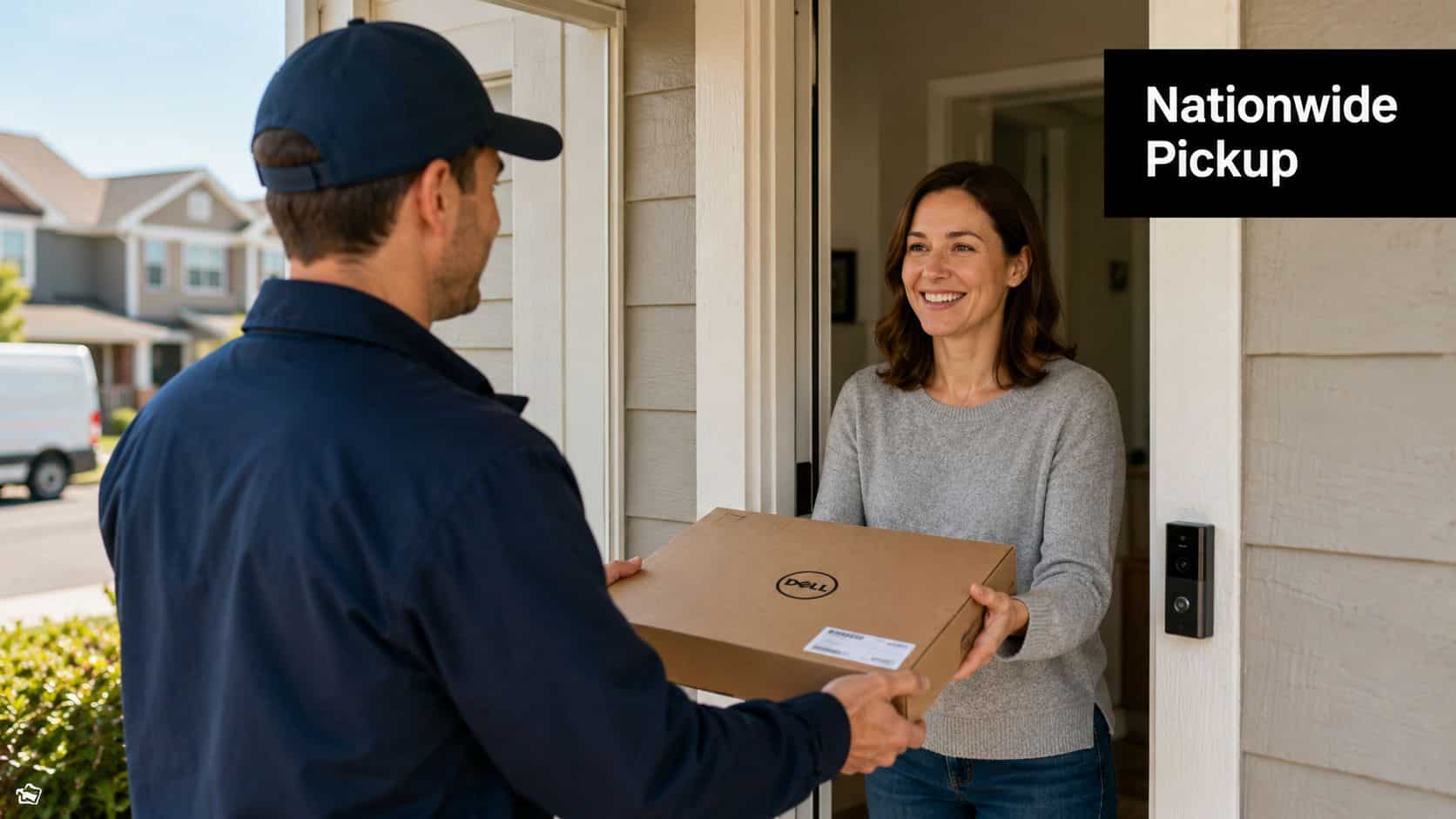
Most internal teams don’t struggle with policy. They struggle with execution. The bottleneck is coordinating packaging, labels, carrier instructions, follow-ups, and status tracking across dozens or hundreds of addresses.
An outsourced process fixes that by centralizing the work. The provider handles return kit fulfillment, pickup scheduling, carrier coordination, and receipt confirmation. Your IT staff stops acting like a shipping department and gets back to actual IT work.
Remove friction that kills return rates
Structured logistics matter because employee effort is one of the biggest reasons devices don’t come back quickly. FedEx’s print-and-ship workflow, which uses QR codes for packing and drop-off, removes the need for the employee to print labels or guess how to package the device. That reduced friction is a major reason outsourcing programs perform better, as described in this overview of automated logistics for remote laptop returns.
A practical example is an offboarding wave after a merger. Instead of asking local managers to improvise return steps, the ITAD partner can batch communications, issue prepaid instructions, and track every shipment to intake. That creates one operating model for every state, not fifty improvised ones.
Practical rule: If a former employee has to buy a box, print a label, or guess where to ship the laptop, your process is already weaker than it should be.
If you’re evaluating providers, look at how they manage courier workflows and pickup routing, not just recycling. Tools and service models used in an AI platform for courier tenders show how much operational efficiency depends on better shipment coordination upstream.
2. Certified Data Security and Compliance Risk Transfer
The device itself is only half the issue. The larger problem is the data still sitting on it while the return drags on. Once a laptop leaves your controlled environment, every undocumented handoff makes compliance harder to prove.
Outsourcing to a certified ITAD partner gives you chain-of-custody controls, documented intake, secure storage, certified wiping, and if needed, physical destruction. That’s how you move from “we asked for it back” to “we can prove what happened to the asset and the data.”
Close the dangerous gap after receipt
One overlooked risk appears after the laptop is physically returned. According to Beyond Surplus research, 42% of returned laptops experience a gap of 14 days or more between receipt and certified data wipe, creating unnecessary exposure and compliance risk, especially where disposal controls matter under the FTC Disposal Rule. That problem is discussed in this piece on why remote employee laptop recovery matters for data security.
In regulated sectors, that delay isn’t administrative. It’s a liability issue. If your internal process receives devices in one room and waits for a different team to process them later, you’re leaving sensitive data in limbo.
Returned doesn’t mean secured. A laptop only becomes low-risk after documented destruction or certified wiping is complete.
Ask for certificates of data destruction tied to device identifiers. Ask how custody is documented from pickup through final processing. If the provider can’t show that process clearly, keep looking.
3. Significant Cost Reduction Through Bulk Asset Recovery and IT Buyback Value
Internal retrieval often looks cheap because the costs are scattered. Labor sits in IT and HR. Packaging sits in office supplies. Shipping sits in operations. Lost devices get written off somewhere else. None of that makes the process efficient.
Outsourcing makes the economics visible. Standard U.S. service fees typically range from $80 to $200 per device in 2025 to 2026, depending on origin country and device type, according to this remote employee laptop return service guide. In many organizations, that’s lower than the actual internal cost once you count staff time, repeated follow-ups, shipping coordination, and asset loss.
Recover value instead of absorbing waste
The better providers don’t stop at retrieval. They inspect, repair, refurbish, wipe, and remarket devices where appropriate. The same Unduit guide notes that refurbishment and secure data wiping can help organizations save 30% to 40% over buying new equipment when device lifecycles are extended through proper recovery and reuse.
That changes the conversation. You’re no longer paying only to get a laptop back. You’re preserving residual value, reducing replacement spending, and creating a cleaner asset lifecycle.
A common scenario is a company finishing a quarterly offboarding cycle. Without a recovery partner, returned devices pile up until someone has time to inspect them. With an ITAD provider, those devices move directly into triage, wiping, refurbishment, or certified recycling.
- Bundle returns by refresh cycle: Batching devices improves handling efficiency and creates cleaner inventory reconciliation.
- Require condition reporting: Honest device condition notes speed valuation and processing.
- Tie recovery to budgeting: Recovered assets and avoided replacement purchases belong in your IT planning model.
For organizations focused on maximizing downstream value, Beyond Surplus outlines this in its page on asset recovery services that maximize value and secure data.
4. Elimination of Internal IT Infrastructure and Secure Storage Burdens
Returned devices need somewhere to go. That usually means a locked room, a cage, a shelf in the server area, or a corner nobody planned to dedicate to reverse logistics. Then the pile grows.
That setup creates three problems at once. It consumes space, it creates inconsistent handling, and it pushes secure processing further down the priority list. Outsourcing removes that burden by sending devices into a purpose-built intake and disposition workflow instead of your office.
Stop using office space as a holding area
If your team is receiving devices internally, you’re also absorbing intake verification, temporary storage, exception handling, and eventual movement for destruction or resale. That’s operational clutter, not strategic work.
Commercial recycling and ITAD partners are built for receiving and consolidating equipment. In Atlanta, for example, some commercial electronics recyclers require a threshold of 10 to 20 major IT assets or a full pallet for free pickup, as noted by Atlanta Computer Recycling’s commercial pickup guidance. That illustrates the broader point. Logistics works best when equipment flows to a dedicated processing channel, not into general office space.
A distributed employer with regular offboarding activity shouldn’t be turning branch locations into temporary evidence lockers for old laptops. A better model is direct return to the processor or scheduled commercial collection coordinated by the ITAD partner.
For teams trying to reduce internal handling points, Beyond Surplus explains the operational benefit in how IT asset recovery services simplify remote employee laptop returns.
5. Standardized Processes and Regulatory Compliance Across Distributed Environments
The more locations you have, the more inconsistency creeps in. One office asks for chargers back. Another doesn’t. One manager sends a label. Another tells the employee to keep the box. One technician wipes the device immediately. Another leaves it untouched for a week.
That inconsistency is what creates audit problems. Outsourcing gives you one process for intake, documentation, wiping, disposition, and reporting regardless of where the employee lives.
Build one policy that actually gets followed
For hybrid and remote-heavy organizations, standardization is no longer optional. The same Unduit guide projects that in 2025, 28% of U.S. workers will be fully remote and 72% will be hybrid, which means asset handling has to work across decentralized environments. You need a process that doesn’t rely on local improvisation.
That standardized model should include:
- Documented intake steps: Every returned device should be logged the same way.
- Consistent custody records: Shipment, receipt, processing, and final disposition should connect in one record trail.
- Uniform end-of-life actions: Reuse, refurbishment, destruction, and recycling decisions should follow policy, not convenience.
Consistency is what turns a laptop return process into a compliance control.
Beyond Surplus addresses this directly in its guidance on secure laptop return procedures for remote and hybrid workforces. If you manage healthcare, finance, education, or government assets, a standardized process is one of the strongest reasons to outsource.
6. Reduced IT Staff Burden and Freed Capacity for Strategic Initiatives
Laptop returns create low-value administrative drag. Someone has to send reminders, verify addresses, answer “where do I drop this off,” check tracking, update inventory, inspect devices, and route them for final processing. None of that moves your roadmap forward.
Outsourcing shifts that work to a partner built to handle it every day. Your team keeps oversight, but loses the repetitive coordination burden that drains time from cybersecurity, infrastructure, support quality, and modernization projects.
Replace chasing with oversight
One telling benchmark from Gartner, cited in the Unduit guide above, is that only about 30% of devices come back on time without outsourcing support. That means internal teams often spend their time chasing exceptions instead of managing a clean system.
The strongest outsourced programs also improve the employee side of the process. Industry benchmarks summarized in a sysadmin discussion of QR-code-based laptop returns show return rates can rise from a typical 10% to 20% with standard mailing to 80% or higher when FedEx QR-code packing and shipping is combined with low-effort workflows and incentives such as gift cards upon receipt.
That matters because IT time disappears fastest when the process depends on repeated manual nudges. Make the return easy, track it centrally, and let your provider handle the exception queue.
- Define escalation ownership: The provider should handle first-line return follow-up.
- Limit IT touchpoints: Your staff should manage policy exceptions, not routine shipment questions.
- Track effort saved: If you don’t measure reclaimed staff time, you’ll undersell the value of the program internally.
7. Environmental Stewardship and Sustainability Reporting for Brand and ESG Goals
Remote laptop returns don’t end with retrieval. They end with reuse, certified destruction, or responsible recycling. If your organization cares about sustainability reporting, landfill diversion, or procurement standards, this final step matters just as much as the pickup.
Too many companies still treat returned laptops as a disposal task instead of a documented environmental process. That leaves value unrecovered and sustainability claims unsupported.
Turn end-of-life handling into a reportable business practice
Only 12.5% of global e-waste is currently recycled, according to eWaste ePlanet’s recycling overview. That gap is exactly why businesses need formal electronics recycling and ITAD partners instead of ad hoc disposal.
For commercial clients, pickup options can also support better sustainability operations. In the Atlanta metro area, some business-focused electronics recyclers offer free pickup regardless of volume when equipment is staged at a commercial address in a ground-floor area, according to eCycle Atlanta’s commercial service details. The broader lesson is that business recycling works best when it’s planned, consolidated, and documented.
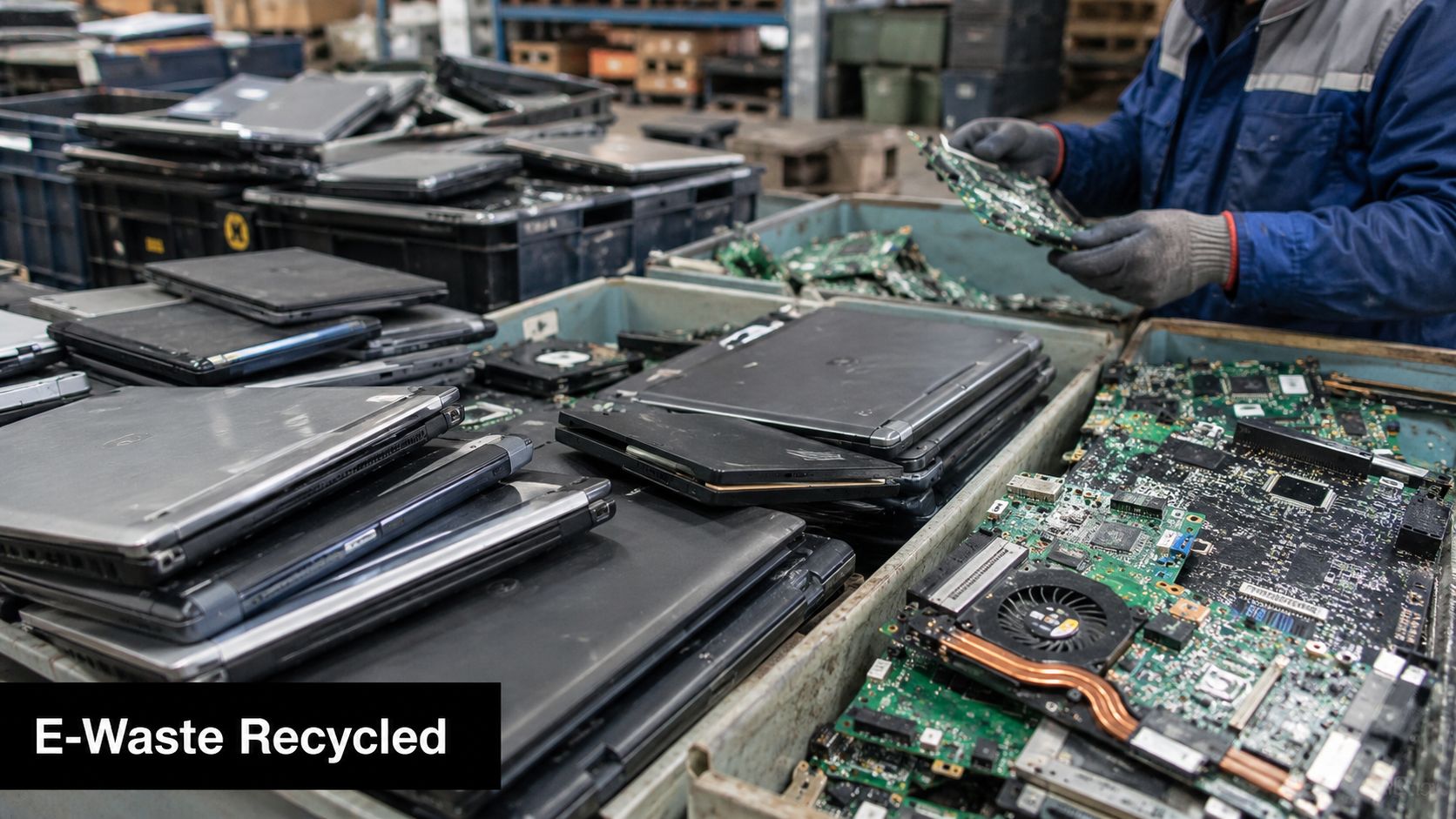
A strong ITAD partner gives you certificates, downstream processing records, and a cleaner story for ESG reporting. That’s useful for boards, customers, procurement reviews, and internal sustainability goals.
Responsible laptop returns should produce documentation you can use in security reviews and sustainability reporting, not just a tracking number.
7-Point Benefits: Outsourced Remote Laptop Returns
| Option | Implementation Complexity 🔄 | Resource Requirements ⚡ | Expected Outcomes 📊⭐ | Ideal Use Cases 💡 |
|---|---|---|---|---|
| Streamlined Logistics and Nationwide Pickup Coordination | Moderate, initial setup, routing/scheduling integration with provider | Low internal effort; relies on provider fleet and tracking portal | 📊 Faster collections; 60–80% less IT coordination; predictable per-device costs | Distributed workforces, mass returns, office closures |
| Certified Data Security and Compliance Risk Transfer | Moderate, contracts, certification verification, process alignment | Low internal resources; requires documentation handoff and periodic audits | 📊 Defensible audit trails; certificates of destruction; reduced regulatory liability | Healthcare, finance, government, education with strict data rules |
| Significant Cost Reduction Through Bulk Asset Recovery and IT Buyback Value | Low–Moderate, device grading and bulk aggregation workflows | Medium, provider valuation; honest condition reporting required | ⭐ Recover 15–40% of purchase price; offset or eliminate disposal costs | Large volumes, scheduled refresh cycles, organizations seeking revenue recovery |
| Elimination of Internal IT Infrastructure and Secure Storage Burdens | Low, redirect reception and storage to provider; coordinate pickups | Low internal infrastructure needs; eliminates warehouse, security, specialized staff | 📊 Avoided facility capex/opex; freed space; lower operational overhead | Companies with storage costs, scaling remote workforces, limited facilities |
| Standardized Processes and Regulatory Compliance Across Distributed Environments | Moderate, define standards, SLAs, and audit cadence with provider | Low ongoing internal effort; requires monitoring and periodic audits | ⭐ Uniform compliance, centralized reporting, fewer violations | Multi-location enterprises, regulated industries, global operations |
| Reduced IT Staff Burden and Freed Capacity for Strategic Initiatives | Low, handoff procedures and role adjustments required | Low ongoing IT involvement; provider handles operational tasks | 📊 Reclaims 60–100+ IT hours/month; enables focus on strategic projects | IT-constrained teams, organizations prioritizing modernization |
| Environmental Stewardship and Sustainability Reporting for Brand and ESG Goals | Low, verify certifications and reporting processes with provider | Low internal effort; provider supplies sustainability metrics and certificates | ⭐ ESG-ready metrics (tons diverted, CO2 avoided); improved brand reputation | Organizations with ESG targets, investor reporting, sustainability programs |
Turn Your Laptop Returns From an Obstacle to an Opportunity
Outsourcing remote employee laptop returns solves more than a shipping problem. It fixes a chain of business risks that most internal teams are carrying without realizing how much exposure has built up. Lost devices create write-offs. Delayed returns slow redeployment. Unwiped systems create security gaps. Inconsistent handling makes audits harder. Staff time disappears into follow-up work that doesn’t strengthen your infrastructure or support growth.
A strong outsourced model replaces that with structure. You get coordinated pickup or return shipping, documented custody, certified data destruction, value recovery options, and responsible recycling through one controlled workflow. That’s why the business case is so strong. You reduce operational friction, tighten compliance, and improve asset recovery at the same time.
The best partners also help you simplify the handoff between HR, IT, operations, and finance. Offboarding becomes cleaner because everyone knows the process. Devices move into a documented return channel instead of sitting in unmanaged limbo. That matters whether you’re managing a few remote departures each quarter or a national workforce with constant turnover.
Beyond Surplus is one relevant option for organizations that need nationwide pickup, certified data destruction, IT asset recovery, and electronics recycling support tied to business compliance requirements. For companies that want one provider to manage logistics, disposition, and documentation, that kind of model is easier to govern than stitching together internal effort and multiple vendors.
If your current process still depends on manual emails, office returns, or improvised shipping instructions, change it now. Remote work isn’t temporary, and laptop retrieval shouldn’t be treated like an exception process anymore. Put a formal return program in place, assign it to a certified ITAD partner, and make every returned device move through one secure, auditable path.
Contact Beyond Surplus for certified electronics recycling, secure IT asset disposal, nationwide laptop return coordination, and data destruction documentation that helps your team reduce risk and recover more value from remote assets.


