You can’t just drag old files to the trash bin when you’re dealing with sensitive company data. Secure data destruction is the only way to guarantee that information stored on old electronics is permanently and irreversibly wiped clean, making it impossible to recover. This isn’t just about deleting files; it involves professional methods like certified data wiping, degaussing, and physical shredding to ensure nothing gets compromised when you retire your IT assets.
Why Security Data Destruction Is a Business Imperative
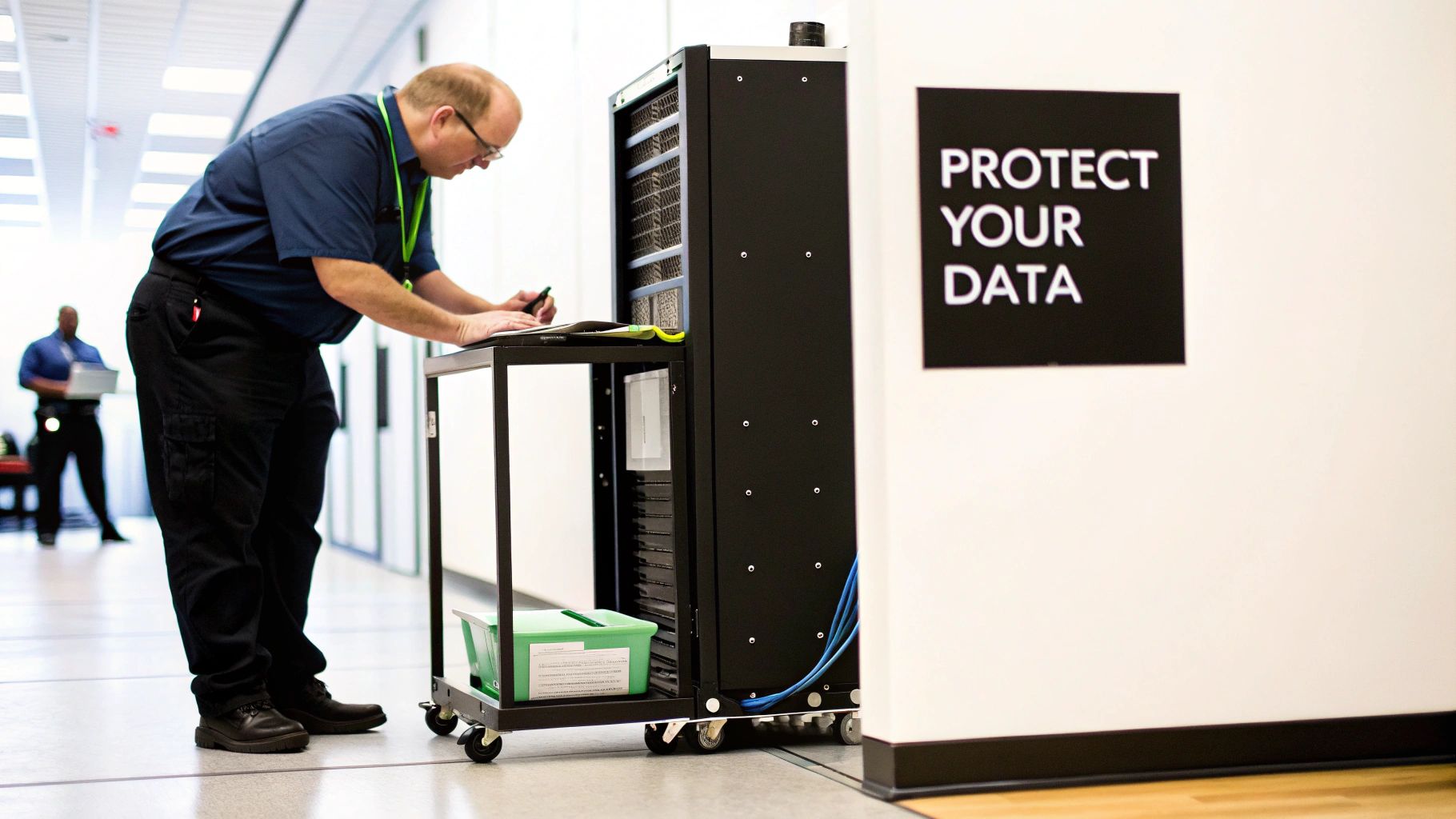
Think of a decommissioned company server or an old employee laptop as an unlocked filing cabinet. Simply deleting files or reformatting the hard drive is like leaving that cabinet on the curb with all the folders still inside. The data might seem gone, but it’s still easily accessible to anyone with basic recovery tools.
In the business world, that’s not just an oversight—it's a massive, unnecessary risk. Professional data destruction closes that loophole for good, turning a potential liability into a secure, compliant final step in your IT hardware’s lifecycle. It's less about disposal and more about smart risk management.
Moving Beyond Simple Deletion
It's absolutely critical to understand the difference between deleting a file and truly destroying it. When you hit "delete," you're only removing the signpost that tells the operating system where to find the data. The actual information remains intact until new data happens to get written over it, leaving a huge window of vulnerability.
True data destruction is a deliberate, methodical process designed to slam that window shut. It guarantees that sensitive information is gone forever, protecting your business from a breach long after the hardware has left your building. For a deeper look, check out our guide on how to protect your company from data breaches with secure data destruction practices.
A solid data destruction strategy delivers key benefits:
- Protection of Intellectual Property: It safeguards your trade secrets, R&D data, and strategic plans stored on retired devices.
- Customer Trust: It proves you’re serious about protecting client information, which goes a long way in building brand loyalty.
- Regulatory Compliance: It helps you meet tough legal standards from regulations like HIPAA, GLBA, and the FTC Disposal Rule, steering clear of hefty fines.
A documented, verifiable destruction process is the only way to formally transfer liability and prove due diligence. It converts a potential data breach waiting to happen into a managed and auditable business procedure.
At the end of the day, folding secure data destruction into your IT asset disposition (ITAD) program isn't optional—it's essential. By working with a certified specialist, you create a defensible and responsible data governance strategy that protects your company’s most valuable asset: its information.
The True Cost of Neglecting Secure Data Disposal
Skipping over secure data disposal isn't just a minor oversight; it's a massive financial and operational gamble. Every single decommissioned laptop, server, or mobile device that leaves your building without certified data destruction is a ticking time bomb.
When that sensitive data gets out, the consequences ripple far beyond a simple IT headache. They hit your company’s bottom line, tarnish its reputation, and land you in serious legal trouble. The fallout is a painful mix of direct financial penalties and equally damaging indirect costs.
The most immediate hit comes from regulatory fines. Governments and industry bodies have put strict rules in place to protect customer and patient data, and they don't mess around with penalties. A single improperly discarded hard drive can be enough to trigger a full-blown audit and lead to fines that are hard to swallow.
Direct Financial Penalties
Several key regulations come with steep price tags for negligence:
- HIPAA (Health Insurance Portability and Accountability Act): For healthcare providers, a breach of patient health information can rack up fines of up to $1.5 million per violation category, per year.
- GLBA (Gramm-Leach-Bliley Act): Financial institutions that fail to protect consumer financial data can face penalties exceeding $1 million.
- GDPR (General Data Protection Regulation): If you handle the data of EU citizens, you could be looking at fines up to €20 million or 4% of your global annual turnover—whichever is higher.
- FTC Disposal Rule: This rule demands that businesses properly dispose of sensitive information from consumer reports. Failing to do so can result in significant civil penalties.
These aren't just empty threats; regulators actively enforce these rules. The direct cost from one single disposal mistake can easily eclipse what it would have cost to implement a compliant, certified data destruction program for your entire fleet of IT assets.
The Larger Indirect Costs
While the fines are scary enough, the indirect costs that stem from a data breach are often far worse. These are the consequences that erode the very foundation of your business and leave a lasting impact that’s hard to measure but impossible to ignore.
Thinking through the potential financial fallout really drives home why secure data destruction is non-negotiable. It's also why understanding what's included in cyber liability coverage is such a critical piece of any solid risk management strategy.
The damage spreads quickly into a few key areas:
- Reputational Damage: News of a data breach travels fast, and it can absolutely tank customer trust and your brand's image. Rebuilding that trust can take years and a whole lot of money spent on PR and marketing.
- Loss of Customer Loyalty: When customers feel their data isn't safe with you, they'll simply take their business somewhere else. That loss of lifetime customer value represents a huge, ongoing hit to your revenue.
- Legal and Remediation Expenses: On top of the regulatory fines, businesses get buried in legal fees from lawsuits, costs for credit monitoring services for victims, and expensive forensic investigations to figure out just how bad the breach was.
The scale of this problem is staggering. Projections show that by 2025, the annual global cost of cybercrime—which includes data theft from insecurely disposed assets—could hit $10.5 trillion. That number alone should tell you just how much risk is packed into every single retired hard drive. At the end of the day, treating secure data destruction as a core security investment is the only smart move.
Choosing the Right Data Destruction Method
Not all approaches to security data destruction are created equal. The best method really boils down to what you plan to do with the old equipment. Are you trying to resell valuable gear, or do you just need to make sure the top-secret data on a dead hard drive is gone forever?
Understanding the differences between the main techniques is the key to making a smart, cost-effective, and secure decision. You've got three primary options: software-based wiping (also called data sanitization), degaussing, and good old-fashioned physical shredding. Each one strikes a different balance between asset reusability, security, and cost.
This decision tree gives you a simple visual. When you're dealing with an old IT asset, there are really only two paths you can take.
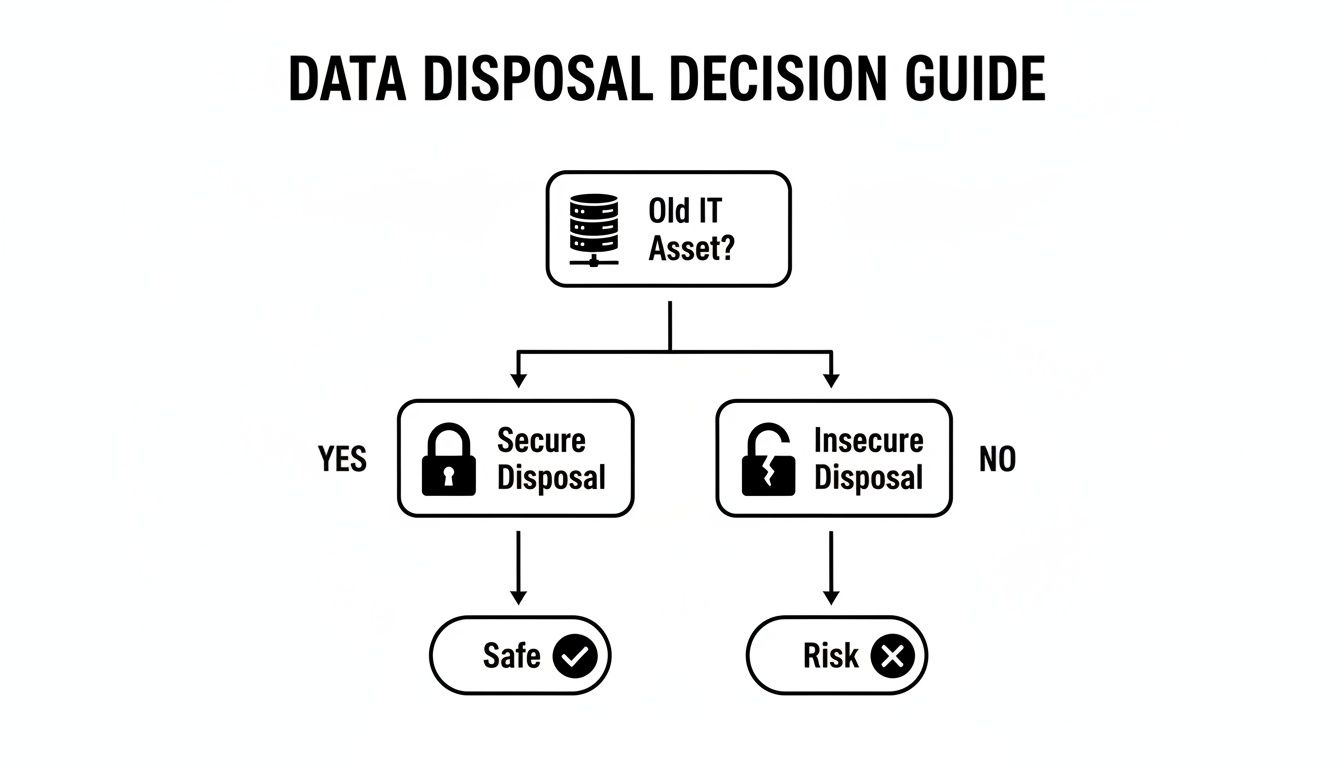
As you can see, one path leads to safety and compliance. The other leads straight to unnecessary risk.
Data Sanitization for Asset Reuse
Data sanitization, or wiping, uses special software to methodically overwrite every single part of a hard drive or solid-state drive (SSD) with random characters. Think of it like scribbling over something on a whiteboard so completely that the original text is impossible to see. This is done to exacting standards, like the NIST 800-88 Guidelines for Media Sanitization.
The biggest win here is that the hardware is preserved. Once the data is verifiably wiped clean, the device is physically intact and can be safely resold, redeployed in your company, or donated. This makes it the perfect choice for:
- Maximizing Value Recovery: Ideal for remarketing newer laptops, servers, and other IT equipment that still have plenty of life and value in them.
- Supporting Sustainability Goals: It promotes a circular economy by keeping functional electronics in use instead of destroying them prematurely.
- Internal Redeployment: Lets you securely repurpose hardware for different departments or new hires.
When you work with a certified vendor, you get a detailed report and a Certificate of Sanitization. This gives you auditable proof that the data was completely destroyed. For any business trying to manage its hardware lifecycle, learning how to erase a computer hard drive the right way is a crucial first step.
Degaussing for Magnetic Media
Degaussing is a powerful and instant solution, but it only works on magnetic storage like traditional hard disk drives (HDDs) and old-school magnetic tapes. A degausser blasts the drive with an incredibly strong magnetic field, completely scrambling the magnetic bits on the drive's platters where your data lives.
It's like holding a giant magnet next to a compass—the needle goes haywire and never points north again. The data is gone forever in seconds. The downside? This process also fries the drive's firmware, rendering the hardware completely useless. Degaussing is the go-to when you need speed and certainty for magnetic media and don't care about reusing the drive.
Physical Shredding for Ultimate Security
When data is so sensitive that you can't accept any level of risk, or when a drive is just plain broken, physical shredding is the final answer. This industrial process uses powerful machinery to grind hard drives, SSDs, smartphones, and other devices into tiny, confetti-like pieces.
Physical destruction offers the highest level of security assurance. Once a drive is reduced to small, mixed pieces of metal and plastic, data recovery is physically and technologically impossible.
Shredding is the last word in data destruction. It's the required method for:
- Top-Secret or Classified Data: Government agencies and defense contractors often mandate it.
- Damaged or Obsolete Drives: If you can't even power a drive on to wipe it, shredding is your only secure option.
- Solid-State Drives (SSDs): Because of how SSDs store data, shredding is often considered the most reliable way to ensure total destruction.
After the shredding is done, a certified ITAD partner like Beyond Surplus issues a Certificate of Destruction. This document confirms which serialized assets were destroyed, giving you an unbroken chain of custody and a clear audit trail for any compliance needs.
The Hidden Value in Data Sanitization Over Destruction
The first instinct when dealing with old IT hardware is often to destroy it. After all, when you're worried about data security, shredding a hard drive seems like the most surefire way to protect sensitive information. But this "shred everything" approach is a costly mistake that leaves a lot of value on the table and creates unnecessary e-waste.
A smarter strategy for IT asset disposition (ITAD) recognizes that not every device needs to be ground into scrap metal. For hardware that's still functional and modern, certified data sanitization is an equally secure—and far more valuable—alternative. This simple shift in thinking can turn a disposal cost into a real financial return.
Unlocking Asset Value Securely
Data sanitization isn't just deleting files or formatting a drive. It’s a process where specialized software overwrites every single bit of data on a storage device, making the original information completely unrecoverable. This method is backed by rigorous government standards like NIST 800-88, ensuring total data security.
By choosing to sanitize instead of shred, you keep the physical hardware intact. A perfectly good server, laptop, or storage array can be securely wiped and given a new life, which creates value in several ways:
- Remarketing: The asset can be sold on the secondary market, allowing you to recoup some of its original cost.
- Redeployment: The device can be safely repurposed for another department or given to new employees.
- Donation: Securely wiped equipment can be donated to schools or nonprofits, helping you meet your corporate social responsibility goals.
This moves IT asset disposal from being a pure cost center to a function that actually recovers value for your company. To get a deeper look at this process, check out our guide on what data sanitization is and how it works.
Avoiding Unnecessary Destruction
Blindly shredding every retired asset isn't just bad for your budget; it's also environmentally unsustainable. So many devices sent to the shredder are still perfectly functional and hold significant value. This practice contributes directly to the growing e-waste problem and represents a huge missed opportunity.
This isn't just an observation—it's a documented problem. Industry research has shown that up to 50% of end-of-life devices were being destroyed unnecessarily. Even more shocking, as many as 47% of those assets were still fully operational when they were destroyed. Moving from a blanket destruction policy to one that prioritizes certified sanitization can slash lifecycle costs and reduce your environmental footprint without ever compromising on security.
A modern ITAD model balances uncompromising security with financial return and corporate sustainability. Certified data erasure provides the auditable proof needed to confidently remarket assets, knowing your data is irretrievably gone.
Opting for sanitization where appropriate isn't a security compromise—it's just a smarter business decision. The key is working with a certified partner who provides auditable proof that every single device has been wiped clean according to the highest industry standards. With a formal Certificate of Sanitization, you get the documentation needed to prove compliance and protect your organization, all while recovering value from assets that would have otherwise ended up as scrap.
How to Build a Compliant Data Destruction Program

A reliable data destruction process doesn’t just happen. It’s the direct result of a well-thought-out, documented program. Building a compliant framework is non-negotiable for any organization handling sensitive information. It shifts data destruction from an operational afterthought to a cornerstone of your risk management strategy, making sure every retired asset is handled by the book.
The very first step is to create a formal Data Disposal Policy. This isn't just some document for the IT department; it's a company-wide policy that spells out exactly how and when data-carrying devices are retired. Think of it as the foundation of your entire program, giving you the authority and direction needed to get things done consistently.
Key Components of a Data Disposal Policy
A solid policy needs to be clear, concise, and something you can actually enforce. It must define the scope of the program, assign clear responsibilities, and outline the approved procedures for every piece of end-of-life media. Without this guiding document, your efforts will be all over the place and nearly impossible to defend during an audit.
Your policy has to cover a few critical areas:
- Asset Identification: Be specific about what’s covered. This includes everything from servers and laptops to mobile phones, networking gear, and even loose hard drives.
- Data Classification: Create rules that connect the sensitivity of the data to the destruction method. For example, you might require NIST 800-88 sanitization for gear you plan to reuse but mandate physical shredding for anything with top-secret data.
- Chain of Custody Requirements: Lay out the documentation process for tracking every asset from the moment it’s taken offline until its final destruction.
- Approved Destruction Methods: Specify the exact techniques your company approves, and tie them back to industry standards like those from NIST or the DoD.
- Vendor Management: Detail the criteria for choosing and auditing third-party ITAD partners, including non-negotiable certifications like NAID AAA.
When you're building out your program, it's smart to look at environments with the most stringent requirements, like those providing data center services. The level of rigor they apply to data security and disposal is an excellent benchmark for any corporate policy.
Establishing an Unbroken Chain of Custody
The concept of a chain of custody is the absolute backbone of any data destruction program you can actually defend. It’s the chronological paper trail that documents the control, transfer, and final outcome of every single asset. An unbroken chain of custody is your proof that your assets were secure every step of the way, from your office to the point of destruction.
This all comes down to meticulous record-keeping. Every asset's serial number should be logged and tracked, with documented handoffs between your team and your certified ITAD vendor. This process creates an auditable record that is priceless for proving you’re compliant with regulations like HIPAA or the FTC Disposal Rule.
The Role of Certification and Documentation
The final—and arguably most critical—piece of the puzzle is the documentation you get back from your vendor. This is your proof of compliance. The stakes are incredibly high; one major European cyber-threat report found that a staggering 68.6% of recorded intrusions led to data breaches that were later leaked online. This is exactly why regulators demand proof that you’ve securely disposed of your data.
A Certificate of Destruction is more than just a receipt. It's a legal document that formally transfers liability for the data from your organization to your destruction vendor. It serves as your official proof of due diligence in the event of an audit or investigation.
This certificate is non-negotiable. It has to detail the specific assets destroyed (including serial numbers), the method used, the date it happened, and an authorized signature from the vendor. Understanding what needs to be on this document is vital, which is why it's a good idea to familiarize yourself with the proper destruction certificate format. Without this verifiable proof, your program simply doesn't have the legal standing to protect your business.
Frequently Asked Questions About Data Destruction
Even with a solid plan in place, a few practical questions always pop up when it's time to roll out a security data destruction program. Here are some straightforward answers to the things IT managers and business leaders ask us most often.
Is Deleting Files or Formatting a Hard Drive Secure Enough?
In a word: no. It’s a common misconception, but neither of these actions actually secures your data. When you "delete" a file, you're really just telling the operating system to forget where it is. The data itself is still sitting on the drive, ready to be recovered with basic, widely available software.
Formatting a hard drive is a step up, but it suffers from the same core problem. It essentially wipes the slate clean by rebuilding the file system, but often leaves all the old data lurking underneath. For real security, you need to either use specialized software that overwrites every inch of the drive according to standards like NIST 800-88, or go the physical route with degaussing or shredding to make sure the data is gone for good.
What Is a Certificate of Destruction and Why Is It Important?
Think of a Certificate of Destruction (CoD) as an official receipt for your data security efforts. It's a formal audit document that proves your IT assets were destroyed properly and in line with all the relevant rules. This piece of paper is absolutely essential for passing audits under laws like HIPAA, GLBA, and GDPR, and for satisfying your own internal governance policies.
A legitimate CoD will always include a few key details:
- The exact date the destruction took place.
- The specific method used (like shredding or degaussing).
- A serialized inventory of every asset that was destroyed.
- The official signature of the certified vendor who did the work.
This document is your proof of due diligence. It officially transfers the liability for the data from your company to your destruction partner, giving you a legal paper trail that shows you handled everything responsibly.
For a deeper dive into the basics, check out our guide on keeping your information secure with proper data destruction.
What Is the Difference Between On-Site and Off-Site Destruction?
The main difference is simply where the destruction happens, which affects both security and logistics. On-site destruction is exactly what it sounds like—a vendor brings their equipment, like a mobile industrial shredder truck, right to your facility. You get to watch the whole process, which offers maximum transparency and keeps the chain of custody right under your nose.
With off-site destruction, your assets are securely transported from your location to a specialized, high-security facility for destruction. A certified vendor will use locked trucks and GPS tracking to keep everything secure, but it does add a transit step. On-site is often the top choice for highly sensitive data, while off-site can be a more efficient and budget-friendly option for larger batches of less critical assets.
How Do I Choose a Reputable Data Destruction Vendor?
Picking the right partner is probably the single most important decision you'll make in your data destruction program. The absolute first thing to look for is third-party certifications. NAID AAA Certification is the gold standard in our industry, period. It’s a guarantee that the vendor meets the toughest requirements for security, employee screening, operational procedures, and the destruction process itself.
Beyond that key certification, any vendor worth their salt will:
- Provide a crystal-clear, unbroken chain of custody for every asset.
- Give you detailed, serialized reports for your records.
- Issue a formal Certificate of Destruction when the job is done.
Don’t be afraid to ask about their liability insurance and make sure they’re completely transparent about their methods. A true partner won't just take your stuff and destroy it; they'll consult with you to figure out the best strategy based on your company's specific compliance needs, risk tolerance, and goals.
When your business needs absolute proof that your data is gone for good, you need a certified expert. Beyond Surplus offers NAID AAA Certified on-site and off-site data destruction services, ensuring your sensitive information is handled securely and in full compliance with all industry regulations. Contact us today for a free consultation.