

You're probably dealing with the same mess Atlanta IT teams always inherit. A lease is ending, a refresh is underway, or finance wants a floor cleared before movers show up, and the room fills with laptops, docks, switches, phones, old monitors, and storage media that can't just be tossed in a bin. That pile isn't a trash problem. It's a data problem, a liability problem, and a logistics problem wrapped together.
For Atlanta businesses, electronics recycling has to mean more than finding a drop-off location. The city's residential recycling ecosystem is fragmented, the rules for covered devices are narrow, and business assets need serialized pickup, documented processing, and proof that liability changed hands. If you want a defensible outcome, you need an ITAD workflow, not a recycling errand.
Table of Contents
- Why Atlanta Businesses Need a Different Recycling Playbook
- Georgia and Atlanta Rules That Shape Your Disposal Plan
- Secure Data Destruction Methods That Actually Transfer Liability
- Atlanta Drop-Off, Mail-In, and Pickup Options Side by Side
- The Enterprise ITAD Workflow From Pickup to Certificate
- Value Recovery, Sustainability, and Compliance as One Business Case
- Choosing an Atlanta ITAD Partner With a Verifiable Checklist
- Frequently Asked Questions From Atlanta IT and Facilities Teams
Why Atlanta Businesses Need a Different Recycling Playbook
A Midtown office closes on Friday. By Monday, the IT director has a stack of decommissioned laptops, a half-rack of networking gear, and a procurement manager asking where the old equipment is going. The wrong answer is, “We'll drop it off somewhere.” That might work for a single household printer, but it doesn't solve serialized assets, storage media, or the need to document who handled what.
Atlanta's local recycling system makes the point clearly. In 2023, the city's municipal recycling program collected nearly 20,000 tons of recyclables, but more than 20% was contaminated because people put the wrong materials in the stream, which tells you curbside systems are built for mixed residential materials, not regulated business equipment (Green Atlanta recycling guidance). The lesson is simple. Mixed-stream public recycling is the wrong channel for retired servers, healthcare devices, finance records, or anything with a hard drive attached.
What a real business disposal plan has to solve
A business ITAD plan has to do three things at once. It has to protect data, preserve value where equipment can be remarketed, and create records that stand up in an audit. That means controlled pickup, chain-of-custody documentation, and a certificate trail, not a vague promise that “the recycler will take care of it.”
Practical rule: if you can't match each asset to a pickup record and a downstream outcome, you don't have a disposal program. You have an exposure.
The global context makes this more urgent. The world generated about 62 million tons of e-waste in 2022, yet only 22.3% was formally collected and recycled, with the UN's Global E-waste Monitor also reporting a lower 17.4% recycling rate for 2019 (Scientific Equipment Disposal). Atlanta businesses are part of that materials problem whether they like it or not. Good ITAD practice is how you keep your assets out of informal channels and your records clean for audit.
Georgia and Atlanta Rules That Shape Your Disposal Plan
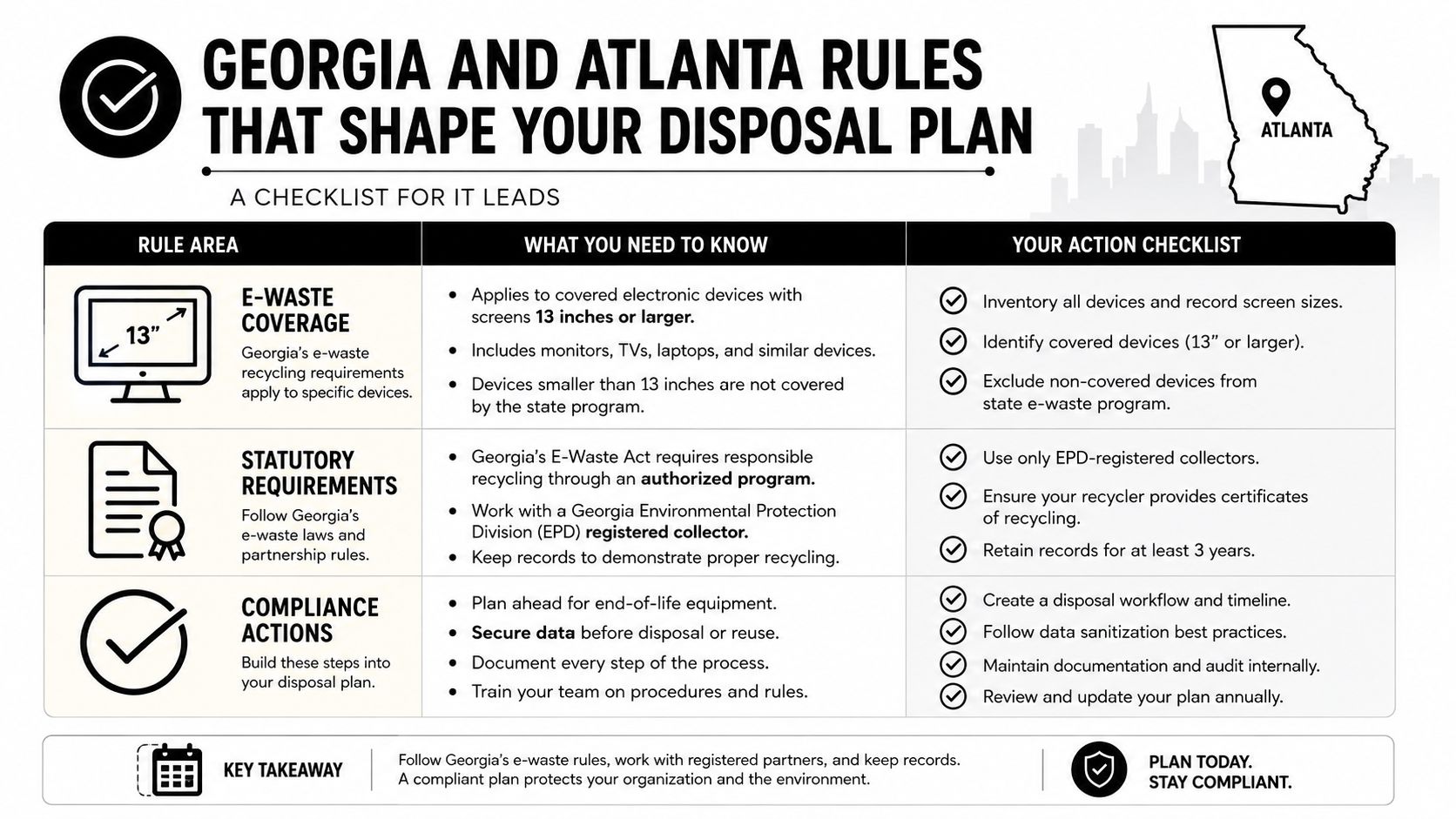
Georgia's electronics law is narrower than many business owners assume. The covered category centers on computers, monitors, and televisions with screens 7 inches or larger. Printers, scanners, and mobile phones are not currently covered under that state e-waste law, as outlined in this review of electronics recycling laws in Georgia and ITAD compliance and the broader Beyond Surplus on Georgia e-waste law. That matters because you cannot treat every office device the same way and assume the legal box is checked.
Atlanta's local disposal rules are stricter. Guidance tied to the city's solid-waste rules says it is illegal to dispose of electronic equipment in a landfill, and local summaries note fines of up to $25,000 for improper disposal (Green Atlanta landfill guidance). Facilities teams need to treat that as an operational control issue, not a recycling tip. Your trash path and your electronics path need to be separate, documented, and intentional.
The Records That Matter
The law alone does not protect you. The paperwork does. Keep a serialized asset list, pickup manifests, downstream processor certifications, and certificates of destruction that show the equipment left your control and went to an approved path. If a device was wiped, the report should show the media type, the method used, and the serial number. If it was shredded, the certificate should tie that destruction back to the asset record.
Operational rule: a landfill prohibition only helps if you can prove you did not use the landfill.
For a procurement team, that changes the buying decision. You are not just buying removal service. You are buying documented diversion. The vendor should be able to tell you exactly which devices fall under the state rule, which ones do not, and how they will document the full load so a later audit does not turn into a reconstruction project.
Secure Data Destruction Methods That Actually Transfer Liability
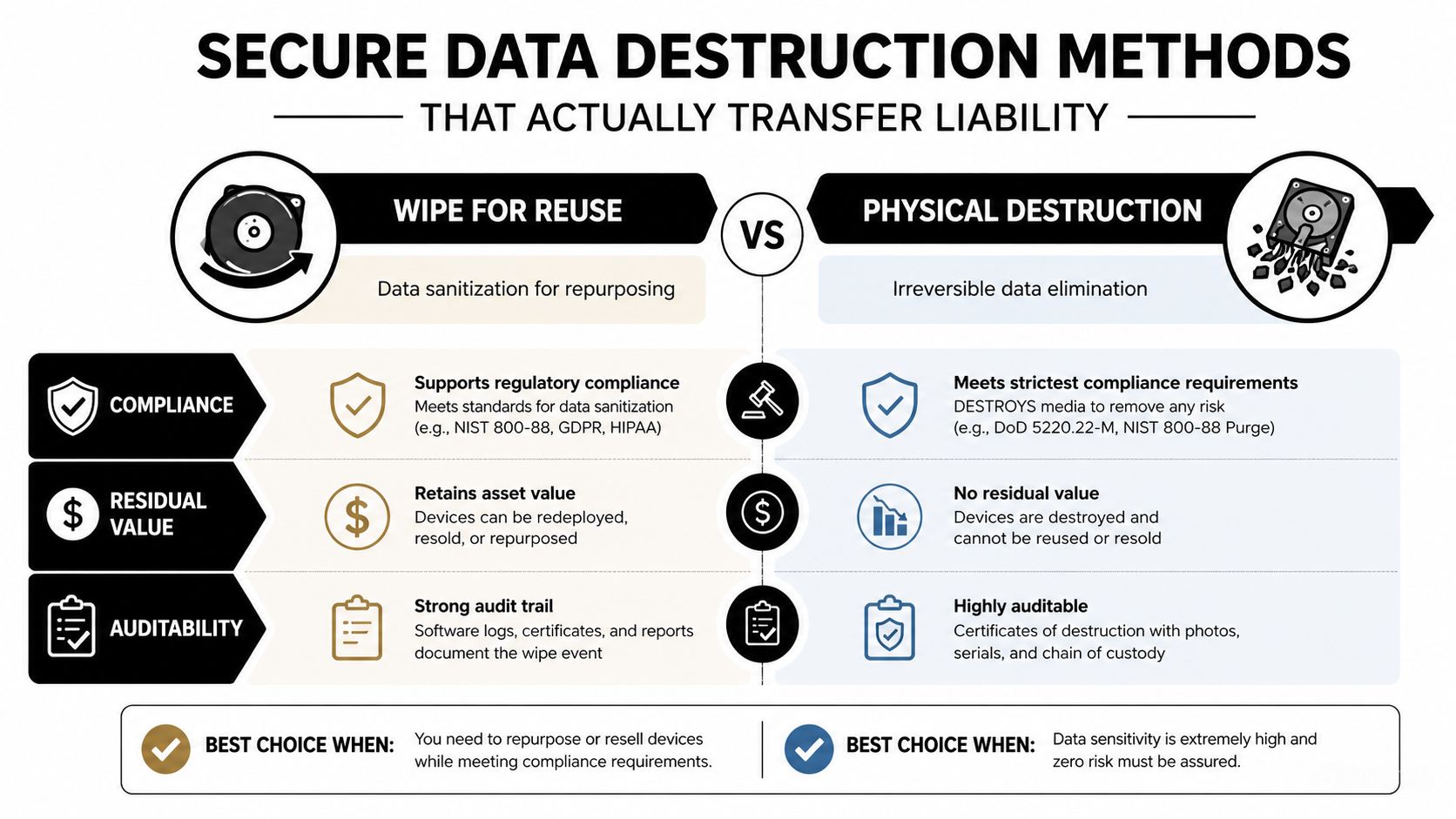
A retired laptop is not just a piece of hardware. It's a storage decision. If the drive is going back into the resale channel, NIST 800-88 software erasure is the right tool. If the device is leaving the reuse stream forever, you want physical destruction, and the method should match the media. That's where a lot of Atlanta teams get lazy, and that's where liability lingers.
Match the method to the media
Hard drives, SSDs, and magnetic tapes do not need the same treatment. Industrial shredding and hydraulic crushing are used when the goal is irreversible destruction. Degaussing is used for magnetic tape. SSD shredding is the safer choice for solid-state media when overwrite can't give you enough confidence. The point isn't to be dramatic. It's to choose a method that makes the data unrecoverable or auditable depending on the asset's fate.
For a healthcare provider, the bar is high because patient information can't be treated casually. For a financial firm, the same is true under disposal obligations tied to consumer information. The process has to produce evidence, not just confidence. That's why the documentation matters as much as the machine.
The documents that close the liability loop
A defensible engagement should produce per-drive erasure reports when wiping is used, weight tickets when material is shredded, and a certificate of destruction that names the serial numbers and the standard applied. If the vendor can't tell you which method was used for which media type, they're not transferring liability. They're leaving you with a story.
For teams comparing workflows across markets, a useful reference point is a guide to secure data wiping for Edmonton, because it highlights the same core issue Atlanta buyers face, wipe only when reuse is intended, destroy when the media can't safely re-enter circulation.
A hard drive destruction record should be specific enough that an auditor doesn't need to guess. Beyond Surplus publishes an HDD destruction certificate format that shows the kind of detail buyers should expect. If a recycler won't commit to that level of proof, keep looking.
Atlanta Drop-Off, Mail-In, and Pickup Options Side by Side
An Atlanta office with a stack of laptops, a few servers, and a deadline has to sort disposal by access, not by convenience alone. A public recycling point may accept the hardware, but that does not make it a business disposal plan. The channel has to match the asset type, the timing, and the paperwork your IT team needs.
A Look at Local Options
PCs for People in Lithia Springs takes dock-door drop-offs only on weekdays from 10 a.m. to 4 p.m. CHaRM Atlanta operates only on Tuesdays, Thursdays, and Saturdays by appointment. Keep North Fulton Beautiful offers free electronics recycling only at the Sandy Springs Recycling Center for any individual, while other users are routed elsewhere (Atlanta access guide). If you are dropping off one laptop, those limits are manageable. If you are clearing an office, they become a scheduling problem.
For smaller loads and select devices, mail-in recycling can fit, but only in a narrow set of cases. It works best when the item count stays low and the device class is accepted without special handling. Once you add mixed hardware, data-bearing media, or a need for proof of transfer, mail-in stops looking like a full solution.
| Channel | Typical Eligibility | Access Constraint |
|---|---|---|
| Dock-door drop-off | Single items or small loads | Weekday hours only |
| Appointment-based nonprofit site | Limited accepted categories | Fixed appointment days |
| Individual recycling center | Household-scale access | Location-specific rules |
| Commercial pickup | Business loads and mixed IT assets | Minimum volume and site logistics |
That is why businesses should compare public access sites with electronics drop-off locations at Beyond Surplus before they assume a retail-style drop-off will cover an office refresh. The difference is simple. Drop-off gets material off your dock, but it does not automatically solve chain-of-custody, asset reconciliation, or data handling.
Where commercial pickup becomes the sensible choice
One Atlanta recycler states that free pickup is realistic for 10 to 20 major items such as PCs, laptops, or servers, or for a full pallet. The pickup has to be at a commercial address in the Atlanta metro area, and the equipment needs to be consolidated in one ground-floor location like a loading dock or storage room (Atlanta Computer Recycling pickup guide). That is the logistics threshold procurement teams need before they schedule a refresh. If your assets are spread across floors, buildings, or business units, the pickup stops being free in practical terms because staging work starts to dominate.
For smaller-business operations, find logistics advice for SMBs if you want a reminder that route constraints and staging matter just as much in disposal as they do in delivery. In Atlanta, the recycler's truck schedule belongs in your project plan, because missed staging windows turn a simple pickup into another week of idle hardware.
The Enterprise ITAD Workflow From Pickup to Certificate
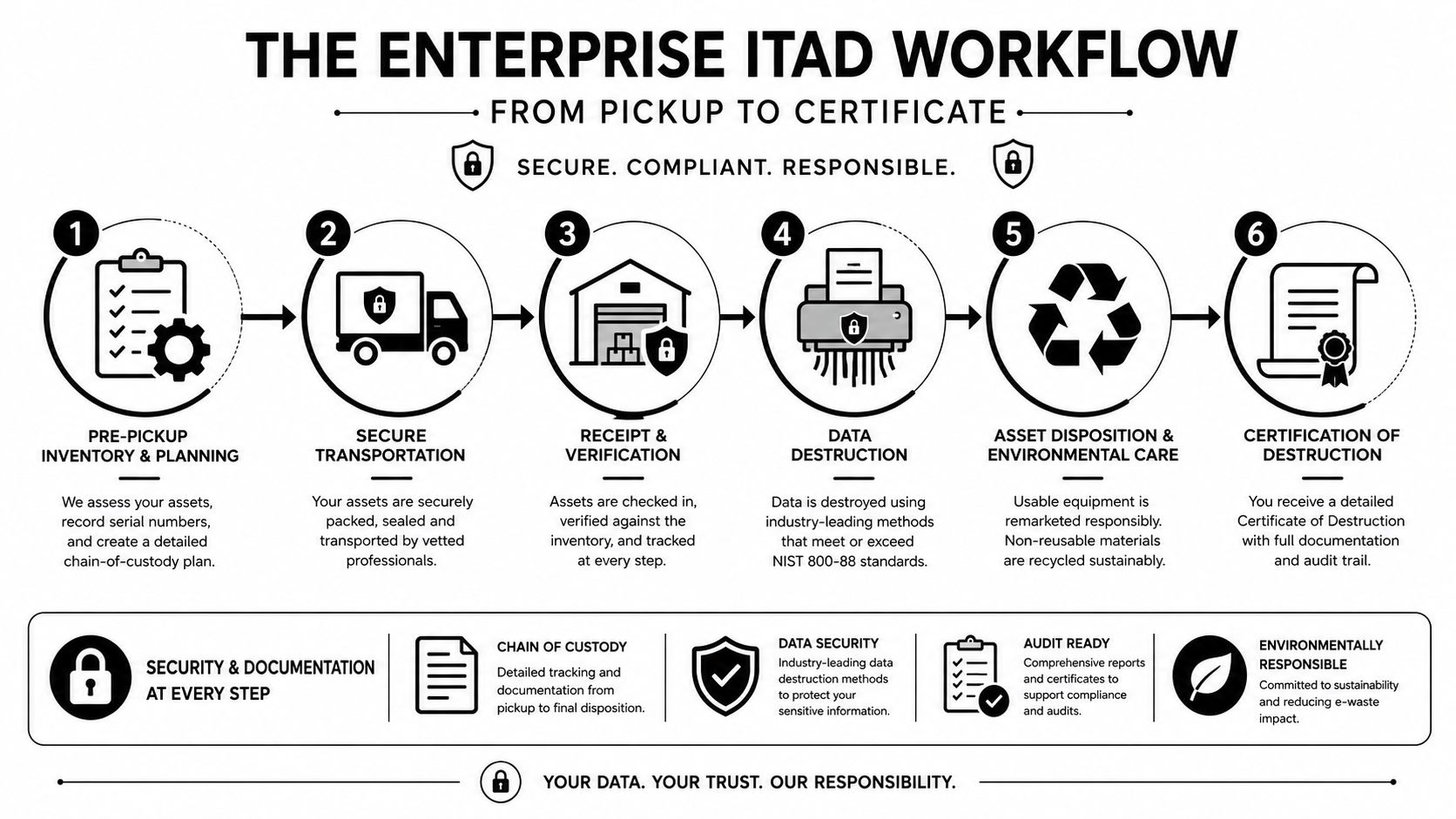
A credible ITAD process starts before the truck arrives. Someone on your side should tag assets, reconcile serial numbers, and separate devices by media type. If that inventory step gets skipped, every later document weakens because the handoff cannot be tied back to a clean asset list.
The checkpoints that should happen in order
The workflow should move in a fixed sequence, pre-pickup inventory, secure vehicle pickup, chain-of-custody signoff at the dock, transport to a certified facility, method selection by media type, destruction or wiping, and final certificates of recycling and data destruction. A 150-laptop enterprise refresh follows the same logic as a small office closure, only with more serial numbers and more pressure to keep the paperwork clean.
A good vendor should answer these questions without hesitation:
- Who signed for the assets?
- Which serial numbers were scanned at pickup?
- What method was applied to each media type?
- Which standard governed the wipe or destruction?
- When did the certificate get issued?
If the answer to any of those is “we'll see after processing,” the process is too loose for enterprise work.
For decommissioned server rooms and colo exits, a strong partner should also handle structured de-installation and transport. If you need that level of support, review data center ITAD services. The same logic applies whether the destination is a few pallets of laptops or a full room of infrastructure. You need a partner that can describe each handoff, not just the truck.
Value Recovery, Sustainability, and Compliance as One Business Case
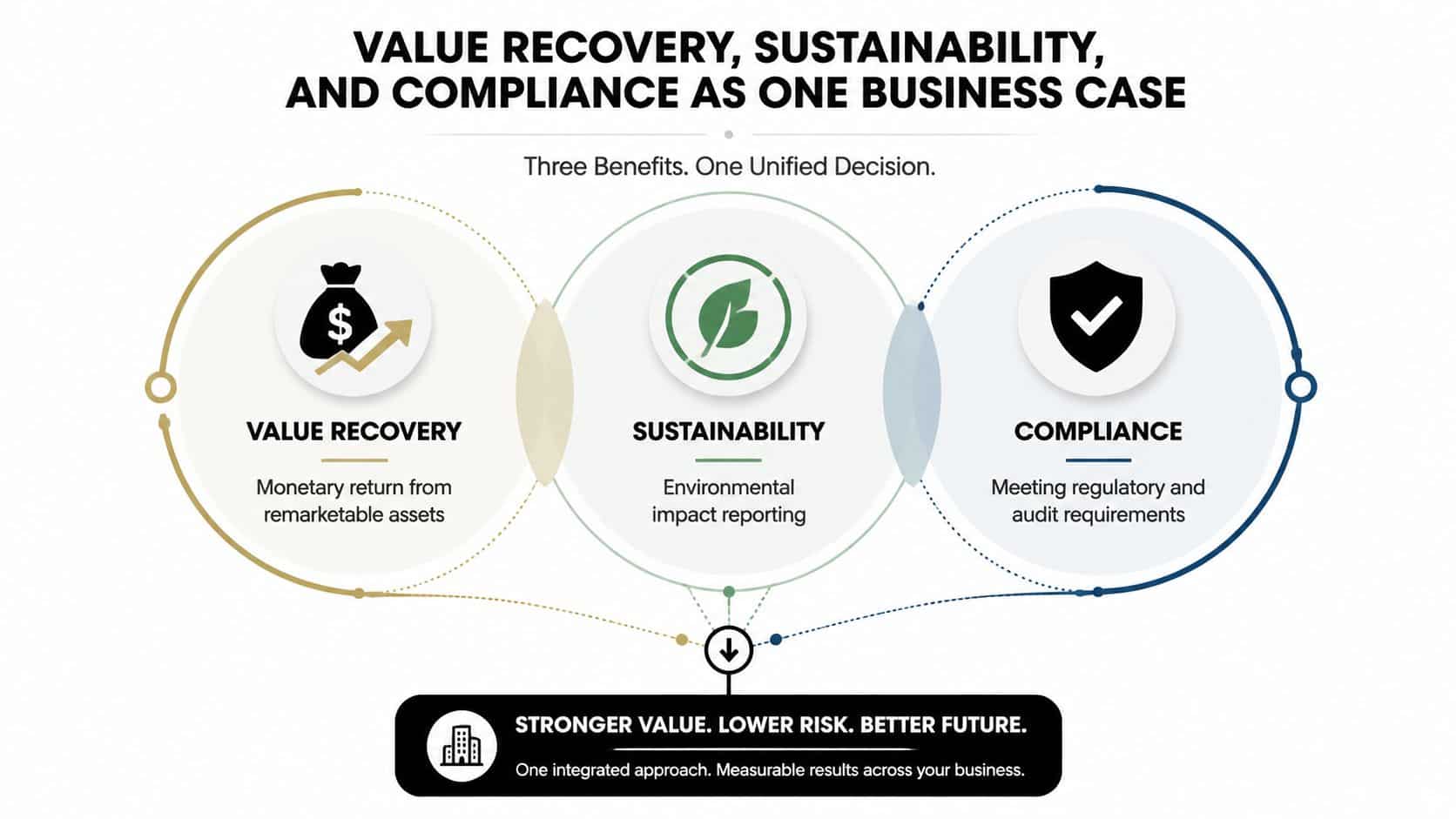
Atlanta IT teams should stop treating resale, recycling, and compliance as separate workstreams. They all start with the same asset pool, and the first decision is economic, not philosophical. If a laptop has resale value, that credit should offset disposal cost. If it does not, the asset still needs documented downstream processing. Either way, you need proof that shows where the hardware went and who handled it.
One load, three outcomes
A shipment of newer laptops, servers, and network gear can produce buyback value if the equipment still has market demand and the media path is clean. Older, damaged, or nonworking assets usually move into material recovery, where the recycler documents the load by weight and disposition. Mixed loads can do both at once, which is why a vendor needs to separate sellable assets from scrap instead of treating everything as one anonymous pickup.
That distinction matters inside the business. Finance needs the credit tied to specific assets. Sustainability teams need diversion records they can defend. Legal needs a file that shows the equipment did not vanish into an informal channel. If the vendor cannot separate value recovery from recycling on paper, the numbers in the final report are too soft to trust.
The broader market reality still points in the same direction. The world generated about 62 million tonnes of e-waste in 2022, but only 22.3% was formally collected and recycled. That gap is why certified downstream processing matters. Any ESG statement about responsible recycling needs a paper trail behind it, not a vague promise.
Why the same records serve finance, legal, and ESG
The same chain-of-custody file that supports an FTC Disposal Rule review also supports sustainability reporting. Legal wants proof of diversion. Finance wants clean disposition accounting. ESG wants evidence that the assets did not disappear into an informal channel. One document set should satisfy all three, and it should do so without hand-waving from the vendor.
A serious Atlanta ITAD partner returns value where it exists, tracks the rest, and issues certificates that let every stakeholder sign off without guessing. That is the business case. Cleaner records, lower exposure, and a better end-of-life outcome for the hardware you already paid for.
Choosing an Atlanta ITAD Partner With a Verifiable Checklist
If you're scoring vendors in an RFP, skip the marketing language and ask for proof. A recycler that can't document the process isn't a serious option for enterprise work. Use a checklist, not a sales call.
Procurement criteria that matter
- Serialized asset reporting. Every pickup should tie to a list of individual assets, not a generic load receipt.
- Method by media type. Drives intended for reuse should get NIST 800-88 erasure. Assets leaving reuse should be physically destroyed.
- Certificates with detail. Ask for certificates of recycling and data destruction that name the standard, date, and media or asset identifiers.
- Downstream certifications. If the recycler outsources, you need to know who handles the material after pickup.
- Secure transport. Closed vehicles and controlled handoffs are basic, not optional.
- Transparent pricing. Disposal fees and buyback credits should be clearly separated.
- Logistics fit. Confirm minimum item counts, ground-floor staging, and commercial address eligibility before scheduling.
- ESG reporting support. If your company reports diversion or recycling metrics, the vendor should be able to produce usable records.
Beyond Surplus also publishes a vendor due diligence checklist, which is the right kind of reference point if you want your procurement team to pressure-test a recycler before a pickup ever gets scheduled.
A good vendor will also agree to a pilot project, give you a clear SLA for certificate turnaround, and name a real contact for chain-of-custody questions. If they dodge those details, they're not ready for regulated assets.
Frequently Asked Questions From Atlanta IT and Facilities Teams
A factory reset is not the same as certified wiping. Deletion removes access for a user, not necessarily for recovery tools, and it doesn't create a defensible audit record. If the device is staying in the reuse stream, use a proper erase process and keep the report.
Shredding is required when the device or media can't safely return to reuse, or when your risk tolerance says physical destruction is the safer call. That's common with sensitive records, broken drives, and media that won't reliably sanitize. The key is not whether shredding sounds secure. It's whether the method matches the media and the business risk.
A certificate of destruction should contain the serial numbers, the method, the standard, the date, and the processor signature. If it doesn't, it's weak evidence. If it's missing serial-level detail, it won't help much during an audit.
Municipal drop-off events are fine for a household-grade object, but they're not a business disposal plan for regulated devices. Atlanta teams handling mixed loads should separate covered devices under Georgia law from uncovered items like printers and phones, then route them through the right channel instead of assuming every device belongs in the same stream.
Keep certificates long enough to satisfy your internal audit and retention requirements. Don't treat them like shipping receipts. They're liability-transfer records.
Beyond Surplus handles scheduled pickup, certified data destruction, certificates of recycling and destruction, and IT buyback for Atlanta businesses that need the process documented from start to finish. If you're planning a refresh, office closure, or data center decommissioning, visit Beyond Surplus and set up a disposal path that protects your records as well as your equipment.


