

Georgia has no statewide electronics take-back mandate, and 25 states plus the District of Columbia have electronics recycling laws. For Atlanta businesses, that means e-waste compliance is driven mainly by federal hazardous-waste handling and data-security controls, so a certified vendor and a documented process matter more than a simple local drop-off decision.
Most IT managers in Atlanta run into the same problem the same way. A storage room fills up with retired laptops, a rack of old servers sits untouched after a refresh, and someone asks whether Facilities can just have it hauled away. That's where risk starts.
For a business, electronic waste isn't just a recycling issue. It's a data destruction, chain-of-custody, and environmental handling issue. The global pressure behind this is real. The Global E-waste Monitor 2024 figures summarized here estimate 62 million metric tonnes of e-waste were generated in 2022, with only 22.3% formally collected and recycled, and project 82 million tonnes by 2030. Buyers, auditors, and internal security teams increasingly expect proof that retired electronics were handled correctly.
Navigating Your Business E-Waste Obligations in Atlanta
An Atlanta office cleanout usually includes more than desktop PCs. It often includes docking stations, phones, network gear, drives, UPS equipment, and a few unknown items that have been sitting in a closet since the last office move. Treating that pile as “junk removal” is the wrong approach.
The practical issue in Atlanta is that companies don't have one simple Georgia e-waste statute telling them exactly what to do with every device. Instead, businesses need a process that ties together environmental controls, defensible data destruction, and documentation that stands up in an audit or incident review.
What the obligation really looks like
For most organizations, compliance comes down to a few questions:
- What exactly are you disposing of? Asset type changes the handling rules, especially when batteries or data-bearing devices are involved.
- What data sits on it? A laptop with cached credentials and a server full of client records don't carry the same risk profile.
- Who touched it and when? If you can't show custody from pickup through final processing, you have a gap.
- What proof do you keep? Inventory records and destruction paperwork often matter more than verbal assurances.
Practical rule: If your disposal process can't reconcile each serialized device from internal release to final destruction or recycling, the process isn't defensible.
Why this now sits with risk management
IT asset disposition used to be treated as back-end operations. That no longer works. Security teams care because of breach exposure. Procurement cares because contracts increasingly require responsible downstream handling. Finance cares because write-offs and remarketing need records. Legal cares because weak disposal controls are hard to defend after an incident.
That's why a solid Atlanta e-waste compliance program looks less like recycling and more like controlled asset retirement.
The E-Waste Legal Landscape for Atlanta Businesses
The legal environment is a patchwork. There is no comprehensive federal e-waste recycling law in the United States, and 25 states and the District of Columbia have enacted electronics-recycling legislation. Georgia is unusual because it does not impose a statewide electronics take-back mandate for businesses, so Atlanta companies usually build compliance around federal hazardous-waste and data-protection requirements instead of a dedicated state recycling framework.
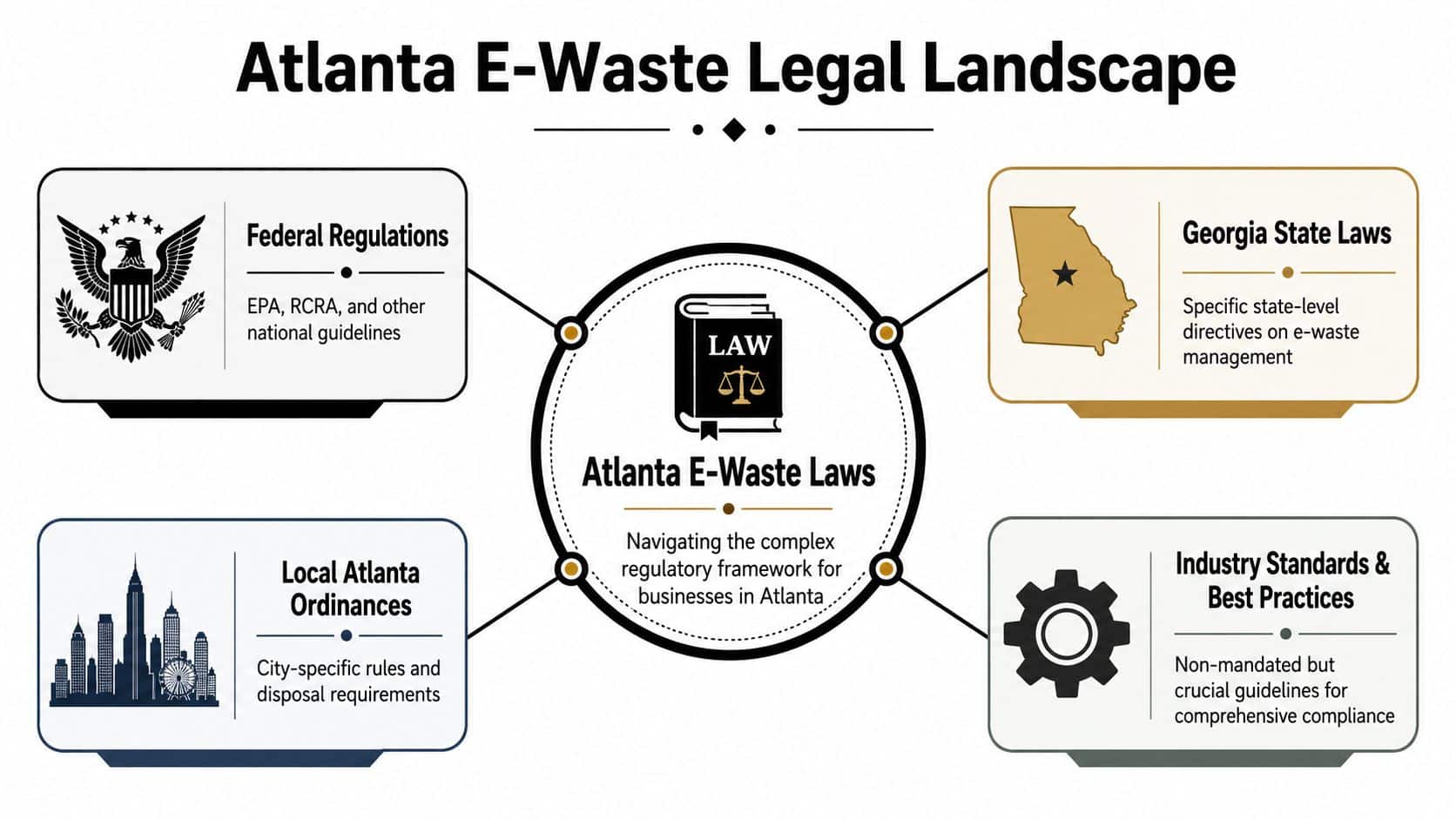
A useful starting point is this Georgia electronics recycling guide for businesses, but the key point is simpler: Atlanta companies can't assume “recycle it” equals “comply with the law.”
What federal rules mean in practice
Without a Georgia-specific business e-waste program, the burden shifts to process discipline. You need to identify hazardous components, manage transportation carefully, and make sure data-bearing devices are sanitized or destroyed before they leave controlled handling.
That usually affects:
- Legacy displays and specialty equipment that may contain regulated materials
- Laptops and mobile devices with embedded batteries
- Servers and storage arrays holding sensitive business or customer information
- Mixed loads where reusable assets, scrap units, and hazardous components are combined
What doesn't work
A one-size-fits-all pickup almost always creates problems. So does mixing batteries, drives, and general peripherals in the same gaylord without segregation. Another common failure is relying on a hauler that can remove equipment but can't produce detailed downstream records.
Compliance fails when the business treats end-of-life electronics as surplus property only. Regulators and plaintiffs will look at the data and environmental controls, not the warehouse label.
A defensible program documents where devices originated, where they were shipped, and how they were processed. That matters even more when assets move across state lines for redeployment, resale, or final recycling.
Key Compliance Risks Data Breaches and Penalties
The biggest mistake companies make is assuming recycling is the main risk. It isn't. The first exposure is usually data leakage from retired devices. The second is mishandling batteries or other hazardous components during storage and shipment.
If an old laptop leaves your office with recoverable data still on it, the problem isn't theoretical. Your organization may have to explain why that device was released without a validated sanitization process, why custody records are incomplete, and why no one can match the serial number to a destruction or erasure record.
Where the risk becomes real
Different departments feel this differently:
- IT owns media handling and often gets blamed when asset records are incomplete.
- Security and compliance have to prove the company used reasonable controls.
- Legal and leadership inherit the fallout if customer or employee information is exposed.
- Facilities and operations often manage staging areas where batteries or mixed electronics create storage and transport issues.
The wrong vendor makes all of that worse. A truck receipt is not a chain-of-custody record. A generic “all material recycled” statement is not enough for data-bearing assets.
For Atlanta organizations already reviewing local cyber exposure, this related look at cybersecurity threats targeting Atlanta companies connects the disposal problem to the broader security environment.
The operational failures that create liability
The pattern is usually familiar:
- Equipment sits too long in an uncontrolled storage area.
- Assets are moved without a serialized inventory.
- Drives aren't wiped or shredded to a defined standard.
- Pickup occurs, but no complete destruction certificate follows.
- Weeks later, no one can prove what happened to a specific device.
If you can't prove destruction, assume you still own the liability.
That mindset changes disposal from a housekeeping task into a control function. It also changes how you evaluate every recycler, ITAD firm, and logistics partner involved.
Secure Data Destruction Standards for Full Compliance
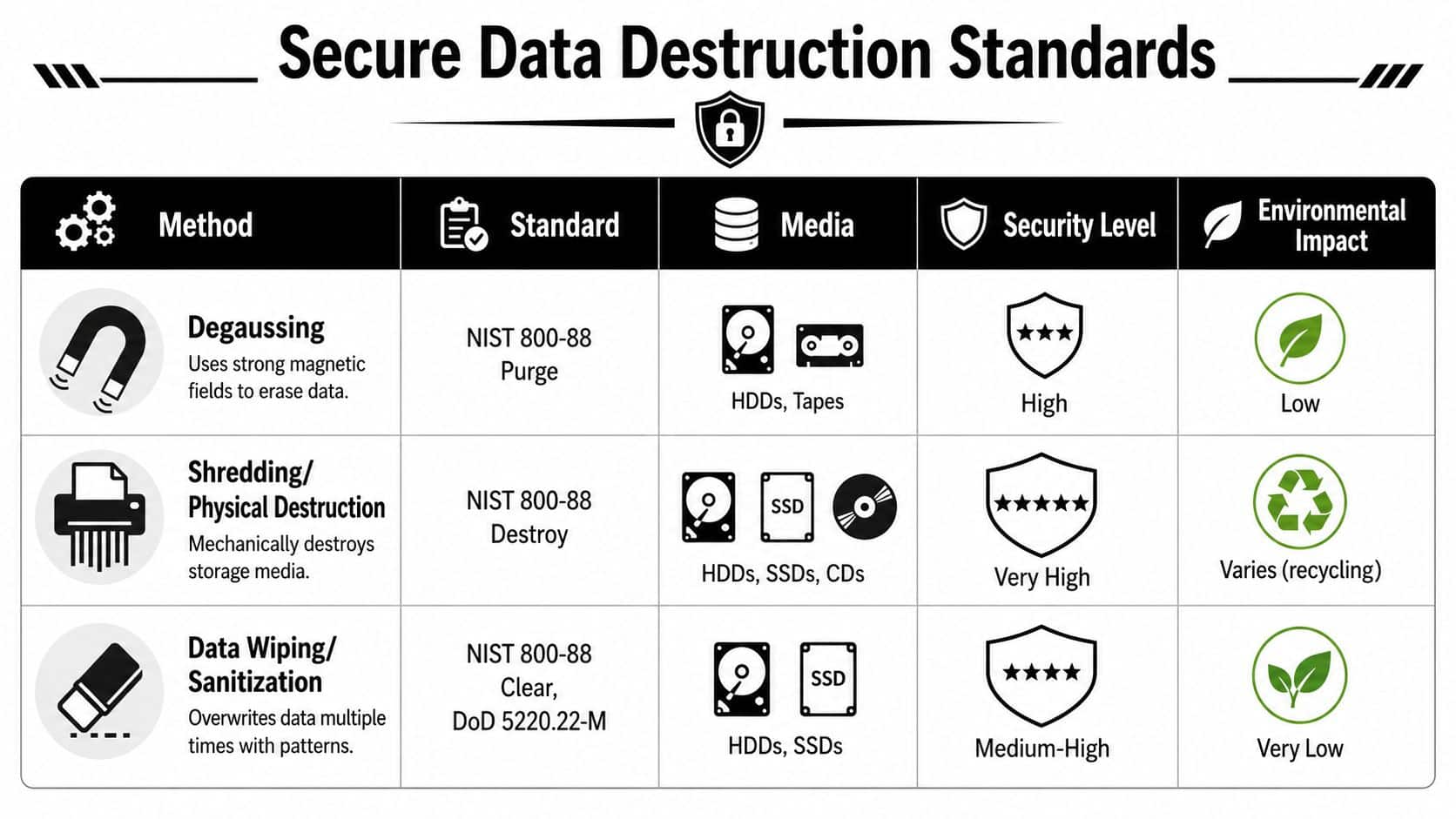
For Atlanta businesses retiring data-bearing equipment, the most defensible standard is NIST SP 800-88. Georgia-specific guidance recommends aligning hard-drive disposition with NIST SP 800-88, using physical shredding or cryptographic erasure for SSDs rather than degaussing, and retaining serialized asset records and destruction certificates.
That last point matters. A wipe only protects you if you can prove which asset was sanitized, by what method, and under whose custody.
A deeper explanation of the standard is available in this NIST SP 800-88 resource.
Matching the method to the media
The practical decision isn't “wipe or shred” in the abstract. It's about the device type, reuse goals, and your risk tolerance.
| Method | Best fit | Weakness |
|---|---|---|
| Data wiping | Reuse or resale workflows where the media supports validated sanitization | Poor choice if the process isn't logged and verified per asset |
| Cryptographic erasure | Encrypted solid-state environments with proper key management | Not useful if encryption status can't be confirmed |
| Physical shredding | High-risk or end-of-life media, especially SSDs | Ends reuse value, so apply it intentionally |
| Degaussing | Older magnetic media only | Not suitable for SSDs |
What experienced teams insist on
Strong programs usually require these controls before release:
- Serialized inventory: Every device, drive, and removable media item is listed before pickup.
- Method selection: The sanitization or destruction method is chosen by asset type, not convenience.
- Exception handling: Failed drives, damaged media, and unknown devices go straight to controlled destruction.
- Final proof: Certificates of destruction tie back to the original inventory.
Older habits cause modern failures. Degaussing may sound secure, but it isn't the answer for solid-state drives.
Many programs tighten up their processes. They stop talking about “hard drive disposal” as one category and start separating HDDs, SSDs, mobile devices, and embedded storage into different workflows.
Building a Compliant ITAD Program with Chain of Custody
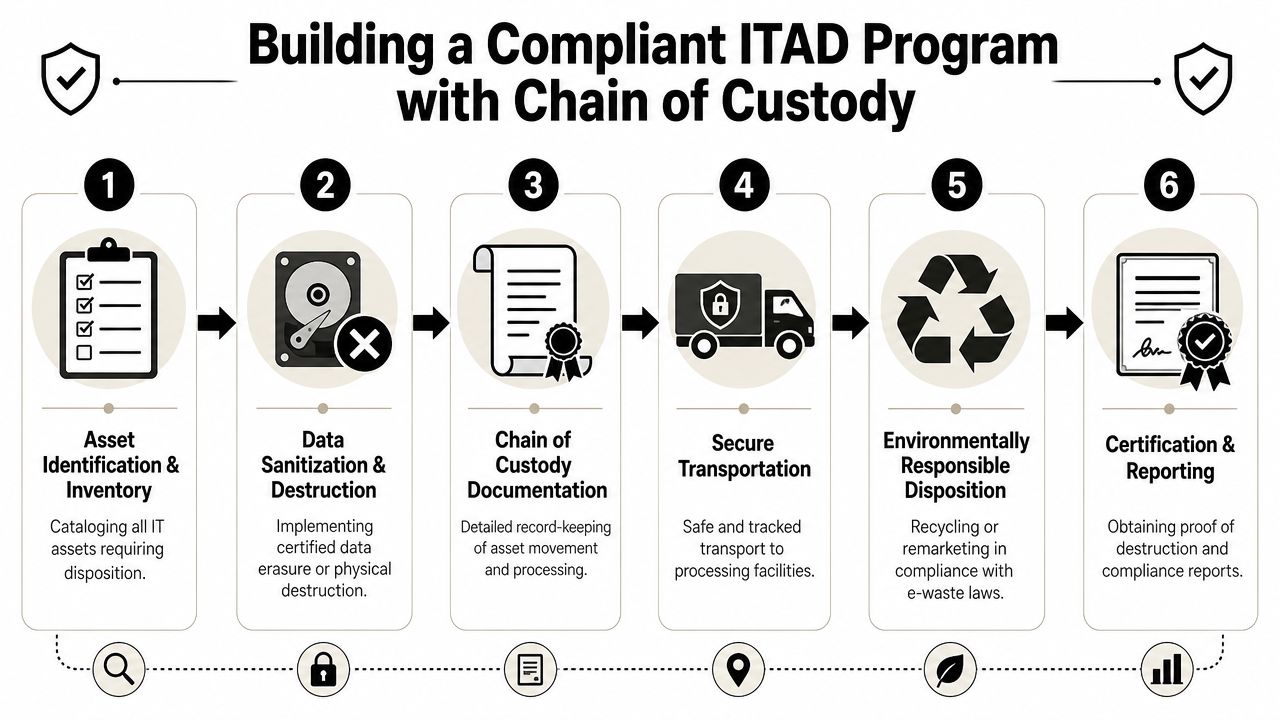
A compliant ITAD program works because it is repeatable. It doesn't depend on whoever happened to be in the server room that day. It uses a written process, clear ownership, and records that reconcile from internal release through final disposition.
Hazardous components deserve special attention. Businesses must manage hazardous components under RCRA-style controls even when the device itself is not strictly hazardous waste, especially in enterprise cleanouts involving laptops, mobile devices, and UPS units where segregation, storage, and shipping can create fire or hazardous-waste liability.
Vendor screening is part of that process. This vendor due diligence checklist is the kind of review many organizations should complete before approving any downstream partner.
The six controls that matter most
Inventory before movement
Build the asset list before anything leaves the site. Include serial numbers, device type, location, and whether the asset contains data or batteries.Secure staging
Don't stack retired equipment in an open hallway or shared loading area. Use a controlled location with restricted access. Separate battery-heavy equipment from general electronics.Documented release
Someone inside the business should sign off on what is being transferred. That creates the handoff point for custody.Tracked transportation
Pickup should be scheduled, controlled, and tied to the asset manifest. Mixed loads need clear packaging and segregation rules.Verified processing
Reuse, resale, shredding, and recycling should all tie back to the same inventory. Nothing should disappear into a bulk category if it started as a serialized asset.Certificates and retention
Store destruction and recycling records where legal, compliance, and IT can retrieve them later. If a question comes up months after pickup, the paperwork must still be accessible.
What a weak chain of custody looks like
A weak program usually has one or more of these warning signs:
- Bulk counts instead of serialized counts
- Unlabeled pallets containing mixed device types
- No distinction between data-bearing and non-data-bearing equipment
- No battery segregation
- No documented exception process for damaged devices
- Certificates that don't map back to the client inventory
What actually works in the field
The cleanest programs assign one owner in IT or compliance, one backup approver, and one approved vendor path. They don't improvise for each refresh cycle. They also treat office moves, lease returns, and data center decommissions as separate workflows because each creates different custody and logistics risks.
For Atlanta companies, battery handling is becoming a bigger operational issue than many teams realize. A pile of retired laptops and UPS units can create storage and transport headaches long before the material reaches a recycler. Segregation, packaging discipline, and pickup timing are practical controls, not paperwork exercises.
How Beyond Surplus Ensures Your Atlanta Business Stays Compliant
A service provider is useful only if it reduces operational risk. For Atlanta businesses, that means secure pickup, controlled logistics, documented data destruction, and final reporting that an auditor or legal team can use.
One local option is Atlanta ITAD services from Beyond Surplus, which offers business electronics recycling, secure data destruction, logistics coordination, and certificates of recycling and data destruction. Those functions matter because they address the exact control gaps that usually create exposure: missing custody records, weak media handling, and vague final disposition paperwork.
The practical value of a certified partner
A qualified ITAD and recycling partner should help your team do four things well:
- Control removal from the start: Pickup, packing, manifests, and transport shouldn't be an afterthought.
- Apply the right destruction method: SSDs, failed drives, laptops, and mobile devices need different handling decisions.
- Produce usable records: Certificates are only valuable if they connect to asset-level tracking.
- Handle downstream processing responsibly: Recycling, remarketing, and destruction all need accountability.
Where businesses save time and reduce errors
Most internal teams don't struggle with deciding that old devices should leave. They struggle with the mechanics. Who inventories them, who signs off, where they wait before pickup, what gets wiped versus shredded, how batteries are separated, and where certificates are stored afterward.
A good vendor doesn't just collect equipment. The vendor should make your internal process easier to audit.
That's the difference between a simple hauling service and a compliance-aligned disposition partner. The first removes clutter. The second helps you prove you handled risk correctly.
Secure Your Assets and Simplify Compliance Today
For Atlanta companies, e-waste compliance isn't about memorizing a single Georgia recycling law because there isn't one broad statewide mandate governing business electronics take-back. The primary work is building a process that protects data, controls hazardous components, and preserves a clear record of what happened to each asset.
The businesses that handle this well tend to follow the same pattern. They inventory before pickup. They separate batteries and mixed-risk devices. They choose sanitization or destruction methods that fit the media. They keep serialized records and final certificates where someone can find them later.
If your current approach depends on a loading dock pickup ticket and verbal assurances, it's time to tighten it up. A documented ITAD workflow reduces breach exposure, supports environmental compliance, and gives leadership a defensible answer when customers, auditors, or regulators ask how retired electronics are handled.
That's the primary value behind an Atlanta E-Waste Laws: Business Compliance Guide. It turns a vague disposal problem into a controlled business process.
Contact Beyond Surplus for certified electronics recycling and secure IT asset disposal meeting your organization's compliance, data destruction, and chain-of-custody requirements.


