Atlanta, Georgia companies usually discover the weak spots in IT asset disposal at the worst possible moment. A server room cleanup turns into a compliance question. A laptop refresh turns into a chain-of-custody problem. A data center shutdown turns into a scramble to figure out who touched which assets, where they went, and whether the destruction paperwork will hold up in an audit.
That's where the phrase end-to-end solution gets tested. In ITAD, it shouldn't mean “one vendor sold you the project.” It should mean one accountable process from pickup through data destruction, remarketing, recycling, and final reporting. If the service breaks into hidden handoffs, your risk doesn't disappear. It just moves out of sight.
For Atlanta electronics recycling services and enterprise IT equipment disposal, the practical question isn't whether a provider offers a broad menu of services. It's whether they control the process tightly enough to protect security, compliance, and asset value across every step.
The Hidden Risks in Your IT Disposal Process
An IT manager decommissions a rack of servers after a storage migration. The equipment leaves the loading dock on time. Facilities thinks the job is done. Procurement has a quote. Legal assumes certificates will follow. Then the questions start. Who transported the equipment? Where was it staged? Which subcontractor handled the drives? Who verified serial numbers against the final destruction report?
That's the normal failure pattern in fragmented ITAD.
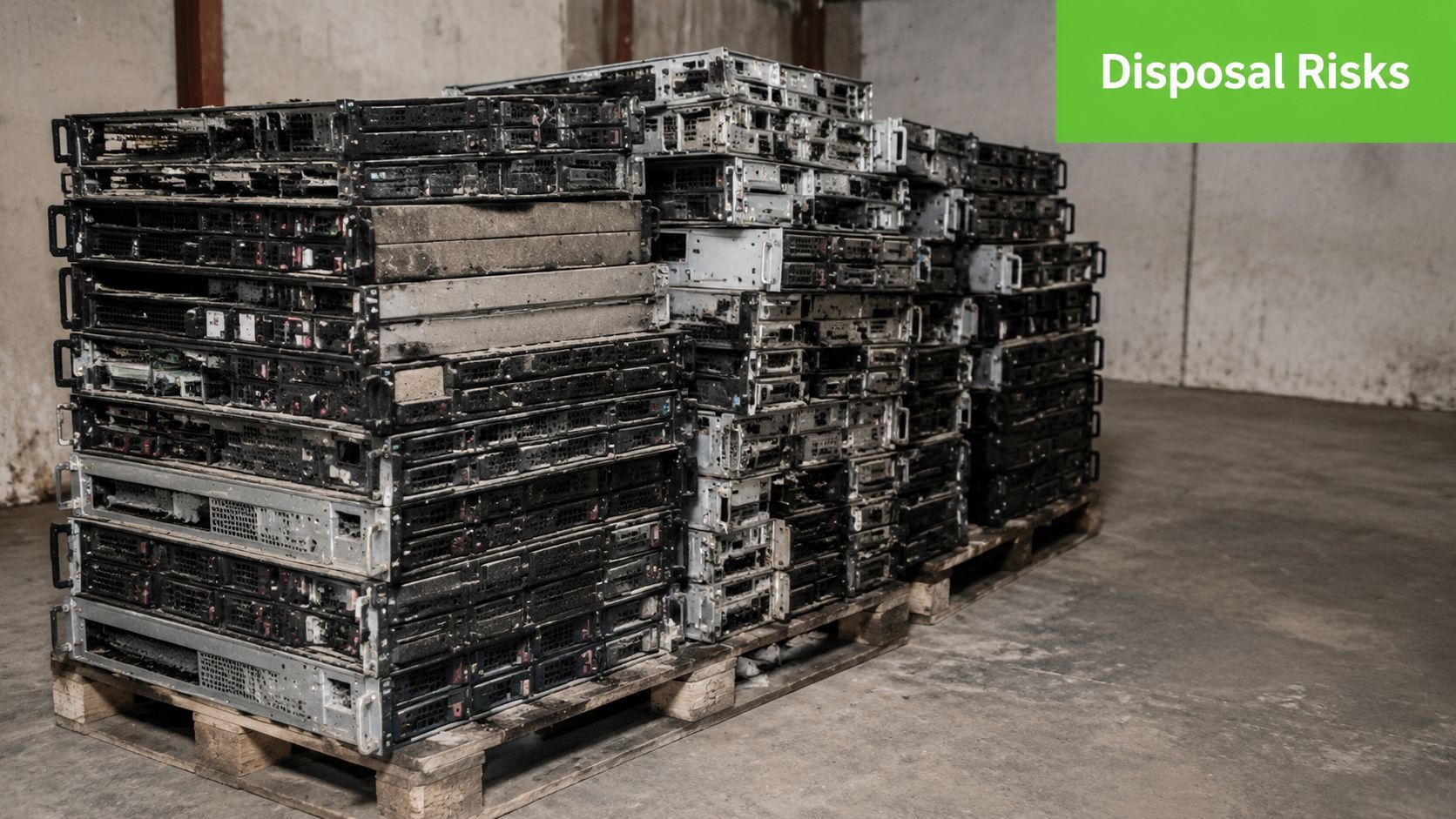
A lot of companies still use a patchwork model. One vendor picks up assets. Another wipes drives. A downstream recycler handles scrap. Someone else issues environmental paperwork. Each handoff creates delay, ambiguity, and room for disputes when records don't match.
The scale of the waste stream makes that risk harder to ignore. The EPA estimates that electronic waste in the United States reached 6.9 million tons in 2022, yet only 15% was formally recycled, with 85% entering landfills or informal channels, which shows why documented commercial recycling workflows matter so much for business assets (EPA e-waste estimate reference).
Where the process usually breaks
- At pickup: Drivers collect mixed loads without serialized verification tied to your internal asset list.
- In transit: Equipment sits in unsecured staging areas while responsibility becomes blurry.
- At downstream facilities: Your primary vendor may not own or directly manage the next processor.
- In reporting: Certificates arrive, but they don't connect every serial number to every custody event.
Practical rule: If your provider can't show a continuous record from your floor to final disposition, you don't have an end-to-end solution. You have a vendor network.
This is why so many organizations run into the same common challenges in IT asset disposition. The risk isn't only data exposure. It's failed audits, disputed accountability, missed resale opportunities, and internal teams wasting time reconciling conflicting records after the fact.
What a fragmented chain costs you
A fragmented approach creates three business problems at once:
| Risk area | What it looks like in practice |
|---|---|
| Security | Unknown handlers touch media before final destruction |
| Compliance | Documentation proves an event happened, but not the full custody path |
| Operations | IT, facilities, and procurement all chase separate vendors for answers |
Most companies don't choose this intentionally. They inherit it. That's why the fix starts with defining what end-to-end should mean.
Defining a True End-to-End ITAD Solution
A security lead signs off on an ITAD pickup because the provider says it handles everything. Weeks later, audit questions start. The truck was subcontracted, media destruction happened at another facility, resale moved through a separate channel, and no one can produce a single asset-level record that ties those events together. That is the end-to-end paradox in ITAD. A service can look unified from the buying side while remaining fragmented in operation.
A true end-to-end solution is defined by control, traceability, and liability across the full disposition chain. The provider either performs each step directly or governs subcontracted steps inside one operating model, with one custody record and one reporting system tied back to each asset. If those records break at any point, the service is not end-to-end. It is an aggregator model with a cleaner sales story.
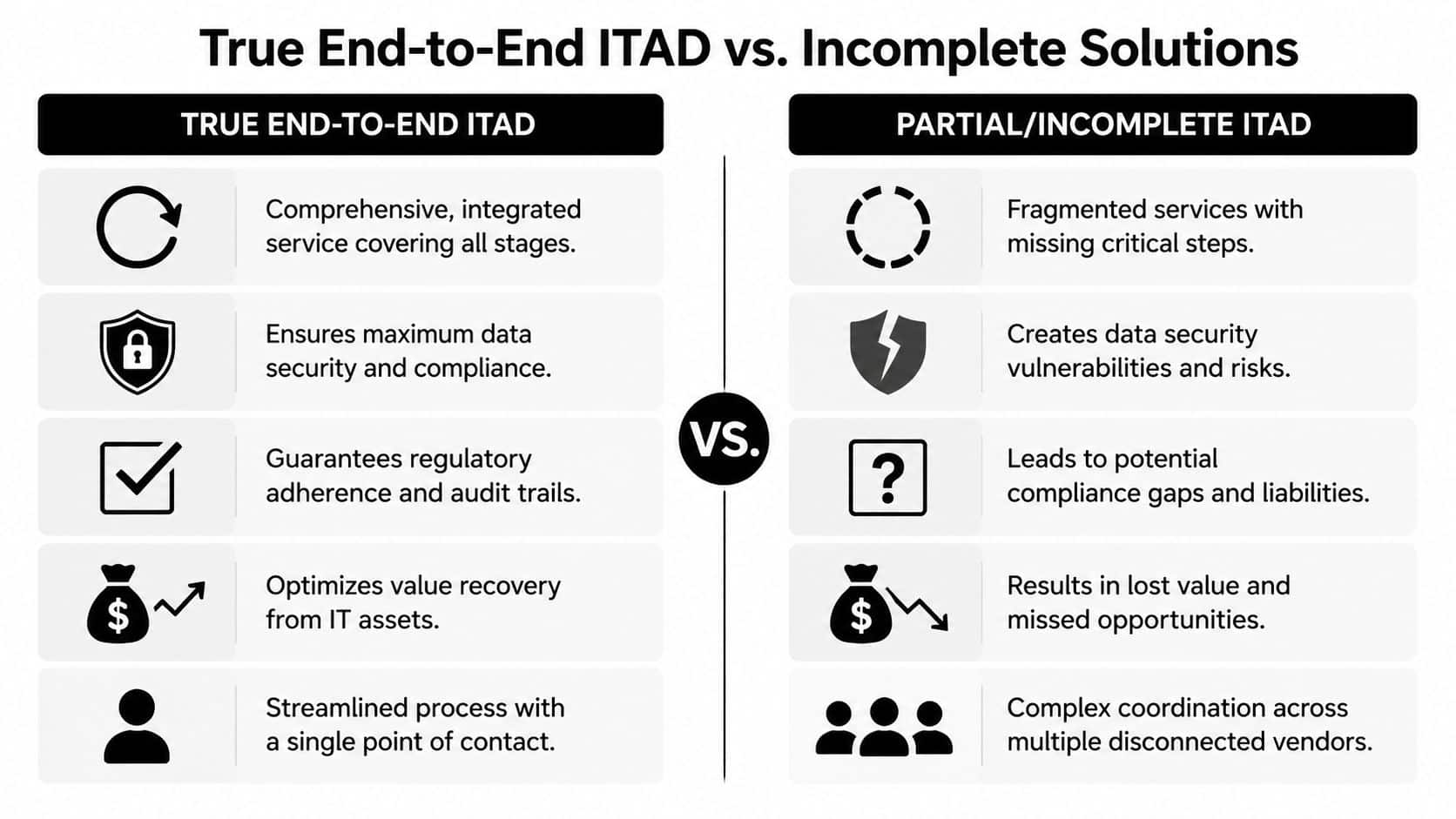
The end-to-end paradox
The highest-risk point is often the gap between operators, not the work performed inside a certified facility. Once a provider starts brokering transport, wiping, shredding, recycling, and remarketing through separate parties, your oversight depends on contract language and after-the-fact paperwork. In practice, that is a weak substitute for direct process control.
I have seen organizations assume that one invoice means one accountable chain. It does not. A provider can present a polished front end while the riskiest custody changes happen outside its direct control. That setup increases exposure in ways that are easy to miss during procurement and hard to defend during an investigation.
The real test is simple. Can the provider show who handled each asset, when custody changed, what happened to the data-bearing media, and how final disposition was recorded in one auditable chain?
What real accountability looks like
A genuine end-to-end model has a few operational traits that are hard to fake:
- Controlled logistics: Pickup, loading, transport, and intake are tied to serialized assets, not just shipment totals.
- One system of record: Custody events, sanitization results, resale outcomes, and recycling records connect to the same asset file.
- Clear liability: The provider remains accountable for downstream performance instead of pushing blame to a processor or freight partner.
- Disclosed subcontracting: If outside firms are involved, their role is documented, audited, and visible to the client.
Those differences have practical consequences. Security teams get a defensible chain of custody. Compliance teams get records that hold up under review. Finance and procurement get a clearer view of what was resold, recycled, or written off, instead of trying to reconcile separate reports that were never built to match.
Teams reviewing an IT asset disposition process should stop asking whether a provider offers every service line. Ask who performs each step, who owns the facilities, where title and custody change, and whether reporting stays at the asset level from pickup through final disposition.
One invoice is not the standard
Convenience is easy to buy. Control is harder.
A real end-to-end ITAD service lets a compliance officer, CISO, and procurement manager review the same record and reach the same conclusion about what happened to each asset. If the answer changes depending on which vendor report you open, the process is still fragmented, even if the proposal says otherwise.
The Core Components of an Integrated Service
A real end-to-end ITAD program works like a connected system. If one component is weak, the others lose value. Secure pickup without defensible data destruction still leaves exposure. Strong destruction without asset-level reporting still creates audit friction. Responsible recycling without remarketing transparency leaves money on the table.
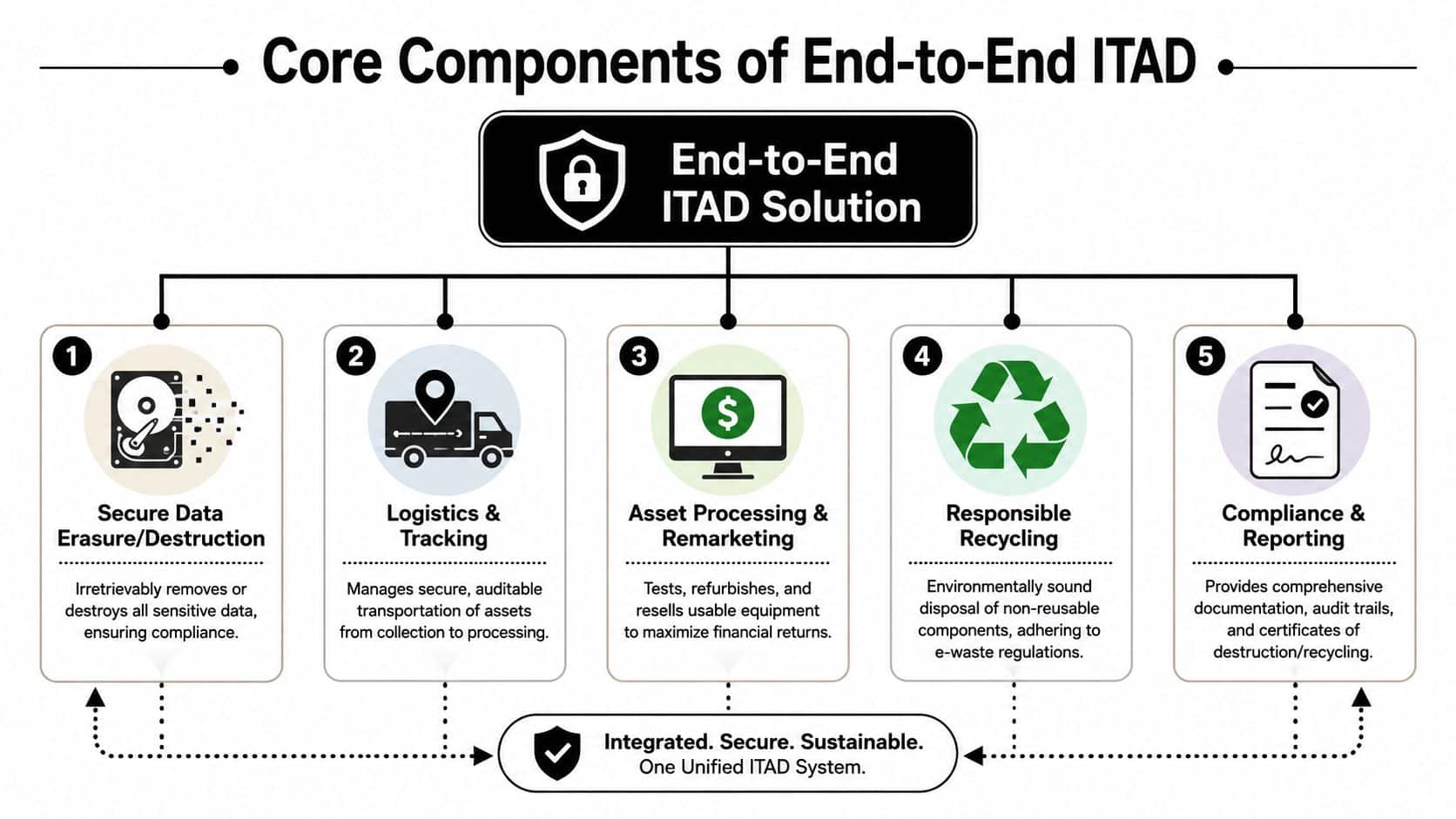
Secure collection and logistics
The process starts at your site, not at the recycler. Assets need serialized collection, controlled loading, and transport procedures that preserve evidence of custody. If equipment is palletized, boxed, or sealed without tying those actions back to a recorded manifest, the chain starts weak.
For enterprise refreshes, this matters most when teams remove mixed devices from multiple departments. Laptops, loose drives, networking gear, and lab systems shouldn't enter a generic pickup stream.
Certified data destruction
Data destruction needs technical discipline, not vague assurances. According to the National Institute of Standards and Technology, proper media sanitization using the Clear method, followed by the Purge method, reduces the risk of data breach by over 99% compared to simple deletion (NIST media sanitization reference).
That's why strong programs separate deletion from sanitization. A file delete, quick format, or factory reset isn't the same as a defensible destruction process.
Field note: If a provider talks about “wiping everything” without defining media type, sanitization method, and exception handling for failed drives, the process is too loose.
Responsible recycling and downstream control
Not every asset has resale value. Some hardware is obsolete, damaged, or nonfunctional. Those materials still require controlled processing through documented recycling channels. The key issue isn't whether recycling happens. It's whether your provider can show where material went after triage.
A provider such as Beyond Surplus can fit this model when it combines pickup, secure data destruction, recycling documentation, and IT asset recovery under one managed workflow for business clients.
Value recovery and remarketing discipline
Remarketing should sit inside the same chain, not off to the side. Assets that can be refurbished and sold need testing, grading, and resale records tied back to the original intake. Otherwise, there's no clean way to confirm what was monetized versus scrapped.
Unified reporting
Integrated service proves its worth. Good reporting should include:
- Asset identity: Serial number, device type, and intake status
- Custody history: Pickup, transport, receipt, processing, and final disposition events
- Data outcome: Sanitized, shredded, failed, exception-managed, or otherwise resolved
- Financial outcome: Resold, recycled, or destroyed, with supporting asset-level detail
- Compliance output: Certificates and audit-ready records linked to the same chain
Without this final layer, the rest of the workflow may be operationally active but still hard to defend under scrutiny.
How End-to-End Solutions Fortify Security and Compliance
Security and compliance teams usually care less about marketing language than proof. They want evidence that sensitive equipment was handled with reasonable controls, that media was destroyed properly, and that the organization can show due diligence if a regulator, customer, or outside auditor asks questions later.
That's where the legal side of an end-to-end solution matters.
The FTC Disposal Rule mandates that businesses holding consumer personal information must implement reasonable measures to protect against unauthorized access, and it requires providers to issue certificates of destruction as legal proof of compliance (FTC Disposal Rule reference).
Why one chain reduces audit exposure
A fragmented process creates gaps in proof. One vendor may show pickup. Another may show shredding. A third may issue recycling paperwork. If those records don't align, your organization still carries the burden of explaining what happened.
A unified provider reduces that friction because the custody path, destruction event, and final certificate all come from one accountable system.
What liability transfer actually requires
A certificate by itself isn't magic. It becomes useful when it's backed by an auditable process. That means the provider can connect the certificate to the actual assets collected, the methods used, and the final disposition path.
Use this standard when you review any ITAD program:
- Can the provider tie certificates to serialized asset records?
- Can they explain exception handling for damaged or unreadable media?
- Can they produce one report that legal, IT, and procurement all understand?
Strong ITAD compliance isn't paperwork generated at the end. It's process discipline recorded from the beginning.
Organizations with stricter controls often map this directly to their internal security frameworks. For media sanitization requirements, the NIST SP 800-88 guidance is the benchmark many teams use to evaluate whether a destruction process is defensible.
Where the model holds up best
This matters most in environments where records can't be approximate:
| Environment | Why end-to-end control matters |
|---|---|
| Healthcare | Equipment may contain regulated patient data |
| Finance | Device history and custody records support audit readiness |
| Government and education | Public-sector oversight raises documentation expectations |
The operational benefit is simple. Your team spends less time reconstructing disposal events after the fact, and more time moving projects forward.
Unlocking Hidden Value and Sustainability Goals
A common failure starts after pickup, not before. A provider markets an end-to-end program, your team expects strong resale returns and clean sustainability reporting, and the final settlement arrives as a single credit with no asset-level detail. At that point, you cannot tell which laptops were resold, which were stripped for parts, and which went straight to scrap.
That is the end-to-end paradox in ITAD. A single vendor relationship can reduce coordination work for your team while still hiding the decisions that affect recovery value and environmental outcomes.
Why some all-in-one models reduce returns
The term end-to-end often describes commercial packaging, not operational control. Some providers run the customer interface and subcontract key steps to downstream processors. Others keep the work in-house but still favor the fastest disposition path because it lowers handling cost and clears inventory faster.
That trade-off matters most for equipment with resale potential. A device that could have been tested, graded, and remarketed may be grouped into bulk recycling if the provider earns more from speed than from transparent value recovery.
Value recovery is only real when each asset's final outcome is visible and defensible.
This situation misleads buyers. A blended settlement summary can make the program look efficient while masking underperforming resale decisions. If finance, procurement, or IT cannot trace value back to serialized assets, they are relying on trust instead of evidence.
What to ask for instead
A value-focused ITAD model should produce records your finance team can review without interpretation. Ask for:
- Per-asset disposition status: Resold, harvested for parts, recycled, or destroyed
- Testing and grading detail: Enough context to explain why a unit entered a specific channel
- Asset-level settlement logic: A clear method for calculating credits, fees, and revenue share
- Exception reporting: Visibility into damaged, locked, or nonfunctional assets that often disappear into scrap totals
Providers that resist this level of reporting usually have a reason. In practice, asset-level transparency exposes whether the service is integrated or just aggregated behind one contract.
Sustainability goals need the same level of proof
Environmental reporting breaks down the same way value recovery does. Broad claims such as zero landfill sound good in a proposal, but internal audit, procurement, and ESG teams need records that connect those claims to actual processing decisions.
A provider with one connected operating record across collection, triage, resale, recycling, and destruction can support sustainability reviews with less guesswork. The benefit is not better marketing language. The benefit is documentation your team can use in internal reporting and supplier reviews. For organizations tying disposition policy to ESG metrics, this ITAD and ESG guidance for Georgia organizations is useful because it connects sustainability goals to measurable disposal controls.
The practical standard is straightforward. If you cannot see asset-level outcomes, you cannot verify return, and you cannot defend sustainability claims.
Your Checklist for Evaluating ITAD Providers
Most ITAD proposals sound complete on paper. Key differences show up when you push past the service list and test how the provider operates under scrutiny.
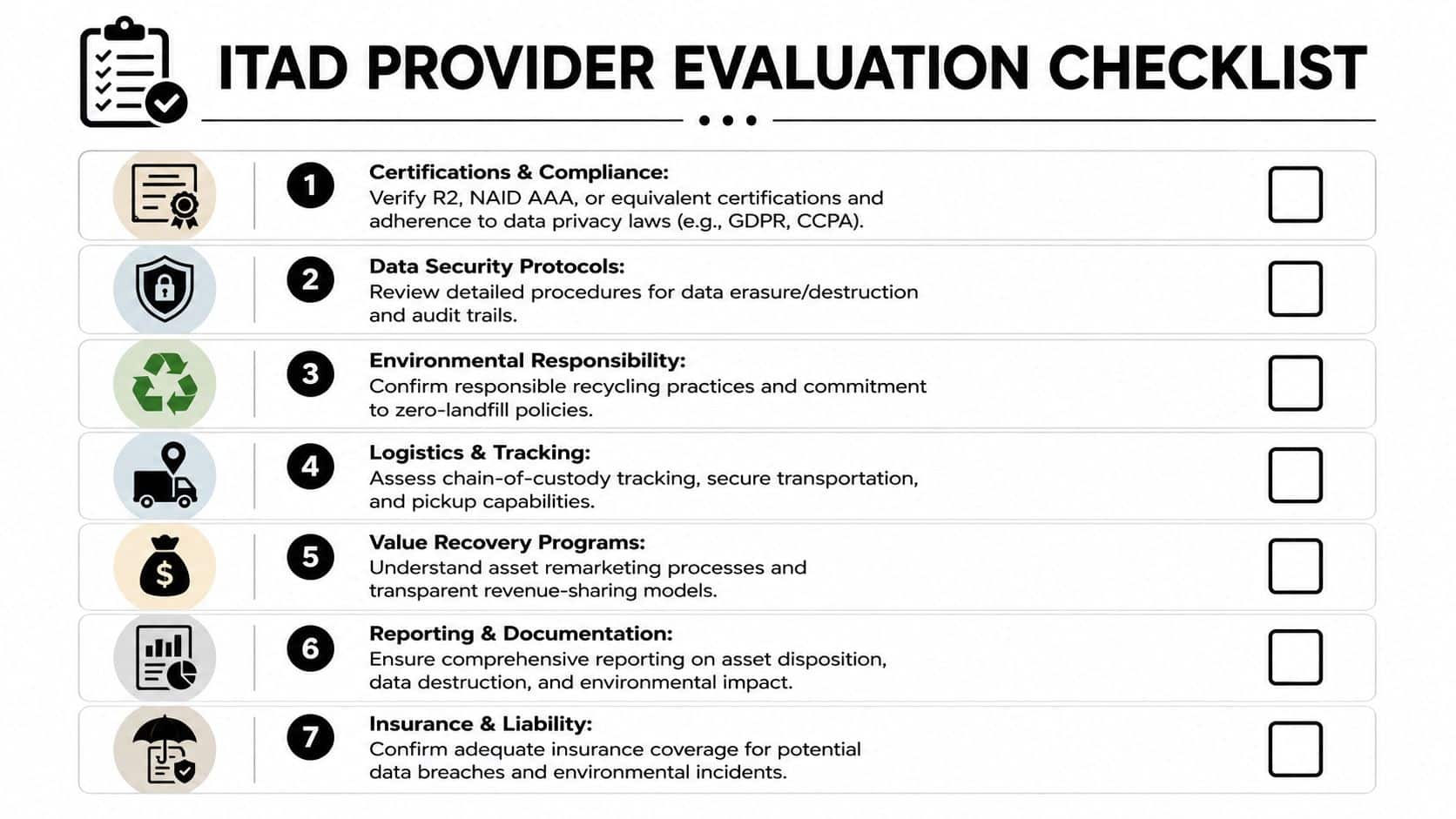
The questions that expose aggregator risk
Ask these early, before pricing becomes the main discussion.
- Who owns the process: Do you operate your own facilities and logistics, or do you broker work to downstream partners?
- Where do handoffs occur: Identify every point where custody changes, including transport, shredding, and recycling.
- How are subcontractors audited: If outside partners are involved, ask for proof of oversight and how those records connect to your assets.
- What does sample reporting look like: Don't settle for promises. Review an actual report with serialized assets, custody events, and final outcomes.
- How do you handle failed media: A strong vendor should explain what happens when drives can't be wiped, scanned, or tested.
- How is resale documented: Ask for asset-level buyback reporting, not just a lump-sum credit.
- What certifications and insurance apply: Certifications matter, but they don't replace operational proof.
What good answers sound like
Good providers answer directly. They can name the site, the process, the control point, and the report that proves it. Weak providers stay broad. They talk about nationwide reach, sustainability commitment, and flexible solutions without showing where accountability lives.
Buying advice: If a provider resists showing sample chain-of-custody reporting, assume the process gets less transparent after pickup, not more.
A simple evaluation table helps procurement teams compare options without getting lost in sales language:
| Evaluation area | Strong answer | Weak answer |
|---|---|---|
| Custody control | Serialized chain from pickup to final disposition | General assurances with no asset-level proof |
| Data destruction | Defined sanitization and destruction methods | “We wipe or destroy as needed” |
| Value recovery | Asset-level resale visibility | Blended credit with no item detail |
| Downstream oversight | Named partners and documented controls | “Trusted network” language |
The right provider should make your internal review easier, not harder.
Implement a Secure ITAD Strategy in Atlanta
For Atlanta businesses, the standard should be straightforward. A true end-to-end solution in ITAD means one chain of liability, one defensible reporting structure, and one process that holds together from pickup through final disposition. That's what protects security teams, compliance officers, procurement staff, and the business itself.
If you're planning a laptop refresh, data center decommissioning project, medical equipment disposal program, or recurring computer recycling service in Atlanta, Georgia, vet providers based on control, not slogans. Ask who touches the assets, how each custody event is recorded, and whether the final report shows asset-level outcomes for destruction, recycling, and value recovery.
For organizations that need local execution with business-focused workflows, review ITAD services in Atlanta and compare the operating model against the checklist above. The right partner should reduce risk, simplify audits, and give your team clear evidence of what happened to every asset.
Contact Beyond Surplus for certified electronics recycling and secure IT asset disposal.