Atlanta businesses are heading into 2026 with real momentum, but most owners still face the same daily tension. Revenue goals are rising while staff time, compliance bandwidth, and operational discipline lag behind. You might be testing AI, tightening sales processes, or looking for better systems, yet a surprising amount of growth still gets lost in the back office through weak asset controls, sloppy vendor management, and delayed decisions.
That matters more in Atlanta than many leaders realize. Atlanta small businesses achieved 49% revenue growth in one year, with 49% of owners confirming the increase and 74% anticipating continued growth. Strong markets reward prepared operators, not just aggressive marketers. The companies that scale best usually connect front-end demand generation with disciplined execution behind the scenes.
Atlanta small business growth strategies for 2026 need to reflect that reality. Growth won't come from one tactic. It comes from better partnerships, tighter vertical positioning, smarter value recovery, stronger compliance, and operational systems that remove friction instead of adding it. That includes overlooked levers like secure IT asset disposition, electronics recycling, and data destruction, especially for companies handling customer records, medical devices, financial data, or aging infrastructure.
If your team is modernizing sales operations, it also helps to discover free CRM tools for B2B that can support cleaner pipelines and better account follow-up. Then pair that commercial discipline with the 10 practical strategies below.
1. Strategic B2B Partnership Development with Data Center Operators and Cloud Providers

Atlanta has a dense infrastructure economy. If you sell B2B services, one of the fastest ways to create steadier revenue is to stop chasing one-off pickups and start building recurring agreements with data center operators, MSPs, and cloud-adjacent service firms.
For electronics recycling and IT asset disposition providers, that means becoming the vendor those operators call before a refresh cycle starts, not after equipment piles up. Multi-year relationships are usually built on logistics reliability, chain-of-custody discipline, and predictable pickup scheduling. A provider that can handle racks, servers, networking gear, and end-of-lease equipment without slowing down an operations team becomes hard to replace.
Where recurring value comes from
A strong partnership model usually includes a few practical elements:
- Dedicated pickup windows: Regularly scheduled removals reduce site disruption and make forecasting easier.
- White-label fulfillment: Regional recyclers can support larger national firms that need Atlanta-area execution.
- Quarterly business reviews: Account reviews keep compliance, service levels, and upcoming decommissions visible.
A useful starting point is studying why Atlanta is a prime data center hub and then identifying which operators, colocation facilities, and MSPs need a stable local ITAD partner.
Practical rule: Enterprise partnerships don't usually fail because of pricing. They fail when pickups are inconsistent, documentation is weak, or communication breaks under time pressure.
One realistic scenario is a regional MSP managing laptop refreshes for several clients across metro Atlanta. That MSP doesn't want five vendors. It wants one recycler that can coordinate pickup, serial tracking, secure wiping or shredding, and final certificates without forcing the MSP to manage the process manually.
What doesn't work is positioning yourself as a commodity hauler. Data center and cloud buyers care about uptime, risk transfer, and documentation. If your proposal sounds interchangeable with junk removal, you won't win strategic contracts.
2. Vertical Market Specialization in Healthcare and Finance Compliance
Generalist messaging gets ignored in regulated sectors. Healthcare systems, banks, credit unions, and government offices don't buy electronics recycling the same way a generic commercial office does. They buy risk reduction.
In Atlanta, that creates a clear opening for companies that can package services around chain of custody, audited processes, documented destruction, and sector-specific handling. A hospital retiring imaging workstations, a finance team replacing encrypted laptops, and a public agency disposing of old storage arrays all need a vendor that understands why disposal is part of compliance, not just cleanup.
Sell to the audit requirement
Commercial electronics recycling in Atlanta requires adherence to NIST 800-88 data destruction standards and documentation such as a Certificate of Data Destruction aligned with that standard. That matters for businesses working through HIPAA and FTC Disposal Rule obligations because the documentation trail is often as important as the physical destruction itself.
That is why compliance-focused service pages, proposals, and sales calls should lead with evidence. HIPAA-compliant electronics recycling in Georgia speaks more directly to healthcare buyers than a generic recycling pitch ever will.
You can strengthen that positioning by connecting disposal to broader digital change inside care environments. For teams modernizing systems and workflows, these healthcare insights from Bridge Global help frame why legacy equipment turnover and data protection must move together.
The buyer in a regulated industry isn't asking, "Can you recycle this?" They're asking, "Can you document every step so I can defend the decision later?"
What works is specialization by vertical. What doesn't work is promising every framework under the sun without operational proof. If your staff can't explain custody records, wipe verification, and escalation procedures clearly, the prospect will keep looking.
3. Value Recovery and IT Buyback Program Expansion
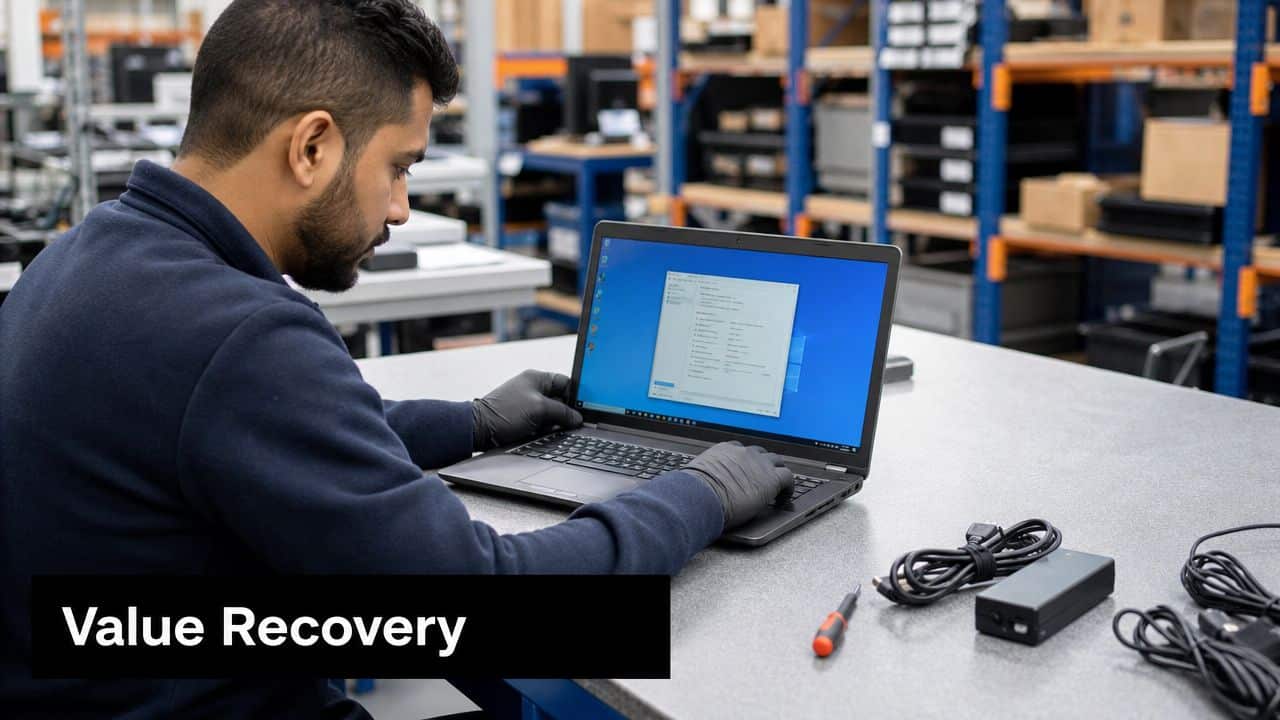
A lot of small businesses treat retired technology like dead weight. That's expensive thinking. In many environments, the better move is to separate assets into three streams. Reuse, resale, and final recycling.
That shift changes the economics of refresh cycles. Instead of paying to remove everything the same way, businesses can evaluate enterprise servers, switches, laptops, and working peripherals for residual value before they enter scrap channels. An IT equipment buy back program can turn a disposal event into a capital recovery conversation.
Build your decision tree before pickup day
Teams usually get better outcomes when they classify assets before collection:
- Resellable equipment: Working or refurbishable units with secondary market demand.
- Donation candidates: Useful hardware that fits nonprofit or internal redeployment needs.
- End-of-life material: Broken or obsolete equipment that should go to secure recycling.
The often-missed strategic angle is that growth content talks constantly about scaling systems but rarely addresses secure value recovery from retired IT while maintaining compliance. That gap is especially important for Atlanta businesses testing new growth plays and trying to generate cash from underused assets. The issue is outlined in this discussion of small business growth strategies and the missed ITAD angle.
A practical example is a mid-sized company replacing employee laptops after a software stack upgrade. If the machines still have resale value, a structured buyback program can offset part of the refresh cost. If they contain sensitive data, secure wiping or shredding must happen before the value conversation is closed.
What doesn't work is waiting until equipment is stacked in a storeroom with no asset list, no condition notes, and no chain of custody. By then, the business has already lost time, bargaining power, and often recoverable value.
4. Targeted Geographic Expansion Beyond Atlanta and Georgia
Many Atlanta businesses outgrow their local footprint before they outgrow their local operating model. They win a client with offices in several states, then scramble to stitch together vendors, freight arrangements, and service standards market by market.
That approach creates avoidable friction. If you're building in ITAD, electronics recycling, data center decommissioning, or product destruction, expansion works better when it follows a network model. Standardize the process in Atlanta first. Then replicate the workflow through vetted transportation partners, regional affiliates, and documented service protocols.
Expand the operating system, not just the map
The businesses that scale cleanly usually package the following:
- Standard intake documentation: Every site follows the same inventory and release process.
- Regional logistics partners: Last-mile execution gets localized without changing compliance expectations.
- Central account management: National clients still want one point of contact.
This matters for enterprise and multi-location customers because procurement teams don't want one service level in Georgia and another in Texas or Illinois. They want consistency. If your company can manage nationwide pickup, document custody, and maintain reporting standards across locations, you're no longer just a local vendor. You're an operational platform.
One realistic scenario is an Atlanta-headquartered company with branch offices across the Southeast. The IT director wants one approved disposal partner for all sites, one reporting format, and one legal standard for data destruction. If your business can only serve metro Atlanta directly and everything else is improvised, that account becomes fragile.
What doesn't work is claiming national capability without a repeatable field process. Buyers notice quickly when a company is brokering jobs instead of managing outcomes.
5. Content Marketing and Thought Leadership for B2B SEO Dominance
Most small business content misses the buying language serious commercial prospects use. It talks broadly about growth, innovation, or sustainability. Buyers search for concrete solutions like secure hard drive destruction, medical equipment disposal, data center decommissioning, and Atlanta electronics recycling services.
That gap creates an opening for companies willing to build content around actual procurement intent. For Beyond Surplus, that means service-led pages and city-led pages that match how IT managers, facility managers, procurement leads, and compliance teams search. Strong content should also support internal linking to service and contact pages, local structured data, and a consistent publishing cadence.
Write for operational intent
A practical B2B SEO stack includes content built around:
- Service keywords: Electronics recycling, IT equipment disposal, computer recycling, product destruction.
- Industry modifiers: Healthcare, finance, education, laboratory, data center.
- Local intent: Atlanta, Georgia, and city-state combinations across national markets.
That structure aligns with the kind of ongoing local publishing that supports city-based commercial search visibility. It also fits the discipline of creating optimized title tags, meta descriptions, featured images, schema, and internal links around enterprise-only service topics.
The common mistake is publishing educational content that never connects to a commercial outcome. A prospect reading about data wiping should be able to move directly to a service page or contact page without hunting through the site.
Good B2B SEO doesn't just attract traffic. It pre-qualifies buyers by answering the questions procurement, compliance, and IT already have before the first call.
What works is content tied to clear service intent and local relevance. What doesn't work is generic blog output that could belong to any business in any city.
6. Strategic Certification and Compliance Accumulation
Certifications don't close deals by themselves, but they change who will even consider you. In IT asset disposition, electronics recycling, and secure data destruction, many enterprise and institutional buyers use certifications as an initial filter.
That means your compliance posture should be treated like market access. If you're selling into healthcare, finance, government, education, or enterprise procurement, you need visible evidence that your processes are disciplined enough for external review. The strongest positioning usually combines data security controls, environmental process standards, and destruction documentation.
Use certifications as sales infrastructure
A good certification strategy does three things:
- Shortens trust-building: Buyers see proof before the first operational audit.
- Improves RFP competitiveness: Formal standards make risk committees more comfortable.
- Clarifies internal process: Preparing for audits often exposes weak handoffs and undocumented steps.
For Atlanta businesses that want to compete harder in secure ITAD, it's worth reviewing what R2 certified ITAD providers in Georgia signal to the market. The certification itself is part of the value. So is the discipline required to maintain it.
Another overlooked issue involves legacy equipment. In Georgia, used CRT funnel glass is regulated differently depending on handling conditions under EPA electronics stewardship rules covering CRT materials and 40 CFR 261.4(a)(22). If your team touches older medical or data center equipment, that distinction isn't academic. It affects process design and downstream risk.
The wrong move is collecting badges that your operations team is unable to support. The right move is pursuing certifications that align with your target buyers and then using them in sales materials, proposals, and account reviews.
7. Direct Sales Team Development and Enterprise Account Management
A common Atlanta growth stall looks like this: the owner wins early business through referrals, a few inbound leads convert, and then larger opportunities keep slipping after the first call. The problem usually is not demand. It is the lack of a sales structure built for long buying cycles, multiple stakeholders, and stricter operational scrutiny.
Enterprise accounts rarely buy on price alone. In ITAD, electronics recycling, and related B2B services, the buying group often includes procurement, IT, security, compliance, facilities, finance, and sustainability. Each group asks a different question. Can you document chain of custody? Can you support multi-site pickups? Can you recover value from retired assets? Can you handle secure disposal without creating downstream risk?
That is why sales development and account management need to work as one system.
Build the team around account coverage, not just lead volume
A practical enterprise sales motion usually includes:
- Business development reps or hunters: Open conversations with target accounts, qualify fit, and keep outbound activity consistent.
- Account managers: Expand relationships after the first job, coordinate renewals, and surface adjacent needs such as buyback, refresh support, or recurring pickup programs.
- Sales operations discipline: Keep CRM records current, define stages clearly, and assign next steps after every buyer interaction.
For Atlanta firms selling operationally sensitive services, a rep also needs enough process fluency to speak credibly about logistics, documentation, and compliance. That does not mean turning salespeople into auditors. It means they can explain what happens after pickup, what reporting the client receives, and where your process reduces risk or recovers value.
The trade-off is straightforward. Generalist reps can create activity faster. Experienced enterprise reps cost more, take longer to hire, and require tighter coordination with operations. For many small businesses, the right move is a lean team with fewer people who can manage complex accounts well.
One account can justify the investment.
A procurement contact may start by requesting basic recycling pricing for one Atlanta office. Two weeks later, the security team asks about drive destruction records. Then finance wants to understand resale credits, and operations asks whether you can support branch locations outside Georgia. If nobody owns the full account, the deal fragments. If one person coordinates the buying group, captures requirements, and brings in the right internal experts, the same opportunity can grow into a multi-service contract.
Overlooked operating capabilities directly affect sales performance. Teams that can clearly present IT asset lifecycle controls, serialized tracking, reporting standards, and secure disposition procedures close better enterprise business because buyers see fewer execution gaps. Practical sustainability proof matters too. Many Atlanta buyers now connect vendor selection to governance, reporting, and asset recovery goals, which is why a sales team should understand how Atlanta ESG trends in sustainable IT practices influence procurement conversations.
Use account planning for the top tier of prospects. Map stakeholders. Identify the likely blocker. Define the first service line, the expansion path, and the documentation each buyer will request. Then review those accounts with operations every month.
Websites and content can start the conversation. Enterprise revenue usually comes from consistent follow-up, credible process knowledge, and account management that turns one project into a long-term relationship.
8. Sustainability Messaging and ESG Marketing
Sustainability messaging only works when it is tied to real operating outcomes. Corporate buyers have become skeptical of vague environmental claims, especially in waste streams involving storage media, regulated equipment, and resale channels.
For Atlanta businesses in electronics recycling and ITAD, the stronger message is practical. Show how responsible disposition supports governance, secure data handling, material recovery, and documented chain of custody. ESG-minded buyers don't just want waste removed. They want a partner whose process can fit inside board reporting, vendor review, and policy commitments.
Tie sustainability to proof and policy
The most credible ESG positioning usually highlights:
- Documented downstream handling: Buyers want to know where equipment goes.
- Secure destruction controls: Environmental stewardship can't come at the expense of data risk.
- Reuse before scrap when appropriate: Value recovery supports both efficiency and waste reduction.
Atlanta-specific sustainability conversations matter. Businesses refining policy and operations around responsible technology turnover can learn from these ESG trends in Atlanta sustainable IT practices.
Atlanta also presents a practical equity angle. Existing coverage often overlooks how businesses in underserved Tax Allocation Districts can use Invest Atlanta grant programs for modernization and compliance-related improvements. Invest Atlanta offers up to $50,000 in small business improvement grants, and the underserved small businesses highlighted in that context are often women-led and led by people of color. For some firms, that can support upgrades that make secure technology handling and compliance more achievable.
Sustainability claims get stronger when they are backed by custody records, destruction certificates, and a clear explanation of what was reused, remarketed, or responsibly recycled.
What doesn't work is green language without operational evidence. Commercial buyers are too experienced for that.
9. Technology Platform Development for Customer Self-Service and Transparency
As your customer base gets larger, service quality starts depending less on good intentions and more on system design. Enterprise clients don't want to email for every pickup request, certificate copy, or status update. They want visibility.
A customer platform doesn't need to be flashy to create value. It needs to remove friction. Scheduling pickups, confirming asset counts, checking destruction status, and downloading final documentation from one portal can improve client experience and lower the administrative burden on your team.
Start with the functions customers actually use
The best first version usually focuses on a narrow set of high-frequency tasks:
- Pickup scheduling: Simple request flows by location and service type.
- Certificate access: Central storage for recycling and destruction documentation.
- Asset visibility: Clear status updates from intake to final disposition.
For Atlanta operators thinking beyond generic automation, there is a local signal worth noting. One report says 68% of Atlanta small businesses have adopted AI-driven analytics tools, with a 42% increase in user satisfaction compared with traditional CRM systems, a 27% year-over-year revenue growth correlation for firms integrating smart automation, 3.2x higher decision-making accuracy, and 79% reporting less time on routine reporting tasks. Those figures should be treated carefully because they come from a commercial trend source, but they still reflect a larger point. Buyers increasingly expect systems that reduce manual reporting and improve visibility.
The mistake is building an overcomplicated portal before validating what customers need. Start with the certificate and scheduling problems first. Then expand based on real usage.
10. Strategic Government and Education Sector Specialization
A Fulton County department has aging laptops stacked in a storage room. A university lab is clearing out equipment before the next semester. A school district needs pickup, chain-of-custody records, and documented data destruction that will stand up to internal review. These are not standard commercial jobs, and treating them that way usually slows the sale or kills it.
Government and education buyers can become durable accounts because their technology turnover is recurring and operationally predictable. Device refreshes, departmental moves, surplus auctions, grant-funded upgrades, and campus lab changes all create repeat demand. For Atlanta businesses that handle IT asset disposition, this segment also rewards the operators that can connect compliance work to cost control, reporting quality, and recovery value.
The sales motion starts with procurement discipline, not persuasion.
A workable public-sector offer usually includes:
- Procurement readiness: Keep insurance certificates, vendor registrations, W-9s, and policy acknowledgments current.
- Audit-ready documentation: Build every proposal around asset counts, custody records, destruction reporting, and service timelines.
- Budget-cycle awareness: Shape outreach around fiscal calendars, bid windows, and board or department approval schedules.
- Account continuity: Assign one point of contact who understands how the agency or institution buys.
Capacity fit matters too. Commercial free e-waste pickup in Atlanta often requires a minimum threshold of 10 to 20 major IT items or a full pallet of equipment. That makes district offices, university departments, city consolidation projects, and warehouse cleanouts better targets than scattered small locations with only a few devices.
There is a trade-off. Public-sector deals usually take longer to close, require more paperwork, and can put pressure on operations if your documentation process is inconsistent. The upside is stronger retention and better route density once you are approved and known as reliable. In practice, one well-run education or municipal account can produce pickup volume, repeat scheduling, and referral access that smaller private accounts rarely match.
This is also where overlooked operating systems affect profit. IT asset lifecycle management, serialized tracking, and secure disposal are not back-office details for this segment. They are part of the value proposition. Companies that can show exactly what was received, where it moved, what was destroyed, and what still had resale value are easier for procurement teams to approve and easier for finance teams to justify.
Owner confidence matters here, but patience matters more. As noted earlier in the article, Atlanta business owners remain willing to invest in growth. Public-sector specialization pays off for firms that stay organized long enough to get through registration, quoting, approvals, and first-project execution without service failures.
The firms that win in this segment respect process, price for administrative effort, and build operations that make compliance visible to the buyer. That is how government and education work turns from slow-moving opportunity into recurring revenue.
2026 Atlanta SMB Growth: 10-Point Strategy Comparison
| Strategy | Implementation Complexity 🔄 | Resource Requirements ⚡ | Expected Outcomes 📊 | Ideal Use Cases ⭐ | Key Advantages 💡 |
|---|---|---|---|---|---|
| Strategic B2B Partnership Development with Data Center Operators and Cloud Providers | High, long enterprise sales cycles and SLAs | High, senior sales, dedicated account mgmt, logistics | Predictable recurring revenue; higher transaction values | Data centers, cloud providers, MSPs in Atlanta metro | Stabilizes cash flow; referral-driven growth; compliance credibility |
| Vertical Market Specialization in Healthcare and Finance Compliance | Medium–High, certification and regulatory alignment | Medium, compliance staff, training, audit readiness | Higher margins; stronger customer retention in regulated sectors | Hospitals, banks, regulated government contractors | Pricing premium; clear differentiation; managed-service opportunities |
| Value Recovery and IT Buyback Program Expansion | Medium, new workflows for refurbishment and resale | Medium–High, inventory capital, testing facilities, storage | Additional revenue streams; improved ROI per asset | Enterprises with resaleable hardware; resale/charity partners | Revenue multiplier; sustainability messaging; customer goodwill |
| Targeted Geographic Expansion Beyond Atlanta/Georgia | High, multi-region operations and partner management | Very High, regional hubs, franchise/affiliate setup, logistics | National reach; enabled multi-location contracts; lower per-pickup cost at scale | Multi-state enterprise clients and national accounts | Geographic diversification; competitive national positioning |
| Content Marketing and Thought Leadership for B2B SEO Dominance | Medium, sustained content production and SEO effort | Medium, writers, SEO expertise or agency, content assets | Long-term organic leads; reduced CAC over time | Inbound enterprise lead generation; local 'near me' searches | Sustainable traffic growth; supports sales with thought leadership |
| Strategic Certification and Compliance Accumulation | Medium, paperwork, process documentation, audits | Medium, certification fees, audit prep, ongoing recertification | Access to compliance-sensitive contracts; pricing premiums | Finance, healthcare, large enterprises requiring audits | Trust signal in RFPs; reduces due diligence friction; pricing power |
| Direct Sales Team Development and Enterprise Account Management | Medium–High, hiring, training, territory setup | High, salaries, commissions, CRM, enablement materials | Faster close of high-value deals; recurring contracts | Fortune 500, government RFPs, multi-location corporations | Proactive deal capture; consultative relationships; custom deals |
| Sustainability Messaging and ESG Marketing | Low–Medium, metrics collection and reporting | Medium, measurement systems, third‑party audits, content | Premium-paying ESG-conscious customers; stronger brand loyalty | Companies with ESG mandates, investors, sustainability programs | Differentiation via verified impact; supports client ESG reporting |
| Technology Platform Development for Customer Self-Service and Transparency | Very High, product development, integrations, security | Very High, dev team or vendor, ongoing maintenance, SOC 2 | Improved ops efficiency; higher retention; automated reporting | Large multi-location customers needing dashboards and certificates | Self-service convenience; increased switching costs; data insights |
| Strategic Government and Education Sector Specialization | High, procurement rules, GSA/cooperative processes | High, proposal teams, compliance, security clearances | Predictable large-volume contracts; vetted credibility | Federal/state agencies, K–12 districts, universities | Access to framework agreements; steady, predictable revenue |
From Strategy to Action Your Next Steps for Growth
Growth in Atlanta is available, but it isn't evenly distributed. The businesses that capture more of it in 2026 will be the ones that operate with more discipline than their competitors. They won't just market harder. They'll tighten partnerships, sharpen vertical focus, improve account management, and treat compliance and asset lifecycle management as revenue protection tools.
That operating mindset fits the city. Atlanta's growth signals are strong, and owner confidence remains high, but optimism doesn't remove execution risk. It raises the cost of sloppiness. If your business is adding locations, replacing devices, testing AI, entering regulated sectors, or bidding on larger accounts, every weak process eventually shows up somewhere painful. It may show up in a delayed sale, a failed audit trail, a lower value recovery outcome, or a buyer who chooses the vendor that looks more prepared.
Secure IT asset handling belongs in that conversation. Too many companies still think of electronics recycling as an end-of-life chore. In practice, it affects financial recovery, data protection, ESG reporting, facilities planning, and procurement trust. If old laptops, drives, servers, lab systems, medical devices, or network hardware are leaving your control, your growth strategy and your disposal process are already connected whether you treat them that way or not.
The strongest Atlanta small business growth strategies for 2026 recognize that relationship. Marketing generates opportunity. Sales converts it. Operations protect it. Compliance sustains it. Asset recovery and secure disposition help finance the next cycle while reducing risk from the last one.
For leadership teams, the next step is straightforward. Audit where growth is getting stuck. Look at partner concentration, content gaps, enterprise sales follow-up, certification needs, and the way retired technology is handled today. If a room full of obsolete devices, undocumented drives, and delayed pickups is sitting in the background, that isn't a side issue. It's a management issue. It ties up space, creates liability, and often hides recoverable value.
If you're pushing toward larger accounts in healthcare, finance, education, government, or multi-location enterprise environments, tighten the operational side now. Buyers in those segments notice process maturity quickly. They also notice when a vendor can schedule consistently, document destruction properly, and support national service needs without confusion.
For broader pipeline planning, it also helps to review your 2026 lead generation guide and make sure demand generation is matched with fulfillment capacity. Growth breaks when those two sides move at different speeds.
Beyond Surplus sits at the operational center of this issue for many organizations. The company supports businesses with electronics recycling, IT equipment disposal, data destruction, IT buyback, product destruction, data center de-installations, and nationwide pickup coordination. That makes secure disposition more than a cleanup service. It becomes part of the infrastructure that helps a business scale cleanly.
Contact Beyond Surplus for certified electronics recycling and secure IT asset disposal to strengthen your operational backbone.
If your business needs a reliable partner for Beyond Surplus, now is the time to tighten your IT asset lifecycle, recover value from retired equipment, and document every step of secure disposal. Contact Beyond Surplus for commercial electronics recycling, hard drive shredding, IT asset disposition, and nationwide pickup support built for business, healthcare, finance, education, and government organizations.