

Atlanta's tech economy is expanding fast. For IT leaders, the more strategic question is what happens after the buying cycle, especially as corporate growth and relocation add to the region's device volume, as seen in why companies continue moving their headquarters to Atlanta.
Growth at this scale changes more than hiring plans. It increases the number of laptops, monitors, phones, servers, and storage devices that must be tracked from procurement through retirement. It also raises the stakes at the end of that lifecycle, where a missed chain-of-custody step can become a data exposure event, and careless disposal can create avoidable environmental liability.
That creates a gap many city-level growth stories miss. Atlanta's rise as a Southeast tech hub is also producing a larger stream of retired hardware that needs secure, compliant, and sustainable disposition.
For security, infrastructure, and procurement teams, that is not a side issue. It is a direct consequence of market expansion, and one that turns IT asset disposition into an operating requirement rather than an afterthought.
Atlanta's Tech Boom and the Hidden IT Challenge
Atlanta's appeal to technology firms is no longer speculative. The city has become a national tech center with scale, talent density, and visible infrastructure. That growth is one reason corporate relocation and expansion activity has remained so active in the region, as discussed in why more companies are moving their headquarters to Atlanta.
For an IT director, the significance goes beyond hiring pipelines and real estate. Growth multiplies endpoints. It shortens refresh windows. It increases the number of business units buying, deploying, and retiring hardware at the same time.
Growth creates an operations problem
A mature tech market doesn't just produce innovation. It produces retired assets.
That matters in Atlanta because the local mix includes startups, enterprise offices, cloud infrastructure teams, healthcare organizations, and financial firms. Those organizations don't dispose of old equipment casually. They have to control data exposure, document custody, and route material into responsible downstream processing.
Practical rule: In a fast-scaling market, end-of-life hardware shouldn't be treated as a facilities cleanup task. It's a security and governance function.
The hidden burden behind expansion
The usual civic narrative celebrates jobs, funding, and ecosystem momentum. It rarely follows the hardware. Yet every expansion wave leaves behind decommissioned devices, failed drives, obsolete switches, and surplus office IT.
That's why Atlanta's growth as a Southeast tech hub deserves a more operational reading. The same conditions that attract technology investment also create a larger surface area for disposal mistakes. If a company can't prove where retired assets went, how data was destroyed, or whether recycling was handled responsibly, growth starts to create liability instead of advantage.
The Data Behind Atlanta's Tech Dominance
The growth figures noted earlier point to a deeper operational reality: density. Atlanta is not just adding companies and talent. It is concentrating them in a way that increases hardware volume, shortens refresh cycles, and raises the stakes of end-of-life control.
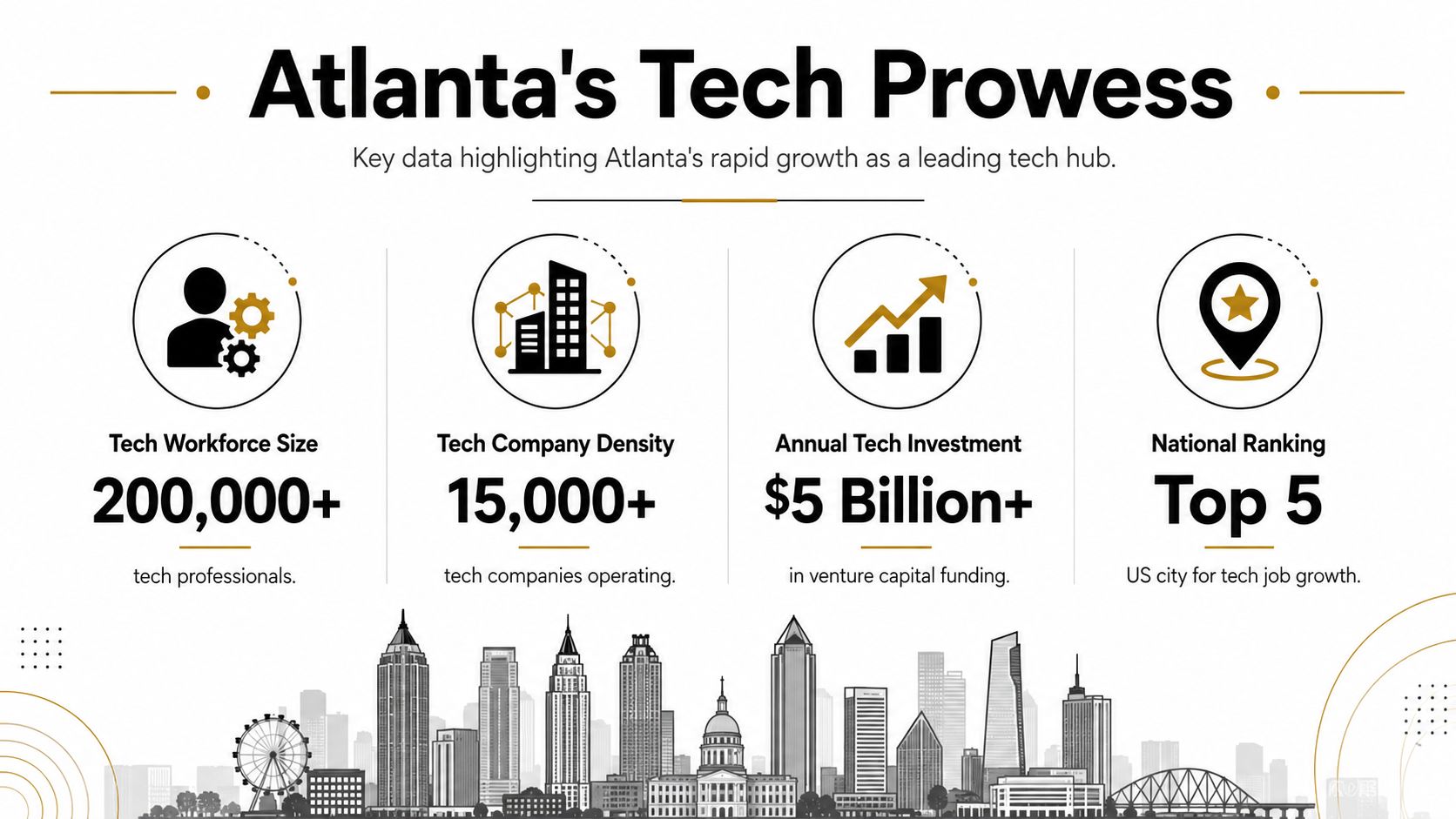
For an IT leader, that changes the interpretation of market success. A dense tech market builds a dense installed base of laptops, monitors, mobile devices, network gear, storage, and test hardware spread across headquarters, satellite offices, coworking spaces, and lab environments. Every one of those assets enters a lifecycle. Procurement gets the attention. Retirement often does not.
Talent density changes the IT math
Workforce growth affects operations first. Each hiring wave usually triggers device provisioning, access assignment, peripheral deployment, and support coverage. A year or two later, those same purchases begin to age out of policy, warranty, performance requirements, or security standards.
That creates three pressures at once:
- Asset visibility gets harder: Rapid growth often leaves equipment distributed across teams, offices, and home setups with inconsistent records.
- Data-bearing devices accumulate faster: Laptops, phones, servers, and removable media all introduce end-of-life data destruction requirements.
- Disposition risk rises with scale: Informal storage rooms, ad hoc pickups, and undocumented recycling become more likely during expansion.
This is the security-sustainability gap. The same growth that strengthens Atlanta's tech economy also increases the volume of retired hardware that must be wiped, tracked, remarketed, or recycled through documented downstream channels.
The startup economy adds another layer. Companies formed during funding surges tend to buy quickly, standardize later, and replace early equipment during their first periods of scale. That pattern is visible across the ecosystem discussed in Atlanta startup funding trends every entrepreneur should know. For ITAD planning, startup growth is not just a financing story. It is an early signal of future surplus volume.
Physical hubs reinforce the disposal burden
Atlanta's innovation clusters matter because they compress technical activity into high-turnover environments. In these hubs, startups, corporate innovation teams, and support functions often operate on short leasing timelines, shared space models, and rapid staffing changes. Hardware moves with that pace.
The operational consequence is easy to miss. Concentrated growth usually produces concentrated retirement events: office consolidations, lab closures, fleet refreshes, and post-merger cleanouts. If chain of custody is weak or downstream recycling is poorly documented, the cost of a disposal mistake can exceed the residual value of the equipment involved.
Atlanta's tech dominance therefore creates two assets at the same time: economic value and retired hardware volume. The companies that treat those retired assets as a governed security and sustainability workflow will be in a stronger position than those that treat them as leftover equipment.
The Data Center Capital of the Southeast
Atlanta's next phase isn't only about software companies and office users. It's about infrastructure.
Since mid-2023, Metro Atlanta's data center space under construction has roughly doubled every six months, pushing the region from the sixth-largest to the second-largest American data center hub, trailing only Northern Virginia, according to GovTech's report on the Atlanta data center market.

That rise changes the conversation. Atlanta is no longer just a place where tech companies hire. It's a place where critical compute, storage, and network infrastructure gets built and replaced at high volume.
What this means for enterprise hardware
Data center growth creates a different disposal profile than office growth. It concentrates higher-value and higher-risk assets in fewer locations. That includes rack servers, storage arrays, backup appliances, switches, load balancers, and the drives inside them.
A normal refresh in this environment isn't a simple pickup job. It often requires:
- Sequenced de-installation: Hardware has to come out without disrupting active environments.
- Documented custody: Teams need a chain of possession from cage or suite to final processing.
- Verified sanitization: Data-bearing assets require destruction or wiping aligned with policy.
Why Atlanta's infrastructure boom changes ITAD demand
The city's infrastructure buildout supports cloud operations and enterprise connectivity. It also guarantees future waves of decommissioning work. Every build becomes tomorrow's refresh cycle.
That's why data center operators should read Atlanta's expansion as both an opportunity and an obligation. The market discussed in why Atlanta is a prime data center hub will keep attracting capital and capacity. But once facilities mature, operators need disciplined plans for retired equipment, failed media, and phased shutdowns.
The hardware backbone of a tech hub doesn't disappear when it ages out. It moves into a risk-sensitive disposal chain.
Spotlight on Atlanta's Thriving Tech Sectors
Atlanta's growth is concentrated in sectors that carry unusually high consequences for poor hardware retirement. Fintech, healthcare technology, and enterprise software firms do not just add jobs and office demand. They expand the volume of laptops, mobile devices, servers, storage media, and network equipment that eventually enter the disposal stream with regulated data still attached.

That distinction matters for IT leaders. A city can post strong tech growth and still miss the operational pressure building underneath it. In Atlanta, expansion in high-compliance industries means end-of-life hardware is more likely to contain payment data, health information, access credentials, customer records, and internal intellectual property. The result is a larger security and governance workload, not just a larger recycling workload.
Finance and payment technology
Atlanta's reputation in fintech and payment processing creates a specific disposal profile. Companies in this segment cycle endpoint devices, office systems, and infrastructure that may touch transaction environments or connect to them. Even if a retired asset does not store cardholder data directly, it can still hold cached credentials, configuration files, network maps, and logs that create downstream risk if disposition controls are weak.
This makes ITAD part of control design, not a facilities task.
Healthcare and regulated operations
Healthcare technology firms and healthcare-adjacent employers face a similar issue, but with different compliance pressure. Retired devices can contain protected health information, user access tokens, imaging data, audit trails, or internal records tied to regulated workflows. If chain of custody breaks, the problem does not end when the asset leaves the building. It shifts into breach response, legal review, and documentation gaps that are expensive to close after the fact.
Cloud and enterprise platforms
Cloud companies and enterprise software firms create another pattern. They tend to refresh devices on tighter cycles, standardize equipment across teams, and formalize procurement as they scale. In startup clusters such as Atlanta Tech Village's innovation community, that growth model often concentrates hardware purchases early, then compresses retirement events later when firms mature, relocate, or upgrade in batches.
For IT operations, that means Atlanta's sector strength creates a timing problem as much as a volume problem. Hardware does not age out evenly. It often exits in waves tied to funding rounds, office expansions, security upgrades, mergers, and platform changes.
The strategic implication is easy to miss. Atlanta is growing fastest in sectors where retired hardware carries both data risk and reporting expectations. That is the security-sustainability gap in practical terms. The same device may require defensible data destruction, documented downstream handling, and proof that materials were processed responsibly. In a market adding tech capacity this quickly, firms that treat disposal as an afterthought create avoidable exposure.
The Security and Sustainability Gap in IT Asset Disposal
Atlanta's most overlooked tech challenge sits at the intersection of speed and responsibility. Companies upgrade equipment to stay competitive, but the faster they cycle hardware, the easier it is to treat end-of-life handling as an afterthought.
That's risky in this market. Forty-three percent of Atlanta-based businesses report upgrading their IT equipment every 2-3 years to stay competitive, generating steady demand for secure data destruction and data center decommissioning that comply with FTC Disposal Rule requirements, according to Atlanta e-waste market data.
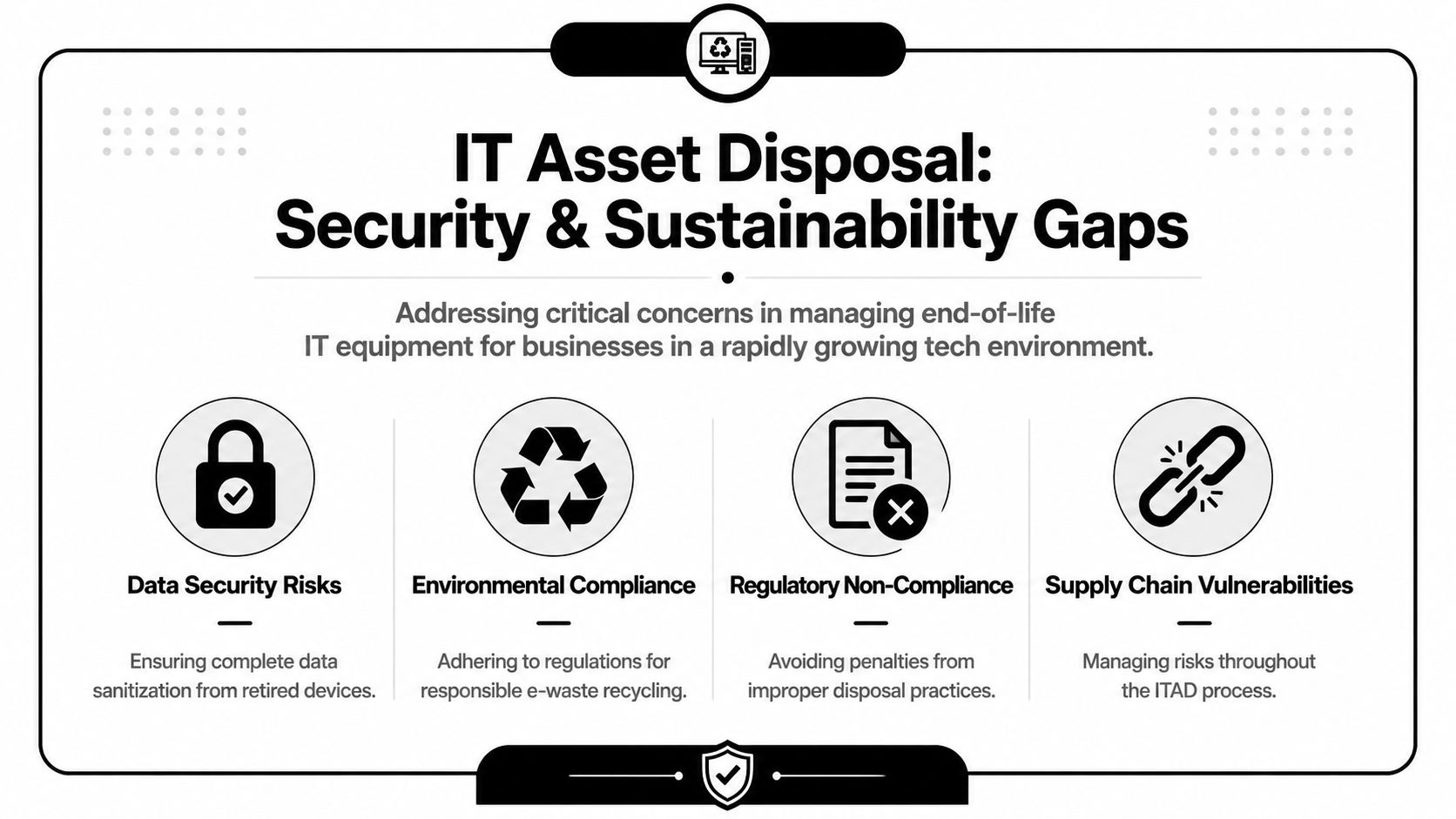
Security and sustainability often get split apart
Many organizations handle this in two separate conversations. Security teams focus on data destruction. Sustainability teams focus on diversion from landfill and ESG reporting. Procurement wants speed. Facilities wants cleared space.
That split creates the security-sustainability gap. A company may choose a vendor that's fast but weak on documentation. Or it may choose a recycler that talks about environmental responsibility without giving IT leaders confidence about data-bearing assets, serialized tracking, or certificates.
What the gap looks like in practice
The problem usually shows up in a few recurring ways:
- Unclear custody: Equipment leaves an office or data hall without a documented handoff trail.
- Weak proof of destruction: Teams get a pickup receipt, not evidence tied to media or assets.
- Recycling without governance: Sustainability goals are cited, but downstream handling remains opaque.
- Policy drift: Different departments retire equipment in different ways, creating inconsistent risk.
If a business upgrades devices on a short cycle, it needs a repeatable disposition process. Ad hoc pickups won't hold up under audit, litigation, or internal review.
Atlanta's growth as a Southeast tech hub makes this gap more urgent because volume is rising across startups, enterprise branches, and infrastructure operators at the same time. The pressure to move quickly is real. So is the obligation to retire hardware carefully, as sustainability leaders increasingly recognize in ESG trends in Atlanta sustainable IT practices.
A Strategic Approach to ITAD in Atlanta
Atlanta handles approximately 42,000 tons of e-waste annually, and 68% of that volume comes from commercial and enterprise sources, according to Atlanta e-waste market reporting. That concentration tells IT leaders something important. This isn't a side issue. Business hardware retirement is already a major operational category in the metro area.
A strong IT asset disposition program should be designed as a control system, not a cleanup service.
Start with chain of custody
The first requirement is visibility. Organizations need to know what left, when it left, who handled it, and where it went next. That applies whether the project involves laptop disposal, network closet cleanouts, or full data center decommissioning.
A useful internal standard includes:
- Asset identification: Match pickups to internal inventories wherever possible.
- Transfer records: Document the point where custody shifts from the business to the service provider.
- Final outcome records: Keep certificates of recycling and data destruction tied to the project file.
Match destruction method to asset risk
Not every asset needs the same treatment. A monitor doesn't create the same exposure as a failed solid-state drive. A retired server from a regulated environment doesn't belong in the same workflow as miscellaneous office peripherals.
That means IT leaders should define separate handling paths for:
- Data-bearing equipment
- Non-data-bearing electronics
- Equipment with resale or recovery value
- Material requiring product destruction
Good ITAD policy separates assets by risk class before pickup day. That makes the actual disposition process faster and easier to verify.
Treat sustainability as a documented outcome
Sustainability shouldn't be a marketing phrase attached at the end of the process. It should be visible in how assets are sorted, processed, and reported. That's especially important in a city with high commercial e-waste volume and a growing base of companies with formal ESG expectations.
The practical takeaway is straightforward. In Atlanta, strategic ITAD means combining secure data destruction, documented custody, environmentally responsible processing, and value recovery where appropriate. Anything less leaves a growing business exposed.
Partnering for Secure and Sustainable Growth
Atlanta's rise is real. The city has the talent base, company density, and infrastructure profile of a national technology center. But the operational consequences of that success don't stay abstract for long. They show up in storage rooms, server halls, office closures, refresh projects, and stacks of retired devices waiting for a decision.
That's why Atlanta's growth as a Southeast tech hub should change how business leaders think about disposal. End-of-life hardware is no longer a back-office afterthought. In this market, it sits at the intersection of security, compliance, sustainability, and operational discipline.
The companies best positioned to scale in Atlanta will be the ones that manage technology across its full lifecycle. They won't just buy and deploy effectively. They'll retire assets with the same rigor they apply to procurement, security policy, and infrastructure planning.
For IT managers, facility teams, procurement leaders, and data center operators, the message is clear. Growth increases opportunity, but it also increases the consequences of weak asset disposition. A documented, repeatable ITAD strategy helps convert that pressure into control.
Contact Beyond Surplus for certified electronics recycling, secure IT asset disposal, data center decommissioning, product destruction, and business-focused pickup services that support compliance, chain-of-custody documentation, and sustainable end-of-life hardware management.


