

Atlanta's AI future is already showing up in the numbers that matter to enterprise leaders. A $215 billion projected AI boost to the metro by 2030 and 126,850 local workers in occupations most susceptible to automation point to a city where AI adoption will reshape budgets, staffing, and hardware turnover at the same time (Technology Association of Georgia cited projection, MyPerfectResume AI Exposure Index for Atlanta). For IT teams, that means the question is not whether AI will change operations, it is how fast infrastructure, governance, and asset disposition have to keep up.
The practical pressure is on the physical stack as much as the software stack. New AI tools increase demand for compute, storage, power, cooling, and tighter controls around data-bearing devices, which makes secure retirement of old equipment part of the AI plan, not an afterthought. Atlanta organizations that are evaluating how AI is affecting day-to-day operations can also use this local overview of AI's business impact in Atlanta to connect adoption decisions with equipment lifecycle planning and risk management.
As AI moves from pilot projects into core workflows, Atlanta IT leaders have to treat asset lifecycle management as a governance issue. Older endpoints, servers, and storage arrays cannot be replaced and forgotten; their data, chain of custody, and disposal path all affect compliance exposure. That is why AI strategy in Atlanta needs to include retirement controls, not just deployment controls.
Understanding AI Impact in Atlanta
Atlanta's AI story is best understood as a capital planning problem, with security and asset lifecycle decisions tied directly to adoption. As noted earlier, the city stands to benefit from broad AI-driven economic gains by 2030, and that pace of change will pressure refresh cycles for endpoints, servers, storage, and networking gear as organizations modernize their stacks. AI does not run on software alone. It depends on compute, storage, power, cooling, and a controlled exit path for older equipment.
What the workforce data really signals
The local labor picture points in the same direction. In Greater Atlanta, 126,850 workers sit in occupations most exposed to AI automation, with customer service representatives and personal financial advisors among the clearest examples of task-level vulnerability. That does not automatically mean mass replacement. It does mean workflow redesign, role reassignment, and more digital systems handling regulated information.
For Atlanta IT leaders, the practical issue is how fast those changes move into the hardware estate. As local analysis of AI's impact on Atlanta businesses shows, adoption decisions quickly affect procurement, inventory control, endpoint security, and secure disposal planning. Each AI pilot can trigger changes in asset tracking, data retention, and chain-of-custody procedures, especially when business units automate customer interactions or financial workflows. That raises the risk that aging devices, storage media, and retired servers become weak points if they are not removed and destroyed under a defined process.
The implication for enterprise teams is direct. AI changes what companies own, how fast they replace it, and how carefully they have to retire it. Atlanta's future is not only about building smarter systems. It is about managing the lifecycle of the systems already in place while the city moves into a more automated economy.
Key Trends Shaping Atlanta's AI Future
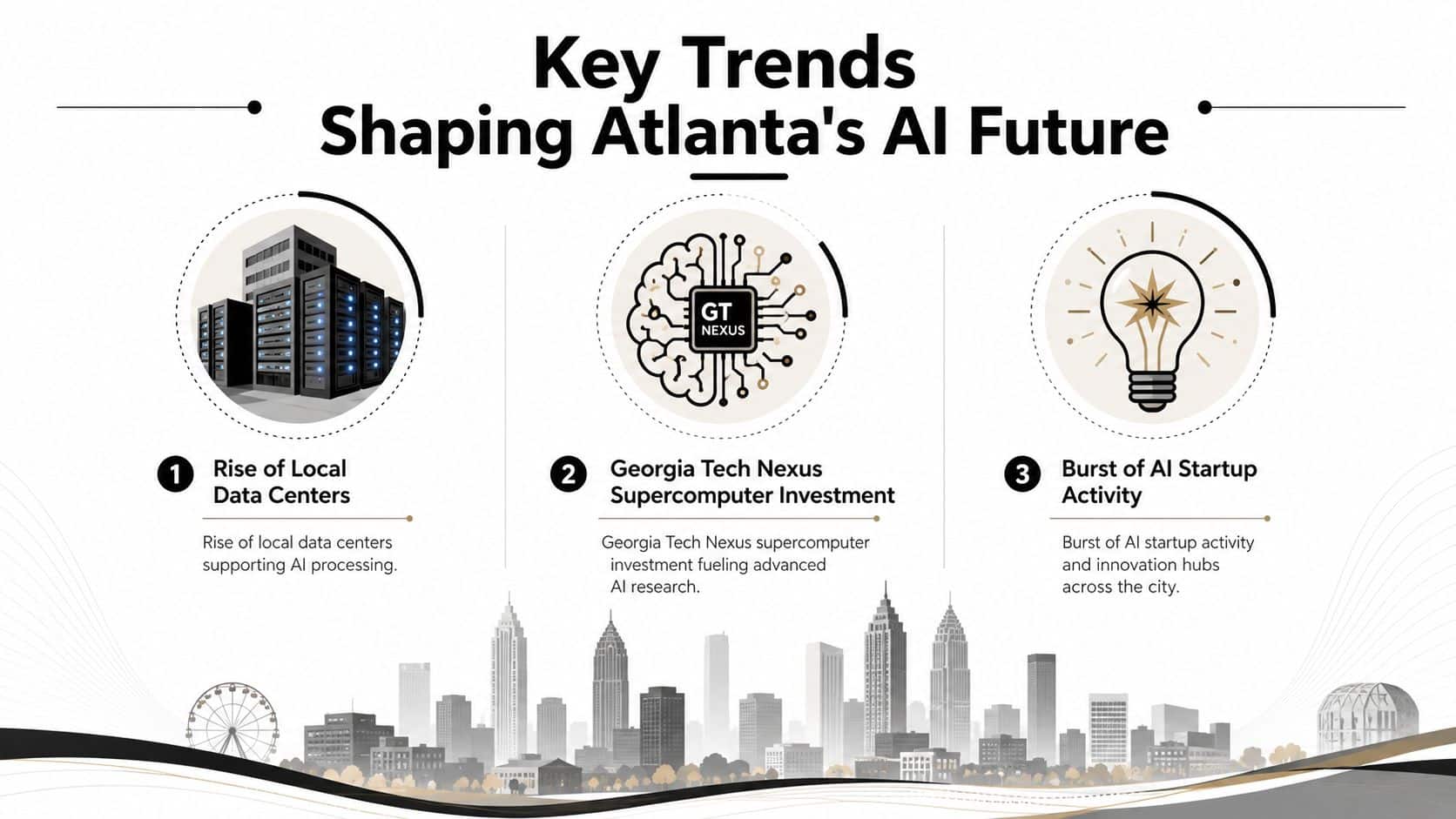
Atlanta's AI momentum is being shaped by three forces that matter to IT planners, research capacity, local demand for compute, and the pressure to bring AI into production before governance teams have fully adjusted. Georgia Tech's $20 million NSF award for Nexus, an AI-powered supercomputer, is the clearest sign that the region is investing in high-throughput infrastructure, not just experimentation (Nucamp coverage of Georgia Tech Nexus funding). That level of compute demand does not stay inside academia. It shapes vendor roadmaps, cloud capacity decisions, and enterprise expectations for AI performance across the city.
Research, startups, and the infrastructure pull
Research matters because it raises the standard for what local organizations expect AI to deliver. When universities stand up serious compute platforms, businesses begin comparing their own environments against a more advanced benchmark. Procurement teams respond by looking harder at GPUs, denser server configurations, and refresh cycles that can keep pace with model training and inference needs.
Atlanta's startup community adds a different kind of pressure. Many of the most practical companies in the market focus on deployment, not spectacle, so the conversation shifts quickly from ideas to execution. That puts infrastructure, data handling, and compliance in the critical path.
The operational pattern is familiar in major metros. Once AI moves from pilots into production systems, hardware replacement accelerates, storage arrays linger in back rooms longer than they should, and informal disposal becomes a risk multiplier. For IT leaders, the right assumption is simple, AI growth will increase compute demand and the volume of legacy equipment waiting to be retired.
A useful local reference point is Atlanta's major IT investments coming in 2026, since infrastructure planning, procurement timing, and end-of-life recovery are becoming linked decisions. Teams also evaluating build-versus-buy choices can review AI development services for a clearer view of how software decisions affect the underlying hardware estate.
Why these trends change the asset lifecycle
The operational consequence is direct. More AI means more upgrades, and more upgrades mean more decommissioning work. Atlanta's AI future should therefore be read alongside asset recovery, secure wiping, documented recycling, and chain-of-custody controls, especially for systems that hold sensitive customer or operational data.
That is where asset lifecycle discipline becomes part of AI governance. As organizations refresh servers, storage, and endpoints to support new workloads, they also need a defined process for retiring devices that no longer belong in active service. In a market like Atlanta, where infrastructure expansion is likely to arrive in waves, teams that plan disposal early will have a cleaner path through compliance, lower residual data risk, and fewer surprises when the next round of capital spending lands.
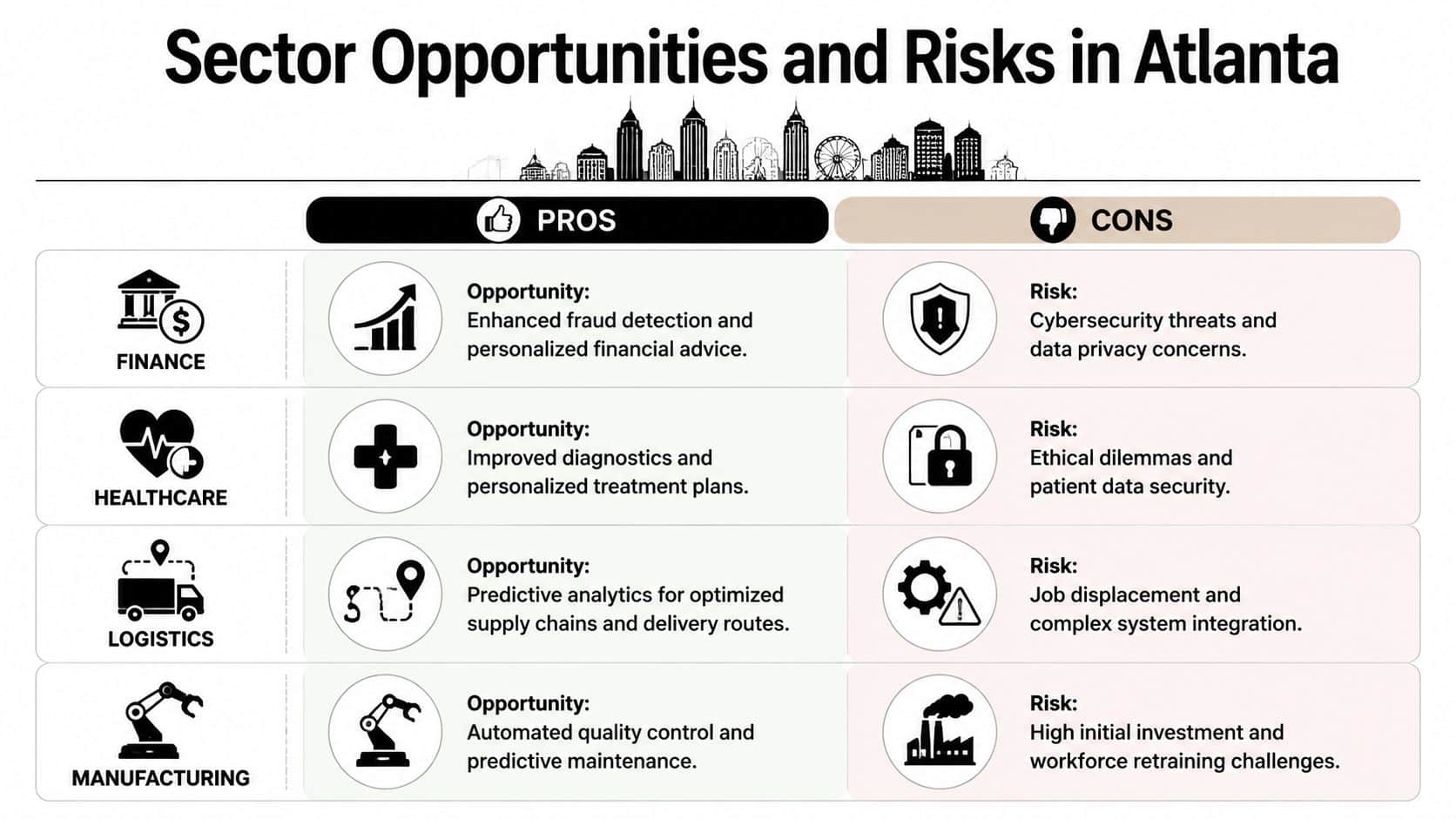
Sector Opportunities and Risks in Atlanta
Atlanta's AI opportunity set is broad, but the operational risk profile is not. Finance, healthcare, logistics, and manufacturing each gain different forms of efficiency from AI, and each creates a different burden on data controls, infrastructure, and device retirement. Atlanta IT leaders should read sector adoption as an asset lifecycle issue as much as a software decision, because every new AI workload eventually leaves older servers, storage arrays, laptops, and endpoints waiting for disposition.
Finance and customer-facing functions
Atlanta's finance teams are under pressure to automate repetitive service work while preserving trust. Local exposure data shows customer service roles have 44% of tasks susceptible to AI automation, and personal financial advisors face 35% task exposure despite an average annual salary of $155,480 (MyPerfectResume AI Exposure Index for Atlanta). That mix points to practical use cases such as AI-assisted routing, triage, and advisory support, but it also raises the bar for privacy controls, auditability, and model oversight.
For finance organizations, the main risk is not only a bad model recommendation. It is the hardware and data trail behind the recommendation. If customer records sit on aging systems that are being replaced to support automation, those assets need secure wiping, documented transfer, and final disposition that matches the sensitivity of the data they held.
Healthcare, logistics, and manufacturing
Healthcare can gain from AI when analysis moves faster, record handling improves, and clinical workflows become easier to manage. The risk appears as soon as AI touches patient data or connected devices, because weak governance quickly becomes a compliance problem instead of an IT issue. Hospitals and care networks also face a disposal challenge that often gets overlooked, since medical systems tend to carry sensitive data longer than other devices and cannot be retired casually.
Logistics teams can use AI to reduce friction in routing, forecasting, and warehouse operations. The weak point is integration, especially when older systems stay in service while new tools are layered on top. That creates a mixed environment with uneven controls, more endpoints to retire later, and greater exposure if old equipment is not tracked from procurement through final wipe and recycling. Atlanta firms that are mapping growth sectors can use Atlanta's fastest growing industries in 2026 as a practical reminder that AI demand is likely to spread through the city's supply chain, not stay confined to one department.
Manufacturing has the clearest upside in predictive maintenance and quality control. It also carries the heaviest retraining burden because plant systems rarely refresh on the same schedule as office IT. That mismatch matters for asset disposition planning. As production hardware is replaced in stages, teams need a clear process for isolating data-bearing components, handling hazardous material where required, and documenting the path from active use to retirement.
A strong AI project in Atlanta should answer three questions cleanly. What data does it use, how does it make decisions, and what happens to the equipment when the workload changes?
For teams building those systems, AI development services matter most when they are tied to infrastructure limits, security review, and the retirement plan for the hardware estate, not just model quality.
Building Secure AI Infrastructure in Atlanta
Atlanta's AI infrastructure challenge starts with a simple fact, every new system makes some older system obsolete. Commercial disposal in the city requires splitting inventory into data-bearing assets that need secure destruction and hazardous components that fall under RCRA, with separate certificates issued for each (Georgia e-waste laws analysis). That operational split should shape the entire AI hardware lifecycle.
The right sequence for legacy equipment
The best sequence begins before the replacement order lands. Inventory should be mapped by function, data sensitivity, and hardware class so IT teams know what needs wiping, what needs shredding, and what needs special handling. From there, decommissioning should be scheduled to avoid disruption to production systems and to keep chain-of-custody records intact.
The practical value of this approach is that it treats AI readiness and disposal readiness as one workflow. If a team is upgrading storage, inferencing nodes, or user endpoints for AI deployment, the old assets shouldn't sit idle while procurement catches up. They should move through a documented retirement path immediately.
Why documentation matters in regulated environments
Certificates matter because they support liability transfer and prove the work happened. That is especially important in Atlanta sectors where customer records, financial files, or health information may still exist on retired equipment. If the organization can't show what was wiped, what was recycled, and what was destroyed, it's carrying unnecessary risk.
Why Atlanta is a prime data center hub becomes easier to understand when you view the market through this lens. Dense infrastructure creates faster refresh cycles, and faster refresh cycles create more disposal events.
A practical deployment checklist looks like this:
- Classify every asset first. Separate servers, storage, user devices, and peripheral gear before any refresh begins.
- Isolate sensitive devices. Anything with customer, employee, or patient records needs secure data destruction.
- Route hazardous materials correctly. Components subject to RCRA need their own handling path.
- Keep certificates together. Recycling and destruction records should be stored with procurement and security documentation.
- Time pickups with project milestones. AI rollouts stall when retired equipment clutters secure space.
Governance Essentials for AI in Atlanta
Georgia's compliance environment gives Atlanta leaders less room for sloppy execution than many teams assume. The state does not have a unified statewide electronics take-back mandate, so businesses must rely on federal waste and data-protection rules plus local compliance controls (Beyond Surplus compliance guide). That patchwork reality makes governance a board-level issue, not a facilities afterthought.
What governance has to cover
AI governance starts with data classification. If a model touches personal, financial, or health information, the organization needs clear ownership over who approved the data, where it lives, and how long it stays in circulation. Human oversight matters too, because automated outputs without review can create downstream legal and operational errors.
Documentation is the second pillar. Teams should be able to trace model inputs, device custody, and retirement records without digging through email threads. That trail becomes especially important when old hardware is repurposed, resold, or shredded. If the proof isn't easy to produce, the process isn't strong enough.
Practical rule: if a retired system ever held sensitive data, assume the audit trail will be reviewed later, then build the paperwork now.
How Atlanta teams should think about compliance
The local regulatory patchwork means AI programs have to fit into existing federal obligations, not replace them. For that reason, disposal controls should be written into procurement, security, and vendor management policies from the start. The right governance model treats hardware disposal as a control, not a cleanup task.
A mature checklist usually includes these items:
- Data lineage review before any AI pilot goes live.
- Retention and destruction rules for the systems supporting the pilot.
- Vendor documentation for recycling, wiping, and chain of custody.
- Escalation paths for regulated records and sensitive assets.
- Human sign-off before retired equipment leaves the site.
Action Steps for IT Leaders in Atlanta
Atlanta IT leaders need a deployment model that assumes AI adoption will continue to accelerate hardware turnover. The best practice is to receive certificates of recycling and data destruction after every pickup so liability moves with the asset, not with the last person who touched it (Beyond Surplus electronics waste disposal guidance). That sounds administrative, but it's really a control point for security and compliance.
A practical rollout sequence
Start with a full hardware audit. Know what's in production, what's sitting in storage, and what's already eligible for retirement. Then separate assets into two lanes, one for secure destruction and one for compliant recycling, because the treatment path isn't the same for both.
After that, align disposal timing with AI project milestones. If a refresh is tied to a new model deployment, the old gear should be removed on the same project calendar. Delays create security gaps, and gaps are where legacy devices get forgotten.
Finally, make paperwork part of the workflow. Certificates, pickup records, and internal approvals should all live in the same compliance file. That way, if the organization is ever asked to prove what happened to a device, the answer is already organized.
Keep the disposal process boring. In regulated AI environments, boring means documented, repeatable, and defensible.
What to ask every vendor
Ask how they handle data-bearing devices, how they separate hazardous components, and whether their certificates clearly identify the asset class processed. Those questions matter because they reveal whether the vendor understands enterprise risk or just moves hardware.
Partnering with Beyond Surplus for IT Asset Disposition
Atlanta's AI growth will reward organizations that modernize quickly and retire hardware cleanly. ITAD services in Atlanta matter because AI projects create a constant stream of displaced laptops, servers, storage devices, and peripherals, and those assets can't be treated like ordinary waste.
Beyond Surplus fits that environment because it combines secure data destruction, certified recycling, logistics coordination, and chain-of-custody documentation into one B2B service model. For Atlanta IT teams balancing AI adoption with compliance pressure, that kind of support reduces risk, supports liability transfer, and helps keep refresh cycles from slowing down the business.
If your organization is planning AI expansion, data center decommissioning, or a large hardware refresh, contact Beyond Surplus for certified electronics recycling and secure IT asset disposal.


