

A laptop disappeared between a healthcare provider's pickup and the vendor's processing facility. The vendor had a disposal receipt, but not a complete timeline showing who handled the device, where it moved, or what happened to its data. That gap turned a routine ITAD transaction into a security and compliance problem.
Table of Contents
- What Audit Trail Reporting Actually Means
- Anatomy of a Defensible Event Record
- Why Audit Trail Reporting Matters Across Security and Compliance
- How Audit Trails Travel With Each IT Asset
- Logging, Retention, and Tamper-Evident Storage Best Practices
- Regulatory Requirements That Depend on Audit Trails
- Implementation Roadmap With KPIs You Can Measure
- Sample Templates, Common Mistakes, and Your Next Steps
What Audit Trail Reporting Actually Means
In IT asset disposition, audit trail reporting means capturing, timestamping, linking, and presenting meaningful events across an asset's lifecycle. The record can begin with procurement and deployment, continue through maintenance and retirement, and end with data sanitization, destruction, recycling, or resale. A useful trail lets a reviewer reconstruct who did what, when, where, and with what result.
A raw event log is only source material. It might show that a barcode was scanned, a shipment was received, or a wipe process ended successfully. A finished audit trail report connects those entries to one asset, orders them chronologically, identifies the responsible people or systems, and attaches supporting evidence. That distinction matters when an auditor, regulator, customer, or attorney needs a defensible record rather than a folder of disconnected files.
A typical data-bearing laptop can generate many linked events between warehouse intake and its final certificate. Those events may include collection, custody transfer, facility receipt, serial-number verification, storage location changes, sanitization, quality review, disposition approval, and certificate issuance.
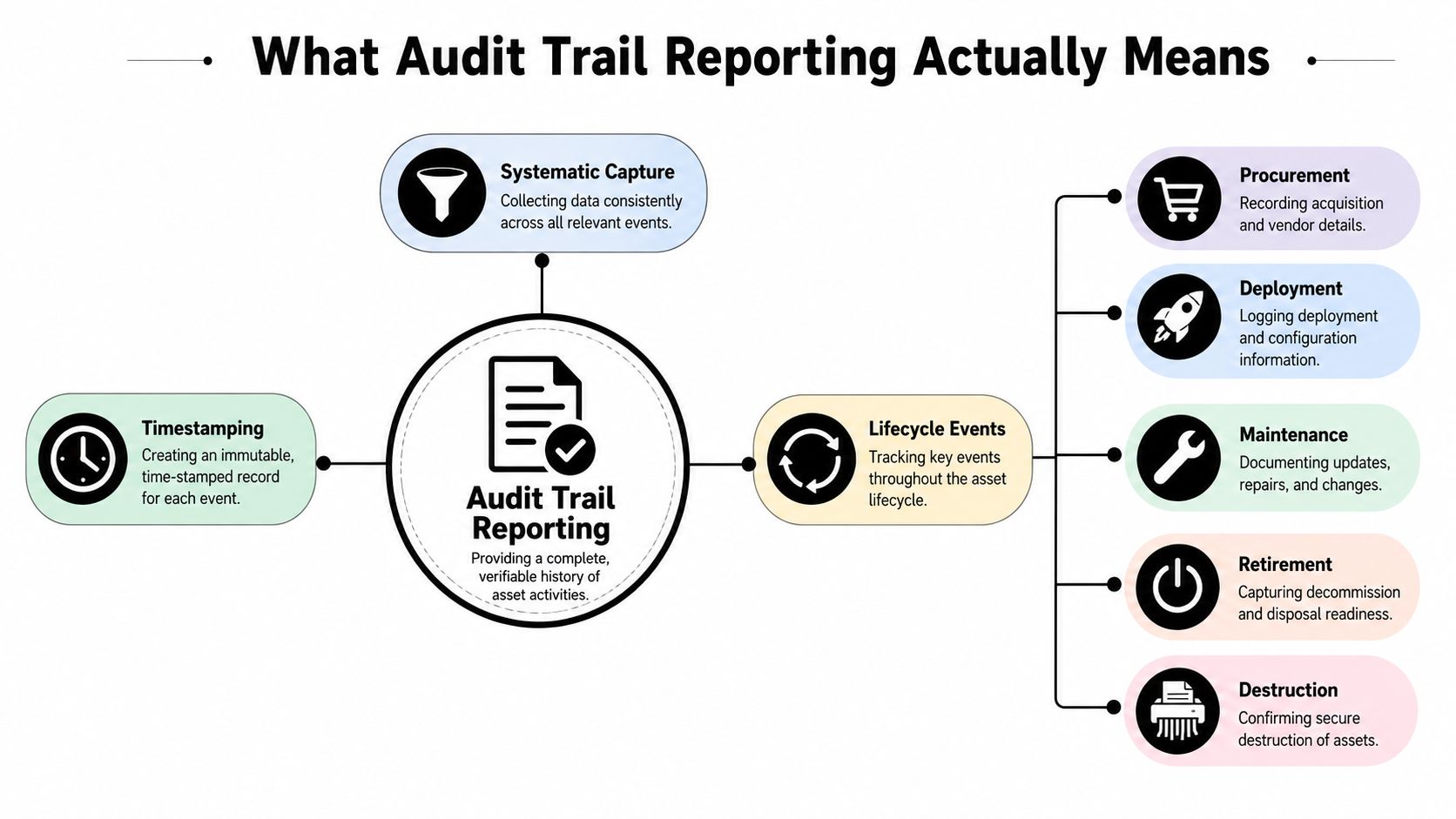
The difference between logs and reports
Think of raw logs as individual security-camera clips. They may be authentic, but someone still has to establish which clips belong to the same incident and arrange them into a coherent sequence. The report is that sequence, supported by the underlying records.
This lifecycle view is central to understanding IT asset disposition. The FTC Disposal Rule requires businesses that possess consumer reports or related records for a business purpose to use appropriate disposal measures, including destroying or erasing electronic media so information can't be read or reconstructed. FTC disposal requirements make the quality of the evidence important, not just the physical act.
Anatomy of a Defensible Event Record
A defensible event record has enough detail to stand on its own and enough shared identifiers to connect with neighboring events. Industry guidance identifies core evidence such as an authenticated user or system ID, an exact timestamp, the action, the affected object, the source application, and the outcome. Audit trail guidance on event evidence and tamper-evident controls provides the underlying model.
Start with these fields:
Unique event identifier. This is the record's tracking number. It prevents two similar events from being confused and makes later investigation faster.
Precise timestamp and timezone. A timestamp works like a notary's seal. Without a consistent timezone, a pickup recorded by a logistics platform may appear to occur after facility receipt.
Actor identity. Record the employee, technician, driver, vendor account, or automated service responsible for the action. “System user” is too vague when a reviewer needs accountability.
Source system or device. Identify the warehouse application, transportation platform, scanner, wipe station, or other origin. This shows where the event came from and helps investigators assess its reliability.
Event classification. Use clear types such as retirement, pickup, transfer, receipt, sanitization, destruction, recycling, resale, or approval. Consistent categories make reports searchable.
Affected asset reference. Tie the event to the asset ID and, where available, serial number, IMEI, or other unique identifier. An event without an asset reference may be impossible to connect to a certificate.
Supporting evidence pointer. Link the event to a signed transfer, scan record, photo, work order, wipe output, weight record, or certificate.
Integrity hash. A hash acts like a tamper-evident bag seal. It doesn't explain the contents, but it helps show whether the record changed after creation.
Connect every field
The fields must connect across the lifecycle. The intake record identifies the laptop, the transfer record identifies the next handler, and the sanitization record uses the same asset reference. A missing serial number, unexplained time change, or shared technician account creates a weak point in the chain.
Use chain-of-custody documentation practices to align physical handoffs with digital events. The record is only as strong as its weakest field, so a polished final PDF can't repair missing evidence at intake.
Why Audit Trail Reporting Matters Across Security and Compliance
Audit trail reporting joins three evidence needs that teams often manage separately: cybersecurity, physical custody, and regulatory compliance. A security analyst wants to reconstruct activity around a suspected breach. An asset manager needs to prove that a device moved through approved hands. A compliance reviewer needs evidence that the organization applied its policies consistently.
Cybersecurity reconstruction
After a breach or suspected loss, investigators need more than a final disposition status. They may need to establish when an asset was retired, whether it was still assigned to a user, who collected it, whether it reached the processing site, and whether a sanitization event completed. Structured records can also feed security monitoring and incident timelines when ITAD systems connect with broader security tooling.
Teams reviewing response performance can benefit from guidance on incident management key roles and KPIs, particularly when asset custody becomes part of the incident record.
Physical custody and legal proof
A physical handoff without a corresponding signature, scan, or location record leaves room for dispute. If a shipment is lost, a report should identify the last confirmed custodian and the next expected event. A certificate that lacks a device-level connection may prove that some equipment was processed, but not that the missing laptop was included.
Compliance evidence
Different obligations may apply to healthcare, financial, payment, privacy, and public-sector environments. The report supports the organization's broader control framework by connecting policy, action, identity, and outcome. It can also support environmental documentation when item-level inventory and weights are required.
Practical rule: A certificate should answer which asset was processed, what method was used, who performed it, and how the supporting events connect.
How Audit Trails Travel With Each IT Asset
Take one retired business laptop. Its audit trail should grow as the device moves, rather than being recreated from memory at the end.
Retirement and collection
The originating organization records the retirement decision, asset identifier, previous owner or department, and pickup request. At collection, the handler scans the device and records custody acceptance. A signed transfer or electronic confirmation establishes that the laptop left the customer's control at a defined point.
The transport record adds shipment or route information, the responsible carrier or driver, and the next expected destination. If the asset arrives with damaged packaging or a changed condition, the receiving employee records that difference instead of overwriting the intake description.
Intake and inventory
At the processing facility, staff scan the serial number, verify the make and model, document condition, and associate the laptop with the customer's work order. Industry ITAD guidance treats this as device-level documentation, with certificates that can include serial number or IMEI, make and model, storage details when known, destruction method, standard applied, date, and responsible technician. Device-level IT disposal reporting guidance explains why batch summaries are weaker than serialized records.
Sanitization or destruction
The next event identifies the selected disposition path. A sanitization record may contain the method, station, operator, completion status, and verification result. Physical destruction should identify the method and technician, while recycling records can add material and weight information where required. EPA materials describe item-level environmental reports that can list manufacturer, model, description, serial number, and weight for processed equipment. EPA electronics recycling reporting material shows the value of detailed inventory.
The final report compiles the linked events into one reviewable artifact. A regulator, customer, or internal auditor shouldn't have to reconcile unrelated spreadsheets to determine whether the device reached its stated disposition.
Logging, Retention, and Tamper-Evident Storage Best Practices
A basic log becomes defensible when the organization controls how events are captured, how long records remain available, and how alterations are detected. These choices should match asset sensitivity, regulatory exposure, operational scale, and the team's ability to maintain the controls.
Logging starts with consistent timestamps, synchronized clocks, structured event formats, and controlled access. Append-only databases or write-once storage can prevent ordinary users from editing historical entries. Retention then determines whether the evidence is still available when a customer asks a question or an investigation begins. Encrypt records at rest and restrict retrieval to authorized roles.
Tamper-evident protection adds another layer. Cryptographic hashing, digital signatures, hash chaining, and WORM storage can reveal unauthorized changes or deletion. More complex approaches, such as third-party time-stamping or blockchain anchoring, may add assurance, but they also introduce implementation and maintenance demands.
| Pillar | Basic Approach | Mature Approach | Best For |
|---|---|---|---|
| Logging | Capture key intake, transfer, processing, and disposition events | Standardized, structured capture across systems with synchronized clocks | Teams establishing consistent evidence |
| Retention | Store reports and source records in access-controlled archives | Risk-based retention with encrypted archival tiers and documented holds | Organizations managing long-lived compliance records |
| Tamper-evident storage | Restrict editing and preserve append-only records | Combine hashing, signatures, and write-once controls | Sensitive assets and frequent audits |
Match controls to the workflow
Don't collect fields that no system owner can validate. A smaller set of reliable, linked events is more useful than a large export filled with shared accounts and inconsistent timestamps. For data sanitization decisions, align the workflow with NIST SP 800-88 guidance and preserve the method, result, and responsible operator in the record.
Regulatory Requirements That Depend on Audit Trails
Audit trail reporting can support several compliance areas through one consolidated lifecycle record, but the report doesn't replace legal interpretation or an organization's control assessment. The practical objective is to map each obligation to evidence fields already created during intake, custody, processing, and disposition.
Privacy and sensitive information
Privacy programs need evidence that the organization handled information according to approved processes. A lifecycle report can connect the asset to its business owner, custody history, sanitization outcome, and final disposition. For healthcare operations, the same evidence can support review of how devices containing protected information were retired and processed.
Financial and payment environments
Financial organizations may need to demonstrate control over data-bearing hardware associated with accounting systems. Payment environments require careful handling of media that may contain cardholder data. Asset references, approval events, sanitization results, and retained certificates help reviewers trace the control from decision to completion.
Sanitization and environmental records
NIST SP 800-88 provides a framework for selecting and documenting media sanitization approaches. Environmental programs may also require records that identify processed equipment and material weights. The same serial-numbered inventory can support security evidence and recycling documentation, reducing duplicate data entry.
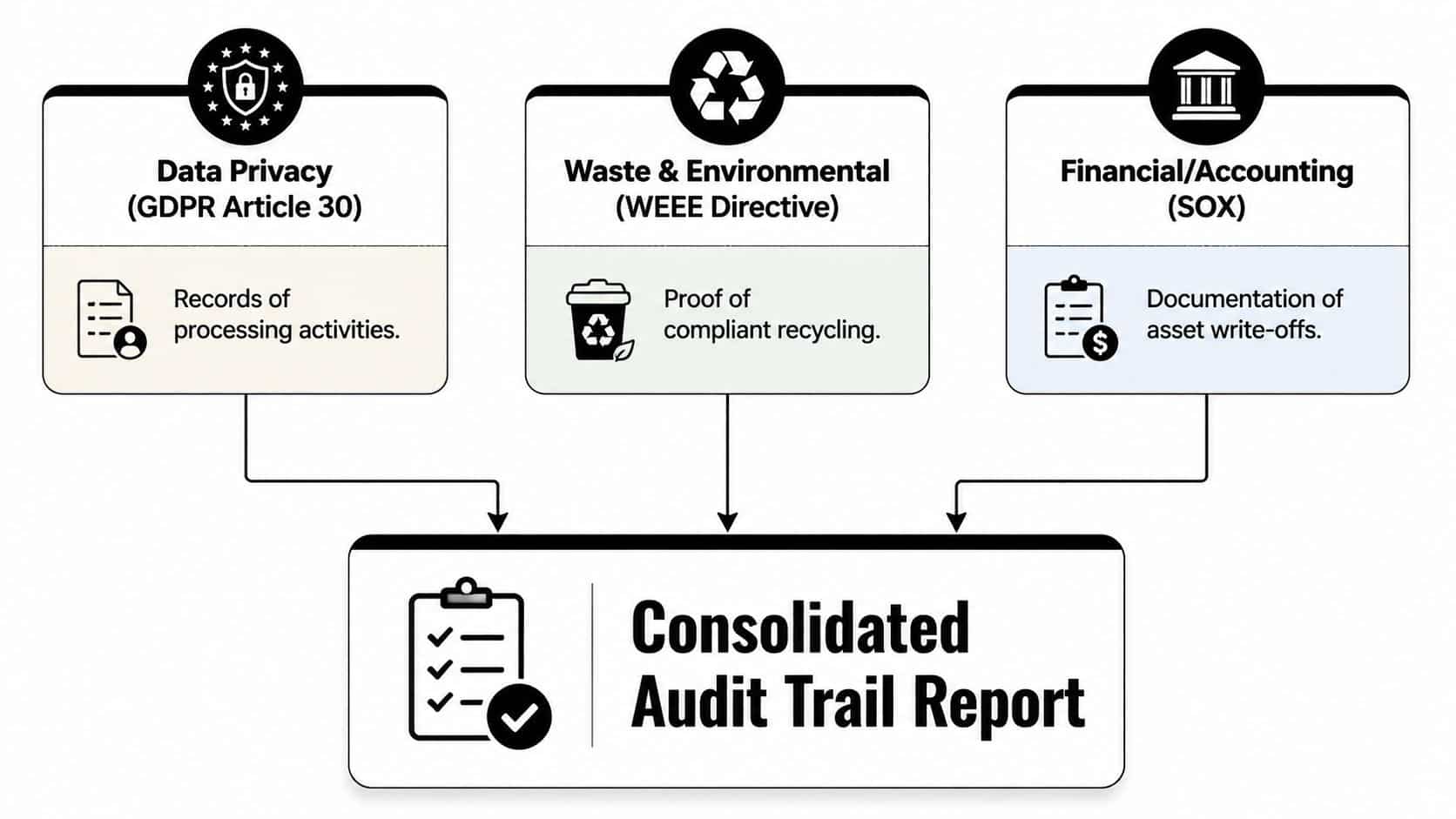
In the United States, financial-market oversight demonstrates the scale of structured audit trail reporting. SEC Rule 613 required FINRA and national securities exchanges to create the Consolidated Audit Trail, which collects order, cancellation, modification, and execution data across exchange-listed equities and options. FINRA says members handling NMS stocks, OTC equity securities, or listed options must report to CAT, including firms of different sizes. Industry members already reporting to OATS began CAT reporting on June 22, 2020, while smaller members not previously in OATS were scheduled later, in December 2021. KPMG's audit trail reporting discussion documents this milestone.
Implementation Roadmap With KPIs You Can Measure
A practical rollout starts with the workflow, not the dashboard. Assign an owner, identify every system and vendor involved in disposition, and select a representative group of assets for a pilot. Document where serial numbers, custody signatures, sanitization results, and certificates currently live.
Build in phases
Phase one focuses on discovery. Interview security, facilities, procurement, finance, and ITAD stakeholders. Map the current process from retirement request to final disposition, then record every manual handoff and missing field.
Phase two standardizes capture. Define event names, required fields, identity rules, timezone conventions, and exception handling. Integrate vendor feeds where practical and place finalized records in tamper-evident storage.
Phase three automates review. Generate consolidated reports, create exception alerts, and give control owners dashboards that show incomplete custody records, delayed processing, or certificates awaiting approval.
Avoid invented targets before collecting a baseline. A KPI is useful only when the organization defines the measurement method, owner, reporting frequency, and action threshold.
| Phase | Milestone | Key KPI | 12-Month Target |
|---|---|---|---|
| Discovery | Workflow and gap map approved | Assets sampled with documented lifecycle fields | Target set after baseline |
| Standardization | Required event schema active | Complete chain-of-custody record rate | Target set after baseline |
| Integration | Vendor and internal feeds connected | Time from disposition event to logged entry | Target set after baseline |
| Automation | Reports and alerts operating | Certificate issuance turnaround | Target set after baseline |
| Governance | Review cadence established | Audit exception rate and report delivery SLA | Target set after baseline |
Review metrics with the control owner, not just the ITAD coordinator. A vendor due diligence checklist can help procurement test whether a provider's evidence, security controls, reporting process, and escalation terms match internal requirements.
Sample Templates, Common Mistakes, and Your Next Steps
A useful template makes the expected evidence clear before the first device arrives. Keep each form tied to the asset identifier and design it so a reviewer can follow the record without contacting the technician who created it.
Four practical templates
Intake log: Capture customer reference, asset ID, serial number, make and model, condition, date received, receiving employee, and source documentation.
Custody transfer form: Record releasing and receiving parties, transfer date and timezone, asset count, identifiers, packaging condition, signatures, and exception notes.
Sanitization certificate: Identify the device, media type, method, standard or procedure applied, operator, completion status, verification result, and date.
Final disposition summary: Connect the earlier events and list the final outcome, certificate reference, recovery or recycling evidence, unresolved exceptions, and reviewer approval.
Preventable weaknesses
Missing serial numbers make certificates difficult to match to physical devices. Require scanning at intake and stop processing when the identifier is absent or unreadable.
Mutable storage allows a privileged user to change history without detection. Preserve source records in append-only or WORM storage and monitor administrative access.
Mixed timezones create confusing sequences across carriers and facilities. Store timestamps consistently and display the timezone in reports.
Skipped secondary review leaves errors undiscovered. Require an independent check for exceptions, failed sanitization results, damaged assets, and certificate issuance.
A data destruction audit trail should follow each medium from custody through destruction and recycling as a connected sequence, not as a single end-of-process statement. A data destruction certificate becomes more useful when it points back to serialized intake, custody, processing, and approval records.
For business teams, Beyond Surplus provides serialized asset reporting, chain-of-custody documentation, secure data wiping, physical destruction, electronics recycling, and certificates that support internal governance and compliance records. Review your current gaps, test the templates against a real disposal workflow, and evaluate whether your ITAD provider can produce evidence-quality reports without manual reconstruction.
Beyond Surplus supports commercial electronics recycling and IT asset disposal with documented pickup, transfer, data destruction, recycling, and final disposition events. Visit Beyond Surplus to discuss a secure, device-level reporting process for your organization's retired technology.


