

A 200-laptop refresh has reached the loading dock. Finance expects recoverable value, security needs proof that every drive was sanitized, and the ITAD provider needs a reliable condition record before it can quote buyback or recycling. A quick sort into “working,” “broken,” and “mystery” won't settle those competing requirements.
A defensible equipment condition assessment turns each device into an evidence-backed disposition decision. The record connects the serial number, physical and functional findings, sanitization evidence, valuation inputs, and final route. That discipline matters across laptops, desktops, servers, medical equipment, laboratory equipment, and data center hardware.
Condition-based assessment is now a mainstream maintenance practice. A 2026 systematic review from NIST noted that vibration is the most common measurand used in industrial condition monitoring. The same source reports that the global machine condition monitoring market was estimated at USD 3.78 billion in 2025 and is projected to reach USD 6.58 billion by 2033, a 7.0% CAGR from 2026 to 2033. ITAD teams can apply the same principle to retired technology: observe the asset, document the evidence, and make the next action traceable.
Table of Contents
- Why Equipment Condition Assessment Decides Buyback or Recycling
- Pre-Assessment Preparation and Asset Identification
- Physical and Functional Inspection Checklist
- Diagnostic Tests and Cosmetic Grading
- Documentation and Chain-of-Custody
- Evidence of Data Sanitization
- Valuation Inputs for Buyback vs. Recycling
Why Equipment Condition Assessment Decides Buyback or Recycling
The assessment is the point where a returned asset stops being an unidentified object and becomes a controlled business record. A laptop with an intact chassis, detected storage, a passing display, complete accessories, and documented sanitization may qualify for resale or buyback. A device with a swollen battery, cracked board, missing storage, or failed diagnostics may need repair, parts recovery, or recycling.
The difference isn't cosmetic preference. It's whether the vendor can defend the route selected for that specific serial number.
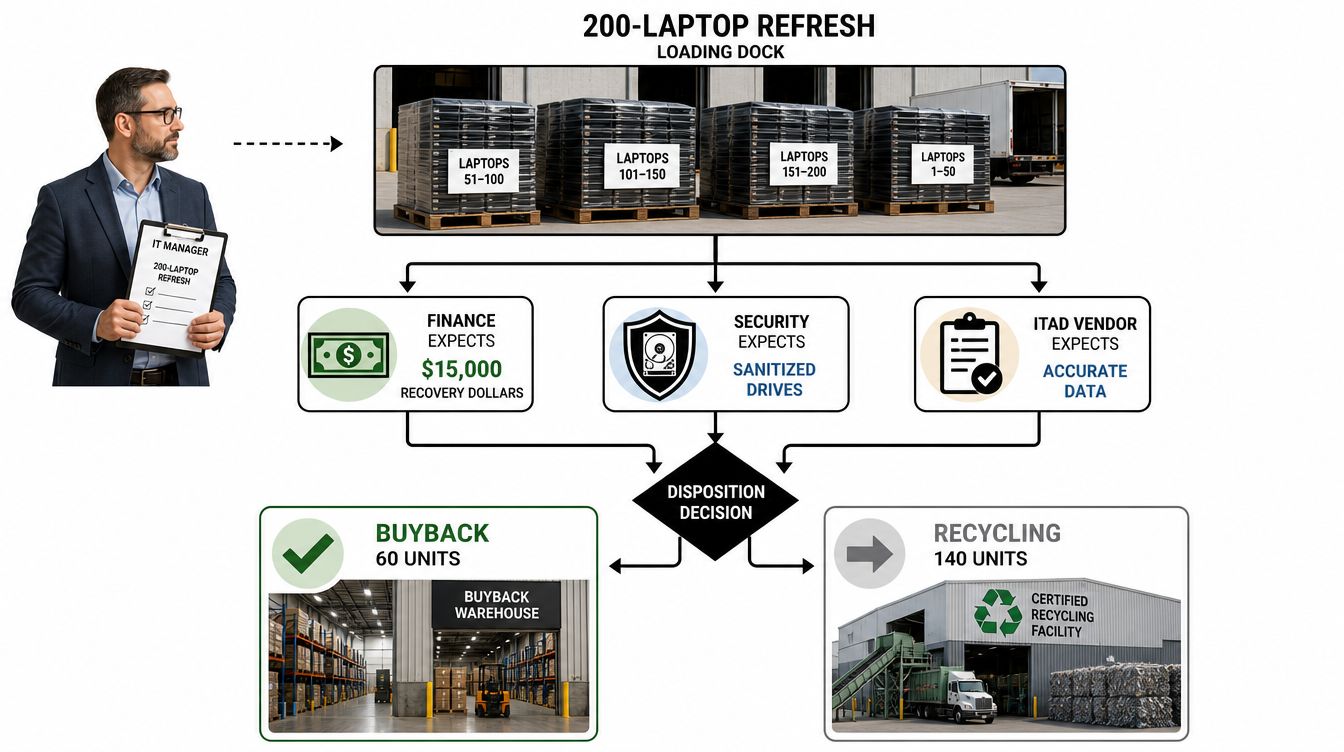
A structured record should connect:
- Identity: Serial number, asset tag, make, model, and configuration.
- Condition: Physical grade, functional results, missing components, and photographs.
- Security: Sanitization method, completion result, certificate identifier, and operator.
- Disposition: Buyback, redeployment, refurbishment, parts recovery, product destruction, or recycling.
That record gives finance a valuation input and gives security a verifiable endpoint. It also gives operations a way to resolve discrepancies without reopening the entire shipment.
Practical rule: If the grade, serial number, and sanitization certificate don't point to the same asset record, the assessment isn't complete.
This is particularly important for mixed loads. A data center decommissioning project may contain rack servers, switches, storage arrays, optics, batteries, and peripherals with very different recovery values and handling requirements. Medical and laboratory equipment adds another layer because specialized moving and handling considerations can affect intake condition. For context, the TLC Moving & Storage medical equipment guide is useful when planning the physical movement of sensitive equipment before assessment begins.
The disposition logic should be documented rather than implied. Beyond Surplus's guidance on ITAD versus e-waste recycling in Georgia illustrates why asset identity, data security, and material routing need to remain connected throughout the process.
Pre-Assessment Preparation and Asset Identification
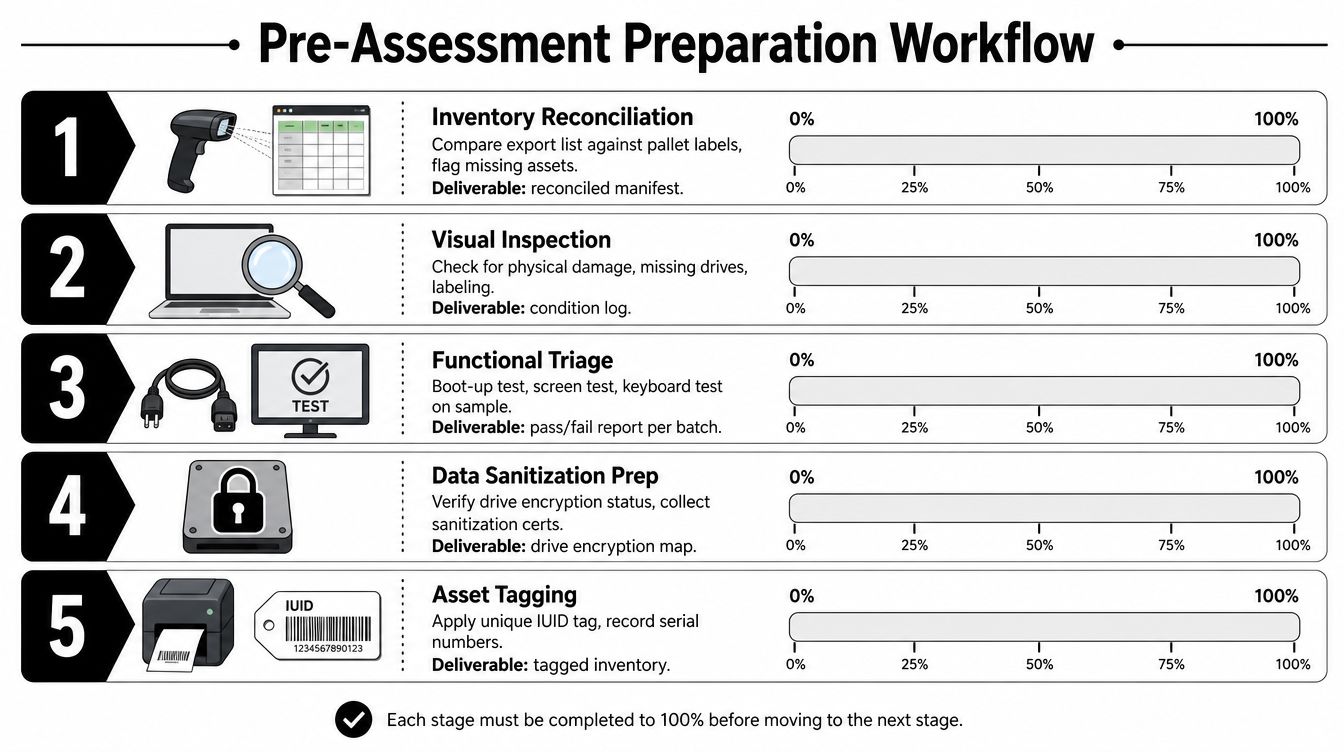
Assessment quality is largely determined before the first device is powered on. A prepared workstation reduces rehandling, prevents serial-number mistakes, and makes the intake team's decisions consistent.
Prepare the register and work area
Start with the inventory export. Reconcile the listed serial numbers and asset tags against pallet labels and the physical shipment. Don't guess when a number is missing or unreadable. Create an exception record, photograph the label, and hold the asset for review.
Stage equipment by form factor and model family. Keep laptops together, separate desktops from servers, and isolate unusual items such as network appliances, medical devices, or laboratory instruments. This reduces context switching and makes the diagnostic sequence repeatable.
Before intake begins, verify the tools:
- Identification tools: Barcode scanner, asset tags, label printer, camera, and a clean serial-number template.
- Diagnostic tools: Known-good power supplies, display adapters, boot media, memory and storage utilities, and network test access.
- Security tools: Approved sanitization software, drive inventory utilities, and certificate-generation workflow.
- Control documents: Condition rubric, escalation rules, intake form, and chain-of-custody template.
The intake form should capture the serial number, model, receiving operator, arrival condition, pallet or container reference, and exceptions. If the form doesn't provide a field for a finding, the team will eventually record it in inconsistent free text.
Brief the team before the first batch
The assessor briefing should define what passes, what fails, and what requires escalation. For example, a missing drive shouldn't receive the same code as a failed drive, and an unreadable serial label shouldn't be replaced with an inventory assumption.
A clean register is also the foundation for inventory optimization. Refurbished consumer devices may use different grading conventions, so teams comparing hardware categories can also consult this practical overview of the best refurbished iPhones as a reference for how condition language affects buyer expectations. The output of preparation should be simple: a reconciled manifest, a ready workstation, and clear ownership of every exception.
Physical and Functional Inspection Checklist
A reliable inspection uses two layers. The physical layer records what the technician can see and handle. The functional layer confirms whether the equipment performs the job expected of its configuration. Each result should be pass, fail, or a defined measured value, never an informal impression.
For laptops, inspect the chassis for cracks, bent frames, loose hinges, missing feet, and damaged panels. Check the display for cracks, dead clusters, and backlight problems. Test the keyboard, touchpad, USB ports, HDMI or DisplayPort output, audio, wireless connection, battery condition, and charging jack. Open the housing when authorized and inspect liquid-damage indicators, corrosion, contamination, and abnormal dust accumulation.
Desktops need the same external review, plus checks for missing covers, damaged expansion slots, power-supply condition, installed memory, storage, graphics cards, and proprietary components. Servers require deeper validation. Confirm RAID controller health, drive visibility, power-supply redundancy, fans, management access such as iDRAC or iLO, and the installed module configuration.
Use reason codes instead of narrative guesses
The functional sequence should include POST, BIOS access, operating-system boot, memory and storage detection, network connectivity, display output, and thermal behavior under a controlled load. A result such as “storage detected at expected capacity” is useful. “Seems fine” isn't.
Record failures against the serial number using short reason codes. Examples include LCD-CRACK, BAT-SWELL, USB-FAIL, RAID-ALERT, PSU-MISSING, or SERIAL-UNREADABLE. Codes make batch reporting and trend review much easier than free-text descriptions.
| Check Category | Laptop Pass Criteria | Desktop Pass Criteria | Server Pass Criteria | Common Fail Markers |
|---|---|---|---|---|
| Chassis and enclosure | No structural crack, secure hinge, intact panels | Secure case, no bent frame, covers present | Rack ears, panels, rails, and enclosure intact | Cracks, bends, corrosion, missing panels |
| Display and output | Internal display and tested external output work | Video output works through assigned adapter | Console or management display path works | No image, damaged connector, dead display area |
| Input and ports | Keyboard, touchpad, USB, audio, and charging pass | USB, network, audio, and power pass | Network, console, and service ports pass | Intermittent port, broken jack, no detection |
| Storage and memory | Expected memory and drive detected | Installed components match record | Drives and RAID set report healthy state | Missing drive, SMART warning, wrong capacity |
| Thermal and power | Stable power and controlled load | Stable power and controlled load | Fans, PSUs, and temperature alerts normal | Swelling, overheating, throttling, PSU fault |
For complex environments, keep a separate server decommissioning checklist so rack removal, configuration capture, and component-level inspection don't disappear inside a generic laptop workflow.
Diagnostic Tests and Cosmetic Grading
A cosmetic grade should never override a functional failure. Conversely, a device that passes diagnostics shouldn't receive a top resale grade if its display, enclosure, keyboard, or accessories show material wear. The defensible approach combines both records into one disposition tier.
Run the same core tests across comparable assets. Battery health, POST cycles, SMART data, thermal load, memory detection, storage detection, and port loopback testing create an objective baseline. Servers need additional attention to RAID state, redundant power, management interfaces, fan operation, and installed modules.
Cosmetic grading also needs defined thresholds. An A grade might require an intact enclosure with minimal wear. A B grade may allow visible scratches or light keyboard shine while preserving full function. Lower grades can capture dents, LCD defects, missing trim, or incomplete accessories. The exact rubric can vary by buyer, but the definitions must remain stable across assessors.
Photograph the findings that affect value
Photo evidence should focus on decision points, not create an undifferentiated image archive. Capture the serial label, front and rear views, screen defects, damaged ports, swollen batteries, missing components, and unusual contamination. Link the image filenames to the asset ID.
A practical matrix might look like this:
| Functional Test Set | Pass Threshold | Cosmetic Grade | Combined Tier | Disposition Path |
|---|---|---|---|---|
| Full laptop diagnostics | All required tests pass | A or B | Buyback eligible | Sanitization, valuation, resale |
| Full desktop diagnostics | Core hardware detected and stable | B or C | Review for refurbishment | Repair estimate, then valuation |
| Server diagnostics | RAID, PSU redundancy, management, and thermals pass | A or B | Enterprise resale review | Configuration validation and secure wipe |
| Partial diagnostics | One or more required tests fail | Any | Non-buyback | Parts recovery or recycling |
| No power or unsafe condition | Cannot safely test | Any | Hold or recycling review | Escalation and documented handling |
Keep the score explainable
A weighted model can combine functional status, cosmetic condition, completeness, age, and configuration relevance. Don't hide the decision inside an opaque algorithm. The assessor and reviewer should be able to see which input lowered the tier and why.
The final grade should route the asset to resale eligibility, refurbishment review, parts recovery, or recycling. For electronics recycling, the inventory must remain tied to the material route, not merely a total weight. That connection protects the valuation process and keeps downstream reporting aligned with the original assessment.
Documentation and Chain-of-Custody
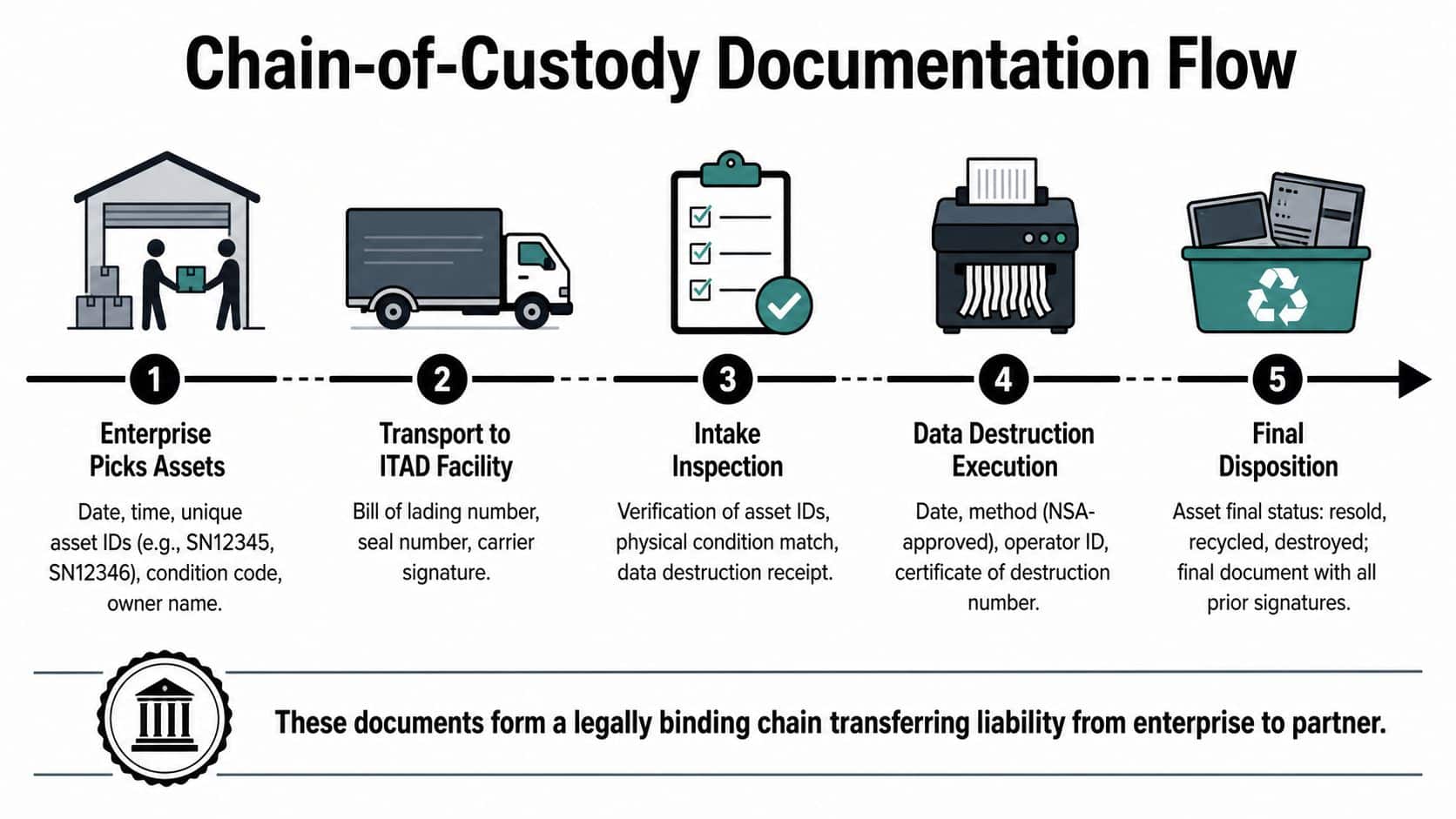
Documentation is the mechanism that shows who controlled the asset, what condition it arrived in, what happened to its data, and where it went. It isn't administrative decoration. A missing handoff or unexplained serial discrepancy can weaken an otherwise thorough inspection.
Every asset record should include:
- Identity: Serial number, asset tag, manufacturer, model, CPU, RAM, and storage configuration.
- Assessment: Date, technician ID, intake condition, diagnostic results, cosmetic grade, photographs, and recommendation.
- Security: Drive serial, sanitization method, certificate number, operator, and completion timestamp.
- Disposition: Buyback, redeployment, refurbishment, product destruction, parts recovery, or recycling status.
The chain-of-custody log should capture every handoff with date, time, parties, container or pallet reference, and tamper-evident seal number. At transport, retain the serialized bill of lading and carrier signature. At the facility, reconcile the shipment against intake records before processing begins.
Build the audit trail from both ends
An auditor should be able to start with an enterprise asset register and follow each serial number to intake, sanitization, valuation, resale, destruction, or recycling. The reverse should also work. A downstream certificate should point back to the originating asset and shipment.
Useful supporting records include:
- Serialized bills of lading
- Pallet and seal logs
- Intake reconciliation reports
- Weighbridge receipts for material shipments
- Downstream recycler certifications
- Certificates of data destruction and recycling
- Exception approvals and corrective-action records
The chain-of-custody documentation workflow provides a practical reference for organizing these records. For U.S. organizations subject to the Fair Credit Reporting Act, the FTC Disposal Rule requires reasonable measures to protect consumer information during disposal, including burning, pulverizing, or shredding records and using service providers capable of those methods. The assessment record and destruction evidence should therefore remain connected until the final report is accepted.
Evidence of Data Sanitization
A device shouldn't move to buyback, redeployment, or recycling solely because a technician believes the drive was cleared. The assessment record needs verifiable sanitization evidence linked to the drive and the asset serial number.
The method depends on the drive technology and final disposition. NIST 800-88 terminology commonly distinguishes Clear, Purge, and Physical Destruction. Clear may use an overwrite process appropriate to the media. Purge can use cryptographic erase or supported secure-erase commands. Physical destruction is appropriate when the media can't be reliably sanitized or the policy requires destruction.
Select the method before routing
A drive inventory should identify whether the asset contains a hard disk drive, solid-state drive, removable media, or another storage technology. The technician should record encryption state, supported commands, software version, and the result returned by the sanitization tool.
| Drive Type | Disposition Path | NIST 800-88 Method | Required Evidence | Audit Risk if Skipped |
|---|---|---|---|---|
| Hard disk drive | Buyback or reuse | Clear or Purge, based on policy and drive use | Drive serial, method, result, operator, timestamp | Unproven data removal |
| Solid-state drive | Buyback or reuse | Purge where supported, otherwise approved destruction route | Media type, command or crypto-erase result, certificate | Remnant data risk from flash behavior |
| Encrypted drive | Reuse or recycling | Purge through verified cryptographic erase when appropriate | Encryption status, key-erasure result, certificate | Assumed protection without proof |
| Failed or inaccessible drive | Recycling or destruction | Physical Destruction | Serial-specific destruction record and certificate | Batch total cannot prove individual handling |
| Removable media | Reuse or destruction | Clear, Purge, or Physical Destruction | Media identifier, method, operator, timestamp | Untracked media leaves the chain |
A certificate should identify the make, model, serial number, capacity, sanitization method, technician, software version, and completion time. Batch reporting is useful for operations, but it shouldn't replace serial-level evidence.
Anchor certificates to the condition log
The asset record should prevent a disposition status from being marked complete until the matching certificate ID is present. If a laptop has two storage devices, both drive records need separate results. If a server has failed media removed before shipment, the removal and final destruction records must still point to the original asset.
Use a data destruction certificate workflow that allows reviewers to match the certificate to the asset register without searching through unrelated batch paperwork. Security evidence becomes part of valuation. A functional device without acceptable sanitization proof may be held, reprocessed, or routed away from resale until the gap is resolved.
Valuation Inputs for Buyback vs. Recycling
Buyback and recycling should use the same assessment dataset, not separate operational opinions. The buyback path depends on whether the asset is functional, desirable, complete, and securely cleared. The recycling path depends on whether recovery remains possible when resale value no longer justifies testing, repair, storage, or handling.
A vendor typically needs the serial list, model and configuration, cosmetic grade, functional result, accessory completeness, grade confidence, and sanitization certificate ID. Without those inputs, a quote may rely on assumptions that later create deductions, exceptions, or disputes.
How the buyback path is calculated
Buyback value generally rises when the equipment has a relevant configuration, stable operation, acceptable cosmetic condition, complete accessories, and clean documentation. It falls when the asset needs repair, has missing components, carries uncertain identity, or lacks acceptable sanitization evidence.
The practical sequence is:
- Confirm identity and configuration. Match the serial number to the model, processor, memory, storage, and installed modules.
- Apply functional eligibility. A device that fails a required test shouldn't be priced as resale-ready.
- Apply cosmetic and completeness adjustments. Dents, display defects, missing chargers, proprietary rails, and absent modules affect preparation cost and buyer demand.
- Confirm security evidence. The certificate ID must match the asset and every relevant drive.
- Review market relevance and handling cost. A technically functional device may still require refurbishment or have limited resale demand.
The assessment should also distinguish grade confidence. A fully tested device with clear photos and complete records has higher decision confidence than an asset graded from an exterior inspection because it couldn't power on.
How recycling sets the alternative
Recycling is not a failure of the assessment. It is the correct route when resale economics no longer cover repair, testing, storage, transportation, or compliance requirements. Non-functional units can still contain recoverable materials and reusable components, but the valuation needs to account for dismantling and downstream processing.
Global scale shows why controlled routing matters. The Global E-waste Monitor 2024 reports that e-waste generation reached 62 million tonnes in 2022, while only 22.3% was documented as formally collected and recycled in an environmentally sound manner. A related Global E-waste Monitor summary says e-waste is growing five times faster than documented recycling and projects 82 million tonnes by 2030 if current trends continue. These figures reinforce the operational point: routing assets accurately matters more than labeling everything as recoverable.
A simple decision rule works well:
- Buyback: Functional grade exceeds the agreed threshold, residual value exceeds the recycling recovery, and sanitization evidence is complete.
- Recycling: The asset fails the functional threshold, residual value doesn't exceed recycling recovery, or the required evidence can't be produced.
- Hold for review: Identity, safety, data status, or configuration remains unresolved.
| Valuation Input | Buyback Path | Recycling Path |
|---|---|---|
| Functional result | Passing diagnostics support resale eligibility | Failure supports parts or material routing |
| Cosmetic condition | Grade influences offer and buyer channel | Cosmetic condition matters less than safe processing |
| Configuration | Relevant CPU, RAM, storage, modules, and accessories add value | Components may be separated for recovery |
| Sanitization | Serial-specific certificate required before release | Destruction evidence required for retained media |
| Asset identity | Exact serial and tag support valuation | Exact identity supports reporting and liability transfer |
| Completeness | Chargers, rails, drives, and modules affect preparation | Missing parts are recorded before dismantling |
| Documentation | Grading manifest and valuation worksheet support payment | Chain-of-custody and downstream records support compliance |
Use a worked threshold without false precision
For a four-year-old laptop fleet, compare the expected per-unit buyback offer against the documented recycling recovery after all handling costs. If the buyback offer is higher and the device passes the agreed tests, route it to buyback. If repair, missing accessories, failed storage, or weak market relevance pushes the net offer below the recycling alternative, route it to recycling.
The threshold should be calculated from the actual fleet data, not a generic market assumption. Record the inputs, assumptions, grade confidence, and approval so another reviewer can reproduce the decision.
Package the handoff before the truck leaves
The liability transfer point is the accepted handoff, not the moment a vehicle departs the loading dock. Before shipment, bundle:
- Grading manifest keyed to serial numbers
- Reconciled chain-of-custody log
- Sanitization certificates for each storage device
- Valuation worksheet and disposition decision
- Exception list with approvals
- Shipping documents and seal references
Enterprise clients may require defined operating commitments, such as 24-hour discrepancy resolution and weekly status reporting. Those requirements should appear in the service workflow and reporting template, not remain informal promises.
For downstream reporting, map each finding to the relevant field in the ITAD certificate of destruction, R2v3 or e-Stewards report, and internal asset retirement register. The final package should show what arrived, what was tested, how data was handled, what value was assigned, and where the equipment went.
Beyond Surplus offers commercial electronics recycling, secure data destruction, IT equipment disposal, IT buyback, product destruction, data center de-installation, and logistics coordination with documented certificates and chain-of-custody records. Visit Beyond Surplus to discuss an equipment condition assessment that connects inspection evidence, sanitization proof, and buyback or recycling routing for your next asset refresh.


