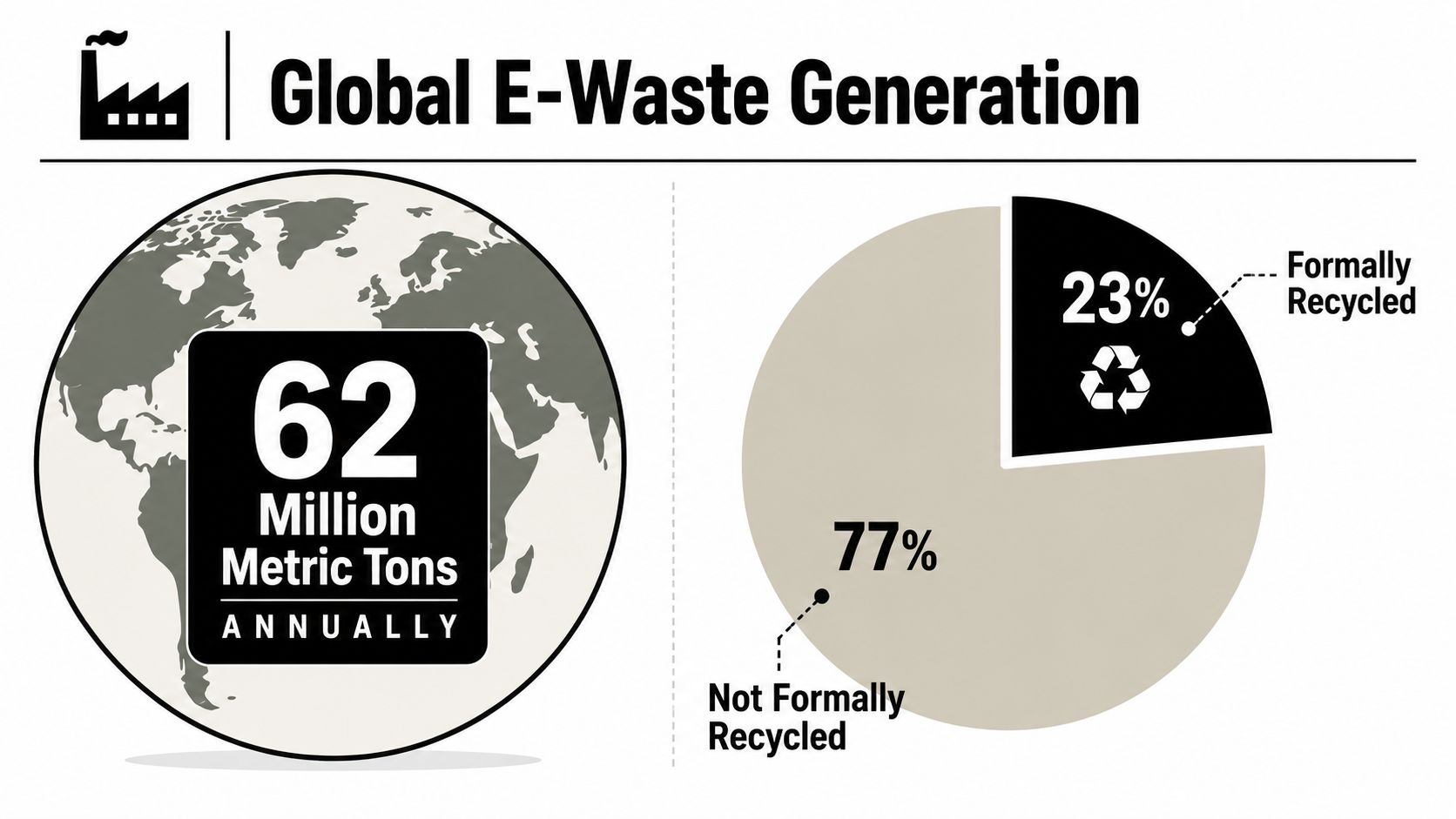
In 2022, the world generated 62 million tonnes of electronic waste, or about 7.8 kilograms per person, yet only 22.3% was formally collected and recycled in an environmentally sound manner, according to the Global E-waste Monitor 2024. For a business, that gap isn't an abstract environmental problem. It represents potential exposure when laptops, servers, medical devices, laboratory equipment, storage media, and other IT assets leave the building without a verifiable chain of custody.
A search for Certified Electronics Recycling Near Me should therefore lead to more than a nearby address. The right question is whether the provider can document who handled the equipment, how data was destroyed, where materials went, and which certification scope covers the work. Distance helps with logistics. Verification protects the business.
Table of Contents
- Why Certified Electronics Recycling Matters for Businesses
- What Certified Electronics Recycling Actually Means
- Key Certifications and What They Guarantee
- How to Verify a Certified Recycler Near You
- Service Options for Business Electronics Disposal
- Preparation Steps and Required Documentation
- Choosing the Right Certified Recycling Partner
Why Certified Electronics Recycling Matters for Businesses
Commercial electronics disposal creates two separate risks. The first involves information stored on devices. The second involves what happens to the physical equipment and hazardous fractions after a recycler accepts them. A vendor that merely takes possession of electronics may not provide the controls needed to manage either risk.
The scale is moving in the wrong direction. Global e-waste increased from 34 million tonnes in 2010 to 62 million tonnes in 2022, an increase of about 82%, while documented recycling grew much more slowly. The 2024 monitor reports that e-waste is rising about five times faster than documented recycling, and it projects 82 million tonnes by 2030 if current trends continue, as detailed by the Global E-waste Monitor.
The liability follows the asset
When an organization gives equipment to an uncertified channel, the transaction may end at the loading dock, but the organization's risk doesn't necessarily end there. If a hard drive later exposes confidential information, or electronics are mishandled downstream, the original owner may need to demonstrate that it selected a competent vendor and exercised appropriate oversight.
The FTC Disposal Rule applies to organizations that use consumer reports. It requires disposal practices that are reasonable and appropriate to prevent unauthorized access or use of information. The FTC identifies shredding, burning, pulverizing, destroying, or erasing electronic files or media, as well as using a contractor after due diligence, as acceptable examples in its Disposal Rule guidance.
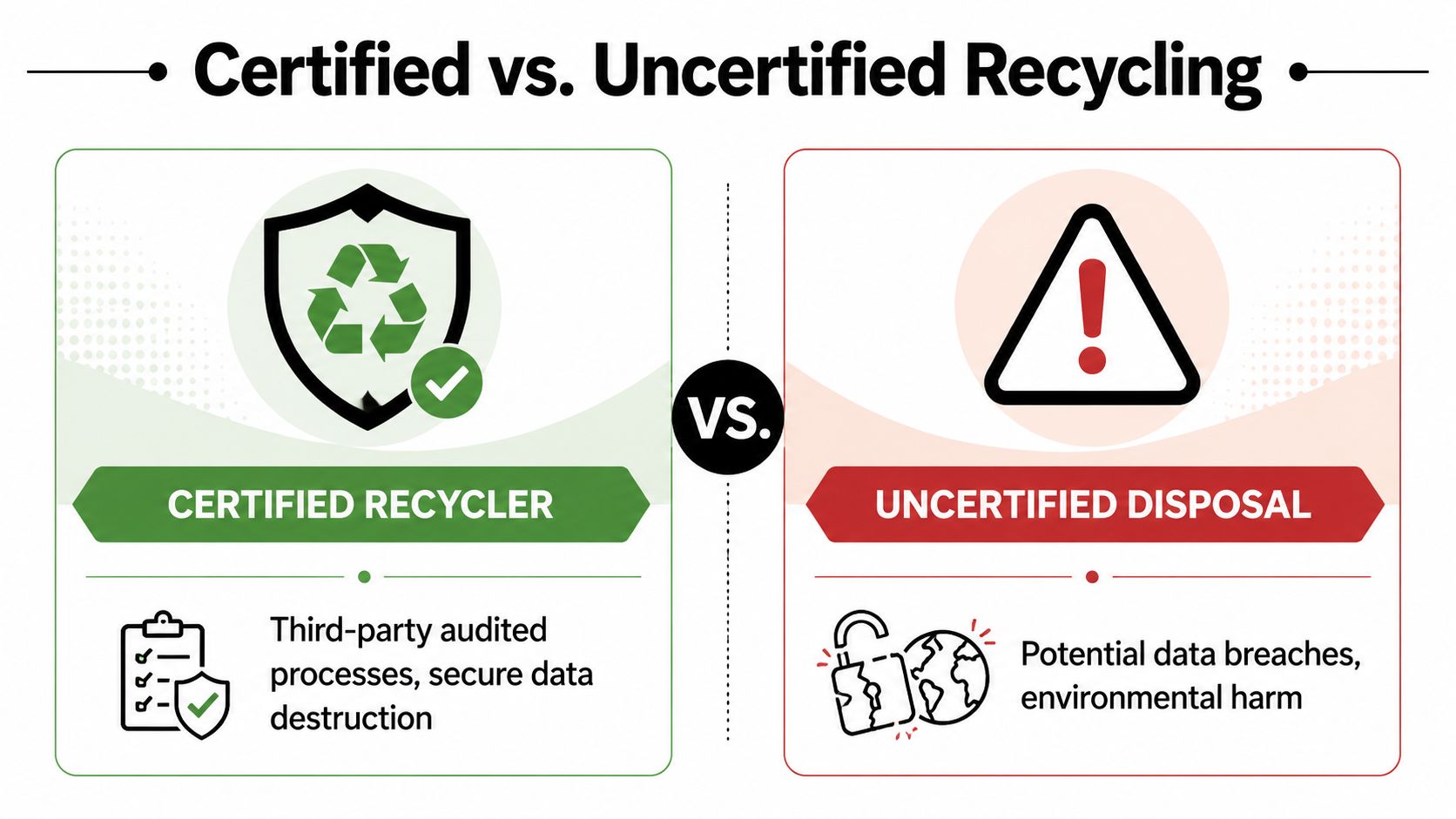
A general recycling permit or a low price doesn't prove that a provider audits downstream vendors, controls data-bearing equipment, or issues defensible records. Certified electronics recycling gives procurement and compliance teams a documented control point. Review Beyond Surplus certified e-waste recycling services to see how a business-focused process can connect pickup, processing, and compliance documentation.
Practical rule: Treat the recycler's certificate scope and custody records as part of the disposal transaction, not as optional paperwork requested afterward.
What Certified Electronics Recycling Actually Means
Certified electronics recycling means a third-party certification program has evaluated defined processes at a specific facility. It isn't synonymous with accepting electronics, owning a baler, or holding a general business license. The meaningful question is whether the certified scope covers the work your assets require.
The EPA's certified electronics recycler guidance identifies R2 and e-Stewards as the two accredited certification programs for electronics recyclers. The EPA says both standards address worker health and safety, downstream control through the recycling chain, and data security.
Follow the material, not the logo
A credible process starts at intake. The recycler should record the shipment, identify equipment, control access, and maintain records as assets move through reuse, parts recovery, material processing, or destruction. For storage devices, the process should identify the sanitization or destruction method and connect the result to the relevant asset record.
Certification also doesn't mean every service at every company location is automatically covered. Buyers should confirm the facility address, certificate status, covered processes, and exclusions. A provider may have a certified operation for certain activities while subcontracting or routing other materials elsewhere.
The distinction matters for mixed corporate loads. Batteries, servers, peripherals, laptops, and specialized equipment may require different handling paths. Ask how the recycler separates those streams, whether batteries are removed, and how non-profitable items are processed rather than assuming one generic “recycling” step covers everything.
Documentation is the operational proof
A certificate of recycling supports the environmental disposition record. A certificate of data destruction supports the information-security record. Neither document should be treated as a decorative PDF. Each should reconcile with the equipment delivered, the serial numbers captured, and the processes performed.
Reuse may be preferable when equipment can be securely sanitized and redeployed. Buyback or asset recovery can also change the economics. Recycling is the correct endpoint for assets that can't be safely or commercially reused, but a responsible partner should explain that decision instead of treating every device as scrap.
Key Certifications and What They Guarantee
Certification names are useful only when procurement teams understand the controls behind them. The EPA recognizes R2 and e-Stewards as accredited electronics-recycling certification programs, while NAID AAA focuses specifically on secure information destruction. These standards can overlap, but they don't serve identical purposes.
R2
R2, including the current R2v3 framework, centers on responsible electronics reuse and recycling. Operational review can address environmental, health, and safety controls, data sanitization, equipment testing, and downstream vendor management. The provider should be able to show how it determines whether equipment is reused, remarketed, harvested for parts, or sent to material recovery.
R2 certification is facility and scope specific. Ask for the certificate and confirm that it includes the processes required for your project, particularly data destruction, resale preparation, and downstream management.
e-Stewards
The e-Stewards Standard requires an ISO 14001-based environmental management approach and third-party certification. Its guidance states that organizations must be concurrently audited and certified to ISO 14001 or RIOS and NAID AAA as part of the standard.
That structure gives buyers a stronger governance lens. It evaluates management systems as well as material handling, which matters when hazardous fractions, residual data, subcontractors, and export decisions must remain controlled across the operating chain.
NAID AAA
NAID AAA is specifically relevant when equipment contains sensitive information. It evaluates operational safeguards for physical and logical destruction, including controlled procedures and verification practices. If a project involves hard-drive shredding, media destruction, or witnessed processing, confirm whether the exact location and service are covered.
State registrations may apply in addition to voluntary certifications. Michigan, for example, requires manufacturers of covered electronic devices to register, provide a free and reasonably convenient takeback program, and recycle or arrange recycling of returned devices. Michigan also states that a manufacturer isn't required to accept more than seven covered devices from one consumer in one day, according to Michigan's electronics takeback information. That framework isn't a substitute for enterprise ITAD due diligence.
| Certification | Data Destruction Guarantee | Export Restrictions | Downstream Auditing | Audit Frequency |
|---|---|---|---|---|
| R2 | Requires controlled data-sanitization processes within applicable scope | Requires responsible downstream management | Includes downstream due diligence | Third-party audit cycle applies |
| e-Stewards | Integrated data-protection requirements, including NAID AAA under its guidance | Strong environmental and export controls | Audits management systems and downstream controls | Third-party certification and audit cycle |
| NAID AAA | Focuses on physical and logical media destruction controls | Not its primary purpose | Focuses on destruction operations and security | Certification audit and ongoing oversight |
For a practical explanation of the R2 framework, consult what R2 certification means.
How to Verify a Certified Recycler Near You
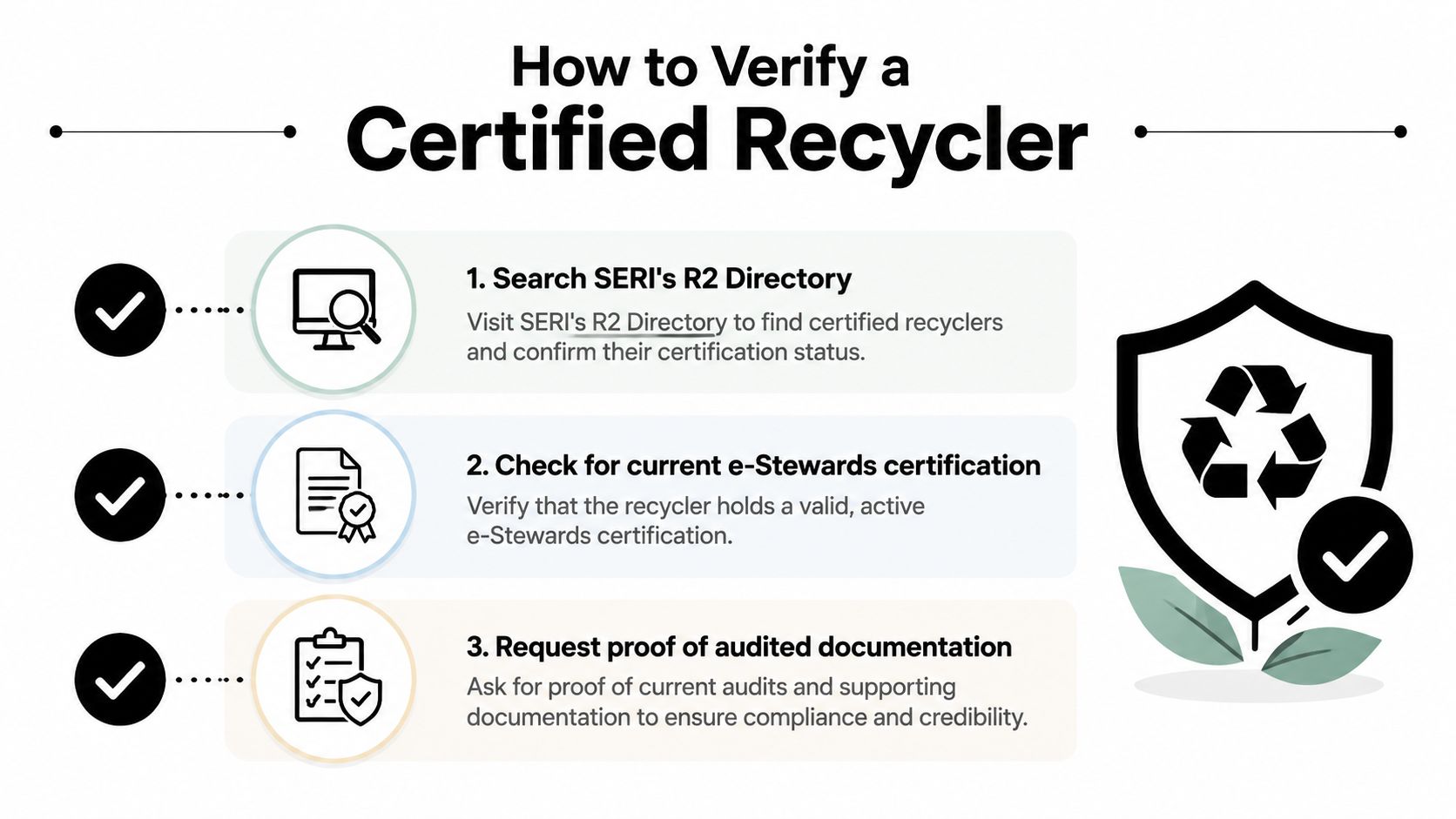
Finding a nearby vendor takes a search engine. Verifying whether that vendor can accept your equipment, protect your data, and document final disposition requires due diligence. Start with the official SERI R2 facility directory and the e-Stewards directory, then compare each listing with the provider's current certificate.
A defensible verification sequence
Identify the actual processing location. Ask where loads are received, sorted, sanitized, destroyed, and processed. A sales office is not a certified facility.
Confirm the certificate scope. Check the legal entity, facility address, certification number, issuing registrar, covered processes, and expiration status. The scope should match the services required, such as computer recycling, data destruction, product destruction, or medical equipment disposal.
Ask about exceptions and downstream handling. Batteries, servers, laboratory equipment, and non-working devices may follow different paths. Request the names of downstream vendors, the services they perform, and how the recycler evaluates their controls.
Request sample records. Review inventory receipts, serialized tracking, certificates of recycling, and certificates of data destruction. Records should reconcile assets leaving your facility with materials processed or destroyed.
Check jurisdictional requirements. State environmental agencies may impose permits, registrations, or material-specific obligations. Confirm that the provider's regulatory standing covers your locations and project type.
Evaluate liability transfer. Review the vendor due diligence checklist for insurance, contract language, incident notification terms, subcontracting provisions, and references from organizations handling comparable data and equipment.
Scope matters more than proximity
A directory listing does not confirm that a recycler's scope covers on-site shredding, medical devices, or downstream processing. A convenient pickup also creates exposure if destruction is outsourced without identifying or controlling the subcontractor. Outsourcing can be acceptable when responsibilities, records, and audit rights are clear.
Red flags include “certified processing” without a named standard, refusal to provide current documents, unexplained gaps between pickup and receipt, and certificates showing only aggregate weight when your organization requires serialized asset records. A certificate alone does not close the liability gap. Confirm custody, scope, and downstream accountability before scheduling collection.
Service Options for Business Electronics Disposal
The service model should match the project's security requirements, equipment volume, geography, and documentation needs. A convenient method can become inefficient when applied to a data center, while an enterprise pickup program may be unnecessary for a small department refresh.
Comparing the operating models
| Service Model | Ideal Volume | Security Level | Documentation | Typical Pricing |
|---|---|---|---|---|
| Drop-off | Small business loads that staff can transport securely | Facility-based processing after delivery | Receipt and downstream records may be limited before intake | Often per-pound or per-item |
| Scheduled pickup | Mid-size to large deployments, office moves, and decommissions | Sealed containers, controlled transport, and optional on-site services | Pickup manifest, inventory record, and processing certificates | Logistics fees, with project or volume pricing |
| Mail-in | Distributed offices and remote locations | Tamper-evident packaging and facility processing | Shipping and processing records | Shipping and processing bundled together |
Drop-off works when the organization can maintain custody during transport and the facility accepts the exact equipment. It's less suitable when employees must move a mixed load without serialized documentation or when the project includes servers, batteries, medical devices, and storage media.
Scheduled pickup offers stronger control at the handoff. Ask whether the provider uses sealed containers, records serial numbers before loading, and supplies a signed manifest. For sensitive devices, clarify whether on-site wiping, drive removal, or witnessed destruction is available.
Mail-in programs can simplify distributed collection, but the organization must control packaging, labels, tracking, and access before shipment. The liability window lasts through transit and receipt, so a prepaid label alone isn't a chain-of-custody program.
The least expensive transport option isn't always the lowest-risk disposal option. Match custody controls to the sensitivity of the equipment.
Preparation Steps and Required Documentation
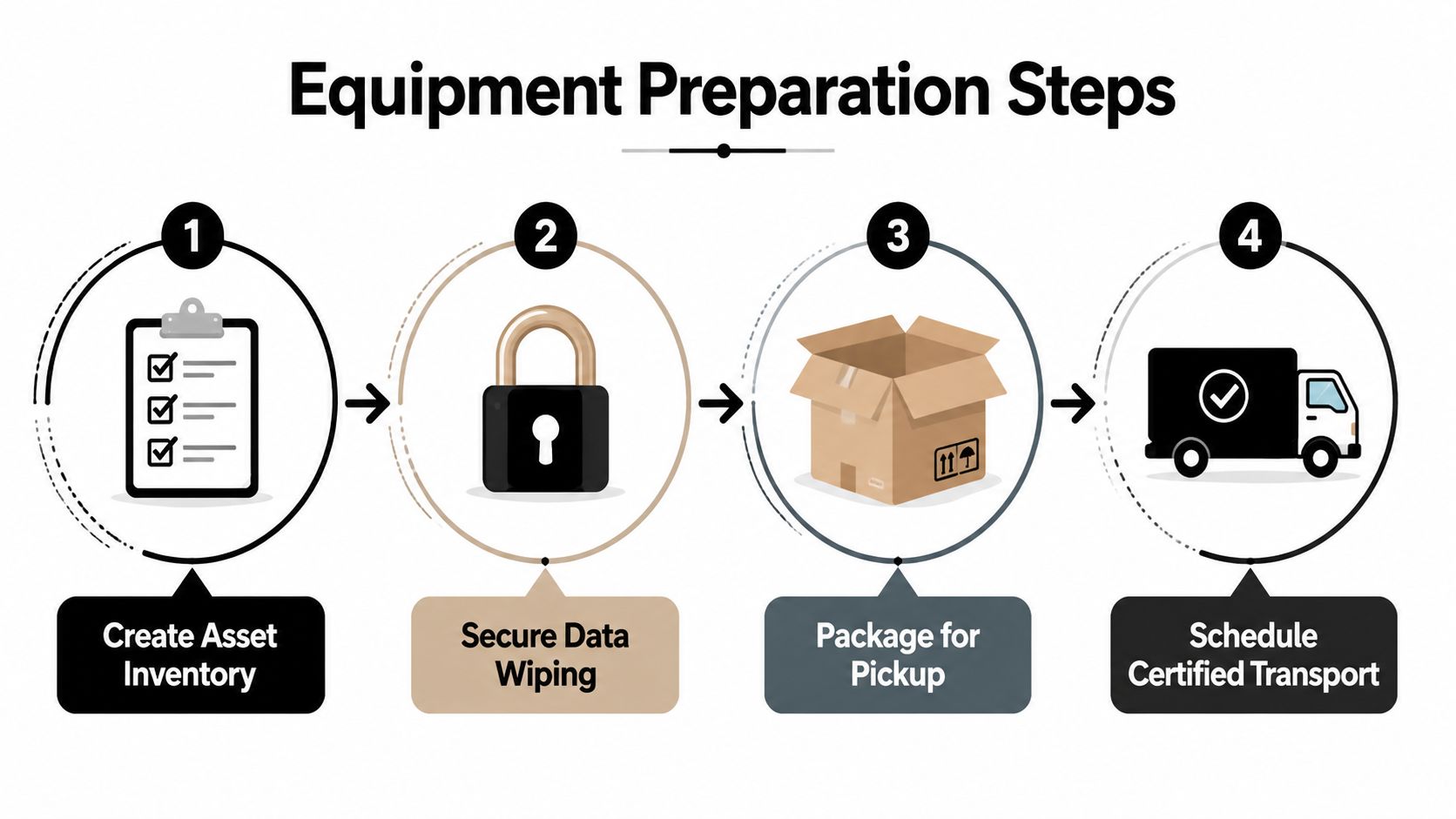
Preparation determines whether the recycler can produce a clean, defensible record. Start before the truck arrives. Build an inventory that identifies serial numbers, device types, storage components, and any special handling requirements.
Prepare the assets
Use the inventory to separate data-bearing equipment from peripherals and materials requiring distinct handling. Flag lithium-ion batteries, servers, networking equipment, medical devices, laboratory equipment, printers, monitors, and damaged units. Mixed loads need clear instructions so the receiving team doesn't treat every item as an undifferentiated pallet.
Back up business data, confirm application or license requirements, and remove proprietary labels or markings where appropriate. Don't rely on the recycler to determine whether a device can be redeployed. That decision belongs with the asset owner and should be made before destruction or material recovery.
For data-bearing media, select a method based on sensitivity, device condition, and reuse plans:
- Software sanitization can support reuse when the device functions and the method is appropriate.
- Physical destruction is suitable when media must not re-enter circulation or cannot be reliably sanitized.
- Degaussing may apply to compatible magnetic media, but it isn't a universal solution for every modern storage technology.
The FTC's Disposal Rule guidance supports reasonable and appropriate disposal practices, including destruction or erasure of electronic media and the use of a contractor after due diligence. Select and document the method before release.
Collect the records
At handoff, obtain a signed receipt with item counts, serial numbers where available, container information, and the receiving representative. After processing, request:
- Certificate of Recycling: Documents environmentally compliant disposition and material processing.
- Certificate of Data Destruction: Identifies the destruction or sanitization method and links results to the affected media.
- Chain-of-custody record: Shows transfer points from pickup through final processing.
- Exception report: Identifies missing, unprocessable, damaged, or diverted assets.
Store these records according to your organization's policy and applicable obligations. Avoid promising a universal retention period because requirements differ by industry, contract, and jurisdiction. A compliance documentation process should make the records searchable and reconcile them with the original inventory.
Choosing the Right Certified Recycling Partner
A sound selection process evaluates the service behind the certification. Score each candidate on facility scope, data destruction, downstream controls, transportation, inventory accuracy, reporting, and geographic coverage. A logo on a website is a starting claim, not proof that the provider can manage your specific project.
Use a practical scoring matrix
| Evaluation Area | What to Verify |
|---|---|
| Certification scope | Current certificate, facility address, covered processes, and exclusions |
| Data destruction | On-site and facility options, method selection, testing, and certificates |
| Downstream management | Vendor due diligence, material routing, and exception handling |
| Chain of custody | Serialized inventory, manifests, secure transport, and receipt controls |
| Service coverage | Pickup geography, data center capability, mixed-load handling, and scheduling |
| Commercial terms | Logistics charges, value recovery, insurance, subcontracting, and reporting |
Ask direct questions. Who owns the equipment during transit? What happens to devices that aren't profitable to refurbish? Are batteries separated? Which location performs destruction? Can the provider document product destruction, medical equipment disposal, laboratory equipment disposal, and data center decommissioning under the relevant scope?
Organizations comparing vendor governance practices can also review this resource on IT vendor management best practices. For businesses managing physical material risk, insurance considerations may also be relevant, including this resource on scrap metal insurance Florida from Professional Insurance Advisors, LLC.
Beyond Surplus is one business-focused option for certified electronics recycling and ITAD. Its services include secure pickup, on-site or off-site hard-drive shredding, certified data wiping, serialized asset tracking, product destruction, IT buyback, data center de-installation, and certificates of recycling and data destruction. Verify the current certification documents and scope for the specific facility and service before awarding a project.
Red flags should stop the procurement process until resolved. These include unclear certification language, refusal to share certificate details, unsupported claims about “zero landfill” or complete data destruction, and no written explanation of downstream handling. The right partner can show the evidence from pickup to final disposition.
Beyond Surplus provides certified electronics recycling, secure IT asset disposal, data destruction, asset recovery, product destruction, and data center decommissioning support for business customers. For a compliance-ready quote and a documented chain-of-custody plan, visit Beyond Surplus before your next IT refresh, office closure, or facility decommission.