
More than 56% of recycled network devices contained sensitive corporate data, including customer information, credentials, and VPN or IPsec keys, according to independent reporting on network-device data exposure. That finding changes the definition of secure computer recycling for businesses. Wiping laptops and hard drives is only part of the job. Switches, routers, firewalls, storage arrays, servers, and other infrastructure can retain configuration data long after a replacement project appears complete.
A defensible IT asset disposition program connects data sanitization, chain of custody, certified recycling, asset recovery, and audit-ready reporting. It gives IT directors, facility managers, and procurement teams a repeatable way to retire equipment without leaving unmanaged inventory or unverified data behind.
Table of Contents
- Why Secure Computer Recycling Demands a Formal Program
- Building Your Pre-Disposal Inventory and Internal Policy
- Choosing the Right Data Destruction Method
- Maintaining Chain of Custody and Compliance Documentation
- Selecting a Certified ITAD Vendor
- Coordinating Logistics and Closing the Loop with Final Reporting
Why Secure Computer Recycling Demands a Formal Program
The world generated a record 62 million tonnes of e-waste in 2022, equal to 7.8 kilograms per person, yet only 22.3% was formally collected and recycled in an environmentally sound manner, according to the Global E-waste Monitor 2024. The report projects annual generation will reach 82 million tonnes by 2030, with e-waste rising about five times faster than documented recycling. For companies, retired technology represents two risks at once. It can expose information, and it can become an undocumented environmental liability.
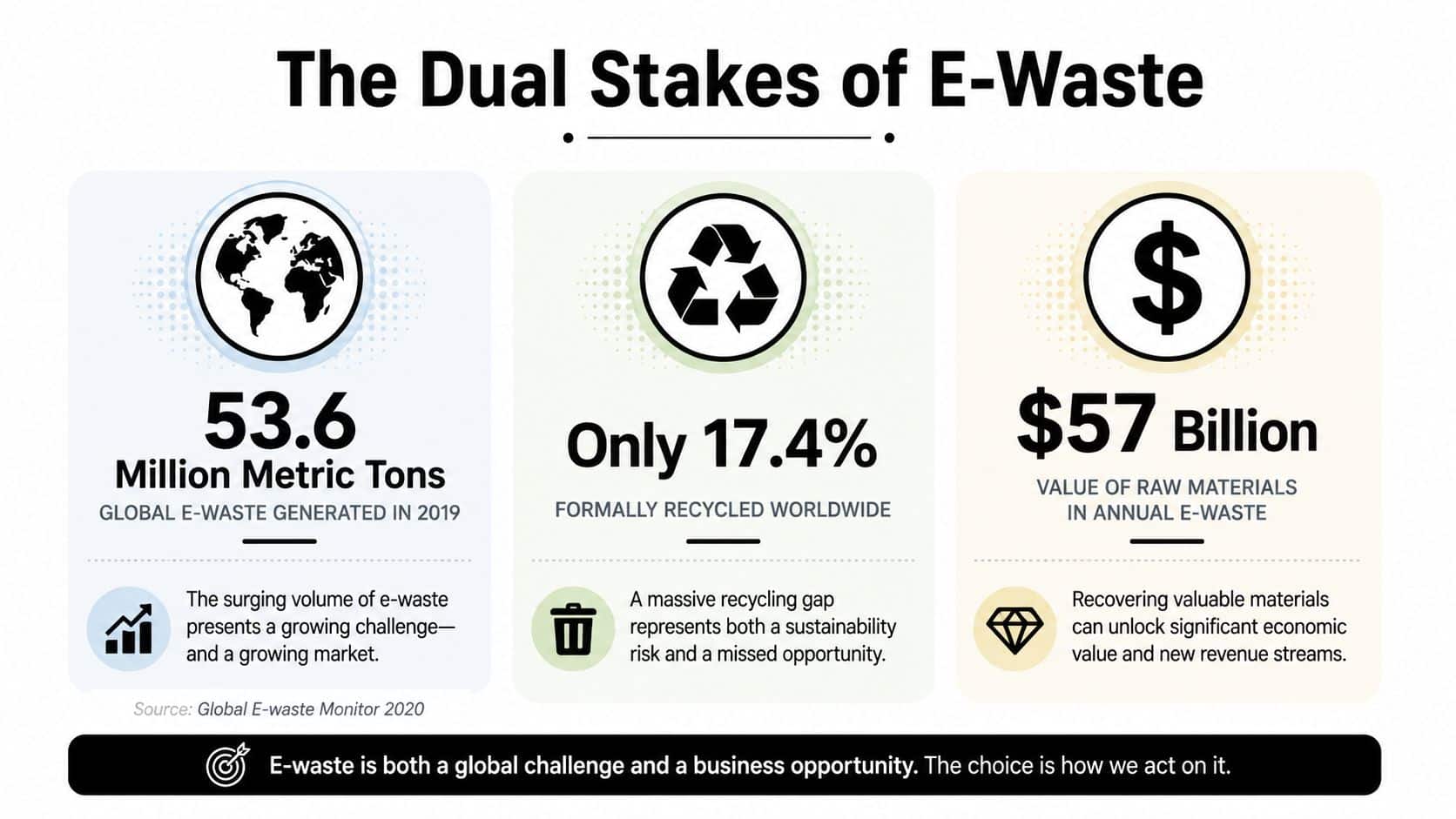
The same monitor estimates that US$62 billion in recoverable natural resources went unaccounted for in 2022, including materials that could have returned to productive use. A business that sends equipment into an informal disposal stream loses visibility over both the data and the materials. That undermines sustainability reporting, weakens procurement controls, and makes it difficult to prove what happened to assets after decommissioning.
Security and environmental responsibility belong together
Secure computer recycling isn't just a truck appointment. It starts when an organization identifies equipment for retirement and continues until each asset reaches reuse, resale, material recovery, or verified destruction. A documented IT asset disposition process should assign ownership, record device identifiers, define sanitization requirements, and preserve disposition evidence.
The FTC Disposal Rule, effective June 1, 2005, requires covered businesses and other entities to dispose of consumer report information securely so it can't be read or reconstructed. The Federal Trade Commission disposal requirement is a useful baseline, but organizations may also face contractual obligations, industry rules, and internal security standards.
Operational rule: Treat every retired device as both a security record and an environmental asset until its final disposition is documented.
Ad hoc disposal creates invisible gaps
A device left in a storeroom can be accessed by unauthorized personnel. A pallet handed to an unverified carrier can lose its custody trail. A recycler's generic weight receipt may confirm that material arrived, but it doesn't necessarily prove that a particular server, SSD, or firewall was sanitized.
A formal program replaces assumptions with controls. It defines who approves the retirement, how equipment is staged, which method applies to each data classification, how transportation is recorded, and which certificates close the record. That structure is especially important during office moves, data center decommissioning, medical technology upgrades, mergers, and large laptop refreshes.
Building Your Pre-Disposal Inventory and Internal Policy
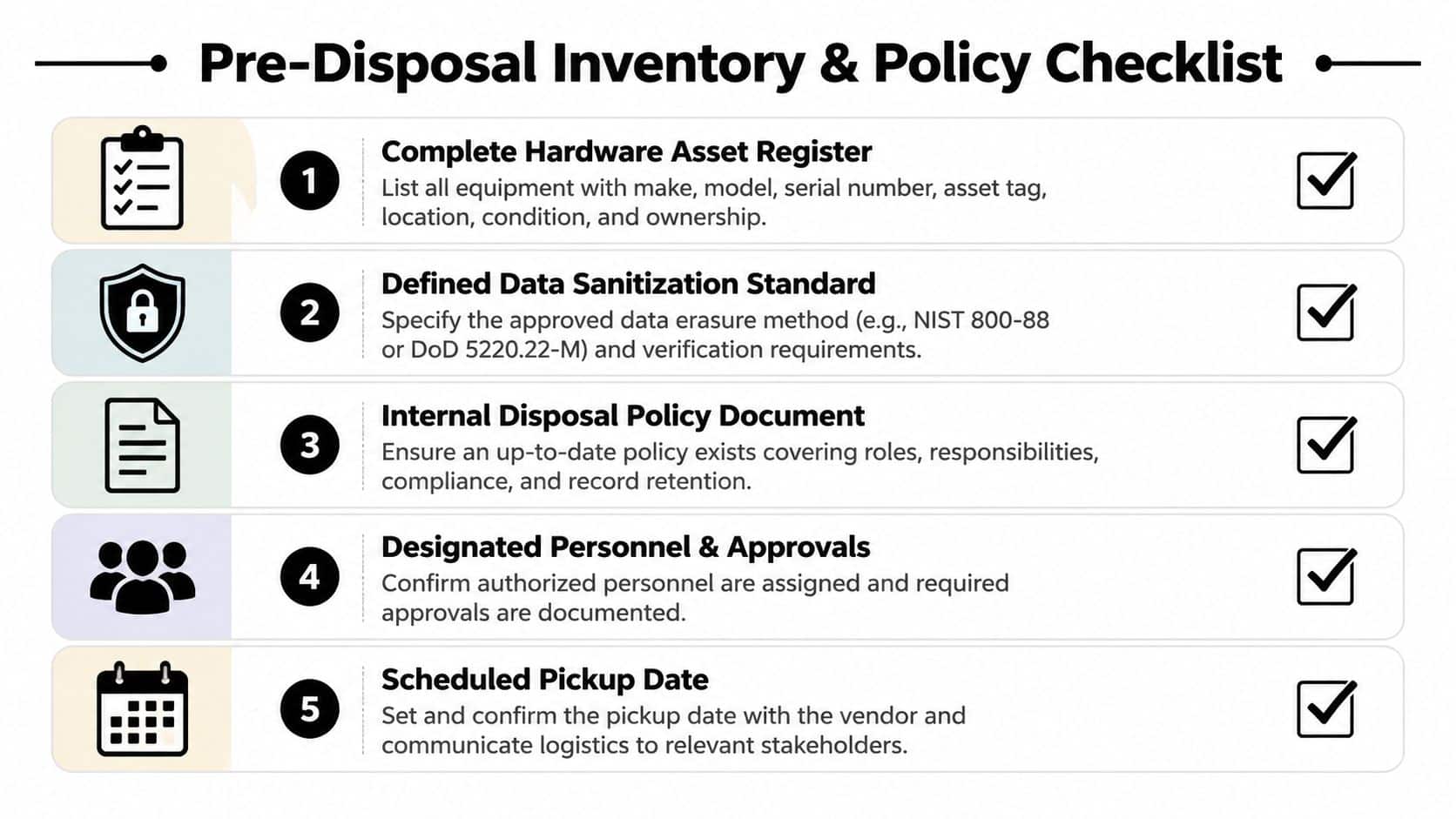
Before equipment leaves a controlled area, create a register that lets another person identify every item without relying on memory. Existing configuration management databases, enterprise asset management platforms, procurement records, and endpoint management tools can provide a starting point. Reconcile those records against a physical count, because devices often move between departments without corresponding updates.
Build an asset register that supports disposition
Capture enough detail to connect the original business record to the final certificate. At minimum, include:
- Asset identifier: Record the internal tag, manufacturer, model, serial number, and physical location.
- Device category: Separate laptops, desktops, servers, SSDs, hard drives, mobile devices, switches, routers, firewalls, printers, laboratory equipment, and medical equipment.
- Media presence: Note removable drives, internal storage, flash memory, backup cartridges, and embedded storage.
- Data classification: Mark whether the device handled public, internal, confidential, regulated, or highly restricted information.
- Disposition decision: Assign reuse, remarketing, certified wiping, physical destruction, or material recycling.
- Condition and accessories: Document missing components, damage, power supplies, racks, rails, and attached peripherals.
Network infrastructure deserves its own inventory category. Record management modules, configuration storage, flash memory, boot media, authentication material, and any removable components. A switch that looks empty after a network migration may still hold credentials or topology information. Assuming network devices are “just hardware” is a common verification failure.
Write policy before the pickup date
The policy should define approval authority, data sanitization standards, exceptions, staging rules, vendor requirements, and record retention. It should also state what happens when an asset can't be identified, when a drive fails a verification check, or when a device arrives without its expected media.
Use inventory optimization procedures to improve the quality of the asset register before a large disposition project. The practical objective isn't a perfect database. It's a defensible connection between the equipment your team releases and the evidence your organization receives later.
Have IT security approve the sanitization matrix. Have facilities approve loading and staging controls. Have procurement or legal review vendor terms, downstream handling, insurance, and certificates. Finance should confirm how recovered value is recorded, while business owners should approve the release of equipment that may still contain operational or regulated information.
Practical rule: If a device can't be matched to an asset record, it shouldn't enter the outbound shipment as an anonymous item.
A simple pre-disposal review should answer five questions:
- Has the asset been physically located and tagged?
- Has business data been backed up or migrated?
- Has the data classification been confirmed?
- Has an authorized person selected the disposition method?
- Has the receiving vendor and pickup window been approved?
This process prevents undocumented stockpiles and gives the service provider usable instructions before equipment arrives.
Choosing the Right Data Destruction Method
No single sanitization method fits every asset. The right choice depends on the media, the information stored, the intended disposition, the condition of the device, and the evidence your auditors require.
NIST SP 800-88 Rev. 1 rejects a simple “wipe and trust” approach. Its verification guidance calls for a full read of accessible areas when time permits, or representative sampling when a full read isn't practical. For sampling, NIST describes pseudorandom locations across the media, coverage across the addressable space, at least two non-overlapping samples per subsection, and a secondary subset rechecked with a different validation tool. For hard drives, its suggested layout uses at least 1,000 subsections, with two samples covering at least 10% of the media and a secondary verification subset of at least 20%, as described in the NIST media sanitization guidance.
Match method to risk and recovery
| Method | Best For | Security Level | Asset Recovery Potential | Typical Turnaround |
|---|---|---|---|---|
| Certified software wiping | Working laptops, desktops, servers, and storage intended for reuse | High when the process and verification match the media | High | Depends on volume, device condition, and verification requirements |
| On-site physical shredding | Sensitive media requiring witnessed destruction at the business location | Very high for destroyed media | None for the destroyed media | Scheduled around equipment access and destruction logistics |
| Off-site shredding | Bulk media consolidated for controlled transport and destruction | Very high when custody and destruction evidence are documented | None for the destroyed media | Depends on pickup, receiving, and processing schedules |
Software wiping preserves resale potential, but it only works when the tool addresses the actual media and the operator verifies the result. Tools can sanitize only a subset of sectors, leaving residual information outside the shallow pass. Failed drives, damaged media, unsupported firmware, and devices with hidden storage require escalation rather than a forced wipe certificate.
Physical destruction provides a stronger endpoint for high-sensitivity media, but it eliminates recovery value and creates material that still needs responsible recycling. On-site shredding can reduce transport exposure and allow a witness to observe the process. Off-site shredding can be efficient for controlled bulk loads, provided the carrier, receiving facility, destruction process, and serialized reporting are clear.
Sanitize the infrastructure, not only the drives
Network equipment requires a separate disposition check. Export and review configurations where appropriate, remove credentials and certificates, clear startup and running configurations, address flash storage, and document the validation method. Routers, switches, firewalls, wireless controllers, and load balancers may hold information that doesn't appear in a traditional hard-drive inventory.
The choice between wiping and shredding should be approved by the data owner or security team. This comparison of hard-drive shredding and data wiping can help frame the recovery and assurance trade-off, but the written policy must govern the final decision.
Maintaining Chain of Custody and Compliance Documentation
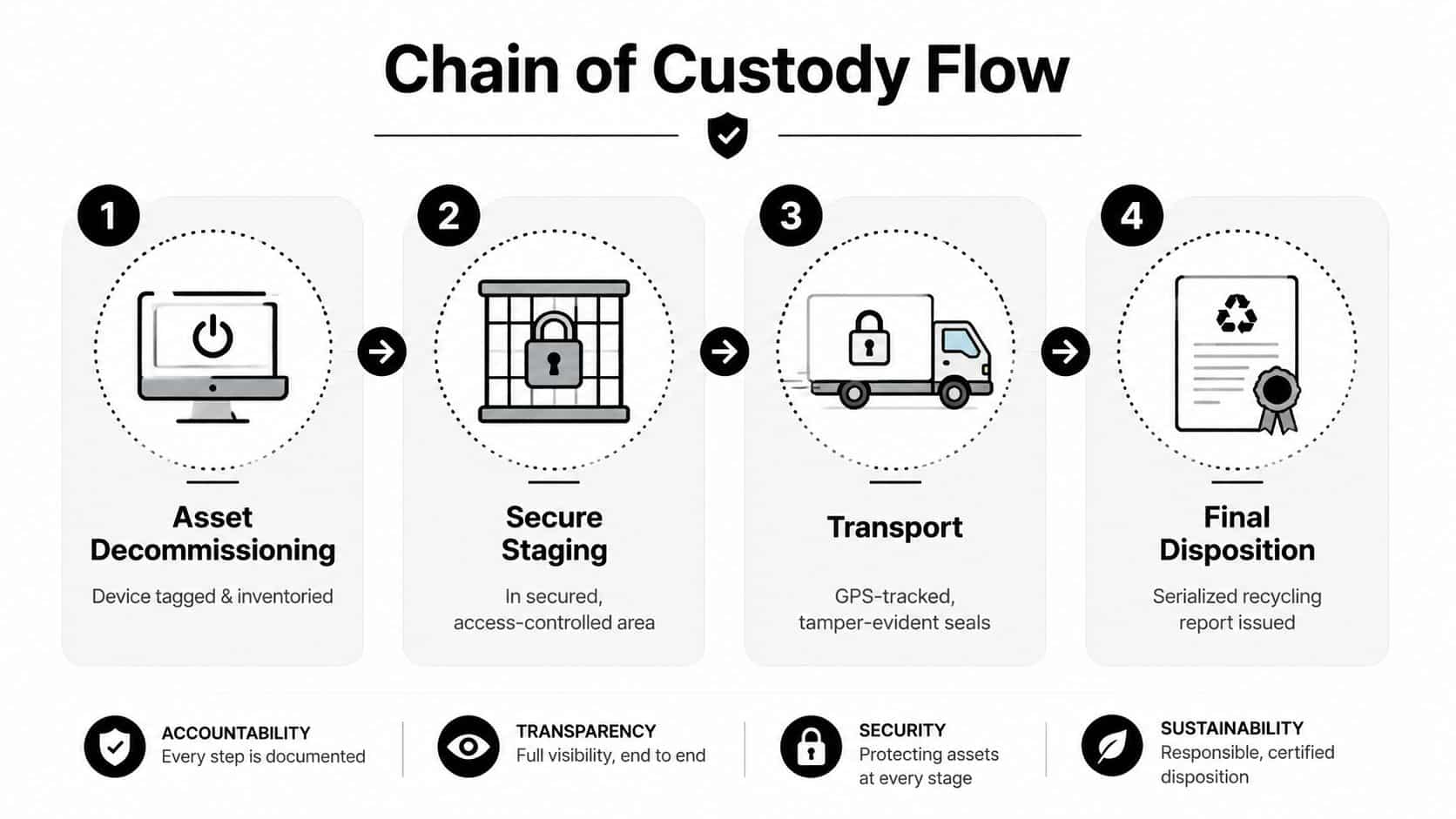
A certificate issued at the end can't repair an undocumented handoff at the beginning. Chain of custody starts when the organization removes an asset from service, then follows it through tagging, staging, loading, transport, receiving, sanitization, resale, recycling, or destruction.
The custody record should identify the asset and the people responsible for it at each transition. Use serialized labels or barcodes that remain readable through staging and processing, and reconcile the shipment against the outbound manifest before the vehicle departs.
Record every custody transition
A useful chain-of-custody package includes:
- Asset identifiers: Serial numbers, internal tags, device descriptions, and media identifiers.
- Release authorization: The approving department, responsible employee, date, and reason for disposition.
- Handler information: Names or accountable roles for staging, loading, transport, receiving, and processing.
- Time and location records: Handoff timestamps, facility locations, and transport references.
- Transport controls: Vehicle or carrier details, tamper-evident seals, and tracking records where used.
- Receiving confirmation: A facility receipt that reconciles actual items against the outbound manifest.
- Disposition evidence: Data destruction certificates, recycling reports, resale records, and exception notes.
A certificate of data destruction proves that specified media underwent a destruction or sanitization process. A certificate of recycling documents the handling of equipment or material through the recycling stream. They answer different questions, so a business often needs both. A weight ticket without serial-level evidence may support an environmental record while leaving a data-security question unanswered.
The FTC Disposal Rule matters because organizations maintaining consumer information for business purposes must protect it from unauthorized access or use that could contribute to identity theft or consumer fraud. HIPAA-covered organizations, financial institutions, public agencies, and businesses with contractual controls may need additional records that align with their specific obligations. The documentation itself doesn't create compliance, but missing documentation makes compliance difficult to demonstrate.
Use a custody record that survives review
Transport controls should reflect the sensitivity of the load. A secured staging cage, restricted access, sealed containers, trained handlers, and a defined escalation process are more valuable than a generic “picked up” status. For organizations benchmarking their documentation practices, the discussion of UK fleet operator documentation requirements offers a useful example of how transport records can support accountability, even though local legal obligations may differ.
Maintain the final package with the asset register, approval record, sanitization results, certificates, recycling evidence, and financial recovery statement. Chain-of-custody documentation for ITAD should be specific enough for an auditor to trace a selected asset from the original inventory through final disposition without relying on informal explanations.
Selecting a Certified ITAD Vendor
A generic recycler and an ITAD provider don't necessarily offer the same controls. Start with certification, then examine the operating model behind the certificate. The U.S. EPA identifies two accredited certification standards for certified electronics recyclers, R2 and e-Stewards, in its guidance on certified electronics recyclers.
Certification is a screening requirement, not the entire evaluation. Ask which facility will process the equipment, whether the certificate applies to that location, how downstream vendors are controlled, and how exceptions are handled. A provider should be able to describe the path for reusable equipment, damaged media, batteries, regulated components, and material that can't be remarketed.
Score the vendor's actual workflow
Use a written scorecard rather than choosing on price alone:
- Security controls: Can the provider perform certified wiping, on-site shredding, off-site shredding, and network-device sanitization? How does it verify results?
- Custody management: Does it operate its own fleet, use transportation partners, or combine both? Who records each handoff?
- Facility controls: Are access restrictions, surveillance, secure staging, and receiving reconciliation clearly documented?
- Reporting: Will the final package include serial-level certificates, exception reports, recycling evidence, and value recovery statements?
- Downstream oversight: Which processors handle scrap, batteries, displays, and other material? Does the provider monitor those relationships?
- Recovery strategy: Does the vendor evaluate reuse before recycling, and are buyback terms transparent?
- Operational fit: Can it handle data center de-installations, medical equipment disposal, laboratory equipment, product destruction, laptop disposal, and electronic waste pickup at the required locations?
Test the answers before signing
Ask for a sample certificate with sensitive fields redacted, a sample asset manifest, a description of failed-media handling, and a clear explanation of how a disputed serial number is investigated. Confirm whether the provider can support witnessed destruction and whether the certificate names the method, date, asset, and responsible facility.
A vendor that offers aggressive recovery estimates but vague sanitization evidence creates the wrong incentive. Conversely, a provider that destroys everything may reduce security uncertainty while sacrificing legitimate recovery value. The procurement decision should reflect the organization's data classification, audit expectations, equipment condition, and sustainability objectives.
For teams comparing providers in a specific market, this ITAD vendor selection guide provides a practical framework for evaluating capabilities and documentation. The final contract should define service scope, insurance, data handling, downstream controls, reporting deadlines, and responsibilities for exceptions.
Coordinating Logistics and Closing the Loop with Final Reporting
A secure disposition can fail during loading just as easily as during sanitization. Confirm the pickup window, loading dock access, pallet dimensions, lift-gate requirements, building security rules, and contact names before the carrier arrives. Separate cleared assets from equipment awaiting approval, and keep sensitive media in controlled containers until the handoff is recorded.
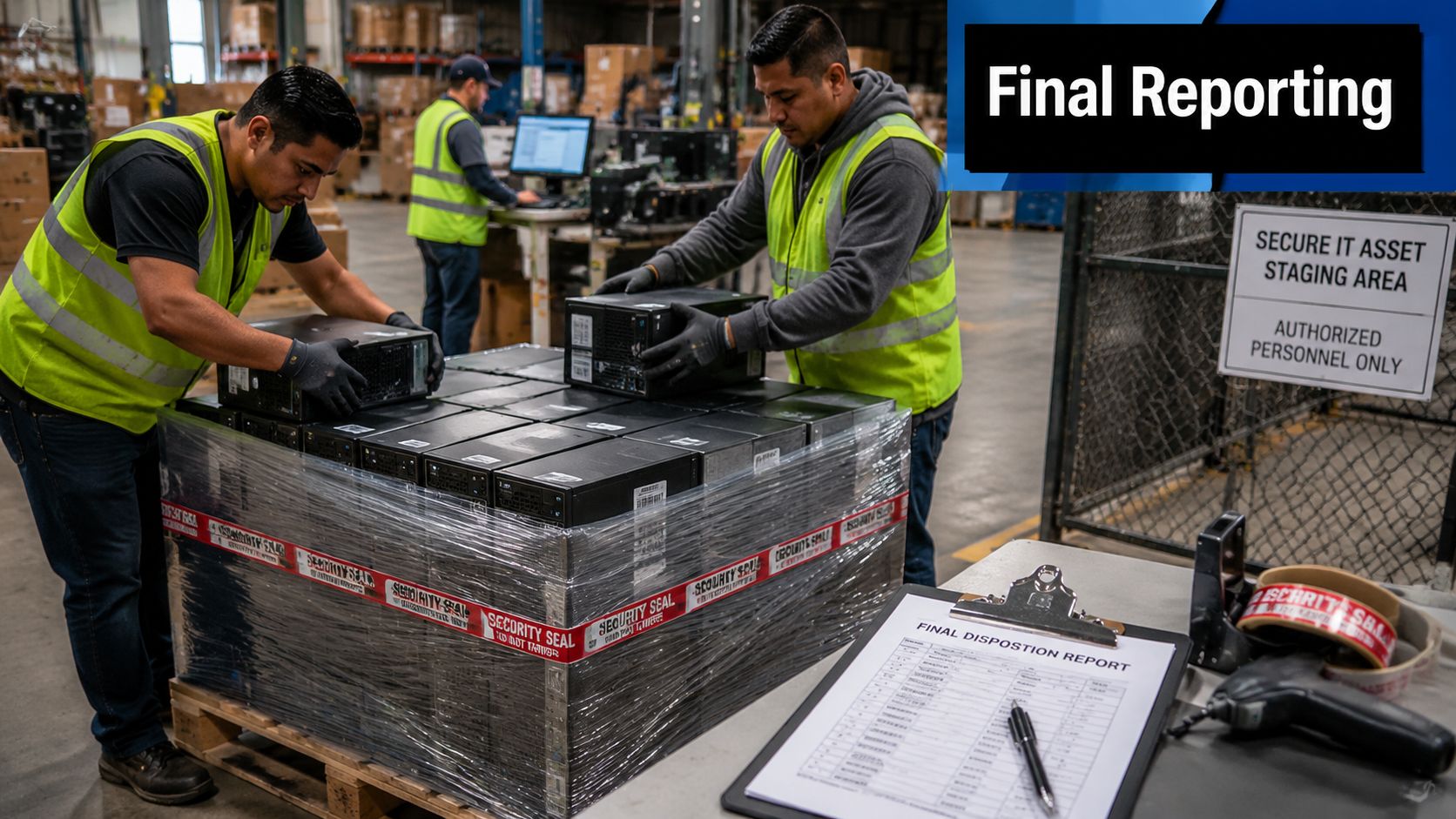
Palletize equipment by disposition path where possible. Keep reuse candidates separate from destruction media, label mixed loads clearly, and photograph sealed pallets when internal policy permits. Data center decommissioning requires extra coordination for rack removal, power-down sequencing, cable identification, elevator reservations, and protection of adjacent production systems.
Close the record with a complete report package
The final report should reconcile what left the site with what the provider received and processed. Include:
- Serialized data destruction certificates
- Certificates of recycling or material recovery records
- Receiving confirmations and exception reports
- Transport and custody documentation
- Weight tickets where relevant
- Asset value recovery statements for remarketed equipment
- A list of assets held, rejected, or requiring additional action
Store the package with the original approval and inventory records. Finance can use recovery statements for accounting, security can retain sanitization evidence, facilities can close the project, and procurement can assess vendor performance.
A recurring disposition cadence prevents retired equipment from becoming an unmanaged stockpile. Schedule periodic reviews, define triggers for urgent pickups, and measure unresolved exceptions rather than only total weight processed. That turns secure computer recycling for businesses into an operating control that supports security, sustainability, and cost recovery.
Beyond Surplus provides business IT asset disposition, secure data wiping, on-site and off-site hard-drive shredding, electronics recycling, product destruction, data center de-installation, logistics coordination, and documented certificates of data destruction and recycling. Visit Beyond Surplus to arrange a secure pickup and build a disposition workflow that accounts for computers, storage media, and network infrastructure.