
Businesses generated a record 62 million tonnes of e-waste globally in 2022, yet only 22.3% was formally collected and recycled, while roughly US$62 billion in recoverable resources went unclaimed. Business e-waste recycling services turn that disposal problem into a controlled process for data protection, regulatory documentation, equipment reuse, and materials recovery.
That distinction matters to an IT director retiring laptops, a facilities manager clearing a data center, and a procurement team replacing medical or laboratory equipment. Electronics recycling isn't merely a truck arriving at a loading dock. It involves identifying assets, protecting information, controlling custody, selecting the right disposition method, and proving what happened afterward.
Table of Contents
- Why Business E-Waste Recycling Matters Now
- Types of Business E-Waste and IT Asset Disposition Services
- Certified Data Wiping Versus Physical Destruction
- Compliance Obligations and Chain-of-Custody Requirements
- Value Recovery Through IT Buyback and Refurbishment
- How to Evaluate a Business E-Waste Provider
- Making the Right Choice for Your Organization
Why Business E-Waste Recycling Matters Now
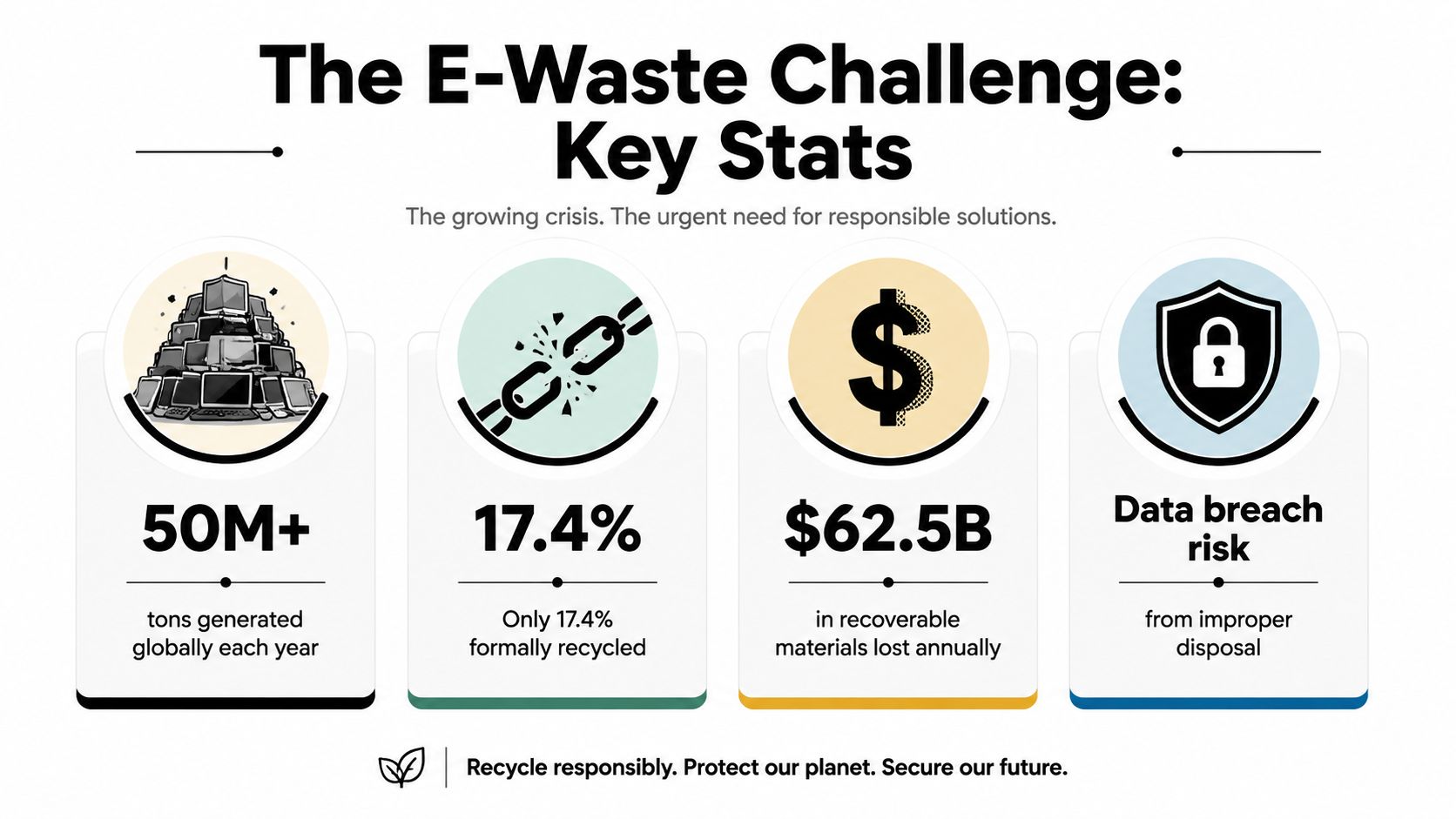
Every organization that buys, operates, and retires technology participates in the e-waste stream. The scale is no longer abstract. The 2024 Global E-waste Monitor records 62 million tonnes generated in 2022, approximately 7.8 kilograms per person, an 82% increase from 2010. Only 22.3% was formally collected and recycled in an environmentally sound way.
The financial implication is just as important. The same report estimates that approximately US$62 billion in recoverable natural resources went unaccounted for in 2022. Those resources include materials that could have supported recovery and reuse instead of being lost through informal handling, landfill disposal, or poorly documented downstream processing.
Disposal creates several forms of exposure
Consider a business replacing a fleet of laptops. If staff send devices to an undocumented recycler, the company may lose potential resale value and lack evidence that stored information was removed. If the same organization stores retired equipment in an unsecured room, it creates an inventory, security, and facilities problem before recycling even begins.
The pressure will increase. The Global E-waste Monitor projects annual generation will reach 82 million tonnes by 2030, approximately a 32% increase from 2022. That trajectory makes organized collection logistics, secure IT asset disposition, and enterprise electronics recycling operational infrastructure rather than optional sustainability projects.
Practical rule: Treat every retired device as both an information-bearing asset and a recoverable material until a documented disposition decision says otherwise.
Beyond Surplus is one example of a commercial provider offering business electronics recycling, secure data destruction, IT equipment disposal, IT buyback, product destruction, and data center de-installation support. For a cautious buyer, the relevant question isn't whether a provider uses the word “recycling.” It's whether the provider can manage the full path from pickup through documented final disposition.
Types of Business E-Waste and IT Asset Disposition Services
Business e-waste includes much more than obsolete desktop computers. A commercial program may handle laptops, servers, networking equipment, monitors, printers, mobile devices, batteries, medical equipment, laboratory equipment, point-of-sale systems, and components from a data center decommissioning project.
The service model should match the asset and its risk.
Common service pathways
Secure collection and transport begins with scheduled electronic waste pickup, asset counts, containers, pallets, or sealed loads. A single-site office can use a straightforward pickup. A multi-site business needs coordinated scheduling, location-level inventories, and consistent documentation.
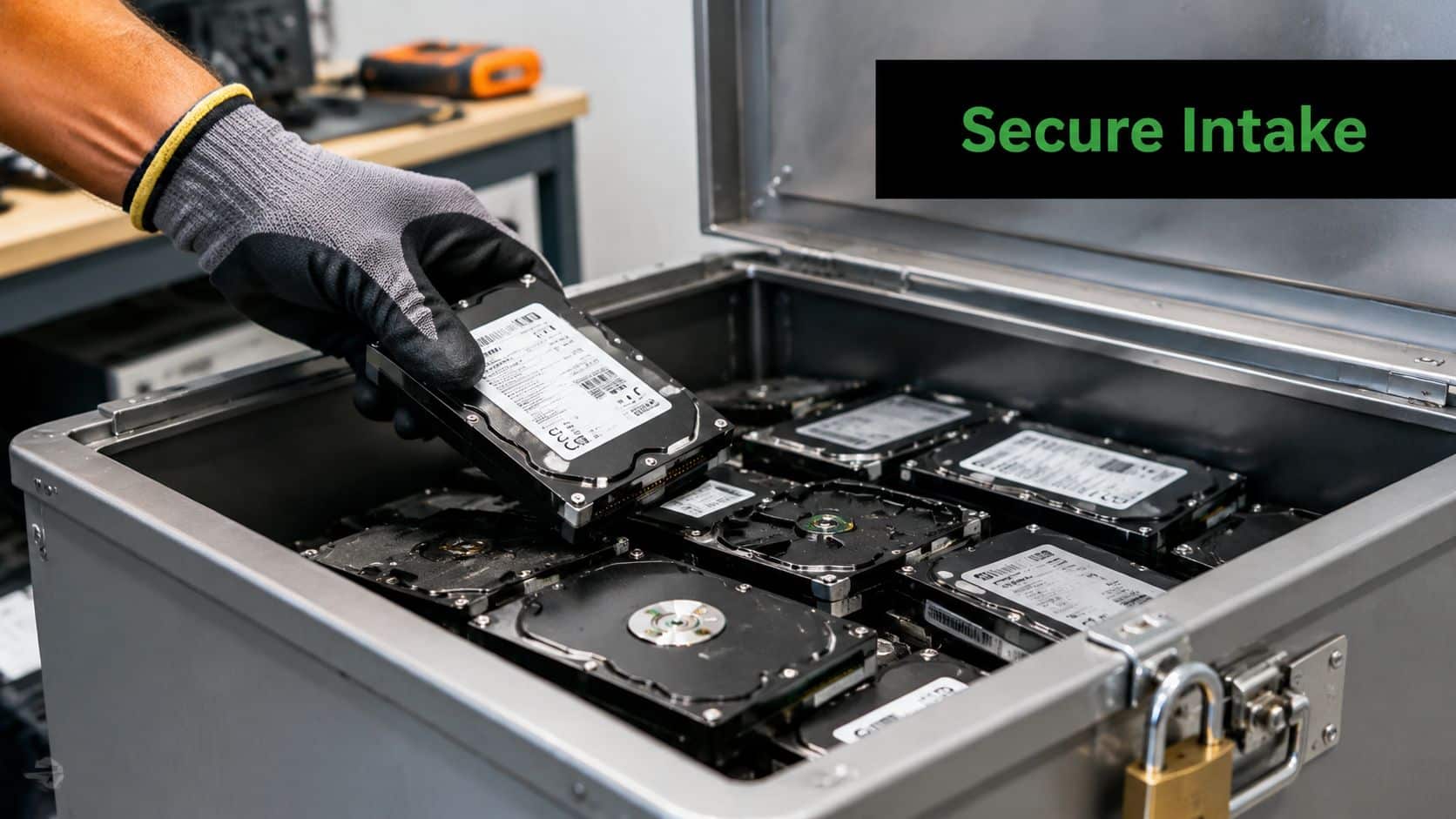
Data destruction can occur on-site or at a secure processing facility. On-site hard drive shredding gives an organization the opportunity to witness destruction before equipment leaves the premises. Off-site destruction can work well when the provider maintains controlled transport and records each serialized drive through completion.
Certified software wiping is appropriate when a device has practical reuse or remarketing value. The provider erases data using a recognized process and produces a record connected to the individual asset.
Product destruction applies when a company needs devices, prototypes, branded goods, defective products, or components rendered unusable. The workflow should document the item received, the destruction method, and the resulting disposition.
IT asset recovery and buyback separates equipment with resale potential from material that should go directly to recycling. A laptop in good condition may follow a different path from a damaged server, a depleted battery, or a legacy display.
A healthcare provider, for example, might send storage media containing patient information through witnessed destruction while routing usable workstations through certified wiping and remarketing. That combination protects sensitive data without automatically destroying equipment that still has commercial value.
For a practical explanation of the complete lifecycle, review what IT asset disposition means for business. The useful distinction is between collection, sanitization, reuse, recycling, and reporting. A provider that only performs one step may not be equipped to manage the entire program.
Certified Data Wiping Versus Physical Destruction
The choice between data wiping and physical destruction affects two outcomes at once: data risk and recovery value. A reusable laptop, server, or storage device should usually be evaluated before anyone destroys it. A failed drive, highly sensitive medium, or device that cannot be reliably sanitized may warrant physical destruction instead.
When wiping preserves value
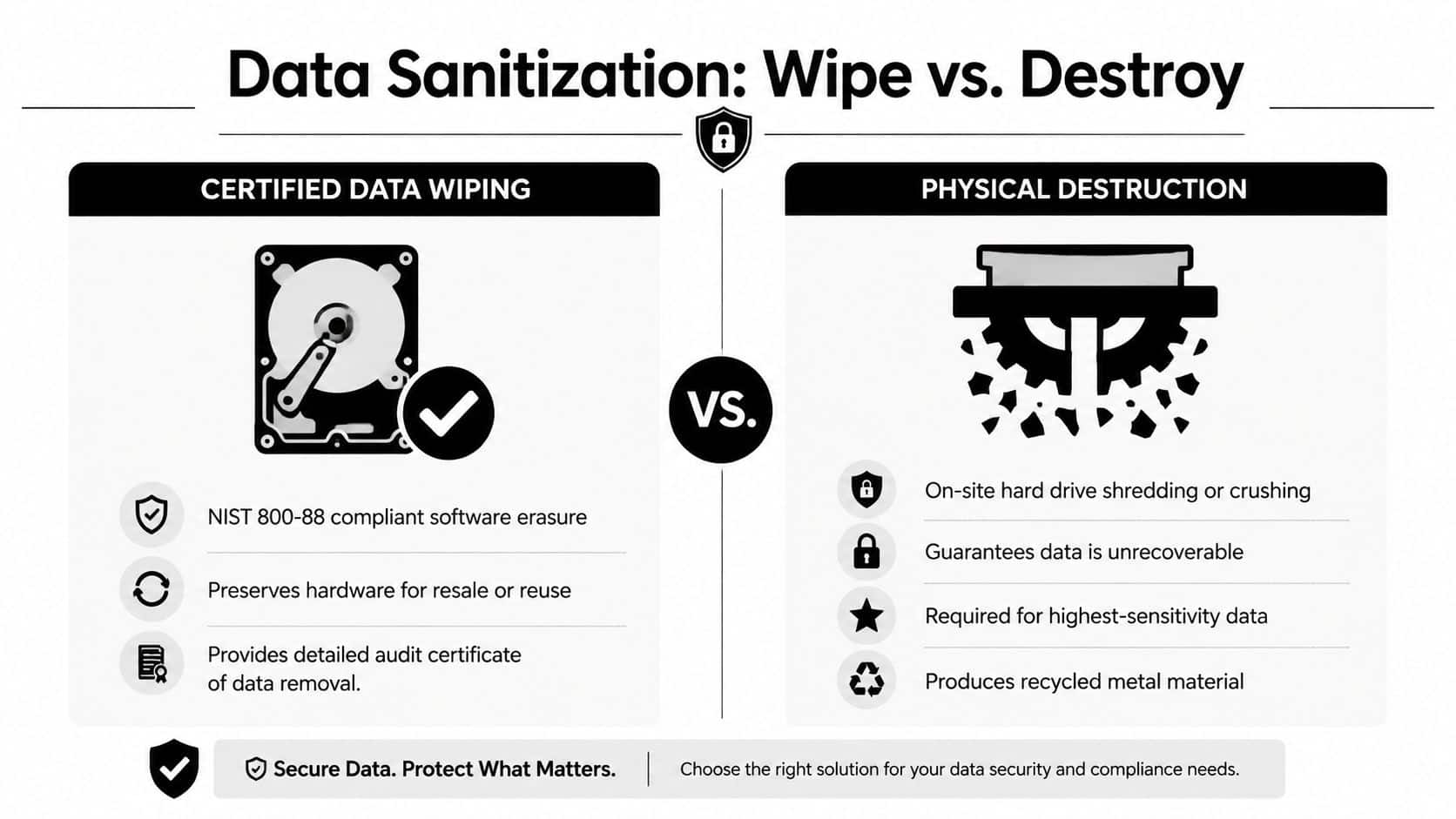
Certified wiping uses software to remove stored information while leaving the hardware intact. A process aligned with NIST 800-88 can support remarketing when the device passes functional and condition checks. The resulting certificate should identify the asset, the method used, and the completion status.
Encryption-based controls can reduce exposure during the device lifecycle, but encryption shouldn't be treated as a substitute for a verified end-of-life disposition process. The organization still needs to know which assets were received and how they were processed.
When destruction is the safer route
Physical destruction changes the decision permanently. Hard drive shredding, crushing, or another approved destruction method makes the storage medium unusable and sends the resulting material toward recycling. This path can be appropriate for failed drives, damaged media, or information classified as especially sensitive.
Industry benchmarking describes a mixed-method environment that includes secure-bin handling, software wiping, physical destruction, and encryption controls. That makes sense operationally. A business doesn't need one universal method. It needs a documented rule for deciding which method applies to each asset class.
Use the comparison of hard drive shredding and data wiping when setting procurement requirements. Ask whether the provider can quarantine unreadable media, record serial numbers before destruction, and issue certificates that match the assets in your inventory.
The wrong shortcut is destroying every device without an assessment. That may reduce data risk, but it can also eliminate resale value unnecessarily. The opposite shortcut, wiping every drive regardless of condition or sensitivity, can leave an organization without a defensible answer when a device cannot be sanitized reliably.
Compliance Obligations and Chain-of-Custody Requirements
Data destruction is only one part of compliance. The organization also needs to demonstrate who handled each asset, when custody changed, what method was used, and whether final processing occurred as represented.
The FTC Disposal Rule requires organizations to take reasonable measures to protect sensitive information during disposal. The FTC Disposal Rule and hard drive destruction guidance describes the operational importance of maintaining control until destruction is complete and documented.
Build the record before the pickup
A defensible chain of custody starts with an inventory. Capture asset tags, serial numbers, device type, location, and any relevant data classification before loading begins. Use sealed containers or controlled staging areas, then document the transfer to the transport team.
A strong record typically includes:
- Serialized intake, showing the assets received.
- Custody transfer details, identifying the responsible parties and timing.
- Processing status, including wiping, destruction, reuse, or recycling.
- Certificates, tied to the specific asset or defined shipment.
- Final disposition reporting, showing where equipment and materials went.
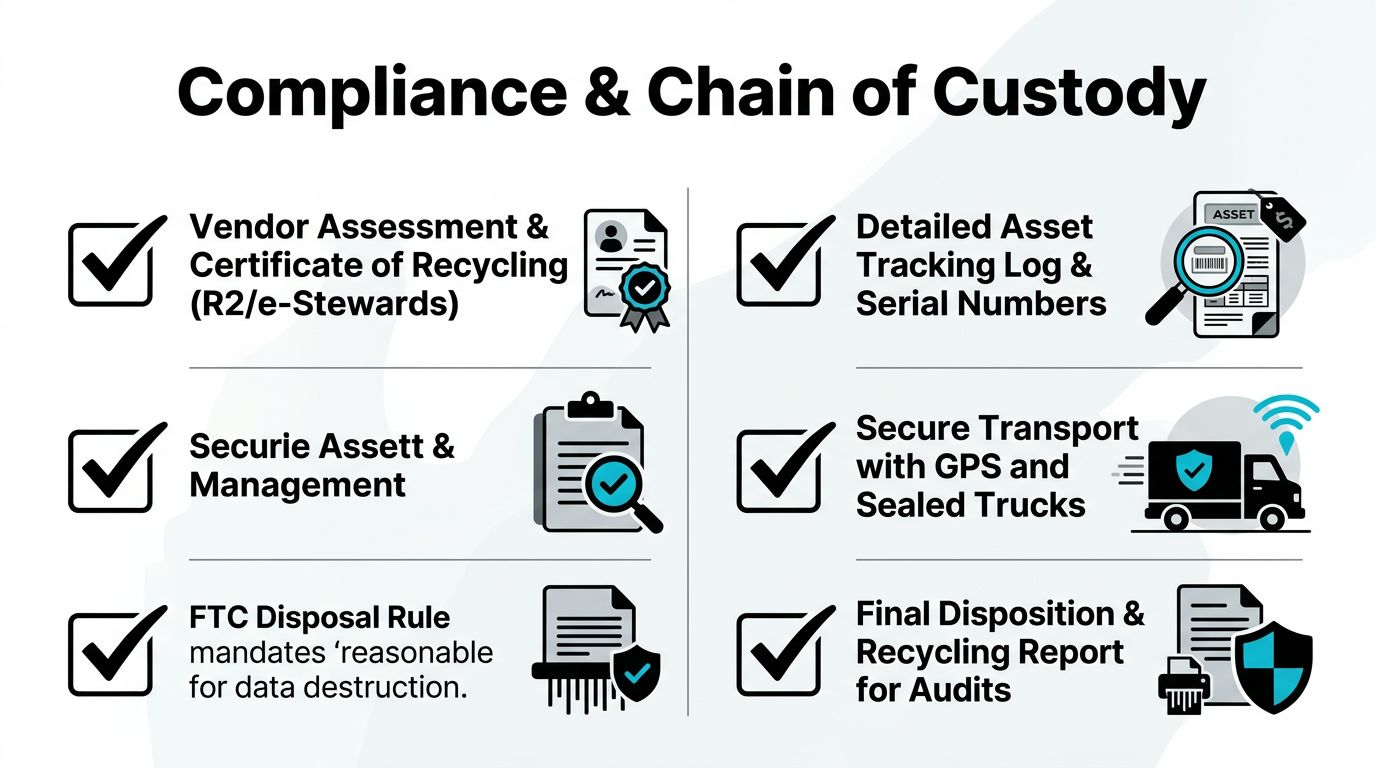
Healthcare and finance teams should connect this documentation to their internal privacy and retention controls. A certificate that only says “electronics recycled” may not answer whether a particular server or drive was wiped, destroyed, or transferred for reuse.
Multi-site and cross-border complications
Distributed organizations need location-level visibility. A provider should explain how it handles different pickup addresses, local transport requirements, batteries, hazardous components, and downstream processors. The chain-of-custody documentation guide provides a useful reference point for evaluating those records.
Certified recycling frameworks such as R2 and e-Stewards can help structure vendor oversight and downstream accountability. They don't remove the buyer's responsibility to review the provider's scope, certificates, and processing pathway. Cross-border shipments require additional care because the Basel Convention's 2025 Prior Informed Consent rules affect international e-waste movements, as outlined in the supplied regulatory background from SK Tes.
Value Recovery Through IT Buyback and Refurbishment
Disposal doesn't always mean writing off the entire asset. A well-run ITAD program first asks whether the equipment can be reused, refurbished, remarketed, harvested for parts, or recycled for materials.
That sequence changes the economics. Certified wiping can preserve a laptop or server for a secondary market, while condition assessment determines whether the device is functional, cosmetically acceptable, complete, and commercially relevant. Equipment with missing components, severe damage, obsolete specifications, or unreliable storage may have little resale value even if it appears intact.
Different assets follow different value paths
A recent e-waste recycling market outlook projects refurbishment and reuse to register the top compound annual growth rate at 12.21% through 2031, while recycling and material recovery held the largest share at 60.88% in 2025. These figures point to a market that supports both life extension and material recovery, not a single universal destination.
A current laptop refresh might produce three groups:
- Remarketable devices, wiped, tested, graded, and offered for buyback.
- Repair candidates, routed through refurbishment if parts and labor support the economics.
- Non-recoverable equipment, dismantled and sent through responsible recycling.
A server removal follows a different pattern. Racks, power distribution equipment, storage arrays, networking hardware, and cabling may require coordinated de-installation before individual assets can be tested. Medical and laboratory equipment may also require specialized handling because function, contamination status, components, and downstream markets vary.
Use an equipment condition assessment to establish a consistent grading process. Two organizations with similar refresh cycles can reach different net disposal costs because one documents condition and captures buyback value, while the other sends everything directly to a recycler.
The cheapest quote is not always the lowest total cost. Compare service fees, avoided handling work, recovered value, and documentation quality together.
How to Evaluate a Business E-Waste Provider
A provider evaluation should test the workflow, not just the sales presentation. Ask for sample reports, certificates, insurance information, processing locations, escalation procedures, and a clear description of what happens to equipment that cannot be reused.
| Criterion | What to Verify | Red Flag |
|---|---|---|
| Certifications | Confirm the provider's applicable R2, e-Stewards, recycling, and data-destruction credentials. | A certificate is mentioned without scope or supporting documentation. |
| Chain of custody | Request serialized intake, transfer records, and final disposition reports. | The provider tracks only pallets or approximate weights. |
| Data destruction | Ask whether wiping follows NIST 800-88 and when physical destruction is required. | One method is used for every device without an asset assessment. |
| Value recovery | Require grading rules, valuation logic, and buyback reporting. | The provider offers a vague credit with no asset-level explanation. |
| Pickup logistics | Confirm service geography, scheduling, containers, transport controls, and site coordination. | The provider can't explain multi-site pickups or downstream transport. |
Questions that expose process gaps
Ask who assumes custody at the dock, how the team handles an asset missing from the manifest, and when the certificate becomes available. For a data center decommissioning project, ask who coordinates rack removal, power-down sequencing, packaging, loading, and site security.
Businesses moving heavy or specialized equipment may also need transport planning beyond standard IT pickups. A facilities team can review resources such as find your best trailer fit when evaluating equipment-hauling requirements, provided the arrangement remains aligned with the recycler's chain-of-custody controls.
A vendor due-diligence process should verify downstream processors rather than accepting a general promise that materials are recycled. Use this vendor due diligence checklist to organize questions before contract approval.
Look for answers that are specific, repeatable, and auditable. A provider that can explain exceptions is usually easier to manage than one that describes only the ideal shipment.
Making the Right Choice for Your Organization
The right business e-waste program starts with an asset inventory, not a disposal quote. Separate storage media from general equipment, identify devices that may contain regulated or confidential information, record locations and quantities, and flag batteries, CRT displays, medical equipment, laboratory instruments, and oversized data center hardware.
Assign a clear outcome to each group:
- Reuse or buyback for equipment with credible market value.
- Certified wiping for reusable devices containing data.
- Physical destruction for media that cannot be reliably sanitized or has a higher sensitivity classification.
- Material recycling for equipment at the end of its practical service life.
- Product destruction for goods that must be rendered unusable and documented.
The contract must match those decisions. Define pickup responsibilities, asset identification, custody transfers, destruction standards, certificates, reporting timelines, downstream oversight, and treatment of recovered value. Multi-site enterprises should also specify how local teams prepare equipment and how IT or procurement receives consolidated reporting.
A practical decision test
Before choosing a provider, ask:
- Can the team prove where every serialized asset went?
- Does the data destruction method match the asset's condition and sensitivity?
- Can the provider separate recoverable equipment from material headed for recycling?
If any answer is unclear, price should wait. Close the process gap first. EPA data show why the disposition channel matters. The agency reported that the United States generated approximately 2.7 million tons of electronics waste in 2018, with 38.5% recycled and the remainder combusted with energy recovery or landfilled, according to its sustainable materials management electronics guidance.
Regulatory classification can change the project scope. The GAO report on used electronics notes that EPA regulates certain used electronics as hazardous waste, including CRT items because older televisions and computer monitors contain significant quantities of lead. A data center clearance involving those materials may require different handling, documentation, and downstream controls.
A manufacturing firm that skips condition assessment could send functional servers to shredding and recover nothing, while a properly assessed refresh may qualify for buyback credits. The same equipment can produce a different business result depending on how it is evaluated before disposition.
Beyond Surplus provides commercial electronics recycling, secure data wiping, on-site and off-site hard drive shredding, IT equipment disposal, IT buyback, product destruction, and data center de-installation support. Visit Beyond Surplus to arrange a documented business pickup and discuss a secure disposition plan for your organization.


