

A senior engineer resigns from a fully remote role on Friday. IT sends a return label, HR closes the offboarding ticket, and the manager assumes someone else is following up. Months later, the laptop is still in a closet, its location is uncertain, and nobody can prove whether the drive was locked, wiped, or accessed after the employee's departure.
That failure isn't caused by shipping alone. It comes from unclear ownership, incomplete asset records, weak escalation, and missing evidence at each handoff. A Remote Employee Laptop Return Program turns retrieval into a controlled process, with defined triggers, accountable owners, tracked logistics, intake verification, sanitization records, and a final disposition record that stands up to audit and legal review.
Table of Contents
- Why Remote Laptop Returns Break Down Without a Program
- Building the Program Foundation
- Designing the Return Workflow
- Shipping, Pickup, and Employee Communications
- Secure Data Sanitization and Documentation
- Vendor, Cost, and SLA Considerations
- Launch Checklist and Program Improvements
Why Remote Laptop Returns Break Down Without a Program
Remote returns fail when the company treats a laptop as a package instead of as an assigned information asset. HR may know the termination date, IT may own the device record, and the manager may know where the employee works, but if nobody owns the next action, the case stalls between departments.
The problem affects a majority of organizations. In a 2022 survey of 287 HR professionals responsible for offboarding, 71% said at least one departing employee had failed to return company-owned equipment during the prior year, according to industry reporting on remote device offboarding. That is a company-level incident rate, not a device-loss rate, so it doesn't show how many laptops were involved. It does show that remote recovery needs a repeatable control rather than individual diligence.
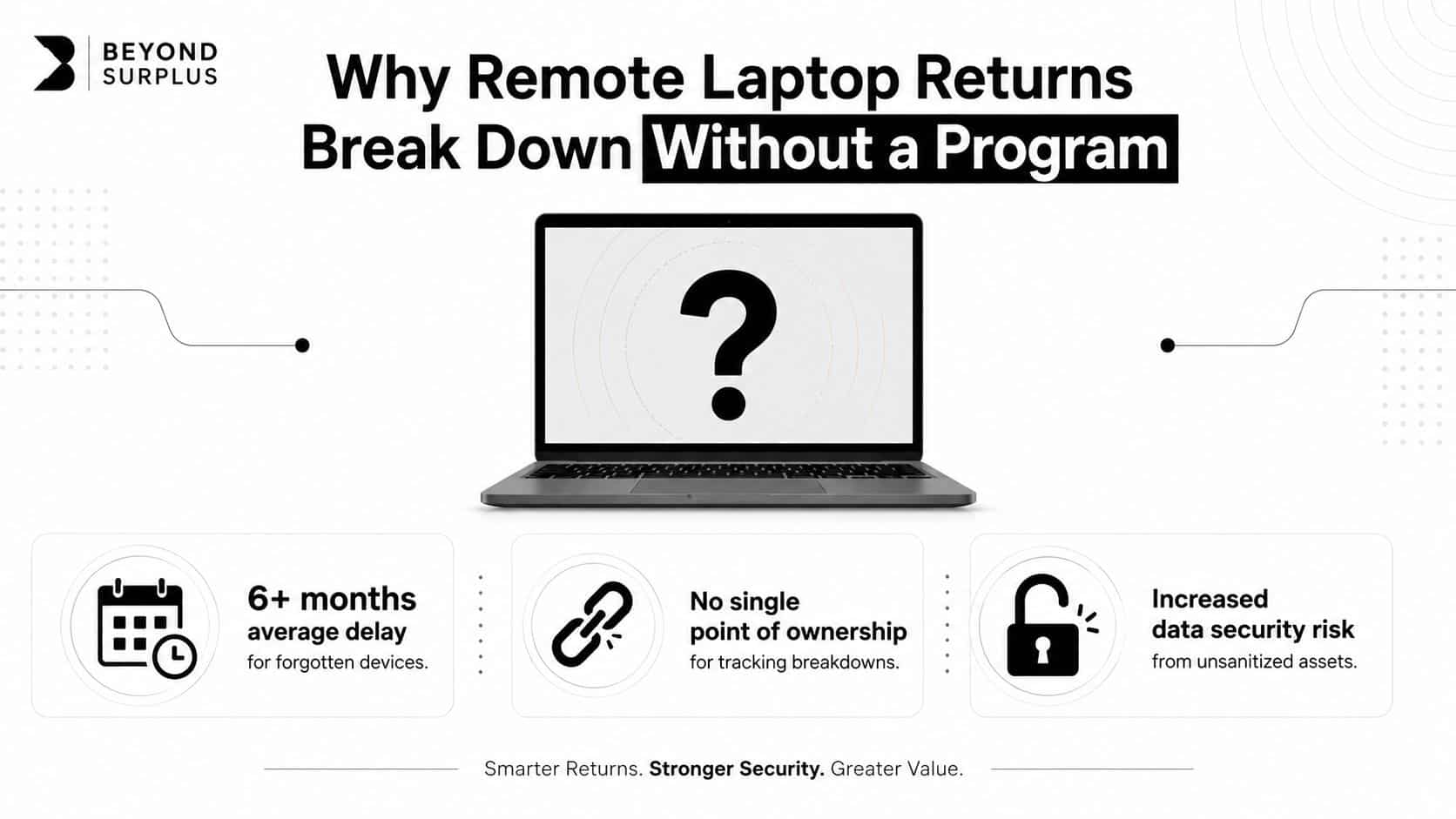
The three breakdowns to eliminate
- Ambiguous ownership: HR initiates offboarding, IT manages the asset, and the manager confirms business details. The workflow must identify one case owner and specify when each supporting role acts.
- Missing chain-of-custody: A tracking number can show that a carrier accepted a box, but it doesn't prove which serial-numbered laptop was inside or who verified it on arrival.
- Unverified data status: A returned laptop can sit in receiving while its storage remains accessible. IT must isolate the asset and document sanitization before redeployment, resale, or recycling.
Organizations without structured processes recover only 70% to 85% of issued devices, leaving roughly 15% to 30% permanently missing, according to remote laptop return benchmarks for IT teams. Ad hoc emails and spreadsheets rarely preserve the evidence auditors, privacy teams, and legal counsel need. A formal program creates a ticket, an owner, a deadline, a shipment record, an intake confirmation, and a certificate-backed disposition trail.
For a practical view of the business impact, review the cost of unreturned employee laptops. The key point is operational, not merely financial. Every missing record makes asset recovery, license reconciliation, data protection, and accountability harder.
Building the Program Foundation
A reliable program starts with governance. Before selecting boxes, carriers, or automation, document what the program covers, who makes decisions, and what evidence the organization must retain.
Five pillars need named owners
Scope and eligibility defines which laptops, phones, monitors, accessories, and removable media enter the workflow. IT should maintain the asset categories, while HR confirms which employment events trigger a return.
Ownership and RACI assigns responsibility for initiation, communication, shipping, receipt, sanitization, escalation, and closure. HR owns the employment trigger, IT owns asset control, managers confirm operational details, and procurement or vendor management owns third-party performance.
Policy and legal framing belongs with HR and Legal. An acceptable-use policy doesn't replace a property-return policy. The return policy should state the employee's responsibilities, the company's shipping obligation, permitted data handling, escalation path, and jurisdiction-specific review requirements.
Technology and asset data requires IT engineering or asset management sign-off. The record should include the employee, department, asset tag, serial number, model, assigned accessories, location, ticket ID, status, tracking number, receipt timestamp, condition, sanitization method, certificate reference, and disposition.
Third-party ITAD alignment belongs with IT, security, procurement, and compliance. The vendor must accept the company's evidence requirements, not just promise to process equipment.
| Program Pillar | RACI Owners | Key Deliverable |
|---|---|---|
| Scope and eligibility | HR, IT asset management | Covered asset and trigger definition |
| Ownership and RACI | HR, IT, managers | Approved responsibility matrix |
| Policy and legal framing | HR, Legal, Privacy | Employee equipment return policy |
| Technology and asset data | IT operations, security | Standard asset record schema |
| ITAD alignment | Procurement, IT, compliance | Vendor requirements and SLA schedule |
The foundation should produce three durable documents: the return policy, the RACI matrix, and the asset data schema. Use this employee equipment return policy guidance to pressure-test language before approval.
Practical rule: If a workflow can't identify the next owner from the asset record, it isn't ready for automation.
Designing the Return Workflow
The workflow should begin automatically when HR records an offboarding event. Manual notification from one department to another creates avoidable gaps, especially when account access changes quickly or the employee's company mailbox is disabled.
Capture evidence at every stage
Initiation: The HRIS trigger creates an IT ticket containing the termination date, employee contact details, manager, department, work location, and assigned asset list. IT validates the serial number before sending instructions. The ticket records who approved the case and when.
Employee notification: Send one complete message to the employee's approved personal contact channel. It should include the return deadline, packing instructions, label or pickup link, asset list, support contact, and data-handling notice. Save the message and delivery status to the ticket.
Return logistics: Issue prepaid tracked packaging or schedule a carrier pickup. Record the package identifier, carrier, pickup appointment, acceptance scan, and employee confirmation. If the employee reports a damaged box or missing accessory, log the exception rather than handling it in an unrecorded email thread.
Asset intake: Receiving staff match the physical device to the expected serial number and asset tag. They record arrival time, package condition, device condition, accessories, photographs where appropriate, and the name of the person who performed the check. A shipment confirmation alone isn't an intake confirmation.
Isolation and sanitization: Keep the device away from production networks until security approves its status. Apply the sanitization method appropriate to the media and intended disposition, then attach the certificate or manifest to the original asset record.
Final disposition: Reconciliation closes the loop. The asset register should show whether the laptop was redeployed, resold, recycled, or destroyed, with the downstream ITAD documentation linked to the return ticket.
Set internal service targets
Use internal targets to expose stalled transitions. For example, require intake confirmation within 5 business days and complete sanitization within 10 business days, unless a documented exception applies. These are management targets, not universal benchmarks, so adjust them to geography, security requirements, and vendor capacity.
The most common stalls occur before physical receipt. Manager confirmation may be missing, or the asset record may lack a serial number. Automated data feeds from the HRIS, MDM platform, and asset register reduce those dependencies. Remote employee asset-return tracking guidance can help teams map statuses and exception handling.
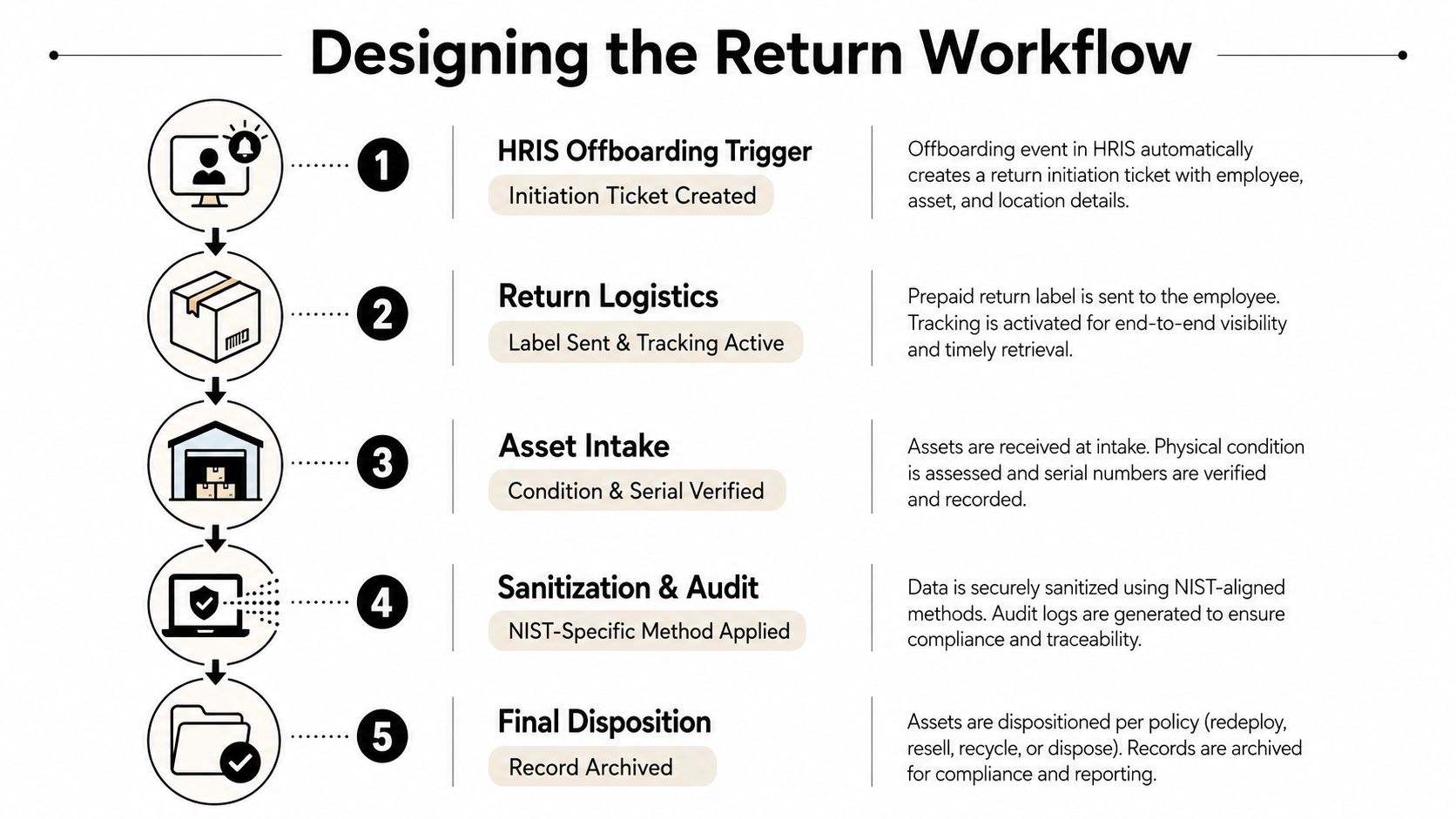
The final record should answer five questions without reconstruction: Which asset was expected, who handled it, when did each handoff occur, what happened to the data, and where did the equipment go next?
Shipping, Pickup, and Employee Communications
The right retrieval channel depends on risk, geography, employee cooperation, and volume. A prepaid label usually creates the least friction, while on-site retrieval provides stronger control when the employee has already missed a self-ship attempt or the device is unusually sensitive.
| Channel | Best Fit | Avg. Cost per Device | Chain-of-Custody Strength | Typical Turnaround |
|---|---|---|---|---|
| Prepaid shipping label | Routine domestic returns | Varies by carrier and package | Moderate, improved with tracking and intake matching | Depends on employee drop-off |
| Scheduled carrier pickup | Employees needing home collection or clustered return volume | Varies by carrier and service level | Strong when appointment and scan are retained | Based on appointment availability |
| On-site technician retrieval | Executive devices, failed self-ship, high-sensitivity cases | Higher than standard shipping | Strongest when technician verifies possession and handoff | Based on local scheduling |
A kickoff email should be short enough to act on immediately:
Subject: Company laptop return instructions
Please return the listed company equipment using the attached label or scheduled pickup option by the stated deadline. Pack the laptop securely, include the inventoried accessories, remove personal items, and contact the support owner if you need a different pickup time. Tracking will update after carrier acceptance.
Follow with a reminder that includes the tracking number and a direct scheduling option. If there's no response, route the escalation to HR and the manager instead of sending endless generic reminders.
Use a packing and measurement standard
- Remove the power adapter only when instructed: Keep required accessories together and match them to the asset record.
- Inventory every item: Record chargers, docks, cables, storage media, and other assigned equipment.
- Use suitable packaging: An original box or equivalent protective container reduces avoidable transit damage.
- Seal for tamper evidence: Record the seal or package condition at intake when the risk profile requires it.
Tag each case with the return method, on-time status, first-attempt success, exception reason, accessory completeness, and certificate status. Those fields make reporting useful instead of merely descriptive.
Policies also need to distinguish equipment controls from unrelated workplace rules. For broader context on employer control over home office dress, consult employment counsel. For laptop logistics, use remote laptop shipping best practices as an operational reference.
Secure Data Sanitization and Documentation
Returning a laptop doesn't make its data safe. The device should remain controlled from intake through sanitization, and the selected method should match the media type, data sensitivity, and planned disposition.
Match the method to the outcome
NIST SP 800-88 organizes media sanitization into Clear, Purge, and Destroy, as summarized in NIST SP 800-88 guidance for ITAD.
- Clear applies when the device is suitable for redeployment and the organization can use approved software or system functions to remove accessible data.
- Purge uses stronger media-specific techniques, such as cryptographic erasure where appropriate, when the device will move across departments or ownership boundaries.
- Destroy physically renders the media unusable when sanitization can't be verified, the media is defective, or the sensitivity and disposition require irreversible handling.
NIST's framework emphasizes verification and documentation. A certificate should not only say “wiped.” It should identify the asset serial number, asset tag, method, tool or process, technician, timestamp, verification result, and any relevant hash or test reference.
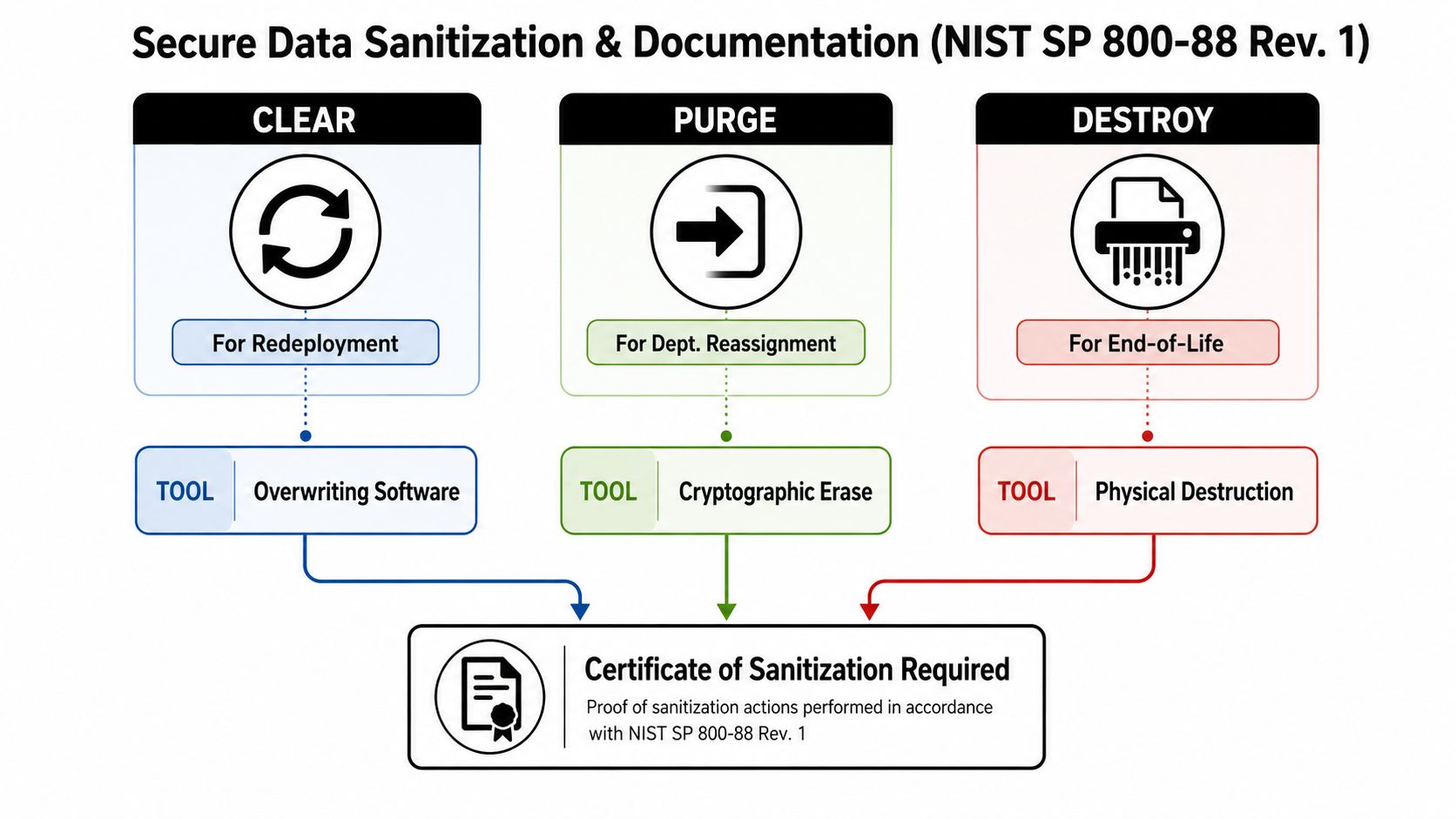
Route the certificate to the right record
A useful certificate layout contains:
- Asset identity and serial number
- Sanitization method and disposition decision
- Technician name and signature
- Processing timestamp and facility
- Verification outcome
- Supervisor review
- Linked ticket and manifest identifiers
HR retains the document with the offboarding record where policy permits. Legal and privacy teams use it during an inquiry or audit. Finance uses the final disposition to support asset write-off or value-recovery accounting. IT links the certificate to the asset register and downstream ITAD report.
Require witnessed or on-site destruction when the media can't be effectively sanitized, when contractual terms demand it, or when the organization's risk assessment identifies a high-consequence asset. UK government security guidance specifies physical destruction when sanitization isn't effective and calls for media to be reduced to particles of 6 mm or less. The same guidance says ITAD suppliers must be approved Assured Service Providers under the NCSC CAS-S Scheme before use, a reminder that destruction requirements include both process and supplier qualification.
The FTC Disposal Rule also requires covered businesses to dispose of consumer report information so it becomes unreadable or undecipherable before disposal, as described in U.S. business e-waste compliance guidance. A certificate closes the accountability loop only when it reconciles to the original return ticket, the physical asset, and the final disposition.
Vendor, Cost, and SLA Considerations
Choose an ITAD provider by reviewing evidence, not by comparing a single processing rate. A low quote can become expensive when the vendor provides weak serial matching, delayed certificates, unclear downstream disposition, or no usable settlement report.
Request the following before approval:
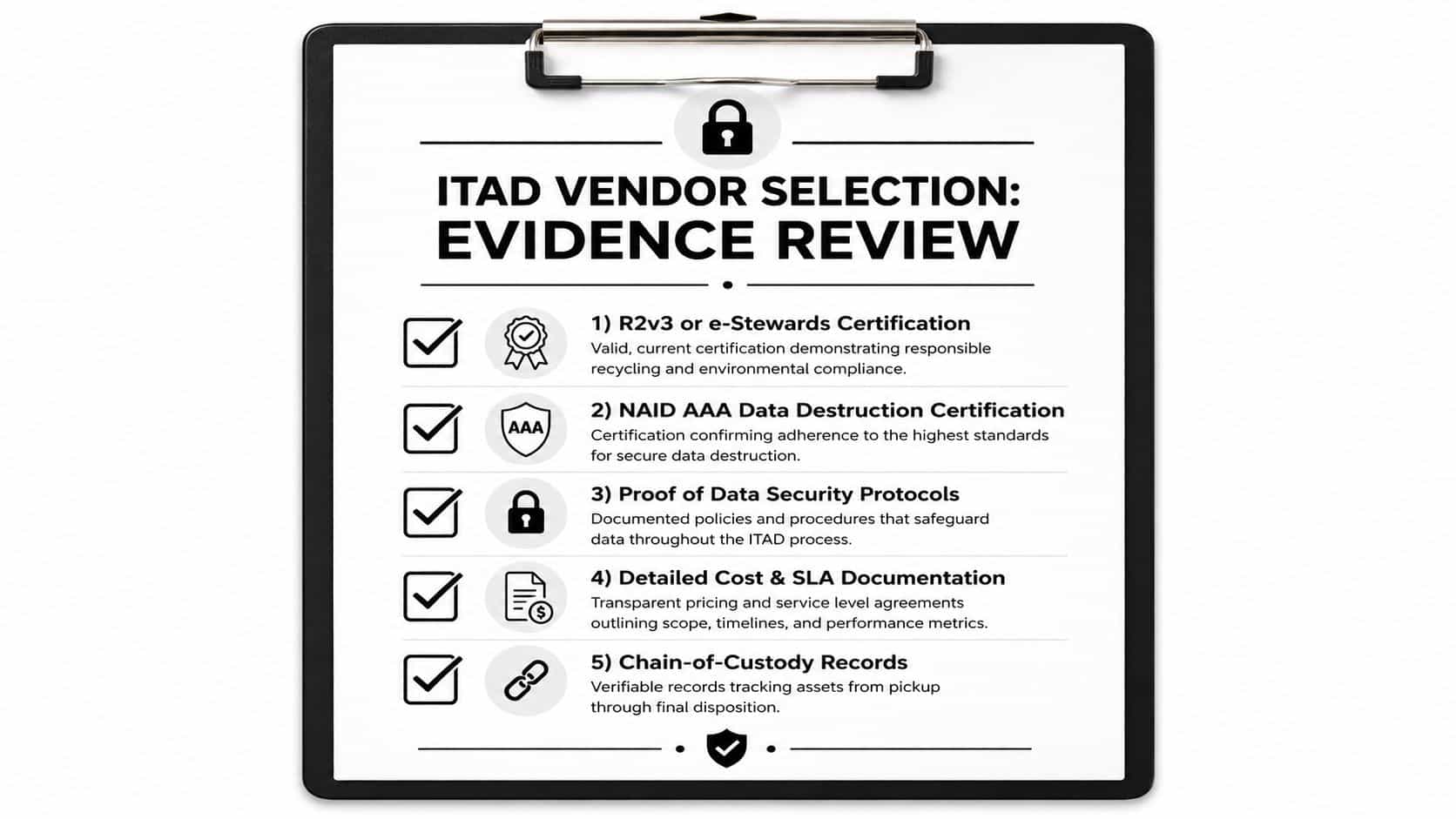
- Environmental certification: Confirm R2v3 or e-Stewards status and verify the scope of the certification.
- Destruction credentials: Request NAID AAA evidence where data destruction is part of the service.
- Sample records: Review certificates of sanitization, destruction, recycling, and resale or recovery.
- Audit and insurance documents: Check audit reports, insurance certificates, and subcontractor controls.
- Chain-of-custody examples: Confirm that each handoff includes asset identity, date, responsible party, and status.
Negotiate service levels around evidence and timing. A buyer may require receipt confirmation within 48 hours, sanitization within 5 business days, settlement reporting within 30 days, and a per-device non-return liability clause. The contract should define what happens when a carrier loses a package, a serial number doesn't match, a certificate is incomplete, or a device arrives damaged.
Build the real cost stack
The total cost includes carrier shipping, packaging, per-device processing, exception handling, and any on-site retrieval. Remarketable equipment may create a value-recovery offset, while damaged or obsolete units may require write-off accounting and compliant recycling. Ask vendors to show each element separately.
Score bidders on compliance documentation, turnaround consistency, reporting depth, financial stability, recovery economics, and escalation responsiveness. A scorecard prevents procurement teams from treating chain-of-custody evidence as an optional feature.
Global disposal conditions reinforce the need for controlled downstream processing. The Global E-waste Monitor 2024 reports 62 billion kg of e-waste generated worldwide in 2022, or 7.8 kg per person, while only 22.3% was formally collected and recycled in an environmentally sound manner. For enterprise buyers, responsible processing means documented custody, secure data handling, and verifiable final disposition.
Launch Checklist and Program Improvements
A practical launch can be organized across the first 90 days, with each phase producing a testable output rather than another policy document.
Establish the operating baseline
- Approve the policy: HR, Legal, Privacy, and IT sign off on return duties, deadlines, shipping costs, data handling, and escalation.
- Onboard the ITAD vendor: Validate certifications, insurance, sample certificates, reporting fields, subcontractors, and SLA remedies.
- Test MDM controls: Confirm lock, remote wipe, device status, and evidence capture without disrupting an active employee.
- Publish the ticket template: Make asset identity, owner, shipment, intake, sanitization, and disposition fields mandatory.
- Run a dry exercise: Process a first wave of five departures using fictional or controlled cases, then document every stall.
The dry run should include a missing serial number, an incomplete accessory return, a carrier exception, and a device that requires destruction. Those scenarios expose whether the team can act without relying on personal memory.
Measure the control, not just the shipment
Review return cycle time, first-attempt pickup success, certificate retrieval latency, cost per recovered device, and non-return rate each quarter. Segment results by geography, manager group, shipping channel, device type, and exception reason. A stable average can hide a serious problem in one region or role category.
Watch the leading indicators: Rising repeat reminders and slower certificate turnaround usually appear before a formal recovery failure.
HR and Finance should reconcile employee departures against asset records and write-offs. IT should compare MDM inventory with the asset register, while Procurement reviews vendor SLA performance and exception trends. An annual tabletop exercise should simulate a lost device, a disputed receipt, and a missing sanitization certificate, then record corrective actions.
Program improvements should remove friction first. If employees struggle to schedule pickups, add a simpler booking path. If intake teams can't match serials, improve asset data at assignment. If certificates arrive late, enforce the vendor remedy or change the downstream workflow. The goal isn't more reminders or more spreadsheet columns. It's a defensible chain of custody from assignment through final disposition.
Beyond Surplus coordinates nationwide laptop returns with tracked shipping or pickup, intake verification, secure data wiping, resale, recycling, and destruction documentation. Visit Beyond Surplus to discuss a remote employee laptop return workflow that gives IT, HR, Finance, and compliance teams a complete asset record.


