A Friday afternoon equipment refresh can leave an IT manager with retired laptops, de-installed servers, monitors, storage devices, and a Monday deadline. The truck is only one part of the problem. The organization also needs to know what left the building, who accepted it, how data-bearing media was handled, and whether the final records will satisfy an auditor.
That's the practical meaning of a business electronics pickup service. It's a contracted logistics and IT asset disposition operation that begins with collection and ends with documented recycling, resale, wiping, or destruction. The global need is substantial: the world generated a record 62 million tonnes of e-waste in 2022, equal to 7.8 kg per person, while only 22.3% was formally collected and recycled in an environmentally sound manner, according to the Global E-waste Monitor 2024. For a business, responsible pickup is the first custody handoff in a much longer evidence trail.
Table of Contents
- What a Business Electronics Pickup Service Actually Does
- Service Types and Which One Your Job Needs
- How the Pickup Workflow Works Step by Step
- Scheduling Logistics and On-Site Readiness
- Security, Compliance, and Documentation After Pickup
- Cost Drivers and Value Recovery Opportunities
- Choosing a Provider and How Beyond Surplus Fits
What a Business Electronics Pickup Service Actually Does
At 4 p.m. Friday, an IT manager may be looking at a room full of retired equipment and thinking about floor space, access badges, and the Monday installation schedule. Forklifts may need to move pallets through a loading dock, rack equipment may still need de-installation, and storage media may require separate handling from ordinary peripherals.
A commercial pickup provider takes responsibility for more than hauling. The service typically coordinates secure collection, inventory intake, transportation, processing, and final documentation. That scope can apply to equipment from a refresh project, lease returns, a data center decommissioning, a medical equipment disposal program, or a product destruction request.
The most important distinction is custody. Once a device leaves the client's site, the organization should be able to connect its asset tag and serial number to each handoff, location, custodian, and timestamp. A business e-waste recycling service explained in operational terms should therefore answer two questions clearly: what happens to the equipment, and what evidence proves it happened?
The four common pickup assignments
A provider may be collecting:
- End-of-life IT hardware, including computers, monitors, networking equipment, printers, and laboratory equipment.
- Lease-return equipment, where condition, packing, and manufacturer requirements affect the handoff.
- Refresh-project overflow, such as laptops and desktops removed faster than internal staff can process.
- Data-bearing assets, including hard drives, solid-state drives, servers, and failed equipment flagged for wiping or physical destruction.
The pickup is successful only when the physical movement and the recordkeeping agree. A truckload that arrives without a reconciled manifest may still be recyclable, but it creates avoidable questions about missing equipment, data exposure, and downstream disposition.
Service Types and Which One Your Job Needs
Pickup programs differ mainly in where preparation occurs, when custody transfers, and what the client receives afterward. Choosing the wrong model can create extra labor, delay a facility project, or send resale-eligible equipment into a destruction workflow.
| Service Type | What Happens | Best Fit | Output You Receive |
|---|---|---|---|
| On-site pickup | The provider collects equipment at the business location, sometimes with preparation or de-installation support. | Sensitive equipment, limited packaging capacity, active offices, and controlled handoffs. | Pickup manifest, custody record, and final disposition documentation. |
| Off-site pickup | Staff stage and package equipment before freight or provider collection. | High-volume projects with an available loading area and internal preparation resources. | Transport records, processing report, and certificates tied to the inventory. |
| Asset recovery pickup | Working or repairable equipment is evaluated for resale, reuse, or buyback. | Refreshes, lease returns, and surplus technology with recoverable value. | Grading results, recovery statement, and possible buyback credit. |
| Product destruction | Equipment or components are routed for documented destruction rather than resale. | Failed drives, branded products, regulated data, and assets under a destruction requirement. | Destruction certificate and device-level disposition evidence. |
On-site service reduces the amount of work left to an already busy facilities team, but it can cost more when labor, access restrictions, or de-installation are involved. Off-site preparation can make freight efficient, yet it shifts responsibility for labeling, palletization, and staging to the client.
Asset recovery introduces a different trade-off. Working laptops and servers may produce value, but grading, testing, data sanitization, and resale take longer than a direct destruction route. Product destruction provides stronger control where equipment must not return to commerce, but it eliminates resale potential.
Procurement teams evaluating technology investments may also benefit from understanding equipment your competitors finance, especially when comparing replacement cycles with recovery opportunities. The pickup decision should still follow the asset's condition, data risk, contractual requirements, and intended disposition.
For a closer operational comparison, review onsite versus offsite ITAD services before selecting a service shape.
How the Pickup Workflow Works Step by Step
A controlled pickup follows a sequence. Each step creates evidence for the next one, so skipping intake or treating the Bill of Lading as the whole record leaves a gap.
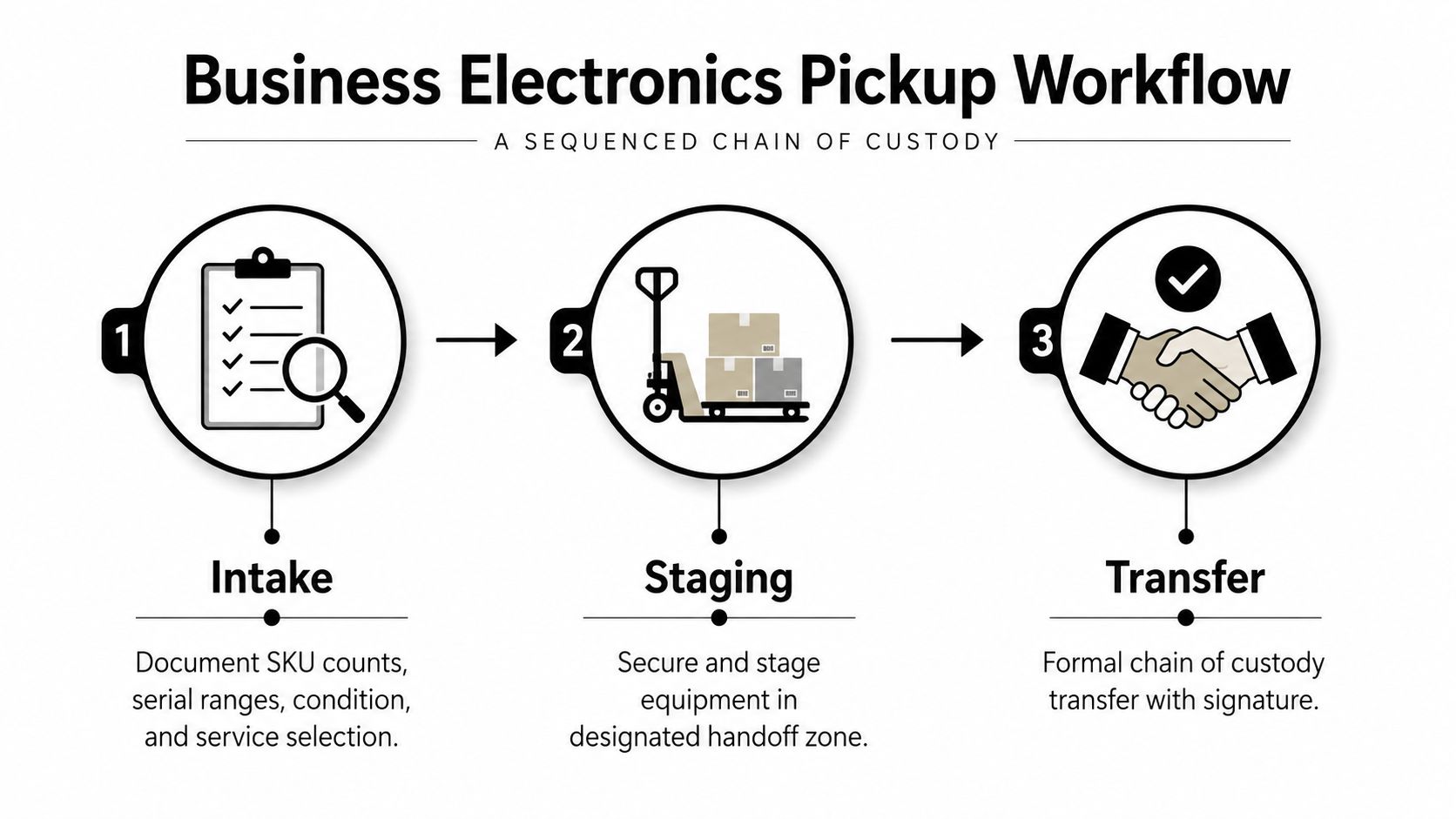
1. Intake establishes the baseline
The provider and client define the equipment population before scheduling. The baseline can include SKU counts, serial ranges, asset tags, location, condition, storage-media type, and the selected service route.
The IT team separates resale candidates from equipment requiring destruction. It's also where the client identifies servers, rack gear, UPS cabinets, medical devices, laboratory equipment, and loose components that may need special preparation.
2. Scheduling turns the inventory into a job
The pickup window should include the address, site contact, driver instructions, loading requirements, equipment quantity, and any security or escort rules. A vague appointment creates friction when the truck arrives and the load isn't ready.
3. Staging prepares the handoff
The client determines who removes rack equipment, labels drives, disconnects devices, and packages loose endpoints. Equipment should be staged in a defined handoff zone where staff can reconcile it against the manifest without blocking normal operations.
4. Collection creates the transfer record
At arrival, the driver or crew counts, scans, or verifies the equipment. The client representative compares the physical load with the manifest, records exceptions, and signs the transport documentation. The Bill of Lading supports the transfer, but a serialized asset record provides the stronger audit trail.
5. Transport preserves custody
The equipment moves under the agreed custody process to the processing facility. Sealed containers, documented handoffs, and transport records help show that the devices stayed within the approved workflow.
Practical rule: Pickup day is the first custody event, not the final disposition event.
6. Processing determines the outcome
Devices may be tested for resale, wiped for reuse, dismantled for material recovery, or physically destroyed. Data-bearing media should remain tied to the device identifier throughout the selected process.
7. Closeout delivers proof
The final package may include a serialized certificate of destruction or recycling, erasure records, custody transfers, and downstream disposition reports. The chain of custody for IT asset disposal is complete only when those records reconcile with the original inventory.
Scheduling Logistics and On-Site Readiness
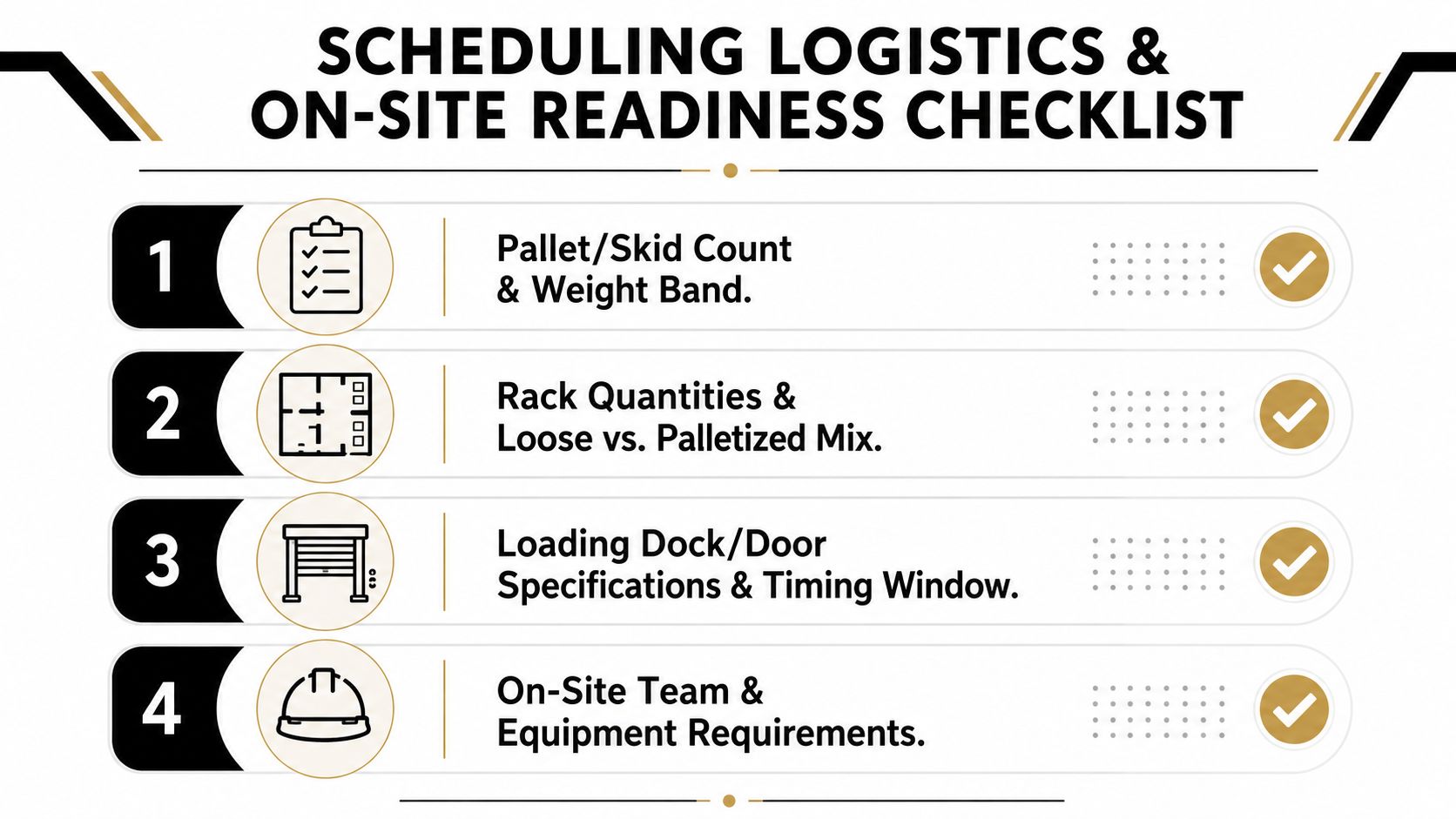
Scheduling is logistics engineering, not just calendar management. The provider needs enough information to assign the right vehicle, labor, equipment, and time window.
Start with the load. Record pallet or skid count, approximate weight band, rack quantities, the mix of loose and palletized equipment, and oversize items such as UPS cabinets or server racks. A pickup that looks simple on an inventory spreadsheet may require crating, lift-gate service, special freight handling, or de-installation labor.
Site access can decide whether the job runs on time. Confirm the loading-dock height, door width, forklift availability, freight-elevator dimensions, elevator booking windows, escort requirements, and any Certificate of Insurance request from a landlord, lender, or property manager.
Confirm the service boundary before the truck arrives
Ask whether the provider is collecting finished pallets or handling de-installation and preparation. Both models can work, but they assign labor differently. The booking should also confirm serialized tagging, photo capture, sealed-container expectations, and who signs the custody transfer.
Scheduling windows vary by project shape. A neutral business recycling FAQ reports that local and national pickups are often schedulable within 1–2 weeks, and that a pickup may require at least a pallet's worth of equipment, as described in business electronics recycling guidance. Treat those as planning references, not guarantees. Building access, load readiness, insurance documents, and freight requirements can move the date.
Before confirmation, verify:
- Load readiness: Equipment is counted, separated by disposition, and staged.
- Access approval: Dock, elevator, parking, escort, and loading windows are confirmed.
- Labor scope: De-installation, packing, palletizing, and shrink-wrapping responsibilities are assigned.
- Documentation: The manifest, site contact details, and custody-signature process are ready.
Security, Compliance, and Documentation After Pickup
The pickup becomes defensible when the organization can reconstruct what happened to each device. That record starts with the serialized baseline and continues through every custody transfer, processing step, and final disposition.
The FTC updated its Disposal Rule in 2018 to align with the Fair and Accurate Credit Transactions Act. The rule requires businesses to take reasonable measures to protect against unauthorized access to consumer information when disposing of records containing sensitive data, including information stored on electronic media, as explained by the FTC Disposal Rule context in the Global E-waste Monitor report.
For financial institutions, the rule connects disposal practice with privacy controls. Healthcare organizations may also need to address protected health information under HIPAA, while organizations handling consumer data must account for applicable federal, contractual, and state requirements. The correct process depends on the data, the organization's sector, and its retention and deletion obligations.
Controls should map to events
| Control | When Generated | Owner | Artifact |
|---|---|---|---|
| Serialized inventory | Before collection and during intake | Client and provider | Asset baseline with tags, serial numbers, location, and condition |
| Custody transfer | At site handoff and each later movement | Client, driver, processor | Signed manifest with timestamps and handlers |
| Data disposition | During wiping or destruction | Processing team | Erasure log or destruction record tied to media identifiers |
| Material disposition | During recycling or downstream processing | Recycler and downstream partners | Recycling or disposition report |
| Closeout review | After processing is complete | Provider account team and client | Certificate package reconciled to the original inventory |
A certificate without serial-level detail is weak evidence. Responsible recycling standards call for downstream tracking beyond the first processor, and secure programs generally connect certificates of destruction or recycling to the exact serial number and disposition method, as reflected in the e-Stewards standard review.
The closeout packet should be assembled for the people who will need it later, including IT security, procurement, facilities, legal, and internal audit. Practical records include serialized manifests, custody transfers, data-disposition logs, downstream reports, vendor agreements, and the certificate of data destruction.
Retention depends on the organization and governing requirements. One compliance source recommends retaining recycler identity, processing dates, destruction records, and custody documentation for at least three years (electronics recycling compliance documentation). Recent audit-readiness guidance describes packages that may be retained for seven years and can include serialized destruction certificates, erasure audit logs, disposition reports, manifests, and vendor agreements (ITAD audit-readiness framework). Follow the longer applicable requirement when organizational policies or sector rules demand it.
Cost Drivers and Value Recovery Opportunities
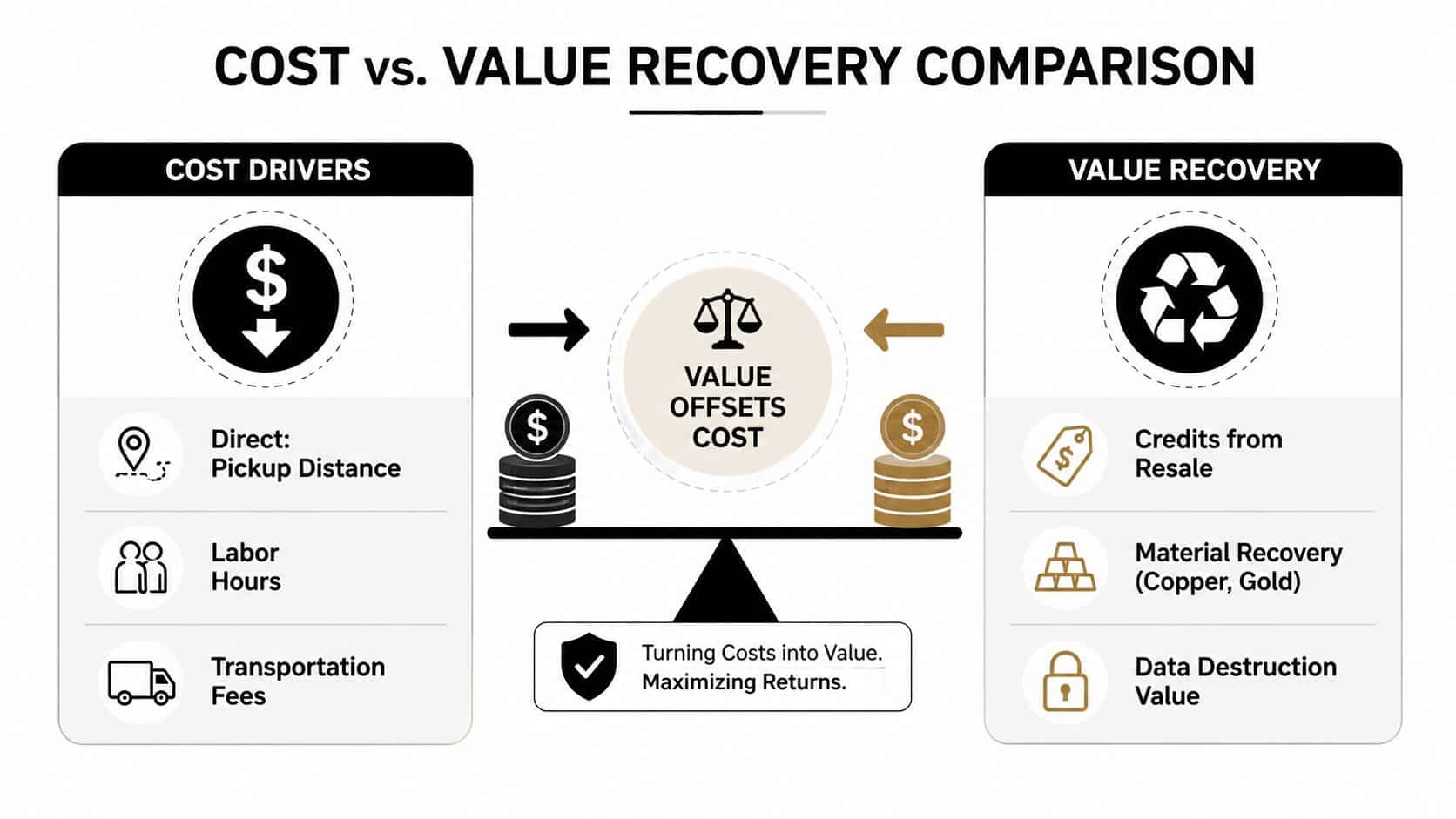
A pickup quote should separate cost drivers from recovery opportunities. Combining them into one unexplained price makes it hard for finance to understand whether the project is expensive because of freight, labor, security controls, or the equipment's condition.
Direct costs may include pickup distance, fuel, de-installation labor, packing materials, palletization, serialized tagging, oversized freight handling, and documentation. Data destruction can add processing labor, while complex sites may require escorts, lift equipment, crating, or appointment-specific access.
Value moves in the opposite direction. Working laptops, servers, networking equipment, and monitors may qualify for resale or buyback credit after testing and data sanitization. Boards and other components can enter material recovery streams, while bulk loads may create recycling revenue depending on composition and downstream terms.
Compare the project options honestly
A rapid data-destruction pickup may minimize storage time and security exposure, but it may not pursue resale value. A recovery-focused program can generate a buyback credit, yet it requires testing, grading, processing, and a longer closeout cycle.
Finance can model the decision as:
Total pickup and processing cost minus estimated buyback or recycling revenue, then compare that result with the cost of holding equipment in storage and correcting incomplete documentation later.
The model should also account for operational risk. A low quoted price that excludes de-installation, certificates, or downstream reporting may become more expensive when internal staff must perform those tasks or when an audit identifies missing evidence.
Choosing a Provider and How Beyond Surplus Fits
Provider selection should resemble a control-point audit. Procurement and security teams need clear answers about custody, data treatment, downstream accountability, insurance, labor, and reporting before the truck is booked.
Ask these questions directly:
| Evaluation Question | What Acceptable Looks Like | How Beyond Surplus Answers |
|---|---|---|
| How is custody recorded? | Serialized manifests, signed transfers, timestamps, and documented destinations. | Uses documented custody records and itemized reporting for business pickups. |
| How is data rendered unrecoverable? | Certified wiping or physical destruction matched to each data-bearing device. | Provides certified data wiping and on-site or off-site hard-drive shredding. |
| What happens downstream? | Identified processors and evidence of final disposition. | Coordinates recycling and disposition documentation through its logistics network. |
| Can the provider support complex sites? | Defined de-installation, transportation, insurance, and access procedures. | Coordinates commercial pickups, data center de-installations, and transportation requirements. |
| What does the client receive? | A closeout package with certificates, manifests, and disposition records. | Issues certificates of recycling and data destruction with supporting documentation. |
The acceptable answer isn't merely “we recycle electronics.” It should explain how the provider identifies each asset, controls the handoff, selects wiping or destruction, and reports the final result. A step-by-step ITAD vendor selection guide can help procurement teams structure that review.
Beyond Surplus is an Atlanta-based ITAD and electronics recycling company that coordinates commercial pickups, data center de-installations, IT equipment disposal, product destruction, secure data wiping, and hard-drive shredding. Its business services include nationwide pickup coordination for organizations, certificates of recycling and data destruction, and value-recovery options for eligible equipment.
The right provider closes the evidentiary loop that began at intake. If the final packet can't connect the certificate to the original serial-numbered inventory, the organization has moved equipment but hasn't fully documented disposition.
Contact Beyond Surplus to coordinate commercial electronics pickup, secure IT asset disposal, data destruction, recycling, and asset recovery. Provide your inventory and site requirements so the team can define the custody process, logistics scope, and documentation your organization needs.