

A partner approves a routine office purge. Closed matter boxes move toward a shred console, while retired laptops and a few external drives sit in an IT closet awaiting disposal. Everyone assumes the cleanup is straightforward, but a missing legal-hold check, an untracked vendor copy, or a drive that was merely reformatted can turn housekeeping into a confidentiality, spoliation, and client-trust problem.
This Law Firm Data Destruction Compliance Guide gives managing partners, records managers, office administrators, and IT teams a practical framework for defensible disposal. It covers the legal foundation, retention decisions, media sanitization, vendor oversight, third-party copies, and the evidence your firm should preserve after destruction.
Table of Contents
- Why Law Firm Data Destruction Compliance Matters Now
- Understanding Your Legal and Ethical Duties for Secure Disposal
- Building a Retention and Destruction Policy That Holds Up
- Choosing the Right Destruction Method for Every Media Type
- Vetting Vendors and Securing Chain of Custody
- Handling Third Party Copies Legal Holds and Breach Response
- Your Audit Ready Roadmap and Next Steps
Why Law Firm Data Destruction Compliance Matters Now
The risk isn't limited to what sits in a filing cabinet. A closed matter may exist as paper correspondence, a document-management folder, an attorney's laptop, an e-discovery workspace, a co-counsel copy, cloud backups, and removable media. If staff destroy only the obvious box, the firm may still hold sensitive information elsewhere without realizing it.
That matters because legal files frequently contain financial records, identity data, background-check materials, medical information, and litigation strategy. The FTC's Disposal Rule applies to businesses and individuals that maintain or possess consumer reports or related records for a business purpose, requiring reasonable measures to protect sensitive information during disposal. The rule became effective on June 1, 2005, and identifies methods such as burning, pulverizing, shredding, or erasing records so they can't be read or reconstructed. FTC guidance on the Disposal Rule explains the compliance expectation in practical terms.

The business consequence of weak disposal
The UK legal sector reported data breaches rising 39% year over year, from 1,633 to 2,284 cases, with affected data involving 7.9 million people, about 12% of the UK population, according to industry reporting on UK legal-sector breaches. The same source reports that 39% of clients would consider leaving their law firm after a data breach. These figures concern the UK, but they illustrate a broader point for US firms: disposal controls protect relationships as well as information.
A defensible program creates a record of what happened, who authorized it, which vendor handled it, and how the firm knows the data became unreadable or unrecoverable. That evidence is more useful than an informal statement that “everything was shredded.”
For a related perspective on protecting sensitive financial information in another professional setting, firms can review financial data safety in nonprofits. Law firms should also consider how improper computer disposal creates data-security risks before sending equipment outside the office.
Understanding Your Legal and Ethical Duties for Secure Disposal
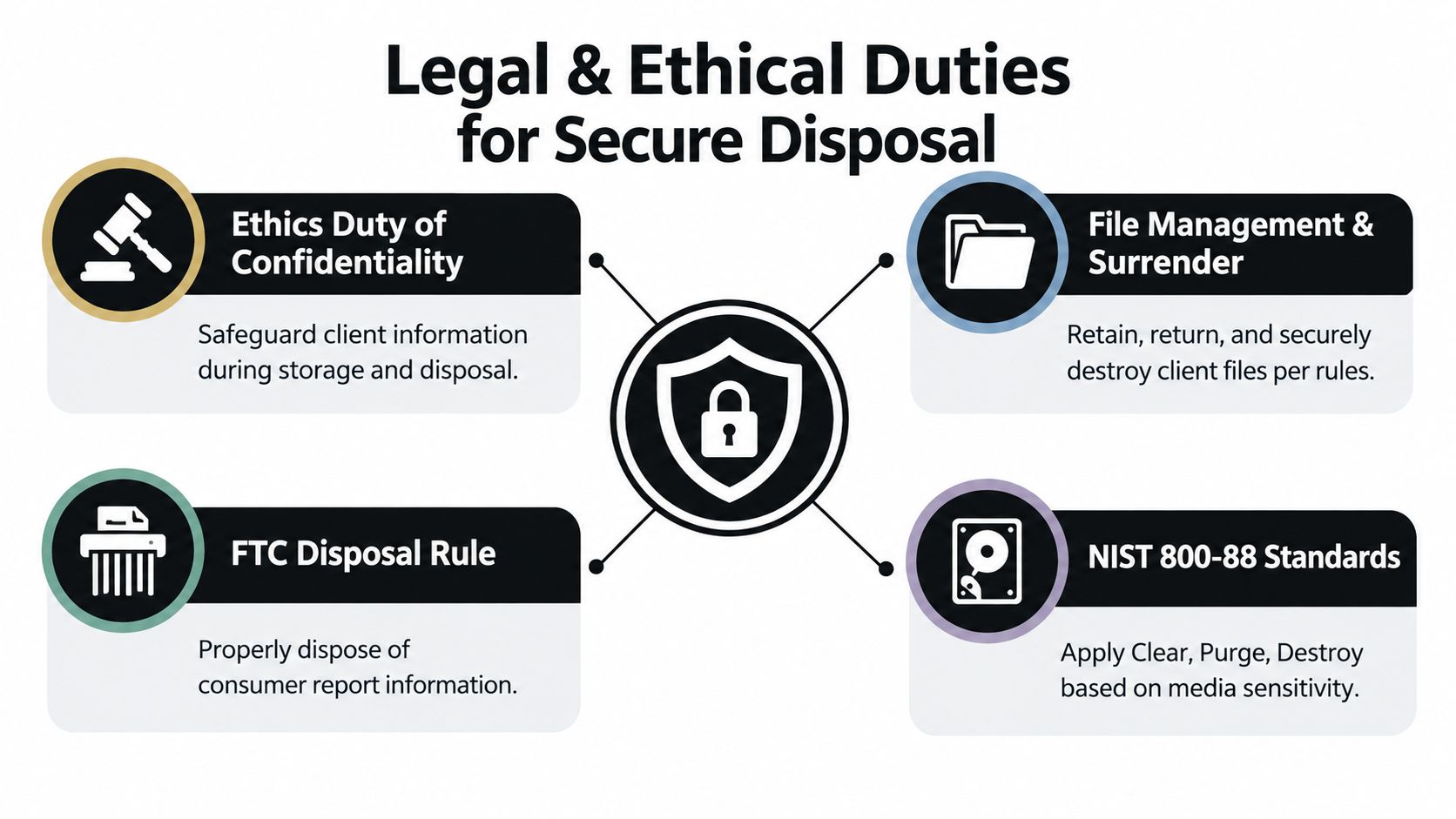
Secure destruction starts with a simple principle: confidentiality continues through disposal. Returning a client's original document, retaining a necessary copy, and destroying an obsolete copy are separate decisions. Each requires the firm to know what the record is, who owns it, whether another obligation applies, and whether the chosen method prevents unauthorized reconstruction.
The FTC standard adds a specific federal layer when consumer-report information is involved. The FTC says appropriate disposal can include burning, pulverizing, shredding, or erasing paper and electronic records so they can't be read or reconstructed. A locked recycling bin or ordinary delete command doesn't meet that objective.
Think in outcomes, not equipment
NIST SP 800-88 frames electronic sanitization around Clear, Purge, and Destroy. The method must make access to the target data infeasible for the expected level of effort. The NIST media sanitization guidance also recognizes documented sanitization and physical destruction as valid outcomes.
Use this mental model:
- Paper files: Shred or otherwise reduce the material so the information can't be reconstructed.
- Reusable electronic media: Apply an appropriate sanitization method, then verify and document the result.
- End-of-life media: Physically destroy the storage component when sanitization for reuse isn't suitable.
- Sensitive mixed records: Treat the entire batch according to the highest relevant risk, not the least sensitive item.
NIST further states that media unsuitable for sanitization should be destroyed by shredding, physically breaking, or rendering it unable to be reinserted into a device for reading. NIST's media-destruction publication provides examples involving hard drives that are bent, mangled, or mutilated enough to prevent reinsertion into a functioning computer.
A written policy and controlled vendor process turn these principles into repeatable behavior. Firms can pair the policy with compliance documentation for IT asset disposition so certificates and custody records remain accessible when a client, insurer, or regulator asks how disposal occurred.
Building a Retention and Destruction Policy That Holds Up
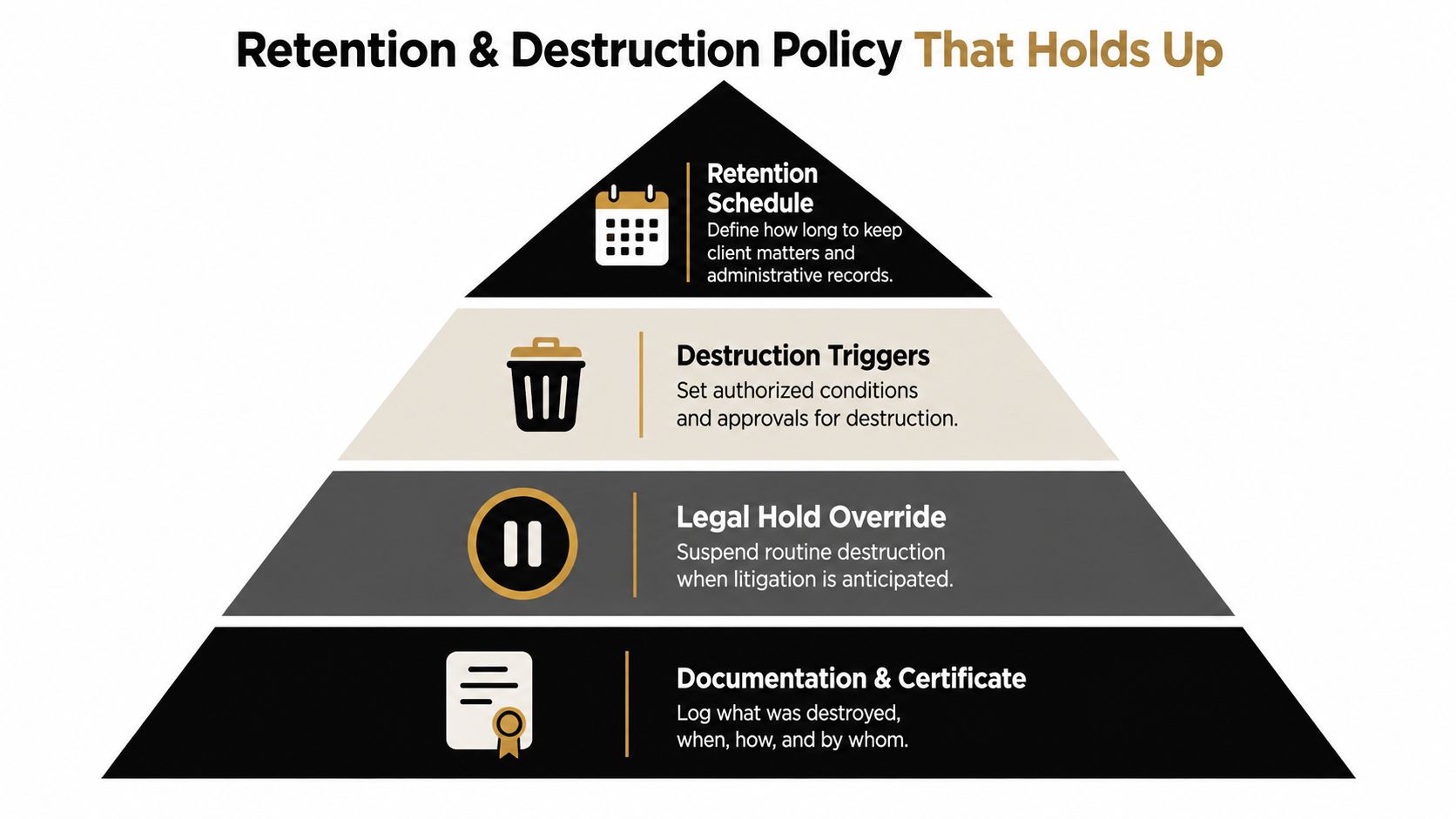
A retention schedule answers how long the firm ordinarily keeps a record. It doesn't authorize destruction by itself. Destruction should happen only after the matter is closed, required retention conditions are satisfied, and every applicable legal hold has been formally cleared.
For many law firms, client records are commonly retained six to eight years after matter close, but the correct period depends on jurisdiction, practice area, engagement terms, insurance considerations, and the record category. Alabama ethics guidance says a lawyer should generally keep a copy of a client file for a minimum of six years from termination of representation or conclusion of the matter, and it recognizes that there isn't a general duty to preserve client files permanently. The Alabama file-management guidance also recommends retaining destruction records indefinitely, including the file name and destruction date.
Build the policy around a hold gate
Separate routine files from matters under legal hold. A hold overrides the ordinary schedule because the firm must preserve potentially relevant information while a dispute, investigation, or anticipated proceeding remains active.
A practical policy should define:
- Matter closure: The responsible attorney confirms that representation ended and identifies unresolved appeals, related matters, client-property issues, or other preservation concerns.
- Retention assignment: Records staff apply the approved period to the matter and distinguish client files from administrative, financial, and operational records.
- Hold review: The legal or risk owner confirms whether a hold exists. No purge proceeds until the hold is lifted in writing.
- Authorized destruction: An assigned person approves the destruction event and identifies the media categories involved.
- Permanent evidence: The firm records the file name, destruction date, method, authorizer, vendor, and certificate reference.
Operational details matter. Use locked collection containers, controlled purge days, restricted access, and a documented chain of custody. A certificate of destruction should connect the material type and date to the relevant batch or asset inventory.
Practical rule: A file can be old enough for review without being cleared for destruction.
A policy also needs an exception process. If a client requests a file, a dispute arises, a regulator asks for records, or a related matter opens, staff should know who can pause destruction and how that pause gets recorded.
Choosing the Right Destruction Method for Every Media Type
The correct method depends on two questions: Will the media be reused, and how difficult must recovery be to prevent? A wipe intended for a redeployed laptop isn't the same decision as destruction of a failed drive that held privileged documents.
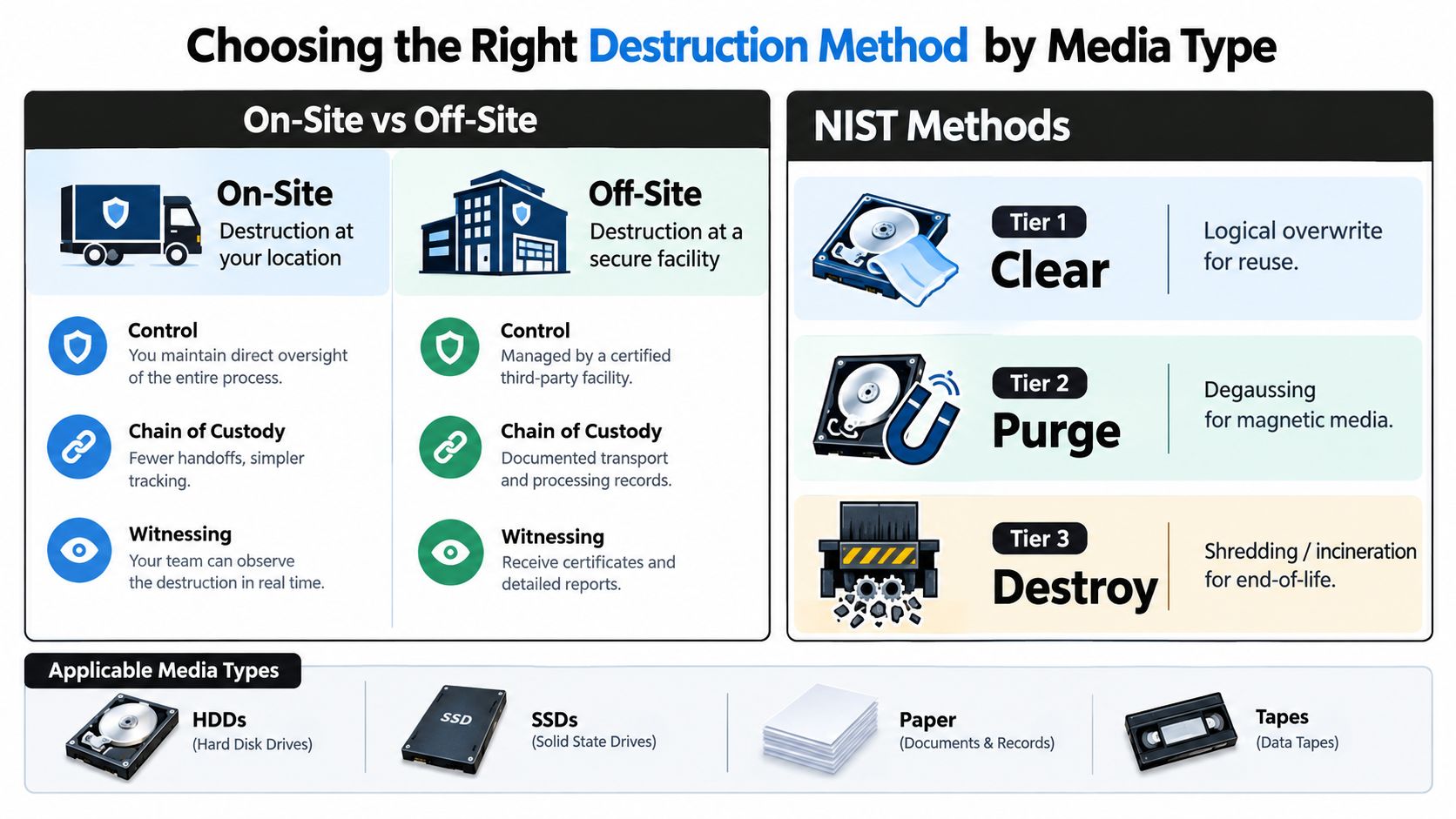
NIST's framework uses three broad outcomes. Clear applies logical techniques for routine reuse when appropriate. Purge uses stronger methods designed to make recovery infeasible, while preserving the possibility of reuse in suitable situations. Destroy physically renders the media unusable.
Compare the operational choices
On-site work can give the firm direct visibility and support witnessing. Off-site processing may provide specialized equipment and controlled facilities, but the provider must document every transfer. Neither location is automatically compliant. The evidence trail and technical result matter more than the address.
| Media Type | Reuse Intent | Recommended Method | When to Choose Destroy |
|---|---|---|---|
| Hard disk drive | Reuse may be possible | A documented Clear or Purge process suited to the drive and risk | Choose physical destruction when reuse isn't approved or sanitization can't produce a defensible result |
| Solid-state drive | Reuse may be possible | Use a method appropriate to flash storage and verify the outcome | Choose destruction when the device is damaged, unsuitable for reuse, or the firm needs a physical end state |
| Paper files | No reuse | Cross-cut or industrial shredding | Choose destruction for confidential records after retention and hold clearance |
| Backup tape | Reuse depends on condition and controls | Apply a validated sanitization approach for the tape format | Choose destruction when the tape can't be reliably sanitized or remains too sensitive for reuse |
The firm should document why it selected the method, not merely record that a device disappeared. For technical implementation details, NIST 800-88 data destruction standards provide a useful reference point.
Cloud copies require a different control. The firm must obtain deletion or destruction confirmation from the service provider, understand backup retention behavior, and record what the provider can and can't remove immediately. “Deleted from the active folder” isn't the same as “destroyed across all retained copies.”
Vetting Vendors and Securing Chain of Custody
A destruction vendor doesn't eliminate the firm's responsibility to select, instruct, and monitor the service. The firm should be able to explain how material moved from a locked collection point to final sanitization or destruction, with no unexplained custody gap.
Start with due diligence:
- Commercial capability: Confirm the provider handles business volumes, serialized IT assets, confidential paper, or specialized media rather than only offering general drop-off service.
- Process evidence: Request sample certificates, sample inventory reports, and a description of how staff verify destruction.
- Contract terms: Specify pickup controls, subcontractor approval, incident notification, confidentiality obligations, insurance, and record availability.
- Witnessing options: Determine whether the firm can observe on-site destruction or receive facility evidence for off-site processing.
- Environmental handling: Ask how destroyed equipment and hazardous components move into responsible downstream processing.
The pickup itself should follow a controlled sequence. Staff place records in locked containers or prepare serialized devices against an inventory. The carrier records the transfer, the receiving facility reconciles the shipment, and the processor records the final method and date.
Make certificates useful
A certificate should do more than state that a load was processed. It should identify the material type, destruction or sanitization date, method, facility or service location, and relevant asset or batch references. For electronic assets, serial numbers help connect the certificate to the firm's inventory. For paper, a batch identifier and collection date can establish the relationship between the certificate and the approved purge event.
Keep custody logs with the matter or destruction record. Chain-of-custody practices for IT asset disposal can help administrators evaluate whether a vendor's documentation supports an auditable handoff.
A vendor's promise is not the evidence. The certificate, inventory reconciliation, and custody trail are the evidence.
Handling Third Party Copies Legal Holds and Breach Response
The most overlooked disposal question is often, “Who else has a copy?” A law firm may control the original workspace while copies remain with an e-discovery provider, co-counsel, an expert, a cloud platform, a backup system, or a departing attorney.
Create a copy inventory when a matter closes and update it when the matter enters a hold. Ask the matter team to identify:
- Discovery repositories: Processed data, load files, review databases, productions, and export packages.
- External professionals: Co-counsel, experts, investigators, translators, and consultants.
- Cloud systems: Active workspaces, archives, snapshots, and backup arrangements.
- Personnel devices: Laptops, phones, removable drives, and local folders used by current or departing attorneys.
- Client-held material: Copies returned to the client or transferred to another representative.
For each third party, the firm should record the contract, data location, retention terms, deletion process, responsible contact, and evidence received after destruction. A written confirmation may be appropriate, but higher-risk matters may justify a certificate, asset list, system report, or other verifiable record.
Let legal holds stop the workflow
A hold should function like a gate in the destruction system. Once issued, the firm pauses routine deletion across identified repositories and tells vendors, co-counsel, experts, and affected personnel what must remain preserved. When the responsible legal authority clears the hold, the firm documents the clearance date, identifies the systems covered, and authorizes destruction through the ordinary process.
Third-party controls and breach response intersect. A complete inventory helps the response team identify potentially affected locations, while destruction logs show which records had already been securely disposed of before an incident. The records won't prevent every breach, but they can help the firm explain its controls and avoid treating unknown copies as an afterthought.
Guidance on data retention and destruction policies highlights the importance of covering all copies, including backups, and verifying third-party destruction. That perspective belongs in the firm's contracts and closure checklist, not just in a cybersecurity memo.
Your Audit Ready Roadmap and Next Steps
A defensible program becomes manageable when each responsibility has an owner. The managing partner or general counsel approves the policy. Practice leaders identify matter-specific risks. Records staff manage schedules and closure reviews. IT maps electronic repositories. Procurement evaluates vendors. The legal-hold owner controls the pause and release decisions.
Start with the files and devices already waiting for disposal. Don't authorize a bulk purge until the firm has separated routine matters from holds, reconciled physical and electronic copies, and selected a method for each media category.
A practical implementation checklist
- Assign ownership: Name the policy owner, hold-clearance authority, records coordinator, and IT contact.
- Inventory locations: Include filing rooms, document systems, laptops, drives, mobile devices, backups, vendor platforms, and former personnel devices.
- Review the schedule: Confirm the firm's retention periods with applicable ethics guidance, jurisdictional rules, engagement terms, and insurer expectations.
- Install the hold gate: Require written clearance before any matter or repository enters a purge batch.
- Control collection: Use locked containers, restricted access, scheduled purge events, and transfer records.
- Select the method: Match Clear, Purge, or Destroy to the media, reuse plan, sensitivity, and technical limitations.
- Reconcile the outcome: Compare the pickup inventory with the processor's final report.
- Archive evidence: Keep destruction logs and certificates with the firm's permanent compliance records.
- Review the program: Reassess repositories, vendors, contracts, and procedures when systems or practice operations change.
The data destruction audit checklist can help administrators organize the evidence review. A useful audit file should let a reviewer trace one matter or device from authorization through final disposition without relying on staff memory.
Audit test: If someone unfamiliar with the purge can understand what was destroyed, when, by whom, and under which approval, the process is producing defensible evidence.
Review the policy on a regular schedule and after major events such as a merger, practice acquisition, document-system migration, vendor change, or significant incident. The strongest programs don't treat destruction as an annual cleanout. They make it a controlled lifecycle process that begins at matter closure and ends with verified disposition.
Beyond Surplus provides business-focused secure data destruction, serialized hard-drive shredding, certified data wiping, electronics recycling, and documented IT asset disposition for law firms. Its certificates of recycling and data destruction, inventory controls, and on-site or off-site service options can support a defensible chain of custody. Visit Beyond Surplus to discuss a documented destruction workflow for your firm's paper records, storage media, and retired technology.


