

A procurement manager has a closet full of retired laptops, an IT lead has obsolete switches stacked beside a server rack, and a lease-return deadline is approaching fast. The search begins with “e-waste recycling near me,” but distance is the wrong first filter. For business equipment, the key question is whether the recycler can protect data, document custody, and prove where every asset went.
That distinction matters because global e-waste generation reached 62 billion kg in 2022, while only 22.3% was formally collected and recycled in an environmentally sound manner, according to the Global E-waste Monitor 2024. A nearby casual drop-off may accept equipment, but acceptance alone doesn't establish secure processing. Use location to solve logistics after you've established trust.
Table of Contents
- What You Actually Need From a Local Recycler
- Vetting Recyclers Before Location Matters
- Matching Your Equipment to the Right Intake Channel
- Preparing Devices and Data Before Pickup
- Choosing Drop-Off or Pickup for Your Situation
- Certificates of Recycling and Data Destruction Explained
- Working With Beyond Surplus in Atlanta and Beyond
What You Actually Need From a Local Recycler
A dependable commercial recycler must deliver three things: an auditable chain of custody, a defensible data destruction process, and downstream accountability. If a vendor can't show how equipment moves from your loading dock to final disposition, proximity doesn't reduce your risk. It only makes an unverified process more convenient.
Start with the audit trail. Your inventory should be tied to serial numbers, asset tags, quantities, custody transfers, and final disposition. That record needs to identify whether equipment was reused, remarketed, harvested for parts, or processed as material. A weight ticket alone is not enough for laptops, servers, storage arrays, or networking equipment that may contain regulated information.
Data protection comes before transportation
Data-bearing devices need a documented sanitization or destruction decision. A recycler should explain when it uses software wiping, cryptographic erasure, degaussing, or physical destruction, and which method applies to hard disk drives, solid-state drives, removable media, and encrypted devices. The EPA's electronics recycling guidance recommends using certified electronics recyclers and describes certification as evidence that an independent accredited auditor has assessed safe recycling practices.
Environmental handling is equally practical. Batteries, lamps, medical electronics, laboratory equipment, and cable-heavy loads shouldn't disappear into a mixed bin. Contamination and poor feedstock quality reduce recovery efficiency and increase processing liability, as documented in this peer-reviewed review of e-waste recycling impacts.
Practical rule: Choose the recycler that can prove each handoff and disposition, not the one with the shortest driving distance.
Use this guide to choosing a secure computer recycling company to formalize your screening criteria before calling local providers.
Vetting Recyclers Before Location Matters
Certification is a starting point, not the entire evaluation. Ask whether the processor holds R2v3 or e-Stewards certification, request the certificate number, and verify it through the relevant accreditation registry. A logo on a website is not proof. A current certificate, defined scope, facility identification, and verifiable registry entry are proof worth checking.
Then test the vendor's operational answers. Ask whether storage media is wiped using logged software output, purged or destroyed under NIST SP 800-88, degaussed where appropriate, or physically shredded. A responsible provider will explain how its method handles SSDs differently from magnetic drives. It should also provide sample certificates before pickup, not after an incident or audit request.
The questions that expose weak programs
Probe downstream processing. Ask where reusable equipment goes, which refurbishers or smelters receive material, whether exports are involved, and how the vendor controls international movement. Ask for evidence of environmental and cyber liability insurance. Finally, ask how receiving staff capture serial numbers and segregate data-bearing assets when a shipment arrives.
Use this ITAD hiring question checklist when comparing proposals.
| Signal | What to Ask For | Acceptable Proof | Red Flag |
|---|---|---|---|
| Certification | Which standard and facility scope apply? | Current certificate and registry verification | Logo without certificate details |
| Data destruction | Which method applies to each media type? | Sample certificate and process description | “We wipe everything” |
| Chain of custody | How is custody recorded at pickup and intake? | Signed transfers and serialized manifest | Weight-only receipt |
| Downstream control | Who receives reusable and recyclable material? | Approved downstream documentation | “Our partners handle it” |
| Insurance | What cyber and environmental coverage exists? | Current certificate of insurance | No written evidence |
| Intake controls | How are assets identified and segregated? | Serialized receiving records | Mixed, untracked loads |
A recycler that won't answer these questions in writing is not ready for your equipment.
Matching Your Equipment to the Right Intake Channel
Different assets need different intake controls. Business laptops, desktops, servers, storage arrays, and networking gear belong with an ITAD-style processor that can serialize the load and produce asset-level destruction records. A municipal event or retailer program may accept limited electronics, but it usually isn't designed for enterprise manifests, regulated data, or decommissioned infrastructure.
Separate volatile and regulated items before scheduling. Lithium battery packs, CRT displays, PCB-bearing medical or laboratory equipment, and devices containing PII or PHI should go only to processors that list those categories explicitly. Don't assume that “electronics accepted” means every component is permitted.
Match cost to documentation
Municipal programs can be convenient for limited, accepted materials, but they may offer little asset-level reporting. Retailer trade-in channels can provide credit, although device condition and category limits apply. Certified commercial recyclers commonly price by pallet, asset, or weight, with remarketing value sometimes offsetting service charges.
That price difference reflects more than transportation. It covers secure receiving, data sanitization, hazardous-component segregation, downstream controls, reporting, and certificates. If a small batch contains data-bearing equipment, the lowest quote may leave your organization carrying the largest liability.
For organizations evaluating resale before recycling, how to sell can help frame the value-recovery decision. Keep that assessment separate from the compliance decision. Reuse is valuable only after the data and custody controls are satisfied.
Preparing Devices and Data Before Pickup
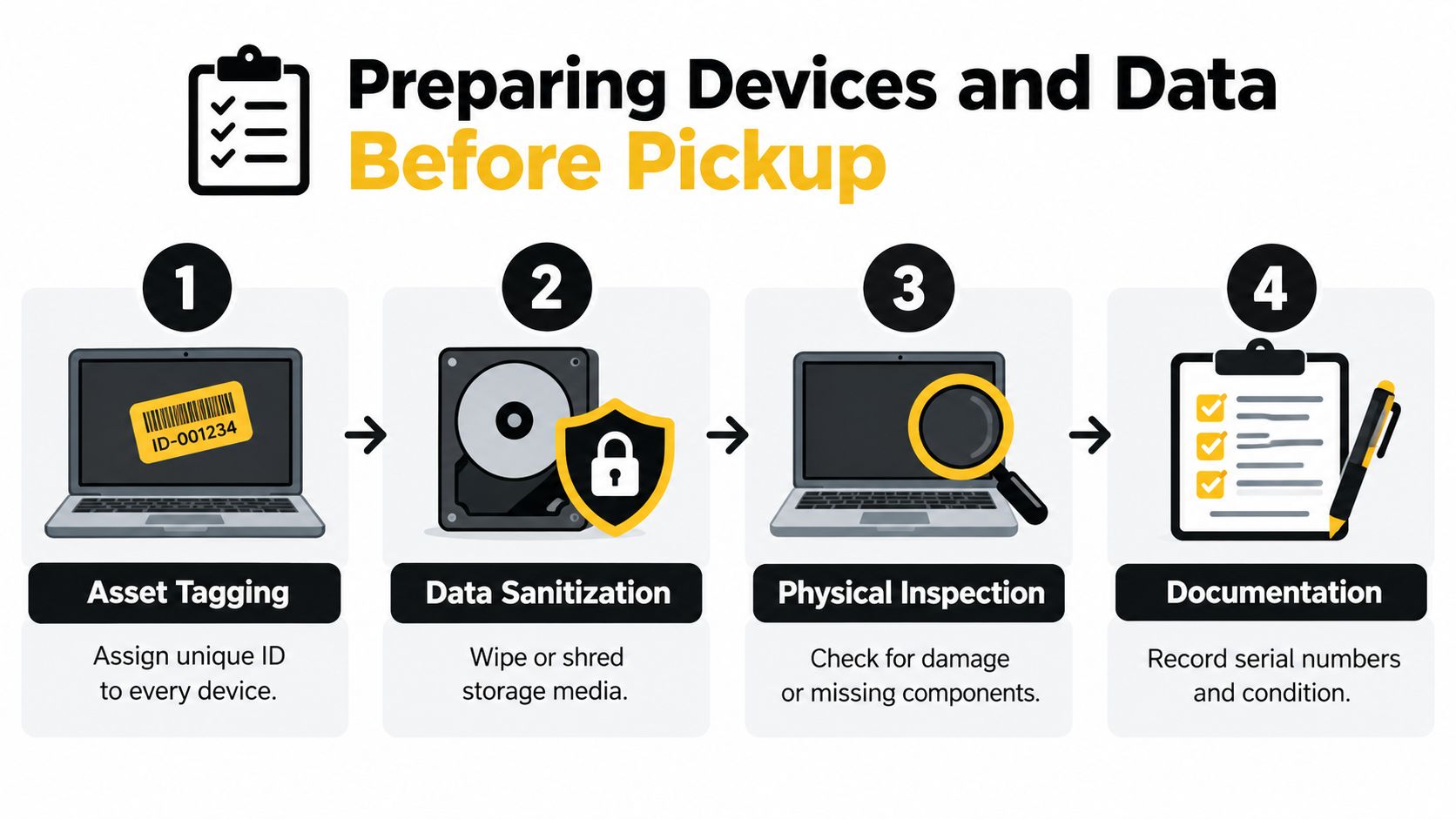
Preparation starts with an inventory that another person can reconcile. Assign a unique identifier to every laptop, desktop, server, monitor, and peripheral. Record the serial number, model, condition, and known storage media, then attach a physical label or barcode that matches the manifest.
Data destruction should reflect the media, not a one-size-fits-all policy. A certified software process may suit reusable equipment when it produces verifiable logs. Physical destruction is the clearer route for failed drives, damaged media, or assets that must never re-enter circulation. Degaussing applies to suitable magnetic media, but it isn't a universal solution for SSDs and flash storage.
Make custody easy to prove
Remove SIM cards, external drives, and accessories that need separate handling. Photograph damaged equipment before loading, especially cracked screens, exposed batteries, missing panels, or rack damage. Those images help establish condition before transportation and prevent disputes over when damage occurred.
For palletized loads, stabilize equipment, protect screens, and keep asset groups aligned with the manifest. Individual laptops should be boxed or secured against movement. Rack decommissioning requires a different plan, including removal sequencing, cable management, labeling, and a clear handoff area.
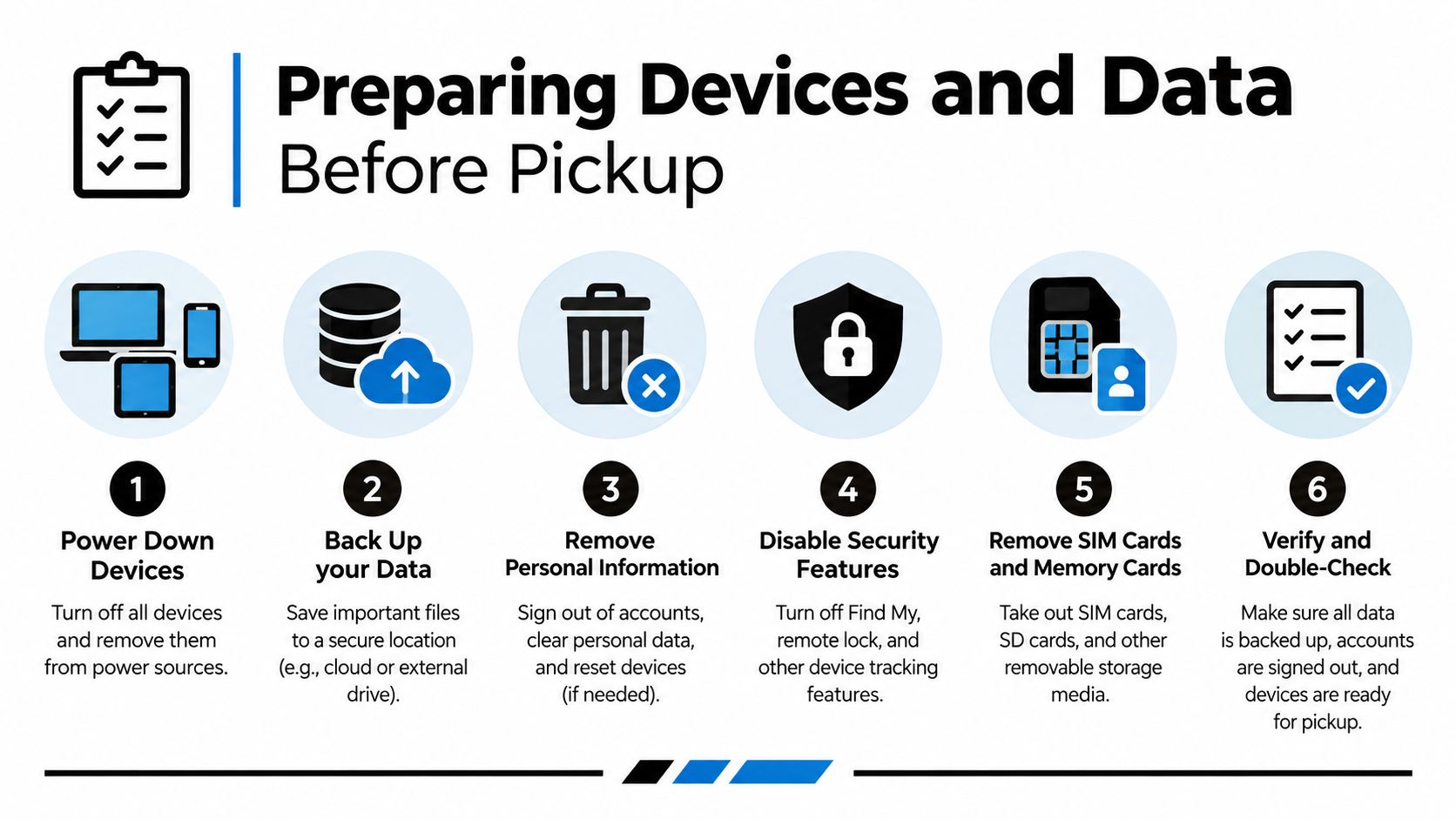
For additional guidance on protecting information before equipment leaves your control, review We Fix PC Laptop repair advice. For a business-ready preparation checklist, see how to prepare computers for recycling.
Operations standard: Don't release an untagged asset into a mixed load. If you can't reconcile the device at pickup, you won't reconcile it at audit time.
Choosing Drop-Off or Pickup for Your Situation
Drop-off works when the inventory is small, accepted, already organized, and safe for your staff to transport. It can reduce scheduling friction and may provide same-day intake. The trade-off is that your team assumes responsibility for loading, transit exposure, and delivery documentation until the facility signs for the equipment.
Pickup is the better channel for pallets, server rooms, multi-site refreshes, or sensitive assets. A commercial provider can use sealed transportation, record custody at the point of collection, and arrange on-site wiping or shredding when the load requires it. Pickup may involve minimum quantities, so ask about thresholds before staging equipment.
| Factor | Drop-Off | Pickup |
|---|---|---|
| Best fit | Small, organized batches | Pallets, racks, and multi-site loads |
| Staff effort | Your team packs and transports assets | Provider coordinates collection and handling |
| Security | Custody begins at facility intake | Custody can begin at your site |
| Documentation | Depends on the receiving program | Can include manifests and transfer records |
| Sensitive media | Transport risk stays with your team | On-site destruction may be available |
| Scheduling | Often flexible for accepted items | Requires route and load planning |
A closet of retired laptops may suit a scheduled commercial drop-off if each device is tagged and the receiving process is documented. A server-room retirement needs controlled removal, palletization, and asset reconciliation. A data center migration needs project management, de-installation, logistics, data destruction, and final reporting.
Don't confuse convenience with suitability
Manufacturer and retailer take-back programs may work for defined products, but acceptance rules and reporting vary. Courier services can suit small batches when the provider supplies secure packaging and tracking. For local Atlanta businesses comparing options, review electronics drop-off locations and confirm accepted categories before loading a vehicle.
The right channel is the one that matches volume, sensitivity, equipment type, and required evidence.
Certificates of Recycling and Data Destruction Explained
A certificate is useful only when it connects a documented process to identifiable equipment. A recycling certificate should identify the processor, facility, applicable certifications, client information, processing date, asset manifest, quantities or weights, and final disposition. A data destruction certificate should identify the media, serial numbers, destruction or sanitization method, date, and authorized signatory.
Read every field before you sign
Look for language that distinguishes reuse, parts harvesting, material recovery, and residual disposal. “Processed responsibly” is too vague if your audit requires proof of what happened to a server or drive. The certificate should match the manifest, and the manifest should match the equipment released.
For data-bearing media, require an attestation that the chosen method met the applicable NIST SP 800-88 sanitization category, such as Clear, Purge, or Destroy. The exact method matters because SSDs, magnetic drives, removable media, and failed devices present different technical conditions. A certificate that omits method and asset identity leaves too much unresolved.
Use this certificate of data destruction explanation when reviewing a provider's sample documents.
A certificate should answer four questions without a phone call: what asset, which method, on what date, and under whose authority?
Organizations subject to HIPAA, FACTA, GDPR, or state privacy requirements should have counsel and compliance teams define retention periods. Keep certificates for the period your industry and internal policy require, and put the documentation obligation into the service agreement before equipment leaves your site. Don't accept a verbal promise that paperwork will arrive later.
Working With Beyond Surplus in Atlanta and Beyond
For Atlanta-area organizations, Beyond Surplus provides a Smyrna drop-off location for eligible electronics and business equipment. That route can suit a small business clearing a technology closet when the assets are already inventoried, packaged, and appropriate for facility intake. Confirm accepted materials and operating details before arrival.
Businesses with larger qualifying inventories can ask about pickup within Georgia. For organizations managing locations outside the state, the company coordinates pallet and freight logistics across the contiguous United States, which makes a single documented workflow more practical than assembling unrelated local vendors.
Match the service to the project
The engagement should begin with an inventory review, equipment categories, data requirements, pickup or drop-off preference, and reporting needs. Available handling can include certified data wiping and hard-drive shredding, with certificates of recycling and data destruction issued for processed lots. Lead time depends on volume, location, equipment type, access restrictions, and whether a data center de-installation or product destruction project is involved, so request scheduling details with the quote.
Beyond Surplus fits several common commercial scenarios:
- IT teams: Retire laptops, desktops, storage media, and networking hardware with serialized records.
- Facilities teams: Coordinate server-room clearouts, rack removal, palletization, and freight.
- Asset managers: Standardize disposition across offices and connect eligible equipment to value recovery.
- Regulated organizations: Establish a documented chain of custody and retain certificates for compliance files.
It may not be the right fit if you need an undocumented cash drop, household-only handling, or a provider unwilling to define acceptance and reporting terms. Ask for a written scope, confirm the destruction method, and schedule only after the documentation package meets your requirements.
Contact Beyond Surplus to request a quote, arrange a Georgia pickup, or schedule a Smyrna drop-off for eligible commercial electronics. For multi-site projects, provide the inventory, locations, equipment categories, and timeline so the team can plan freight, de-installation, data destruction, and final reporting.
Beyond Surplus provides commercial electronics recycling, secure IT asset disposal, data destruction, product destruction, and data center de-installation support with pickup and drop-off options. Visit Beyond Surplus to request a quote or schedule a documented disposition plan for your business equipment.


