
A laptop refresh rarely ends when the replacement devices arrive. The old equipment is still in a storage room, a loading bay, or a data center rack, and someone must decide what happens to the drives, servers, mobile devices, and medical or laboratory hardware inside it. That decision can affect data security, regulatory exposure, recovery value, and the evidence your auditors expect to see.
Choosing an ITAD company means selecting more than a recycler or a hauling service. The right provider gives your organization a controlled process for inventory, secure transport, data sanitization, reuse, recycling, and final reporting. The wrong provider may remove equipment quickly while leaving your team unable to prove what happened to each asset.
Table of Contents
- The Evolution of IT Asset Disposition
- Core Services Beyond Basic Recycling
- Navigating Compliance and Audit Requirements
- Service Models and Value Recovery Strategies
- Vendor Selection Checklist for IT Managers
- Local Logistics and Sustainability Impact
- Executing Your ITAD Strategy
The Evolution of IT Asset Disposition
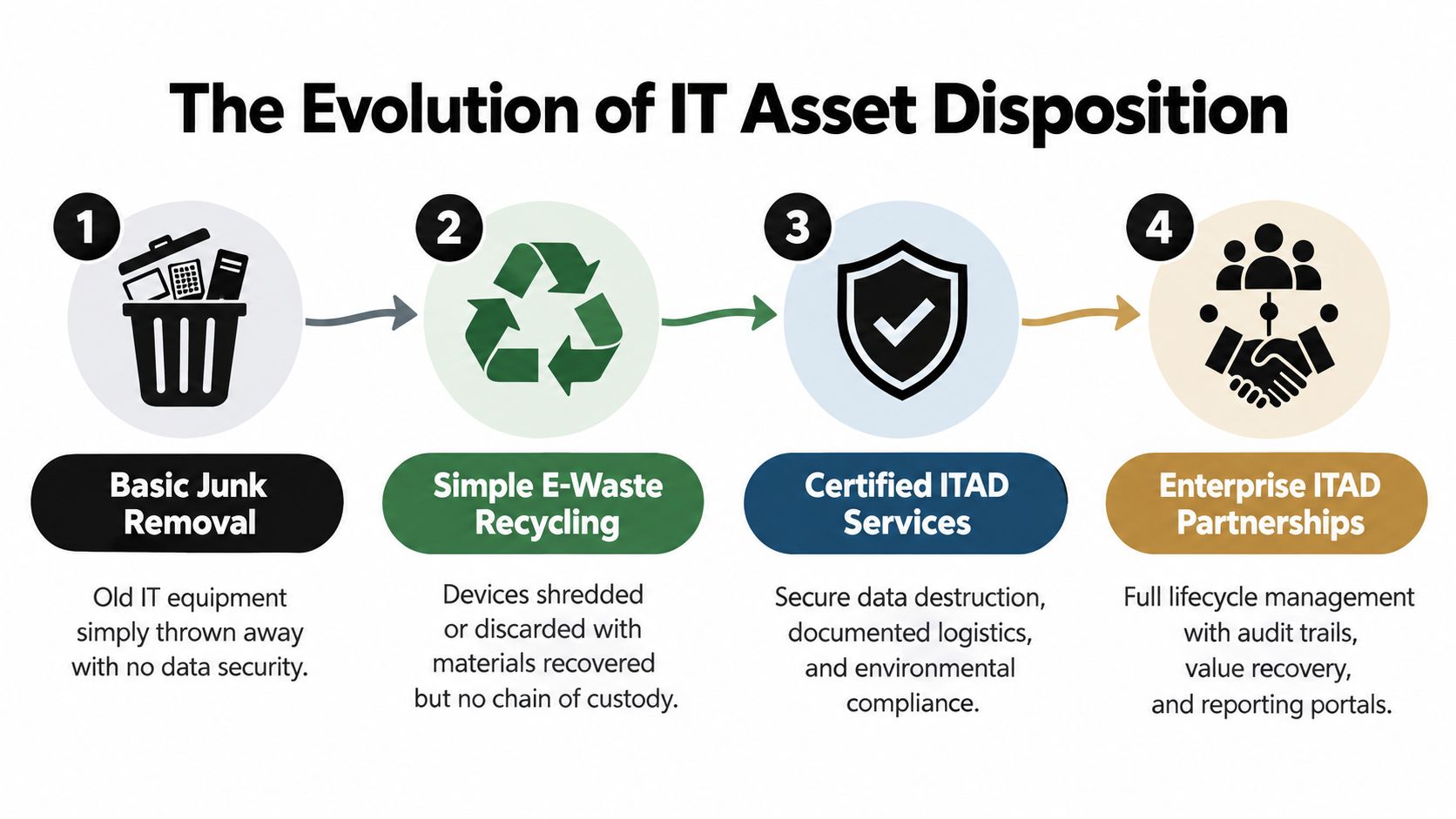
An enterprise IT refresh often creates a deceptively simple problem. The IT team has retired laptops, storage arrays, network hardware, and servers, while facilities wants the equipment removed and procurement wants any recoverable value returned. A basic junk-removal service may solve the space problem, but it doesn't establish whether a drive was sanitized, who handled it, or where its components went afterward.
That distinction created the need for IT asset disposition, or ITAD. An ITAD company treats retired technology as a controlled business asset rather than anonymous waste. Its workflow can include serialized inventory, chain-of-custody records, certified wiping, physical destruction, remarketing, responsible recycling, and documentation that supports an internal or external audit.
Why informal disposal stopped working
The sector developed as regulation and technology turnover made undocumented disposal increasingly difficult to defend. The historical development of ITAD is tied to compliance foundations from the late 1990s and early 2000s, including the Fair and Accurate Credit Transactions Act disposal provisions and HIPAA-related expectations, followed by the publication of NIST SP 800-88 in 2006.
NIST's framework addressed media sanitization across hard drives, SSDs, flash storage, and mobile devices. Its Clear, Purge, and Destroy tiers helped organizations match the treatment to the media and the sensitivity of the information. That was a major shift from assuming that deleting files or reformatting a device made it safe.
The commercial scale reflects this change. One market estimate values global ITAD at USD 20.1 billion in 2025, with a projection of USD 35.58 billion by 2032 and an implied 8.5% CAGR. The same estimate reports processed assets rising from 180.0 million in 2020 to 243.0 million in 2025, while average provider revenue per asset increased from USD 76.0 to USD 82.7. These figures are reported in the global ITAD market estimate.
The practical conclusion is straightforward. ITAD has become a repeatable enterprise control connected to refresh cycles, secure sanitization, certified recycling, and value recovery. A provider such as Beyond Surplus ITAD services should be evaluated on that complete operating model, not on whether it can collect old equipment.
Core Services Beyond Basic Recycling
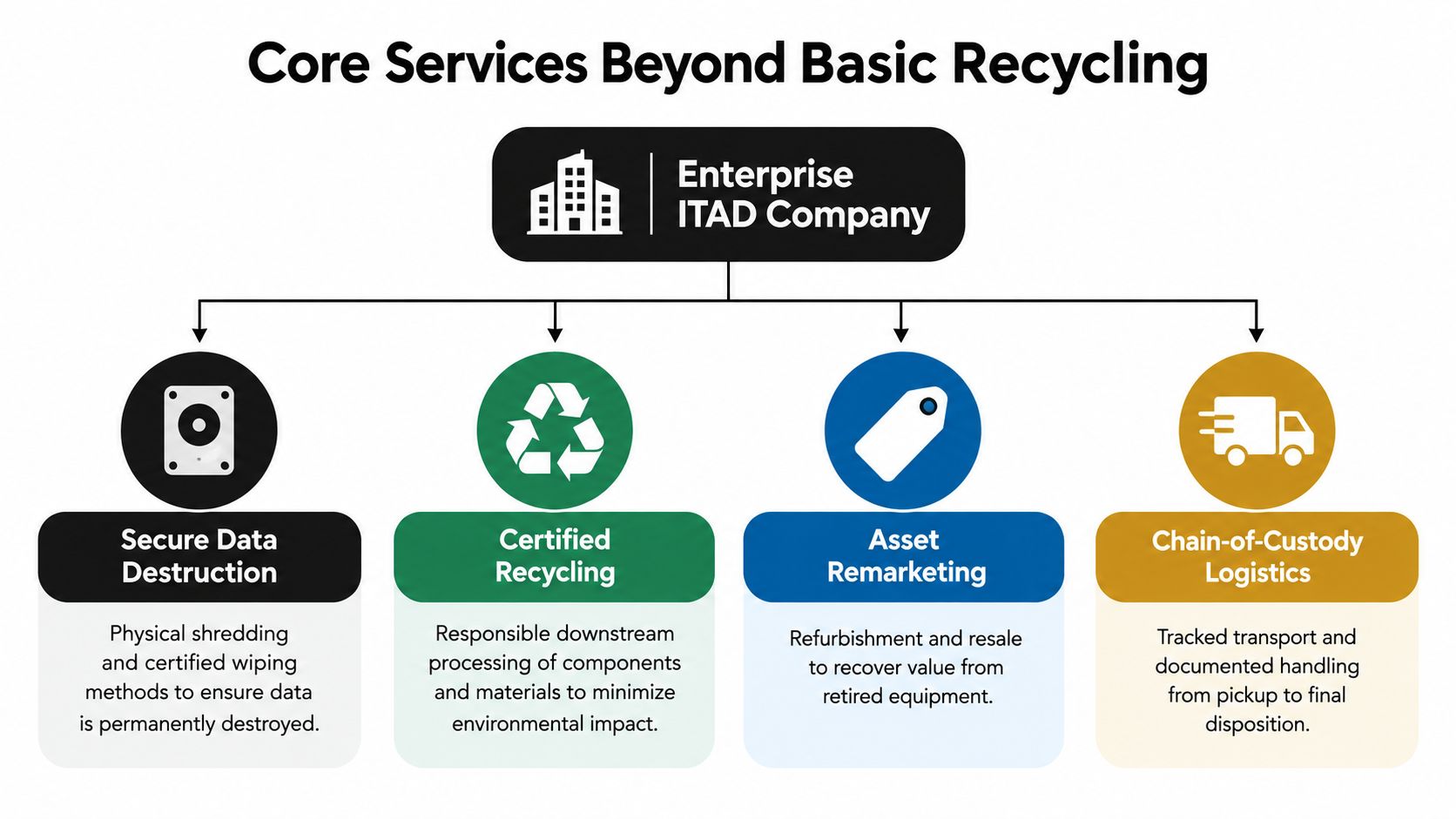
An ITAD company protects more than discarded equipment. Its operating model must connect data destruction, controlled logistics, value recovery, and certified recycling, because a gap in one area can create financial or legal exposure elsewhere.
Match sanitization to the media
Begin with an inventory of every data-bearing component, then select a treatment that fits the media, its condition, and the planned disposition.
- Certified wiping: Use a validated process when the drive supports reliable sanitization and may remain in service.
- Physical destruction: Shredding, crushing, or another documented method suits damaged media, end-of-life equipment, or assets whose sensitivity rules out reuse.
- Degaussing: This applies to some magnetic media, but it does not provide a universal solution for modern SSDs or flash storage.
- Mobile-device processing: Phones and tablets need controls for embedded storage, device locks, user accounts, and removable media.
Every action should remain tied to the serialized asset. A statement that “all data was destroyed” gives an auditor little insight into whether a laptop was wiped, an SSD was shredded, or a failed server disk followed another approved route.
Control the reverse supply chain
Chain of custody begins before collection. The provider should create an itemized manifest, verify loading, track transportation, and produce a disposition record connected to the original asset identifier. Downstream recyclers and remarketers require the same oversight, particularly when equipment changes hands after the first facility.
Teams planning a broader move may also want to find office equipment relocation help that handles furniture, fixtures, and technology separately from secure ITAD processing, so relocation activity is never confused with chain-of-custody handling.
Separate reuse from recycling
Product destruction may be necessary for branded goods, prototypes, recalled inventory, or equipment that must not re-enter the market. The decision should be documented because destruction removes any recovery value and may require stronger approval than routine recycling.
For complex moves, white-glove IT asset removal services can coordinate de-installation, packing, transportation, inventory, and final disposition. That coordination helps keep equipment attached to its records during a busy office or data center project, while the later value-recovery decision remains tied to risk, condition, and business requirements.
Navigating Compliance and Audit Requirements
A generic certificate of destruction is useful, but it isn't a complete compliance record. It may confirm that a service occurred while leaving unanswered questions about which assets were processed, which method was used, when custody changed, and whether subcontractors followed the same controls.
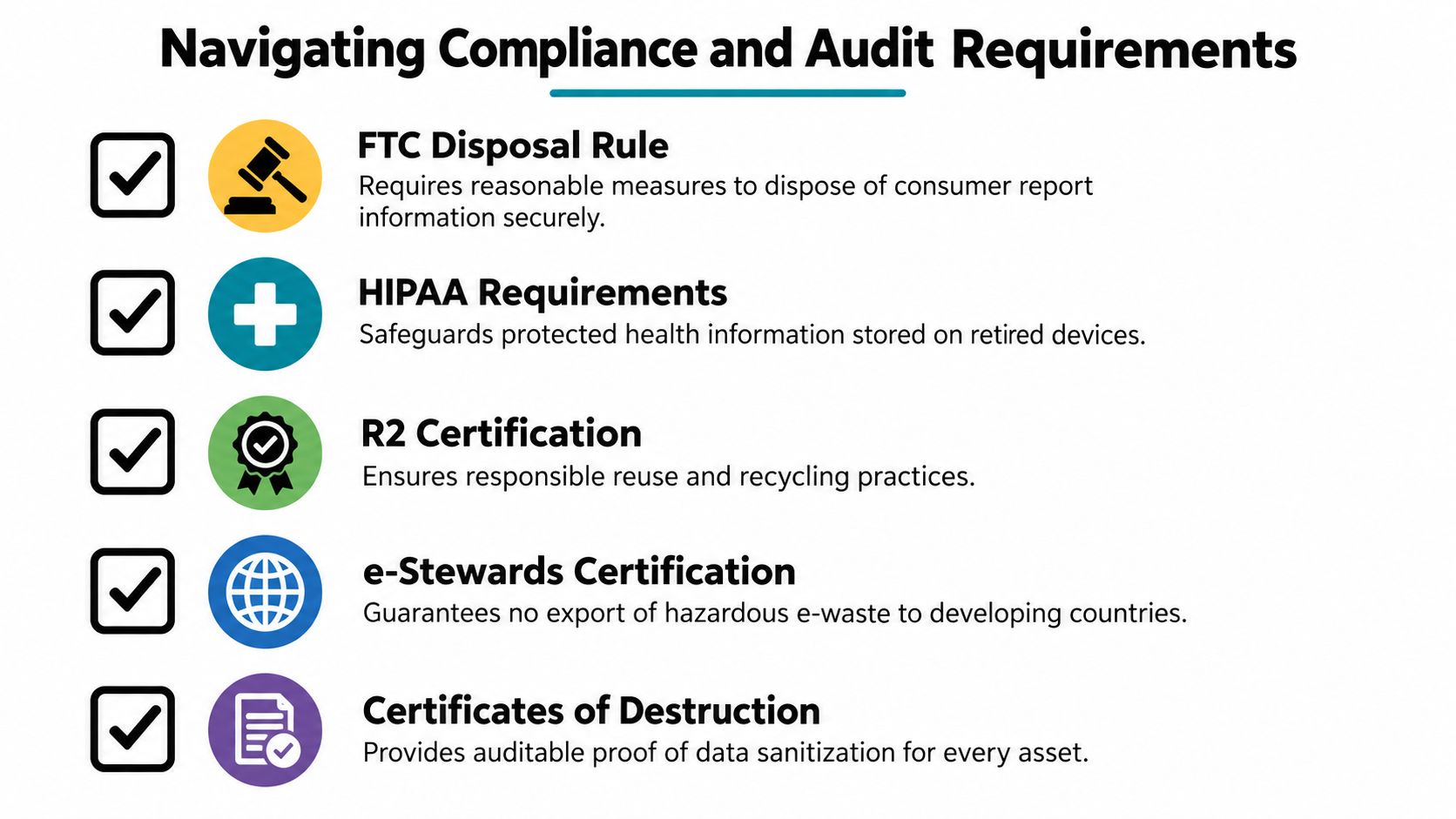
The FTC Disposal Rule requires disposal practices that are reasonable and appropriate to prevent unauthorized access or use of consumer report information. It identifies secure destruction or erasure of electronic files and media, along with due diligence when hiring a destruction contractor, as core control families.
Require evidence that follows the asset
Healthcare, finance, government, and education teams should ask for evidence that connects the physical item to the final action. Useful records include:
- Serialized inventory: The manifest should identify asset tags, serial numbers, device type, and any relevant drive identifiers.
- Sanitization detail: The record should state whether the asset was wiped, cryptographically erased, degaussed, shredded, or otherwise destroyed.
- Custody history: Pickup, transport, receiving, processing, and downstream transfers should be traceable.
- Certificates by asset or defined batch: The certificate should reconcile to the inventory rather than stand alone.
- Downstream accountability: The provider should explain who handles recycling or resale and how those parties are vetted.
- Audit access: Your team should be able to retrieve records when an auditor, regulator, customer, or legal team requests them.
HIPAA obligations make the issue especially clear for protected health information. Retired clinical workstations, diagnostic systems, servers, and removable media need a documented disposition process that protects information after the equipment leaves service.
Distinguish standards from certifications
A standard describes how work should be performed. A certification provides external validation that a provider's operating controls meet defined requirements. Neither replaces your organization's responsibility to classify assets and specify the evidence it needs.
A provider's NAID AAA-certified service can be relevant when your procurement team needs independently assessed destruction practices, physical security, employee controls, and documented handling. Ask to see the certification scope and confirm that it covers the service, facility, and asset types in your project.
Audit rule: If the provider can't reconcile the certificate to a serialized asset list, treat the record as incomplete.
Service Models and Value Recovery Strategies
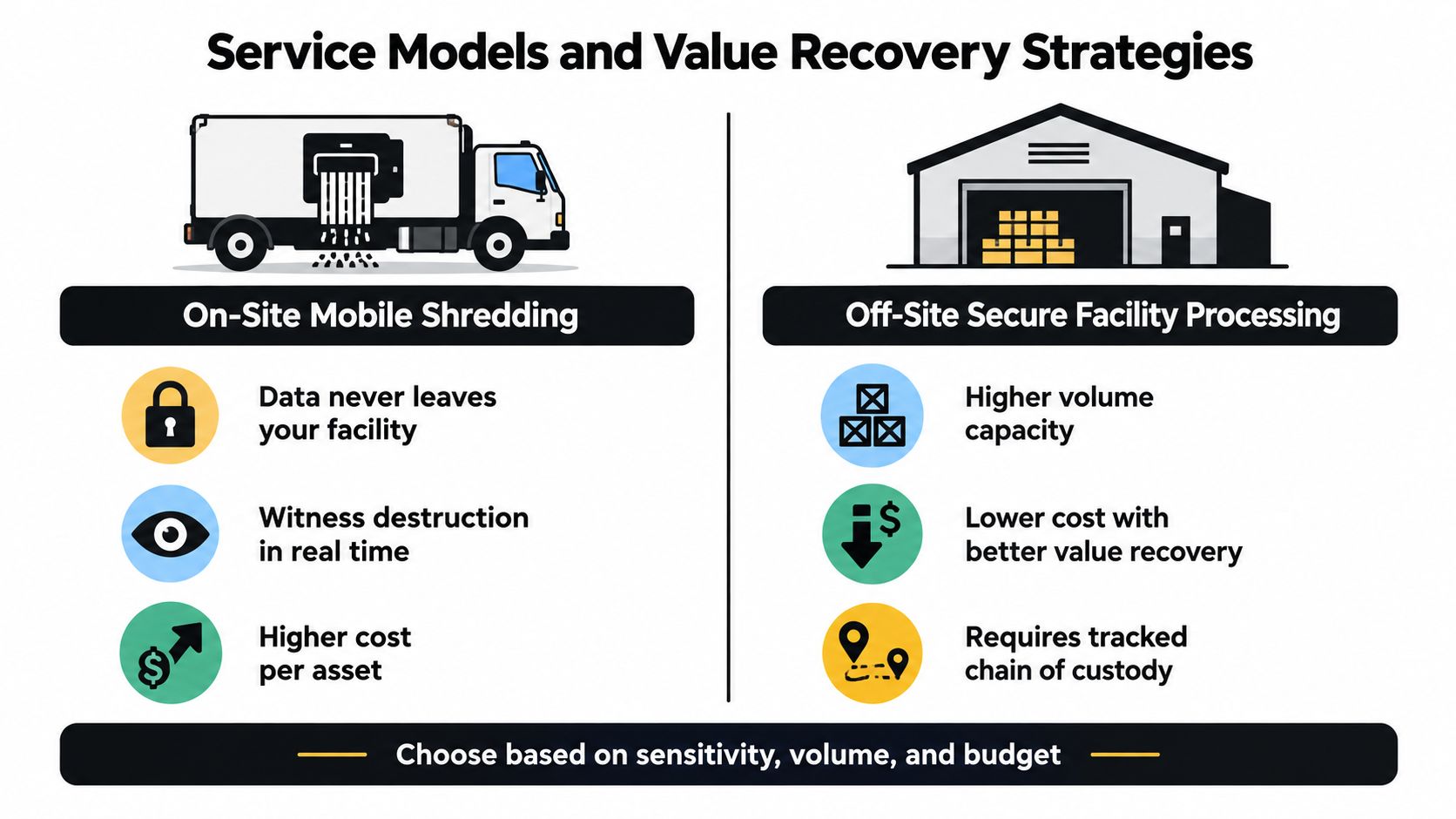
The choice between on-site and off-site processing isn't purely a security preference. It depends on data sensitivity, asset condition, project volume, available space, timing, and the value of equipment that could be reused.
On-site destruction
Mobile shredding keeps selected media at the customer's facility until destruction. That can be appropriate for highly sensitive drives, classified workflows, or projects where the client needs to witness the action. It can also reduce concerns about transporting a particular group of media before it has been destroyed.
The trade-off is operational. On-site equipment needs access, staging space, scheduling, and safety controls. The provider must still identify the drives, document the destruction, and issue records that reconcile to the inventory. On-site shredding may also limit the opportunity to test, wipe, refurbish, or remarket whole devices.
Off-site secure processing
Off-site processing can support higher throughput and a broader range of services. A secure facility may receive equipment, separate data-bearing components, test reusable hardware, perform certified wiping, route failed media to destruction, and prepare recoverable equipment for resale.
This model depends on disciplined chain of custody. The loading process, vehicle controls, receiving scan, facility access, and downstream records all matter. Lower handling costs may make off-site processing more practical for larger loads, but the provider must show exactly how it prevents loss or substitution during transit.
Make reuse the default, not the exception
Physical destruction eliminates residual value. Certified wiping may preserve value when the device is functional, supportable, and suitable for a secondary market. The right decision is not “reuse is always better.” It is a risk-based comparison of data sensitivity, media reliability, device age, refurbishment cost, market demand, and contractual obligations.
Recent industry coverage identifies remarketing as the fastest-growing ITAD service type and servers as the fastest-growing asset class, while connecting 2026 activity to device-life extension, emissions reduction, and data center refresh cycles. Those claims appear in the 2026 Gartner market guide coverage. AI-related infrastructure changes can accelerate refresh activity, but they don't guarantee a particular residual value for every server or storage device.
A reuse-first program can reduce procurement pressure and support sustainability reporting, provided the organization documents the decision and doesn't compromise data security.
Vendor Selection Checklist for IT Managers
Procurement teams should disqualify an ITAD vendor that answers with slogans instead of evidence. A polished sales presentation can't replace facility controls, insurance documentation, downstream transparency, or records that stand up during an audit.
Use the following questions before approving a contract.
| Evaluation Category | Critical Question to Ask | Acceptable Enterprise Standard |
|---|---|---|
| Data sanitization | Which method is used for each media type? | Written procedures aligned with applicable sanitization guidance, with asset-level records |
| Inventory control | How are devices reconciled from pickup to disposition? | Serialized manifest, scan events, exception handling, and final reconciliation |
| Physical security | Who can access equipment and processing areas? | Controlled access, documented personnel procedures, and facility security controls |
| Downstream processing | Who receives assets that aren't handled in-house? | Named downstream parties, due diligence, and documented accountability |
| Destruction evidence | What does the certificate identify? | Certificate tied to serialized assets, method, date, and processing outcome |
| Environmental handling | How are non-reusable electronics managed? | Certified or audited recycling channels and transparent material disposition |
| Insurance and liability | What coverage applies during transport and processing? | Current certificates of insurance and clear contractual responsibility |
| Complex projects | Can the provider handle data center de-installation? | Experienced removal, packing, logistics, inventory, and decommissioning coordination |
| Financial reporting | How is recovered value calculated? | Transparent pricing, documented offsets, and recovery reporting |
Ask about exceptions
The difficult assets reveal the quality of the process. Ask how the vendor handles missing serial numbers, locked mobile devices, failed drives, mixed pallets, damaged batteries, encrypted systems, and equipment that arrives without a matching manifest.
Also ask what happens when a subcontractor handles transportation or recycling. Responsibility shouldn't disappear when the equipment leaves the primary provider's building. Before signing, review the practical guidance in questions to ask before hiring an ITAD company and require written answers from every shortlisted vendor.
A vendor that can't explain its exception process probably hasn't designed one.
Local Logistics and Sustainability Impact
Local logistics can improve control without limiting national coverage. In the Atlanta and Smyrna markets, a regionally anchored ITAD provider may offer nearby facility access, coordinated pickup routes, and a clearer line of communication between the customer, driver, receiving team, and account manager.
That matters during office closures, data center moves, medical equipment upgrades, and laboratory equipment disposal. A local team can often coordinate dock access, loading restrictions, serialized counts, and urgent changes more directly than a chain of unrelated brokers. The benefit isn't only convenience. Fewer handoffs make the chain of custody easier to manage.
Connect local handling to enterprise reporting
Sustainability reporting needs more than a statement that equipment was recycled. Procurement and ESG teams may need to know which assets were reused, which were recycled, how downstream processors were selected, and what evidence supports the reported outcome.
The EPA's historical data illustrates why recovery controls matter. In 2009, consumers and businesses discarded 2.37 million tons of televisions, computers, cell phones, and hard-copy peripherals, while only about 25% was collected for recycling, according to the EPA electronic waste overview. The EPA also states that electronics represented about 1-2% of the total U.S. waste stream and reports that 438 million new electronic products were sold in 2009, with 5 million short tons in storage and 2.37 million short tons ready for end-of-life management in that year, as documented in its broader e-waste policy overview.
More recent EPA program data reported consumer electronics recycling at 41.7% in 2014, compared with 37.8% in 2013. It also reported that SMM Electronics Challenge participants collected more than 243,000 tons of used electronics in 2013, with 99.6% sent to certified recyclers. Those benchmarks appear in the EPA electronics generation and recycling report.
For a business, the practical lesson is to retain disposition evidence that supports sustainability claims and Scope 3 discussions. Local processing can reduce unnecessary reverse-logistics complexity, but nationwide projects still need consistent standards across every pickup location.
Executing Your ITAD Strategy
Start with an asset audit, not a truck request. Export the equipment list from your IT management system, identify laptops, servers, storage devices, phones, medical equipment, laboratory systems, and other data-bearing hardware, then flag missing tags and uncertain ownership.
Next, divide the load by disposition path:
- Reuse candidates: Functional equipment that can be tested, wiped, refurbished, and remarketed.
- Destruction candidates: Failed, damaged, sensitive, or end-of-life media that requires physical destruction.
- Recycling candidates: Hardware with no practical reuse value, routed through responsible downstream processing.
- Project assets: Data center racks, cabling, appliances, and equipment requiring de-installation or coordinated removal.
Give the provider the location details, access requirements, target dates, asset list, and required reporting fields. Confirm whether the first pickup will be on-site or off-site, how exceptions will be recorded, and when certificates and recovery reports will be available.
A repeatable process is stronger than a one-time cleanup. Add ITAD checkpoints to procurement, refresh planning, office relocation, data center decommissioning, and employee offboarding. The business technology disposal planning guide can help teams define those checkpoints before the next hardware wave arrives.
Beyond Surplus provides business IT asset disposition, secure on-site or off-site data destruction, electronics recycling, product destruction, asset recovery, and data center de-installation support with documented chain of custody. Visit Beyond Surplus to discuss your equipment inventory, compliance requirements, pickup logistics, and the right reuse or destruction path for your organization.


