

A facilities manager in Atlanta gets an unexpected call from the Georgia Environmental Protection Division. A former ITAD vendor is under investigation after a downstream processor allegedly sent CRT glass to a landfill, and the company's pickup records are now under review. The manager has certificates, but not a complete chain of custody, shipment history, or proof of where every load went.
That situation is hypothetical, but the operational lesson is real. Local environmental laws can turn a routine equipment refresh into a compliance event when a business can't show how retired laptops, servers, monitors, medical devices, batteries, and other electronics were classified, transported, processed, and documented.
Table of Contents
- Why Local Environmental Laws Matter for Your ITAD Program
- How Federal, State, and Local Rules Fit Together
- Key Jurisdictional Differences Across the U.S.
- Georgia and Atlanta Rules You Need to Know
- Core Compliance Obligations for Businesses
- Penalties and Real-World Risk Exposure
- Practical Steps to Build a Compliant ITAD Workflow
- Frequently Asked Compliance Questions
Why Local Environmental Laws Matter for Your ITAD Program
Local environmental laws aren't limited to city recycling brochures. In an IT asset disposition program, they include state solid-waste and hazardous-waste statutes, county requirements, city ordinances, facility rules, and transportation obligations that affect what happens after equipment leaves your building.
The rules may govern whether a business must separate electronics, which facilities may accept them, how a recycler stores them, whether a hauler needs authorization, and what documentation the generator must retain. A national vendor may understand federal requirements while still missing a county ordinance or a state-specific restriction.
Treat disposal as an operational risk
A vendor's mistake doesn't necessarily end your responsibility. Your company selected the vendor, released the assets, and may need to demonstrate reasonable oversight when an inspector asks where the equipment went. An invoice showing “recycling” isn't enough if the file lacks asset lists, weights, transfer records, downstream details, and destruction evidence.
Local coverage can vary sharply. A study of environmental legislation in China found 2,908 local environmental decrees, rules, and related measures, with 29 provincial-level regions and 34 major cities having implemented local environmental laws. The study also identified different legislative vacancy rates between provincial-level regions and major cities, illustrating why national frameworks don't guarantee uniform local coverage. See the analysis of local environmental legislation for the underlying figures and jurisdictional comparison.
Four questions should drive your review
Your compliance review should answer four practical questions:
- Which rule applies? Identify the state, county, city, generator location, receiving facility, and destination jurisdiction.
- What triggers a duty? Check equipment type, waste classification, monthly volume, storage method, business size, and whether the material crosses a state or national border.
- Who owns the evidence? Assign responsibility for waste determinations, vendor qualification, manifests, certificates, and exception handling.
- What happens in the next 30 days? Close gaps before the next equipment refresh creates another undocumented shipment.
This is a working briefing, not a legal opinion. If your business operates across multiple states, have environmental counsel verify current requirements. Your ITAD workflow should still be built around a stricter principle: no asset leaves the site without a documented destination and an accountable handler.
How Federal, State, and Local Rules Fit Together
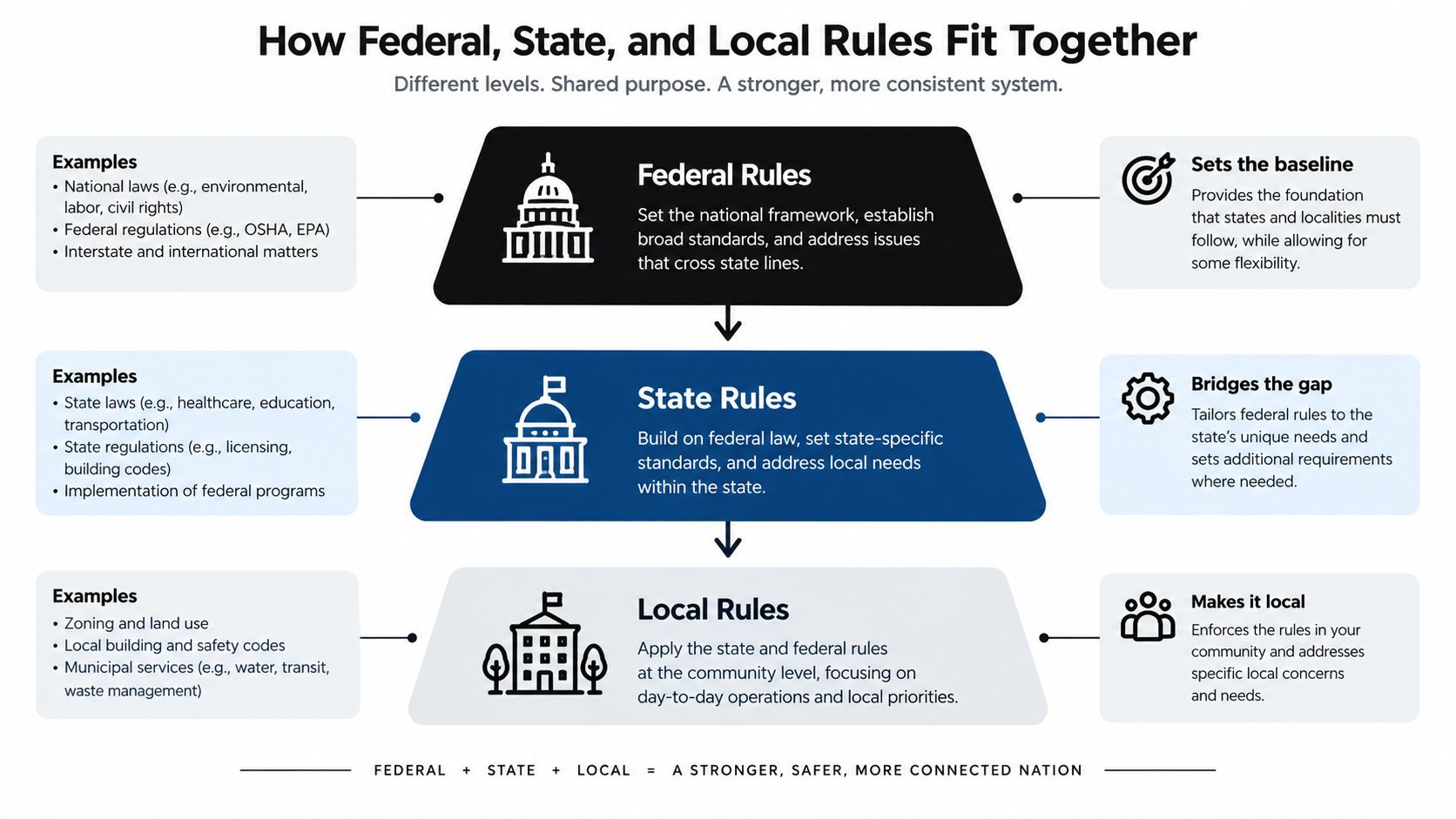
Federal law establishes a baseline, but it doesn't answer every question your facilities team faces. State agencies can classify materials differently, counties can assign collection duties, and cities can impose operational requirements on businesses or haulers.
The federal-state-local cascade works like this:
- Federal requirements establish broad rules for hazardous waste, transportation, exports, and certain electronics categories.
- State agencies classify waste, register handlers, regulate facilities, and add restrictions.
- Counties and municipalities control practical collection, storage, disposal, and recycling activities through ordinances and local programs.
- Your contract and audit process must connect every layer to a shipment record and a responsible vendor.
The CRT example makes the problem concrete. CRT funnel glass can contain enough lead to qualify as hazardous waste when discarded, and states with electronics recycling laws may impose requirements beyond federal rules. The EPA electronics stewardship guidance explains why businesses can't assume every electronic component receives identical treatment.
Certification isn't the whole answer
A recycler's certification can support vendor diligence, but it doesn't replace jurisdictional review. Ask which facility receives the material, whether subcontractors are used, how rejected loads are handled, and whether the receiving site is allowed to process the equipment.
A business also needs to distinguish reuse, resale, recycling, and disposal. Equipment moving to a resale channel may still contain regulated components or sensitive data. Equipment exported for reuse or recycling may trigger shipment controls even when the original business never intended to discard it.
Practical rule: A certificate proves an event. It doesn't automatically prove that every earlier transfer, classification decision, and downstream movement was lawful.
Counties and cities can make the workflow more specific. A county may assign responsibility for solid-waste management, while a municipality may require separation, collection arrangements, or permitted service providers. The business guide to e-waste laws is useful as a starting point, but local agency confirmation remains necessary for an active program.
Key Jurisdictional Differences Across the U.S.
A server rack can create different compliance duties based on its state of origin, contents, storage method, and destination. Do not apply one national disposal rule everywhere. Use a national control framework, then add state and local checks.
Build the workflow around five questions: How much waste does the site generate? What equipment category applies? Is the generator a business or household? How is the material stored? Where will it go? Thresholds can change the required process, from a 50-employee recycling rule to 220 pounds per month of regulated waste or an annual 23-ton program threshold.
State ITAD Regulatory Thresholds and Duties
| State | Generation Trigger | Landfill Ban | Key ITAD Duty |
|---|---|---|---|
| New York | For-profit businesses with fewer than 50 full-time employees qualify for free and convenient recycling. Businesses with 50 or more may be charged. | Covered-electronics access and recycling obligations apply through the state program. | Confirm eligibility, charges, covered equipment, and manufacturer-provided recycling access through New York's electronics recycling guidance. |
| Texas | A business or recycler may need identification numbers above 220 pounds of hazardous waste per month, 220 pounds of non-hazardous Class 1 waste, or 2.2 pounds of acute hazardous waste per month. | Perform a waste determination before discarding electronics. | Confirm classification, identification requirements, and facility-notice duties through Texas electronics recycling regulations. |
| Washington | No single statewide ITAD volume threshold applies to this comparison. | County and city governments carry primary responsibility for solid-waste management and may set operational ordinances. | Confirm local storage, collection, transportation, treatment, and disposal rules with the relevant solid-waste program before pickup. |
| California | Manufacturer take-back and covered-equipment requirements apply rather than one general generator-volume trigger. | Covered-equipment and disposal restrictions vary by equipment type and current state requirements. | Confirm the covered-equipment list, recovery obligations, and destination before shipment. |
| Illinois | Manufacturer take-back and covered-equipment requirements apply rather than one general generator-volume trigger. | Electronic-products recycling and landfill-disposal restrictions apply to covered equipment. | Confirm the current covered-equipment list and Illinois requirements before assigning a vendor or destination. |
Classification rules vary by state. Review our universal waste regulations guide before assigning a category to lamps, batteries, or CRTs.
The 220-pound monthly breakpoint matters because exceeding it can bring stricter hazardous-waste handling and identification requirements. Household exemptions do not resolve a commercial program's duties. The GAO discussion of hazardous-waste generator rules provides relevant context.
Cross-border movement requires a separate export review. Since 1 January 2025, Basel Convention amendments have expanded prior informed consent requirements to transboundary e-waste movements. EU rules also restrict exports, including shipments of e-waste to non-OECD countries. Include the EPA update on international e-waste requirements in the review file.
Georgia and Atlanta Rules You Need to Know
Atlanta businesses shouldn't treat Georgia as a simple “recycle everything” state. The correct workflow starts with classification, then checks the generator location, receiving facility, transportation route, and final processing destination.
Georgia-specific obligations should be verified with the Georgia Environmental Protection Division and the relevant local authority before a commercial program begins. Don't rely on a vendor's general statement that it “handles Georgia.” Ask for the exact facility, registration status where applicable, accepted materials, storage controls, and downstream path.
Atlanta operations require local discipline
The city, county, and facility jurisdiction can change how a pickup is arranged. A commercial generator may need a documented recycling arrangement, an authorized hauler, or a receiving facility that follows conditions beyond the generator's own site. DeKalb and Fulton County operations may also involve different local contacts and requirements, so a metro-wide playbook should contain county-specific checks rather than one Atlanta label.
Use this snapshot as a workflow control, not as a substitute for agency confirmation:
Georgia and Atlanta Compliance Snapshot
| Rule | Trigger | What You Must Do |
|---|---|---|
| Waste characterization | Equipment may contain lead, mercury, lithium, or other regulated components. | Document the classification decision before shipment. |
| Commercial collection | Business electronics leave a commercial site. | Confirm the hauler, receiving facility, and accepted material categories. |
| Local jurisdiction | The generator, storage site, and processor sit in different counties or municipalities. | Record each jurisdiction and verify applicable local requirements. |
| Data-bearing equipment | Servers, laptops, drives, phones, and network hardware contain business data. | Separate data destruction from environmental processing and retain destruction evidence. |
| Downstream processing | A contractor sends material to another processor. | Require disclosure, approval, and records for every material transfer. |
Indiana demonstrates why facility controls matter. Facilities that store or process e-waste may need to register before operating and follow requirements involving storage, training, cleanup, closure, and financial assurance. Sites holding less than 23 tons in a building or lockable trailer, or removing e-waste within 5 business days to a registered or permitted facility, may qualify for narrow operational exemptions under the state's rules. Review the Indiana electronic waste requirements before applying an exemption to a commercial workflow.
For an Atlanta-specific operating checklist, use this Atlanta e-waste compliance guide, then confirm the current rule with the applicable authority. Your vendor file should show that verification.
Core Compliance Obligations for Businesses
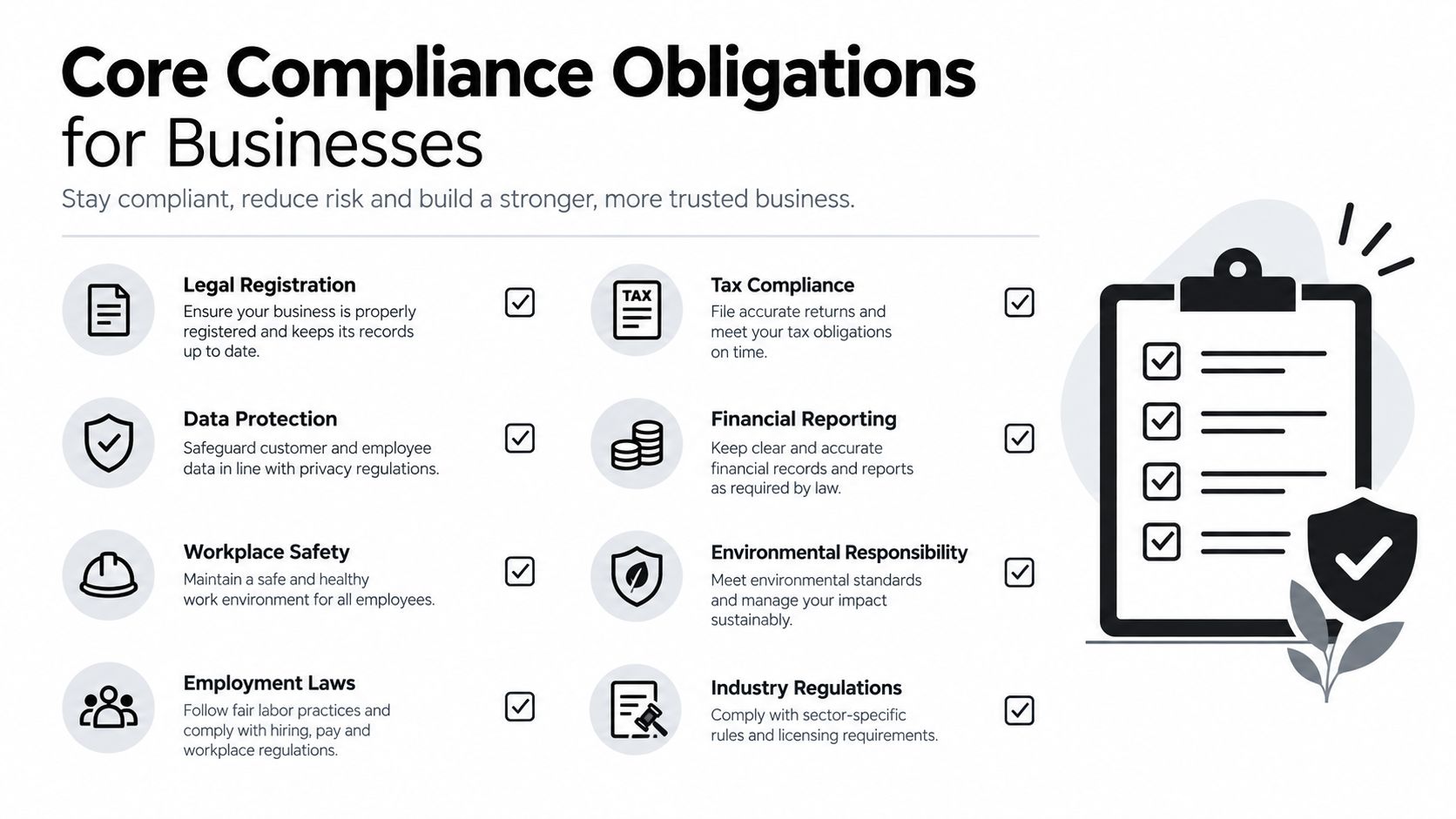
A defensible ITAD program has four stages: classify the material, select the handler, document every transfer, and report or retain what the rule requires. Businesses get into trouble when they jump directly to scheduling a truck.
Start with classification
Create an equipment inventory before pickup. Identify CRT monitors, batteries, laptops, servers, networking equipment, medical devices, laboratory equipment, lamps, and anything containing mercury, lead, or lithium. A waste determination should explain whether an item is a product for reuse, universal waste, hazardous waste, or another regulated category.
Texas specifically says businesses must conduct a waste determination before disposing of electronics to show the devices aren't hazardous. That decision belongs in the job file, not only in a vendor's internal system.
Qualify the complete chain
Vendor selection should cover more than a logo on a proposal. Request facility details, registrations, insurance, downstream policies, export controls, data-destruction procedures, and sample certificates. Certifications such as R2 or e-Stewards can support diligence, but your contract should still require notice before subcontracting or changing the downstream route.
Your file should connect:
- Asset identity: Serial numbers, asset tags, descriptions, and quantities.
- Transfer evidence: Pickup date, originating site, carrier, weight, and receiving facility.
- Processing proof: Certificate of recycling, certificate of destruction, resale report, or other applicable record.
- Exception handling: Rejected equipment, damaged batteries, unknown devices, and material sent to another facility.
- Approval history: The employee who released the load and the employee who approved the vendor.
The compliance documentation resource can help organize the evidence set. Keep legal requirements separate from best practices. A regulator may require a specific record, while a detailed serial-level report, photographic evidence, or customer dashboard may be your chosen proof of due diligence.
Penalties and Real-World Risk Exposure
The risk isn't limited to a fine. A weak ITAD file can create cleanup exposure, contract disputes, data-security questions, procurement problems, and reputational damage at the same time.
Three layers of exposure
Direct enforcement can target improper storage, transportation, disposal, reporting, or facility operation. The amount and remedy depend on the jurisdiction and violation, and the verified material here doesn't establish penalty ranges. Don't put unsupported dollar figures in an executive risk register. State the actual rule, identify the responsible party, and obtain current agency guidance.
Cleanup liability becomes more serious when a downstream processor abandons or mishandles material. The generator may face demands for records, corrective action, investigation costs, or participation in a broader cleanup dispute. A separate pollution liability guide for farms offers useful background on how environmental liability discussions extend beyond ordinary property damage coverage.
Commercial exposure often arrives before an agency decision. Enterprise customers may ask for downstream documentation, public-sector contracts may require environmental controls, and security teams may question whether data remained protected after equipment left the building.
Risk and Penalty Reference
| Risk Type | Likely Consequence | Typical Range |
|---|---|---|
| Improper classification | Required corrective action, investigation, or enforcement | Not stated in the verified material |
| Unapproved downstream handling | Cleanup demands, contract disputes, and vendor replacement | Not stated in the verified material |
| Missing data-destruction evidence | Security investigation, customer escalation, or breach-related exposure | Not stated in the verified material |
| Cross-border shipment failure | Shipment delay, consent problems, or regulator intervention | Not stated in the verified material |
| Incomplete local records | Audit findings and inability to demonstrate due diligence | Not stated in the verified material |
The cheapest time to discover a downstream problem is before the pickup is scheduled.
Your control should therefore measure evidence, not promises. If a vendor can't identify the receiving facility, explain classification, and produce a complete transfer trail, treat that gap as a material risk.
Practical Steps to Build a Compliant ITAD Workflow
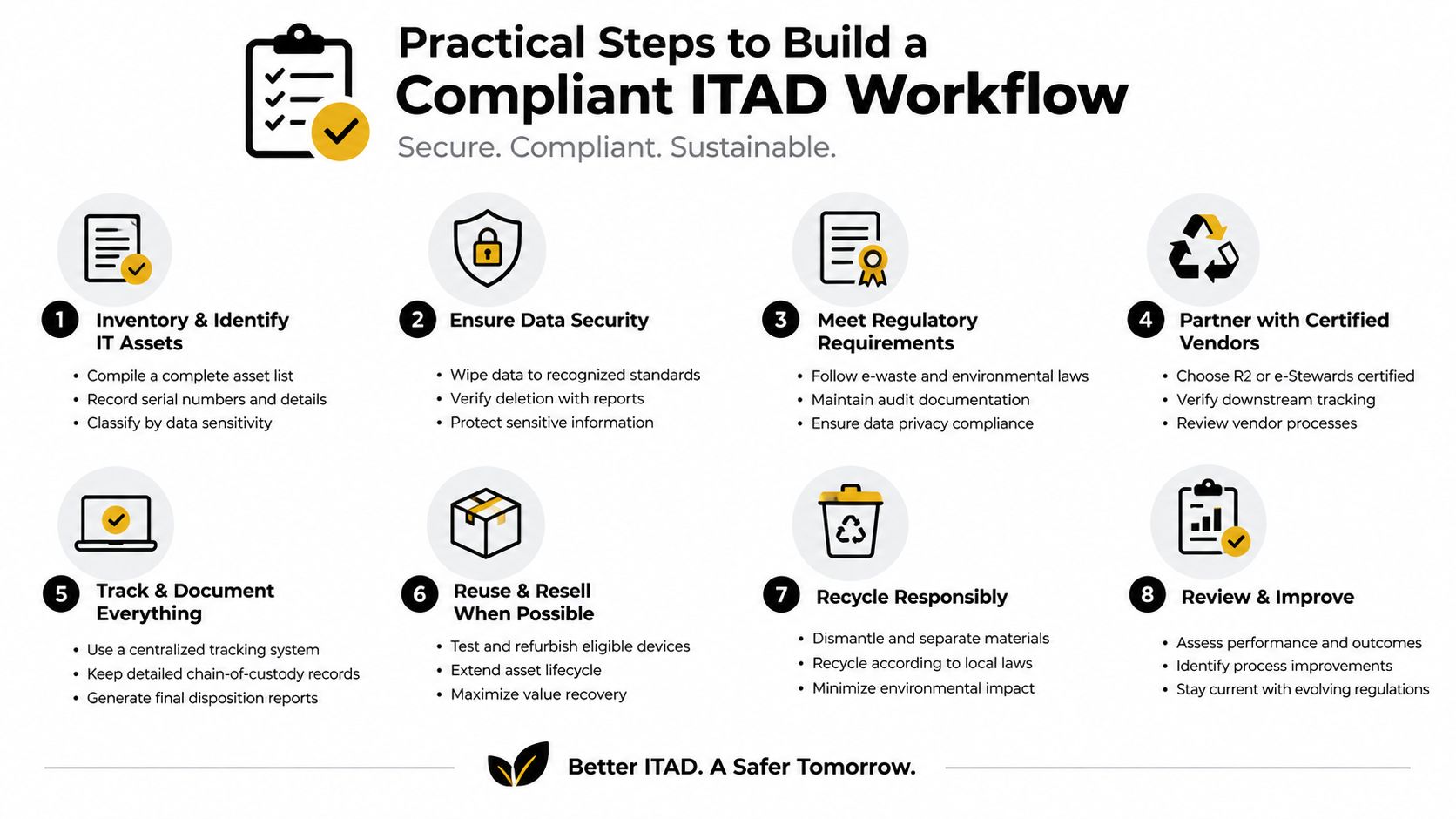
A 30-day remediation plan works when each task has an owner and a deliverable. Assign the facilities manager to site controls, the IT manager to asset identity and data destruction, procurement to contract terms, and environmental or legal staff to jurisdictional verification.
Days one through seven
- Inventory current equipment. Export asset records for laptops, desktops, servers, drives, monitors, networking hardware, medical equipment, laboratory equipment, and batteries. Flag missing serial numbers and unknown ownership.
- Separate material categories. Create distinct staging areas for data-bearing equipment, CRTs, batteries, lamps, reusable assets, and items requiring special handling.
- Map the jurisdictions. Record the generator site, storage location, pickup route, receiving facility, and final destination. Do this for every operating state.
- Review current vendors. Request facility names, registrations, certifications, insurance, downstream disclosures, sample certificates, and export procedures.
Days eight through thirty
- Complete waste determinations. Document decisions for electronics that may contain lead, mercury, lithium, or other regulated components. Escalate uncertain items instead of guessing.
- Fix the contract. Require approved downstream facilities, notice of changes, certificates, asset-level reporting, incident notification, and record access.
- Train the pickup team. Staff should know how to isolate damaged batteries, protect data-bearing equipment, prevent mixed loads, and photograph unusual conditions.
- Build the evidence file. Store the work order, asset list, chain-of-custody log, weights, carrier details, certificates, destruction reports, and exception approvals together.
Texas businesses should check whether monthly generation levels trigger identification requirements, while Indiana operators should examine storage volume and removal timing before relying on an exemption. New York employers should verify whether company size affects recycling charges or access.
Use the business technology disposal planning guide to structure refreshes before equipment accumulates in an uncontrolled storeroom. A qualified ITAD partner can coordinate pickup, secure data destruction, material separation, recycling, resale, product destruction, and audit documentation, but your company should retain approval authority and oversight.
Frequently Asked Compliance Questions
Are small businesses exempt from local environmental laws?
No. Smaller operations may qualify for a program benefit or a narrow handling exception, but size doesn't eliminate the need to classify equipment and use an appropriate destination. New York, for example, distinguishes for-profit businesses below and above 50 full-time employees for recycling access and potential charges. Texas also uses waste-generation thresholds that can affect identification requirements. Verify the rule for the generator's location and material category.
What documents prove due diligence during an inspection?
Keep the asset inventory, waste determination, vendor qualification file, pickup record, carrier information, receiving-facility details, downstream approvals, certificates, and exception log. For data-bearing equipment, include serial-level destruction evidence or a documented wiping result. A single certificate with no asset list or transfer trail is weak evidence.
Can one national program handle equipment from multiple states?
Yes, but only if the program uses a common control framework with location-specific rules. Maintain one corporate process, then attach state, county, city, facility, and export checks to each shipment. Never assume that a rule covering the originating office also covers the receiving facility.
Does a certified ITAD vendor take liability away from the generator?
No. Certification can support vendor diligence, but it doesn't erase the generator's responsibility to select, instruct, and monitor the contractor. Require downstream transparency, preserve records, and stop shipments when the vendor can't explain where material is going.
Beyond Surplus provides business IT equipment disposal, secure data destruction, electronics recycling, product destruction, data center decommissioning, and chain-of-custody documentation for organizations managing local environmental law requirements. Review the available services and schedule a compliant pickup through Beyond Surplus.


