

A tenant moves out of an Atlanta office tower, leaving laptops in desks, monitors in a storage room, and a small server rack behind a locked suite door. At another property, a renovation crew finds printers, access-control hardware, networking equipment, and damaged drives in the basement. Those devices aren't ordinary trash. They may contain tenant data, belong to someone other than the landlord, or require controlled handling because of batteries and other hazardous components.
Electronics recycling for Atlanta property management companies must therefore operate as an evidence system, not a simple hauling arrangement. A defensible program identifies ownership, protects data, documents custody, separates equipment by risk, and produces records that connect each asset to its final disposition. Managers overseeing office, multifamily, retail, healthcare, and mixed-use properties need the same discipline across every building.
The framework is practical: maintain an inventory, segregate data-bearing equipment, select a documented sanitization method, use qualified downstream processors, and reconcile certificates before closing the work order. Property managers who want broader operational guidance can also review these Richard Maize property tips, particularly the advice on planning and controlling property responsibilities.
Table of Contents
- Why Atlanta Property Managers Need a Real Electronics Recycling Program
- The Regulatory Picture for Atlanta Commercial Properties
- The Five-Step Disposition Workflow for a Property Portfolio
- Vetting Vendors With R2 and e-Stewards Standards
- Matching Sanitization Methods to Real Equipment
- Pickup, Staging, and Tenant Logistics Across Properties
- Records, Value Recovery, and Next Steps
Why Atlanta Property Managers Need a Real Electronics Recycling Program
A portfolio creates repeated exposure. One tenant may abandon laptops during a move-out, while another replaces monitors during a lease change. A multifamily community may accumulate resident access-control equipment, printers, and office computers. A data center or healthcare tenant may retire storage systems that demand far tighter custody than a broken printer.
The risk isn't limited to environmental handling. Managers may need to resolve ownership disputes, tenant privacy concerns, missing assets, data exposure, lease obligations, and vendor accountability. A dumpster receipt won't answer who collected a device, whether the storage media was sanitized, or where the equipment went afterward.
The global scale explains why informal handling is inadequate. The Global E-waste Monitor 2024 reported 62 billion kilograms of discarded electrical and electronic equipment worldwide in 2022, equal to 7.8 kilograms per person. Only 22.3% was documented as formally collected and recycled in an environmentally sound manner, leaving approximately 77.7% outside documented formal recycling systems. Those figures are global, not Atlanta-specific, but they show why property operators need controlled workflows wherever technology accumulates.
What a defensible program delivers
A serious Atlanta program should produce five outcomes:
- Clear ownership: The register identifies whether equipment belongs to the landlord, tenant, contractor, or another party.
- Controlled custody: Locked staging, pickup scans, manifests, and building-level reconciliation limit disputes.
- Risk-based sanitization: Storage media receives a method matched to sensitivity, condition, and reuse plans.
- Certified processing: Qualified downstream partners document reuse, recycling, destruction, and exceptions.
- Inspection-ready evidence: Certificates connect assets or batches to the property, tenant, date, and disposition.
EPA's historical electronics initiative reinforces the measurement principle. The agency reported that consumer-electronics recycling rose from 30.6% in 2012 to 40.4% in 2013, an increase of 9.8 percentage points, while its challenge expected participating organizations by their third year to send 100% of used electronics to a recognized third-party certified recycler and report that information (EPA electronics recycling report). For Atlanta portfolios, the lesson is direct: a collection area isn't proof of responsible disposition. Records are.
For a local overview of service considerations, see electronics recycling in Atlanta for businesses.
The Regulatory Picture for Atlanta Commercial Properties
A tenant vacates a suite, leaving laptops, servers, monitors, and batteries in a loading area. The property manager now has to resolve ownership, data custody, environmental handling, vendor qualification, and security across one mixed load. Atlanta electronics recycling is therefore an evidence problem at the property level, not a simple waste-hauling task.
Georgia does not impose a statewide electronics-recycling mandate for ordinary commercial e-waste. That does not make a dumpster an acceptable route for every device. Equipment type, components, stored data, ownership, and the processor's qualifications determine the appropriate disposition.
The federal FTC Disposal Rule applies to businesses and individuals that use consumer reports for a business purpose, including landlords and service providers maintaining covered information for another organization. The FTC Disposal Rule requires reasonable measures to prevent unauthorized access to or use of consumer-report information. It recognizes destruction or erasure of electronic files and media so the information cannot be read or reconstructed as an acceptable disposal measure.
Three layers managers must keep separate
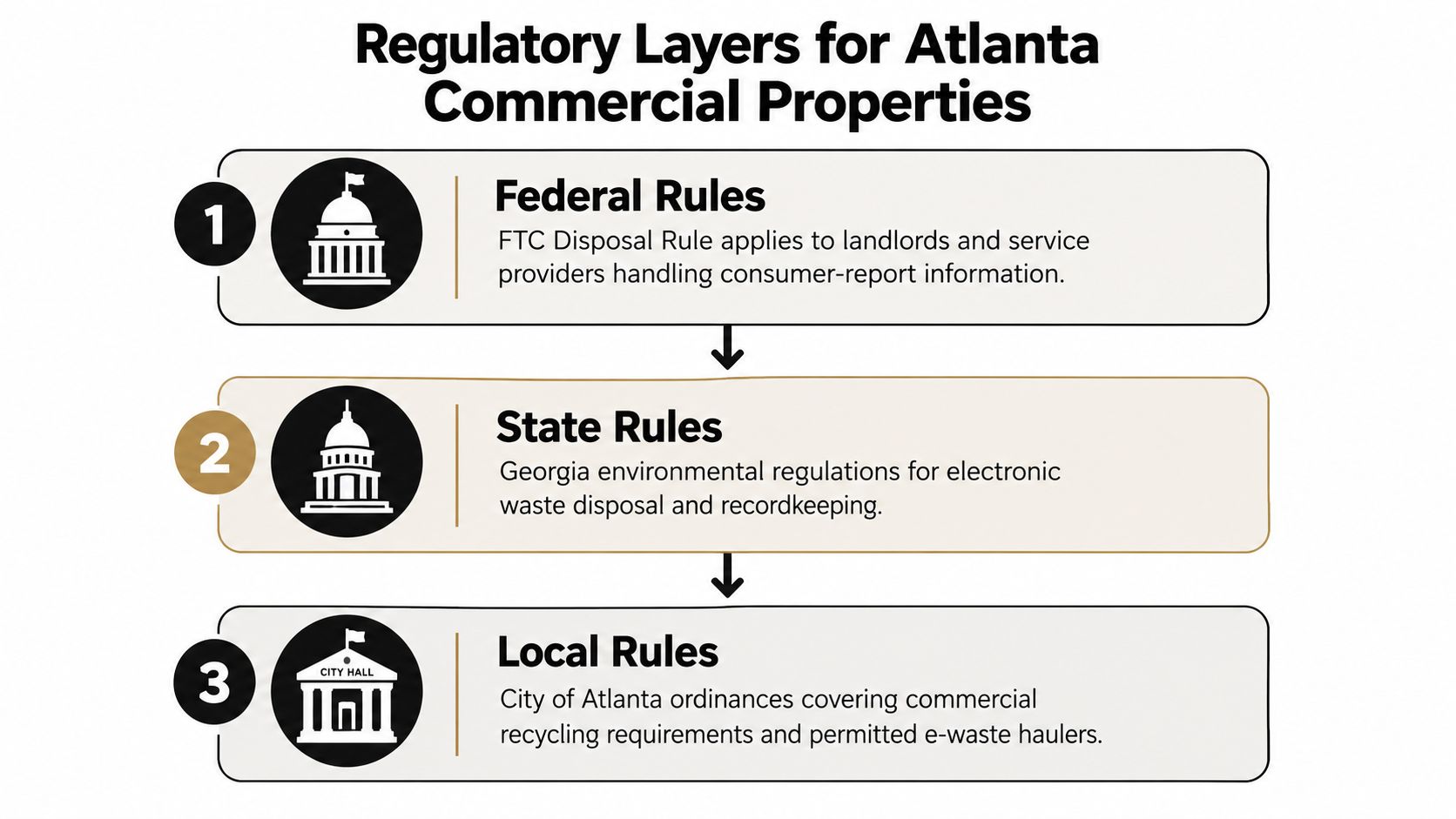
Federal obligations focus on information protection when covered consumer-report data is present. A property-management company handling tenant, applicant, employee, or vendor information must prevent unauthorized reconstruction during disposition.
State and environmental obligations depend on batteries, mercury, PCBs, and other hazardous components. The correct route follows the device and waste classification, not the vendor's marketing label.
Local service realities affect execution. Atlanta's residential curbside program does not serve as a commercial-building solution. Businesses need privately arranged collection, defined access procedures, agreed pickup terms, and downstream records.
EPA identifies R2 and e-Stewards as the two accredited U.S. certification standards and recommends certified electronics recyclers for businesses, governments, and large purchasers (EPA certified electronics recyclers). Certification does not replace property-level controls. It gives vendor qualification a defensible reference point.
Practical rule: A lease clause assigning abandoned equipment to the landlord does not remove the need to identify data, confirm ownership, document transfer, or assess hazardous components.
Security controls must cover the period between tenant turnover and processor acceptance. Coordinate loading access, escorts, locked staging, and monitoring with the building's security plan. Guidance on mobile patrols for communities can inform broader site-protection decisions, but patrols do not establish an electronics chain of custody.
Use a written decision tree. Identify the equipment and hazards, determine whether it contains data, confirm ownership, record the transfer, and send it to a qualified processor. The Atlanta e-waste laws and business compliance guide provides a local reference for that evaluation. For a defensible file, retain the property, tenant, asset or batch, custody, and final disposition records together.
The Five-Step Disposition Workflow for a Property Portfolio
The workflow should work for both a downtown office tower and a suburban multifamily community. The difference is the equipment and the parties involved, not the control structure.
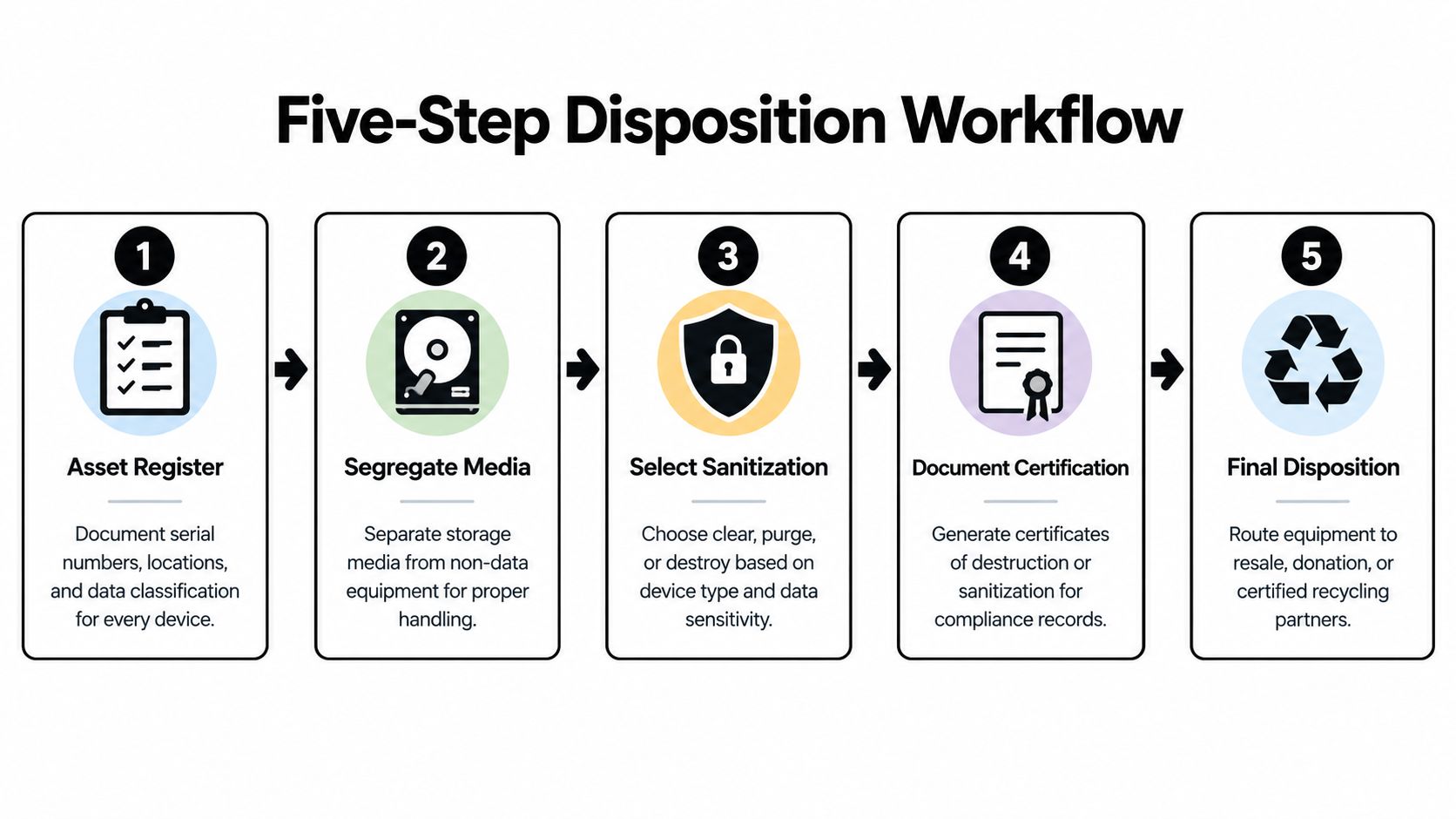
1. Build the asset register
Record the serial number, property, suite or room, owner, equipment type, condition, data classification, and intended disposition. For an office tower, that may include tenant laptops, switches, printers, and a server rack. For multifamily, it may cover leasing-office desktops, access-control panels, cameras, tablets, and network hardware.
Don't accept “one pallet of electronics” as an inventory. A batch description may be sufficient for low-risk non-data material, but storage devices need asset-level or clearly defined batch-level identification.
2. Separate storage media
Segregate hard drives, solid-state drives, laptops, servers, phones, tablets, and other data-bearing equipment from displays, keyboards, cables, printers, and non-data hardware. Mark exceptions immediately. A damaged drive from a leasing office shouldn't travel in an unmarked mixed load because it was found beside monitors.
3. Select the sanitization method
NIST distinguishes clear, purge, and destroy. Clear uses logical techniques intended to protect against ordinary, non-invasive recovery. Purge uses physical or logical techniques intended to make recovery infeasible with state-of-the-art laboratory methods while potentially preserving the device for reuse. Destroy makes recovery infeasible and leaves the media unable to store data (NIST media sanitization guidance).
A redeployable office laptop may qualify for clear or purge after a sensitivity review. A damaged drive, uncertain encryption state, or media subject to a no-reuse requirement may require destruction.
4. Document the operation
The sanitization log should capture the technique, tool and version, operator, date, verification method, device identifier, and result. NIST distinguishes verification, which checks whether the operation completed without technical errors, from validation, which is the organization's decision that residual confidentiality risk is acceptable. Verify every applicable operation, then consider independent secondary verification on a random sample using a different tool. NIST's sampling guidance calls for pseudorandom coverage across user-addressable and reserved areas, with each consecutive sample covering at least 5% of its subsection (NIST SP 800-88r2 FAQ).
5. Reconcile the certificate
Before closing the work order, compare the certificate, manifest, and original register. Confirm that every serialized asset appears as reused, remarketed, recycled, destroyed, or recorded as an exception.
Common failures include treating a deletion report as proof of sanitization, omitting reserved storage areas, mixing buildings without reconciliation, and failing to document failed units that require physical destruction. The secure electronics recycling workflow for multi-location companies offers a useful model for keeping property-level records consistent across sites.
Vetting Vendors With R2 and e-Stewards Standards
A vendor's environmental language does not prove controlled processing. Atlanta property managers should require the certification scope, accepted equipment categories, data-destruction procedures, downstream controls, exception process, and sample reports before awarding work. The vendor must be able to connect each asset to its owning tenant or property, custody record, processing result, and final disposition.
EPA identifies R2 and e-Stewards as the two accredited U.S. certification standards. Both address responsible processing, environmental protection, downstream management, reuse or recycling, and data destruction. The certificate alone is not enough. Review whether it covers the activities, equipment, facilities, and downstream partners involved in your portfolio.
R2 versus e-Stewards
| Standard | Scope | Data Destruction Emphasis | Best Fit For |
|---|---|---|---|
| R2 | Responsible reuse, recycling, environmental health and safety, and documented downstream management | Requires controlled data destruction practices appropriate to the equipment and service | Portfolios seeking a recognized, operationally structured recycling and ITAD framework |
| e-Stewards | Responsible recycling, worker and environmental protections, downstream accountability, and restrictions on irresponsible export or disposal | Emphasizes secure destruction and responsible handling throughout the chain | Portfolios that place strong emphasis on strict downstream and environmental controls |
Use the table to narrow the field, then inspect the vendor's certificate and audit scope. Certification should cover the processing activities you are buying, rather than a related facility or separate corporate entity.
Questions for the RFP
Require written answers to these questions:
- Acceptance criteria: Will the vendor accept lithium batteries, displays, networking gear, servers, printers, and damaged storage media?
- Pickup evidence: Will the driver provide building-specific counts, photographs or scans, a manifest, and tamper-evident staging?
- Processing evidence: Will the vendor report unit counts or weights at pickup and after processing?
- Data controls: Which clear, purge, or destroy methods are available, and how are failures escalated?
- Downstream records: Can the vendor identify downstream processors and provide recycling or destruction certificates?
- Value separation: Does the report distinguish reuse, resale, material recycling, and residual disposal?
- Audit process: Are exceptions reviewed regularly, with corrective action recorded?
Category-level reporting matters because product streams do not perform alike. Historical 2014 estimates included recycling rates of 78% for laptops, 72% for desktops, 60% for flat-panel monitors, 65% for mobile phones, and 70% for televisions, according to an EPA materials-management report. The same historical source reported that an earlier EPA program sent 99.6% of more than 243,000 tons collected in 2013 to certified recyclers, while overall consumer-electronics recycling was estimated at 41.7% in 2014. These figures are not a forecast for an Atlanta portfolio. They show why one tonnage total cannot replace equipment-category records.
For a practical checklist, review how to choose an R2-certified electronics recycler. A defensible vendor should produce property-level evidence, not only a certificate and a pickup receipt.
Matching Sanitization Methods to Real Equipment
“Wiped” isn't a sufficient method statement. The property manager needs to know what was done, to which device, with which tool, and how the result was verified.
Laptops and desktops
A redeployable laptop with a known ownership history and an approved reuse plan may receive a clear or purge method after the organization classifies the data and confirms the device supports the chosen technique. A multifamily leasing-office desktop may look low risk, but it can still contain applicant or resident information. Ownership and data classification should control the decision, not the device's age.
Servers and storage arrays
A server removed during a lease change can contain multiple drives, logical volumes, reserved areas, and backup media. Purge may preserve reusable hardware when the organization accepts the residual risk and the method is supported. If a drive is damaged, encryption status is uncertain, or the business prohibits reuse, destruction is the stronger route.
Access-control and building systems
Access-control panels, intercom controllers, cameras, badge systems, and smart-building gateways may hold credentials, logs, configurations, or network details. Treat them as data-bearing until the responsible owner confirms otherwise. Remove or sanitize storage media before routing the remaining hardware for recycling.
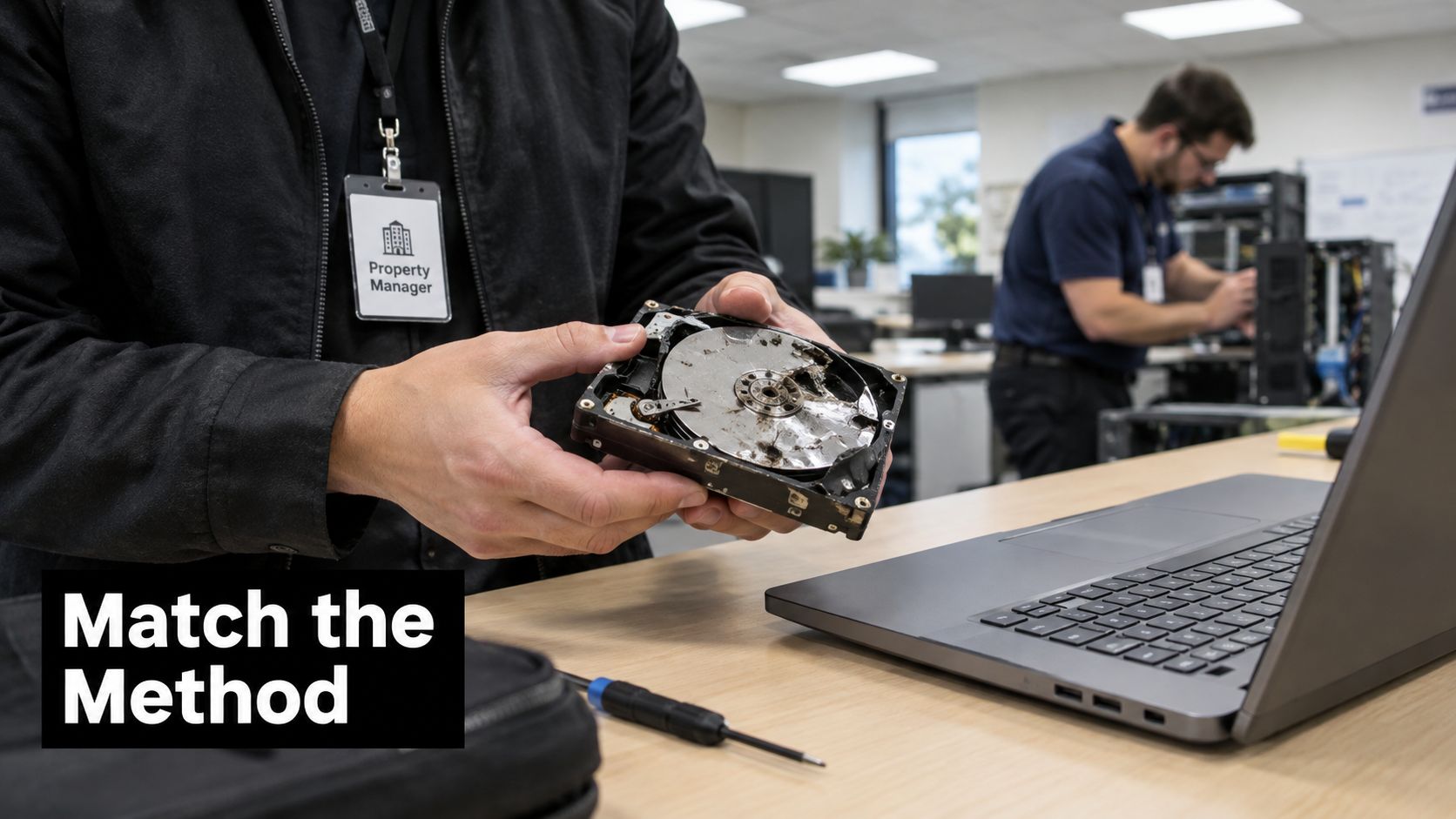
Damaged media
A failed drive isn't an exception to document. It is an exception that needs a defined outcome. If software sanitization can't complete, record the failure and route the media for physical destruction under the approved process.
The evidence package
NIST's newer guidance describes media sanitization as a process that makes access to target data infeasible for a specified level of effort and calls for controls based on information sensitivity (NIST SP 800-88r2 overview). Your records should therefore show:
- Asset identity: Serial number or controlled batch identifier.
- Selected method: Clear, purge, or destroy, with the reason.
- Execution details: Tool, version, operator, date, and result.
- Verification: Technical check and any secondary sample review.
- Final disposition: Reuse, resale, recycling, destruction, or exception.
That evidence lets an owner, lender, tenant, auditor, or regulator understand what happened without relying on a vague vendor assertion.
Pickup, Staging, and Tenant Logistics Across Properties
Move-out week exposes weak logistics quickly. A tenant's suite may contain equipment owned by the tenant, the landlord, a managed-service provider, or a leasing contractor. If crews place everything in one loading-dock pile, the property manager loses the distinction before the recycler arrives.
During a move-out, assign a property, suite, tenant, and work-order identifier before collection. Use a locked room or controlled cage for staging. Scan or photograph assets at pickup, record the building-specific count, and keep storage media separate from non-data equipment. The driver should leave with a manifest that both parties can reconcile.
Renovation week creates a different pattern. Contractors may remove access-control panels, cameras, cabling, displays, printers, and server-room equipment while the property manager focuses on schedule and dust control. Require the contractor to place electronics in a designated area, not a general construction container, and route data-bearing equipment through the same register and custody process.
Choose the service channel by risk
- Onsite pickup: Best for occupied office buildings, multi-tenant move-outs, server-room refreshes, and projects needing serialized manifests at the dock.
- Offsite processing: Appropriate for higher-volume loads that require controlled transport, sorting, data destruction, and downstream reporting away from the property.
- Mail-in recycling: Useful for remote suites or small offices with limited quantities, provided each data-bearing item remains identified and the shipment is traceable.
- Drop-off: A practical option for residential programs and overflow, but it isn't a substitute for a commercial portfolio workflow when tenant ownership and business data are involved.
Beyond Surplus coordinates business electronics pickup, processing, data destruction, and documentation, while its business electronics pickup service explains the operational differences among collection options.
Chain-of-custody rule: Never combine assets from multiple buildings in a report that can't separate the properties later.
The cheapest pickup can become the most expensive option when certificates omit tenant identity, manifests don't match the load, or a missing laptop triggers a dispute. Require building-by-building counts, exception reports, pickup photographs or scans, and certificates that identify the property and processing date.
Records, Value Recovery, and Next Steps
A property manager should be able to assemble the complete file without searching through email threads. Use this record structure for every work order:
- Work order: Property, address, requesting department, tenant, access window, responsible manager, and project reason.
- Asset or batch register: Make, model, serial number, location, owner, condition, data classification, and intended disposition.
- Sanitization log: Method, tool and version, operator, date, verification result, and failed-unit disposition.
- Pickup manifest: Driver or carrier, vehicle or shipment reference, collection time, building count, signatures, and exceptions.
- Final certificate: Recycling, reuse, resale, or destruction outcome matched to the original asset or batch identifier.
Store the file with the property record and retain the tenant authorization or lease-related transfer documentation. That makes the evidence useful during tenant inquiries, sustainability reporting, insurance reviews, audits, and disputes.
When ITAD recovery makes sense
Buyback and resale deserve a disciplined screen. Newer enterprise hardware, standardized laptop fleets, complete server rows, and equipment with clear ownership can justify valuation and remarketing. Older mixed loads, damaged devices, incomplete systems, and low-value peripherals may generate little recovery after transport, testing, data destruction, and administrative work.
Keep value recovery separate from compliance. A device should never be reused or resold merely because it has residual value. Data sanitization, ownership authorization, and documented disposition come first.
The EPA electronics recycling overview distinguishes reuse, donation, and recycling. That distinction matters for property managers because reuse preserves value while also demanding proof that every data-bearing device was sanitized before transfer.
Questions managers ask after pickup planning
Can abandoned tenant electronics go in the dumpster? Not automatically. Identify ownership, data exposure, hazardous components, lease terms, and the appropriate processor first.
Does a deletion report prove sanitization? No. The record should identify the method, tool, operator, date, verification, and final disposition.
Should every device be physically destroyed? No. Clear, purge, and destroy serve different purposes. Match the method to data sensitivity, condition, reuse plans, and organizational risk.
What should the certificate contain? It should reconcile to the inventory and identify the property, tenant or owner where applicable, asset or batch, date, and recycling or destruction outcome.
How should a portfolio report performance? Track units or weight by building and equipment category, then separate reuse, resale, material recycling, and residual disposal. EPA's historical category-level data demonstrate why total tonnage alone is inadequate.
Beyond Surplus coordinates commercial electronics recycling, secure IT asset disposal, data destruction, product destruction, data-center decommissioning, and value recovery for Atlanta property portfolios and organizations nationwide. Visit Beyond Surplus to schedule a pickup, request a quote, or arrange a controlled disposition program with property-level documentation.


