

A client shuts a Smyrna office and asks your team to remove its servers, workstations, and switch rack by Friday. The SAN may hold sensitive client information, the facilities manager wants the room cleared, and your technicians already have a full schedule. Without a written disposition process, the MSP can end up carrying the risk and the cost after the equipment leaves the building.
Electronics recycling for Atlanta MSPs and IT service providers works better as a managed, billable IT asset disposition service than as an occasional cleanout. The workflow can cover inventory, sanitization or destruction, transport, asset recovery, and final documentation, with the client paying for defined work rather than the MSP absorbing an unplanned task. The scale of the underlying waste problem reinforces why retired equipment deserves a deliberate process: the UN reported that the world generated 62 million metric tonnes of e-waste in 2022, but only 22.3% was documented as formally collected and recycled in an environmentally sound manner (Global E-waste Monitor).
Table of Contents
- Why Atlanta MSPs Should Treat E-Waste as a Service Line
- The Policy Stack Every MSP Needs Before the First Pickup
- Choosing On-Site or Off-Site Data Destruction
- A Vendor Selection Checklist That Holds Up in Audit
- Scheduling and Chain of Custody From Quote to Certificate
- Pricing the Engagement and Building IT Buyback Margin
- Turning One-Off Cleanouts Into a Quarterly Recurring Service
Why Atlanta MSPs Should Treat E-Waste as a Service Line
A client's office move can leave servers, laptops, and network gear piled for removal on a tight deadline. Your technicians know which devices held business data and which equipment may still have recovery value. That operational knowledge positions the MSP to manage the disposition workflow and bill for the work, rather than absorb an unplanned cleanout.
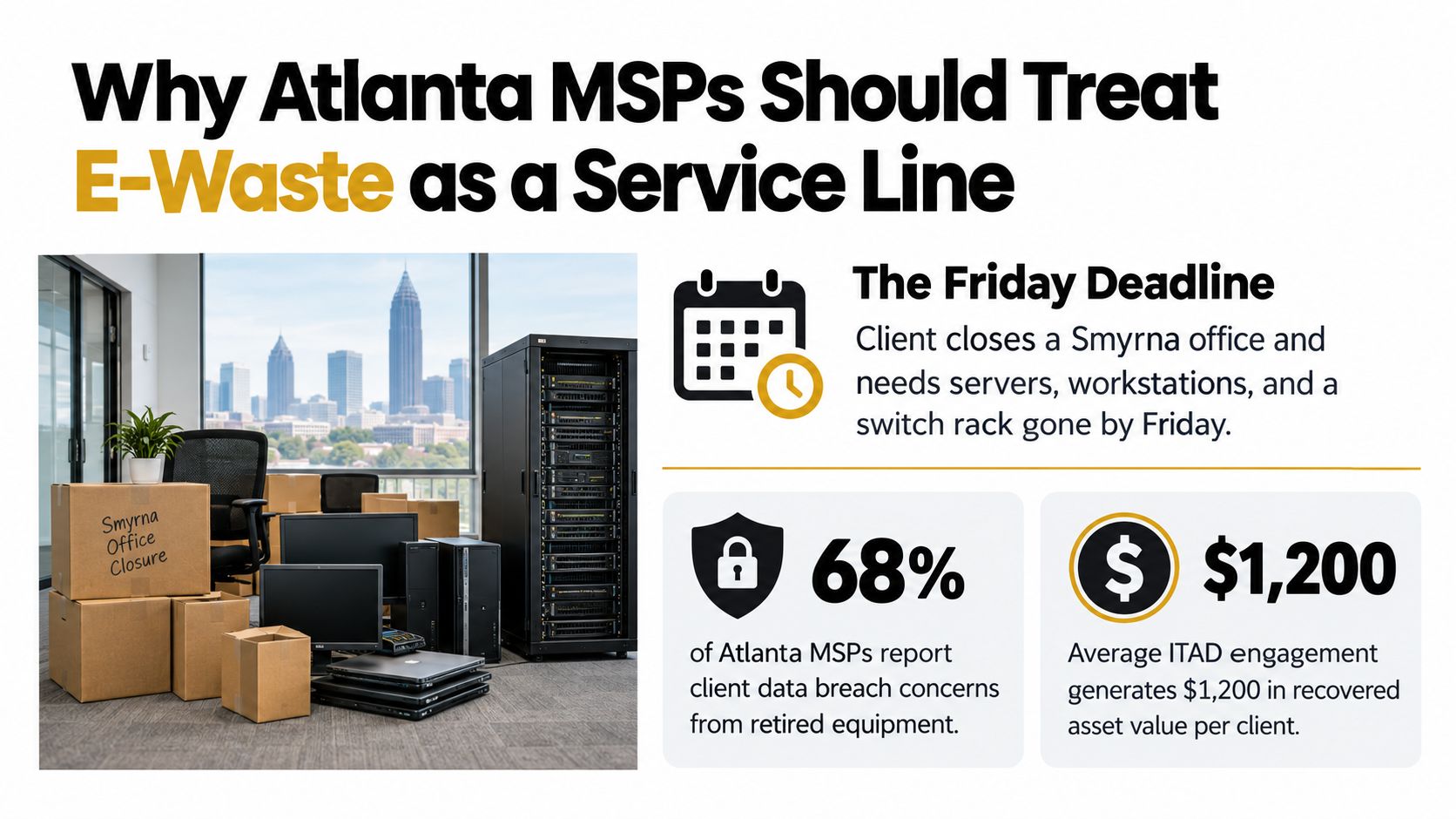
Use verifiable tasks to define the service: count and identify assets, agree on the sanitization method, document the handoff, and obtain a disposition report. The infographic's figures are illustrative, so base client pricing on the work and vendor terms you can confirm. Charge for coordination and technical labor, pass through agreed vendor costs, and show any confirmed buyback credit separately. That structure lets the MSP transfer handling responsibilities through a documented vendor process while keeping charges clear to the client.
A single pickup solves one space problem. A recurring service can cover refreshes, office moves, laptop replacements, and data-center decommissioning, giving clients a consistent route for retiring equipment. It also gives the MSP a defined, billable role when clients ask how retired devices and stored data are handled.
Equipment disposal deserves planning at scale. The UN's Global E-waste Monitor projects that global e-waste could reach 82 million tonnes by 2030. For an Atlanta MSP, the practical response is to include servers, network equipment, laptops, storage, displays, and peripherals in the client's end-of-life workflow instead of sending an untracked pile to general waste.
Start recovery decisions with reviewing excess inventory data. It can help identify equipment for reuse or potential recovery before the vendor quotes the work. Keep the resulting asset decisions tied to serial-level records and the agreed data controls so the inventory review supports, rather than replaces, accountable handling.
The Policy Stack Every MSP Needs Before the First Pickup
Write the rules before the first asset leaves a client site. The policy stack should tell technicians what qualifies for retirement, who authorizes it, which data treatment is acceptable, and what documentation closes the job. If the procedure depends on a particular technician remembering an unwritten rule, it isn't a reliable control.
The FTC Disposal Rule took effect on June 1, 2005, and applies to organizations that use consumer reports for business purposes, including service providers handling covered information. The FTC defines disposal broadly: selling, donating, transferring, abandoning, or discarding equipment that contains consumer-report information can all count. Organizations must take reasonable measures to prevent unauthorized access or use, and destroying or erasing electronic media so data can't be read or reconstructed is one example (FTC Disposal Rule guidance).
Put scope and responsibility in writing
Your master policy should cover computers, servers, drives, removable media, and embedded storage. Add an approved sanitization standard and require an authorized client contact to approve the inventory and disposition route before scheduling.
In the client-facing statement of work, define who supplies the asset list, who disconnects equipment, whether packing and de-installation are included, what data treatment is ordered, and how exceptions are handled. MSA language should assign responsibility for accurate asset identification and approvals, establish the chain-of-custody process, and specify how the client receives destruction and recycling records. Don't promise that a certificate alone transfers every legal responsibility. It documents the work performed; the contract and actual controls still matter.
Healthcare clients need a specific ePHI procedure. HHS says covered entities must address final disposition of electronic protected health information and the media holding it, and must remove ePHI before media are reused. The policy should require an asset-level choice between clearing, purging, reuse, and destruction, based on the client's circumstances (HHS guidance on disposing of ePHI).
Make the runbook usable on a busy day
Give technicians a short intake checklist, approval record, packing and handoff instructions, exception path, and closeout checklist. Include a certificate template that records the client, service date, asset identifiers, method, and final disposition. Use the same fields in the ticketing system and vendor handoff so staff aren't transcribing the same details into incompatible forms.
Review the policy when client requirements, services, or vendor arrangements change. For Georgia-specific context, check the electronics recycling and ITAD compliance overview alongside the requirements that apply to each client's data and industry.
Choosing On-Site or Off-Site Data Destruction
On-site and off-site destruction solve different problems. On-site work keeps the destruction event at the client location and lets an authorized observer witness it. Off-site processing can suit routine refreshes when the MSP can verify each asset's handoff and obtain credible processing records. The choice should follow the client's confidentiality needs, not whichever quote looks cheaper.
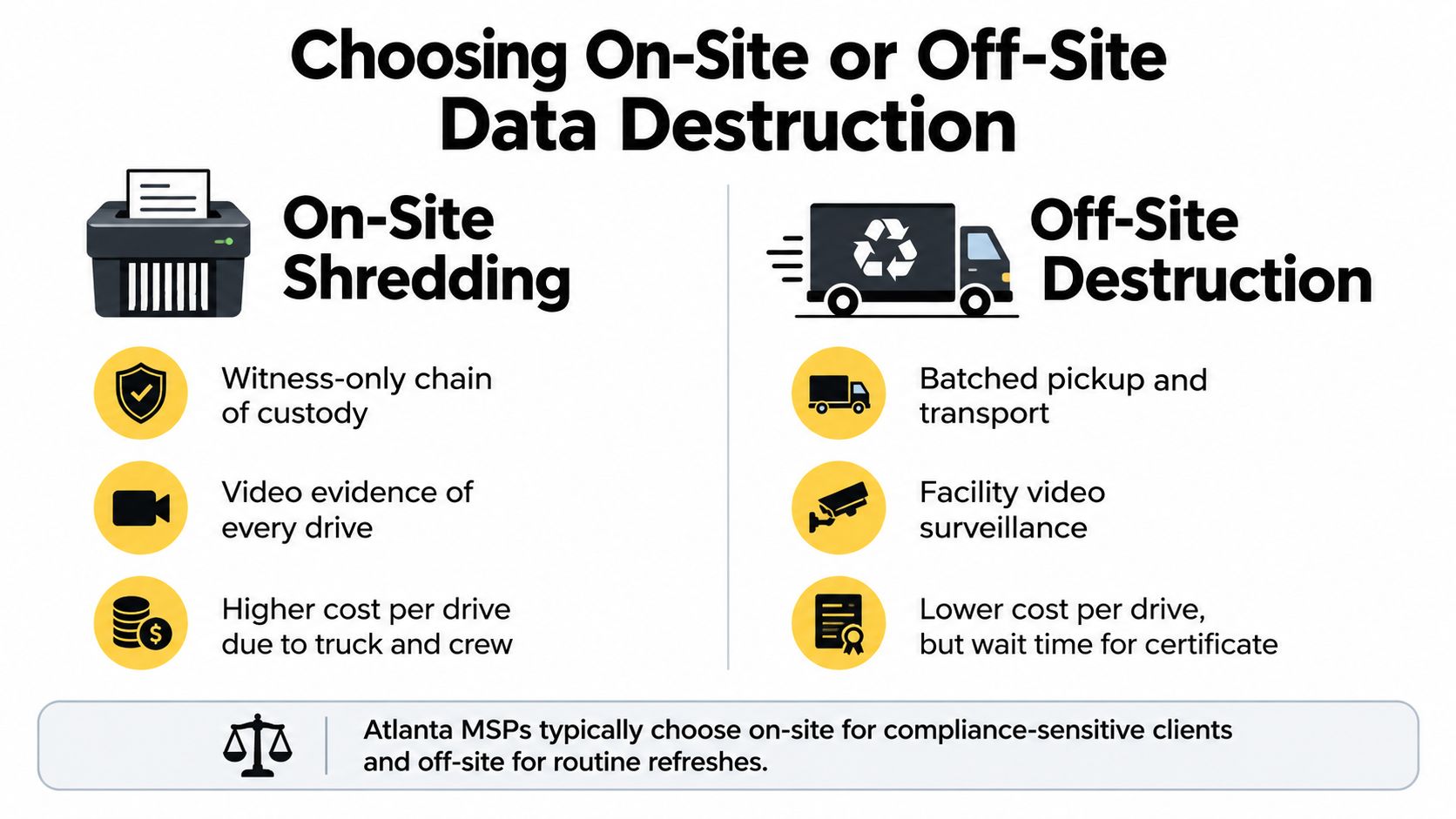
The comparison graphic includes claims about video evidence for every drive, relative costs, and typical Atlanta purchasing patterns. Those aren't established by the verified data here, so confirm them directly with a vendor before relying on them. Ask what the service includes, what evidence it produces, and whether the process accommodates the client's devices and security requirements.
Match the method to the media
NIST's Clear, Purge, and Destroy categories help structure the choice. Clear makes data inaccessible through logical techniques; Purge uses a stronger sanitization approach appropriate to the media and risk; Destroy makes the media unusable. Don't assume a quick format or operating-system delete is enough. Nor should you apply a magnetic-media process to an SSD without confirming that it's suitable for that device.
NIST distinguishes verification from validation. Verification checks whether the sanitization process completed without technical errors. Validation is the formal decision that the remaining confidentiality risk is acceptable. The MSP should capture the method, tool version, operator, timestamp, and result, then ensure an authorized reviewer makes the validation decision against the client's requirement (NIST SP 800-88 Rev. 1).
Decision rule: If the client requires physical destruction or cannot accept the residual risk of reuse, choose an approved destruction route. If reuse is allowed, select a media-appropriate sanitization method and retain evidence that supports the decision.
For both service models, ask what the certificate records. A useful certificate identifies the media or serialized asset, states the method, and can be reconciled to the pickup inventory. A generic statement that a batch was destroyed is weaker if it doesn't establish which client assets were included. Compare the on-site and off-site ITAD trade-offs against the client's sensitivity, transport controls, and evidence requirements.
A Vendor Selection Checklist That Holds Up in Audit
A vendor's sales pitch is not due diligence. Ask for records that show how the company handles your equipment from collection through downstream processing, and make sure the answers are specific enough to become contract terms. A certification logo or a polished certificate template can't answer every operational question.
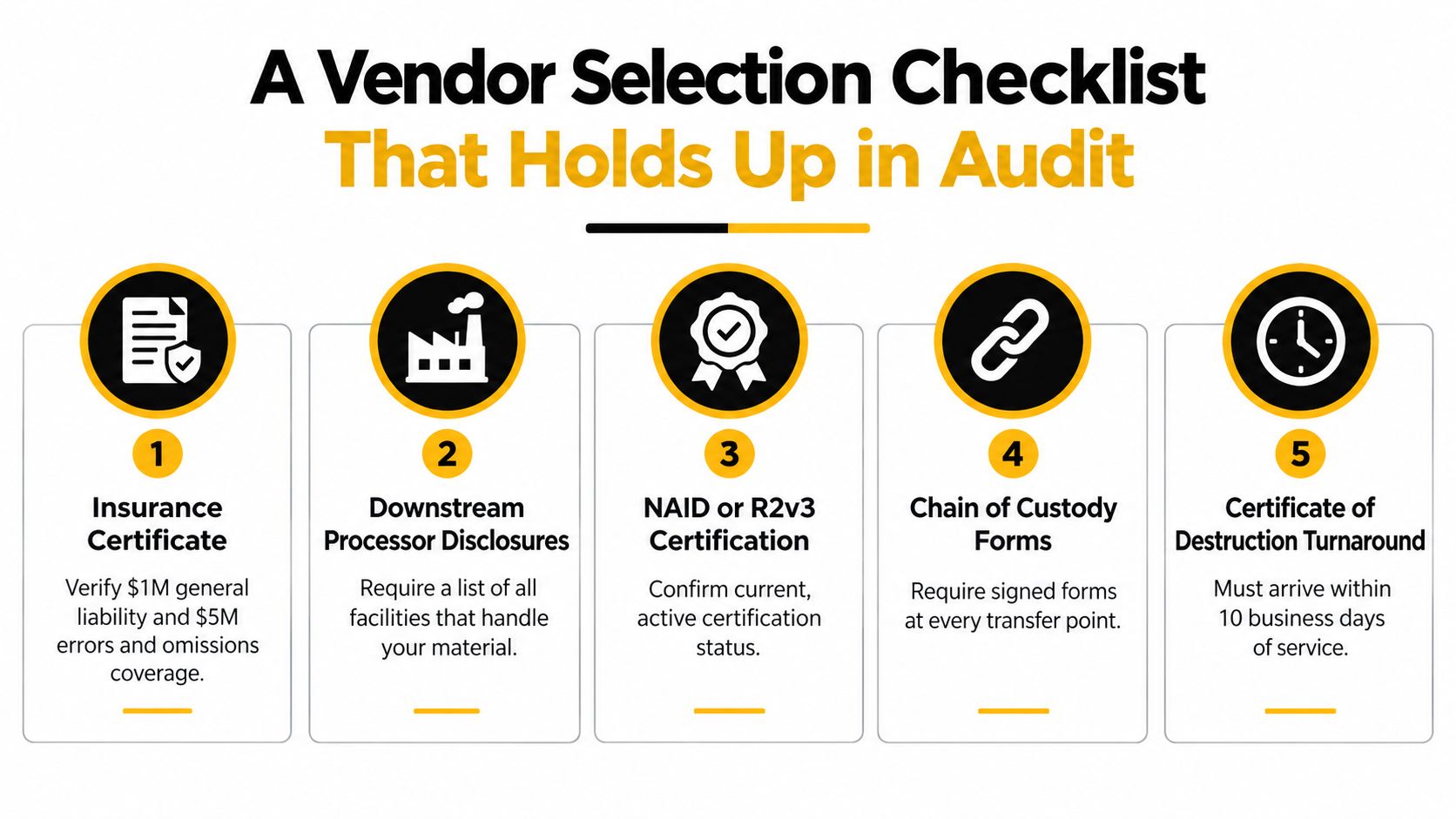
The infographic specifies insurance limits and a certificate turnaround deadline. Those amounts and timing aren't established by the verified data here, so treat them as proposed procurement criteria only if they fit your risk and contract requirements, not as universal standards.
Ask for evidence, not assurances
Use a consistent checklist for each candidate:
- Insurance: Request current certificates and confirm the coverage types and limits are suitable for the work.
- Downstream processors: Ask for the facilities and subcontractors that may handle the material, plus the point at which responsibility transfers.
- Certifications: Verify any claimed NAID or R2v3 status directly with the issuing organization and check that the scope covers the relevant service.
- Audit rights: Put record access, process review, and exception reporting into the agreement.
- Chain of custody: Review the forms used at each handoff and ask who signs them.
- Missed or mismatched assets: Require a documented escalation process when a serial number is absent from a manifest or receiving report.
- Transport and facility access: Ask how equipment moves out of metro Atlanta, where it is processed, and whether a client visit or process review can be arranged.
The vendor due-diligence checklist can help organize these questions. Request a sample receiving report and certificate before signing. Check whether the record identifies individual assets, the disposition method, exceptions, and the responsible processor. If the vendor only offers a general weight ticket, that may support a material shipment record, but it doesn't replace an asset-level destruction record.
“We recycle everything we collect” isn't an answer to what happens to reusable equipment, data-bearing devices, or material that goes to a downstream processor.
Other warning signs include refusing to disclose subcontractors, treating all drives the same regardless of media type, and declining to explain how discrepancies are resolved. Score providers against the same written requirements. That makes the eventual selection easier to defend to a client or auditor.
Scheduling and Chain of Custody From Quote to Certificate
A clean closeout starts before dispatch. Export the retirement list from the RMM or CMDB, confirm the client's scope, and ask a technician to walk the site with the list. Record asset identifiers and note storage-bearing components separately, including installed drives, removable media, and embedded storage where identifiable.
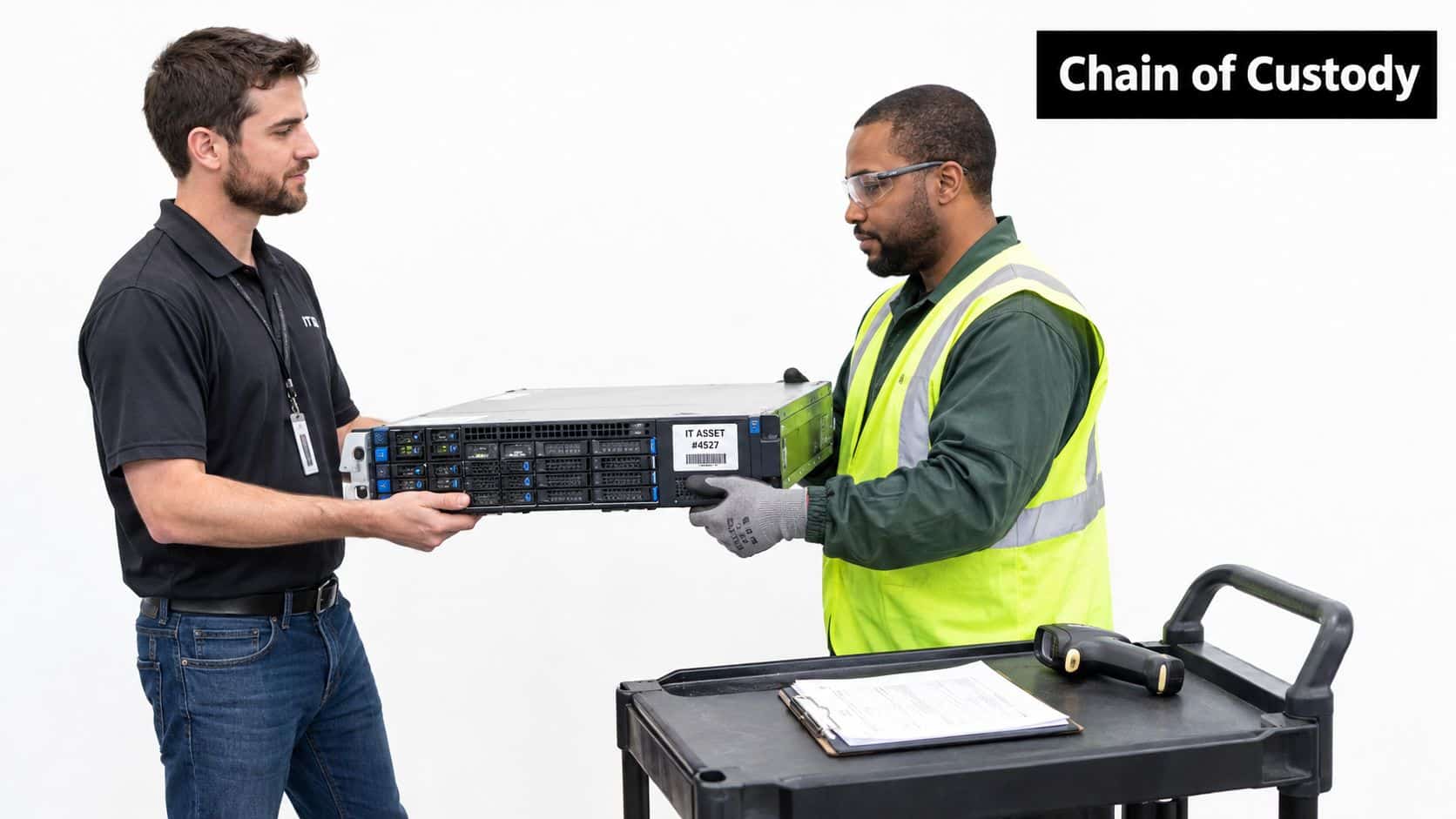
On pickup day, reconcile what is physically handed over against the approved list. Have the client representative and transporter record exceptions, such as an asset that cannot be located or equipment added after approval. A discrepancy should produce a ticket and an owner, not a silent adjustment to the inventory.
At the receiving facility, compare the vendor's serialized receiving report with the MSP's handoff record. If a serial number is missing, ask the vendor to investigate and document the outcome before the ticket is closed. If the asset needs sanitization or destruction, link the processing record to the same identifier. That makes it possible to follow an asset from the client site to its final disposition.
The closeout package should include the final inventory, documented exceptions, processing evidence, certificates, and any agreed recovery statement. The certificate should name the method used rather than relying on a generic “data destroyed” label. For healthcare clients, make sure the record shows how each data-bearing device was handled under the approved ePHI disposition process.
The EPA's electronics-recycling methodology underscores why truck weight alone is a poor performance measure. It considers generation estimates, end-of-life behavior, recycling-program data, and processor reports, and uses product-specific lifespan distributions rather than assuming every device lasts the same time (EPA methodology review). For your own reporting, reconcile the asset list to receiving records, then report reuse, parts recovery, material recycling, and residual disposal separately. Don't label every collected device as recycled.
For multi-site clients, standardize the handoff and evidence requirements before scheduling. Beyond Surplus coordinates business pickups across the contiguous United States using its own fleet and transportation partners. Its chain-of-custody overview is a useful reference when defining the records your client expects.
Pricing the Engagement and Building IT Buyback Margin
The client invoice should make the work legible. Separate labor and de-installation from logistics, data services, and per-device processing. If the vendor offers buyback, show the credit as a distinct line item tied to eligible equipment, rather than folding an uncertain resale estimate into the project price.
Value depends on condition, configuration, demand, and the vendor's resale route. Enterprise laptops with usable components, server CPUs and memory, and some networking equipment may qualify for recovery. Older consumer desktops, damaged equipment, and mixed peripherals may have little resale value and still require handling or recycling. Treat every estimate as provisional until the receiving inspection confirms what arrived.
Quote for confirmed work, not hoped-for proceeds
For a laptop refresh, first agree on the service scope: inventory and packing, pickup, data sanitization or destruction, processing, and reporting. Ask the buyer to state the eligibility criteria and how it will document the final count and condition. Then invoice the client using the agreed service charges and apply the confirmed credit after reconciliation.
This avoids promising that resale will cover destruction costs before anyone has inspected the devices. It also protects the MSP from a dispute if a unit has a missing drive, damaged screen, or configuration that doesn't match the inventory. Keep the original asset list, receiving report, valuation, and payment record together so the buyback trail is auditable.
Practical rule: Quote the service fee on its own merits. Treat buyback as a documented offset, not a guaranteed discount.
A transparent structure gives procurement a clear view of what the MSP managed and what the vendor charged. It also makes margin easier to manage: bill for coordination and technical work, account for the vendor's processing and transport charges, then apply only the recovery value earned. For a closer comparison of resale and recycling decisions, use this guide to computer buyback versus recycling.
Turning One-Off Cleanouts Into a Quarterly Recurring Service
A recurring program doesn't need a complicated portal. Pull a retirement list from the MSP's RMM or CMDB on a set cadence, ask the client to approve the assets, and reserve a standing pickup window with the selected vendor. Send a branded client packet that explains preparation, data treatment, approvals, and the records delivered at closeout.
That cadence makes equipment retirement easier to forecast and gives the client a clear service owner. It also produces a consistent answer for security questionnaires: the MSP can point to a written procedure, approved methods, and asset-level documentation rather than describing an improvised cleanout. Keep the commercial scope explicit so quarterly coordination, de-installation, logistics, and processing are billed as agreed.
For healthcare clients, include media containing ePHI in the approved disposition workflow. HHS identifies clearing, purging, and destruction as approaches before reuse or disposal, with destruction methods such as shredding or pulverizing available when appropriate (HHS guidance on reusing computers with ePHI). Match the method to the device and the client's policy, then retain the record.
Atlanta MSPs can make retirement work a defined part of managed service delivery instead of an unplanned favor. Build the process around documented scope, verified vendor controls, traceable assets, and confirmed recovery value.
Contact Beyond Surplus to coordinate commercial electronics recycling, secure data destruction, IT equipment disposal, and IT asset recovery for Atlanta clients and distributed operations. Review its services and arrange a pickup through Beyond Surplus.


