

You're coordinating a laptop refresh, clearing a server room, and trying to keep an Atlanta office running while equipment leaves the building. The recycling pickup may be the easiest part. The audit risk starts when nobody can show which assets were collected, what happened to their data, or where hazardous components went.
For electronics recycling for Atlanta corporate offices and headquarters, treat retirement as two connected operations: manage regulated materials correctly and control every data-bearing asset through documented custody and processing. A defensible IT asset disposition (ITAD) program starts before you select a vendor.
Table of Contents
- Why Atlanta Headquarters Need a Real ITAD Playbook
- What Georgia and Federal Law Actually Require
- The Risk-Based ITAD Workflow That Holds Up in Audit
- On-Site Shredding, Off-Site Shredding, or Certified Wiping
- Choosing an Atlanta ITAD Vendor You Can Actually Audit
- Scheduling, Logistics, and Closing the Documentation Loop
- Sample ITAD Policy and Closing Checklist for Atlanta HQs
Why Atlanta Headquarters Need a Real ITAD Playbook
An office refresh and a server-room decommissioning can put laptops, drives, monitors, batteries, and network equipment in the same staging area. That doesn't make them one waste stream. Monitors may contain regulated materials, batteries need appropriate handling, and storage devices carry information that can expose the organization if custody or sanitization is undocumented.
The scale of the broader e-waste challenge makes informal disposal a poor operating plan. The United Nations' Global E-waste Monitor findings report that the world generated roughly 62 million tonnes of e-waste in 2022, about 7.8 kilograms per person. Only 22.3% was documented as formally collected and recycled. For a corporate office, that's a reminder to account for equipment after it leaves the building, not merely to arrange a truck.

Separate materials from data-bearing assets
First, identify what each asset is and whether it contains storage media or regulated components. Then assign distinct handling paths. A laptop slated for reuse may need sanitization and a processing record. A failed drive may require physical destruction. A CRT monitor or mercury-containing component needs a materials decision, not a data-wiping decision.
Practical rule: A pickup receipt proves that equipment changed hands. It doesn't prove that each device was sanitized, destroyed, reused, or recycled appropriately.
Before calling vendors, create an asset register, define data-sensitivity categories, and decide what evidence you'll require at closeout. Include peripherals and accessories in the review. Docking stations and other equipment can be overlooked when teams inventory only laptops and servers.
The “just call a recycler” approach leaves too many questions unanswered: Were all serial-numbered assets collected? Did a failed wipe get escalated? Were regulated components routed appropriately? A real ITAD playbook answers those questions before the equipment is staged for pickup.
What Georgia and Federal Law Actually Require
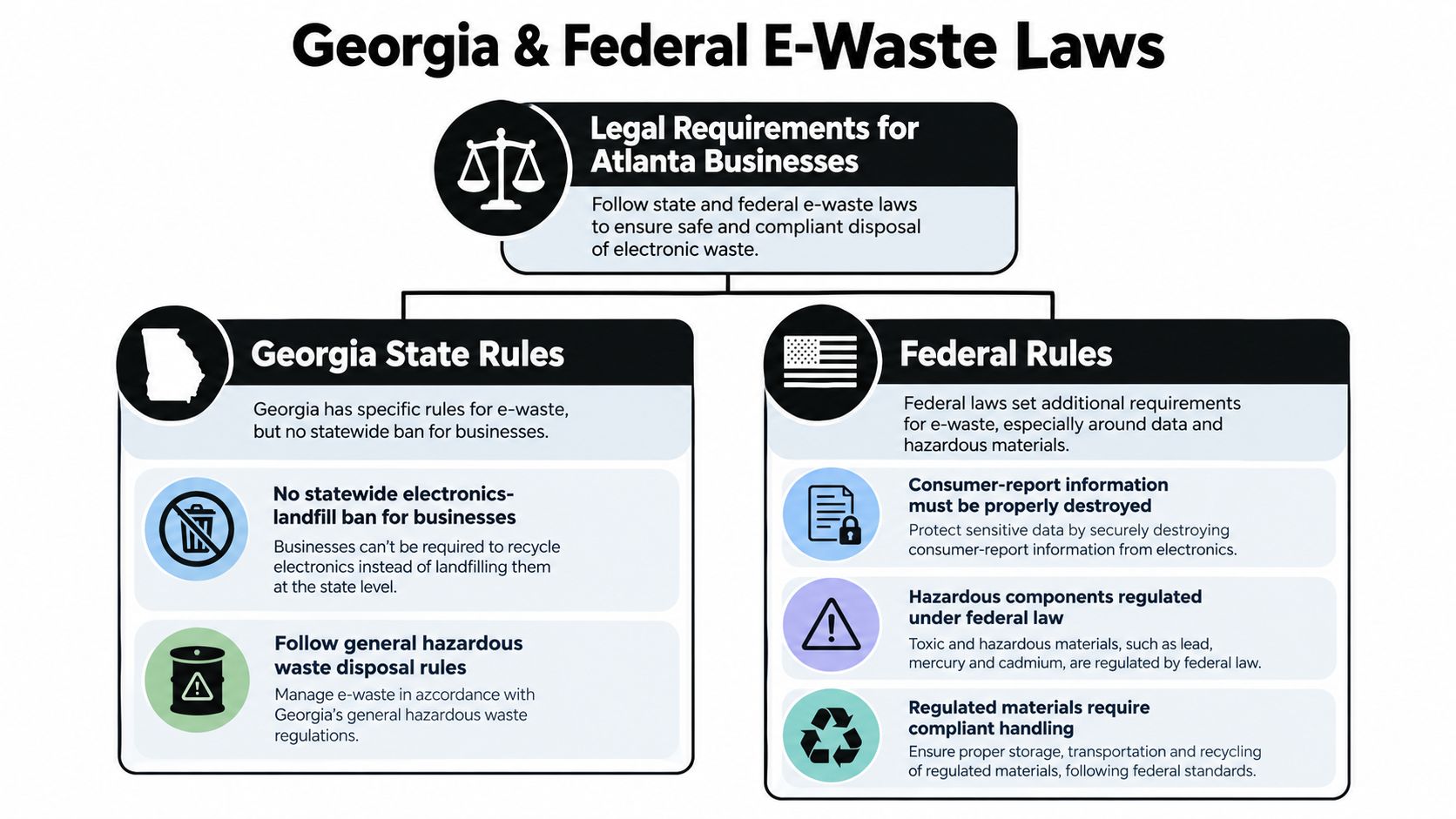
A mixed office load can contain ordinary equipment, data-bearing devices, and components that need separate materials handling. Georgia does not impose a statewide electronics-landfill ban or a universal business e-waste recycling mandate. However, CRT glass, batteries, and mercury-containing equipment may trigger hazardous-material handling requirements. Confirm the applicable rules with Georgia EPD or EPA guidance, and review this Georgia electronics-disposal guidance as a secondary reference.
Georgia electronics-disposal guidance
Ask what's in the load before scheduling
An Atlanta office may be clearing older workstations alongside CRT monitors, backup batteries, and equipment with mercury-bearing switches. Do not give the entire load one handling instruction. Ask the vendor to identify how each relevant component is classified, who takes custody, and what downstream records will document its disposition.
Georgia's requirements for electronics disposal and ITAD compliance are summarized in this overview of Georgia electronics recycling laws. Apply the same discipline to federal data-disposal rules. The FTC Disposal Rule covers organizations that use consumer-report information for business purposes, including service providers handling that information. It requires reasonable disposal practices to prevent unauthorized access or use. The FTC's Disposal Rule guidance says electronic files or media must be destroyed or erased so information cannot be read or reconstructed, and businesses should exercise due diligence when using contractors.
Put these questions in writing
- Materials: Which items may require hazardous-material handling, and how will the vendor segregate them?
- Data: Which assets contain applicant, employee, customer, or consumer-report information, and what disposal method applies?
- Custody: Who handles loading, transport, temporary storage, and downstream processing?
- Evidence: Which records identify the equipment and document its final disposition?
“Recycle everything” is not a compliance plan. Separate materials handling from data protection, document the decision for each asset class, and agree on the required records before pickup.
The Risk-Based ITAD Workflow That Holds Up in Audit
A useful workflow makes the same asset identifiable from inventory through final disposition. NIST distinguishes verification, checking whether sanitization completed without errors, from validation, deciding whether the evidence is sufficient for the information's sensitivity. Its guidance supports 100% serialized inventory reconciliation and an item-level certificate trail for enterprise ITAD. See NIST SP 800-88 Rev. 1.
Apply the workflow to every device
- Inventory and barcode every laptop, server, drive, and mobile device. Record make, model, and serial number where available.
- Classify the information each asset may hold. Don't assume a retired device is empty because an employee returned it.
- Choose a sanitization outcome based on data sensitivity, media type, and whether the asset may be reused.
- Isolate equipment pending processing so devices don't get mixed into general scrap or leave through untracked routes.
- Sanitize or destroy according to the selected method, and escalate failed wipes rather than marking them complete.
- Verify and validate the result. Confirm the operation completed, then assess whether the record supports the risk decision.
- Reconcile final disposition against the original asset register and resolve every exception.
NIST's Clear, Purge, and Destroy categories are not interchangeable. Clear uses logical techniques, such as standard read/write commands or a factory reset, to address user-accessible storage. Purge aims to make recovery infeasible even with advanced laboratory methods while potentially allowing media reuse. Destroy makes recovery infeasible and prevents the media from being reused for data storage.
Choose the method to match the media
| Sanitization Level | Typical Method | Best-Fit Assets | Reusable? |
|---|---|---|---|
| Clear | Logical sanitization or factory reset | Lower-sensitivity media suitable for reuse | Potentially |
| Purge | Physical or logical technique selected for the media | Sensitive media that may remain in service | Potentially |
| Destroy | Physical destruction, such as drive shredding | Failed or high-risk media that won't be reused | No |
Don't apply magnetic-drive assumptions to SSDs. Check that docks and accessories haven't been missed, and reject certificates that show only pallet weight. An item-level record should identify the asset and its method, operator, date, and result. For practical audit-trail reporting, reconcile that record to the original register before closing the project.
On-Site Shredding, Off-Site Shredding, or Certified Wiping
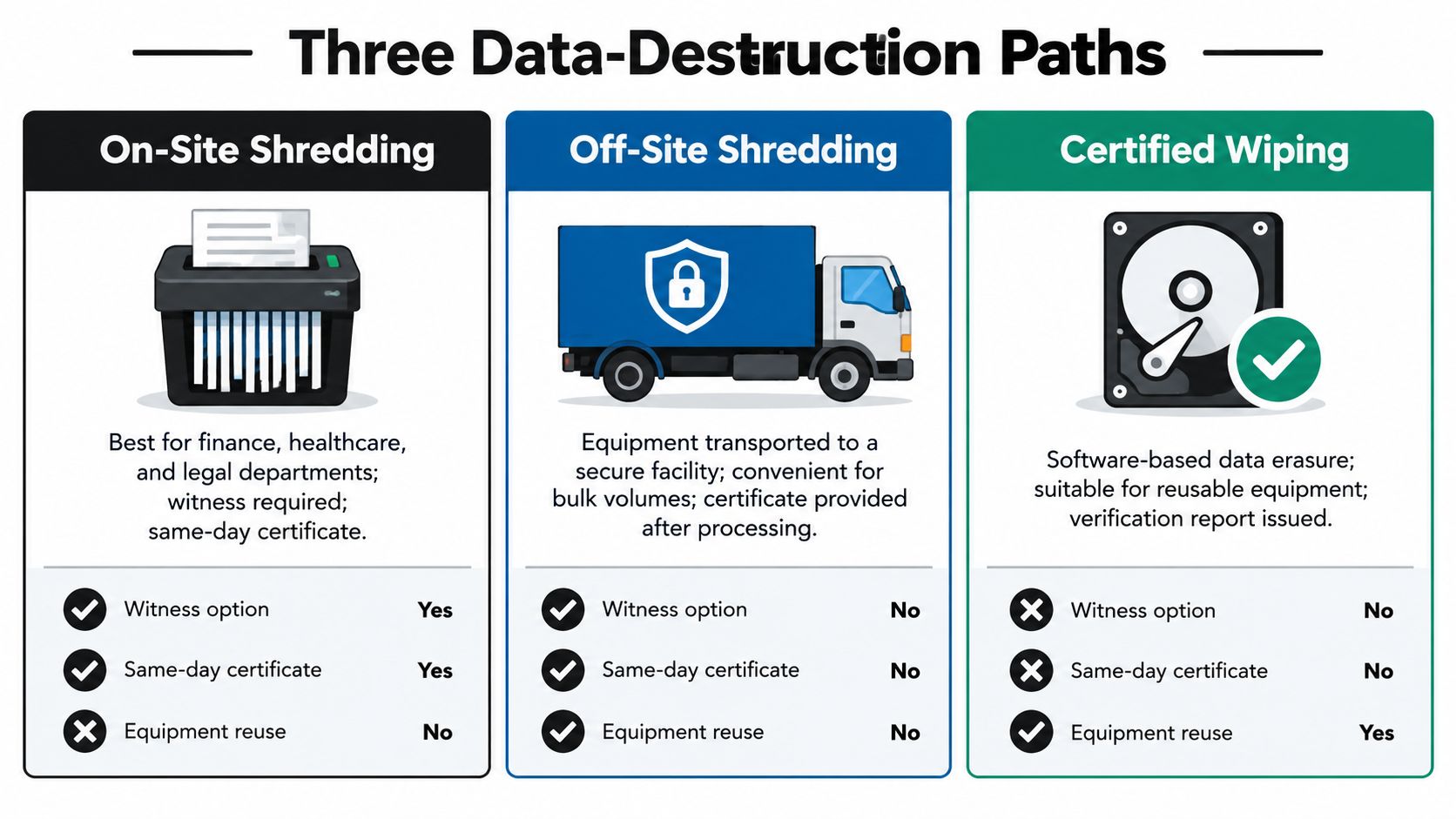
These methods solve different problems. Choose based on information sensitivity, whether equipment can be reused, and what level of custody evidence your team needs. Mixing methods within one pickup is normal when the inventory contains reusable devices, failed media, and assets designated for destruction.
Match the path to the asset
| Method | Best Fit | What to Confirm |
|---|---|---|
| On-site shredding | Sensitive drives when staff need to witness destruction | Whether destruction happens at your location and what certificate follows |
| Off-site shredding | Bulk media handled through a secure facility | Sealed-container custody, transport records, and processing evidence |
| Certified wiping | Functional equipment with potential reuse or recovery value | Method, completion result, and an item-level verification report |
A Midtown financial-services team might designate some laptops for destruction, others for wiping and buyback, and failed drives for physical destruction. The key is to record each category before pickup, then reconcile every item against the processing result. Don't let an asset's resale potential override its data classification.
On-site shredding gives the organization an opportunity to witness processing at the premises, but it requires coordinating access and work areas. Off-site shredding can suit larger loads, provided custody stays documented through transport and processing. Wiping supports reuse when the drive and device can be sanitized successfully; a failed wipe needs an exception path, not a quiet change in status.
For a closer look at secure data destruction options in Atlanta, compare the method with your security requirements, not just the vendor's equipment. Ask what happens when a device won't power on, when a drive is damaged, or when the serial number is unreadable. Agree on how those cases will be recorded before the pickup crew arrives.
Choosing an Atlanta ITAD Vendor You Can Actually Audit
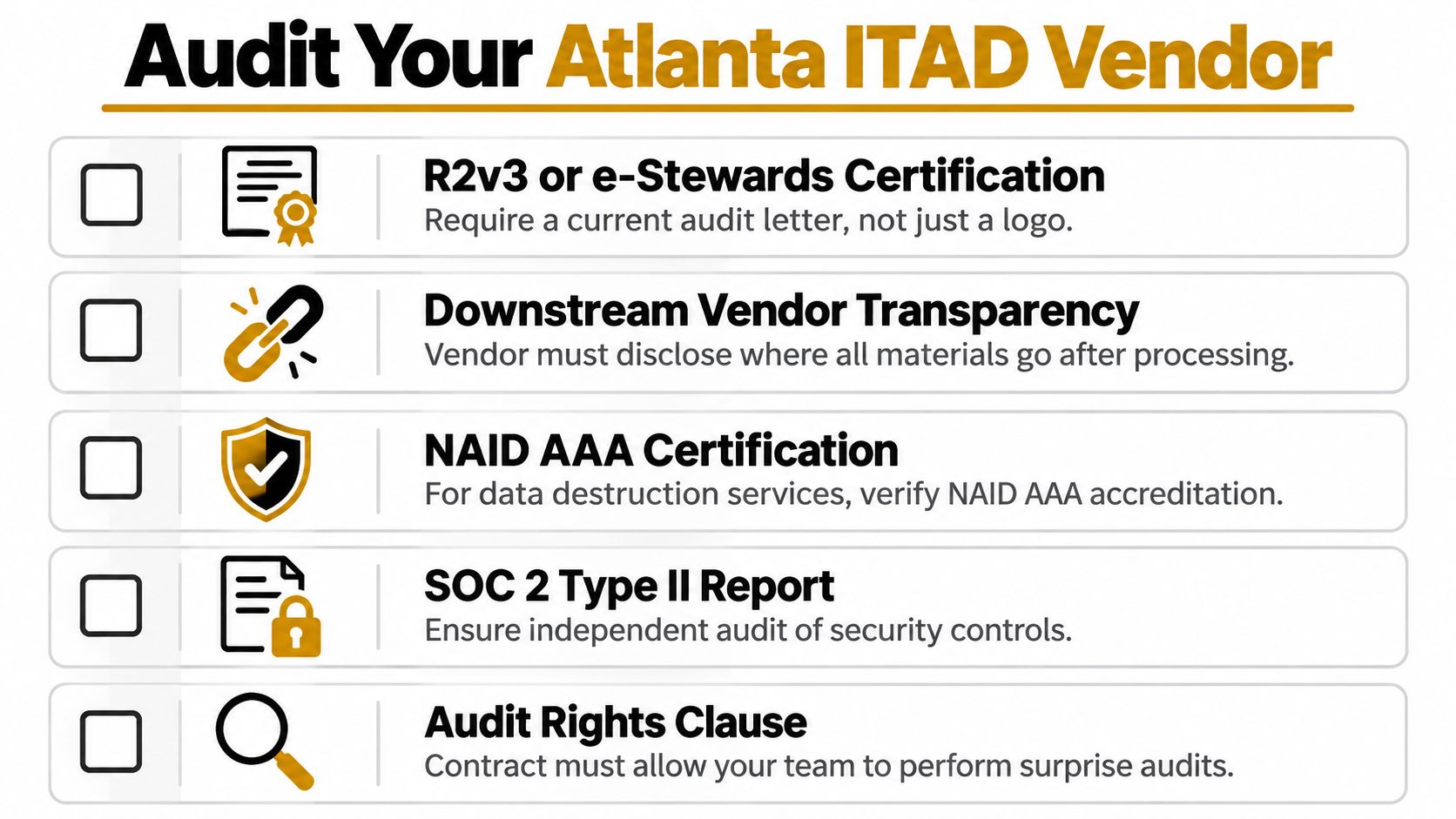
A logo on a website isn't enough. EPA guidance recommends recyclers certified to R2 or e-Stewards standards, but certification should be only one part of vendor review. Evaluate downstream accountability, insurance, and document quality as well as the certification itself, using the EPA's electronics generation and recycling analysis as a reference point.
Test the evidence, not the sales pitch
Request current certification evidence and ask who receives materials after the vendor's own facility. For data destruction, verify the relevant qualifications for the service being offered. Ask how the vendor protects equipment during loading and transport, and whether the contract gives your organization access to records or allows an audit.
Put these questions into the RFP:
- Downstream processing: Will you identify downstream processors and explain where materials go?
- Destruction records: Do certificates list individual asset identifiers and processing results?
- Insurance: Do cargo and cyber-liability coverages fit the assets and risks in this project?
- Local logistics: Who will perform pickup and loading in Atlanta or Smyrna, and who is accountable if a subcontractor handles the equipment?
- Audit access: Can your team review relevant procedures and supporting records?
Red flags include a refusal to identify downstream processors, certificates summarized only by pallet weight, and an unclear handoff between the sales contact and the local pickup crew. These gaps can leave you unable to explain what happened to a device even if the original vendor holds a certificate.
Ask vendors to show a sample certificate and sample chain-of-custody record before signing. Check that the record captures the fields your asset register needs for reconciliation. This Georgia ITAD vendor selection guide can help structure the evaluation. Your final choice should make local execution and downstream accountability clear, not just promise compliant recycling.
Scheduling, Logistics, and Closing the Documentation Loop
A clean pickup begins with a scoped inventory and a clear route from office to processor. For Atlanta and Smyrna locations, confirm building access, loading arrangements, equipment staging, and the staff member authorized to sign for custody. For multi-site Georgia projects, put locations, responsibilities, and processing requirements into one statement of work where practical.
Use two linked inventories. The asset register records what the organization released and who accepted custody at pickup. The processing register records whether each item was sanitized, shredded, reused, recycled, or routed for hazardous-material handling. The registers should connect through serial numbers or another reliable identifier, not a general description of the load.
A complete file explains both sides of the handoff: what left the office, and what happened to each item afterward.
Reconcile exceptions before closeout
A missing serial number or unexplained quantity difference can undermine auditability even when the wipe operation succeeded. Track exceptions such as failed wipes, damaged drives, encrypted devices, and assets moved between buildings during the project. Record the disposition decision and the person responsible for approving it.
A common Georgia compliance benchmark is to retain recycling and destruction records for at least three years, including chain-of-custody and serial-number-level destruction records, as described in this Georgia e-waste compliance guidance. Apply your organization's own retention and legal-hold requirements where they call for longer retention.
For a local rollout, coordinate pickup windows and site contacts with the facilities team before equipment reaches the loading area. For a national fleet, use one documented process across locations, while recording each site's custody transfer and processing outcomes. A business pickup plan for Atlanta electronics recycling should make those handoffs explicit rather than relying on a final certificate to fill in missing steps.
Sample ITAD Policy and Closing Checklist for Atlanta HQs
A Midtown Atlanta office can have laptops ready for pickup while CRT glass, batteries, and mercury-containing equipment still need separate handling. Set a policy that tracks these materials apart from data-bearing assets, assigns approval authority, and defines the records required to close the project. Facilities, IT, procurement, and security should be able to follow the same process.
Sample policy clause: “Inventory all retired corporate technology before transfer and classify each item for data and materials risks. Document custody at pickup, record the sanitization or destruction result for each data-bearing asset, and route regulated components through appropriate handling. Reconcile both inventories and their final outcomes to the original asset register, then retain supporting records under applicable retention requirements.”
Pre-pickup checklist
- Asset register: Identify equipment and record available serial numbers.
- Data inventory: Flag devices that may contain sensitive or consumer-report information.
- Materials inventory: Separately identify batteries, CRT glass, mercury-containing equipment, and other components needing special handling.
- Method selection: Assign Clear, Purge, Destroy, or another documented route as appropriate.
- Exceptions: Isolate damaged, encrypted, or failed devices and record who approves their disposition.
- Site plan: Confirm staging, building access, loading arrangements, and authorized contacts.
- Custody record: Prepare the pickup inventory and obtain transfer sign-off.
- Vendor review: Confirm certifications, downstream transparency, insurance, and audit terms.
- Processing record: Check that the certificate template captures item identifiers and results.
- Closeout owner: Assign someone to reconcile the materials and data-processing records against the original asset register.
Closeout depends on matching both inventories, not just receiving a destruction certificate. Resolve missing identifiers, quantity differences, and exceptions before approving the project.
HR laptops and consumer-report information: As noted earlier, if your organization handles consumer-report information, the FTC Disposal Rule obligations apply when retiring laptops and servers containing that information. Do not treat the asset's department as proof that its data has been properly addressed.
Beyond Surplus provides Atlanta-area business electronics recycling and ITAD, including secure data wiping, on-site or off-site drive shredding, equipment pickup, and item-level disposition documentation. Contact Beyond Surplus to discuss a Smyrna-area pickup or coordinate a documented rollout across corporate locations.


