

A branch refresh in Atlanta can leave laptops, teller workstations, servers, and loose drives staged in a locked room while teams wait for pickup. That equipment isn't just surplus inventory. Until the bank can show what happened to each data-bearing device, who handled it, and where it went, disposal remains a security and oversight issue.
For Electronics Recycling for Atlanta Banks and Financial Institutions, the standard should be straightforward: decide the method by risk, maintain custody from collection through final processing, and retain evidence tied to each asset. That gives IT, compliance, procurement, and branch operations a record they can use.
Table of Contents
- Why Atlanta Banks Need a Real ITAD Program
- Mapping the Regulatory Landscape for Financial Institutions
- Building the Internal Policy and RFP a Bank Can Actually Defend
- Choosing Between On-Site Shredding, Off-Site Shredding, and Certified Wiping
- Designing an Asset-Level Chain of Custody That Survives an Audit
- Running Logistics, Value Recovery, and Reporting on a Quarterly Cadence
Why Atlanta Banks Need a Real ITAD Program
A multi-branch refresh can generate mixed loads of laptops, desktops, network switches, displays, servers, backup media, and drives removed from equipment. A single pickup ticket may confirm that a truck arrived, but it won't establish whether a particular drive was wiped, destroyed, returned to a lessor, or sent downstream for processing.
The scale of the waste problem makes informal disposal especially hard to defend. The Global E-waste Monitor 2024 reported 62 billion kilograms of e-waste generated worldwide in 2022, with only 22.3% documented as formally collected and recycled in an environmentally sound manner. For a financial institution, that gap connects sustainability reporting to operational governance: a bank needs records of both data disposition and material destination.
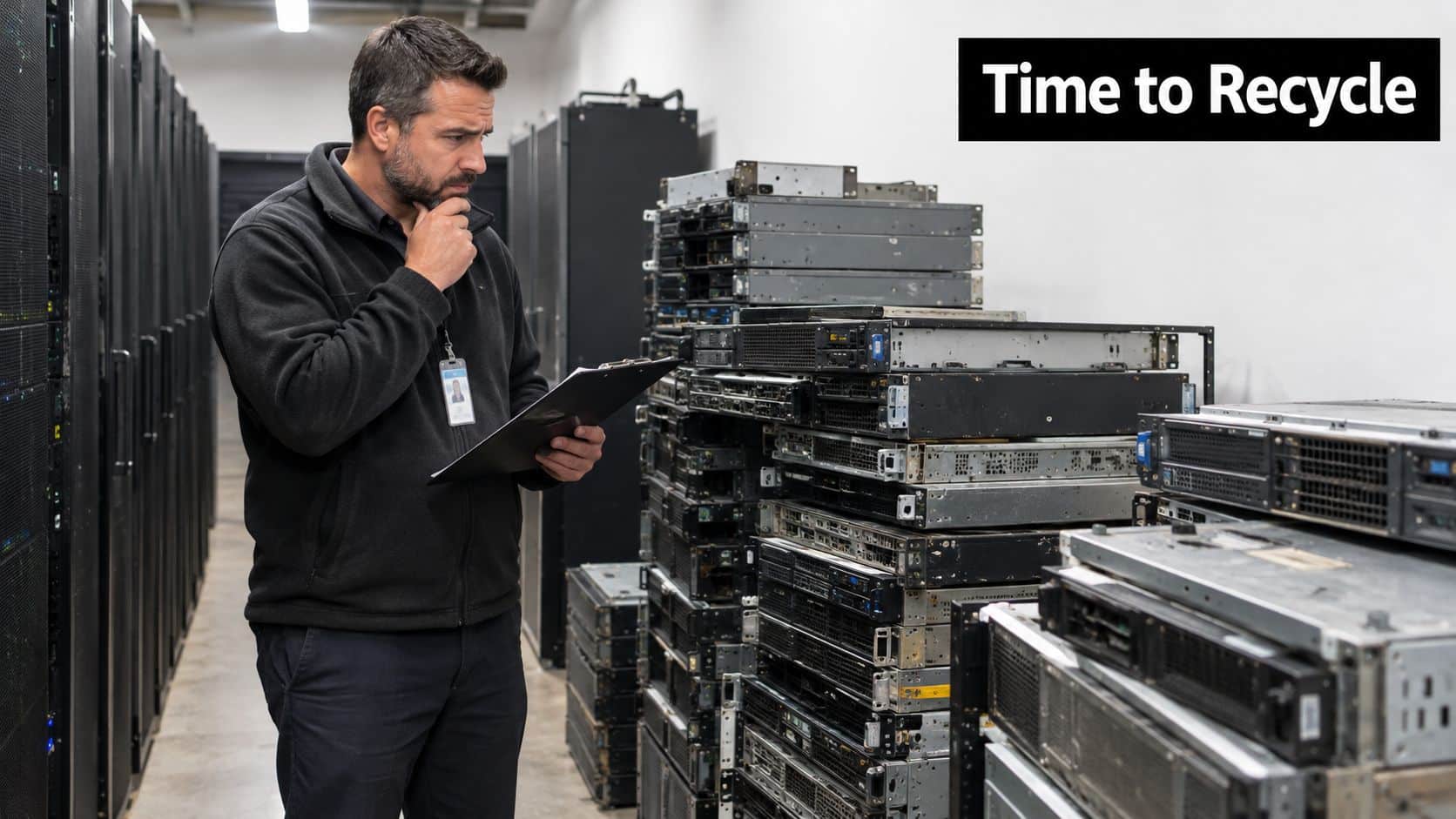
Treat every retired device as a tracked asset
Start with an inventory that identifies the asset and its storage media. Capture the serial number, asset tag, owner or department, pickup location, media type, and intended outcome. Include loose drives and removable media, not just complete computers.
Then assign a disposition path. Equipment approved for reuse needs verified sanitization. Failed, inaccessible, or high-risk media may require physical destruction. Devices under lease or finance agreements need a separate return path, so they don't get mixed into recycling loads.
Practical rule: A certificate is useful only when the bank can trace it back to the specific asset and its original inventory record.
For each handoff, log who transferred custody, who received the equipment, when the transfer occurred, and what was moved. Record exceptions such as missing serial numbers, failed wipes, or a drive that doesn't reconcile to the pickup list. Quarantine unresolved assets instead of letting a bulk shipment proceed with an unexplained discrepancy.
A formal program also helps the bank plan branch closures, equipment refreshes, and data-center work as controlled projects rather than urgent clear-outs. Assign owners in IT, information security, compliance, procurement, and facilities. Each team should know who approves the disposition method, who checks the evidence, and who closes exceptions.
Mapping the Regulatory Landscape for Financial Institutions
Retired equipment can contain consumer-report information or other sensitive records. The FTC Disposal Rule applies to businesses and individuals that use, maintain, or possess consumer reports or information derived from consumer reports for a business purpose. It calls for reasonable measures to prevent unauthorized access during disposal, including destroying or erasing electronic files or media so information can't practicably be read or reconstructed, and conducting due diligence on disposal contractors. The FTC's Disposal Rule guidance describes those expectations.
The GLBA Safeguards Rule belongs in the same operating picture. For institutions subject to it, disposal should sit within the broader information-security program, with documented vendor oversight rather than an isolated recycling procedure. FINRA-regulated firms should likewise build disposal into their supervision of third-party vendors and their records and information-security practices. Keep the control tied to the asset and the service provider, not just to a general policy statement.
| Asset class | Triggering rule | Required control | Evidence to retain |
|---|---|---|---|
| Laptops, desktops, and removable drives | FTC Disposal Rule and applicable GLBA safeguards | Verify sanitization or destroy media according to risk | Asset record, method, result, custody log, certificate |
| Servers and storage arrays | FTC Disposal Rule and applicable GLBA safeguards | Track each data-bearing component through processing | Serial and media inventory, sanitization records, exception log |
| Networking and branch equipment | Information-security program and vendor oversight | Identify embedded or removable storage and document its disposition | Asset list, media checks, transfer records, final outcome |
| FINRA-regulated firm equipment | Applicable firm supervision and recordkeeping practices | Document vendor oversight and retain disposal records | Vendor review, approvals, custody evidence, disposition record |
When a bank is reviewing technology controls alongside vendor risk and operational continuity, operational resilience for Church Extension Funds offers relevant context on the wider governance picture. For disposal-specific controls, banks can also review FINRA-compliant IT asset disposal.
The practical test is whether an auditor can reconstruct the asset's route without relying on someone's memory. A certificate that lacks serial-level detail, exceptions, or a clear connection to the originating inventory is not a complete evidence trail.
Building the Internal Policy and RFP a Bank Can Actually Defend
A defensible RFP starts with an internal policy that names decision-makers. IT should own the equipment inventory and technical disposition; information security should approve sanitization standards; compliance should define record-retention and review requirements; procurement should qualify vendors; and facilities should control staging and site access.
The policy must define a data-bearing asset broadly. Laptops and servers are obvious, but storage may also sit in network appliances, multifunction printers, surveillance systems, or removable media. Don't assume a device is data-free because its primary function isn't computing.
Put measurable requirements in the RFP
Ask each bidder to document certifications and their scope. For electronics recycling, request current R2v3 or e-Stewards evidence where applicable. For mobile destruction, ask about NAID AAA certification and confirm what activities, facilities, and subcontractors it covers. Request sample asset-level certificates, insurance documentation, a third-party audit summary, and references from financial institutions with comparable operating needs.
The proposal should explain exactly how the vendor will handle:
- Inventory reconciliation: How are asset tags and serial numbers captured, and how are missing or mismatched items reported?
- Data sanitization: Which methods are available for each media type, how are results verified, and what happens when a device fails?
- Custody and transport: Are sealed containers, serialized tags, restricted-access areas, and documented handoffs part of the service?
- Downstream processing: Which processors receive materials, and what documentation can the bank review?
- Exceptions and incident escalation: Who contacts the bank when a seal is broken, a drive is unaccounted for, or a wipe fails?
A guide to questions to ask before hiring an ITAD company can help procurement structure vendor interviews around evidence, controls, and scope.

Choosing the lowest-cost Atlanta recycler without comparing these details is a false economy. The bank may end up with one bulk receipt, no serial continuity, and vague downstream reporting. Those gaps make it harder to answer basic questions during an audit or incident review.
Before issuing the RFP, procurement should confirm the policy owner, included asset classes, required certifications and scope, sample reporting fields, exception process, insurance requirements, and vendor-reference criteria. If bidders can't explain how their records will connect each asset to a final outcome, they're not ready for a financial institution's program.
Choosing Between On-Site Shredding, Off-Site Shredding, and Certified Wiping
The right method depends on the media, reuse plan, and custody risk. A bank shouldn't destroy every device by default, but it also shouldn't choose wiping just to preserve resale value when the process can't be verified.
| Method | Best fit | Required controls | Trade-off |
|---|---|---|---|
| On-site shredding | High-risk or failed media, incident-response assets, and devices that shouldn't travel intact | Confirm the asset and media before destruction; record the operator and result | Reduces transit exposure and reconstruction risk, but eliminates reuse |
| Off-site shredding | High-volume branch refreshes where secure transport is documented | Use locked containers, serialized tags, controlled handoffs, and reconciled intake | Supports efficient processing, but requires confidence in custody during transport |
| Certified wiping | Equipment approved for reuse or resale | Use an approved tool, log the operator and result, and independently verify a sample | Preserves potential value, but only when the bank can demonstrate successful sanitization |
Match the method to the media and risk
On-site mobile shredding is a strong choice for failed drives, sensitive executive devices, or situations where the bank's risk assessment doesn't permit a vehicle transit with readable media. Before work begins, reconcile the devices on the truck's manifest to the bank's inventory. Retain evidence of what was destroyed and what couldn't be processed.
Off-site shredding can work well for a planned branch refresh if the vendor uses locked totes, serialized tags, documented transport, and an intake reconciliation at the facility. Ask how the vendor handles a broken seal, an unlisted device, or a discrepancy between pickup records and receiving records. A generic pickup receipt doesn't answer those questions.
Wiping suits usable laptops, servers, and other equipment with a legitimate reuse path. NIST SP 800-88 recommends verification after sanitization and a full secondary verification of a randomly selected subset using a different verification tool. The bank should record the tool, operator, date, result, and any failed attempt. A comparison of data wiping and hard-drive shredding for Atlanta organizations can help teams evaluate those options.
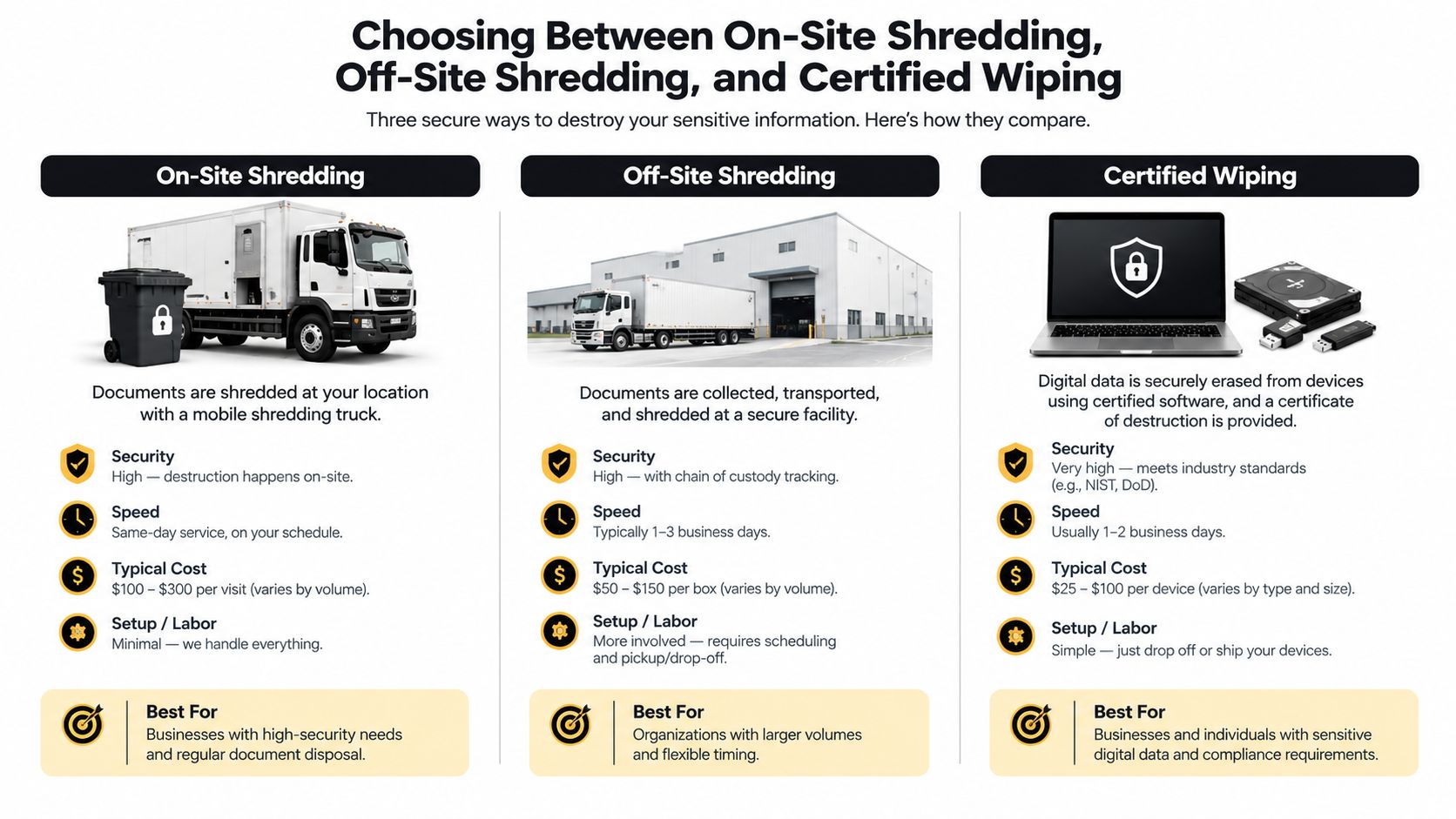
Decision rule: Reuse only when the bank can verify sanitization and preserve asset-level evidence. If a drive fails, can't be accessed reliably, or carries a risk the bank won't accept, quarantine it and destroy it.
Designing an Asset-Level Chain of Custody That Survives an Audit
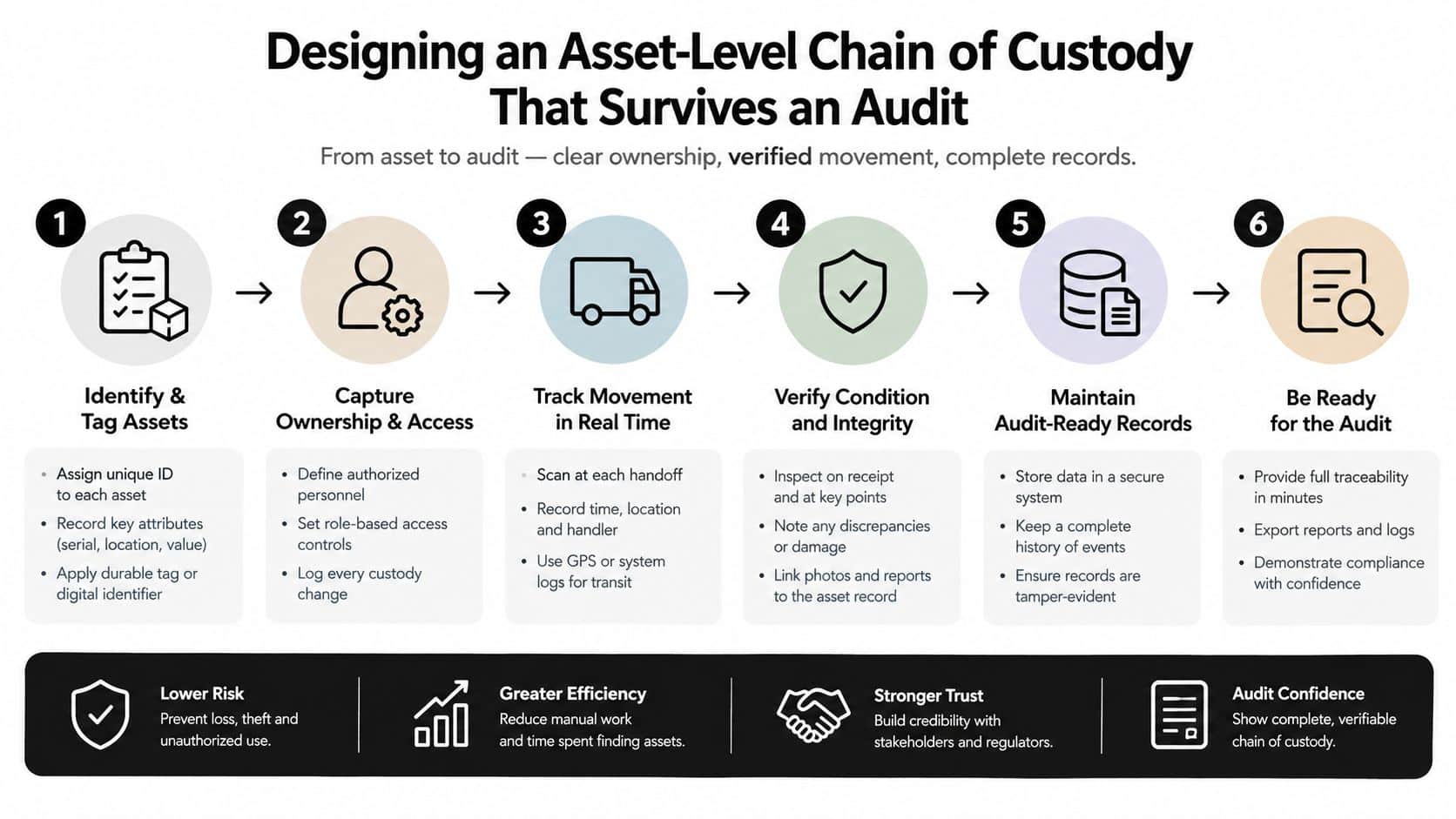
A chain-of-custody record should let a compliance officer identify the device, the method applied, the operator, and the downstream processor without calling the vendor to fill in missing details. That means the bank's inventory and the vendor's processing report must share identifiers, not just project names or total counts.
Build the record at the handoff
Capture the asset tag, branch or data-center origin, serial number, media type, custody transfers, and intended outcome before the equipment leaves bank control. At processing, add the sanitization or destruction method, tool or equipment, operator, date, result, certificate ID, and the final destination. Keep failed attempts and exceptions in the same record rather than burying them in email.
NIST SP 800-88 recommends verification after sanitization and full secondary verification of a randomly selected subset using a different verification tool. A bank should retain the sampling plan, selected asset identifiers, verifier, tool, outcome, and any corrective action. If a device fails verification, quarantine it for reprocessing or destruction and keep it out of resale inventory.
Loose drives need their own reconciliation. Record them individually or in a controlled group with identifiers that can be matched to the intake inventory; don't let them become an untraceable tote inside a mixed equipment load. Encrypted SSDs that fail wiping still need a documented outcome. Leased assets require a separate return record so a finance vendor's property doesn't get recorded as the bank's recycled material.
If the asset register, custody log, and certificate can't be reconciled, the bank doesn't have a complete disposition record.
The FTC Disposal Rule expects reasonable measures to protect consumer-report information and due diligence on disposal providers. Treat that due diligence as an ongoing file: retain vendor approvals, certification scope, insurance details, audit materials, subcontractor information, and evidence that the vendor's process still matches the bank's requirements.
A chain-of-custody framework for IT asset disposal can help teams specify which fields belong in a transferable record. The bank should be able to link every certificate to the originating inventory and review open exceptions before closing the project.
Running Logistics, Value Recovery, and Reporting on a Quarterly Cadence
Make ITAD part of the bank's operating calendar. Coordinate branch consolidations, ATM decommissioning, and core-platform refreshes so pickups are planned and equipment isn't left waiting in unsecured or poorly controlled spaces. For smaller Atlanta-area volumes, arrange a scheduled drop-off window near Smyrna and use the same inventory and custody requirements as a larger pickup.
Value recovery is appropriate when the controls support it. Before reusable assets leave the loading dock, record their serial numbers, verify sanitization, and document the handoff. Tie buyback credits to verified wiped serial ranges, not a general weight or an estimate based on mixed equipment.
The bank should report the program as a portfolio of outcomes, not a single recycling tonnage. Useful quarterly measures include assets retired, the share sanitized versus destroyed, the share reused versus recycled, downstream certification, recovery value by device class, and open exceptions. Keep data-bearing components, batteries, and other materials visible in downstream reports so an aggregate weight doesn't conceal gaps.
The EPA's electronics recycling estimates put U.S. consumer-electronics recycling at 37.8% of generation in 2013 and 41.7% in 2014. Those historical figures make a useful case for measuring a bank's own recovery rate per asset instead of relying on national averages.
For Atlanta programs, IT asset recovery services can support a controlled process for evaluating reusable equipment alongside recycling and destruction. Start this month by naming the policy owner, reconciling the next retirement batch to its asset register, and reviewing the vendor's sample certificate and exception report.
Beyond Surplus provides business-focused IT asset disposition, electronics recycling, secure data destruction, and IT asset recovery for financial institutions, with documented chain of custody and certificates of recycling or destruction. Visit Beyond Surplus to discuss a controlled disposition program for your Atlanta-area bank or credit union.


