

Your firm is replacing laptops, clearing a trading floor, or decommissioning a server rack. The equipment is powered down, tagged for recycling, and waiting for pickup. Then Compliance asks a question that stops the project: Has every device been cleared for destruction, or might it still contain a regulated communication or record?
That question defines FINRA compliant IT asset disposal. A broker-dealer's obligation follows the content stored, processed, or transmitted by an asset, not the asset's category or resale value. A laptop, mobile phone, server, backup drive, printer, or storage array can become a records-risk asset when business communications or other required records pass through it.
The practical answer is a device-level workflow that connects retention holds, data destruction, chain of custody, vendor oversight, and audit evidence. This roadmap is written for business owners, IT managers, facility teams, procurement professionals, and regulated organizations managing commercial electronics recycling, IT equipment disposal, data center decommissioning, laptop disposal, product destruction, and secure e-waste management.
Table of Contents
- Understanding FINRA Books and Records Rules
- Building a Compliant Internal ITAD Policy
- Choosing Secure Data Destruction Methods
- Managing Chain of Custody and Certificates
- Evaluating Third Party ITAD Vendors
- Preparing for Audits and Record Retention
Understanding FINRA Books and Records Rules
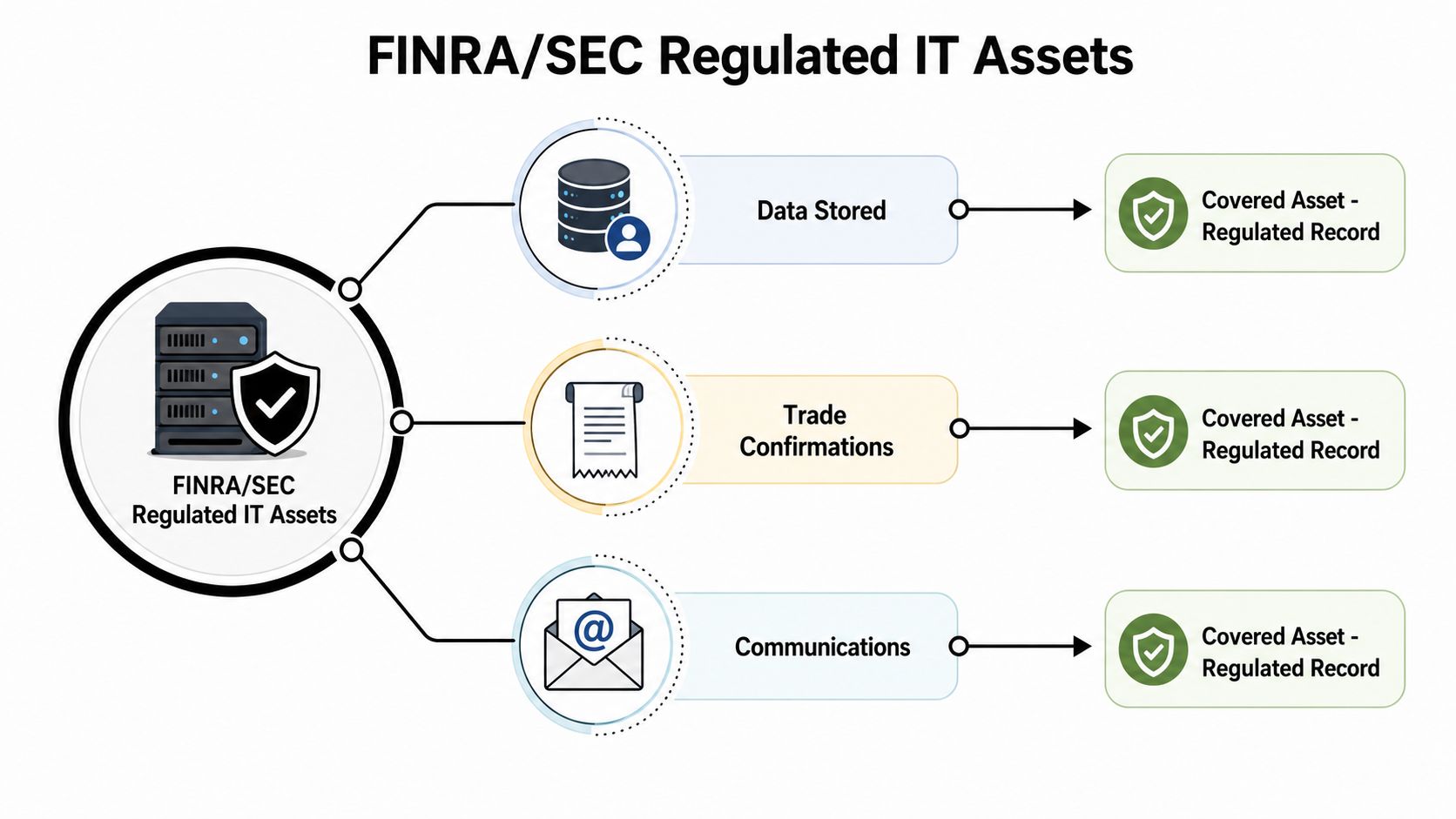
FINRA Rule 4511 and the SEC books-and-records framework make the content on a device more important than the device itself. FINRA requires broker-dealers to retain originals of communications received and copies of communications sent that relate to the firm's business for at least three years, with the first two years kept in an easily accessible place. The requirement extends to email, instant messages, text messages, chat messages, and business-related social media posts, as described in FINRA's books-and-records guidance.
A decommissioned laptop therefore isn't automatically ordinary e-waste. If it contains a retrievable business message, trade-related record, supervisory communication, or customer information, destruction before clearance can create a records problem. FINRA's framework is content-based, so the same rule can affect an executive phone, a trading desk workstation, a server hosting an email archive, a printer hard drive, or a storage array.
Retention rules and hardware lifecycles
The physical lifecycle of IT equipment rarely matches the regulatory lifecycle of its contents. A firm may retire a laptop because of an operating system refresh, replace a phone during an employee offboarding, or remove a server during a data center migration while the records on that equipment remain subject to retention or legal hold.
FINRA's more recent regulatory materials reiterate the need for written procedures and accessible preservation across modern communication channels, including email, text, chat, and interactive blogs. FINRA's 2026 annual regulatory oversight report also reinforces that firms must manage these obligations through procedures, not informal assumptions.
The SEC amendment to Rule 17a-4 became effective on January 3, 2023, changing requirements around electronically preserved records and third-party recordkeeping access arrangements. A compliant disposal process must therefore preserve or securely transfer required records before destruction, even when the equipment appears to have reached the end of its useful life.
What examiners tend to notice
Broker-dealers should identify assets that may contain:
- Electronic communications, including messages synchronized to endpoints.
- Trading and transaction records, including files cached on workstations or servers.
- Supervisory material, such as review notes and business correspondence.
- Customer or counterparty information, especially on mobile devices and removable media.
- Archived or replicated data, including backup media and storage systems.
Required electronic records must be preserved in a non-rewriteable, non-erasable format with a complete, time-stamped audit trail that captures modifications and deletions. The practical consequence is clear: wiping a device isn't the same as proving that the firm preserved the required record before disposal.
For regulated organizations, Beyond Surplus compliance documentation can support the evidence trail associated with commercial IT asset disposition. The firm still owns the retention decision, but a documented service process can help connect that decision to serialized destruction and recycling records.
Building a Compliant Internal ITAD Policy
A workable ITAD policy begins before equipment reaches the loading dock. It should connect the firm's legal hold process with its asset inventory, service management platform, information security controls, and vendor management program.
Step one, create a disposition gate
Assign every asset a unique record in the organization's inventory system. Capture the serial number, asset tag, assigned user or department, location, device type, operating status, storage media, and planned disposition. A generic count of “laptops for recycling” won't support a defensible review because it can't show which device contained which data or who approved its release.
The disposal queue should remain locked until the required review is complete. At minimum, route the record to Legal, Compliance, and IT Security when the device may contain regulated communications, customer information, trading data, or material connected to an investigation.
Step two, classify the content
Use a classification model that matches the firm's risks rather than the resale value of the hardware. A simple internal structure might distinguish:
- Customer information, including personal or account data.
- Trading and transaction records, including confirmations and related files.
- Business communications, including messages held on endpoints or synced applications.
- General corporate data, which may still require secure sanitization.
- No retained data, supported by technical verification rather than assumption.
The classification should determine whether the asset is wiped, physically destroyed, quarantined, or transferred to an approved repository. Encrypted storage may support a carefully documented cryptographic-erasure decision, but encryption alone doesn't eliminate the need for records clearance and evidence.
Practical rule: No asset should move from “retired” to “destroyed” without a recorded hold status, an approving owner, and a method that matches its media and content risk.
Step three, quarantine unresolved assets
Place devices with an active hold, uncertain status, failed wipe, or incomplete inventory in a controlled area. Restrict access, record each movement, and prevent a recycler or internal technician from treating the equipment as routine e-waste.
The policy should define escalation paths. Legal should decide whether a litigation or regulatory hold applies. Compliance should confirm the relevant books-and-records treatment. IT Security should determine whether the data can be preserved, transferred, sanitized, or destroyed safely.
Step four, document release and custody
A hold release should identify the asset, approving function, decision date, applicable records category, and authorized disposition method. From there, the asset record should connect to pickup documentation, transport records, destruction verification, recycling evidence, and final approval.
Use Beyond Surplus's vendor due diligence checklist as a practical reference when formalizing supplier review. A strong policy doesn't just say “use a certified recycler.” It identifies what the supplier must prove, how the firm will verify it, and what happens if evidence is missing.
Choosing Secure Data Destruction Methods
The right destruction method depends on the media, the data, the hold status, and the evidence an examiner may request. Onsite destruction reduces transportation exposure, while offsite processing can provide broader equipment, labor, and recycling capacity. Neither option is compliant by itself. The firm must control the decision and preserve proof.
For data-bearing media, a NIST SP 800-88-style sanitization process can be appropriate when the firm has verified that the method addresses the specific media. A wiping record should identify the device, method, date, operator or custodian, and verification result. The strongest implementation pattern pairs sanitization with a per-device certificate and a preserved handoff history, consistent with the evidence principles outlined in FINRA's Rule 17a-4 amendment materials.
Physical shredding is more definitive for failed drives, damaged media, solid-state storage that can't be reliably sanitized, and assets where the firm's risk assessment requires destruction. It also eliminates recovery concerns, but it can reduce resale or reuse value and requires a clear serial-number manifest before the device is destroyed.
Comparing practical options
| Method | FINRA Evidence Requirements | Cost Profile | Best Use Case |
|---|---|---|---|
| Verified wiping | Device-level logs, method, date, operator, and verification result | Often supports reuse or resale, with process costs | Serviceable drives with cleared records and validated sanitization |
| Physical shredding | Serial manifest, destruction confirmation, custody records, and certificate | Higher value loss, with strong finality | Failed, high-risk, or unsuitable storage media |
| Onsite destruction | Witness or operator records, equipment controls, device identification, and final certificate | Requires onsite capability and scheduling | Sensitive assets where transport risk needs to be minimized |
| Offsite destruction | Pickup, transport, intake reconciliation, destruction evidence, and vendor certificate | Scales across larger or distributed projects | Enterprise refreshes, office closures, and data center clearances |
| Hybrid disposition | Separate evidence packages for each method and asset group | Balances risk, throughput, and recovery | High-risk servers alongside ordinary business equipment |
Cryptographic erasure can be considered only when encryption, key control, device condition, and records clearance are documented. SSDs deserve particular attention because traditional assumptions about overwriting may not address every storage area. The firm should select a validated process rather than relying on generic deletion.
Before approving a method, review NIST SP 800-88 data destruction standards and map the chosen technique to the actual device and evidence requirement. A certificate with no serial number, method, or verification detail won't repair a weak process.
Managing Chain of Custody and Certificates
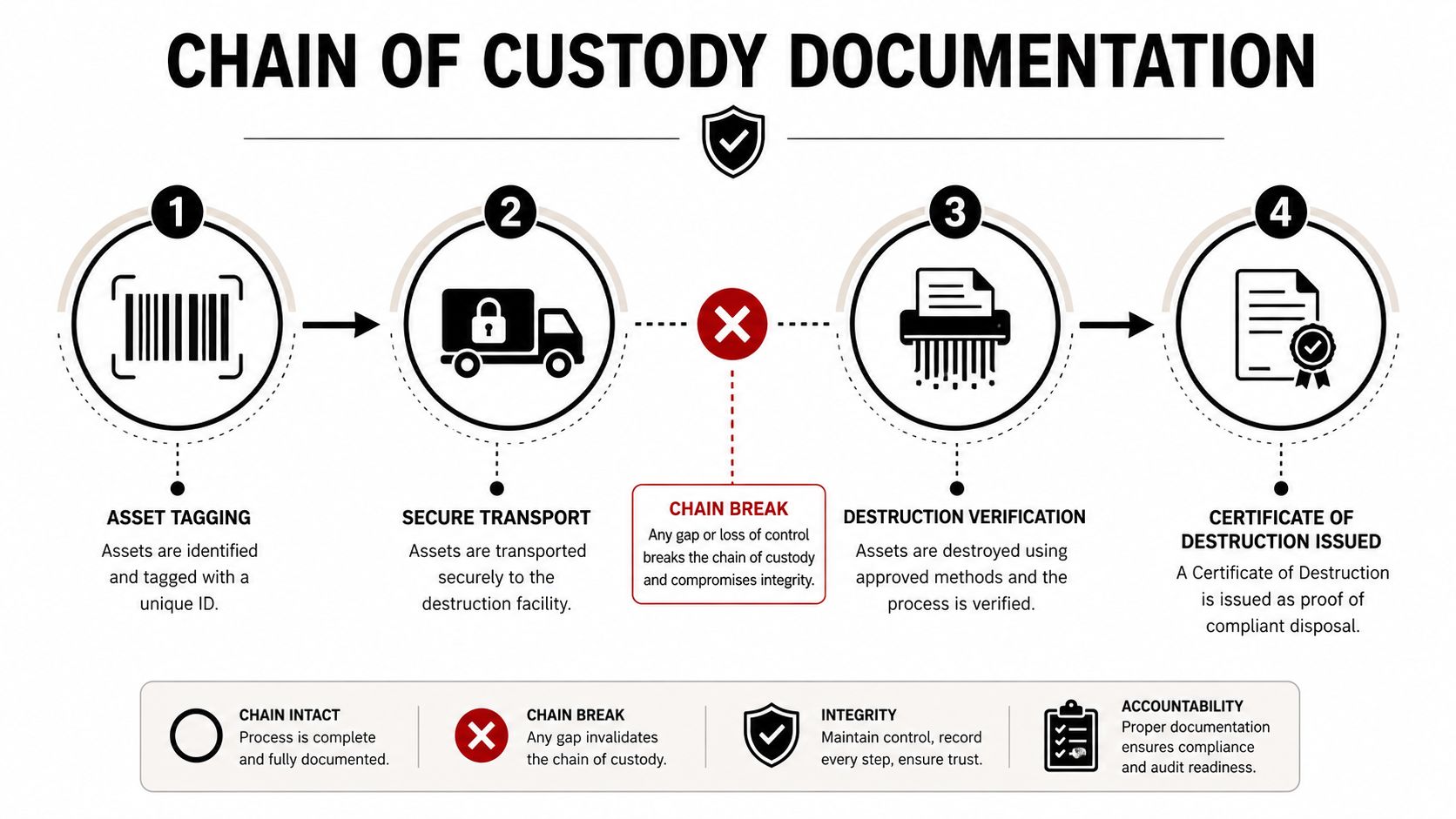
A certificate of destruction is the final page in a much longer record. It can't prove what happened before the vendor received the equipment unless the firm preserves the preceding custody trail.
Start at decommissioning. The technician should scan or record the asset tag and serial number, confirm the device identity, note the storage media, and attach the approved hold status. The internal transfer log should then identify who released the asset, who received it, where it was stored, and when the next handoff occurred.
The evidence trail
A defensible chain generally includes:
- Asset identity, with serial number, asset tag, device type, and relevant media.
- Release decision, including hold review, approving function, and disposition authorization.
- Internal custody, showing department transfers and secure storage.
- Transport evidence, including pickup details, carrier or vehicle information, and receiving confirmation.
- Processing records, identifying the wipe, shredding, or destruction method.
- Final certification, connecting each device to its destruction or recycling result.
A manifest that says “one hundred devices destroyed” isn't enough for an examiner who asks about one specific laptop. The certificate should identify each asset, the method used, the date and time of processing, the responsible facility or operator, and authorized sign-off. Where applicable, retain photographs or machine-generated verification logs as supporting evidence.
The device-level decision tree
Use a simple status model:
- Hold active or unclear: quarantine the asset and prohibit destruction.
- Records preserved and release approved: select the approved sanitization or destruction method.
- Processing exception: return the asset to controlled storage and investigate.
- Processing complete: reconcile the certificate against the original manifest.
- Record incomplete: keep the asset and evidence open until corrected.
This structure prevents a common operational failure, where a device is wiped before Legal confirms that its records were preserved. Chain-of-custody controls for IT asset disposal should be reflected in both the vendor contract and the internal procedure.
Evaluating Third Party ITAD Vendors
Outsourcing physical handling doesn't outsource the broker-dealer's regulatory responsibility. The firm must be able to explain how it selected the vendor, restricted downstream transfers, verified destruction, and retained evidence after the engagement ended.
Certifications such as NAID AAA, R2, or e-Stewards may help with supplier qualification, but a certificate alone isn't a complete control. Review the vendor's actual process for serialized inventory, secure storage, transport, employee screening, incident response, environmental compliance, insurance, and subcontractor management.
A practical scorecard
| Evaluation Criteria | Required Evidence | Risk Level if Missing |
|---|---|---|
| Data destruction | Written methods, media-specific procedures, sample certificates, and verification records | High |
| Chain of custody | Serialized manifests, handoff logs, transport controls, and reconciliation process | High |
| Certifications | Current certification details and scope covering the proposed service | Medium to high |
| Personnel controls | Background-check policy, training records, and access restrictions | High |
| Subcontractors | Disclosure, approval rights, flow-down obligations, and custody evidence | High |
| Insurance and response | Coverage documentation, breach response plan, notification duties, and escalation contacts | High |
| Environmental handling | Downstream processor controls and recycling documentation | Medium |
| Audit rights | Contractual inspection, evidence access, and remediation provisions | High |
The contract should require advance notice or approval for subcontractors, prohibit unauthorized handoffs, and preserve the firm's right to obtain records after termination. Include service-level expectations for inventory reconciliation, exceptions, damaged assets, missing serial numbers, and suspected data exposure.
Operational context matters too. A data center relocation or modular expansion may involve temporary secure work areas, staging rooms, and controlled access. Teams planning that type of project may find custom modular buildings for data centers useful when evaluating secure facilities and compliance controls around infrastructure work.
A vendor should also demonstrate how it handles mixed loads. Servers with customer databases, trading-floor workstations, mobile devices, monitors, networking equipment, and laboratory or medical electronics shouldn't automatically follow the same path. Beyond Surplus, for example, provides commercial IT asset disposition, secure data wiping or hard drive shredding, electronics recycling, product destruction, and documentation tied to processed equipment. The firm still needs to validate that the proposed workflow fits its own retention and security requirements.
Preparing for Audits and Record Retention
Audit readiness depends on retrieval, not on the existence of a folder full of certificates. An examiner should be able to start with a device, a destruction event, or a vendor invoice and follow the evidence through authorization, custody, processing, and retention.
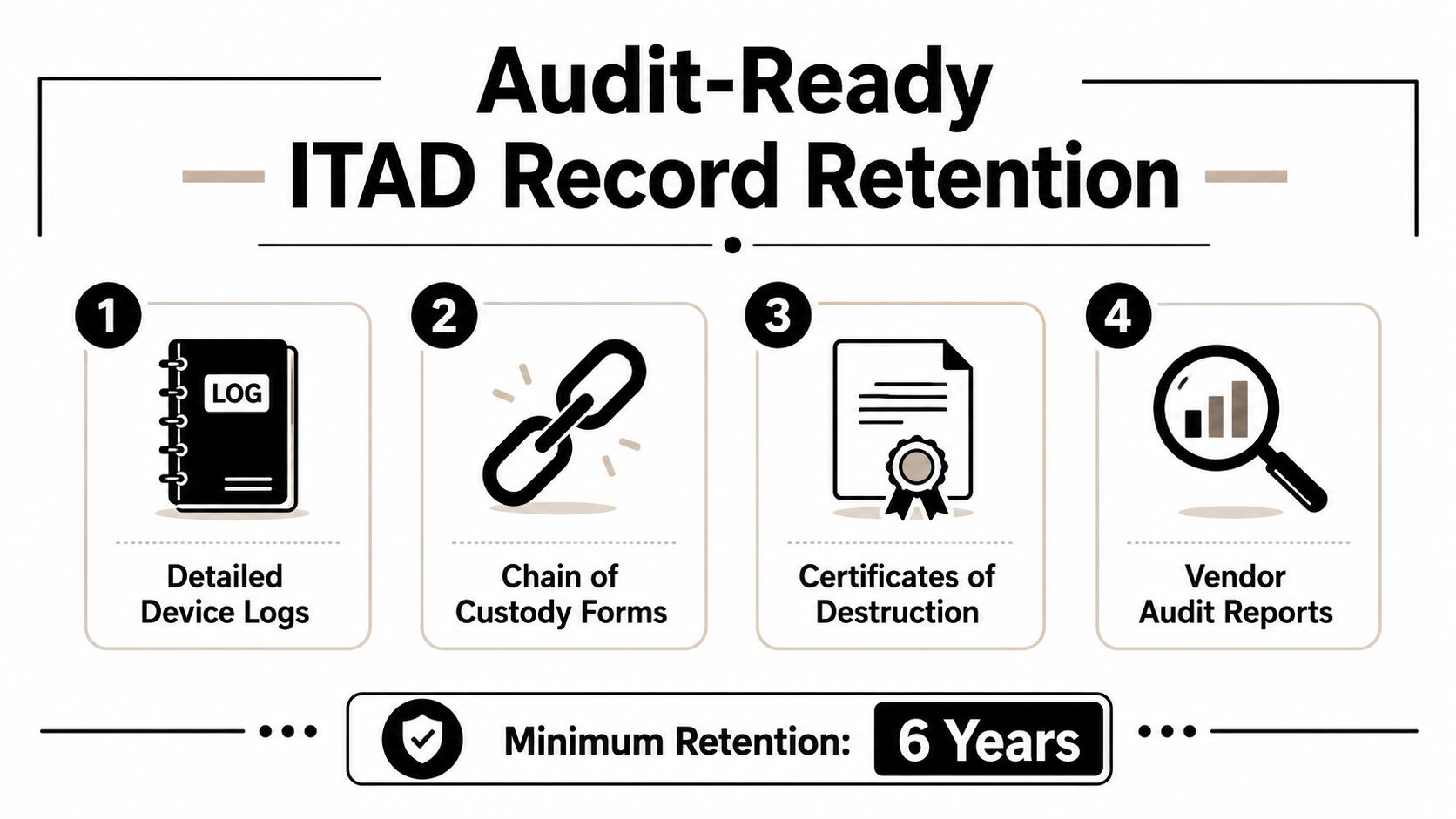
FINRA materials describe recordkeeping duties that commonly require preservation for at least three years, while required records may generally need to be retained for at least six years when no more specific period applies, as explained in FINRA's SEA Rule 17a-4 interpretation. The firm's schedule must account for the applicable record category, legal holds, regulatory requests, and the retention of the ITAD evidence itself.
Build the audit file around the asset
Maintain a searchable record for every processed device. The file should connect:
- Detailed device logs, including serial number, asset tag, location, owner, and disposition status.
- Hold and release records, showing the responsible review and approval.
- Chain-of-custody forms, including internal and external handoffs.
- Destruction or sanitization evidence, with method and verification details.
- Certificates of destruction and recycling, reconciled to the original inventory.
- Vendor records, including contracts, certifications, insurance, audits, and incident reports.
Run an internal sample review before a FINRA examination. Select assets from different locations, departments, media types, vendors, and disposition methods. Confirm that the serial number appears consistently across the inventory, approval, transport, certificate, and retained evidence.
Audit-trail reporting for ITAD can help structure the records needed to demonstrate this continuity. The control owner should also review exceptions, including missing certificates, duplicate asset identifiers, failed wipes, incomplete manifests, expired contracts, and assets destroyed while a hold status was unresolved.
An audit-ready program can answer three questions quickly: what was on the device, why destruction was authorized, and how the firm can prove what happened.
The most damaging gap is often procedural rather than technical. A firm may use a capable shredder or wiping platform yet fail to preserve the release decision, retain the destruction evidence, or restrict a downstream vendor. The strongest program treats physical destruction as one event inside a longer records-control lifecycle.
Beyond Surplus supports commercial IT asset disposition with serialized inventory, secure data wiping, hard drive shredding, electronics recycling, product destruction, data center decommissioning, and certificates documenting processed equipment. Visit Beyond Surplus to arrange a documented ITAD workflow that connects retention clearance, chain of custody, secure destruction, and responsible recycling.


