A Sandy Springs operations team may be facing a familiar deadline: employees have new laptops, the old devices are stacked near the loading area, and a server-room refresh has produced loose drives nobody has confidently matched to an asset list. The pickup can be arranged quickly. The harder question is whether the organization can prove what left, how its data was handled, and where each item ended up.
Electronics recycling in Sandy Springs, GA should be managed as a chain-of-custody and risk-control project, not just a removal service. The right process connects inventory, approved data treatment, secure logistics, documented downstream handling, and value recovery.
Table of Contents
- Why Commercial IT Disposal Needs a Controlled Workflow
- Audit and Prepare the IT Asset Inventory
- Choose Certified Wiping or Physical Destruction
- Schedule Pickup and Preserve Chain of Custody
- Map Compliance Duties Before Disposal
- Recover Value Without Losing Control
- Build the Final Disposal Checklist
Why Commercial IT Disposal Needs a Controlled Workflow
In a commercial retirement project, getting equipment out of the building is only the visible task. A defensible IT asset disposition process must also account for stored data, hazardous components, ownership, possible reuse value, and evidence of final disposition.
The environmental stakes are significant. The United Nations' Global E-waste Monitor 2024 reports that the world generated approximately 62 million metric tonnes of e-waste in 2022, while only 22.3% was documented as formally collected and properly recycled. The report also estimates approximately US$62 billion in recoverable materials went uncaptured through documented recycling systems. These figures put commercial electronics retirement in context: controlled routing can support material recovery and give a business a record of what happened after decommissioning. (Global E-waste Monitor 2024 findings)
Before choosing a provider, answer four questions: What does the organization own? What data does each asset hold? What outcome is approved for it? What evidence must remain after the project? A working laptop approved for reuse and a failed server drive containing sensitive records shouldn't automatically enter the same processing stream.
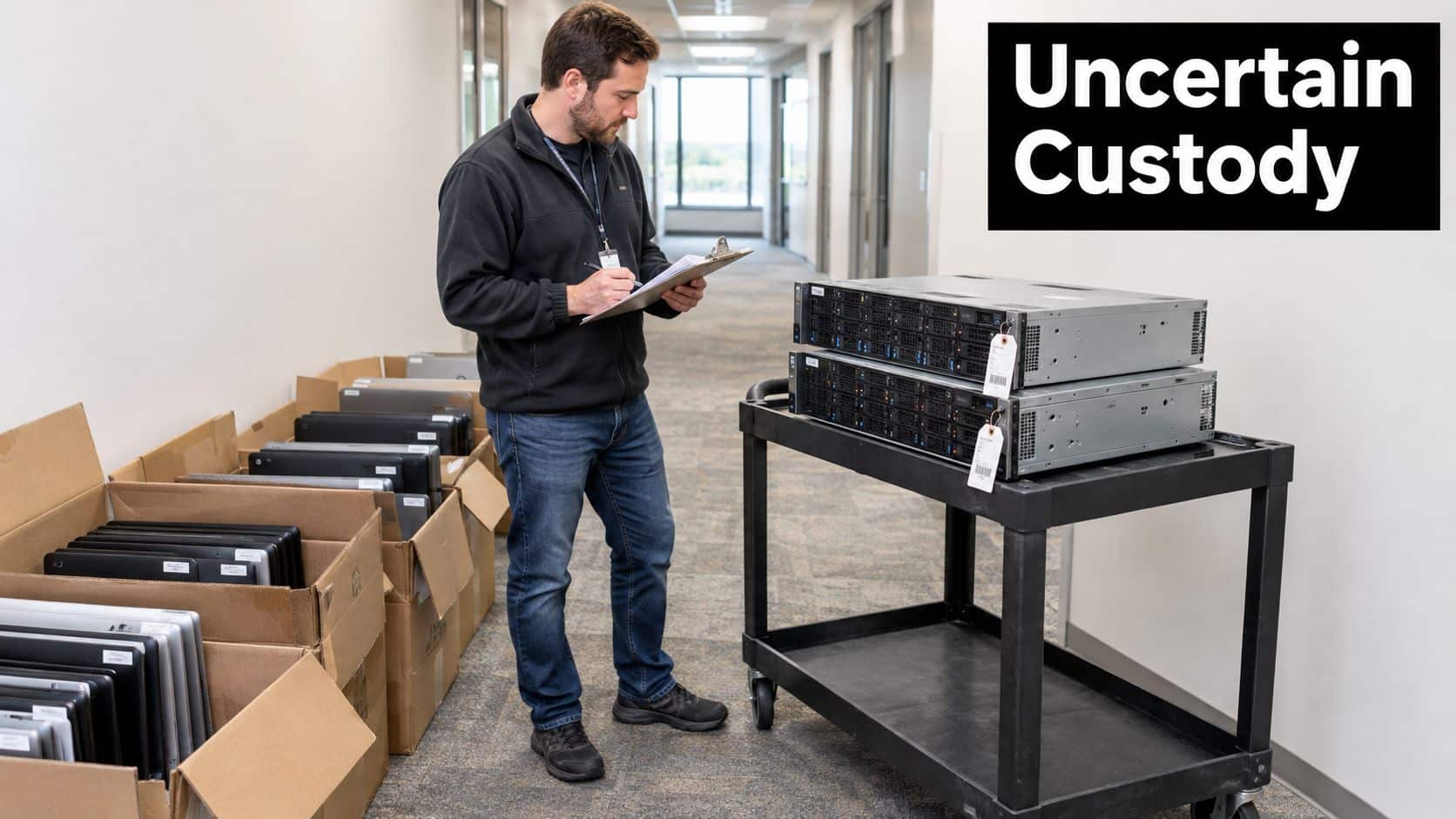
A pickup certificate can document a collection. It can't replace an asset-level record that connects each device to its data treatment and final outcome.
Audit and Prepare the IT Asset Inventory
Start with a reconciled inventory, not a collection date. IT, procurement, security, facilities, and business owners should agree on the equipment list and who can approve exceptions. Give every device a unique identifier and record its owner, location, storage type, data classification, and proposed disposition.
Include laptops, desktops, servers, networking equipment, SSDs, removable media, failed drives, and storage discovered during data-center de-installation. Small items are easy to miss: a loose drive in a rack, a server boot device, or removable media stored separately can create a gap between what the organization believes it retired and what left.
Classify assets before assigning a destination
Classify information according to your organization's own confidentiality rules. Then identify whether each device is suitable for reuse, requires sanitization, or should be escalated for destruction. Don't assume every device needs the most destructive option, and don't treat an encrypted drive as safe to release just because it's locked.
Use this checklist before booking collection:
- Confirm ownership: Name the business or department responsible for each asset, and resolve equipment that has no assigned owner.
- Reconcile identifiers: Compare serial numbers and asset tags with the source inventory. Investigate missing devices and duplicate records.
- Identify storage: Record whether the equipment contains magnetic drives, SSDs, removable media, or other data-bearing components.
- Flag exceptions: Escalate failed, damaged, locked, or encrypted media when the approved sanitization method may not work.
- Control staging: Store equipment securely and keep loose drives separate, labeled, and accounted for while pickup is pending.
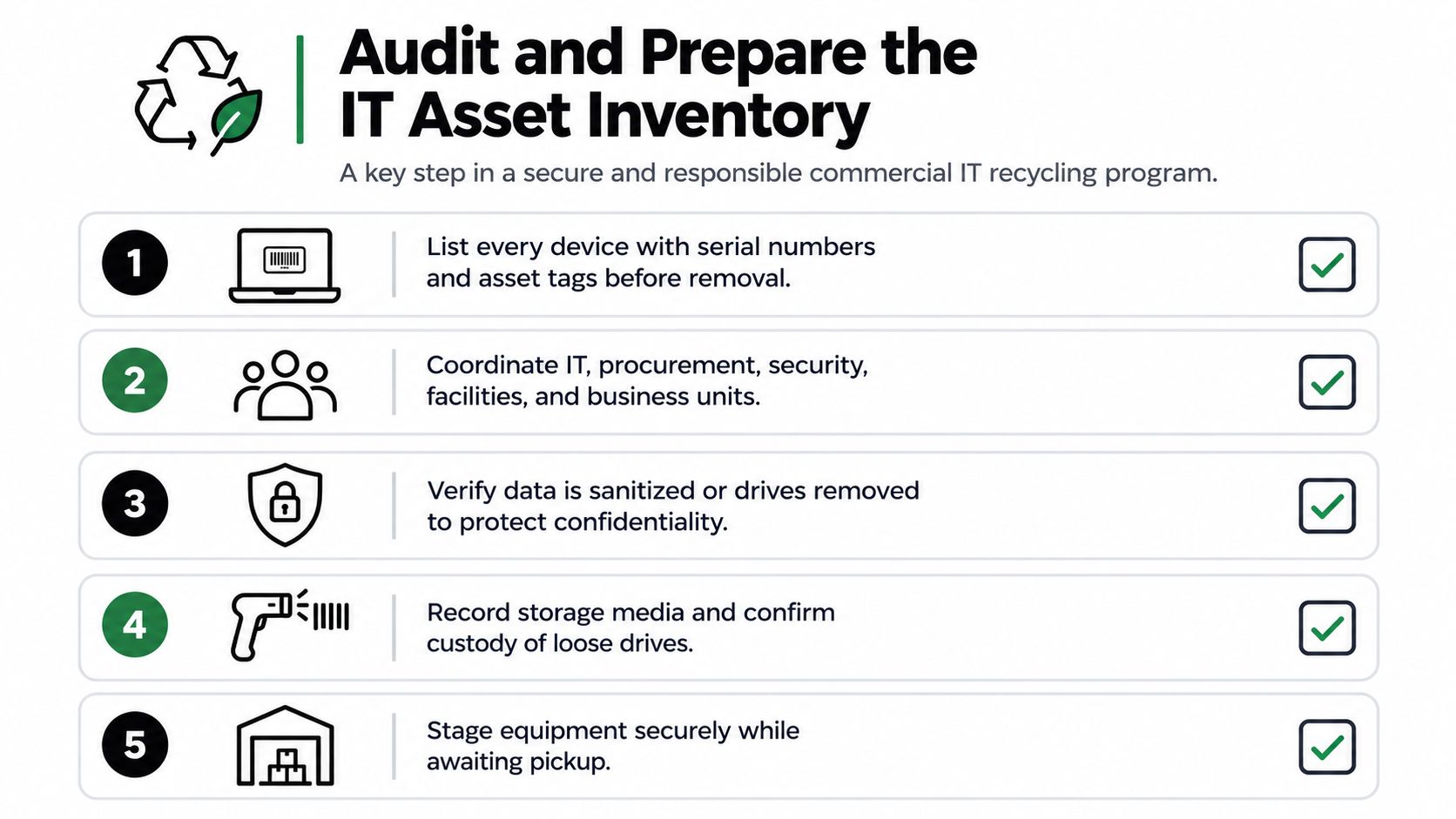
For a structured review of equipment and disposition priorities, use Beyond Surplus's inventory optimization service. Keep the resulting asset list as the control document for collection and processing, not merely as a purchasing or accounting record.
Choose Certified Wiping or Physical Destruction
Wiping and shredding are different outcomes, not interchangeable labels. Match the method to the information's sensitivity, storage technology, technical condition, reuse plan, and evidence requirements.
NIST describes three sanitization outcomes. Clear uses logical techniques intended to protect against simple, non-invasive recovery. Purge uses physical or logical techniques intended to make recovery infeasible using state-of-the-art laboratory methods while potentially preserving the media for reuse. Destroy makes recovery infeasible and prevents the media from being used again for data storage. (NIST media sanitization guidance)
Use verification as a decision gate
A software report that says “wipe complete” doesn't settle the question if a drive has unreadable sectors, firmware errors, hidden areas, or an incompatible SSD method. NIST distinguishes verification, confirming that the operation completed without technical errors, from validation, deciding whether the result is adequate for the data's sensitivity. Failed verification should trigger rejection or escalation, not automatic release for resale. For a practical method-selection reference, see this NIST SP 800-88 guide for IT managers.
| Asset situation | Preferred path | Required evidence | Escalation trigger |
|---|---|---|---|
| Ordinary corporate laptop approved for reuse | Documented purge, if suitable for its storage technology | Asset identifier, method, completion status, and certificate | Verification fails or storage condition is uncertain |
| Healthcare device containing ePHI | Approved sanitization or physical destruction | Device-level outcome and custody documentation | Data can't be removed or destruction is required by policy |
| Failed SSD | Assess whether a suitable sanitization method can be verified; otherwise destroy | Device identifier, exception record, and destruction certificate | Unreadable sectors, errors, or unsupported method |
| Encrypted media with inaccessible keys | Escalate for an approved destruction decision | Media identity, approval, and recorded disposition | Sanitization can't be confirmed |
| High-impact server | Apply the organization's data classification and approved media-by-media method | Serial-level records, method, outcome, and exception closure | Missing drives or a failed sanitization result |
On-site shredding can suit assets that must remain at the source until destruction is complete. Off-site shredding can fit a controlled workflow when secure transport, sealed containers, and documented receiving procedures are approved. Indiscriminate shredding can destroy reusable equipment and its residual value. A wipe command alone, however, isn't enough when the method is unsuitable or its outcome can't be verified.
Schedule Pickup and Preserve Chain of Custody
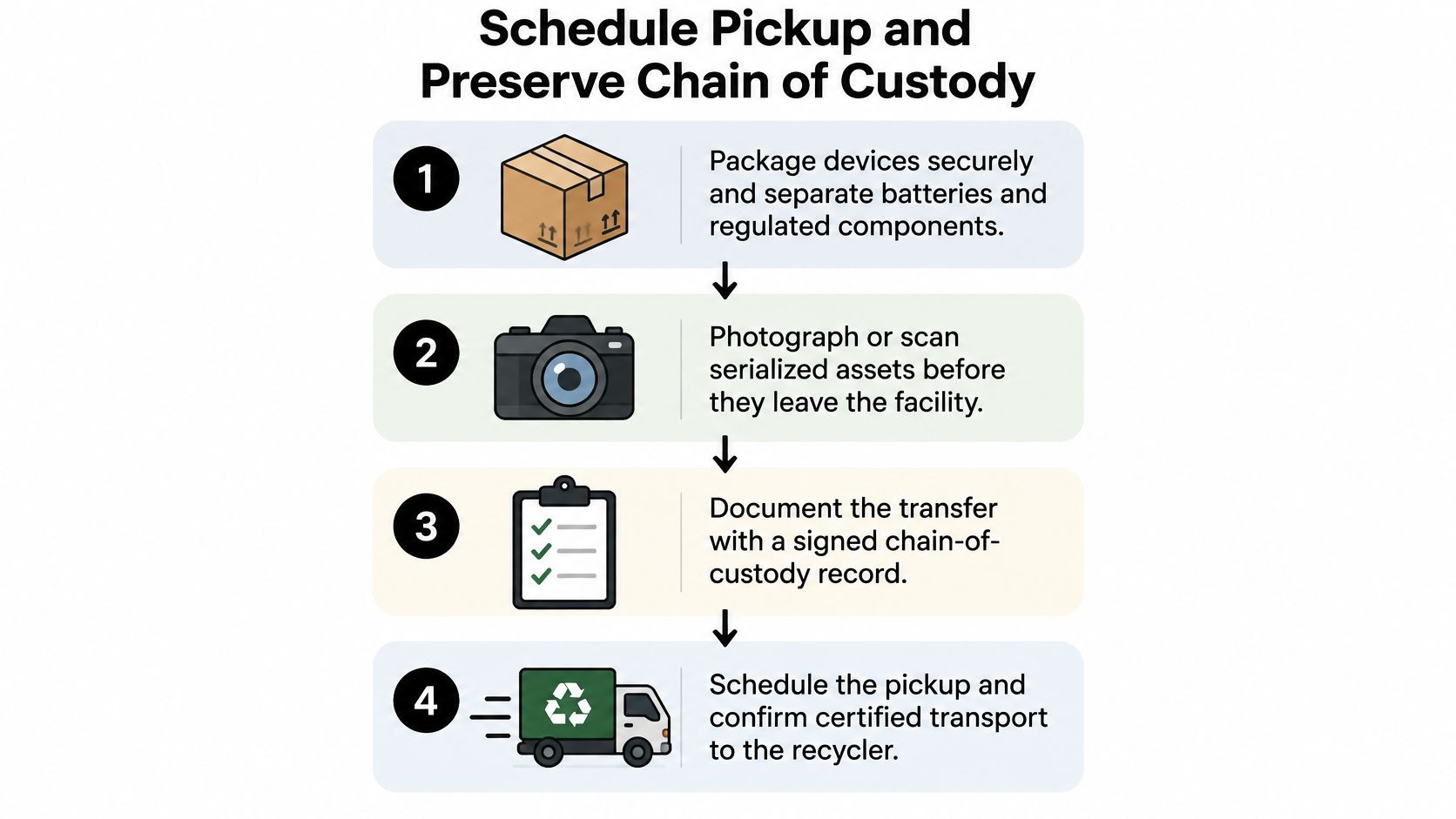
Prepare the physical transfer so that the inventory, containers, and receiving record can be reconciled. Before pickup, separate batteries and regulated components as required by the handling plan. Photograph or scan serialized assets where appropriate, package equipment securely, and record container seals and counts on a manifest.
Reconcile the handoff at every stage
Consider an office closure where boxed laptops are collected on the same day that a server room is de-installed. The laptop containers may be easy to count, but a loose drive removed from a server can disappear from the paperwork if staff don't add it to the manifest. At intake, the processor should reconcile received equipment against the transfer record and quarantine unidentified or damaged items instead of folding them into a mixed load.
A chain-of-custody record tracks transfer and responsibility. A certificate of data destruction should identify the media and sanitization or destruction outcome. A certificate of recycling records recycling disposition, while serial-level records connect specific assets to those results. Ask how downstream processing and exceptions will be documented, and require unresolved discrepancies to be closed before final reporting.
Use Beyond Surplus's chain-of-custody overview to evaluate what transfer records should cover. The acceptance test is straightforward: every serialized device must connect to a recorded final outcome.
Map Compliance Duties Before Disposal
Don't treat the absence of a statewide electronics-recycling mandate as permission to ignore data security, hazardous components, contracts, or internal controls. Compliance depends on what the equipment contains, what information it holds, and which rules or commitments apply to the organization.
Georgia doesn't impose a broad statewide electronics-recycling mandate, but hazardous components may still require appropriate handling under applicable state and federal requirements. EPA's universal-waste guidance, for example, describes containment and packaging requirements for mercury-containing equipment and lamps, including measures to prevent breakage and releases. A pickup that includes facility controls, laboratory instruments, or medical equipment should identify such components before loading. (EPA universal-waste handling guidance)
Check data and sector obligations separately
The FTC Disposal Rule is relevant to consumer reports and personally identifiable information, and the FTC Safeguards Rule applies in its relevant context. Healthcare organizations covered by HIPAA must address electronic protected health information before reuse or disposal, either by removing it from media or destroying the media. HHS identifies clearing and purging as possible removal approaches, and lists physical destruction methods where destruction is selected. (HHS guidance on disposing of devices containing ePHI)
NIST media sanitization guidance can inform the technical process, but it doesn't replace legal analysis or organization-specific policy. Financial institutions, government organizations, medical providers, and companies with national operations should check their own sector rules, contracts, and data-retention requirements. A Georgia collection may still involve corporate standards or contractual obligations set elsewhere.
For medical equipment, identify storage media that may contain ePHI. For laboratory instruments, check for data-bearing components and regulated materials. For finance, government, and multi-state businesses, confirm that the approved disposition process satisfies the organization's own security and contractual controls. Use Georgia electronics recycling and ITAD compliance guidance as a starting point, then ask qualified legal or compliance counsel to assess your specific duties.
Recover Value Without Losing Control
Resale value comes after control is established. A working laptop, server, or switch can still create exposure if ownership, data status, or downstream handling is unresolved. Treat every quote as conditional until the asset is tested, sanitized or destroyed according to its risk, and reconciled to a serial number.
Set the decision rules before pickup. Define which assets can be remarketed, which should be harvested for parts, and which must be destroyed because of damage, policy, or customer contract. For data-center gear, state which modules leave service, which stay installed, and how the team will count rails, drives, power supplies, and cards after de-installation.
Evaluate the provider's evidence, not just its pickup promise
Use a provider-selection checklist that covers:
- Data treatment: Can the provider support certified wiping and on-site or off-site shredding matched to media type?
- Commercial logistics: Can it coordinate packing, movement, pickup, and de-installation without mixing loads?
- Reconciliation: Will it issue asset-level records and close discrepancies before sign-off?
- Environmental handling: Can it explain how batteries and regulated components are managed?
- Downstream accountability: Will it document the processing route and provide recycling and destruction certificates?
- Value recovery: Are testing, grading, missing parts, and buyback decisions documented? Use this IT asset remarketing guide to set expectations for grading and pricing.
- Geographic coverage: Can it coordinate projects when assets sit outside Georgia?
Reject a generic “responsibly recycled” claim when records are vague. Agree on evidence, exceptions, and who approves recovered value before equipment moves. Beyond Surplus is an Atlanta-based ITAD provider offering commercial electronics recycling, secure data destruction, buyback, product destruction, data-center de-installation, and logistics coordination, including business pickup and nationwide service for organizations.
Build the Final Disposal Checklist
Before closing the project, confirm four checkpoints:
- Assets inventoried: Named owners, serial-level counts, storage media, and missing equipment are reconciled.
- Data outcomes approved: Each asset has an approved storage-specific method, and failed verification or damaged media has been escalated.
- Custody records issued: Manifests, seals, transfer records, and pickup counts match.
- Final evidence received: Certificates match the devices, downstream disposition is documented, and value-recovery records are approved.
Don't close the project with missing drives after de-installation, mixed unidentified loads, unresolved wipe failures, undocumented brokers, or certificates that can't be matched to assets. Keep the final record with the organization's retirement documentation so an operations or compliance team can establish what happened without relying on recollection.
Contact Beyond Surplus to coordinate certified electronics recycling, secure IT asset disposal, data destruction, and commercial logistics for your Sandy Springs project. Arrange a controlled pickup in Sandy Springs or Atlanta, or discuss organization-wide service across the contiguous United States through Beyond Surplus.