Disposal is rarely the approved remedy for recalled warehouse stock. Freeze the SKU and wait for written instructions before destroying anything. In CPSC five-year remedy data, disposal accounted for 1.1%, compared with refunds, repairs, and replacements.
Clearing the floor quickly can erase evidence a regulator may need, close off a refund or repair option, and send batteries or data-bearing drives into an unapproved waste stream. A recycler receipt alone does not prove the recalled units were destroyed, their data was sanitized, or their batteries were handled as hazardous material. Keep the units on hold until the remedy is authorized, then retain a record that connects each unit to its final disposition.
Table of Contents
- Why Warehouse Recall Disposal Is Not Automatic
- How to Quarantine and Document Recalled Warehouse Stock
- Choose an Authorized Disposition Before You Move Stock
- Triage Electronics Batteries and Data-Bearing Units
- Notify Regulators and Lock the Destruction Record
- Staff the Quarantine and Run the Hold Clock
- Schedule a Certified Destruction Pickup
Why Warehouse Recall Disposal Is Not Automatic
A disposal order is not the default remedy for recalled warehouse stock. If a notice arrives while the SKU is on an active pick wave, the risk is immediate: units may be picked, transferred stock may still be in transit, and a disposal decision may be made before anyone authorizes it. Treat the notice as a hold, not a destruction instruction.
The CPSC FY24 Annual Report reports 333 cooperative recalls completed in fiscal year 2024, including 166 Fast-Track recalls. It also reports 98.08% of Fast-Track recalls in 2024 were initiated within 20 days of a firm's report to the CPSC. These cases involve a potential substantial hazard and proceed without a lengthy preliminary hazard analysis. A monthly cycle count may not catch affected stock within that window.
The Freeze First Rule
Block the SKU in the WMS during the same shift. Stop picks, transfers, and outbound ASNs, then keep the affected units on hold until the responsible party provides the remedy in writing. Fast movement through the warehouse is no substitute for an approved disposition.
That pause matters because disposal is rare, with refunds, repairs, and replacements accounting for most remedies.
Don't destroy a unit the brand may need to refund, repair, replace, or inspect. The forklift doesn't decide the remedy.
If disposal is authorized, keep a record connecting product identification, quantity, date, method, and final processor. Those details show what happened to the affected inventory and help establish that it did not re-enter commerce. A recycler receipt alone does not prove that recalled units were destroyed, data was sanitized, or batteries were handled as required. Hold the stock until the remedy is clear, then retain the record that ties the units to their final disposition.
How to Quarantine and Document Recalled Warehouse Stock
Run this sequence the same shift the notice arrives. Each step prevents a specific failure, usually a recalled unit shipping, mixing with cleared stock, or disappearing from the count.
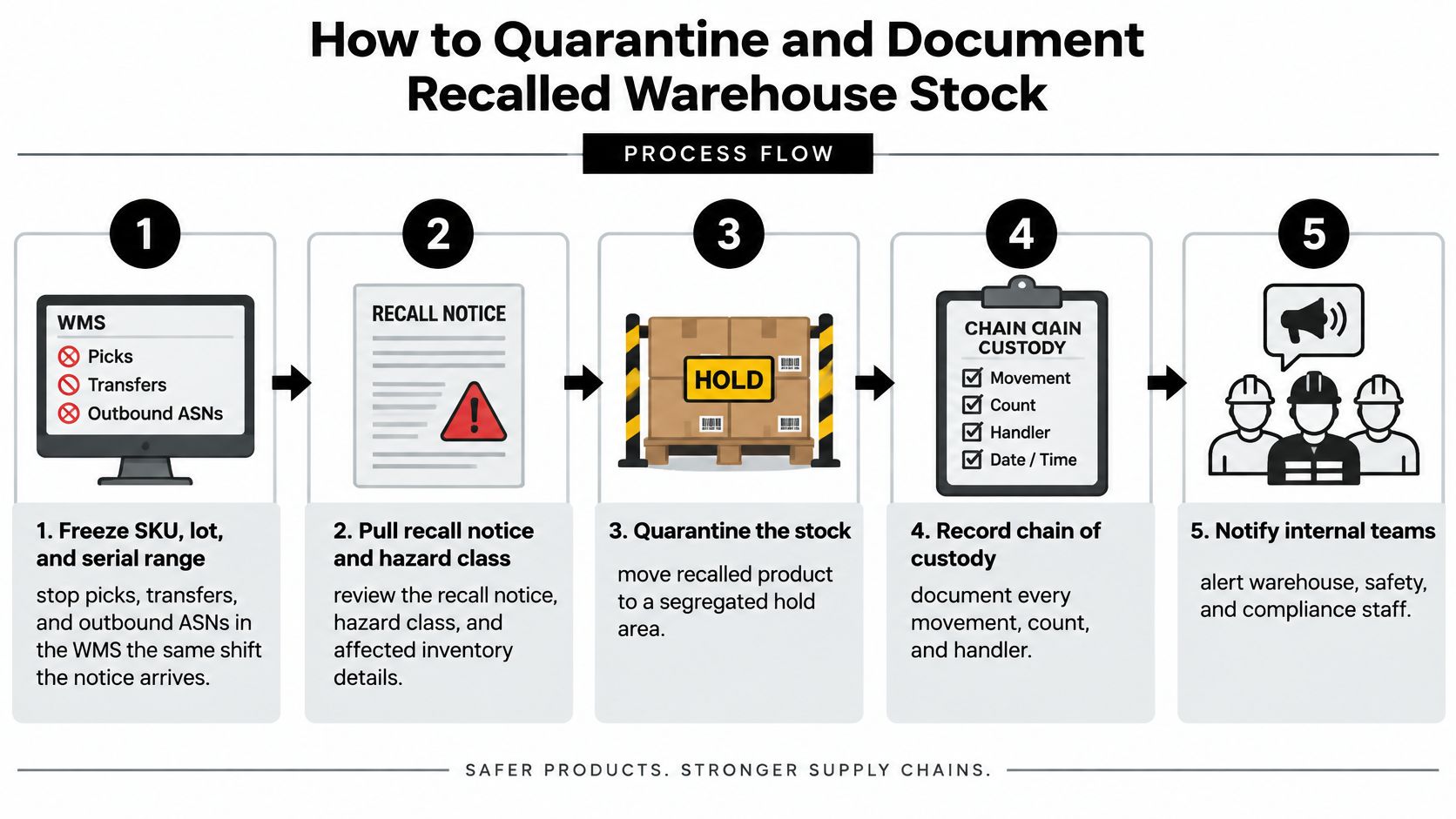
- Freeze the SKU, lot, and serial range: Stop picks, transfers, and outbound ASNs in the WMS. This prevents the next wave from pulling recalled stock.
- Pull the recall notice and hazard class: File the notice, affected identifiers, and named remedy on the quarantine record. Without it, staff guess at scope.
- Locate every unit: Search pick faces, bulk, returns, quality hold, dock staging, and trailers in the yard. Missed locations become accidental shipments.
- Move stock to a locked cage: Use a labeled area saleable inventory can't share. A red tag in a normal aisle isn't segregation.
- Mark pallets and cartons clearly: Mark each unit as not for sale, distribution, or donation. Unmarked pallets get restacked and lost.
- Count and reconcile: Match physical units to ERP and WMS records. Treat any variance as a named exception, not an estimate, and don't release quarantine until serialized stock reconciles or the gap is logged with an owner.
- Photograph pallets and labels: Capture lot and serial labels before restacking. Photos settle disputes when shrink wrap hides identifiers later.
- Scan every handoff: Record who had the goods, when they moved, and where they went. Gaps in custody are where units leak back to saleable stock.
- Wait for the disposition code: Don't apply a code until the authorizer signs. An early code turns a hold into an unauthorized shipment.
- Preserve customer-contact records: If your warehouse shipped affected goods, keep downstream contact records with the recall file. Deleting them breaks notification.
Build a Hold That Survives an Audit
Physical controls matter as much as system controls. Secure stored material against sliding, falling, or collapse, respect floor-load limits, and separate incompatible materials. That's basic safe storage, and a crowded quarantine cage is where teams ignore it first.
For duties, roles, and cage setup, align your SOP with a documented recalled product quarantine service workflow so the hold doesn't depend on one supervisor's memory. If the cage holds high-value electronics, camera coverage of entrances and handoff points helps verify who accessed it, and Wisenet Security's warehouse camera guide is a useful reference for placing cameras without leaving blind spots at dock doors.
Contamination changes the container, not just the location. The FDA product recalls guidance states that more than 83,000 FDA-regulated products were recalled between 2014 and 2024, and says contaminated products should be placed in secure containers or covered trash receptacles so people and animals cannot access them. It also says recalled products should not be donated or redistributed.
That scale is why this can't be improvised. Restricted access, preserved lot identifiers, and a documented disposition are the floor. A hold built on a red tag and a guess won't survive an audit, a brand chargeback review, or a regulator asking where unit 47 went.
Choose an Authorized Disposition Before You Move Stock
Give every unit a code before a forklift moves it. Use the codes in the corrective-action plan and don't invent a seventh path such as donation or employee sale. If a unit has no code, it doesn't ship, transfer, or get destroyed.
| Disposition code | CPSC five-year share | Warehouse action | Release only when |
|---|---|---|---|
| Refund | 54.6% | Hold unit, process the credit path, do not destroy | Recall owner authorizes the refund remedy |
| Repair | 26.3% | Stage for the approved repair, keep lot and serial readable | Corrective-action plan names the repair |
| Replacement | 16.9% | Quarantine the defective unit and separate any replacement stock | Manufacturer instructions cover the swap |
| Return to manufacturer | Not in the five-year split | Ship only on the written reverse-distribution plan | Brand or importer issues written instructions |
| Recycling | Not a default share | Send to a qualified processor if recovery is allowed | Written approval; refuse if destruction is required |
| Disposal or destruction | 1.1% | Dual sign-off, photos, then certified destruction | Regulator notice and the corrective-action plan |
The Rows Teams Misuse
Recycling is the most abused code. It's allowed only when the plan permits component recovery. If the plan says destroy, pulling boards, drives, or housings for salvage can put nonconforming goods back into commerce and create legal exposure for the warehouse that released them.
Return to manufacturer isn't a generic RMA. Ship on written carrier instructions that name the recall, quantities, and destination. A driver with a verbal instruction and an unmarked pallet is how recalled goods end up in a salvage auction.
Repair and replacement need readable identifiers. Don't wrap, relabel, or kit units in a way that hides lot or serial marks before the repair site or brand inspects them. Keep replacement stock in a different location status so pickers can't swap it for the defective unit by mistake.
Before you code electronics as recycling, check whether any fraction falls under universal waste regulations for electronics handling in your state. That determination affects labeling, accumulation, training, and where the load can legally go.
Gate rule: No code, no shipment. Destruction needs dual sign-off before the code is released.
I would put that gate in the WMS, not on a poster. Block the outbound transaction until the code, authorizer, and date fields are populated. Posters get ignored during a wave. System blocks don't.
Triage Electronics Batteries and Data-Bearing Units
A pallet of recalled laptops may contain swollen batteries, cracked screens, and drives holding data. Treating it as one waste stream sacrifices serial traceability and can send incompatible hazards through the same route. Separate the units before wrapping or moving them.
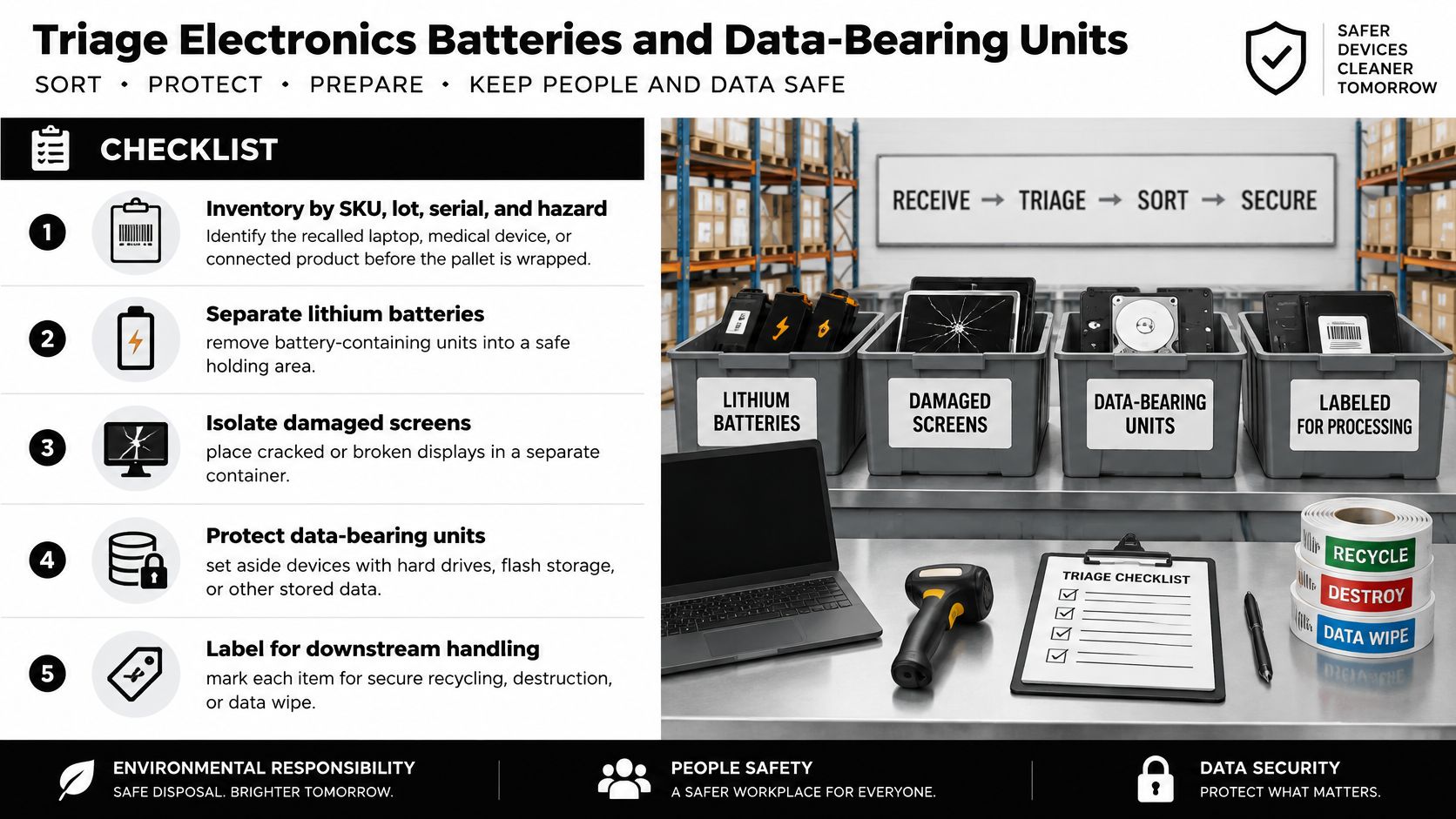
Record each unit's SKU, lot, serial number, and hazard before it leaves the quarantine area. The CPSC Recall Handbook recommends marking recalled goods as illegal to sell, distribute, or donate, segregating them from regular inventory, and following the manufacturer's corrective-action plan. It also advises giving off-site vendors written instructions and keeping recalled products out of salvage.
Split the Pallet by Hazard and Data
- Separate lithium batteries: Place battery-containing and damaged-battery units in compatible, labeled zones away from ordinary freight. For backup units, follow the UPS battery disposal guidelines for warehouse triage, since their handling differs from loose consumer cells.
- Isolate damaged screens and refrigerants: Keep cracked displays and refrigerant-bearing equipment out of mixed salvage. Assign them separate containers and processors qualified to handle those fractions.
- Protect data-bearing units: Remove or secure drives and removable media only when the plan authorizes it. Sanitizing storage addresses data security; it does not authorize salvaging the rest of the unit.
- Weigh and count inbound units: Record both before routing fractions. Weight can expose a discrepancy that a carton count alone misses.
Recalled EV chargers need the same unit-level control. They combine electronics and cabling, and may hold configuration data. Consumer buying roundups such as best home charger for tesla do not determine the disposition of the recalled unit. Follow the recall plan for that unit, regardless of what replacement equipment is selected.
Do not send these loads to a municipal dumpster. Some used electronics and hazardous fractions may be subject to waste-handling requirements, so route each fraction only to a processor qualified to receive it. Recovery is appropriate only when the authorized remedy permits it. A recycler receipt alone does not establish that recalled units, batteries, or data were destroyed.
Close the record against the quarantine manifest. Require documentation identifying quantities, serial ranges, destruction method, date, and downstream destination. If the serial ranges cannot be matched, the paperwork shows that material left the facility, not that each recalled unit was destroyed.
Notify Regulators and Lock the Destruction Record
Start the record before a recalled load leaves the dock. Reconstructing counts and handoffs from memory after pickup leaves gaps in the chain of custody.
For CPSC-regulated products, the firm should notify CPSC staff by email before recalled products are destroyed, disposed of, or recycled, according to the CPSC Regulated Products Handbook. The reverse-distribution plan should explain how products will be removed from shelves, quarantined, returned, repaired, replaced, or disposed of. Destruction must follow applicable state and local regulations and may take place under the supervision of a CPSC or Customs and Border Protection officer or employee.
The File the Dock Must Close
| Document | What it must show | When it is captured |
|---|---|---|
| Recall notice and hazard class | SKU, lot or serial range, and named remedy | Same shift the notice arrives |
| Quarantine count sheet | Physical count versus ERP and WMS, with variances logged | Before any outbound move |
| Disposition authorization | Signed code such as return, repair, replacement, refund, recycling, or destruction | Before that code is released |
| Regulator email | CPSC notice before destruction, disposal, or recycling, plus any state or local requirement | Before those actions |
| Bill of lading | Recall ID, piece count, weight, and not for resale | At carrier handoff |
| Certificate | Quantity, serial or lot range, method, date, and destination | Matched to the manifest after processing |
Send written handling instructions with every off-site load. Keep recalled goods separate from ordinary freight, and mark the bill of lading “not for resale.” Barcode each handoff so the carrier scan, dock scan, and processor intake scan can be reconciled to the same shipment.
For electronics managed as universal waste, settle requirements for notification, container labels, accumulation start dates, employee training, tracking, and transportation before the carrier arrives. A label applied at the dock may be incomplete or lack the date needed to track accumulation.
A recycler receipt alone does not prove recalled units were destroyed, or that batteries and data-bearing components received the required handling. Match the processor's certificate to the manifest line by line. Use a certificate of destruction for recalled products that identifies quantity, serial or lot range, method, date, and destination. Reject a certificate showing only total weight. Check that selected serials on the manifest also appear on the certificate with a method and date.
Keep the notice, count sheets, photos, approvals, carrier documents, and certificates together in one packet. Retain it for the full period required by the recall plan and your legal team. Enterprise, healthcare, finance, and government shipments need that same record because environmental and data-security duties can apply to one load. The closed packet is the evidence that the goods did not re-enter commerce.
Staff the Quarantine and Run the Hold Clock
Treat the quarantine cage as a staffed work center, not a corner of the returns lane. Assign ownership for the count, the WMS block, and the outbound deadline. Without named owners, work can stall at shift change while recalled stock remains available to ship.
A 2025 survey reported by Extensiv on reverse logistics found that 92% of more than 600 warehouses charged for returns processing, with an average charge of $4.06 per return. That figure describes customer charges for returns processing, not a warehouse's internal recall labor cost. Budget scan, count, and staging time from your own labor records and throughput data. Keep data sanitization, destruction, and carrier costs separate until the remedy code is signed.
Staffing and Clock Controls
- Open a recall job immediately: Name a lead, a counter, and a WMS editor in the first hour. Shared ownership leaves the job exposed when shifts change.
- Block picks before the next wave: If the system block and physical pull cannot happen together, block picks first. A recalled unit shipped to a customer creates a new problem.
- Set a maximum dwell target: Run a weekly aging report to catch degrading serial labels, battery condition, and hazard marks. Review exceptions by owner, not just by pallet count.
- Keep quantity gaps open: Assign each variance an owner and due date. Do not close a gap because the pallet is leaving.
- Start the accumulation clock: For electronics managed as universal waste, the EPA universal waste guidance generally allows accumulation for no more than one year from the date the waste was generated or received. A longer period is allowed when it is needed solely to accumulate enough material for proper recovery, treatment, or disposal.
Schedule the outbound load well before the accumulation period expires. Waiting until the final month can leave too little time to secure carrier and processor capacity. Workers handling hazardous substances at treatment, storage, or disposal facilities need proper training and a written safety program, so confirm staffing qualifications before setting a ship date.
Review the aging report alongside open quality holds. That keeps recalled stock visible after the initial urgency fades, and gives the team a clear view of who owns each exception and when it must move. A staffed hold with a clock is controllable. An unmarked pallet with a fading label is not.
Schedule a Certified Destruction Pickup
When the signed remedy is destruction or approved recycling of electronics, stop looking for a general hauler. A hauler moves freight. You need a processor who'll document destruction at serial level and handle data-bearing media correctly.
Hand the vendor a packet before pickup, not after. Include the recall ID, SKU and serial list, piece count, weight, battery and damaged-display notes, and whether drives must be wiped or shredded. Require a chain-of-custody scan at your dock and certificates that name the same quantities and serial ranges on your manifest.
For sites holding stock in several buildings, coordinate the work through multi-location recall collection services so each location uses the same manifest format and certificate standard. Mixed formats across sites are where serial gaps hide.
Beyond Surplus, an IT asset disposition and electronics recycling company, runs this type of work for businesses, including secure data destruction with on-site or off-site drive shredding and certified wiping, product destruction, and logistics using its own fleet plus transportation partners. Business pickups can be scheduled across the contiguous United States, which fits a warehouse that can't mail a recalled pallet.
Keep the returned certificate with your five-year recall file. Liability for the data and the product moves with that record, not with the truck.
If the plan says return, repair, replacement, or refund, don't book destruction to clear space. Contact a certified processor only when destruction or approved recycling is the authorized end of the recall.
If your signed remedy is destruction or approved recycling, send the recall ID, serial list, and battery and data notes to Beyond Surplus to schedule a certified pickup with dock-level chain of custody. You'll get certificates of recycling and data destruction matched to your manifest, so the file that closes the recall proves what happened to every unit.