The most popular advice about a recalled stroller is also the riskiest for a business: throw it away right now. That sounds safe. It's often wrong. If you destroy a unit before you read its recall notice, you can lose a full refund, miss a free repair kit, and create a file with no proof of what you held or where it went.
For daycares, schools, retailers, landlords, and rental operators, recalled stroller disposal services aren't a trash decision. They're a sequence. You match the notice to its remedy, quarantine the unit, choose only the path the notice allows, and close the file with evidence. Start there, and you protect children without giving up money or creating audit problems.
Table of Contents
- Match the Recall Notice to Its Remedy
- Quarantine Every Recalled Unit Today
- Choose the Disposition Path the Notice Allows
- Vet a Certified Disposal Service
- Build the Records File and Call Scripts
- Close the File With Proof of Disposition
Match the Recall Notice to Its Remedy
Before any unit moves, do the lookup. Find the label, usually on the frame, seat underside, or rear leg, and record the brand, model, serial or lot number, and manufacture date. Then pull the exact recall notice and write down its number and the remedy it names. Don't sort by appearance. A clean, rolling stroller can still be unsafe, and a tired-looking one may only need a part.
That remedy falls into one of three buckets: refund or return, repair kit, or disposal. Your job is to put each individual unit in the right bucket. Multi-unit inventories can't be cleared as a group, because two strollers that look alike may have different manufacture dates and different notices.
Why blanket disposal fails
Disposal is the exception, not the default. The U.S. Consumer Product Safety Commission's five-year recall-remedy data reported 23 product recalls categorized as requiring disposal, representing 1.1% of listed remedies in 2026. In other words, most recalls point somewhere else first. If you treat every recalled stroller as trash, you'll be wrong most of the time.
Practical rule: If you haven't read the notice for that exact model and date range, you don't yet know whether disposal is allowed.
Recent examples show how different the answers can be. One manufacturer wants the product registered for a refund. Another sends a kit and expects the stroller to stay in service after repair. An older, very large recall can cover models made over many years, so a unit in storage may still be affected long after purchase.
Recent stroller recalls and the remedy that controls disposal
| Recall | Approximate units | Hazard | Remedy in the notice |
|---|---|---|---|
| Stokke YOYO³, November 2024 | 2,890 | Defect named in the notice for that model | Full refund |
| Guava Family Roam | 8,500 | Brake defect named in the notice | Free repair kit, not disposal |
| Graco and Century, November 20, 2014 (11 models) | 4.7 million U.S.; 4.9 million across three countries | Folding hinge finger pinch; 11 finger injuries | Follow the notice for each model |
| Repair program, May 1986 | 200,000 | Shoulder harness restraint missing | Repair |
| Umbrella strollers, December 1988 | 14,600 | Mechanical problems | Manufacturer correction |
Read the table the way a facility manager should. The Stokke YOYO³ row tells you to preserve the unit and pursue money back. The Guava Family Roam row tells you not to pay for destruction when a kit fixes the problem. The Graco and Century row warns you that age doesn't clear a unit, since that recall covered strollers made from August 1, 2000 through September 25, 2014.
Cells you can't confirm from the label don't get guessed. You open the notice and fill them from that document. If the model matches but the date range doesn't, record that result too. A documented non-match is useful evidence.
Until that check is done, the stroller isn't eligible for donation, resale, lending, or transfer to another site. It doesn't matter that the brakes feel fine or the hinge looks smooth. The notice, not your hands, clears it.
If you're building a program across several locations, use a single lookup form for every unit and route questions through recalled baby product disposal services that start with verification rather than pickup. That order matters. Identification first, movement second.
Quarantine Every Recalled Unit Today
Quarantine is the same-day step you can take before the remedy question is fully settled. It costs almost nothing, and it prevents the worst mistake, which is a recalled stroller drifting back into a classroom, rental pool, or sales floor because someone didn't know.
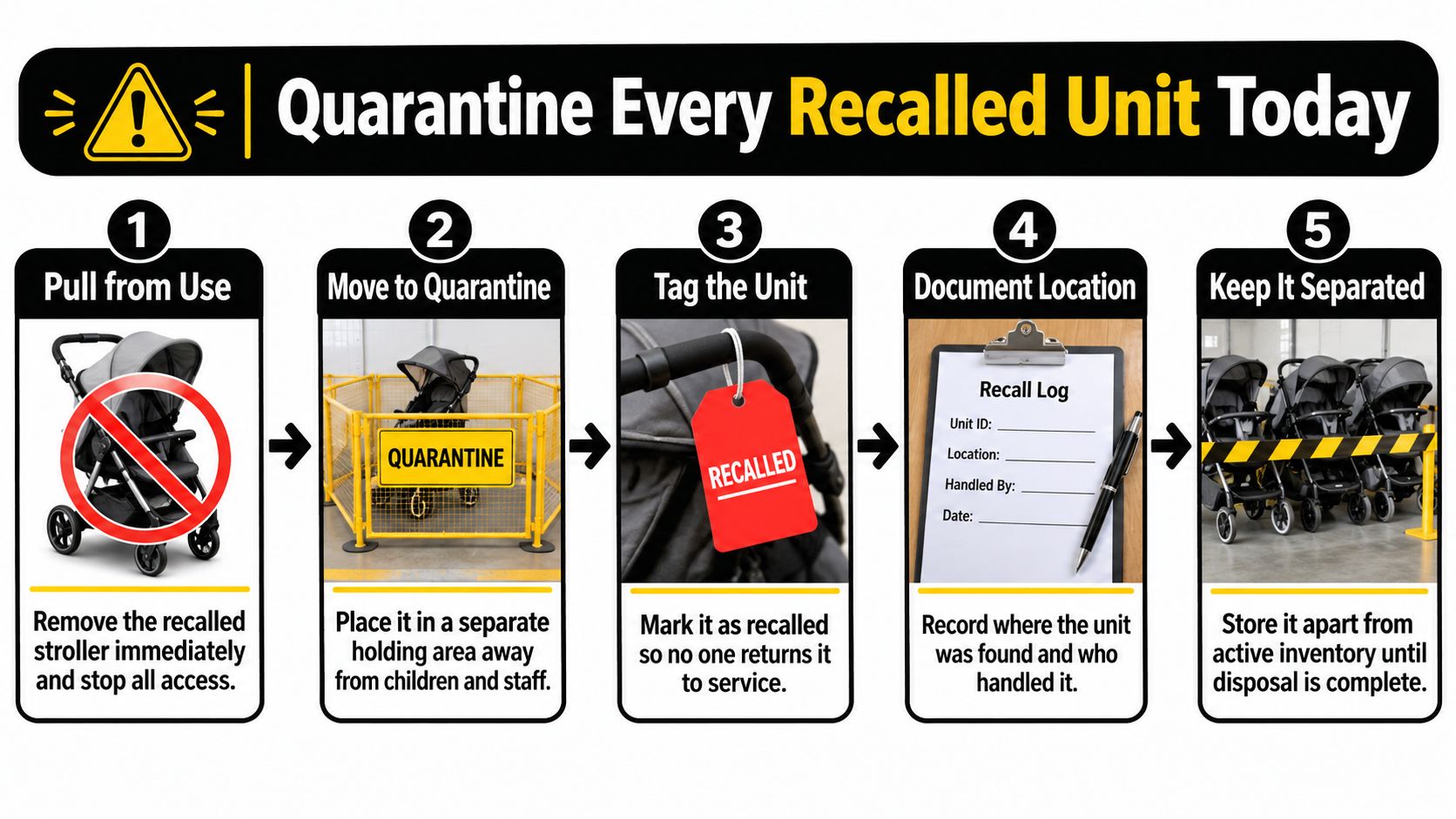
The same-day sequence
- Pull the unit from use: Take it out of service immediately and move it away from children and from any area where staff could sell, lend, or give it away.
- Tag and assign custody: Mark it recalled, do not use, log the room or department where you found it, and name one custodian who owns the record.
- Photograph before you touch parts: Capture the labels, model, serial or lot, manufacture date, and overall condition while the stroller is still intact.
- Inspect without disassembling: Check wheels, brakes, restraints, folding joints, adapters, and sharp edges, but don't remove anything until you've confirmed the remedy.
- Separate accessories from strollers: Keep a recalled car-seat adapter apart from a stroller that isn't itself recalled, so you don't condemn the wrong item.
- Sort each unit: Classify it as manufacturer return, repair-kit eligible, or destruction-authorized, and store those groups apart.
Triage by defect type, not just by how many units you have. In a CPSC review covering January 2008 to December 2012, 29 stroller recalls involved approximately 6.82 million units, while 1,207 reported incidents included four fatalities; wheels were the most frequently reported hazard category, representing 429 incidents, or 36%. That's why wheels get checked first, but not only. A brake problem can be just as serious and may point to repair instead of disposal.
That same caution explains step four. One brake-failure recall cited in that review context reported 67 unintended brake-lock disengagements and 152 failures to engage, yet directed owners to get a repair kit rather than discard the stroller. If your team had cut the frame on day one, you'd have destroyed a repairable asset and lost the fix.
Set targets you can audit
Don't measure success as a recycling percentage. Measure control. Aim for 100% identifier capture, 100% physical quarantine before disposition, and zero units released to reuse without documented recall clearance. Those three numbers tell a director, insurer, or regulator whether your process worked.
Say a childcare operator finds six strollers across three rooms. Two match a notice, one matches only by adapter, and three don't match. Quarantine lets you hold the two, set the adapter aside for its own remedy, and return the cleared three with a paper trail. Without tags and photos, all six become a guess by next week.
If the manufacturer won't honor the published remedy, don't improvise destruction to end the argument. Escalate to CPSC and keep the unit quarantined while you wait. For organizations that need a holding process across sites, recalled product quarantine services can standardize tagging, location logs, and custodian handoffs so a unit in storage doesn't reenter service.
Choose the Disposition Path the Notice Allows
Stop at the first path the notice names. That's the whole decision rule, and it's where many organizations lose money. They jump to a hauler because a truck is easy to schedule, even though the manufacturer was ready to refund, replace, or repair the product at no cost to them.
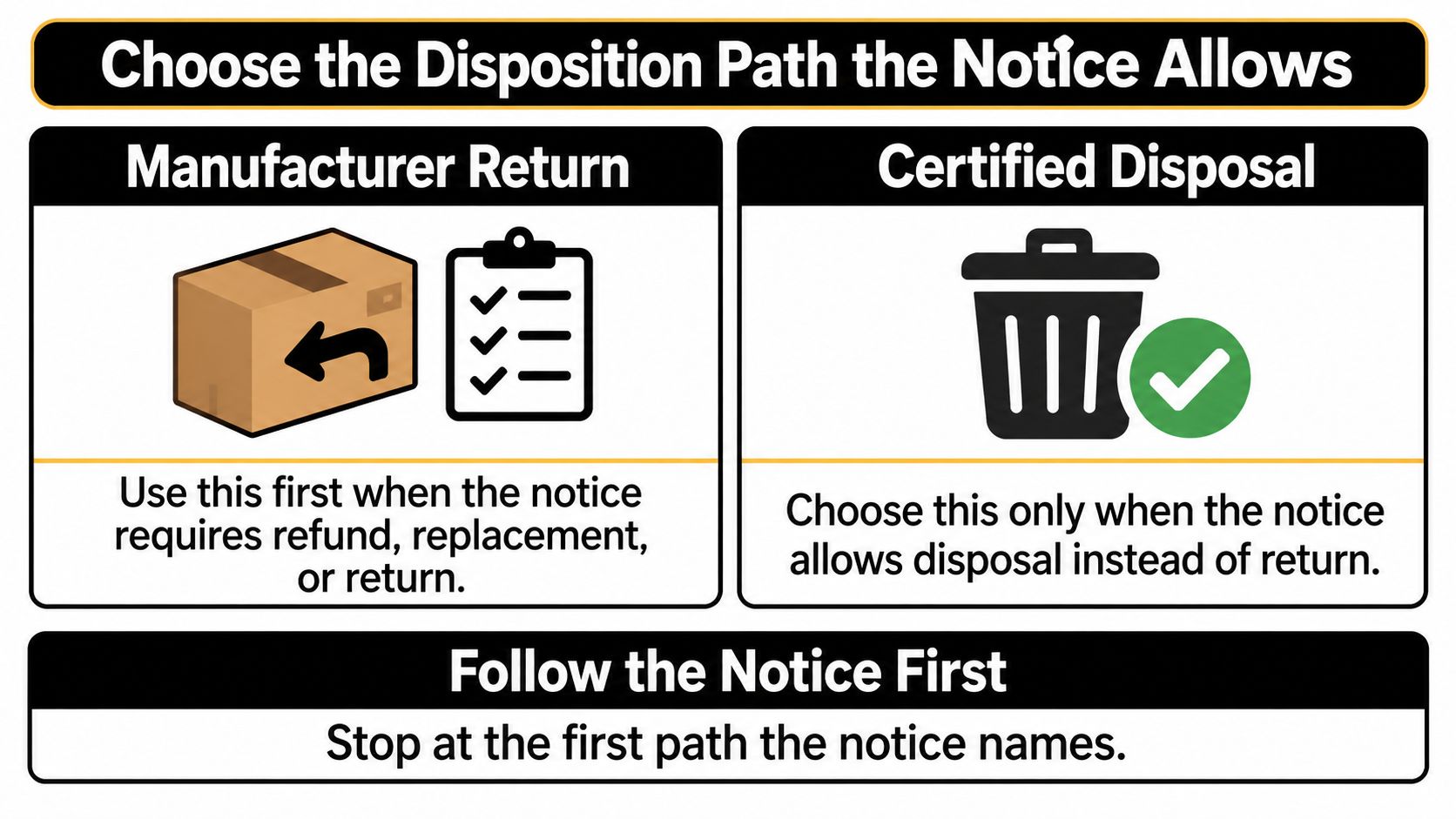
Recall disposition paths compared
| Path | Use it when | Do not use it when | Evidence to keep |
|---|---|---|---|
| Manufacturer refund or return | Notice offers refund, replacement or return | You already destroyed required parts | Registration, photos, shipping receipt |
| Repair kit | Notice supplies a kit and the stroller is not condemned | The hazard is the whole frame or destruction is ordered | Kit order and install date |
| Notice-directed dismantling | Notice tells you to take it apart and use local garbage rules | A refund or kit is still available | Before-and-after photos and part list |
| Municipal bulk trash | Household notice allows local garbage after separation | An organization needs chain of custody | Local acceptance rules and date |
| Certified destruction service | Several units, resale risk, or audit needs | The notice requires manufacturer return first | Serial log, transporter, destruction method, certificate |
A manufacturer refund or return wins whenever the notice requires it. Register first, follow the photo or shipping instructions exactly, and keep the stroller intact until the company tells you otherwise. Some refunds depend on a label, a cut strap, or a specific part. Destroy the wrong piece early and you may not be able to prove eligibility.
A repair kit wins when the defect is a correctable component, such as a brake or harness part, and the frame isn't condemned. Order the kit, keep children off the unit until it's installed, and record who installed it and when. Don't pay a disposal fee for a stroller the manufacturer intends to put back into safe use.
Authorized destruction is narrower. Use it only when the notice orders disposal, or when return is impossible and reuse must be blocked under documented instructions. The CPSC stroller recall guidance describes a workflow that begins with model-level verification and warns that blanket disposal can forfeit a remedy or violate instructions. Where dismantling is prescribed, one instruction specifies detaching the wheels, removing the grab bar, fabric seat, and canopy, then placing the separated pieces in accordance with local garbage rules.
Do not sell or give away a stroller that a notice tells you to dismantle. Separation is meant to prevent reuse, not to create spare parts for another family.
Why organizations need more than bulk trash
Household instructions don't solve a business problem. For business, institutional, or service-provider inventories, you need quantity, custody transfers, transporter details, destruction method, and final disposition in the file. Household exemptions don't automatically apply to non-household generators, which must determine whether discarded materials are regulated waste and follow applicable storage, transport, and disposal rules. A bulk drop-off may remove the object, but it leaves no audit trail.
That's where a certified destruction or recycling service fits. Daycares, schools, retailers, landlords, and multi-unit properties often need scheduled pickup, serial logs, and proof that units can't be reassembled or resold. We provide product destruction with documented chain of custody for loads that qualify, and certificates are available for each load of equipment picked up. Confirm the category is accepted before you schedule, because manufacturer take-back still outranks a paid hauler whenever the notice specifies it.
Keep mixed materials separate during any authorized breakdown. A stroller isn't one waste stream. The metal frame, plastic parts, foam, fabric seat, canopy, and any battery or electronic accessory should be handled as separate components under local rules. Don't treat a recall as ordinary e-waste, and don't assume every stroller can be recycled. The notice controls the product, and local rules control the separated pieces.
For a single household unit with a clear dismantling instruction, the notice-directed path may be enough. For a retailer with a pallet of returned units, it isn't. Scale, resale risk, and audit needs move you down the table toward certified destruction, but only after the first two rows have been ruled out in writing.
Vet a Certified Disposal Service
Hire for control, not just hauling. Any vendor can carry a bulky stroller to a truck. Fewer can prove that a specific recalled unit was quarantined, transported without mixing into reusable stock, and destroyed so it can't come back.
A seven-step hiring check
- Get the notice commitment in writing: Confirm the vendor will follow the named CPSC notice and won't resell, donate, or part out recalled units.
- Ask about quarantine: Find out who tags units, how they're marked, and where they're stored away from sellable inventory.
- Require identifier capture before loading: Serial or model numbers should be logged before the truck leaves, with no commingling with reusable products.
- Ask how parts are separated: Wheels, frames, fabric, foam, plastic, batteries, and electronic accessories need separate handling, and destruction must prevent reassembly.
- Demand proof details: Require the destruction method, site, date, quantity, identifiers, and a certificate you can file.
- Compare the quote basis: There's no single published price list to rely on, so get at least two written quotes stated per unit, per pallet, or as a flat stop fee, and check insurance and pickup logistics.
- Reject generic recycling claims: Walk away from a vendor that calls every stroller ordinary recycling or won't photograph the destroyed condition.
Those questions follow the approach in CPSC stroller guidance on hazardous products, which reflects recall handbook advice to quarantine returned products, physically segregate or mark them, track defective materials, and break products down for reclamation or destruction so they don't reenter commerce. It also repeats the household-level warning for certain strollers to detach wheels, remove the grab bar, fabric seat, and canopy, dispose of pieces under local rules, and not sell or give the stroller away.
The gap is scale. Putting pieces in the trash may satisfy a single household instruction. It doesn't give a school, retailer, or property manager auditable records, controlled transport, or proof that inventory wasn't redistributed. Your vendor should fill that gap with documented intake, deconstruction, photos, and a certificate workflow.
Request chain-of-custody records at every handoff. The file should show who held each unit, when custody changed, which transporter moved it, and where it ended. If a vendor can't explain that chain in plain language, they don't have one.
End with one exposing question: "If we learn tomorrow that the notice offers a repair kit for these units, will you stop and preserve them?" The right answer is yes, immediately, without a sales argument. A vendor who pushes destruction anyway is selling a service, not following the recall.
When you compare providers, look at certified destruction for recalled products as a documentation model: pickup logistics, serial capture, and a certificate tied to the load. You can request a pickup or drop-off by phone, by email, or by filling out the online form, and business organizations can schedule pickups anywhere in the contiguous United States. Confirm your recalled category is on the accepted list before you commit units to a truck.
Build the Records File and Call Scripts
Build the file before you schedule a pickup or pick up a tool. If the paperwork starts after destruction, you're reconstructing evidence from memory, and memory won't help when a parent, auditor, or manufacturer asks which serial number went where.
What goes in the file
- Recall notice details: Notice number, source, brand, model, hazard, and the exact remedy named.
- Unit identifiers: Serial or lot number, manufacture date, quantity, site, and room or department found.
- Custody record: Custodian names, quarantine date, every handoff, transporter, and pickup date.
- Photos: Labels before handling and final condition after repair, return packing, or authorized dismantling.
- Outcome proof: Refund confirmation, kit order and install date, shipping receipt, destruction method, and certificate.
Keep one shared spreadsheet across sites instead of scattered texts and email threads. One row per unit works better than one row per pickup, because remedies differ unit by unit. Attach photos to that row or name the files with the serial number so they don't get separated.
Don't assume cost comes first. The CPSC FAQ on recall remedies makes clear there's no one-size-fits-all remedy, since outcomes may include a refund, repair, replacement, or disposal. Recent examples underline the point: Stokke's November 2024 YOYO³ recall involved approximately 2,890 strollers and offered a full refund, while Guava Family's recall of about 8,500 Roam strollers offered a free repair kit rather than disposal. A refund or kit can be worth far more than any disposal charge you were about to pay.
Preserve the remedy first. A destroyed stroller can't be registered, returned, or repaired.
If you do need a commercial quote, compare written quotes on the same scope. Each one should state whether serial logging, transport, destruction, photos, and the certificate are included, and whether pricing is per piece, per pallet, or per stop. Accept a quote only after you've confirmed that disposal is the authorized path. For documented handling across handoffs, product recall chain of custody services should be judged on that paper trail, not on the truck alone.
Three scripts that prevent mistakes
To the manufacturer: "This is model X, serial Y, under recall Z. Do you require return, photos, or a repair kit before I disable it?"
That question protects eligibility. Ask it before wheels come off, straps are cut, or fabric is removed. Write down the representative's name, date, and answer.
To CPSC if the company is silent: "I cannot get the published remedy for this recalled stroller. What should I do next?"
CPSC directs consumers with remedy problems to contact the agency. Use that route instead of guessing, especially when a manufacturer doesn't respond or gives instructions that conflict with the notice.
To a hauler: "These units are under a CPSC recall. Quote destruction with no resale, serial logging and a certificate, and do not collect them if the remedy is still a refund or kit."
That last clause matters. It puts the stop condition in the request, so speed doesn't override the notice. If the notice requires a dismantling sequence, photograph the separated parts as instructed and file those images with the serial record.
Close the File With Proof of Disposition
A file is finished when you can prove the outcome, not when the stroller leaves the building. That distinction matters because recalled products can sit unnoticed for years in storage rooms, resale stock, and childcare settings, then surface long after the original announcement.
Scale is the reason. The CPSC notice for the November 20, 2014 Graco recall covered 11 stroller models sold under Graco and Century brands, with approximately 4.7 million units in the United States, 202,000 in Canada, and 10,300 in Mexico, about 4.9 million strollers across the three markets. Manufacture dates ran from August 1, 2000 through September 25, 2014, more than 14 years of production. Graco reported 11 finger injuries: six fingertip amputations, four partial-fingertip amputations, and one finger laceration from folding hinges that could pinch a child's finger.
An older unit in your storage cage isn't cleared by age. It may be exactly the kind of dispersed inventory a large recall leaves behind.
The three-way completion check
Finish only when one of these conditions is met:
- Refund, replacement, or return confirmed: You registered the unit, shipped or photographed it exactly as instructed, and kept it intact until that step was complete.
- Repair kit completed: You ordered the kit, kept children off the unit, installed it, and recorded the date and installer instead of paying for destruction.
- Authorized disposal proved: You dismantled in the stated order or used a service that quarantined the unit, logged identifiers, and certified destruction without resale.
If none of those is true, the file is still open. A stroller in a corner with a tag is controlled, but it isn't closed. A truck receipt without serial numbers is movement, but it isn't proof. A verbal assurance that units were destroyed isn't a certificate.
The finish line is specific: a notice match, a quarantined unit, and either a confirmed remedy or a certificate proving the stroller cannot be used again. When you can hand that file to a new manager and they can follow it without calling you, you're done.
Take the unit you already have and do the next concrete thing today. Photograph its label, look up the notice, and write the remedy on its tag. That single step decides whether your next call is to the manufacturer for money or a kit, or to a service for authorized destruction. Organizations that need documented support can review certificate of destruction for recalls and confirm which recalled-product categories are accepted before scheduling a quote. Questions and recycling requests can be directed to us at 404-905-8235.
If your organization holds recalled strollers that a notice has authorized for disposal, we can help with documented product destruction, chain-of-custody pickup logistics, and certificates tied to the load so your file shows those units didn't reenter use. Visit Beyond Surplus to confirm accepted categories and request a pickup or quote before you schedule removal.