
Your warehouse has pallets of recalled blenders, a retailer wants credit, and procurement needs the floor space back. Someone suggests sending everything to the scrap bin, but nobody can say which serial numbers will leave, whether the processor will remove hazardous components, or what evidence will come back.
For a business, recalled kitchen product destruction is complete only when the approved treatment and the documentation agree. The deliverable isn't a crushed pile. It's a defensible record showing that the affected products can't return to use and that the resulting materials reached appropriate processing channels.
Table of Contents
- Why Recalled Kitchen Products Need Controlled Destruction
- Regulatory Routes and Mistakes That Create Liability
- Destruction Methods Matched to Each Product Hazard
- How to Run a Recall Destruction Step by Step
- Destruction Records That Prove Compliance
- Choose a Certified Destruction Partner and Book Your Pickup
Why Recalled Kitchen Products Need Controlled Destruction
Retailers, distributors, food-service operators, schools, and manufacturers need controlled destruction when an approved recall disposition requires permanently preventing a hazardous product's resale, donation, repair, or parts harvesting. A warehouse team should therefore quarantine recalled stock before arranging its removal, not treat the recall as an ordinary inventory write-off. Destruction is a product-safety control, with waste handling as part of the process.
In its ten-year recall summary, the U.S. Consumer Product Safety Commission reported 1,110 recalls resolved through refunds, representing 54.5% of listed remedies; 537 through repairs, or 26.4%; 345 through replacements, or 17.0%; and 23 through disposal, or 1.1%. Disposal was the least common listed remedy, but those categories don't mean every returned or replaced item was subsequently reused. Operations staff still need an authorized disposition for the physical inventory.

Kitchen equipment can remain in circulation long before a defect triggers removal. Check identifying labels on older stock rather than assuming that the recall notice applies only to recent purchases.
For commercial bakeries, contamination controls also matter while staff isolate affected equipment and ingredients. DBakerAid™’s guidance on how to prevent cross-contact when baking offers useful operational context, although the applicable recall instructions still determine disposition.
Practical rule: Approve what must become unusable before deciding what material can be recovered.
A workable plan answers distinct questions: which route applies, which treatment fits the hazard, who authorizes processing, and which records prove completion. It also defines when staff must stop rather than destroy.
Regulatory Routes and Mistakes That Create Liability
A recall notice may require a return, approved destruction, or another specific disposition. Follow the manufacturer's or regulator's written instructions. A refund authorization does not automatically approve local shredding, and a recycling arrangement does not override a required return.
The CPSC Recall Handbook says destruction may require prior approval and may be witnessed by an investigator. It also calls for written instructions to off-site vendors, clear marking and segregation of recalled goods, controls against mixing them with other returns or sending them to salvage, and certification of destruction.
Disposition routes and the proof each requires
| Route | Use when | Proof required |
|---|---|---|
| Manufacturer return | Notice requires return rather than destruction | Carrier receipt and return confirmation |
| Approved destruction | Notice or regulator requires destruction | Certificate, witnessed destruction where required, and reconciliation |
| Material recovery | Notice allows recovery and no hazard remains | Processor records of materials recovered |
| Regulated waste handling | Units contain refrigerant, PCBs, mercury, or capacitors requiring controlled handling | Documented component and refrigerant handling record |
Routes can overlap. A refrigerator designated for destruction may still need refrigerant management, and recovered metal remains subject to the restrictions in the approved plan.
Use the table as a file checklist, not as a claim that every recall has identical legal requirements. Before shipment, settle who can approve the disposition, whether a witness is required, and which processing methods are acceptable. Keep the written instruction and evidence of completion together; the evidence file is the control, not merely a record of a crushed pile.
For recalled food, written procedures should specify the authorized disposition, which may include reprocessing, reworking, safe diversion, or destruction. Food-contact appliances are not automatically regulated in the same way as the food processed through them. Identify the product, the hazard, and the authority overseeing the recall.
Food-service operators should connect recall responsibilities to their broader food-safety system, including HACCP planning for food businesses. Keep release authority explicit so a kitchen manager cannot accidentally return held inventory to production.
Mistakes that leave the business exposed
- Using an ordinary dumpster: North Carolina public-health guidance warns that putting recalled food in a dumpster may not prevent retrieval and consumption. Document the quantity, removal date, and responsible person, and use a controlled method that prevents retrieval.
- Crushing before removing hazards: Unplanned dismantling can expose workers to sharp fragments, batteries, refrigerants, and contaminated residues. Qualified personnel should complete applicable pre-treatment before mechanical processing.
- Destroying before written authorization: A verbal instruction from a buyer or account representative may not establish the approved recall route. Save the disposition instruction and resolve conflicts before releasing stock.
Apply the same segregation discipline across product categories, including recalled-toy disposal and destruction. Keep unrelated recall cases separate, even when the products fit in the same truck.
Stop condition: If the notice requires return, stop the destruction booking and follow the return route. People handling a personally held recalled unit should follow the notice's return or refund instructions, not a commercial processing plan.
Destruction Methods Matched to Each Product Hazard
The method follows the hazard, not the crusher, so classify each product before selecting the processing equipment.
Destruction methods by product and hazard
| Product | Primary hazard | Pre-destruction step | Destruction method |
|---|---|---|---|
| Refrigerators, freezers, ice makers | Refrigerant, compressor oil, foam insulation | Refrigerant recovery by a qualified technician before any shredding | Shredding after recovery, with metals, plastics, and oils segregated |
| Glass cooktops and ceramic ranges | Shattering and unintended element activation | Isolate power components and remove electrical parts | Crushing or shredding into unusable fragments |
| Countertop electrics, dishwashers, microwaves | Capacitors, PCBs, mercury switches in some models | Remove regulated components per applicable EPA requirements | Shredding with component handling documented |
| Nonstick cookware and coated utensils | Coating residue and sharp metal fragments | Segregate coated material from other streams | Shredding, or incineration at a permitted facility that accepts the material |
| Food-contact equipment and packaged food inventory | Contamination and unauthorized consumption | Confirm the approved FDA disposition route in writing where FDA oversight applies | Approved processing with the food waste stream logged |
| Connected appliances, POS terminals, units with storage media | Retained data in controllers and drives | Sanitize or remove storage media | Where destruction is selected, shredding, disintegration, or pulverizing under applicable NIST criteria |
The table identifies planning options, not permission to use every method for every product. Confirm that the facility accepts the coating, residue, component, or waste classification involved.
Refrigerant recovery comes before size reduction
The EPA's appliance-disposal guidance identifies refrigerants, used oil, mercury, capacitors, and other potentially hazardous components, and states that refrigerant-containing appliances must not be mixed into containers or roll-offs sent directly to landfill. It also addresses the final processor's responsibility to ensure refrigerant recovery and the supporting statements or contractual arrangements used for relevant transfers.
Keep refrigeration equipment upright and protected from damage while awaiting treatment. Require a record connecting the recovery work to the transferred appliances, rather than accepting a general statement that the hauler recycles metal.
A low scrap-hauling price can leave important work outside the scope. Separate transport, recovery, component removal, destruction, and downstream processing in the written quotation.
Food-contact stock and data-bearing equipment need separate decisions
For contaminated inventory, distinguish the food, packaging, and equipment. Cleaning an appliance doesn't by itself resolve a recall affecting its construction, and destroying its contents doesn't establish that the appliance is safe to reuse.
For connected equipment, NIST media-sanitization guidance distinguishes destruction from clearing or purging because destroyed media can't be reused for their original storage purpose. Choose sanitization for any storage that may lawfully remain in service; choose destruction when permanent media elimination is required.
Products outside these categories need their own treatment review, including recalled-grill disposal. For mixed loads, apply the most restrictive relevant pre-treatment to affected units and separate incompatible streams rather than processing everything together.
How to Run a Recall Destruction Step by Step
Assign a recall owner who can authorize holds, approve instructions, and resolve discrepancies. Warehouse staff, procurement, environmental personnel, and the processor should work from the same controlled inventory version.
The FDA's recall-compliance guidance emphasizes effective recall controls and adequate destruction documentation, including contacting the district recall coordinator before destruction when FDA oversight applies. Build that coordination into the schedule rather than treating it as an administrative task after processing.

From recall notice to controlled processing
Confirm the recall scope. Read the notice for the model, lot, date code, hazard, and required return or destruction route. Save the notice and any subsequent written instructions so staff don't work from an outdated email.
Inventory every unit. Record serial or lot identifiers, quantities, ownership, and distribution level, including stock at branches or third-party warehouses. Photograph unreadable labels and place uncertain matches on hold instead of guessing whether they belong in the recall.
Quarantine the stock. Place affected units in a labeled, access-controlled area and block their release in the inventory system. Suspend resale, donation, repair, and parts harvesting until the disposition decision expressly permits an activity.
Get approval before processing. Obtain the manufacturer's instructions and complete any applicable regulator coordination or approval. If a processor proposes a different treatment, submit that change for approval before anyone alters the goods.
Write the destruction plan with the processor. Specify the method, responsible party, facility, transport arrangements, witness requirements, and evidence package. Include subcontracted stages and define who must provide records for each one.
Complete hazard pre-treatment. Arrange refrigerant recovery, oil draining, and applicable capacitor, PCB, mercury-switch, or battery handling by qualified personnel. Keep those treatment records associated with the load so later reviewers can distinguish pre-treatment from final destruction.
Destroy and capture evidence. Use witnessed destruction where required and, where practical, for high-risk loads. Capture dated photographs or video, unit counts or weights, and a signed processor attestation that identifies the actual method used.
Reconcile inbound inventory and outbound streams. Match the receiving count to the dispatch manifest, then account for the processed units, recovered materials, residues, and any rejected stock. Investigate discrepancies before signing completion, and don't substitute a weight conversion for serial-level accountability when serials were the controlling identifiers.
File the linked certificate. Obtain a certificate that identifies the recall case and the units processed, with attachments where necessary. Have the recall owner review the supporting records rather than accepting a generic disposal statement as closure.
Manage exceptions without losing control
Use an exception log for missing labels, damaged containers, quantity differences, and rejected materials. Each entry needs an owner, an interim hold location, and a documented resolution.
For example, if the receiver finds a model outside the approved scope, keep it segregated until the recall owner decides its route. Don't add it to the destruction count to make the shipment balance.
Coordinate recalled-product disposal for warehouses around loading access, container identification, and custody handoffs. A pickup window should never become a reason to release an unapproved load.
Sign-off point: The file stays open until the reconciliation is complete, even if every scheduled pallet has left the building.
Destruction Records That Prove Compliance
The destruction file needs linked fields that establish identity, custody, treatment, and outcome. The evidence file is the core deliverable, because a photograph of fragments can't establish which recalled units produced them.
Destruction record fields and what each must show
| Record field | What to capture | Why auditors ask |
|---|---|---|
| Recall reference | Recall number, notice date, and hazard | Links destruction to the recall case |
| Product identifiers | Model, lot, serial number, and date code | Confirms units match the notice |
| Quantities | Unit count and weight for each container | Reconciles inbound stock with destroyed stock |
| Custody transfers | Signed handoff with date, carrier, and receiving party | Closes the chain of custody |
| Method and facility | Shredding, incineration, or other method, with applicable facility permit | Identifies the authorized processing location and treatment |
| Evidence | Dated photos or video and named witnesses | Supports the destruction claim |
| Certificate | Processing date, facility, units destroyed, and signed attestation | Provides the final attestation for the recall file |
A return authorization proves that someone accepted a proposed return. A landfill receipt proves receipt at a destination. Neither alone proves destruction, and neither establishes that the affected serials or lots were processed.
Keep the signed originals of custody transfers and a controlled electronic copy of the full file. Retain the package with the recall documentation for the period specified by the applicable recall instructions, legal requirements, and company retention policy.
Build the file around traceable identifiers
Use a consistent recall reference on manifests, container labels, treatment records, photographs, and certificates. Where a processor uses its own job number, record the relationship between that number and your recall reference.
For example, suppose a distributor destroys 1,200 units across three pickups. It could keep a separate dispatch and receiving record for each pickup, a consolidated reconciliation sheet, and a final certificate listing all applicable serial ranges.
That is a hypothetical filing structure, not a prescribed batch size. Its value is that a reviewer can trace a selected serial range from the distributor's inventory through receipt and processing without reconstructing the job from emails.
A certificate should summarize a traceable transaction, not replace the records needed to verify it.
Resolve discrepancies before accepting the certificate
Check whether the certificate identifies whole units, storage media, recovered material, or merely the shipment's gross weight. Those descriptions aren't interchangeable.
Review the certificate-of-destruction requirements for recalls before approving the evidence package. Request correction when the recall reference, processing method, facility, or identifiers are missing.
The auditor's first practical check is whether the serial or lot count on the certificate matches the inbound manifest. If it doesn't, keep the discrepancy visible and unresolved until the supporting records explain it.
Choose a Certified Destruction Partner and Book Your Pickup
Evaluate a bidder's written scope against the actual recall, not just its ability to collect appliances.
- Custody accountability: Require documented handoffs from pickup through processing, including any transfer between facilities.
- Approved processing plan: Confirm the treatment, exclusions, responsible personnel, and evidence package before loading.
- Witness arrangements: Establish whether observation is available and how the witness will identify the relevant load.
- Load-specific certification: Specify the recall reference and identifiers that the certificate and attachments must contain.
- Environmental controls: Include applicable refrigerant recovery and component-handling records in the scope.
- Storage-media treatment: Specify the appropriate sanitization or destruction outcome for data-bearing equipment.
Certification should match the work being purchased. A data-destruction credential doesn't independently establish that a facility can accept contaminated food, recover refrigerants, or manage every regulated component.
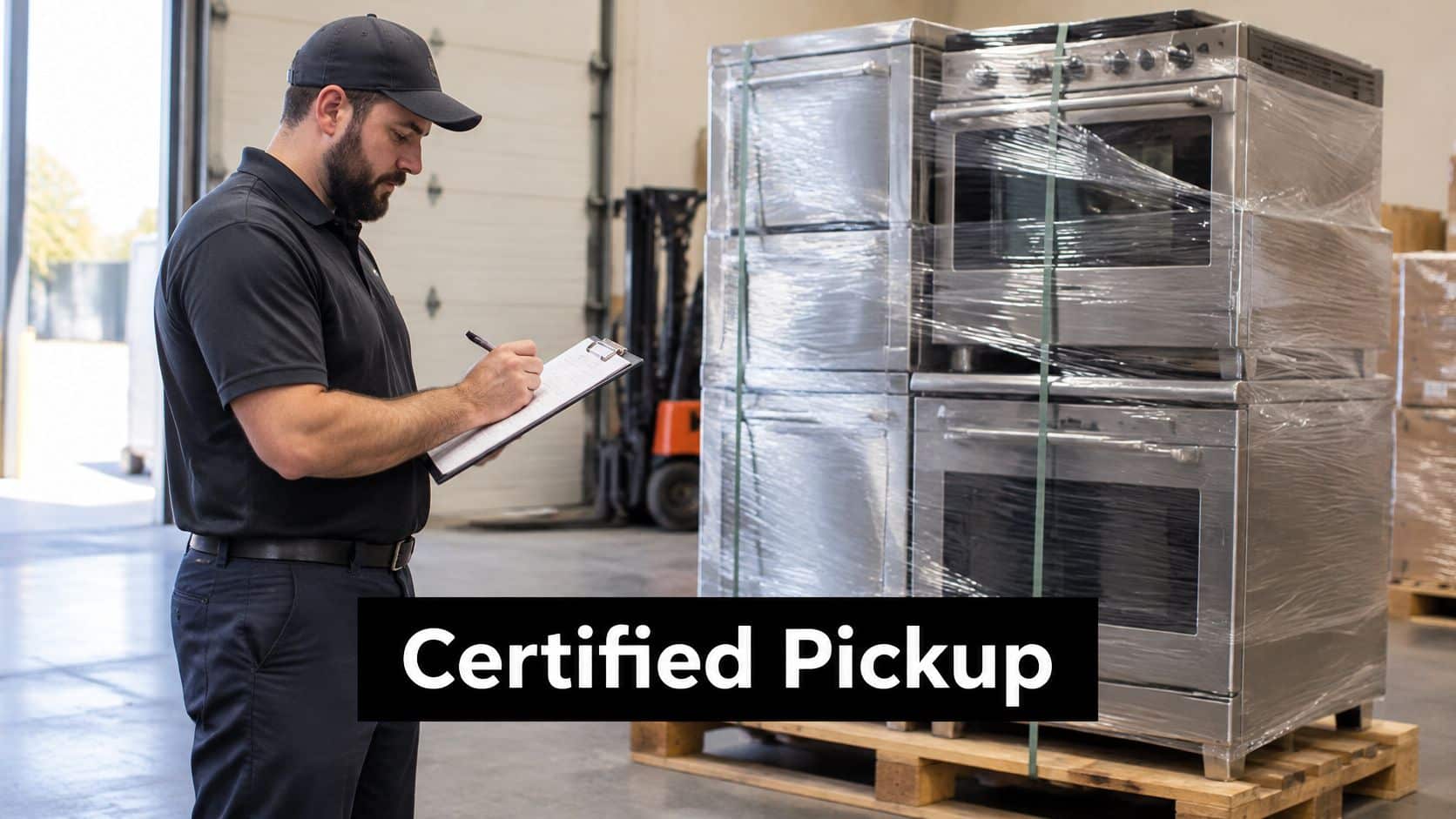
Match the scope to the evidence you need
Beyond Surplus provides product destruction with documented chain of custody and sustainable material recovery built in. Our NAID AAA certified data destruction covers hard drive shredding and product destruction with chain of custody for Atlanta pickups.
Certificates of recycling and data destruction are available for each load of equipment picked up, and certificates of destruction are available upon request. Clients who need to witness the process can perform visual verification at our Smyrna warehouse; arrange that requirement before scheduling.
For certified destruction of recalled products, identify any special treatment needs in the initial scope. Don't assume a standard equipment pickup includes a particular refrigerant, contamination, or regulated-waste service.
Prepare the booking package
Send the recall notice, inventory list, product photographs, locations, and known hazards for review. Include the required certificate fields and any regulator correspondence that affects treatment.
Approve the destruction plan in writing, including the accepted equipment and any exclusions or separate handling arrangements. Then schedule pickup and, if needed, witness attendance so the documentation requirements are settled before the load moves.
Beyond Surplus offers documented product destruction, sustainable material recovery, and load-level certification to support commercial recall files. Visit Beyond Surplus with your recall notice and inventory list to discuss certified product destruction, the required evidence package, and pickup arrangements.


