

When IT equipment reaches its end-of-life, the data left on it becomes a significant liability for your organization. For businesses across Arkansas, from Little Rock to Fayetteville, professional Arkansas data destruction is not merely an IT task—it is a critical security function essential for protecting sensitive information, maintaining customer trust, and ensuring compliance with federal and state regulations.
Why Secure Data Destruction Is Critical for Arkansas Businesses
For any commercial or enterprise entity in Arkansas, retired IT assets like servers, laptops, and hard drives are latent risks containing sensitive data. Simply deleting files or reformatting a drive is insufficient. These actions are superficial and leave the underlying data intact, easily recoverable with basic software tools.
True data destruction involves the permanent, irreversible, and verifiable elimination of information. Anything less exposes a business to severe consequences, including data breaches, financial penalties, and reputational damage.
The Real-World Consequences of Improper Disposal
Ignoring secure IT asset disposal can lead to catastrophic outcomes. A single discarded hard drive can contain a trove of confidential information, including:
- Customer financial records and personally identifiable information (PII)
- Proprietary corporate data, trade secrets, and intellectual property
- Employee records containing social security numbers and health information
- Confidential internal communications and strategic business plans
A breach of this data can result in severe financial penalties under federal laws like the FTC Disposal Rule and industry-specific regulations like HIPAA. The principles behind global standards such as GDPR compliance underscore the universal importance of stringent data handling protocols.
Navigating Arkansas's Regulatory and Recycling Landscape
While Arkansas has strengthened its approach to IT equipment management, largely driven by federal mandates, a significant compliance gap remains. National estimates indicate that only 20-25% of electronic waste is processed through certified IT Asset Disposition (ITAD) channels.
This gap represents a substantial risk for businesses required to demonstrate regulatory compliance. The only effective way to mitigate this liability is to partner with a certified provider that offers auditable certificates of data destruction. Explore comprehensive Arkansas ITAD services that adhere to the highest national security standards.
Choosing the Right Data Destruction Method for Your Assets
Not all data destruction methods offer the same level of security. The appropriate technique depends on the type of media, your security requirements, and the potential for asset reuse. For businesses in Arkansas, selecting the right method is a critical risk management decision. The three primary professional methods are data wiping (sanitization), degaussing, and physical destruction (shredding).
Data Wiping and Sanitization
Data wiping, or sanitization, uses specialized software to overwrite every sector of a hard drive with random data, typically in multiple passes. This process completely erases the original information, rendering it unrecoverable by conventional means.
This method is ideal for IT assets intended for resale, internal redeployment, or donation, as it preserves the hardware's functionality and value. It is a secure solution for extending the life of newer laptops, servers, and networking equipment while ensuring complete data removal.
Degaussing
Degaussing employs a powerful magnetic field to neutralize the magnetic domains on storage media where data is stored. This process effectively erases the magnetic blueprint of a hard drive or backup tape, rendering it permanently unusable.
Degaussing is highly effective for magnetic media like traditional hard disk drives (HDDs) and legacy tapes. However, it is completely ineffective on solid-state drives (SSDs), which use electronic, non-magnetic storage. A degaussed drive is permanently inoperable.
Physical Destruction or Shredding
For assets requiring the highest level of security where reuse is not a consideration, physical destruction is the definitive solution. This process utilizes industrial-grade shredders to pulverize hard drives, SSDs, smartphones, and other media into small, irrecoverable fragments.
For organizations handling highly sensitive information—such as financial institutions, healthcare providers, or government contractors—shredding is often the mandated standard. It provides tangible, verifiable proof that both the data and the device it was stored on are irrevocably destroyed.
To help you decide on the right approach for your retired IT equipment, it helps to map out the potential liabilities.
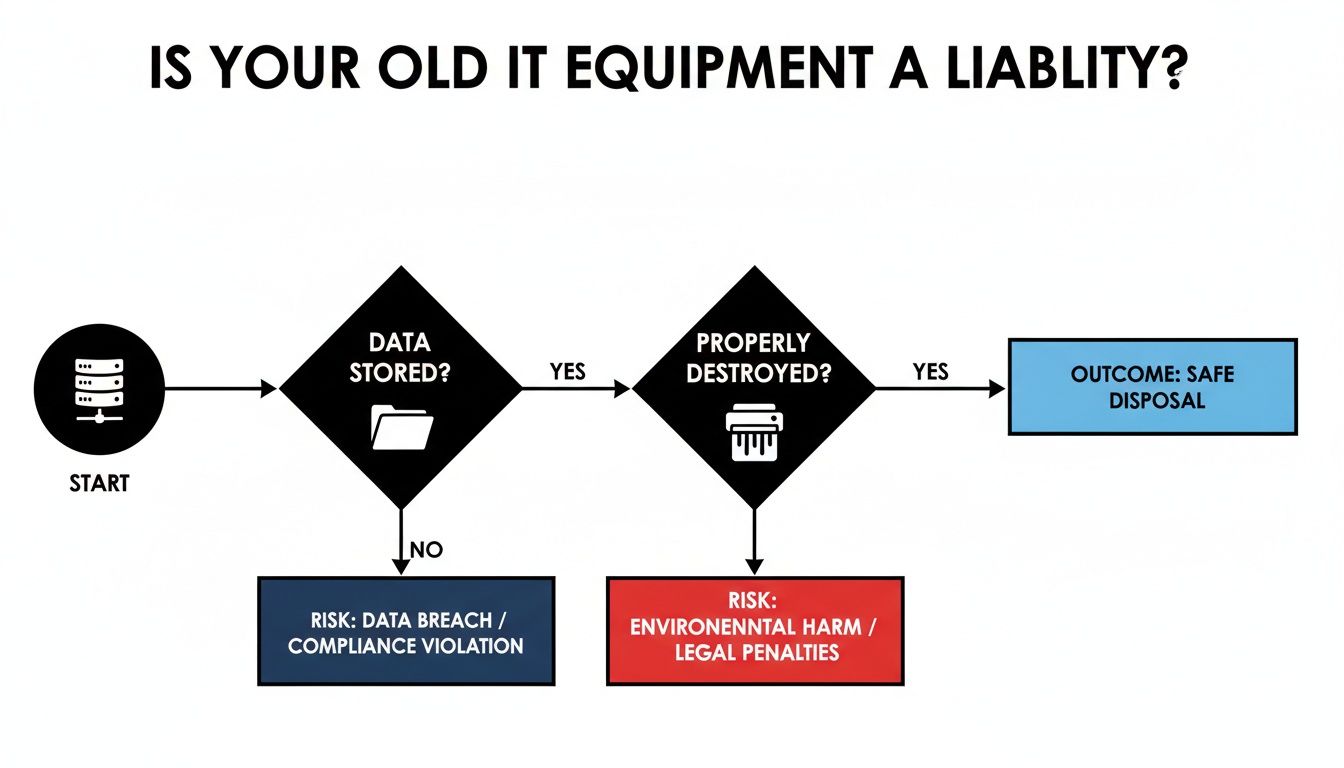
This flowchart makes it clear: any device that once held data is a liability until that data is verifiably destroyed. The best strategy often involves a mix of these methods, tailored to your specific inventory.
Comparison of Data Destruction Methods for Arkansas Businesses
To make the choice clearer, here’s a quick breakdown of how these professional methods stack up against each other.
| Method | Description | Best For | Security Level | Allows Reuse? |
|---|---|---|---|---|
| Data Wiping (Sanitization) | Software overwrites all data on a drive with random characters, making original data unrecoverable. | Reselling, donating, or redeploying functional IT assets like laptops, servers, and PCs. | High | Yes |
| Degaussing | A powerful magnetic field is used to neutralize the magnetic domains on storage media. | End-of-life magnetic media, such as HDDs and backup tapes. Does not work on SSDs. | Very High | No |
| Physical Destruction (Shredding) | Industrial shredders pulverize drives and other media into small, irrecoverable pieces. | Obsolete, damaged, or non-functional devices; highest-security compliance needs. | Absolute | No |
Ultimately, choosing the right method comes down to your specific needs. You can learn more about these techniques by exploring professional security and data destruction services. Working with a certified vendor ensures the correct method is used for each asset, giving you the auditable documentation needed for peace of mind and compliance.
How Chain of Custody Documentation Protects Your Business
Chain of custody documentation creates an official, auditable trail for your retired IT assets, proving your organization fulfilled its Arkansas data destruction responsibilities according to legal and regulatory standards. This verifiable record is essential for transferring liability from your company to your certified ITAD vendor.
Once your vendor takes possession of the assets and the initial documentation is signed, the responsibility for securing and destroying the data shifts to them. This formal handoff serves as a critical defense against legal and financial repercussions from a potential data breach. Without this proof, your company remains liable.
Key Documents in the Chain of Custody
A robust chain of custody is not a single form but a series of interconnected documents that create an unbroken record of an asset's journey from your facility to its final disposition.
The key components of this crucial paper trail include:
- Initial Pickup Receipt: This document confirms the transfer of assets, detailing the date, location, and a general description of the equipment collected.
- Serialized Asset Report: Upon arrival at the secure facility, each data-bearing device is inventoried by its unique serial number, creating a detailed manifest for destruction.
- Transportation Manifests: Secure logs track assets if they are moved between facilities, ensuring complete accountability throughout transit.
The Final Step: The Certificate of Data Destruction
Following the secure wiping or physical shredding of the media, your ITAD partner issues the most critical document: the Certificate of Data Destruction. This serves as your definitive legal proof that the process was completed correctly and in accordance with all relevant industry standards.
This certificate is an official affidavit detailing the exact method of destruction, listing the serial numbers of the destroyed assets, and confirming the date of service. Retaining this document is non-negotiable for demonstrating compliance during any future audits.
This final certificate provides the concrete evidence needed to satisfy auditors, stakeholders, and internal governance requirements. A robust chain of custody is the foundation of any defensible data destruction strategy, protecting your Arkansas business from liability. You can learn more about the components of a proper Certificate of Destruction to understand its full value.
Why Data Destruction Is a Key Part of Disaster Recovery
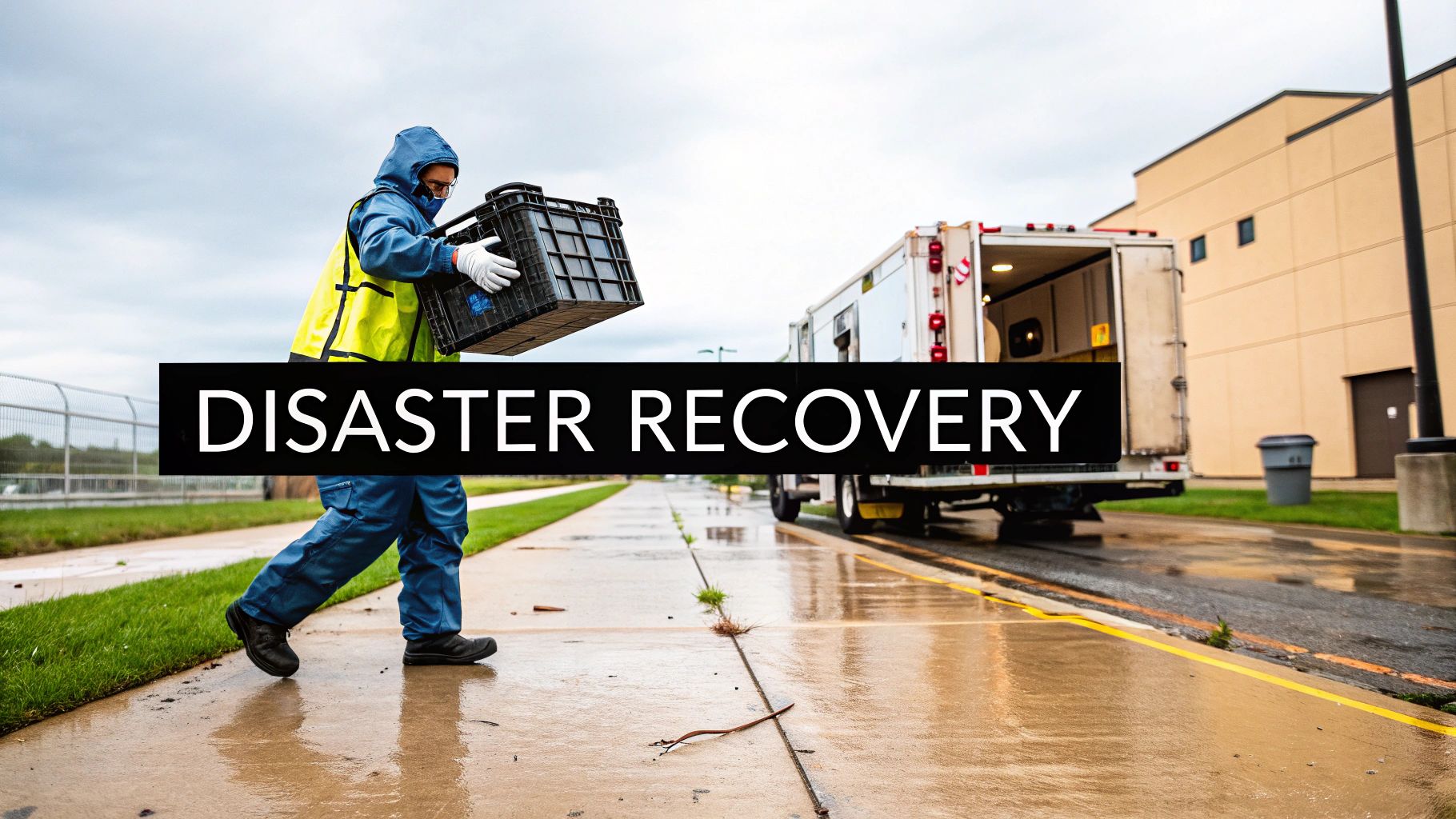
Business continuity planning typically focuses on restoring operational systems after a crisis, but what about the physical IT assets left behind? For any Arkansas business, a severe weather event like a tornado or flood can instantly transform a physical disaster into a major data breach.
Damaged or exposed servers, hard drives, and other devices become easy targets for data theft. This elevates secure IT asset disposal from a routine end-of-life task to a critical component of your disaster recovery strategy. Proactive planning is the only way to ensure data remains protected during a crisis.
Proactive Strategies for Emergency ITAD
Waiting until after a disaster to arrange for IT asset recovery is a critical mistake. Instead, integrate emergency ITAD protocols directly into your existing disaster recovery plan.
This involves establishing a partnership with a certified provider before a crisis occurs. This allows you to pre-arrange essential services for rapid deployment when needed.
- Emergency On-Site Shredding: A mobile shredding truck can be dispatched to your location to physically destroy compromised media, providing immediate and verifiable Arkansas data destruction.
- Secure Asset Collection: Damaged equipment can be securely collected, inventoried under chain of custody, and transported to a secure facility.
- Priority Response: An established relationship ensures you receive priority service when resources are constrained across an affected region.
The Real Impact of Severe Weather on Data Security
Arkansas is frequently impacted by severe weather, which poses a direct and often overlooked threat to data security. According to the National Centers for Environmental Information, Arkansas experienced 97 separate billion-dollar weather disasters between 1980 and 2024, including 55 severe storm events.
These incidents can leave on-premise servers and storage devices scattered or water-damaged, making them accessible. As data from the state's long-term disaster trends confirms, integrating a rapid ITAD response into disaster planning is essential for protecting data when physical security is compromised.
By planning ahead, organizations can maintain compliance and protect sensitive information even when facing the total loss of a facility. This proactive stance ensures business continuity extends beyond operational recovery to include comprehensive data security.
Connecting Secure ITAD with Corporate Sustainability Goals
Modern corporate responsibility extends beyond data security to include environmental stewardship. Secure IT Asset Disposition (ITAD) and professional Arkansas data destruction are now integral components of corporate Environmental, Social, and Governance (ESG) initiatives, transforming a necessary operational task into a reflection of your company's values.
Partnering with a certified, zero-landfill ITAD provider allows you to mitigate data breach risks while simultaneously achieving sustainability targets and enhancing your corporate reputation. Prioritizing both secure data wiping for reusable assets and certified recycling for end-of-life electronics builds a strong connection between IT security and environmental commitments.
Aligning ITAD with ESG Reporting
Growing investor expectations and regulatory mandates are reshaping how Arkansas organizations manage technology retirement. Documented data destruction is no longer just an IT security issue—it has become a key metric for ESG and sustainability reports. The total weight of electronics recycled or the percentage of devices refurbished can now be reported alongside traditional metrics like energy consumption and carbon emissions.
This trend is part of a broader corporate focus on environmental impact. While data from Global Forest Watch shows that from 2001 to 2024, only 8.0% of Arkansas’s tree-cover loss resulted in permanent deforestation, companies remain under pressure to demonstrate a reduced environmental footprint. You can explore these land-use trends and their implications for Arkansas on globalforestwatch.org.
Turning a Cost into a Corporate Asset
Working with an ITAD provider that manages both secure data destruction and certified recycling allows Arkansas organizations to achieve measurable progress on two critical fronts simultaneously.
- Risk Reduction: Ensure compliance and protect your organization from costly data breaches with certified, documented destruction.
- Environmental Stewardship: Contribute to the circular economy by promoting equipment reuse and ensuring responsible, zero-landfill recycling for all other assets.
By integrating secure ITAD into your sustainability strategy, you transform a necessary operational cost into a valuable corporate asset. It provides a verifiable narrative for annual reports and stakeholder communications—one that demonstrates a tangible commitment to environmental responsibility and robust data governance.
How to Select a Certified Data Destruction Partner
Selecting the right IT asset disposition (ITAD) partner is a critical decision that directly impacts your data security, compliance posture, and brand reputation. When evaluating providers for your Arkansas business, look beyond price and thoroughly vet their qualifications, processes, and logistical capabilities. The goal is to establish a partnership built on confidence, ensuring the vendor meets the highest industry standards and aligns with your operational needs.
Vet Certifications and Compliance Standards
The first step is to verify industry-recognized certifications. These credentials are non-negotiable and prove a vendor's commitment to security and environmental responsibility.
The two most critical certifications are NAID AAA and R2 (Responsible Recycling). NAID AAA certification is the gold standard for data destruction, signifying that a vendor has passed rigorous, unannounced audits of its security protocols, from hiring practices to facility access controls.
R2 certification ensures that electronics not suitable for reuse are processed in an environmentally safe manner that protects both workers and the ecosystem. A vendor holding both certifications demonstrates a comprehensive commitment to best practices.
A partner lacking these core certifications introduces unnecessary risk. Without third-party verification, you are relying solely on their word to protect your company from a potential data breach or environmental compliance violation.
Evaluate On-Site and Logistical Capabilities
Next, assess the provider’s operational flexibility. A crucial question is whether they offer on-site data destruction at your Arkansas facility. Mobile shredding services bring the destruction process directly to you, allowing your team to witness the physical destruction of assets before they leave your premises. This provides the highest level of security.
Additionally, consider their logistical reach. While a local vendor may seem convenient, a national provider like Beyond Surplus offers the capacity to service multiple business locations—across the state or country—with a consistent, standardized process. This is particularly valuable for enterprises with a distributed workforce or multiple offices. For more details, review our guide on comparing top IT asset disposition companies.
Finally, demand clear and comprehensive reporting. A trustworthy partner will provide a detailed chain of custody report and a serialized Certificate of Data Destruction. This documentation is not just paperwork; it is the auditable proof required to satisfy any compliance audit.
Common Questions About Data Destruction in Arkansas
Arkansas businesses often have practical questions regarding the secure disposal of IT assets. Here are answers to some of the most common inquiries we receive.
How Long Should We Keep Data Destruction Records?
While specific regulations vary, a sound business practice is to retain your Certificate of Data Destruction and all related chain of custody documents for a minimum of three to five years.
For organizations in highly regulated sectors such as healthcare (HIPAA) or finance (GLBA), this retention period should be extended to six years or longer, as stipulated by industry mandates. These documents serve as your official proof of compliance in the event of an audit.
Can You Destroy Data On-Site at Our Arkansas Facility?
Yes. Any reputable ITAD provider should offer on-site data destruction services. A mobile shredding truck can be dispatched directly to your location, whether in Little Rock, Fort Smith, or elsewhere in Arkansas.
On-site shredding is the most secure method available, as it allows you to witness the physical destruction of your hard drives and other media before they leave your custody, providing complete and verifiable security.
What Happens to the Equipment After Data Is Destroyed?
Once data has been permanently destroyed through sanitization or shredding, the remaining electronic components are processed for recycling. Certified providers adhere to strict environmental standards, such as R2 (Responsible Recycling), to ensure all materials are managed responsibly.
Commodities like aluminum, steel, copper, and plastic are recovered and reintroduced into the manufacturing supply chain. This practice supports a circular economy and prevents hazardous e-waste from entering landfills.
Contact Beyond Surplus for certified electronics recycling and secure IT asset disposal. We provide nationwide pickup services and a complete, auditable data destruction process to protect your Arkansas business. Learn more at https://www.beyondsurplus.com.


