

Atlanta's sustainability story is no longer about image. It's about operating scale. Hartsfield-Jackson Atlanta International Airport reported a 90% diversion rate for construction waste since 2017, 41% water-use reduction in capital projects since 2017, and a 6% estimated emissions reduction from 2022 to 2023, while also operating 297 EV charging stations and supporting 63,000 on-site jobs with $428.4 million in net revenue for fiscal year 2023 ATL ESGP Fact Sheet. For business leaders, that mix of infrastructure, labor, and measurable environmental performance changes the economics of procurement, facilities planning, and end-of-life technology programs.
Atlanta Sustainability Trends Driving Business Growth are especially relevant for IT directors, facility managers, and procurement teams because the region's clean-economy shift is being tracked in hard numbers, not broad promises. Georgia's emissions fell from 141 Mt CO2e in 2005 to 92 Mt CO2e in 2024, while GDP rose from $389 billion to $883 billion, a 127% increase TAG Ecosystem Report. That means sustainability here is showing up as a business environment with more suppliers, more jobs, and more pressure to prove waste handling, carbon outcomes, and chain-of-custody documentation.
Table of Contents
- Why Atlanta's Sustainability Metrics Now Matter for Business
- The Policy Backbone Behind Atlanta's Clean Economy
- Where Atlanta's Recycling and E-Waste Infrastructure Actually Stands
- How Atlanta Businesses Can Turn ITAD and E-Waste Into a Growth Lever
- An Atlanta Enterprise Scenario From Asset to Audit
- The Hidden Constraint Atlanta Operators Keep Missing
- Your Atlanta Sustainability Action Checklist for 2026
Why Atlanta's Sustainability Metrics Now Matter for Business
Atlanta's airport and transportation data show that sustainability is already part of the region's operating system. The airport's 90% construction-waste diversion rate since 2017 and 297 EV charging stations indicate that waste handling and electrification are being built into core infrastructure, not treated as add-ons ATL ESGP Fact Sheet. For businesses, that matters because the same metro area that supports logistics, travel, and enterprise growth is also raising expectations for waste documentation, fleet planning, and measurable environmental performance.
Why procurement teams feel this first
Procurement teams see the change in vendor reviews and RFPs. They are being asked where retired laptops go, how hard drives are destroyed, and whether downstream processors can prove responsible recycling. Those questions are no longer narrow compliance checks, they are part of how Atlanta organizations show operational maturity in a market tied to $66 billion in annual economic impact across Georgia ATL ESGP Fact Sheet.
Practical rule: if a sustainability metric cannot be documented, audited, or repeated, it will not hold up in a vendor review for long.
Atlanta's infrastructure also changes what “good” looks like for end-of-life IT. A market that measures diversion, emissions, and capital-project efficiency gives businesses less room to rely on generic ESG language. They need evidence of reuse, recycling, logistics coordination, and liability transfer. Atlanta's sustainability data now functions as a business-growth signal as much as a civic one.
The clearest bridge to enterprise action is a documented ITAD program. Atlanta organizations that can show secure collection, certified processing, and recycling records are better positioned in audits, customer diligence, and internal reporting. For a closer look at how those expectations are shaping local operations, see Beyond Surplus's Atlanta ESG and sustainable IT practices overview.
The Policy Backbone Behind Atlanta's Clean Economy
Atlanta's clean-economy direction already has a policy framework behind it. The city's current targets call for 100% clean energy community-wide by 2035 and a 40% reduction in greenhouse gas emissions by 2030 City of Atlanta ESG Program. Those goals matter to businesses because they shape how local governments, utilities, developers, and enterprise landlords think about energy, fleet planning, and building performance.
Voluntary targets still change market behavior
City targets and performance benchmarks influence procurement, investment, and day-to-day operating standards. The Better Buildings Challenge materials show the city had already achieved a 12.5% greenhouse-gas reduction, 23% fossil-fuel reduction, 16% natural-gas reduction, and 25% reduction in energy use at City Hall under its sustainability plan Atlanta Better Buildings Challenge. That kind of measured progress tells vendors that the market rewards documented efficiency, not broad environmental claims.
Georgia's broader investment climate reinforces the same message. The state has attracted more than $11.5 billion in sustainability-related investment since 2018, and its electricity mix now includes nearly 12% renewables after renewable generation increased by more than 93% since 2009 Georgia sustainability hub. For companies that run offices, warehouses, labs, or server rooms in Atlanta, that means energy choices are increasingly tied to capital planning and tenant expectations. It also raises the bar for compliance-heavy teams working through electronics recycling laws in Georgia and ITAD compliance, because disposal decisions now sit closer to procurement, reporting, and risk review.
Clean-energy policy only becomes meaningful for business when it changes vendor selection, utility planning, or facility performance. Atlanta is already there.
Atlanta's earlier sustainability planning also set measurable commercial benchmarks, including a target to cut commercial building energy consumption by 20% by 2020, a reported 15% decrease in commercial natural gas consumption, and the finding that 50% of jobs were within a half-mile walk of public transit TAG Ecosystem Report. Taken together, those figures show a region where policy, infrastructure access, and workforce geography are aligned around operational efficiency. That matters for companies making decisions about IT disposal, fleet turnover, and facilities upgrades, because each of those choices now affects both cost control and audit readiness.
For compliance-heavy teams, the lesson is straightforward. Sustainability is part of how Atlanta's market prices energy, labor access, and risk.
Where Atlanta's Recycling and E-Waste Infrastructure Actually Stands
Atlanta's biggest sustainability bottleneck isn't awareness, it's capacity. The city's diversion rate has improved from about 18% in 2015 to 34% in 2024, but commercial recycling still drives 62% of all diverted material, and organic waste remains roughly 30% of what goes to Atlanta landfills Atlanta Zero Waste guide. That tells business leaders something important. The highest-impact moves come from commercial participation and better waste-stream handling, not from generic messaging.
Commercial volume is the lever
Businesses move the needle because they generate predictable volumes of packaging, obsolete equipment, and facility waste. Residential campaigns matter socially, but the data shows Atlanta's diversion gains depend heavily on the commercial stream. That's why certified recycling partners, documented pickup schedules, and better sorting at the point of removal matter more than broad ESG language.
| Year | Reported Diversion Rate | What Drove the Change |
|---|---|---|
| 2015 | About 18% | Early diversion programs and limited commercial participation |
| 2024 | 34% | Stronger commercial recycling and broader diversion activity |
The table makes the operational takeaway clear. Diversion improves when commercial material is captured cleanly and routed into verified downstream processing. For businesses retiring electronics, that means the key question isn't whether recycling exists. It's whether the recycler can separate reusable assets, destroy data, and document the final processing path.
Why certified downstream processing matters
Atlanta firms that want to support diversion goals need more than a haul-away service. They need a processor that can show how equipment is tagged, sorted, tested, wiped, reused, or recycled. That is especially important for IT hardware, where poor handling can create data exposure and compliance risk. A provider familiar with business electronics flows, such as R2-certified recycling practices used in Atlanta, helps close that gap.
Operational takeaway: when commercial recycling is the dominant diversion source, the best growth strategy is to make each pickup more documentable, more secure, and more reusable.
Atlanta businesses should also treat waste-stream expansion as a planning issue. If facilities teams can't separate office electronics, lab gear, and end-of-life peripherals from mixed waste, those assets are likely to lose value and visibility. Better sorting improves diversion, supports ESG reporting, and reduces the chance that recoverable equipment ends up in a landfill stream.
How Atlanta Businesses Can Turn ITAD and E-Waste Into a Growth Lever
Atlanta companies can turn retired hardware into a measurable business asset by treating ITAD as a structured workflow with clear documentation and value-recovery steps. That matters in a market where clean-economy employment is becoming more visible and where compliance records are now part of operational credibility. A secure end-of-life program reduces risk, recovers value where possible, and gives sustainability reporting a stronger factual base.
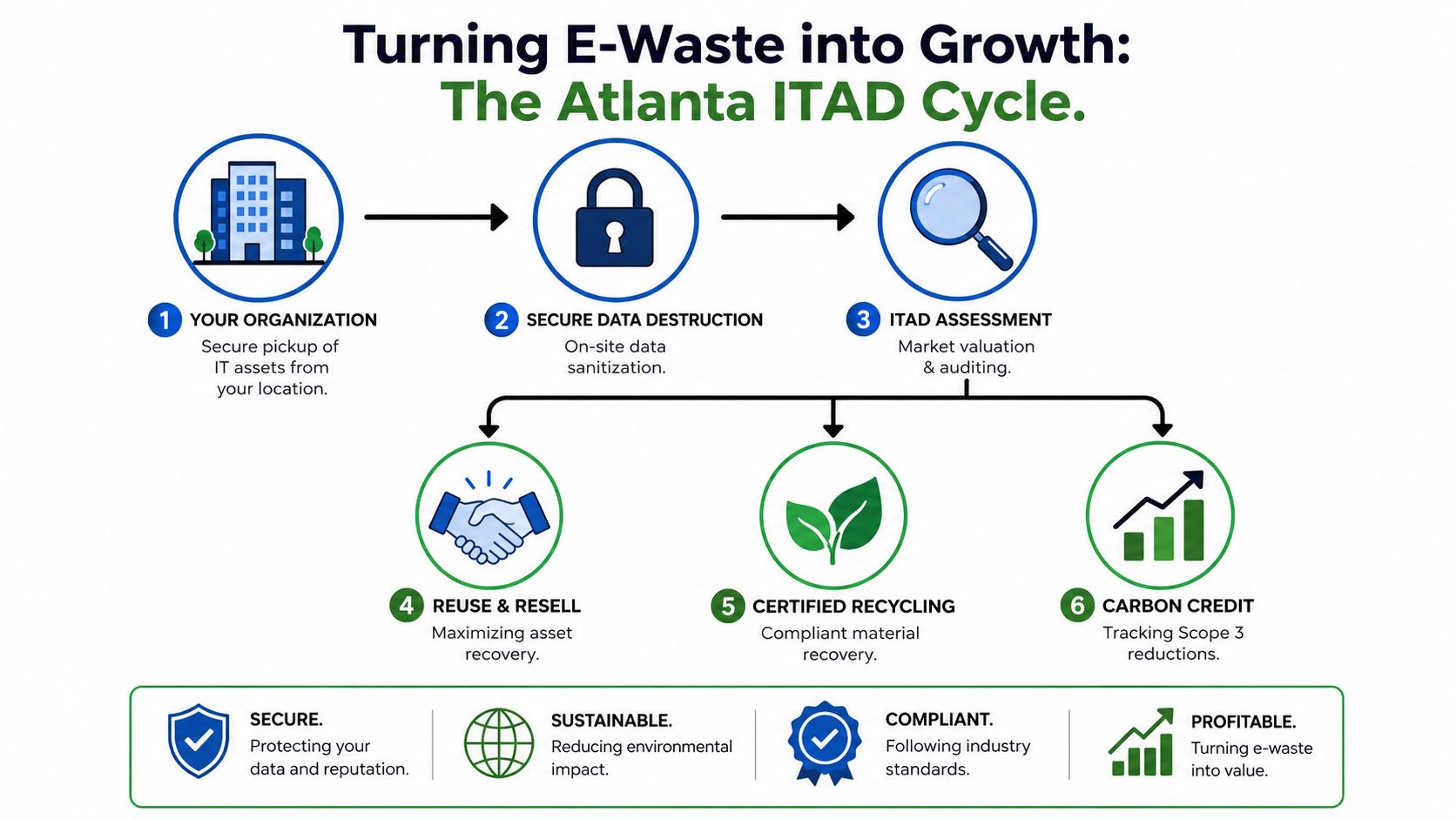
A practical ITAD workflow
Start with inventory and tagging. Every laptop, desktop, server, monitor, and peripheral should be accounted for before it leaves the site. That creates a clean asset list for valuation, destruction, or redeployment, and it also reduces disputes later in the process.
Next comes data sanitization or shredding. Hard drives that can be wiped should be wiped under a controlled process, while media that cannot be trusted should be destroyed on-site or off-site depending on the risk profile. If your team is moving batteries, damaged equipment, or mixed material across state lines, the Ship Restrict hazmat guide helps clarify packaging and transport constraints.
Then comes chain-of-custody documentation. That paperwork should show who handled the assets, where they went, and whether they were reused, recycled, or destroyed. Certificates of recycling and destruction make the program auditable and reduce ambiguity during vendor reviews.
Where value recovery fits
Residual value belongs in the same workflow, not in a separate afterthought. If devices still have market value, IT buyback can offset disposal costs and keep usable hardware in circulation. If the equipment is obsolete, product destruction may be the right choice for branded items, regulated devices, or assets that cannot re-enter the market safely. For Atlanta organizations, that mix of reuse, recovery, and certified recycling is where sustainability becomes a financial control, not just a reporting line.
Beyond Surplus's own services sit naturally in that process because they cover secure data destruction, IT equipment disposal, e-waste recycling, IT buyback, product destruction, and data center de-installations. Businesses that want the program handled through one vendor can use its Atlanta electronics recycling and ITAD guidance as a starting point for structuring pickups and documentation.
Best practice: build the pickup schedule, evidence trail, and reporting package at the same time. If those three pieces do not line up, the recycling program will not be useful in an audit.
An Atlanta Enterprise Scenario From Asset to Audit
A mid-sized Atlanta company with several offices and a small on-prem data room retires 400 laptops and one server rack over a quarter. The IT director does not treat that as a simple haul-away job. They schedule staged pickups, separate devices by condition, and decide which drives need on-site shredding versus controlled off-site destruction. That split matters because the risk profile is not the same for every asset, and the data room hardware follows the same retirement logic Atlanta firms use in data center decommissioning planning.
How the documentation trail gets built
The IT team first maps the equipment against internal inventory records, then assigns serial numbers to each device moving out. Once the assets are collected, the vendor issues serialized certificates of destruction for media that was shredded and recycling certificates for units processed downstream. That paper trail becomes part of the company's audit package, vendor risk file, and sustainability reporting.
For teams comparing software or process tools, a resource like Finchum Fixes IT asset management picks can help frame the kind of inventory control and lifecycle tracking needed before assets reach a recycler. The software itself is only part of the answer, though. The operational discipline has to extend to the pickup, the wipe or shred step, and the final certificate.
If some laptops still have resale value, IT buyback offsets replacement costs. If the devices are too old, the company still benefits from controlled disposal because the old hardware leaves the facility with documented handling. In regulated environments, that documentation helps narrow exposure tied to disposal practices, especially where confidentiality, payment data, or health information may be involved.
Why the compliance team cares too
The compliance team wants proof that disposal did not create exposure under the FTC Disposal Rule, and any HIPAA or PCI scope considerations were handled with appropriate care. Vendor assessments also improve when the company can show where retired hardware went and who managed it. That is why an end-of-life project touches more than IT. It affects legal review, finance, sustainability, and procurement.
Atlanta firms that repeat this process every quarter stop treating e-waste as an occasional cleanup. They turn it into a controlled operating rhythm with measurable records.
The Hidden Constraint Atlanta Operators Keep Missing
Atlanta's freight and e-commerce pressures are shaping sustainability decisions as much as energy and waste policy are. The Atlanta Regional Freight Mobility Plan points to a gap many operators miss, local planning often treats freight movement, curb access, and industrial land use as separate issues even though they shape where businesses can operate, how fast goods move, and what it costs to retire equipment responsibly. The report also notes that local plans often overlook e-commerce curb management, delivery zones, and preservation of industrial land use, even though industrial centers and freight movement are major economic drivers and job sources. For Atlanta businesses, that means site selection, warehouse access, last-mile delivery, and reverse logistics all sit inside the same policy environment.
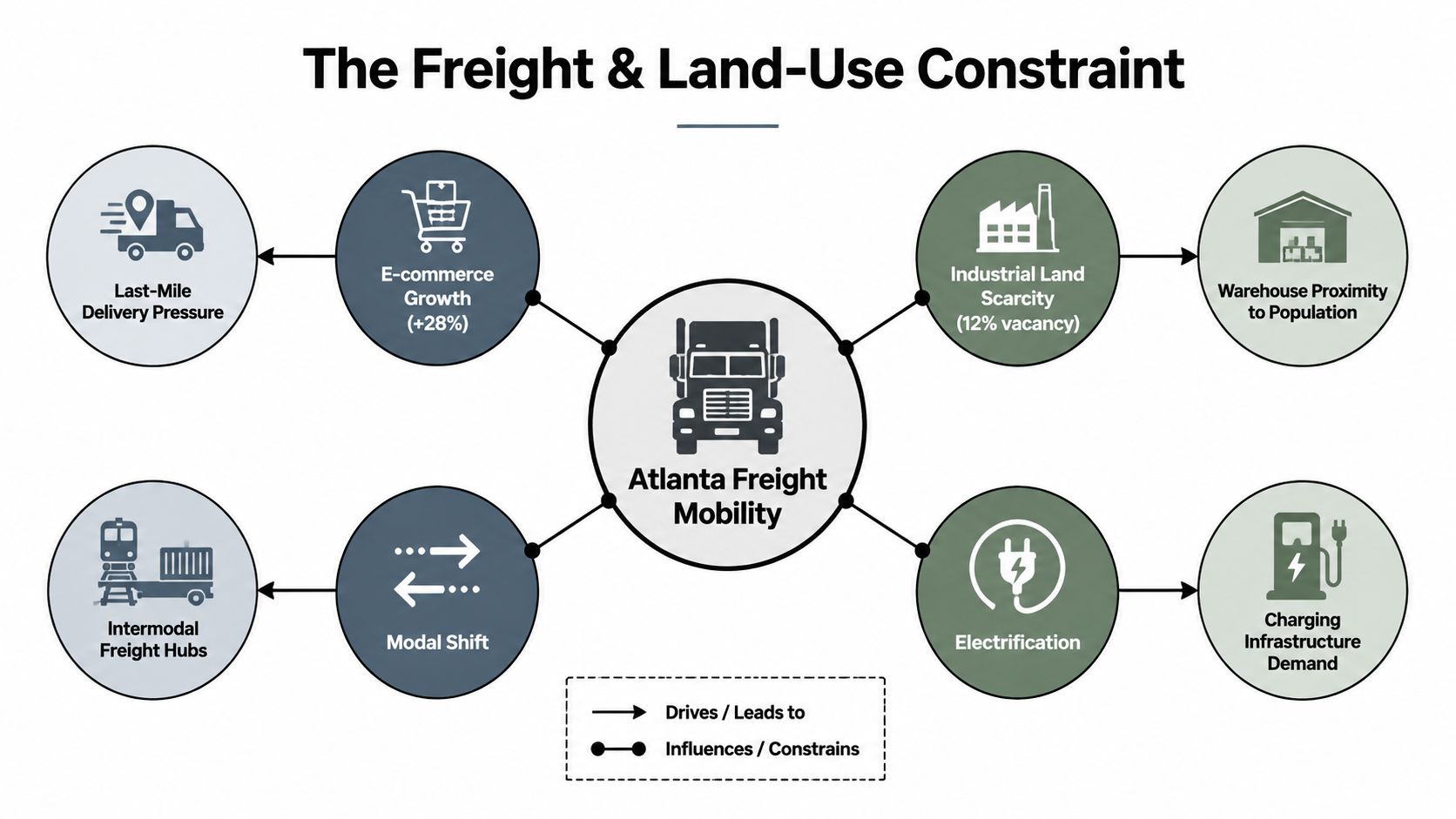
Why logistics teams should care about sustainability
Warehousing and transportation operators often control the same physical assets that later become ITAD projects. Edge devices, kiosks, barcode scanners, warehouse tablets, printers, and on-site networking gear all need secure retirement. If the logistics team and the IT team are not aligned, old devices can sit in storage, miss destruction windows, or move outside the formal chain of custody.
That is the operational risk. A company managing fleet routes and fulfillment centers may also be decommissioning hardware across multiple sites, often under different schedules and different managers. If curb policy, industrial space constraints, and delivery congestion are ignored in that planning, the company absorbs more handling cost and loses time on asset recovery.
Sustainability and logistics should sit in the same planning process in Atlanta. Companies that connect them face fewer surprises at the dock, the loading bay, and the audit table.
The freight plan also points to a competitiveness issue that matters beyond transportation. Preserving industrial land use supports the businesses that need proximity to customers, transit corridors, and intermodal access. That directly affects electronics reverse logistics, because used equipment still has to move efficiently from offices and warehouses to certified processors. When land access and curb use are strained, the disposal network slows down and gets more expensive.
For Atlanta operators, the practical takeaway is straightforward. Treat last-mile delivery, warehouse turnover, and equipment retirement as one system. Companies that do that can move hardware out faster, document it better, and keep sustainability goals aligned with the logistics reality on the ground.
Your Atlanta Sustainability Action Checklist for 2026
Atlanta businesses already have the regional data they need. The priority now is turning cleaner energy targets, better building performance, stronger diversion, and logistics planning into a tighter operating plan for 2026.
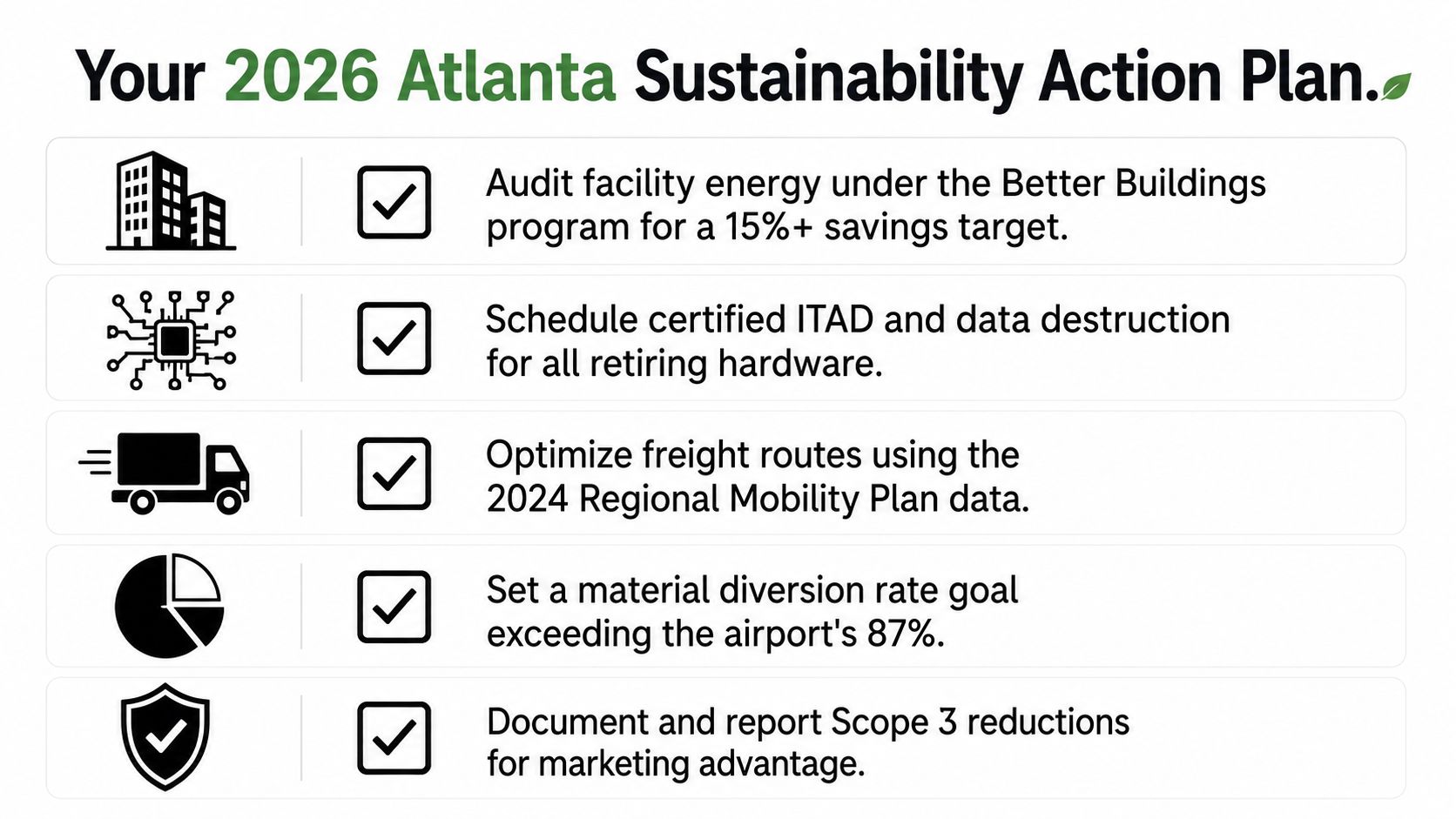
What to do this quarter
- Audit facility energy performance. Use your building data to identify the biggest savings opportunities and line them up with the city's clean-energy direction and building-efficiency programs.
- Schedule certified ITAD and data destruction. Retiring hardware should move through a documented process with secure wiping, shredding, or both, so devices stay inside a clear chain of custody.
- Make pickups recurring, not one-off. A regular e-waste program gives you better diversion visibility, cleaner reporting, and fewer gaps when equipment leaves the office, warehouse, or server room.
- Recover residual value where it exists. Buyback can reduce total disposal cost and keep usable equipment in circulation instead of sending it straight to recycling or destruction.
- Connect logistics with sustainability reporting. The team tracking freight, storage, and warehouse moves should also track device retirement, diversion outcomes, and any constraints that affect collection timing.
If your company needs a documented process for electronics recycling, secure IT asset disposal, data center decommissioning, or scheduled business pickups across Atlanta and the contiguous United States, Beyond Surplus can support the workflow from collection through certificates and downstream processing. Visit Beyond Surplus to set up a business-focused disposal plan that fits your compliance, facilities, and sustainability goals.


