
Your team has just retired a large laptop fleet, and the deadline is already on the calendar. Procurement wants the equipment removed, security wants proof that every drive is safe, finance wants any recoverable value, and sustainability needs a defensible downstream record. Treating that workload as a truck-and-dumpster exercise is how organizations lose control of data, money, and accountability.
Business electronics recycling is the final operating stage of the technology lifecycle. The right program separates equipment for redeployment, resale, parts recovery, secure destruction, and material recycling. It also gives IT directors and procurement leads an evidence trail that remains useful after the equipment leaves the building.
Table of Contents
- The Moment Recycling Becomes a Business Decision
- Why Business Electronics Recycling Is Under-Collected
- Compliance Requirements Every Enterprise Must Plan For
- Secure Data Destruction Methods That Hold Up in an Audit
- The End-to-End IT Asset Disposition Workflow
- How to Choose an Electronics Recycling Vendor
- Value Recovery and Cost Control in Practice
- Next Steps and Common Questions
The Moment Recycling Becomes a Business Decision
A refresh becomes an IT asset disposition problem the moment equipment leaves active service. A data center decommissioning creates the same pressure, especially when a lease deadline, facility closure, or infrastructure migration limits the time available for sorting and documentation.
Most IT teams plan purchases carefully. They compare specifications, negotiate contracts, assign owners, and schedule deployment. End-of-life planning often receives far less attention. That imbalance is costly because the closing stage determines three outcomes: regulatory exposure, residual data risk, and recoverable value.
A retired laptop isn't automatically waste. It may be suitable for redeployment, resale, parts harvesting, or donation through an approved channel. A server may contain storage media that requires a different treatment from its chassis. Medical equipment and laboratory equipment may need specialized assessment before either reuse or recycling. The disposition decision has to follow the asset, not a generic category such as “old electronics.”
Practical rule: Decide the disposition path before collection. Never let a recycler make an undocumented choice at the loading dock.
The final 1% of an asset's life can determine the entire outcome of the other 99%. If the organization can't connect a serial number to its owner, pickup record, sanitization result, and final disposition, it has a control gap. If a vendor reports only pallet weights, finance can't verify value recovery and sustainability can't substantiate diversion.
This matters even more across multiple locations. A single improvised pickup might create a manageable nuisance. Repeating the same weak process across offices, data centers, hospitals, schools, or manufacturing sites creates a systemic liability. The correct framing is simple: disposal is not merely an expense line. It's the last stage of asset recovery.
Why Business Electronics Recycling Is Under-Collected
The global e-waste gap is too large for enterprises to treat retired equipment as a secondary facilities task. In 2022, the world generated 62 million tonnes of e-waste, or about 7.8 kilograms per person, while only 22.3% was formally collected and recycled in an environmentally sound way, according to the UN Global E-waste Monitor 2024 announcement. The same source estimates that roughly US$62 billion in recoverable natural resources was left unaccounted for, with generation rising by about 2.6 million tonnes per year and projected to reach 82 million tonnes by 2030.
The United States reflects the same structural problem. The U.S. EPA's electronics materials data reports that, in 2018, about 2.7 million tons of selected consumer electronics were generated and 1.04 million tons were collected for recycling, a 38.5% recovery rate. Separately, the National Renewable Energy Laboratory's U.S. e-waste analysis states that the United States generated nearly 8 million tons of e-waste in 2022, with less than 20% formally collected and recycled.
| Category | Annual Generation (Mt) | Documented Recycling Rate |
|---|---|---|
| Global e-waste, 2022 | 62 | 22.3% |
| Selected U.S. consumer electronics, 2018 | 2.7 | 38.5% |
Business electronics recycling has different operating requirements from household drop-off programs. Enterprises must account for data-bearing media, asset ownership, lease returns, retention policies, procurement records, and resale controls. Bulk refreshes also arrive in concentrated waves. A weak process can leave hundreds of devices in storage, transfer equipment informally to employees or subsidiaries, or send mixed loads to a processor that can't provide item-level accountability.
What the gap means for IT leaders
Under-collection isn't just an environmental statistic. It signals that organizations are losing control of equipment before final disposition. The consequences include:
- Unresolved data exposure: Devices may remain accessible in storage rooms, staging areas, or informal transfer channels.
- Lost recovery value: Functional laptops, servers, networking equipment, and components can be mixed with scrap.
- Weak sustainability reporting: Weight tickets without asset records don't show what happened to reusable equipment.
- Vendor due-diligence risk: Downstream leakage can become an enterprise problem even when a subcontractor handled the final processing.
The business response is to design collection logistics deliberately. Consolidated pickup, de-installation support, serialized manifests, and reuse triage give more assets a formal route. That's particularly important for data-center operators and organizations with dispersed facilities, where packaging and transport decisions influence whether equipment is recovered or abandoned.
Compliance Requirements Every Enterprise Must Plan For
Compliance starts with the information stored on equipment, not with the equipment's resale value. The FTC Disposal Rule requires covered organizations handling consumer-report information to take reasonable measures to destroy or erase electronic files and media so the information can't be read or reconstructed. The rule also permits a qualified destruction contractor to perform the disposal, but outsourcing the task doesn't eliminate the enterprise's need to select, supervise, and document the process.
Healthcare, financial services, education, government, and other regulated environments may also face sector-specific obligations. HIPAA controls can apply to protected health information, GLBA safeguards can govern customer information held by financial institutions, and state requirements may affect electronics handling, take-back programs, and documentation. California's SB 1217 and New York's proposed electronics take-back obligations illustrate why a national policy can't rely on one state's assumptions.
Build the control around the strictest applicable requirement
Multi-state organizations should map obligations by location, asset type, and data class. A laptop from a finance team shouldn't automatically follow the same route as a monitor from a public workspace. A server containing regulated records may require physical destruction, while a reusable endpoint may be eligible for certified sanitization and resale.
Use the business e-waste law guidance from Beyond Surplus as a starting point for identifying questions, then have legal, privacy, and security teams confirm the rules that apply to your organization.
The contract should define:
- Asset accountability: Serial numbers, asset tags, quantities, and exceptions.
- Data controls: Approved methods by media type, verification requirements, and escalation procedures.
- Custody evidence: Signatures, timestamps, transport records, facility intake, and subcontractor disclosures.
- Final records: Certificates of Sanitization or Destruction, itemized recovery statements, and downstream documentation.
- Retention and access: Who stores the records, how they can be retrieved, and how long the enterprise retains them.
Compliance isn't a checklist completed by the recycler. The enterprise owns the obligation to demonstrate reasonable measures. The recycler produces the evidence that supports that position.
Secure Data Destruction Methods That Hold Up in an Audit
A resale decision fails the moment a vendor treats every device the same. NIST SP 800-88 Rev. 1 defines three sanitization methods, Clear, Purge, and Destroy. Use the NIST SP 800-88 Rev. 1 sanitization framework to set the decision rules, then require the vendor to document how each asset met them. The NIST 800-88 service overview also connects enterprise ITAD programs with credentials such as R2v3, ISO 27001, NAID AAA, ISO 14001, and ISO 9001.
Choose the method by storage technology, condition, encryption status, resale intent, and audit requirements. Your procedure should address SSDs, NVMe devices, self-encrypting drives, removable media, mobile devices, and damaged equipment separately.
Match the method to the media
| Media Type | Clear (Wipe/Overwrite) | Purge (Crypto Erase/Degauss) | Destroy (Shred/Crush) | Recommended Default |
|---|---|---|---|---|
| Magnetic HDD | Certified overwrite where supported | Degauss or approved purge method | Shred or crush if damaged | Clear for reuse, Destroy for failed media |
| SSD and NVMe | Limited use, verify device support | Cryptographic erase where validated | Physical destruction for high-risk or failed drives | Purge for reuse, Destroy when verification fails |
| Self-encrypting drive | Not a default | Crypto erase with documented key handling | Shred or crush when keys or device state are uncertain | Purge with evidence, otherwise Destroy |
| USB and removable media | Overwrite only where technically validated | Purge if supported | Shred or crush | Destroy for sensitive media |
| Mobile devices | Device reset alone isn't sufficient | Validated cryptographic erase | Physical destruction if verification fails | Purge with verification |
| Damaged or legacy media | Often unreliable | May not be supported | Shred or crush | Destroy |
Clear supports reuse when the technology and procedure permit reliable sanitization. Purge applies stronger logical or physical controls, including validated cryptographic erase or degaussing where appropriate. Destroy removes resale potential, but it provides the clearest control for damaged, unsupported, or highly sensitive media.
Write the decision before pickup
Your SOP must name the exception approver, define failed-verification handling, and specify the certificate the vendor issues. A drive that fails wiping goes to physical destruction, not resale. Record the exception, final method, operator, verification result, and asset identifier.
The trade-off is operational. Certified wiping preserves recovery value, but it requires testing, method validation, and evidence. Degaussing addresses supported magnetic media only. Shredding is irreversible and can eliminate resale value, so reserve it for cases where audit defensibility outweighs recovery. Require item-level records that let an auditor connect the approved method to the final disposition.
The End-to-End IT Asset Disposition Workflow
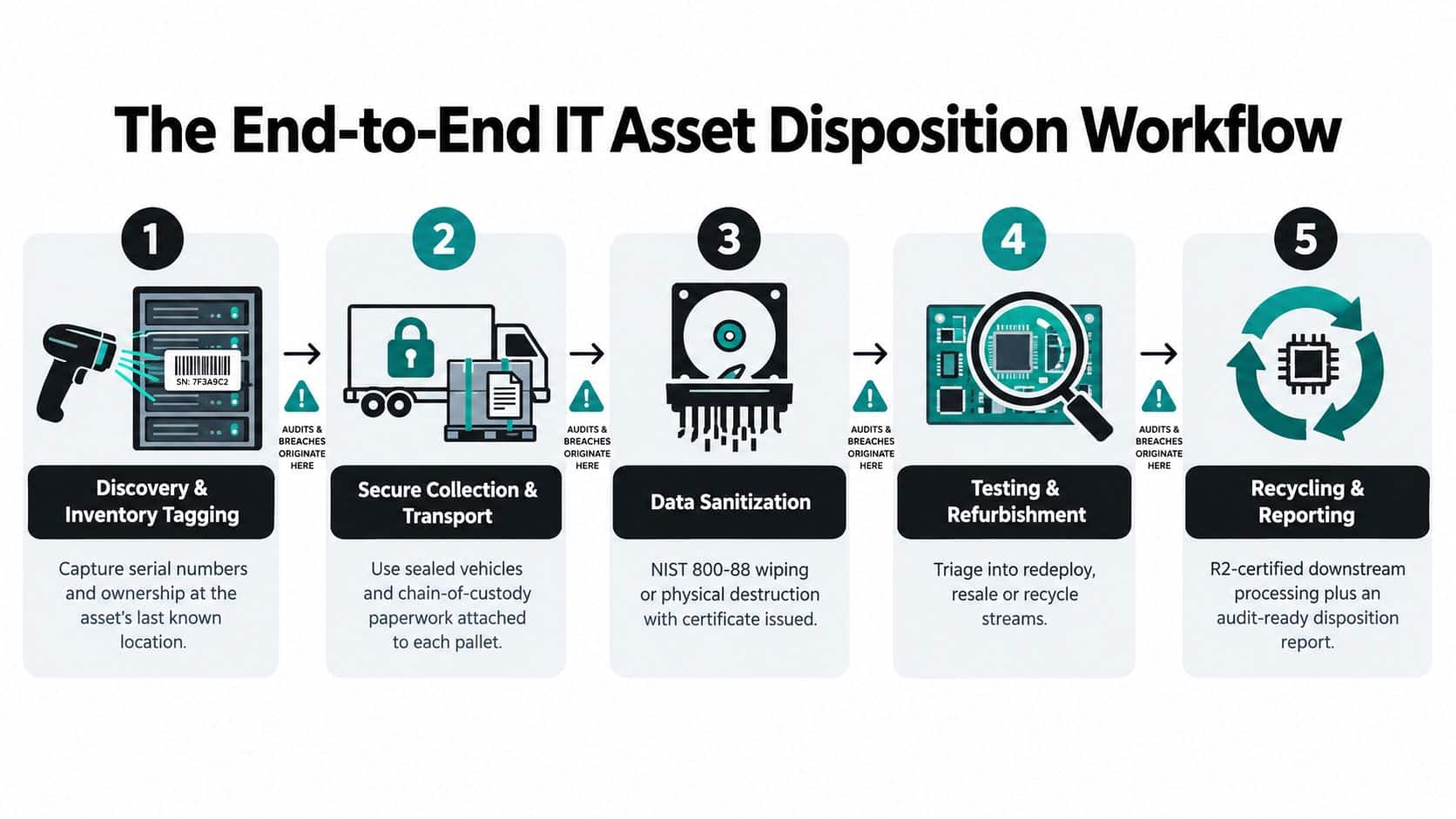
A reliable ITAD program is a controlled sequence. The gaps between steps create the exposure, so assign an owner to each handoff and keep one record system for the full chain.
Five steps that prevent loose ends
- Discovery and inventory tagging: Capture serial numbers, asset tags, user assignment, location, media type, and operating status while equipment is still under enterprise control.
- Secure collection and transport: Move assets to a locked staging area, use a signed manifest, and document custody through loading, transport, and facility intake.
- Data sanitization: Route each asset to Clear, Purge, or Destroy according to the preapproved rule. Record the method, date, operator, verification result, and exception.
- Testing and refurbishment: Separate redeployable, resale, parts, and recycling streams after sanitization and condition testing.
- Recycling and reporting: Obtain certificates, recovery statements, downstream weight tickets, and exception reports that reconcile to the original inventory.
Control the handoffs
The staging area should be access-controlled, and the manifest should survive every transfer. At intake, the processor should reconcile serial numbers, photograph condition where useful, and trigger the disposition rule for each asset class. Sensitive drives and encrypted media warrant documented dual control or other safeguards defined in the SOW.
The final package should include a Certificate of Destruction or Sanitization, an itemized value-recovery statement, and downstream weight tickets. If those documents don't reconcile to the original list, the program isn't closed.
Use a documented IT asset disposition guide for businesses to standardize the process across refresh cycles, office moves, data-center decommissioning, and lease returns. A repeatable workflow is more valuable than a polished one-time cleanup because it gives auditors the same answer every quarter.
How to Choose an Electronics Recycling Vendor
A vendor scorecard turns broad procurement language into a defensible decision. Don't award the work because a provider promises “secure recycling” or offers a convenient pickup. Require evidence that matches the risks in your asset population.
Evaluate at least three vendors using the same questions. Ask for current certification records, sample asset-level certificates, a facility review, downstream destination documentation, insurance details, and references from organizations with comparable volumes or regulatory obligations.
Use a practical decision matrix
| Evaluation Pillar | What to Verify | Weight (%) | Vendor A Score | Vendor B Score | Vendor C Score |
|---|---|---|---|---|---|
| Certifications | R2v3, e-Stewards, ISO 14001, NAID AAA, scope and current status | 25 | |||
| Chain of custody | Sealed transport, GPS-tracked vehicles, manifests, serial reconciliation | 30 | |||
| Reporting depth | Per-asset certificates, downstream destinations by weight, recovery lines | 25 | |||
| Financial terms | Baseline fees, revenue share, scrap charges, payment timing | 20 |
A certificate dated within the last twelve months proves more than a logo on a sales deck. An actual site audit shows whether the documented process matches the physical operation. A downstream report should identify the final processor for hazardous fractions. Eliminate vendors that won't disclose that destination.
Test regional and national capacity
Atlanta and Smyrna buyers should consider local pickup to simplify logistics, but local proximity isn't enough for multi-site enterprises. Confirm that the provider can coordinate nationwide collection, maintain one reporting standard, and manage unusual loads such as servers, networking gear, medical equipment, laboratory equipment, and product destruction projects.
Review Beyond Surplus's ITAD company information alongside other providers, then retain the completed scorecard in the procurement file. The record matters when the contract is renewed, the vendor changes ownership, or an auditor asks why the organization selected one processor over another.
Value Recovery and Cost Control in Practice
The strongest ITAD programs treat retired equipment as a net P&L decision, not a disposal expense. Track three separate lines: gross resale value from redeployable assets, processing costs for non-resale material, and avoided exposure associated with secure handling and defensible records.
Market structure matters. IBISWorld forecasts the U.S. electronic goods recycling industry to reach $29.1 billion in 2026, with revenue growing at a 3.8% CAGR through 2026, while projected profit falls to 4.6% and the sector relies heavily on direct or indirect government subsidies, according to its electronic goods recycling industry analysis. Those conditions make vendor economics important. A recycler's offer depends on resale demand, commodity prices, processing costs, compliance controls, and the quality of the lot.
Separate recovery from scrap
Buyback pricing commonly reflects device class, generation, cosmetic grade, verified data sanitization, and lot composition. A mixed shipment of recent laptops with complete accessories won't price like a damaged load of obsolete desktops, monitors, and unsupported drives. Keep the quote itemized so the enterprise can see what is being resold, recycled, destroyed, or charged.
The value recovery guidance for used business IT assets supports the right commercial question: which assets should be recovered, and which should be destroyed or recycled? Don't force every asset into resale. Data sensitivity and condition can make irreversible destruction the correct financial and compliance decision.
| Pricing Model | Who Pays / Earns | Best Fit | Watch-Out |
|---|---|---|---|
| Flat per-device fee | Enterprise pays a defined handling or processing charge | Predictable budgets and low-value mixed equipment | Can hide resale proceeds or exception charges |
| Revenue share | Vendor sells eligible assets and shares proceeds | Equipment with clear remarketing demand | Require sale records, deductions, and payout timing |
| Hybrid | Fixed service terms plus recovery allocation | Mixed fleets containing resale and scrap streams | Define every fee, threshold, and residual category |
Require the contract to disclose brokers, deductions, payment timing, failed-sanitization charges, freight treatment, and scrap residuals. A recovery statement should reconcile to asset IDs, not merely report a lump-sum payment. That level of detail lets finance test whether the vendor's offer is better than a pure recycling quote.
Next Steps and Common Questions
Give procurement this checklist:
- Inventory the refresh or decommissioning scope.
- Classify devices by media type and data sensitivity.
- Approve the wipe-versus-shred policy before pickup.
- Shortlist vendors with relevant R2v3 and e-Stewards credentials.
- Request lot-specific quotes with separate resale and scrap lines.
- Lock custody controls and certificate formats into the SOW.
- Schedule pickup with serialized receiving reports.
Questions enterprise buyers ask
Who owns residual data risk after pickup? Your contract should define responsibility, but the enterprise still needs evidence that the provider used reasonable measures and followed the agreed process.
How long should certificates be retained? Set the retention period with legal, privacy, and records-management teams. The vendor should provide searchable records in a durable format.
Can devices be donated for a tax credit? Possibly, depending on ownership, valuation, recipient eligibility, and tax advice. Don't treat a donation receipt as a substitute for sanitization or asset reconciliation.
What insurance should the carrier hold? Require coverage appropriate to the equipment, transport activity, custody risk, and contractual indemnities. Ask for current certificates rather than accepting a verbal assurance.
How should Atlanta, Smyrna, and Southeast organizations manage service? Use on-site collection and documented processing where the scope justifies it. National organizations should require coordinated regional pickups under one reporting and security standard.
Start with a scoped inventory, not a generic request for “electronics recycling.” Ask vendors to price the actual asset mix and show the records they'll deliver.
Beyond Surplus provides business electronics recycling, secure data destruction, IT equipment disposal, value recovery, product destruction, and data-center de-installation support, with nationwide pickup available for organizations. Visit Beyond Surplus to request a scoped quote and define the custody, sanitization, recovery, and reporting requirements for your next technology refresh.


