
A company has shut down its on-premises server room. Inside a locked cage sit 140 laptops, 18 switches, and four SAN shelves. The equipment is powered down, but the liability is still active. Every device may contain regulated data, residual contract obligations, and recoverable capital.
That's why IT equipment recycling is a compliance and value-recovery decision, not a sustainability talking point. A credible program identifies every asset, protects data, separates reuse from material recovery, and returns documentation that procurement, legal, auditors, and insurers can understand.
Table of Contents
- Why IT Equipment Recycling Matters for Your Business
- What IT Equipment Recycling Actually Covers
- The Standard Processing Flow From Pickup to Certificate
- Compliance Requirements Businesses Cannot Skip
- Value Recovery Through Buyback and Resale
- How to Choose the Right Recycling Vendor
- Atlanta and Smyrna Options Plus Nationwide Pickup
- Vendor Checklist and Frequently Asked Questions
Why IT Equipment Recycling Matters for Your Business
The first risk is data exposure. A retired laptop, storage shelf, or network appliance can retain customer records, credentials, financial information, or internal files long after an employee stops using it. The FTC Disposal Rule requires covered businesses to use disposal practices that are reasonable and appropriate to prevent unauthorized access to consumer report information. It specifically recognizes secure erasure, shredding, pulverizing, or destruction that makes electronic information unreadable or unreconstructable.
The second risk is downstream handling. A business can complete a careful pickup and still face exposure if its vendor passes equipment to an undisclosed broker, exporter, or informal processor. Texas guidance, for example, requires businesses to conduct a waste determination before disposing of electronics and sets identification-number triggers for certain waste streams, including more than 220 pounds of hazardous waste per month, more than 220 pounds of non-hazardous Class 1 waste per month, or more than 2.2 pounds of acute hazardous waste per month. Those thresholds are described in Texas e-recycling compliance guidance.
The capital sitting in the cage
The third issue is value. Working laptops, servers, switches, and storage components may qualify for redeployment, refurbishment, or resale. Sending everything directly to a shredder destroys potential recovery before anyone has tested condition, configuration, or marketability.
Global waste volumes make poor processing more consequential. The world generated 62 million tonnes of e-waste in 2022, equal to about 7.8 kg per person, while only 22.3% was formally collected and recycled in an environmentally sound manner, according to The Global E-waste Monitor 2024. Small IT and telecommunications equipment accounted for 4.6 million tonnes, with about 22% documented as collected and recycled.
For a first-time buyer, the practical test is simple: can the vendor show a clear processing flow, protect data, document each handoff, explain the value decision, and support Atlanta-area or nationwide logistics? The rest of this guide gives you that operating model and an audit-ready checklist. A useful starting point for the reporting side is how businesses can improve ESG through IT recycling.
What IT Equipment Recycling Actually Covers
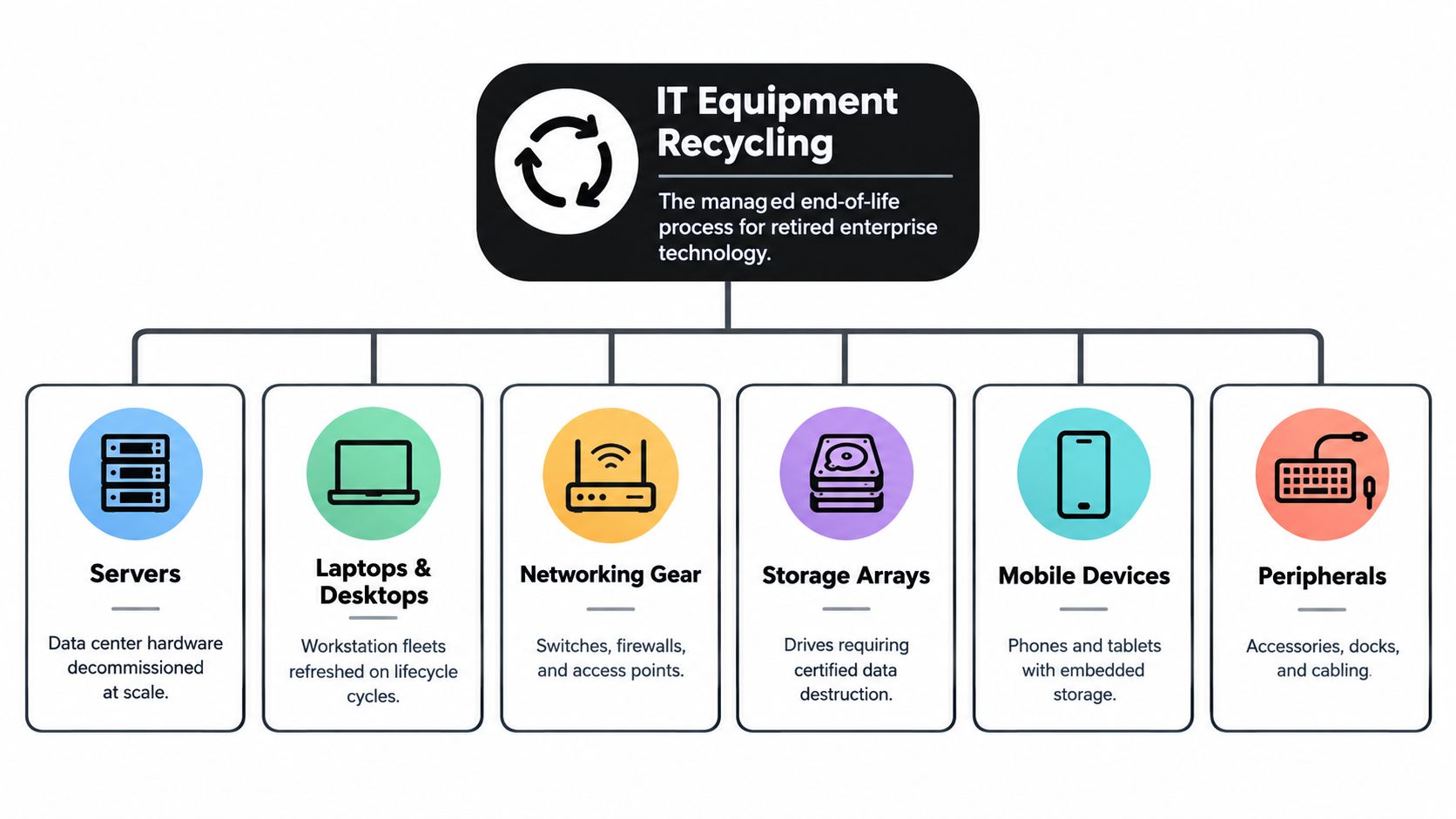
IT equipment recycling is the managed end-of-life process for enterprise technology. It belongs inside an IT Asset Disposition, or ITAD, program, not inside a general facilities cleanup order.
The scope commonly includes:
- Servers: Rack hardware, tower systems, blades, and data center components.
- Laptops and desktops: Employee fleets, engineering workstations, thin clients, and spare devices.
- Networking gear: Switches, firewalls, routers, wireless access points, and transceivers.
- Storage arrays: SAN shelves, disk enclosures, hard drives, SSDs, and backup media.
- Mobile devices: Phones, tablets, handheld scanners, and embedded-storage equipment.
- Peripherals: Monitors, docks, keyboards, printers, copiers, cabling, and accessories.
Three outcomes that vendors must separate
Reuse means a working asset is redeployed to another user, location, or organization. The vendor should retain a resale or redeployment trail, including the asset identifier and the approved data-sanitization result.
Refurbishment means technicians test, repair, grade, wipe, and remarket equipment or components. This route often preserves more value than immediate material processing, but it also requires tighter quality controls and a documented secondary-market channel.
Material recycling applies when an asset is obsolete, damaged, uneconomical to repair, or unsuitable for reuse. The equipment is dismantled and processed so steel, aluminum, copper, plastics, and printed circuit boards can enter appropriate commodity-recovery streams.
Those outcomes aren't interchangeable. Reuse and refurbishment require stronger product and resale records. Material recycling requires evidence that the equipment reached an accountable processor and that storage media were handled correctly.
Why the chassis isn't the whole asset
Hard drives, SSDs, memory modules, batteries, and toner can require separate handling. A vendor that lists only “computers recycled” hasn't shown what happened to the storage media or embedded batteries.
EPA guidance also describes conditional pathways under which certain electronics managed for reuse or recycling can be excluded from the Resource Conservation and Recovery Act definition of solid waste. The distinction depends on how equipment is processed, stored, and transferred, which is why a business should ask for the vendor's ITAD services and downstream procedures before the loading dock opens.
The Standard Processing Flow From Pickup to Certificate
A defensible program follows a sequence. The vendor shouldn't issue a polished certificate while the underlying inventory is still unresolved.
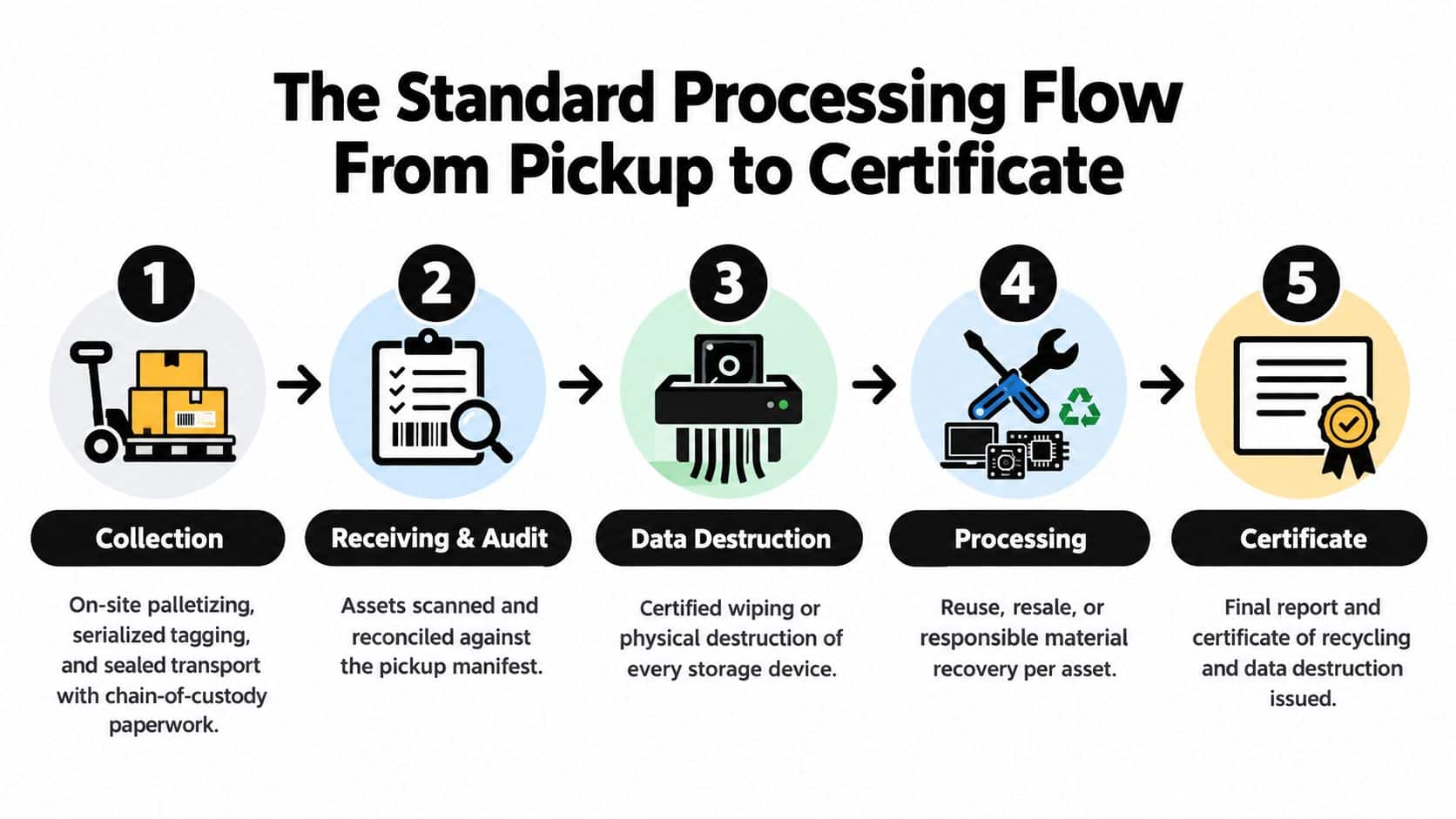
1. Collection and receiving
The process starts at the customer's dock. Technicians palletize equipment, apply serialized tags, and record the condition and quantity against a pickup manifest. Sealed transport and signed chain-of-custody paperwork establish who accepted the assets and when.
At the receiving facility, staff scan each item and reconcile the scan against the manifest. Missing serials, duplicate tags, unlisted drives, and damaged containers should be exceptions, not silent adjustments.
2. Data destruction
Storage devices need a decision based on data sensitivity, device type, and intended disposition. Certified wiping may suit some reusable equipment. Purge or physical destruction may be appropriate when recovery risk, device condition, or policy requires it.
The vendor should capture scan evidence for every drive and associate the method, result, date, and technician with the relevant serial number. A generic statement that “all data was erased” doesn't prove that every storage device was processed.
3. Refurbishment and testing
Technicians test functionality, assess cosmetic condition, verify the wipe result, and harvest usable components. The vendor then assigns the asset to redeployment, resale, parts recovery, or recycling.
4. Material processing
Non-reusable equipment is dismantled and sent through controlled processing. Research on staged e-waste recovery describes sorting and dismantling before shredding, followed by magnetic separation for ferrous metals and eddy-current systems for non-ferrous metals and non-metals. E-waste contains recoverable gold, silver, copper, iron, and rare-earth elements. Upstream sorting affects downstream yield and purity.
5. Final reconciliation
The deliverables should include a Certificate of Data Destruction, Certificate of Recycling, and asset-level manifest showing resale, redeployment, parts recovery, or recycling for each serial.
Operational rule: Certificates should follow reconciliation, not precede it.
The common failures are predictable: missing per-drive evidence, mixed downstream channels that no one can audit, and certificates issued before the final processor confirms disposition. Ask the vendor to explain how it closes those gaps and review its chain-of-custody process before signing.
Compliance Requirements Businesses Cannot Skip
The FTC rule is not satisfied by the word “recycled.” It requires reasonable and appropriate disposal practices that prevent unauthorized access to consumer report information. For procurement and IT managers, that means writing the required controls into the statement of work instead of treating certificates as an afterthought.
A strong contract calls for sanitization aligned with NIST SP 800-88 Rev. 1, using Clear, Purge, or Destroy methods appropriate to each media type. The vendor should document whether a laptop drive was wiped for reuse, whether an SSD required a different purge approach, or whether a failed storage device was physically destroyed. NIST 800-88 data destruction standards provide a useful framework for defining those requirements.
Documents that survive an audit
Require these outputs:
- Signed Bill of Lading: Establishes the transport record.
- Serialized receiving report: Confirms what arrived and identifies exceptions.
- Asset-level sanitization record: Names the method and result for each storage device.
- Certificate of Destruction: Includes the date, technician identity, and covered serials.
- Certificate of Recycling: Identifies the recycling outcome and applicable asset group.
- Downstream attestation: Shows where material or reusable equipment went next.
Frameworks such as HIPAA, FACTA, GLBA, state breach laws, and e-Stewards requirements may apply differently depending on the data, organization, and vendor program. Don't assume one document satisfies every obligation. A recycling certificate alone may show material processing, but it doesn't necessarily prove that consumer report information was rendered unreadable.
Documentation Required by Compliance Framework
| Framework | Required Vendor Output | Client Audit Trigger |
|---|---|---|
| FTC Disposal Rule | Documented secure disposal method and contractor controls | Consumer report information handled without evidence of unreadability |
| HIPAA | Media-specific sanitization record and accountable chain of custody | Protected health information leaves control without documented safeguards |
| FACTA and GLBA | Destruction evidence tied to covered assets and service-provider oversight | Financial or consumer information is disposed of through an unverified channel |
| State breach laws | Asset and media records supporting investigation and response | A lost device or unclear handoff creates uncertainty about exposure |
| e-Stewards or equivalent program requirements | Certified process controls and downstream accountability | Vendor cannot disclose or verify material and reuse destinations |
State rules can add facility-level obligations. New York, for example, requires electronic waste facility owners and operators to register at least 90 days before receiving electronic waste, pay a one-time $250 registration fee, submit a closure plan, maintain financial assurance, and remove electronic waste within one year of receipt, as summarized by NSF's e-waste recycling certification guidance. Those requirements demonstrate why the receiving facility matters as much as the pickup truck.
Value Recovery Through Buyback and Resale
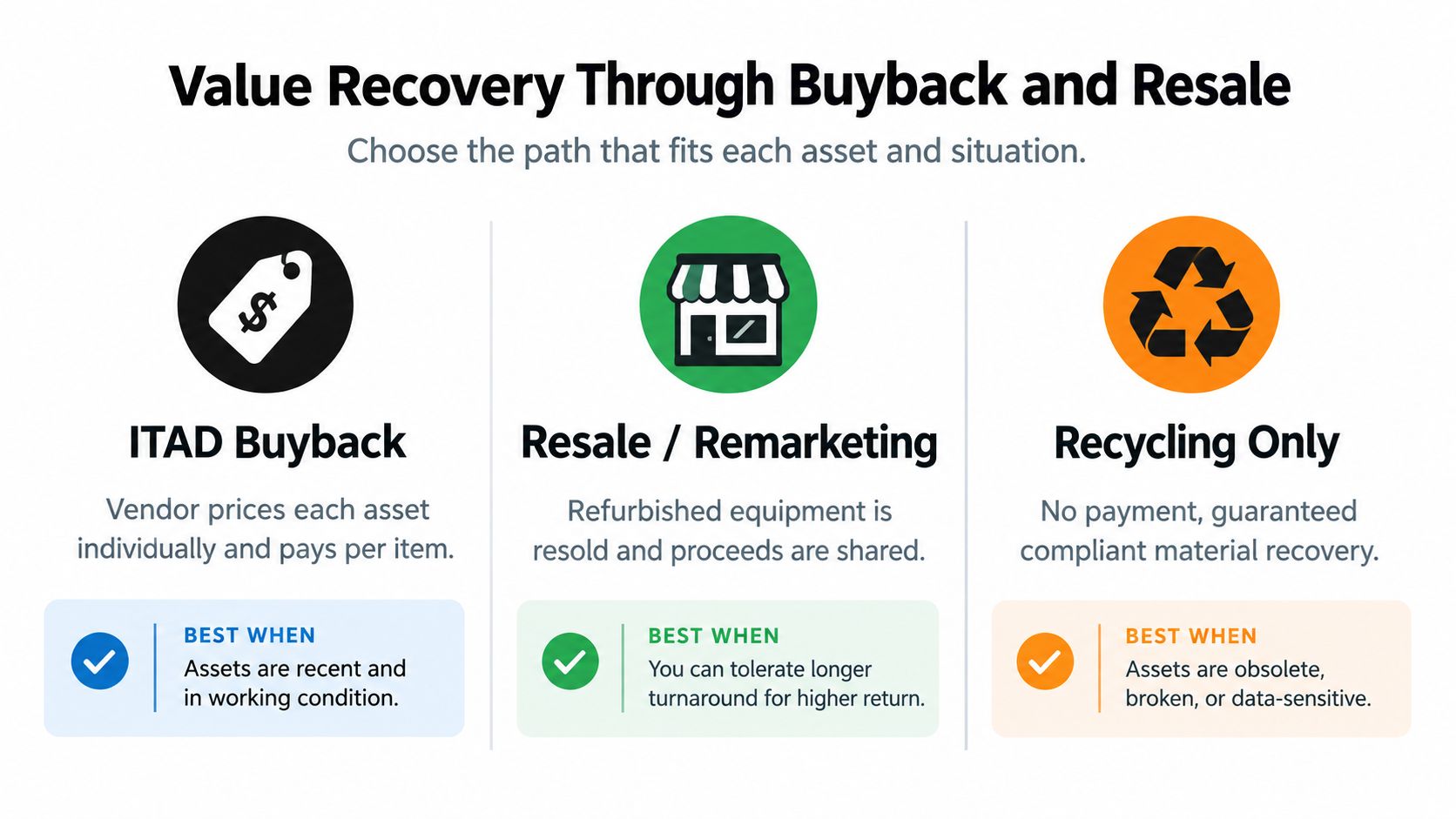
Treat the financial decision as primary, with compliance and ESG as constraints. A working laptop should not be priced like shredded steel, and a failed SAN drive shouldn't enter resale because the vendor wants a higher margin.
ITAD buyback is the fastest route to a defined financial settlement. The vendor prices individual assets against secondary-market demand, condition, specifications, and lot composition, then issues a credit or payment. It works best when equipment is recent, complete, and operational.
Redeployment keeps usable equipment inside the organization or moves it to a secondary user, donation recipient, or spare-parts pool. It can produce strong operational value, but it requires imaging, access control, wipe verification, and an internal recipient who can use the equipment.
Charitable donation may support a tax receipt and a clear ESG narrative, but it can produce lower cash recovery and require more coordination. Donation is a disposition choice, not a substitute for data destruction.
What changes the settlement
Per-unit pricing depends on age, technical specification, cosmetic grade, lot size, completeness, and whether storage devices are present or already removed. Market demand can also change between quotation and settlement, so the contract needs more than a headline offer.
Ask whether the proposal provides a guaranteed minimum value or a best-effort quote. Define who absorbs a market decline, how rejected assets are handled, when payment is due, and whether the vendor can substitute scrap valuation after testing.
For broader facility procurement, teams may also find it useful to compare affordable prefab structures when planning temporary storage, staging, or site reconfiguration around an equipment refresh. The resource is relevant because logistics space often determines whether a controlled disposition can proceed without mixing old and new inventory.
Use a documented used business IT asset recovery process that assigns every asset one path. The right disposition is the one that preserves value without weakening the evidence trail.
How to Choose the Right Recycling Vendor
Choose vendors by the liability they can absorb and prove, not by the number of logos on their homepage.
Tier one requirements
Start with current certifications and audit evidence. Depending on the service scope, look for R2v3, e-Stewards, NAID AAA, or RIOS certification, then ask to review current audit reports or certificates rather than accepting an unsupported claim.
The vendor must also show documented chain of custody from pickup through the refurbisher, smelter, or commodity buyer. For data-bearing assets, require NIST SP 800-88-aligned processing and serialized certificates for each storage device.
Commercial liability insurance matters. Require environmental and cyber coverage, confirm the limits in writing, and ask whether your organization can be named as an additional insured. A vendor that refuses to discuss insurance hasn't demonstrated that it can support the risk it wants you to transfer.
Tier two controls
The operating details reveal whether the program is real:
- Destruction location: Prefer on-site destruction for highly regulated data or environments that can't release media before processing.
- Pickup security: Require locked vehicles, sealed loads, and two-person protocols where your risk profile demands them.
- Asset tagging: Have staff tag and scan equipment at your dock before removal.
- Downstream disclosure: Obtain the names and roles of material processors, refurbishers, and resale channels.
Vendor test: If the provider can't explain the handoff after its own facility, you don't have a complete chain of custody.
Tier three evidence
Ask for ESG-ready manifests that report weight and downstream outcome, a defined reporting cadence, evidence of financial stability, and references from organizations with similar asset volumes and compliance requirements. A broker can coordinate transportation, but undisclosed subcontracting is a liability gap. If equipment is later exported illegally or appears on the secondary market with data intact, your organization may still face questions.
Vendor Evaluation Criteria Ranked by Liability Impact
| Tier | Criterion | What to Verify |
|---|---|---|
| One | Certification and audit status | Current R2v3, e-Stewards, NAID AAA, or RIOS evidence |
| One | Chain of custody | Every handoff from customer dock to final downstream destination |
| One | Data destruction | NIST-aligned method and serialized proof per storage device |
| One | Insurance | Environmental and cyber coverage, with additional-insured terms |
| Two | Pickup controls | Sealed transport, locked vehicles, tagging, and scan procedures |
| Two | Processing options | On-site and off-site destruction, with witnessed logging where needed |
| Three | Reporting and stability | ESG manifests, reporting cadence, financial health, and peer references |
Atlanta and Smyrna Options Plus Nationwide Pickup
An Atlanta business with a small surplus may consider facility drop-off at a certified ITAD processor near the I-285 corridor. That can work for a small batch, particularly when the equipment is already consolidated and the team has a complete inventory. It shouldn't replace a documented intake process.
Scheduled pickup suits offices across Fulton and Cobb counties, while data centers in Midtown or Buckhead may need a faster response coordinated around a maintenance window. A proper commercial pickup includes palletizing, serialized scanning, sealed transport, and a named account manager who owns exceptions.
Local convenience versus controlled logistics
Drop-off is appropriate for ten or fewer assets when the equipment is easy to move and the organization can preserve custody until handover. Multi-site refreshes need enterprise logistics. One account manager should coordinate office locations, data center decommissions, remote branches, and final reporting instead of forcing each site to manage a separate vendor relationship.
Nationwide pickup extends the same controls to remote offices. Local proximity is useful, but it isn't the deciding factor. Pickup seals, serial-number logging, receiving reconciliation, and downstream transparency matter more than a short drive to a recycler.
A regional consolidation warehouse can make sense when Atlanta has enough volume to support controlled staging before final processing. It can reduce fragmented shipments and simplify reporting, provided the warehouse is disclosed, secure, and covered by the vendor's operating controls.
For Smyrna-based recyclers, verify the actual certification of the facility receiving the assets. Ask whether the destination is Georgia E-registered where applicable, whether it holds R2v3 or e-Stewards certification, and whether the provider is a processor or a broker. Don't release equipment from the loading dock until those answers are documented.
Vendor Checklist and Frequently Asked Questions
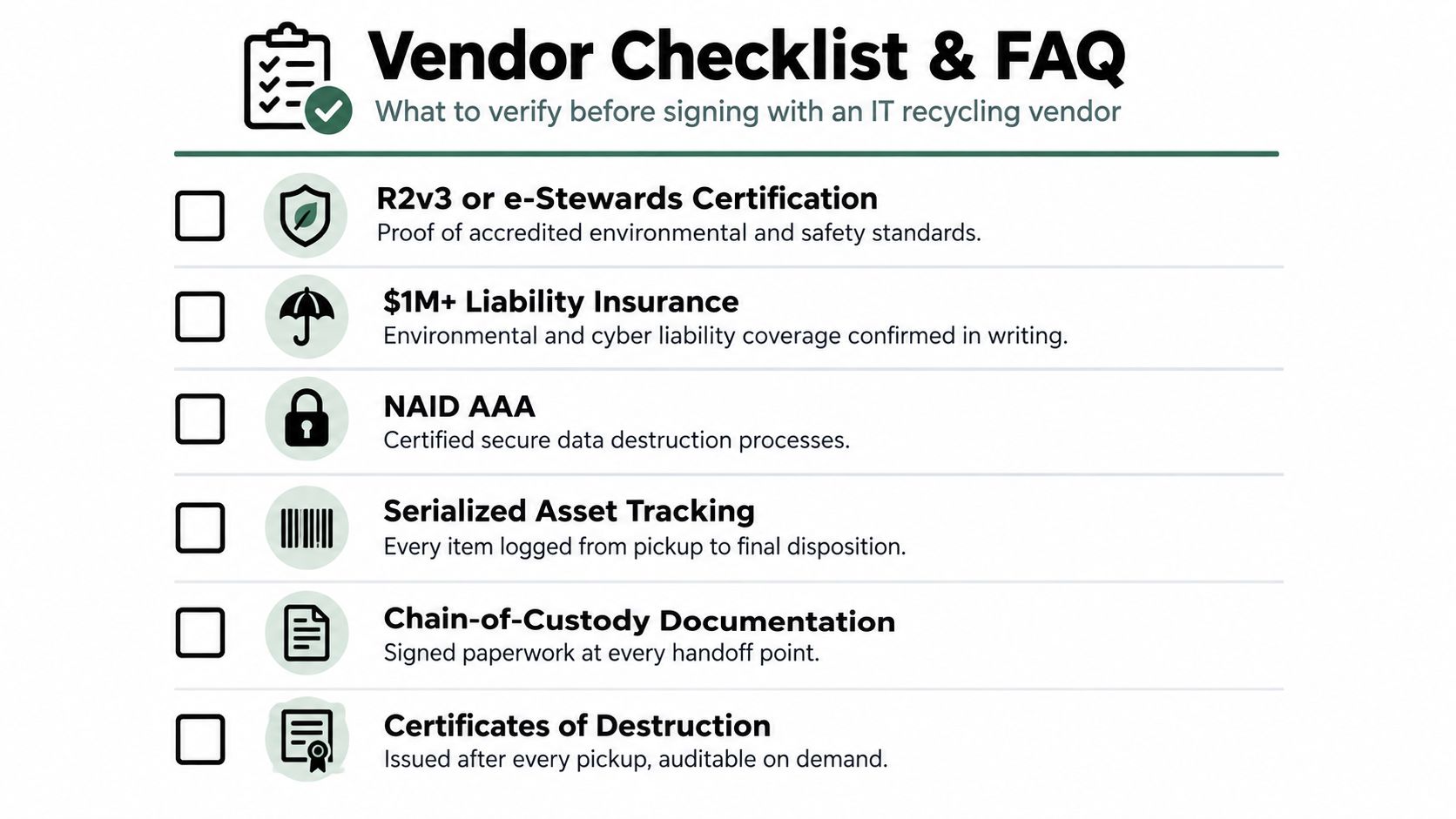
Use this checklist before signing:
- R2v3 or e-Stewards certification: Confirm the certificate, scope, facility, and current status.
- Environmental and cyber liability insurance: Verify the policy in writing and ask about additional-insured terms.
- NAID AAA: Confirm certification when secure data destruction is part of the scope.
- Serialized tracking: Require every asset and storage device to remain identifiable.
- Downstream disclosure: Obtain processor and refurbisher information before pickup.
- On-site witnessed purge: Confirm availability for regulated or high-risk media.
- Certificates: Require separate, serialized certificates for destruction and recycling.
- Chain of custody: Review the paperwork used at pickup, receiving, transfer, and final disposition.
Frequently asked questions
Does a Certificate of Recycling satisfy the FTC Disposal Rule?
Not by itself. It can document material recovery, but the vendor must also show that consumer report information was erased or destroyed so it can't be read or reconstructed. Require a destruction record tied to each relevant storage device.
How are buyback payouts calculated?
A credible offer considers fair-market demand, age, specifications, working condition, cosmetic grade, completeness, lot size, and storage configuration. Scrap weight shouldn't replace asset-level valuation when equipment has resale potential.
Do SSDs and encrypted drives require physical destruction?
Not automatically. The correct method depends on the device, encryption controls, intended disposition, and policy. Require a documented method that addresses the specific media rather than accepting a blanket statement.
How long should records be retained?
Follow your legal, regulatory, contractual, and insurance requirements. Your retention policy should preserve certificates, manifests, destruction logs, and downstream evidence for as long as an audit, claim, or investigation could reasonably require them.
Who owns residual data liability after pickup?
The contract must define responsibility, but pickup doesn't erase the client's need for vendor oversight. Liability can remain disputed if the provider uses undisclosed subcontractors or fails to prove destruction.
What insurance responds if a device reappears with data intact?
Ask the vendor's broker about cyber, technology errors and omissions, environmental liability, and any exclusions involving secondary-market equipment. Get the answer in writing before award.
The decision rule is direct: choose the vendor that can prove every asset's custody, data outcome, and final disposition, then contract for the value recovery it promises.
Beyond Surplus provides commercial IT equipment disposal, secure data wiping and hard drive shredding, electronics recycling, product destruction, IT buyback, and data center de-installation support with nationwide pickup available for business customers. Review the service scope and documentation options at Beyond Surplus, then request a controlled pickup plan for your Atlanta, Smyrna, or multi-site asset refresh.


