
A fleet refresh rarely ends when the new equipment arrives. The old laptops are stacked beside the loading dock, servers are waiting for transport, and asset tags have been removed while storage media remains inside. Then procurement asks a question that should have been answered before pickup: who is signing the certificate, and what exactly does it certify?
That question exposes the core issue with IT asset recycling. A business isn't only moving obsolete hardware out of the building. It's deciding where the data will be destroyed, who carries liability during transport and processing, which rules apply, and how much residual value can be recovered. IT asset disposition, or ITAD, provides the controlled process. Recycling is one downstream outcome for equipment that can't be reused or remarketed.
Table of Contents
- Why IT Asset Recycling Is Suddenly a Strategic Decision
- What IT Asset Recycling Actually Covers
- The Market and the E-Waste Gap Behind the Headlines
- Compliance Rules That Drive Your Recycling Program
- Data Destruction Methods Matched to the Right Devices
- Chain of Custody and the Certificate That Closes the Loop
- Choosing an IT Asset Recycling Partner You Can Audit
- Next Steps for IT Managers and Facility Leaders
Why IT Asset Recycling Is Suddenly a Strategic Decision
A fleet refresh turns recycling into an operating decision. IT needs the old devices removed, security needs evidence that every drive was sanitized, finance wants recoverable value, and facilities needs a controlled handoff. If those requirements are managed separately, the equipment may leave the building while data liability remains unresolved.
ITAD connects those decisions through inventory, secure collection, data sanitization, valuation, remarketing, parts recovery, recycling, and reporting. IT asset recycling is the material-recovery stage for assets that aren't suitable for continued use. It should follow a documented decision on whether each device can be securely reused, resold, harvested for parts, or destroyed.
Before pickup, require clear answers to four questions:
- Where does the data die? Identify the media type, sanitization or destruction method, verification process, and responsible operator.
- Who carries liability? Define custody, transport, subcontractors, downstream processors, and insurance in the contract.
- Which compliance rules apply? The FTC Disposal Rule, recognized media-sanitization practices, and international shipment controls can change the workflow.
- How is value recovered? Reusable equipment may support redeployment or resale. Obsolete units should enter controlled material recovery.
Business leaders can also review how IT recycling supports ESG objectives, but an ESG report cannot substitute for operational records. A weight ticket does not prove that a laptop's storage was sanitized. A generic recycling receipt does not show who handled a server, which downstream processor received it, or where its components went.
Practical rule: Treat every device leaving the building as both a data-bearing asset and a material stream until your records prove otherwise.
That makes vendor selection a risk decision, not a facilities purchase. Require certificates tied to asset identifiers, documented chain of custody, defined destruction standards, and reporting that distinguishes reuse, parts recovery, and recycling. Compliance requirements and data-destruction choices determine whether the recycling outcome is defensible.
The market reflects this shift. The global ITAD market was estimated at USD 25.31 billion in 2024 and is projected to reach USD 54.54 billion by 2030, with a projected 14.0% CAGR from 2025 to 2030, according to Grand View Research's IT asset disposition market analysis. ITAD belongs in risk management, sustainability reporting, and capital recovery discussions, not only facilities logistics.
What IT Asset Recycling Actually Covers
IT asset recycling is controlled processing for hardware that has reached the end of its useful or commercial life. That may include obsolete laptops, failed servers, retired storage systems, network equipment, medical devices, laboratory equipment, monitors, and other business electronics. It isn't the same as generic e-waste collection, because a commercial program must address data, inventory, custody, downstream handling, and documentation.
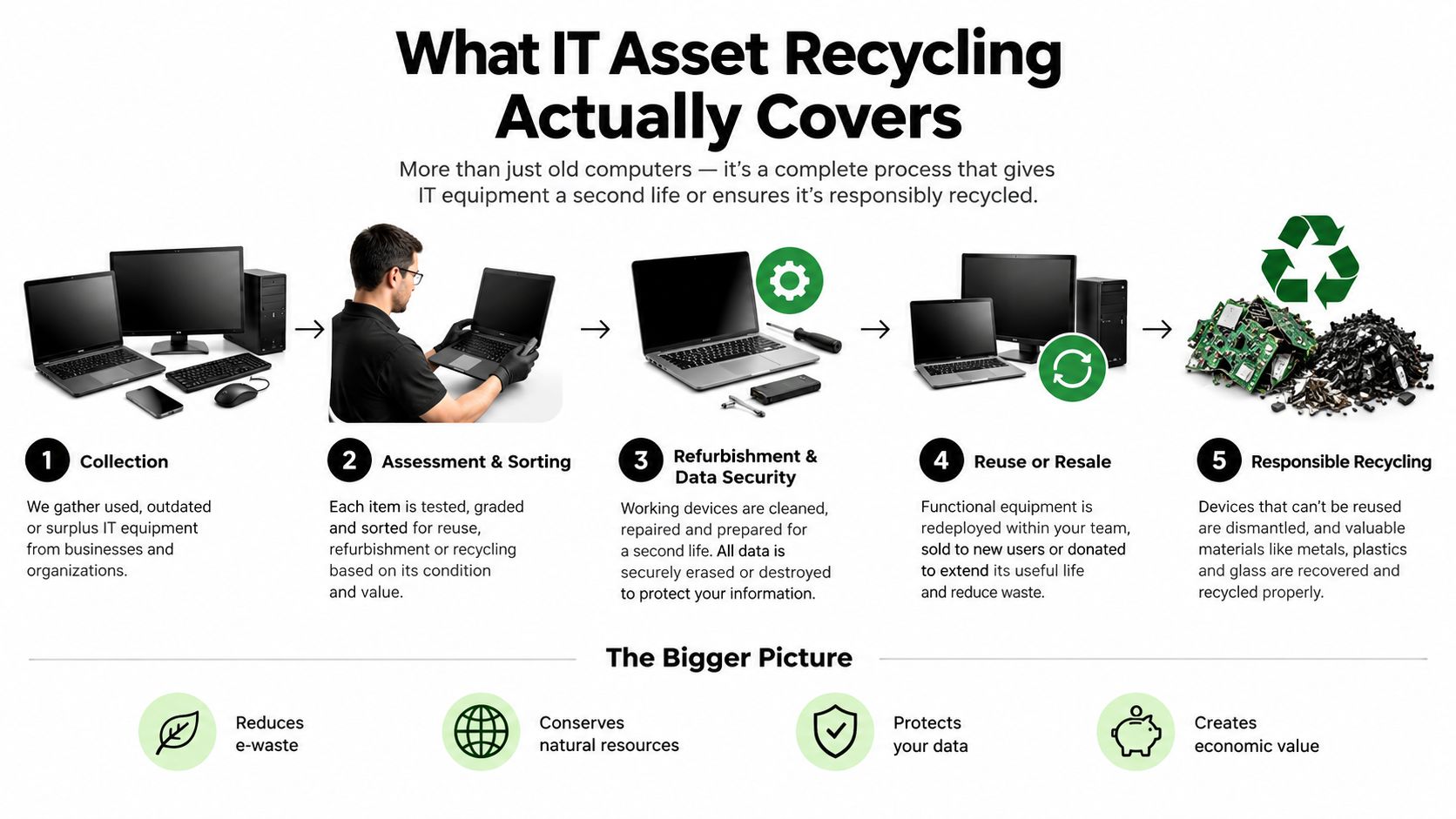
ITAD is the broader lifecycle service. A complete workflow commonly follows this order:
- Inventory and collection: Record serial numbers, asset tags, condition, accessories, and location.
- Data sanitization: Select a method based on the storage medium and sensitivity of the information.
- Triage: Separate working assets, repairable units, parts, and true end-of-life material.
- Value recovery: Redeploy, refurbish, or remarket suitable equipment.
- Material recovery: Dismantle and route non-reusable components through controlled recycling streams.
Reuse comes before destruction when the controls support it
A functioning laptop may retain value through redeployment or secondary-market resale. A server may provide recoverable components even when the complete system is obsolete. Reuse generally preserves more economic value than immediate shredding, but it only makes sense when the data sanitization method is appropriate, verifiable, and documented.
Destructive recycling applies when equipment is non-functional, too old for responsible resale, contaminated, uneconomical to repair, or too sensitive to release into a secondary market. Processors may separate circuit boards, plastics, steel, aluminum, and other materials for specialized recovery. Well-sorted input matters because controlled preprocessing can improve recovery efficiency. A laptop recycling guide by myhalo offers useful background on the stages involved in responsible device handling.
The decision shouldn't be based on convenience. Match each asset class to its data sensitivity, condition, age, residual market price, and downstream risk. Businesses that send every device straight to a shredder may destroy recoverable value. Businesses that resell everything without media-specific sanitization create a security problem.
For a structured commercial workflow, review Beyond Surplus ITAD services, including asset handling, data destruction, recycling, and value recovery options.
The Market and the E-Waste Gap Behind the Headlines
During a 1,000-device refresh, the vendor's truck may leave before your team can prove where each asset went. That is the operational risk behind the e-waste numbers. The 2024 Global E-waste Monitor reported 62 billion kilograms of e-waste generated globally in 2022, equal to 7.8 kilograms per person, while only 22.3% was formally collected and recycled in an environmentally sound manner. These figures are documented in the IT asset disposition market report from Mordor Intelligence.
Treat that formal-recycling rate as a global benchmark, not as an estimate of your company's outcome. It shows how much material remains outside controlled recovery channels. A fast pickup proves only that equipment was removed. It does not prove secure data destruction, documented downstream handling, or environmentally sound recycling.
Applying the benchmark mechanically to a 1,000-device refresh produces 223 devices formally recycled and 777 devices outside that formal channel. This is not an audit result and cannot replace an asset inventory. It does show why the vendor must provide asset-level records rather than a general recycling statement.
E-waste reality for a typical 1,000-device refresh
| Devices Retired | Estimated Formally Recycled (22.3%) | Estimated Untracked / Informal | Audit Exposure |
|---|---|---|---|
| 1,000 | 223 | 777 | Material handling, data destruction, and downstream disposition require asset-level evidence |
Recovery performance also varies by process and material. One review reports that 20.1% of e-waste was recycled in 2023, while optimized hydrometallurgical and bioleaching processes increased precious-metal recovery rates from 25.0% in 2015 to 35.0% in 2023. The figures appear in the review of e-waste recycling and recovery processes.
The growing ITAD market reflects a procurement problem, not just an environmental one. Organizations need secure data wiping, physical destruction where appropriate, resale valuation, certified recycling, and chain-of-custody records. Analyst estimates cited earlier place the ITAD market above USD 25 billion in 2024, with strong projected growth. Select a vendor that can connect those services to each asset and issue evidence your audit team can test. A program without downstream visibility leaves a governance gap.
Compliance Rules That Drive Your Recycling Program
Compliance should shape the workflow before the vendor writes a quote. The recycler needs to know what information the assets contain, which media types are present, whether equipment can be reused, and whether any material will cross borders. Put those requirements in the RFP, then demand evidence rather than assurances.
The FTC Disposal Rule protects information during disposal
The FTC Disposal Rule requires businesses that dispose of consumer report information to take reasonable measures against unauthorized access or use. The obligation covers records, consumer reports, and derived information, including information stored on electronic media. This explanation of the FTC Disposal Rule and IT asset recovery compliance describes why disposal controls remain part of the organization's responsibility.
Your RFP should require documented handling from collection through final processing. Ask how the vendor identifies data-bearing devices, restricts access, records transfers, and issues certificates tied to the relevant assets. A recycler that only provides a scale ticket hasn't demonstrated that sensitive information became unreadable or irreconstructible.
NIST SP 800-88 gives the team a common language
NIST SP 800-88 Rev. 1 distinguishes among Clear, Purge, and Destroy approaches. The correct selection depends on the storage technology, the asset's future use, and the sensitivity of the data. Your vendor should explain the chosen method for hard disk drives, solid-state drives, removable media, and failed devices, then document the result.
Don't accept “we wipe everything” as a control description. Ask whether the process includes verification, exception handling, serial-level reporting, and a fallback for drives that fail sanitization. The NIST SP 800-88 guidance for IT asset recycling helps align internal policy and vendor requirements.
Basel controls apply when e-waste crosses borders
The 2022 Basel Convention e-waste amendments became effective on 1 January 2025 and expand controls to transboundary movements of electrical and electronic waste. International shipments for recovery or disposal generally require prior informed consent from the importing country and, where applicable, transit countries, as explained by the U.S. Environmental Protection Agency's international e-waste requirements.
| Framework | Scope | What It Requires | Proof Your Recycler Must Provide |
|---|---|---|---|
| FTC Disposal Rule | Consumer report information in disposed records | Reasonable protection against unauthorized access or use | Written disposal controls and completion records |
| NIST SP 800-88 Rev. 1 | Media sanitization | Clear, Purge, or Destroy selection appropriate to the media | Method, verification, exceptions, and asset-linked reporting |
| Basel Convention amendments | International e-waste movements | Applicable consent and lawful transboundary handling | Shipment classification, destination disclosure, and consent records |
Ask the vendor to identify subcontractors, exporters, processors, and final destinations before release. Compliance isn't a clause you review after pickup. It is a chain of decisions that begins with classification.
Data Destruction Methods Matched to the Right Devices
No single destruction method fits every device. A working hard disk intended for resale needs a different treatment from a failed solid-state drive containing regulated information. The defensible choice is the one that matches the medium, sensitivity, destination, and evidence required by your policy.
Compare the method with the media
Software-based wiping can preserve resale value for functioning hard disk drives and some solid-state drives when the procedure is appropriate, verified, and documented. It shouldn't be confused with a factory reset, which may not address all storage areas or provide an audit trail.
Cryptographic erase can be appropriate for functional SSDs and NVMe devices when encryption architecture, key management, and verification support the decision. Wear leveling, compression, and over-provisioning make simplistic wipe assumptions unsafe for modern flash media.
Degaussing applies to magnetic media. It renders the affected drive unusable, so it belongs with non-resale assets where permanent inoperability is acceptable. It isn't a solution for SSDs or NVMe drives.
Physical destruction includes drilling, crushing, or other destructive treatment. Industrial shredding can provide a specified particle size for high-risk media and end-of-life equipment, but it eliminates resale value and should be selected deliberately.
| Method | Media Compatibility | NIST 800-88 Level | Resale Impact | Best For |
|---|---|---|---|---|
| Software sanitization | Suitable functioning media, subject to validation | Clear or Purge | Preserves potential resale | Reusable drives with verifiable results |
| Cryptographic erase | Supported encrypted SSD and NVMe devices | Purge | Can preserve the device | Functional flash media with controlled key management |
| Degaussing | Magnetic media only | Destroy | Makes the drive inoperable | Non-resale magnetic drives |
| Physical destruction or shredding | Failed, sensitive, or end-of-life media | Destroy | Eliminates resale | Highest-risk data and non-reusable assets |
Certificates must identify the actual asset
A certificate should connect the chosen method to the device's serial number, not just to a shipment or weight. Require the method, completion status, exceptions, operator or processor record, and final disposition. If a drive failed sanitization, the record should show whether it moved to destruction.
A vendor that offers one universal method is optimizing its process, not your risk profile.
Before approving a recycling partner, ask for a sample certificate and a sample exception report. Confirm that your audit team can reconcile the document against the pickup inventory. Data destruction is the control that determines whether reuse and recycling are safe outcomes.
Chain of Custody and the Certificate That Closes the Loop
Chain of custody is the documented chronological transfer of assets between authorized handlers, from collection through final processing. It proves who had responsibility for the equipment, when the transfer occurred, and which disposition path the asset followed. Without that record, a business may know that hardware left the building but not what happened afterward.
The process should begin at pickup with serial numbers, asset tags, condition, location, and an authorized handoff. The parties should sign a Bill of Lading or asset transfer receipt, and the equipment should move in sealed containers or secure vehicles with documented custody.
Build the audit trail at every handoff
At the processing facility, each device should be scanned into a tracking system. The operator then routes it to reuse, parts harvest, data destruction, or material recovery. If brokers, subcontractors, or downstream smelters are involved, the vendor should disclose them and obtain approval where the contract requires it.
The certificate closes the operational loop. A useful certificate of recycling and data destruction should include:
- Asset identity: Serial number, asset tag, device type, and quantity where applicable.
- Security action: Sanitization or destruction method and the applicable NIST level.
- Final disposition: Reuse, resale, parts harvest, recycling, or destruction.
- Accountability: Processing date, responsible processor, signature, and reference to the custody record.
- Retention: Delivery within the agreed service-level timeline and storage in an auditable format.
A generic weight receipt can't prove that a particular laptop was wiped or that a server entered the claimed downstream stream. This explanation of certificates of data destruction provides useful context for defining the evidence your compliance team should retain.
Don't treat custody as a vendor's internal paperwork. Write the required records into the agreement, define the delivery deadline, and state what happens when an asset can't be reconciled. The company remains exposed to the consequences of an incomplete record, even when an outside provider performed the physical work.
Choosing an IT Asset Recycling Partner You Can Audit
Vendor selection should start with verification, not price. A low quote can conceal weak transport controls, undisclosed downstream processors, incomplete certificates, or a data destruction method that doesn't fit the media. Ask each bidder to prove how its operation works before comparing commercial terms.
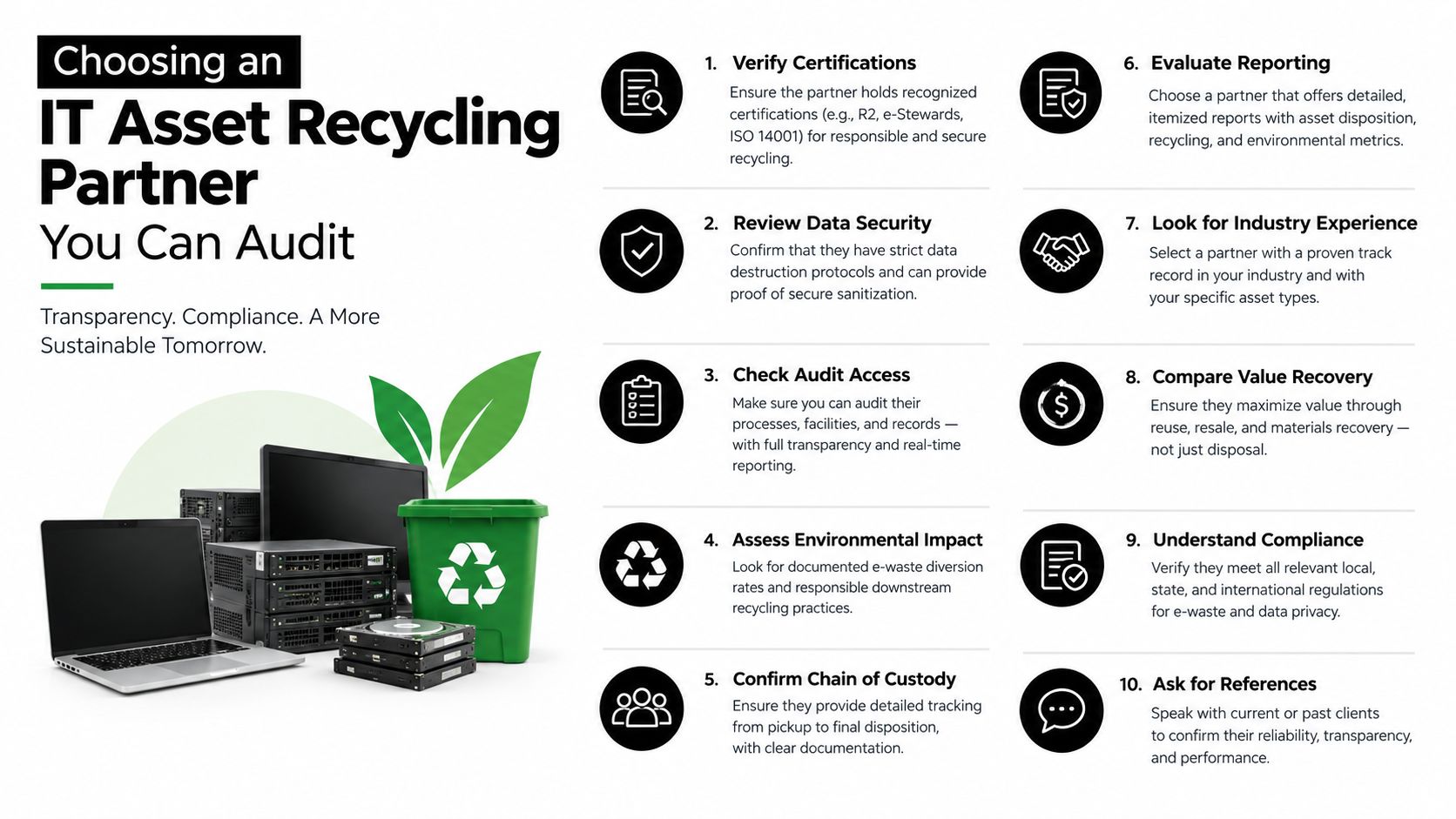
Verify four categories before signing
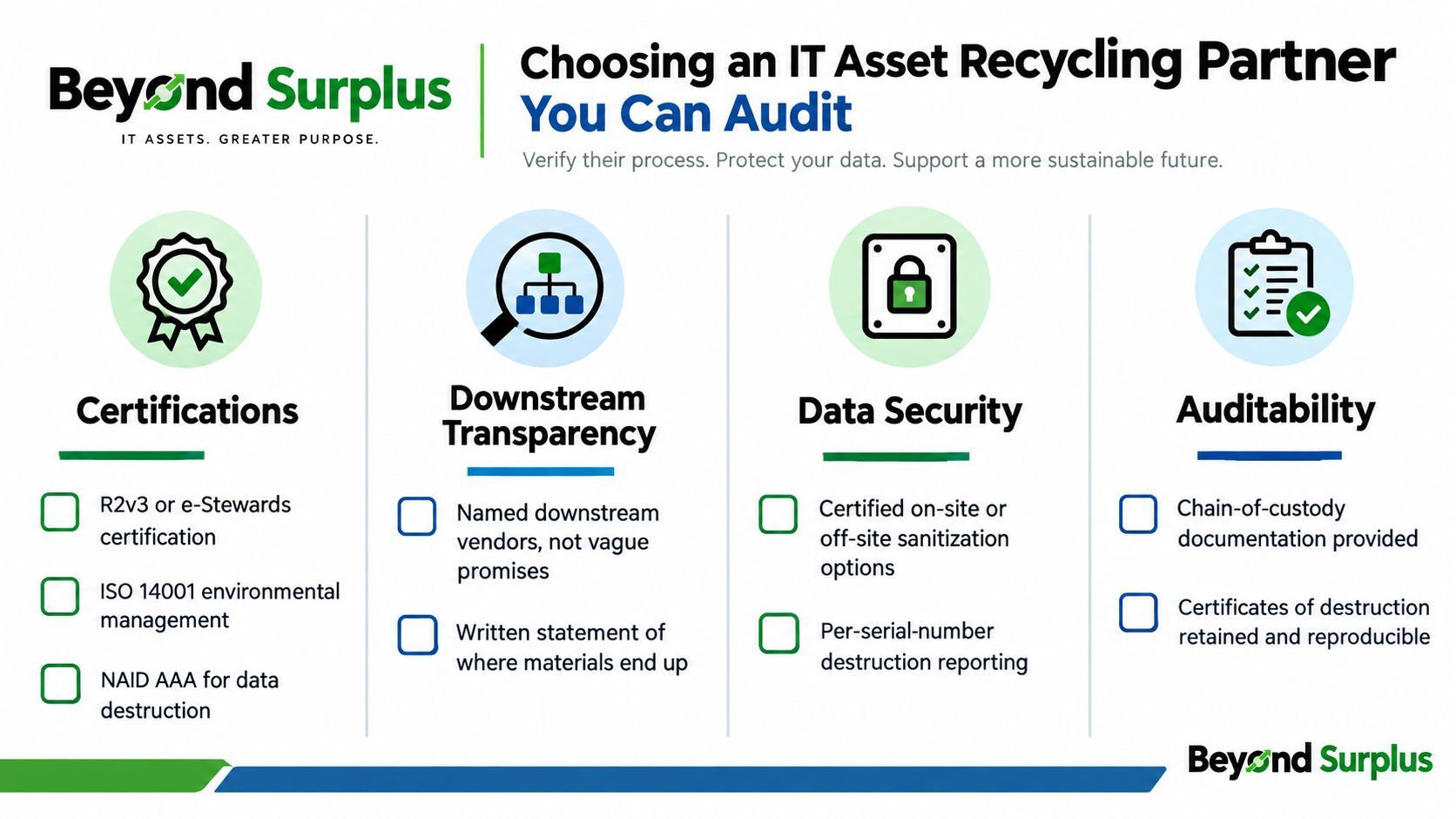
Certifications: Check current R2v3 or e-Stewards certification, ISO 14001 environmental management, and NAID AAA data destruction coverage where relevant to the services offered. Confirm the certificate scope and facility location. A logo in a sales presentation isn't enough.
Downstream transparency: Require named downstream vendors and a written statement describing where equipment and recovered materials go. “Responsible processing” is not a destination. Your contract should address exports, brokers, and changes to downstream partners.
Financial protection: Review insurance limits, data-breach liability, and environmental impairment coverage. Make sure the policy responds to the services and jurisdictions involved. The provider should explain how liability is allocated during pickup, storage, processing, and downstream transfer.
Reporting: Demand serial-level inventory, custody records, destruction and recycling certificates, exception reports, and portal access where available. Set an SLA for certificate delivery and require reproducible records.
Use a controlled pilot before an enterprise rollout
Run a trial pickup with a representative asset mix. Include working laptops, failed drives, servers, network equipment, and any specialized devices such as medical or laboratory equipment. A pilot reveals whether the vendor can reconcile serial numbers, segregate data-bearing media, document exceptions, and return usable value without losing control of the process.
Red flags include:
- Offshore ambiguity: The vendor won't identify export destinations or downstream processors.
- Verbal custody promises: Staff describe controls that aren't written into the agreement.
- Late certificates: Documentation arrives only after invoicing or requires repeated requests.
- Universal wiping claims: The vendor can't specify how its method handles HDDs, SSDs, and failed devices.
- Weight-only reporting: The final record identifies material weight but not the assets processed.
A pilot also tests logistics. Can the team schedule pickups across locations, handle secure packing, process data center equipment, and manage product destruction without improvising? Beyond Surplus's vendor due diligence checklist can help organize the questions and evidence requested during procurement.
For U.S. business programs, Beyond Surplus provides commercial ITAD, secure data wiping, hard drive shredding, electronics recycling, product destruction, data center decommissioning, logistics coordination, and asset value recovery. Evaluate those capabilities against the same requirements applied to every bidder.
Next Steps for IT Managers and Facility Leaders
Turn the policy into a working program before the next refresh reaches the loading dock.
- Inventory current equipment: Reconcile stored devices, peripherals, servers, drives, medical equipment, and laboratory equipment against your asset records.
- Classify data sensitivity: Separate ordinary business devices from assets containing regulated, confidential, or high-risk information.
- Shortlist qualified providers: Request current certification evidence, downstream disclosures, insurance details, sample certificates, and documented sanitization procedures.
- Run a pilot pickup: Use a controlled group that reflects the actual device mix, then test inventory accuracy, custody records, exceptions, and certificate delivery.
- Set the operating standard: Put serial-level reporting, approved methods, subcontractor rules, export controls, and certificate retention into the master agreement.
Disposal isn't a one-time cleanup. It recurs with every laptop refresh, data center decommissioning, office move, equipment failure, and product destruction project. The partner selected this quarter will influence how your organization handles every future asset stream, so choose an operating process rather than a one-off truckload.
Beyond Surplus provides secure IT asset disposition, certified data destruction, electronics recycling, product destruction, data center decommissioning, logistics coordination, and value recovery for business equipment. Visit Beyond Surplus to discuss your next refresh and build a documented recycling program that protects data, supports compliance, and recovers usable value.


