

The week after finals, an Atlanta campus IT manager opens the surplus room and finds Chromebooks stacked on retired servers, faculty laptops waiting for review, and a digital copier scheduled for removal. Procurement wants to know whether the equipment still has resale value. Legal wants proof that student and employee data is gone. Facilities wants the room cleared before the next project begins.
That's the challenge behind electronics recycling for Atlanta schools and universities. The job isn't finding a truck to haul away old equipment. It's deciding what to reuse, donate, resell, recycle, or destroy, then documenting every decision so IT, finance, sustainability officers, and legal can defend the outcome.
Table of Contents
- A Surplus Closet, a Legal Clock, and an Atlanta Campus
- The Compliance Floor for Atlanta Schools and Universities
- Triage Before You Recycle Reuse Donate Resell or Destroy
- A Controlled Asset-Flow Methodology That Audits Itself
- Choosing the Right Data-Destruction and Logistics Setup
- Copiers Lab Equipment and Other High-Risk Devices
- Running a Drop-Off Day or Surplus Event That Actually Works
A Surplus Closet, a Legal Clock, and an Atlanta Campus
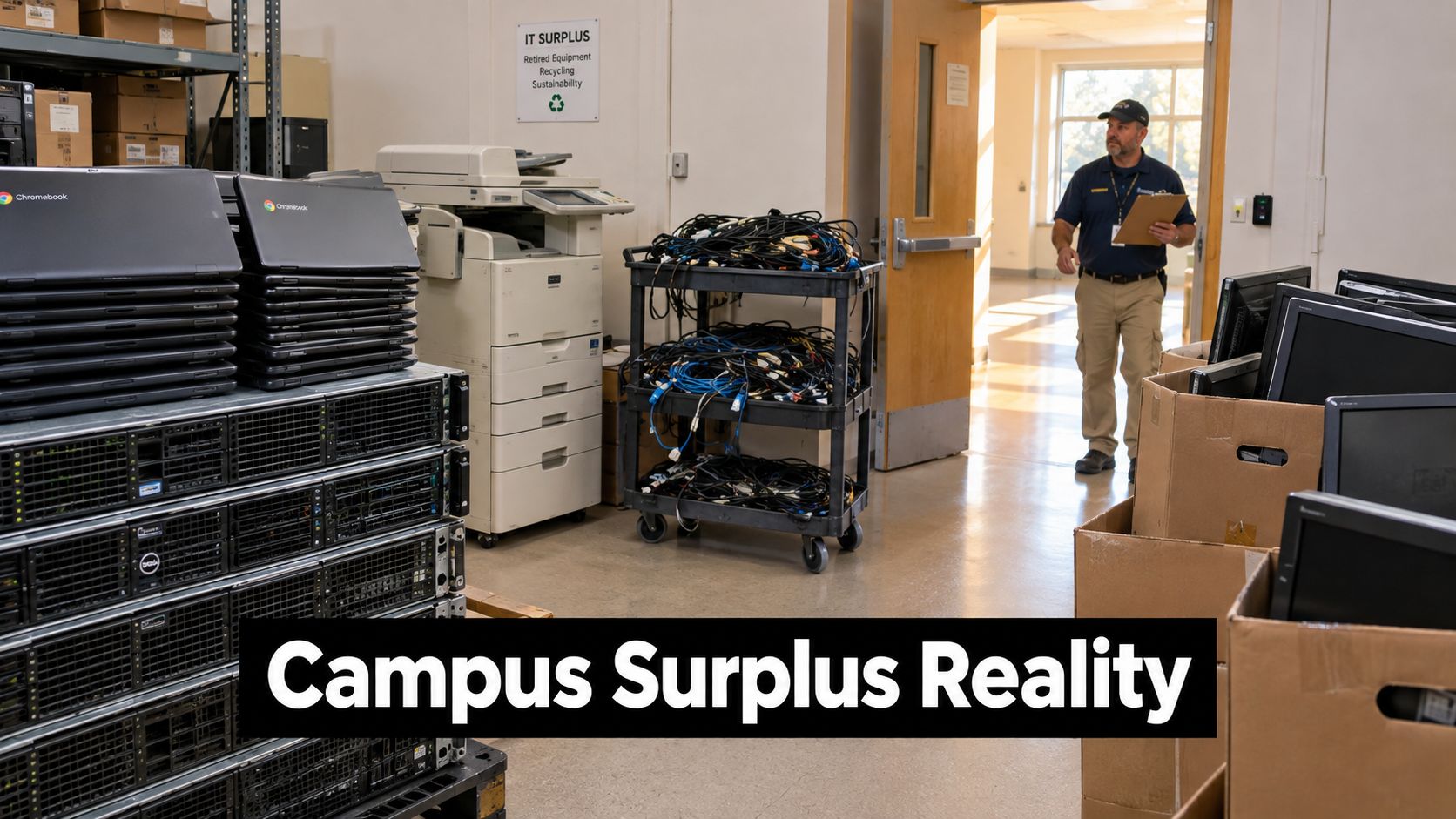
A packed surplus room creates several problems at once. Working laptops may represent recoverable value, while damaged drives may require destruction. A copier may contain stored documents. Networking equipment can hold configurations, credentials, or logs. Laboratory and audiovisual systems may include storage that never appeared in the central IT inventory.
The global context makes poor planning harder to justify. The world generated 62 million tonnes of e-waste in 2022, an average of 7.8 kilograms per person, and that total was 82% higher than in 2010. Documented recycling reached only 22.3% of the 2022 total, according to the Global E-waste Monitor update.
For a school district or university, the consequences are practical:
- Compliance exposure: Selling, donating, or transferring equipment can still count as disposal when covered consumer-report information is present.
- Data risk: A factory reset or ordinary file deletion doesn't prove that data cannot be recovered.
- Lost value: Sending usable laptops directly to destruction eliminates potential resale proceeds and redeployment opportunities.
- Equity impact: Refurbished equipment can support students, partner schools, and community programs when the institution can release it securely.
- Audit friction: A weight ticket or generic recycling receipt won't reconcile individual devices.
The governing principle: Don't ask, “How do we get rid of this equipment?” Ask, “What is the safest and most responsible disposition for each asset?”
A sound Atlanta electronics recycling program starts with an inventory and a decision tree. It separates data-bearing equipment from non-data electronics, identifies ownership, checks condition and supportability, selects a disposition path, and preserves evidence from pickup through final processing. That approach gives the budget office a valuation record, gives legal a defensible chain of custody, and gives sustainability staff a credible account of reuse and recycling outcomes.
The Compliance Floor for Atlanta Schools and Universities
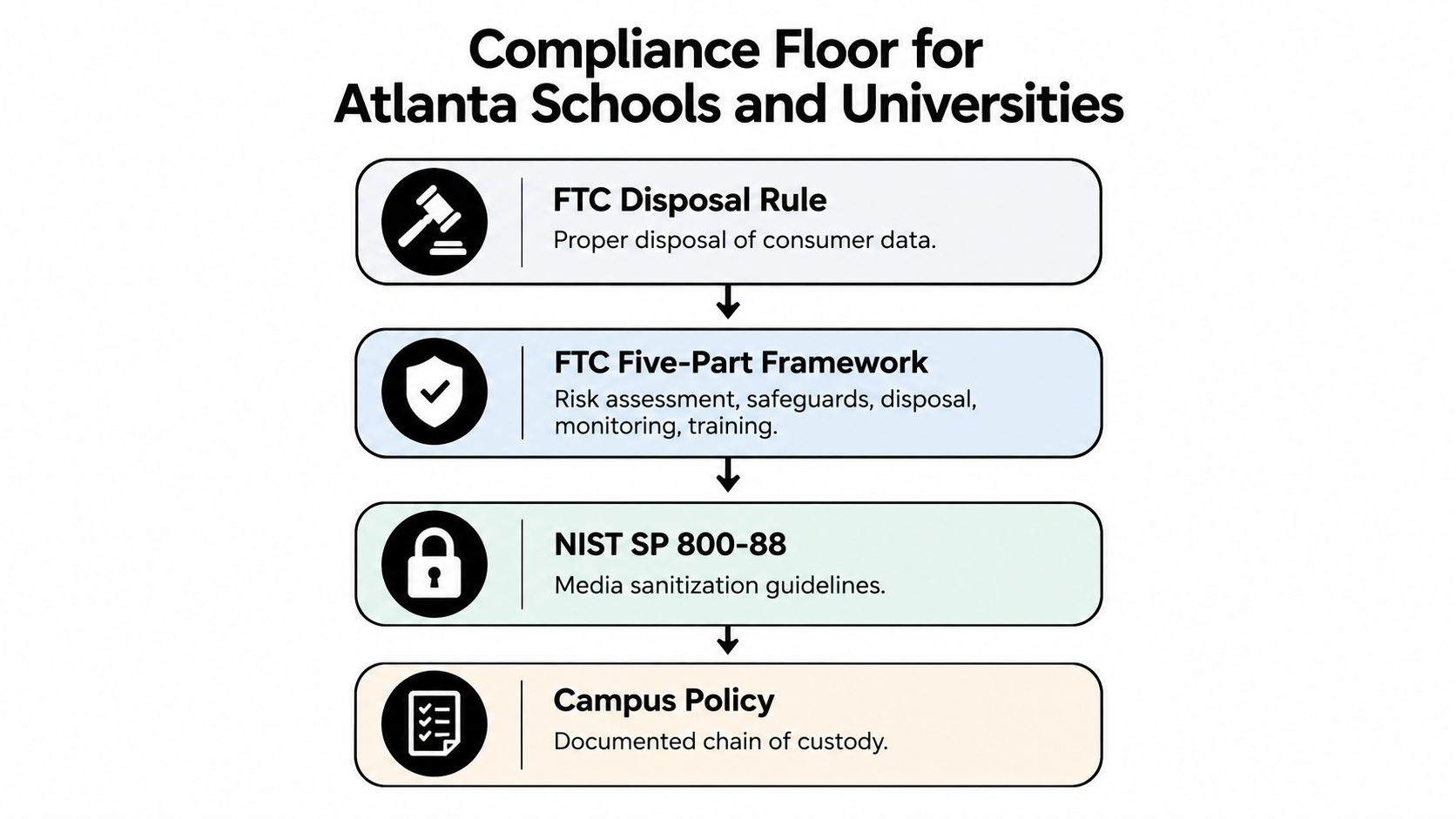
The compliance floor begins before a device enters a loading dock. The FTC Disposal Rule requires appropriate measures for secure disposal of consumer-report information and defines disposal to include selling, donating, or transferring any medium on which the information is stored. A surplus laptop leaving one department for another can therefore require the same discipline as equipment shipped to a recycler.
The institution should establish four controls before scheduling collection.
Identify information and ownership
Start with computers, laptops, mobile devices, flash drives, disks, servers, digital copiers, and multifunction printers. Record the owning department, asset number, serial number, storage type, and disposition authority. Georgia Tech's guidance illustrates the distinction between personally owned electronics and organization-owned property. Institute-owned equipment follows a formal surplus process, while personally owned devices can use community or event-based options.
The FTC's information-security framework gives administrators a useful operating model:
- Take stock of where personal information exists.
- Scale down information that no longer needs retention.
- Lock information that must remain.
- Pitch information that no longer needs to be kept.
- Plan for security incidents.
Written retention schedules should state what the institution retains, how long it keeps it, who authorizes release, and how secure destruction is verified. The Georgia electronics recycling compliance guide can help teams organize state-specific policy questions alongside their own counsel's requirements.
Match sanitization to the media
NIST SP 800-88 Rev. 1 defines three sanitization outcomes:
- Clear: Logical techniques applied to user-addressable storage.
- Purge: Physical or logical methods intended to make laboratory recovery infeasible.
- Destroy: A method that makes recovery infeasible and prevents further storage use.
A conventional magnetic hard drive may support an approved overwrite or firmware secure-erase process when reuse is intended. SSDs need more caution because wear-leveling can leave data outside ordinary overwrite paths. For high-assurance cases, use a device-supported sanitize command, cryptographic erase, or destruction, then retain the result.
The records should identify the device, method, operator or provider, verification result, transfer history, and final disposition. A policy that says “IT wipes everything” isn't enough unless the institution can show what happened to each asset.
Triage Before You Recycle Reuse Donate Resell or Destroy
Bulk shredding feels safe, but it can destroy equipment that could support another classroom or recover value for the institution. The right disposition depends on the device's condition, support horizon, battery health, repair cost, accessibility features, residual data risk, and logistics cost.
The U.S. generates roughly 3.4 million tons of e-waste annually, while only about 40% of computers, 17% of televisions, and 11% of mobile devices are recycled, according to the University of Georgia Cooperative Extension field report. Those figures reinforce the need to make a deliberate decision before equipment enters the recycling stream.
Use a device-level decision
A Chromebook with supported operating software, a healthy battery, and no unresolved account lock may be suitable for redeployment or donation after verified sanitization. A laptop with a failing battery may still have resale value if the buyer accepts refurbishment. A workstation with obsolete software, damaged storage, and no practical repair path belongs in material recycling or destruction, depending on data assurance requirements.
| Device Class | Reuse | Donate | Resell | Recycle | Destroy |
|---|---|---|---|---|---|
| Student Chromebooks | Supported units after secure reset and verification | Suitable units for approved education partners | Units with market demand | Broken or uneconomical units | Devices with failed storage or unresolved data risk |
| Faculty laptops | Redeploy after inspection and sanitization | Units approved for student access programs | Working units with residual market value | Units with major hardware faults | Drives that cannot meet assurance requirements |
| Lab workstations | Keep if software and instruments remain supported | Only after technical and data review | Sell when support and documentation are clear | Obsolete towers and peripherals | Storage that cannot be sanitized reliably |
| Audiovisual gear | Reuse projectors, displays, and control hardware where compatible | Donate functional equipment through an approved program | Sell working professional equipment | Nonfunctional displays and cables | Embedded storage with unresolved data |
| Networking hardware | Redeploy after configuration removal | Donate only when security and support status are acceptable | Sell equipment with clear provenance | Damaged switches, access points, and cabling | Storage or configurations that cannot be cleared |
Approvals matter. Procurement should confirm ownership and valuation. IT should approve sanitization. Finance should record proceeds or avoided procurement. Legal or compliance should approve donation language and evidence requirements. Sustainability staff should track reuse and downstream recycling rather than relying only on total weight.
Donation is safer than destruction only when the institution controls the data removal, recipient approval, transfer record, and acceptance terms.
Use a worksheet with one row per asset and columns for condition, support status, storage type, data sensitivity, repair estimate, likely recipient or buyer, logistics cost, approval status, and final decision. The refurbish-or-recycle decision guide provides a useful way to frame that choice.
A Controlled Asset-Flow Methodology That Audits Itself
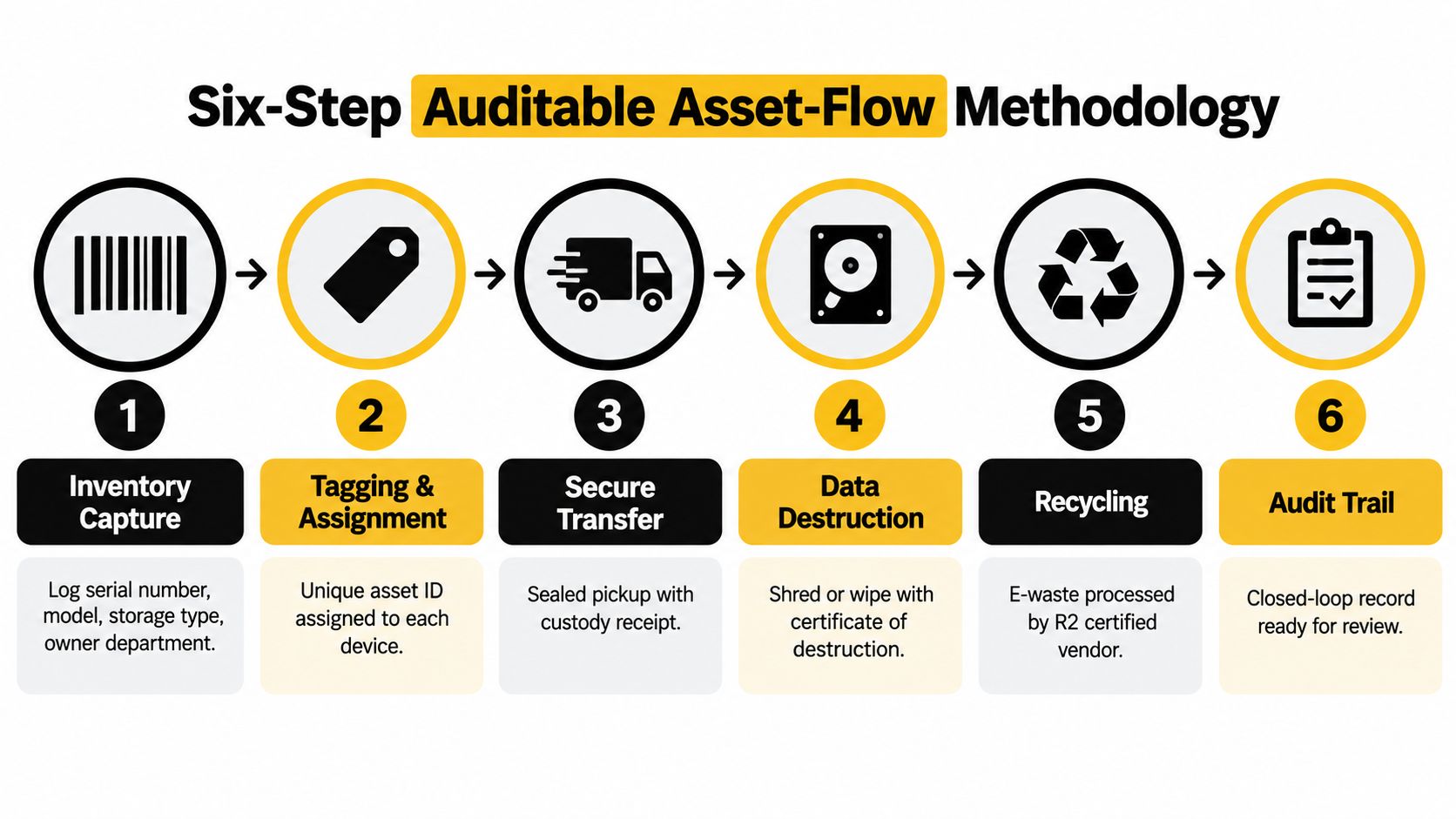
A reliable program creates a closed loop. The device should be identifiable when it leaves the surplus room, during transport, at sanitization, and when the recycler issues its final record.
Capture the asset record
Record the serial number, model, storage type, owner department, physical condition, and proposed disposition. Assign a unique asset identifier if the institution's existing tag doesn't connect cleanly to the recycling or destruction record. Segregate data-bearing devices from monitors, keyboards, cables, and other non-data electronics before packing.
Control movement and custody
Every handoff should produce a receipt. The record should show who released the equipment, who accepted it, the date, the vehicle or shipment reference, the container or seal identifier where used, and the destination facility. Keep high-risk storage devices in a controlled area, not in an open event staging zone.
Apply and verify sanitization
NIST SP 800-88 Rev. 1 identifies clear, purge, and destroy as the three sanitization outcomes and warns that ordinary SSD overwriting may be unreliable. The NIST media sanitization guidance supports selecting a method based on media type and assurance needs, then verifying the result.
The institution's benchmark should be 100% serial-number reconciliation and 100% disposition documentation. A single bulk certificate without a device list is a warning sign because it doesn't demonstrate what happened to a particular laptop, drive, copier, or server.
The accounting team also needs a consistent way to classify transportation, processing, destruction, and recovery activity. A resource such as this chart of accounts for waste management can help finance teams structure internal categories, although the institution should adapt them to its own accounting policy.
Finally, reconcile the original inventory against certificates of data destruction, certificates of recycling, resale statements, donation receipts, and exception logs. The audit trail reporting service reflects the level of device-level evidence procurement and legal reviewers should expect.
Choosing the Right Data-Destruction and Logistics Setup
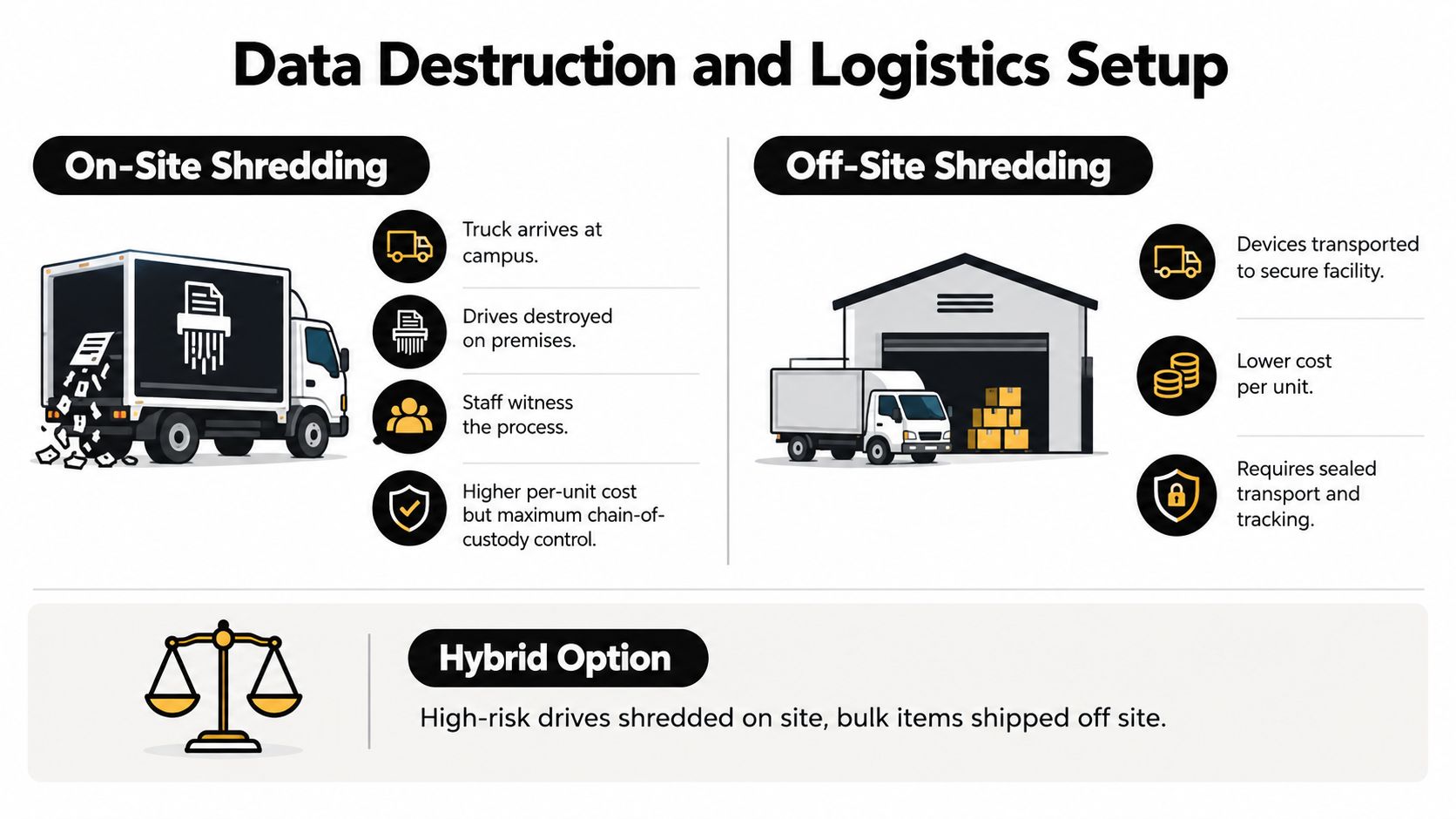
Choose the logistics model by data sensitivity, device value, volume, deadline, and the evidence your procurement and legal teams require. On-site destruction provides direct visibility and physical control. Off-site processing handles larger batches efficiently when sealed transport and tracking are documented. A hybrid model separates high-risk devices from assets suitable for reuse, resale, or recycling.
| Setup | Best fit | Procurement requirements |
|---|---|---|
| On-site shredding | High-risk drives, urgent projects, witness requirements | Mobile equipment, witnessed destruction, serialized records |
| Off-site wiping or shredding | Larger batches, resale candidates, routine pickups | Sealed transport, tracking, facility controls, device-level certificates |
| Hybrid processing | Mixed inventory with high-risk and recoverable assets | Separate routing rules, documented handoffs, exception handling |
| Campus collection event | Several departments releasing equipment together | Intake stations, security coverage, pre-labeled assets, scheduled follow-up |
| Consolidated pickup | Multiple buildings or campuses | Site manifest, loading plan, custody receipts, centralized reporting |
The FTC warns that ordinary file deletion can leave recoverable data on a hard drive. Its business data-security guidance recommends secure overwrite utilities and written retention and disposal policies.
Require each quote to identify the sanitization method for every media type, whether wiping preserves resale value, how failed drives are handled, who carries insurance, how transport is secured, and which certifications apply. Use this guide to secure data destruction, wiping versus hard-drive shredding when setting media-specific requirements. Ask for serialized certificates rather than a total weight, and require disclosure of downstream processors plus appropriate R2 or e-Stewards certification when policy requires it.
Use an RFP clause such as: “Vendor shall provide device-level chain-of-custody records, media-specific sanitization results, certificates of destruction or recycling, exception reports, and downstream processor documentation for all serialized assets.”
Beyond Surplus offers Atlanta-area on-site and off-site hard-drive shredding, certified data wiping, electronics recycling, IT equipment disposal, and reporting. Choose the route by asset disposition and risk, then require records that prove the decision was completed.
Copiers Lab Equipment and Other High-Risk Devices
The equipment most likely to escape an ITAD plan is often the equipment that stores the most overlooked data. Digital copiers and multifunction printers may contain internal hard drives. Laboratory instruments can rely on control PCs or embedded storage. Network switches, security NVRs, badge readers, intercom systems, and audiovisual controllers may retain configurations, credentials, logs, or user records.
The FTC states that digital copiers can contain internal hard drives, recommends securely overwriting the entire drive at least monthly, and notes that consumer information stored on a copier may fall under the Disposal Rule. Its copier data-security guidance also recommends checking with the manufacturer, dealer, or service provider about hard-drive removal and return options.
Add overlooked devices to the intake script
Ask the equipment owner:
- Does this device have internal storage, removable media, or a connected control computer?
- Does it store scans, print jobs, user profiles, credentials, logs, or configuration files?
- Is it leased, owned, or subject to a manufacturer return process?
- Who can confirm the approved wipe, removal, or destruction method?
- What record proves the method was completed?
Put a line on every bill of lading for “embedded storage status and sanitization disposition.” Don't close the project until copiers, lab systems, servers, and security devices appear in the final reconciliation.
Running a Drop-Off Day or Surplus Event That Actually Works
An Atlanta campus collection event needs more than a truck and a sign. Facilities controls traffic and loading access. IT validates data-bearing assets. Procurement confirms ownership and surplus authority. Public safety protects the staging area. Communications tells faculty and staff what the event accepts. Student volunteers can direct traffic, but they shouldn't handle unprocessed storage devices without supervision.
The EPA identifies reuse as a preferred electronics-management strategy, names schools as potential recipients of used computers, and recommends community drop-off sites at neighborhood schools in its electronics reuse guidance. For an institution, that means a collection event can support both secure disposition and approved digital-equity partnerships, provided data removal happens before transfer.
Use a controlled run of show
- Before opening: Publish accepted equipment, ownership rules, data responsibility, location, hours, and contact names.
- At intake: Scan or record the asset identifier, serial number, department, owner, and storage status.
- At segregation: Place data-bearing equipment in a restricted cage or sealed container. Keep non-data electronics in a separate stream.
- At handoff: Issue the department a receipt listing what it surrendered and what remains pending review.
- After collection: Reconcile the intake list, schedule the processor pickup, and distribute final certificates when the work closes.
The electronics collection event service can support the logistics side, but the institution must retain ownership of its policy decisions and approvals. The common failures are predictable: unlabeled boxes, personal devices mixed with institutional property, copiers excluded from the manifest, and data-bearing equipment left overnight in an unsecured room.
Send faculty and staff a short message with three instructions: bring only institution-owned equipment authorized for release, don't place storage devices in an unattended hallway, and provide the department asset tag at intake. That simple discipline keeps the event moving and preserves the evidence needed by IT, finance, and legal.
Beyond Surplus provides Atlanta schools and universities with secure electronics recycling, IT asset disposal, certified data wiping, hard-drive shredding, equipment pickup, value recovery, and compliance reporting. Review the available services and schedule a controlled disposition project through Beyond Surplus.


