

An Atlanta healthcare team usually reaches this problem in the middle of something else. Imaging laptops are coming off lease. A lab is replacing workstations. Biomedical engineering has a row of pumps and carts waiting for pickup. IT knows some of it stores patient data. Compliance wants proof. Facilities wants the hallway cleared.
That's where healthcare electronics recycling in Atlanta stops being a recycling question and becomes a control question. If a device leaves your building without the right sanitization record, decontamination signoff, and custody trail, you haven't finished decommissioning. You've only moved risk to the loading dock.
Table of Contents
- Why Medical Electronics Disposal Is a Compliance Decision
- HIPAA Requirements for Disposing of Medical Electronics in Atlanta
- NIST Sanitization Methods That Map to Atlanta Medical Media
- On-Site and Off-Site Shredding and Certified Wiping Compared
- Chain-of-Custody and Certificate of Destruction Essentials
- The Decontamination Gap Beyond Data Destruction
- How to Evaluate an Atlanta Healthcare ITAD Partner
- Next Steps for Atlanta Healthcare Facilities
Why Medical Electronics Disposal Is a Compliance Decision
In healthcare, disposal is part of information governance. HHS requires covered entities to maintain policies for the final disposition of electronic protected health information and procedures that remove ePHI before equipment is reused or discarded, as described in HHS guidance on reusing computers that store protected information.
What counts as a data-bearing medical asset
The mistake I see most often is narrowing the scope too early. Teams remember laptops and servers, then miss the devices around them that also need review.
That review should include:
- Diagnostic workstations used in radiology, cardiology, or lab environments
- SSDs and hard drives pulled from PACS stations, nurse stations, and admin systems
- Removable media such as USB devices and legacy backup media
- Network appliances that may log or cache sensitive information
- Tablets and carts used for bedside charting or rounding
- Embedded medical devices that store settings, logs, patient identifiers, or local records
A retired infusion pump with embedded storage isn't “just biomed.” A discarded review PC in imaging isn't “just old IT.” Both are end-of-life assets with different handling requirements, and both create audit exposure if nobody owns the disposal decision.
Why casual recycling creates real risk
Deleting files isn't sanitization. Reinstalling the operating system isn't sanitization either. Data can remain in remapped blocks, hidden partitions, or controller-managed areas even when a device looks clean.
Practical rule: If your inventory stops at the outer chassis and doesn't identify the actual storage media inside it, your disposal record is incomplete.
That's why vendor selection matters as much as process design. The disposal workflow has to connect asset identification, sanitization method, verification, custody transfer, and final disposition. If one link is weak, the whole event becomes harder to defend during an internal audit, incident review, or vendor assessment.
HIPAA Requirements for Disposing of Medical Electronics in Atlanta
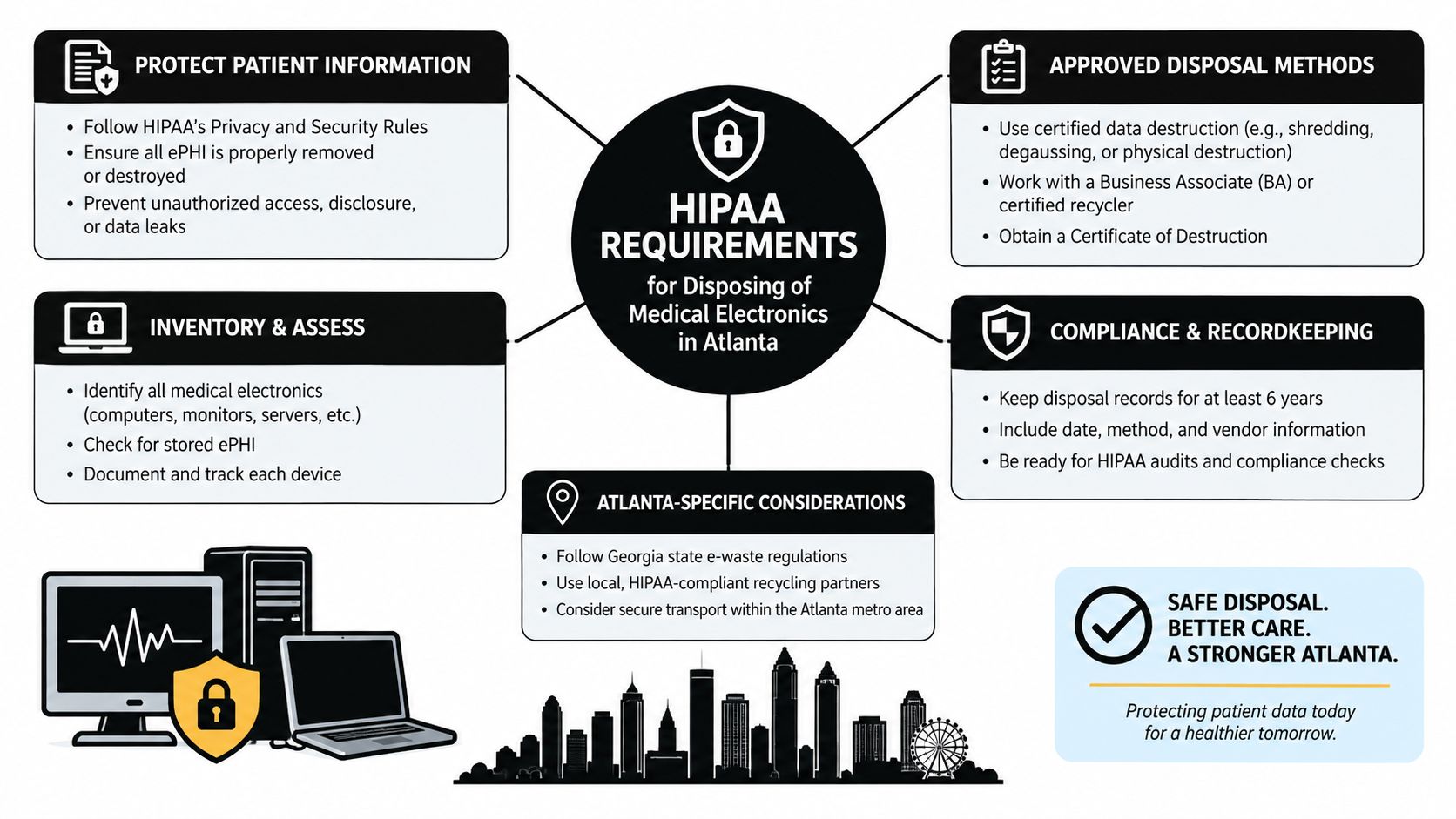
An Atlanta clinic may release a workstation for resale, return a cart to its lessor, or send a failed drive for recycling. Each choice requires a documented decision about the media, the information it held, and the safeguards used before release. HHS expects covered entities to assess their circumstances and protect PHI during disposal through appropriate clearing, purging, or destruction, as described in HHS disposal requirements for protected health information.
What HIPAA expects at end of life
A workable policy assigns responsibility and records the decision. It should identify:
- Who authorizes release from IT, clinical, or biomedical areas
- Which assets require media sanitization before reuse, resale, return, or recycling
- How results are documented against each device or storage component
- What vendor oversight looks like after equipment leaves the facility
HIPAA does not prescribe one disposal technique for every asset. A reusable laptop sent to a satellite clinic can follow a different path from a failed SSD removed from a clinical workstation. The organization must be able to explain why the selected safeguard matched the media and its intended disposition.
Where healthcare teams get tripped up
The recurring weakness is an incomplete evidence trail. A custody transfer without a receiving record, a batch certificate without serial numbers, or a sanitization result that cannot be tied to an asset leaves the provider with little support during an audit, incident review, or vendor assessment.
Billing and financial systems may also contain consumer-report information. The FTC Disposal Rule requires businesses that possess such information to use reasonable disposal practices that prevent unauthorized access or use, supporting controlled wiping, destruction, custody records, and certificates for retired medical IT, according to the FTC Disposal Rule guidance.
Good disposal policy language is plain: inventory the asset, identify the media, select the approved method, verify the result, and retain the record.
Staff training should use the same workflow as the written policy. Healthcare administrators can earn HIPAA training credits through a continuing education course, then apply that knowledge to release approvals, vendor handoffs, and record retention.
For Georgia-specific execution details, Beyond Surplus describes HIPAA-compliant ITAD services in Georgia and the controls healthcare buyers should examine before selecting a provider.
NIST Sanitization Methods That Map to Atlanta Medical Media
NIST gives healthcare teams the vocabulary that HIPAA leaves flexible. NIST Special Publication 800-88 defines three distinct media-sanitization outcomes: clear uses logical techniques against simple non-invasive recovery, purge uses physical or logical techniques that make recovery infeasible with state-of-the-art laboratory methods while potentially preserving the device for reuse, and destroy makes recovery infeasible and prevents further storage use, as defined in NIST SP 800-88 Rev. 2.
A practical matrix for real hospital assets
The fastest way to use that framework is to match the storage media to the business goal.
| Media or Asset Type | Typical Disposition Goal | Best-Fit Outcome | Operational Note |
|---|---|---|---|
| Magnetic hard drive in a redeployed workstation | Reuse inside the organization | Clear or purge | Use approved tools and verify at device level |
| Diagnostic laptop going to another clinic | Reuse or reassignment | Purge when feasible | Stronger outcome preserves the asset |
| Failed SSD from a PACS or imaging review PC | No reuse | Destroy | Failed flash media is hard to verify reliably |
| Returned-lease cart with identifiable storage | Return to lessor | Clear or purge with documentation | Certificate must map to serial number |
| Damaged encrypted drive with uncertain status | No trust in verification | Destroy | Don't rely on encryption alone if it can't be verified |
What doesn't work
What fails in practice is treating “empty” as “sanitized.” A drive can boot to a fresh operating system and still retain recoverable information outside the obvious file system. That's especially important with SSDs and flash-based devices, where logical overwriting may not address overprovisioned capacity or bad-block remapping.
NIST's model pushes teams toward device-level identification and verification. A spreadsheet that records only the cart, kiosk, or workstation shell isn't enough when the actual risk lives inside the storage component.
The most defensible process tracks the media itself, not just the equipment frame around it.
How Atlanta teams usually decide
For a same-day decision, this is the plain-English version:
- Use clear when the media is low risk, the tool is approved, and the device remains under controlled reuse.
- Use purge when you want stronger assurance but still want the asset or storage device preserved.
- Use destroy when the media is failed, damaged, high sensitivity, encrypted but unverifiable, or not worth trusting.
That's the logic most biomedical and infrastructure teams can work with once the options are translated out of standards language. For Atlanta operations teams building that workflow, this local guide to NIST 800-88 data destruction in Atlanta is a useful implementation reference.
On-Site and Off-Site Shredding and Certified Wiping Compared
Execution is where policy either holds together or falls apart. Atlanta healthcare organizations usually end up choosing between on-site shredding, off-site shredding, and certified wiping. Each can be valid. Each also creates different trade-offs in witnessability, logistics, reuse value, and recordkeeping.
Choosing a destruction method for Atlanta healthcare IT
| Asset Example | Recommended Method | Reason | Evidence Required |
|---|---|---|---|
| Failed SSD from a radiology workstation | On-site or off-site shredding | Reuse value is gone and verification may be uncertain | Serial number match, custody log, destruction record |
| Bulk pallet of end-of-life desktop drives | Off-site shredding | Better fit for volume processing | Pickup manifest tied to final batch result |
| Redeployable laptop from a physician office | Certified wiping | Asset can stay in service if sanitization is verified | Device-level wipe result with method and verification |
| Returned lease equipment with storage | Certified wiping or purge workflow | Lessor return may require media preserved | Serial-level certificate and reconciliation |
| High-sensitivity failed flash media | On-site shredding when witness is required | Immediate witnessed destruction removes uncertainty | Witnessed event record plus certificate |
The real trade-offs
On-site shredding works best when a facility wants the destruction event witnessed before media leaves the property. That often matters for small batches of high-sensitivity drives or for teams that don't want to move failed storage through internal holding areas.
Off-site shredding fits larger refreshes and decommissions better. It can reduce dock congestion and let the processor handle staged destruction in a controlled environment, but only if transport and intake are documented well.
Certified wiping preserves asset value and supports redeployment, but it only counts when the record is specific. “Drive wiped successfully” is not enough. The report should identify the device and show the method used and the verification result.
A practical local comparison of those choices appears in Beyond Surplus's guide to secure data destruction in Atlanta with data wiping vs hard drive shredding.
Chain-of-Custody and Certificate of Destruction Essentials
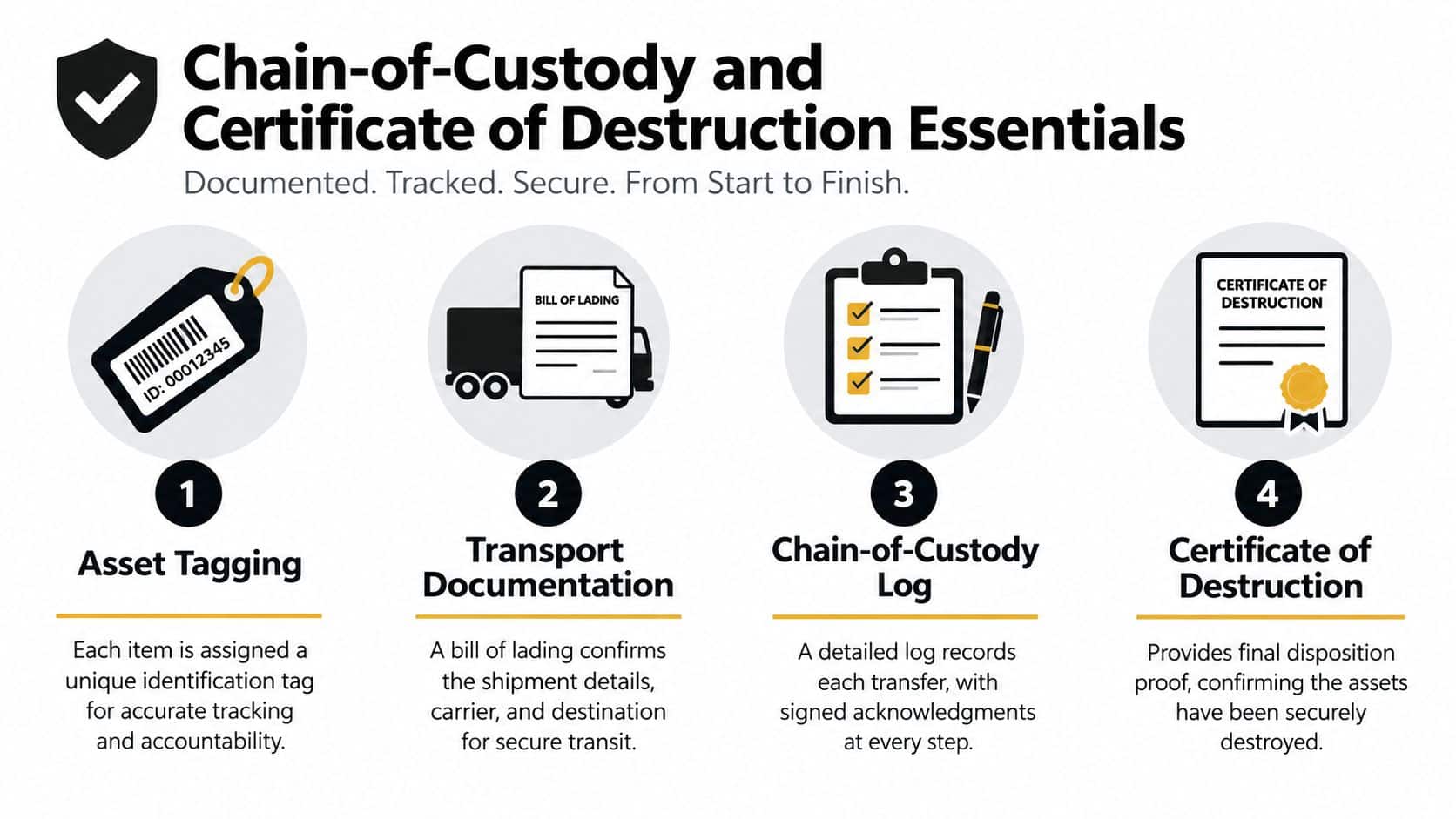
Healthcare disposal records should read like evidence, not marketing. A generic “certificate of recycling” may confirm that something was processed, but it won't answer the questions a compliance officer, internal auditor, or incident-response team will ask later.
What a defensible record should contain
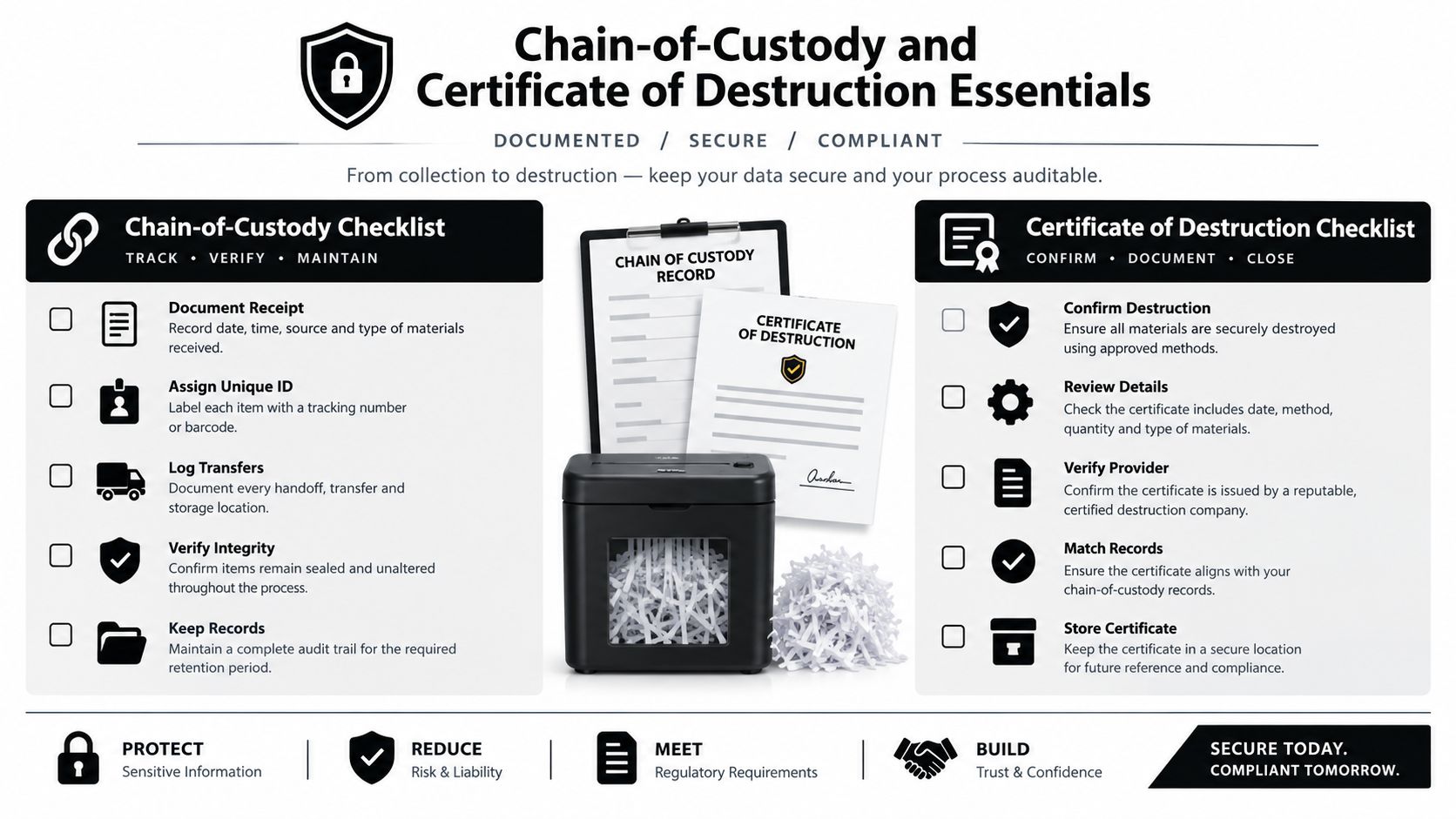
A strong certificate does more than confirm pickup. A certificate should reconcile asset identity, serial number, media type, sanitization technique, operator, date, verification result, and final disposition to the pickup or destruction batch so the evidence supports audits, vendor oversight, incident response, and defensible accountability when equipment leaves a hospital, physician practice, laboratory, or imaging center.
That means your evidence package should connect three layers:
- Pickup layer with manifest, sealed container IDs, and transfer signatures
- Processing layer with sanitization or destruction results for each device or media item
- Disposition layer with the final outcome, whether resale, recycling, or physical destruction
Why each field matters
Serial number matters because batch-only reporting can't prove which device was handled. Media type matters because the approved method depends on what was sanitized. Operator and date matter because they create accountability. Verification result matters because a method without a recorded outcome is only an attempt.
If the certificate can't be reconciled back to the original pickup manifest, the record is weaker than it looks.
A short checklist for vendor scopes of work
Ask for these items before the first pickup:
- Device-level reporting instead of chassis-only or pallet-only summaries
- Method detail that identifies the sanitization or destruction technique used
- Verification detail showing result status, not just a generic completion note
- Batch reconciliation tying certificates to the manifest and transport event
- Final disposition language stating whether the item was reused, recycled, or destroyed
Atlanta buyers that want a benchmark can review this overview of a certificate of data destruction in Atlanta.
The Decontamination Gap Beyond Data Destruction
A device can be perfectly sanitized for data and still be blocked from transport. That's the part many IT-led disposal projects miss.
Laboratory and clinical equipment may require a signed decontamination declaration before transport, especially when devices have contacted specimens, pharmaceuticals, or hazardous substances, because a device can be perfectly data-sanitized yet still be unacceptable for transport or recycling if its physical contamination risk is unresolved, as noted in federal medical-device cybersecurity and decommissioning guidance.
Which assets trigger this issue
This comes up with equipment such as:
- Patient monitors that moved room to room in clinical use
- Infusion pumps with patient-contact history
- Analyzers and lab carts exposed to specimens or reagents
- Imaging accessories and support devices that may carry contamination concerns
- Devices with batteries or mercury-containing parts requiring separate handling
If contamination status is unknown, don't release the asset into the normal ITAD stream. Segregate it, involve environmental health and safety, and require a signed release before transport.
For teams that need a plain-language primer on the physical side of that process, this explanation of how decontamination works is a helpful operational reference.
How to Evaluate an Atlanta Healthcare ITAD Partner
A hospital replaces a failed imaging workstation, a clinic retires laptops, and a lab clears older analyzers. Each asset needs a documented decision before pickup. The ITAD provider must show how it identifies storage media, records condition, protects custody, and handles exceptions.
Use the FTC's disposal guidance for businesses as a reference point when reviewing a vendor's controls. The practical question is whether the provider can demonstrate that its process protects information through documented wiping or destruction, controlled transport, and final disposition records.
Questions worth asking before a pickup order
- What does the certificate show at the device level, not only by batch?
- How do you verify sanitization for SSDs, failed drives, and embedded media?
- What transport controls exist from pickup through intake and processing?
- How is downstream recycling documented after data-bearing components are handled?
- Can you show a written sanitization policy using NIST terminology?
- Who owns the exception when a device cannot be sanitized as planned?
- How are contamination holds recorded before clinical equipment enters the ITAD stream?
Look for evidence rather than polished promises: serial-level records, defined exception handling, named downstream vendors, and certificates that match the inventory. A vendor unable to explain failed-media handling is not ready for a clinical decommissioning.
Beyond Surplus provides on-site and off-site hard drive shredding, certified data wiping, logistics coordination, and certificates for business healthcare clients. Keep the selection process formal, and use this vendor due diligence checklist to organize questions about insurance, subcontractors, security controls, and reporting. The right partner makes recycling the final step in a documented governance process, not the starting point.
Next Steps for Atlanta Healthcare Facilities
Start with the inventory. Identify every storage-bearing medical asset scheduled for retirement, including embedded devices that usually fall between IT and biomed. Then request a sample chain-of-custody record and sample certificate before the pickup is scheduled, not after the truck arrives.
Last, update your disposal policy so sanitization evidence and decontamination release are both required where applicable. For Atlanta healthcare operations, that usually means combining certified data wiping, on-site or off-site shredding for the right media, and documented logistics for facilities across Atlanta and the contiguous United States.
Beyond Surplus handles commercial healthcare electronics recycling, secure IT asset disposition, certified data wiping, and on-site or off-site hard drive shredding with documentation that supports chain-of-custody and final disposition. If your team needs a defensible process for retired clinical hardware, visit Beyond Surplus to schedule secure medical IT disposal and review service options for Atlanta healthcare facilities.


