

A family moving into Atlanta can feel confident one day and overwhelmed the next. A third grader needs a stable classroom fast, a high school student needs a path that fits credits and graduation timing, and a parent suddenly has to sort out zones, magnet programs, charter options, private schools, calendars, and transportation. For school administrators, the questions look different but they're just as real, especially when end-of-life laptops, classroom devices, and data-heavy equipment have to be retired without creating security or compliance problems. That's why Everything You Need to Know About Atlanta Schools starts with the map of the system, then moves into the decisions that shape daily life for families and campuses.
Meeting the Atlanta Schools Landscape Through One Family's Move
A family arriving in the metro area usually starts with one simple search and gets a confusing result. One child may be entering third grade, another may be starting high school, and the first question is rarely “What is the best school?” It's usually, “Which district am I even in, and what are my real options?”
Start with the residence line, not the school list
Atlanta is not one school system. It's a patchwork of city, county, charter, and private choices, and the address on your lease or deed often matters more than the school name you've heard on a recommendation. That's why parents should first identify their home district, then confirm whether they're looking at a zoned assignment, a lottery-based option, or a tuition-based school.
For a family in motion, that distinction saves time. It also keeps expectations realistic, because the path for an elementary student can look very different from the path for a high school student with credit needs, testing requirements, and graduation deadlines.
The practical question behind every move
Parents usually want convenience, continuity, and a school that fits their child's needs. Administrators usually want the same thing from the other side, reliable enrollment, predictable calendars, and a clean asset-handling process when old devices come off the books. Both groups are making trade-offs, they're just doing it in different lanes.
If you're mapping the city while planning a move, this Atlanta relocation guide for families is a useful place to compare the everyday realities that shape school choice, housing, and commute timing.
How Atlanta's Districts and Counties Are Organized
A family moving across Atlanta often discovers that school assignment works like a set of nested maps. The city district, the county district, and the school pathway all affect what a child can attend, and the address on the lease or deed is usually the first key to the whole system. Atlanta Public Schools, or APS, is the central city district and the anchor many people mean when they say “Atlanta schools.” APS served about 49,558 students in SY2025 across 103 school sites, including 50 elementary schools, 15 middle schools, 21 high schools, four single-gender academies, and 13 charter schools (Atlanta Public Schools overview). That scale matters because APS is large enough to offer several pathways inside one district, yet specific enough that a single school name never explains the full assignment picture.
The metro map is broader than APS
APS sits beside several major county systems that shape the wider region. Fulton County Schools covers the area north of the city, DeKalb County School District stretches to the east, Cobb County School District sits to the northwest, and Clayton County Public Schools anchors the south. Each district sets its own zoning rules, calendars, transportation policies, and access to specialty programs, so two homes only a few miles apart can follow very different school rules.
Citywide, one local education profile lists 155 public schools, 64 private schools, and 46 post-secondary schools in Atlanta, along with an average 15:1 student-to-teacher ratio and 86.6% high school completion (Atlanta schools profile). Those counts help families see how much choice exists outside a single district boundary, and they also show why a school search has to start with the correct district before it moves to individual campuses.
A quick way to orient yourself
The clearest first step is simple, look up your address, confirm the district boundary, then ask whether the school you want is zoned, magnet, charter, private, or outside the district entirely. Families often spend days comparing schools before they know which system controls enrollment. Start with the district, then compare the schools.
| Atlanta Metro School Districts at a Glance | Type | Approx. Enrollment | Key Notes |
|---|---|---|---|
| Atlanta Public Schools | City district | About 49,558 | Large urban district with multiple school pathways |
| Fulton County Schools | County district | Varies by zone | North metro option with its own calendars and magnets |
| DeKalb County School District | County district | Varies by zone | East metro option with separate assignment rules |
| Cobb County School District | County district | Varies by zone | Northwest metro option with distinct school communities |
| Clayton County Public Schools | County district | Varies by zone | South metro option for families outside APS |
For families deciding whether a neighborhood works, this Atlanta neighborhood guide for families can help connect housing patterns to school access. For a broader planning view that links housing, commute patterns, and local services, this Atlanta living guide gives additional context.
What the district data stack is really for
APS does not rely on one scorecard. Its public data tools separate school, district, and state comparisons for performance, climate, and demographics, and the Atlanta Schools Data Project breaks quality into categories such as Achievement, Student Growth, Climate, Equity, Similar Schools, and Graduation Rate (APS Insights). That kind of structure helps families and administrators compare schools without pretending that one number tells the full story.
Practical rule: If a school conversation starts and ends with one headline metric, you still do not know enough to make a real decision.
The same layered thinking shows up in curriculum and staffing conversations. A district can serve a broad population well and still have very different needs from one school to the next, so the right question is often which students are being served, in which grades, and under what support conditions. Parents also need to factor in operational questions, because school choices affect device handoffs, record retention, and data security. Districts that close the loop on old laptops, tablets, and storage drives can reduce risk and keep student information from lingering on retired hardware, which is why some Atlanta-area schools work with local partners such as Beyond Surplus to handle end-of-life IT assets with care, including the way administrators find for schools when they are comparing operational support options.
Choosing Between Zones, Magnet, Charter, and Private Schools
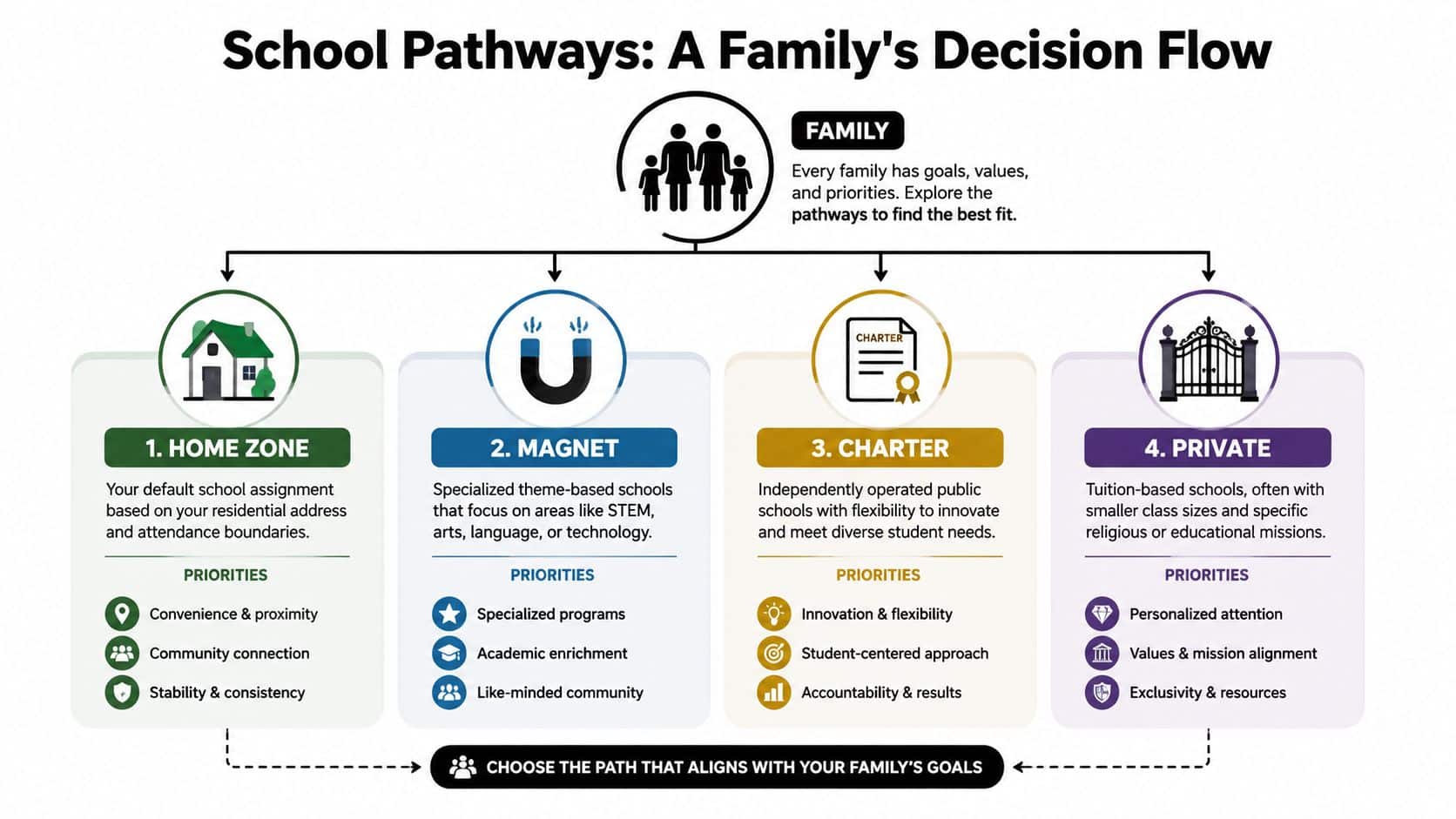
A family choosing in Atlanta is often choosing between four different systems of rules. A home zone ties a child to the school assigned by address. A magnet school centers on a specialty theme or academic model. A charter school is publicly funded and independently run. Private schools set their own admissions rules and charge tuition.
Match the pathway to the family's real constraints
The right choice usually starts with daily life, not prestige. A zoned school often fits when stability and distance matter most, because the routine is simpler and the commute is easier to predict. A magnet school can make sense for a child with a strong interest or a family willing to manage an application process that may involve a lottery or program criteria. A charter school works for families looking for a public option with a different school model. Private schools fit families who want a separate admissions track and can handle tuition and transportation differences.
APS's charter campuses show how charter schooling sits inside the public system, while the broader metro profile shows that private schools are part of Atlanta's school mix. Families comparing these paths should focus on fit, commute, admissions timing, and whether the school's day matches the rest of the household calendar.
Operational fit matters too. A school choice affects how devices are handed out, how records are stored, and how student data is protected. Districts that retire laptops, tablets, and drives without a clear process can leave student information on old hardware, so some Atlanta-area schools work with local partners such as Beyond Surplus to handle end-of-life IT assets and data security with care, especially when administrators find for schools while comparing operational support options. For families who are also weighing where to live, a guide to Atlanta neighborhoods for families can help connect school access with the day-to-day reality of commuting, care schedules, and household logistics.
Verify the details before you apply
Application windows matter. Transportation rules matter. So do disability services, language support, and advanced learning options. A school can look like a strong match on paper and still be a poor fit if the bus schedule does not work or the calendar clashes with your work hours.
The best choice is the school that can serve your child's needs on a schedule and in a location your family can actually sustain.
Homeschooling and learning pods are also legal options. They are not the right fit for every family, but they do give parents another route when they want more control over pace, schedule, or instructional setting. Before choosing either one, families should ask how re-entry, records, and accreditation would work later.
What Academic Performance Data Tells You
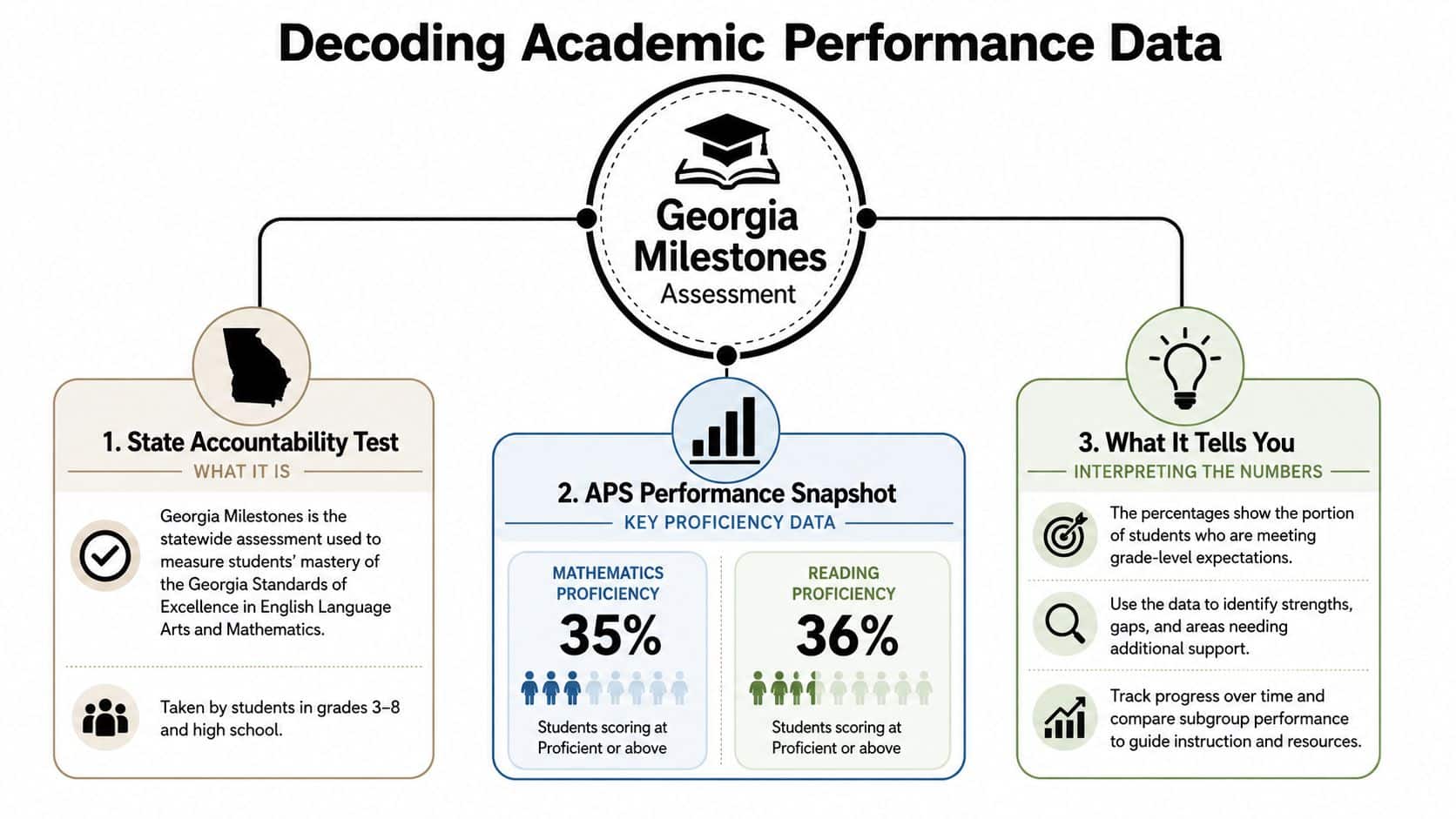
A school report can feel discouraging if you read it like a final judgment. It works better as a map. Georgia Milestones is the state's annual accountability test, and independent district summaries place APS at roughly 35% proficiency in math and 36% in reading (Atlanta Public Schools academic profile). Those figures matter, but only when you know what they measure and what they leave out.
Proficiency is not the same as school effectiveness
Proficiency shows how many students reached the state benchmark at a single point in time. It does not show how much a school helped a particular child grow, how steady the school climate feels, or whether students are improving from fall to spring. Families can miss that difference if they treat raw scores as the whole story.
APS uses its own data tools, through district reporting and related performance summaries, to separate achievement from growth, climate, equity, and graduation context. That split matters because one school may start with heavier challenges and still show real progress, while another may post stronger-looking scores without the same growth pattern.
Use the right test for the right question
APS also administers NWEA MAP twice per year, with an optional third administration to track growth during the year (APS turnaround case study). That schedule gives schools a second reading before the year ends, like checking a route while the trip is still underway instead of waiting until the destination.
Parents should read Georgia Milestones as the wide-angle view and MAP as the progress check. One shows where a child landed. The other helps show whether instruction is moving in the right direction.
Annual tests tell you where the car parked. Growth data tells you whether the engine is working.
For families weighing whether a school and a home location fit together, the school picture also ties to the broader Atlanta real estate market forecast for 2026, because enrollment patterns, commute times, and district boundaries often move together. For schools serving highly mobile populations, that context matters. A school with changing enrollment, shifting attendance, or uneven subgroup composition needs more than one final score to show whether support systems are working.
Calendars, Transportation, and Support Programs
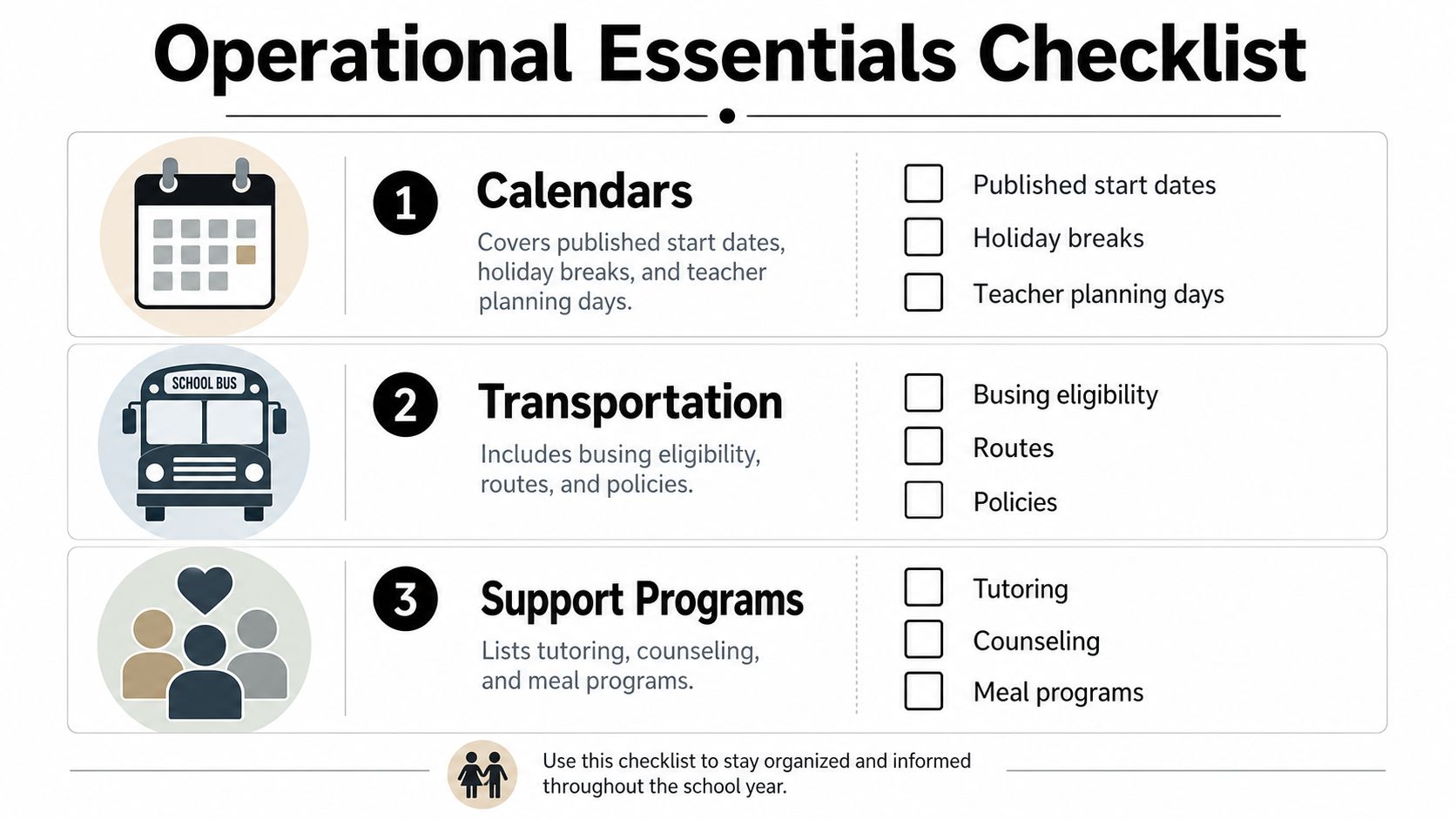
A school can have strong academics and still be a poor fit if the calendar or support services do not match family life. APS and neighboring districts publish calendars with start dates, breaks, and teacher planning days, and those dates do not always line up from one district to another. For families balancing childcare, that mismatch can decide whether a school works in daily life.
Transportation changes the real school choice
Transportation is where many families hit the wall. Zoned schools usually have the clearest bus access, while magnet and charter families often need to plan for more personal drop-off and pickup. MARTA can help some older students and families in limited situations, but it does not replace district transportation planning.
If you are trying to understand how accommodations connect with classroom support, the ADHD classroom accommodations guide is a useful reference for thinking through learning needs before you submit enrollment paperwork or ask for meetings.
Support services should be part of the first conversation
Parents often ask about ESOL, special education, Section 504 plans, and gifted services. Those supports help students access school in practical ways, but the process for starting each one is district-specific, so families should ask early and get contact names in writing. It is easier to plan before school starts than to ask for adjustments after a child has already struggled for weeks.
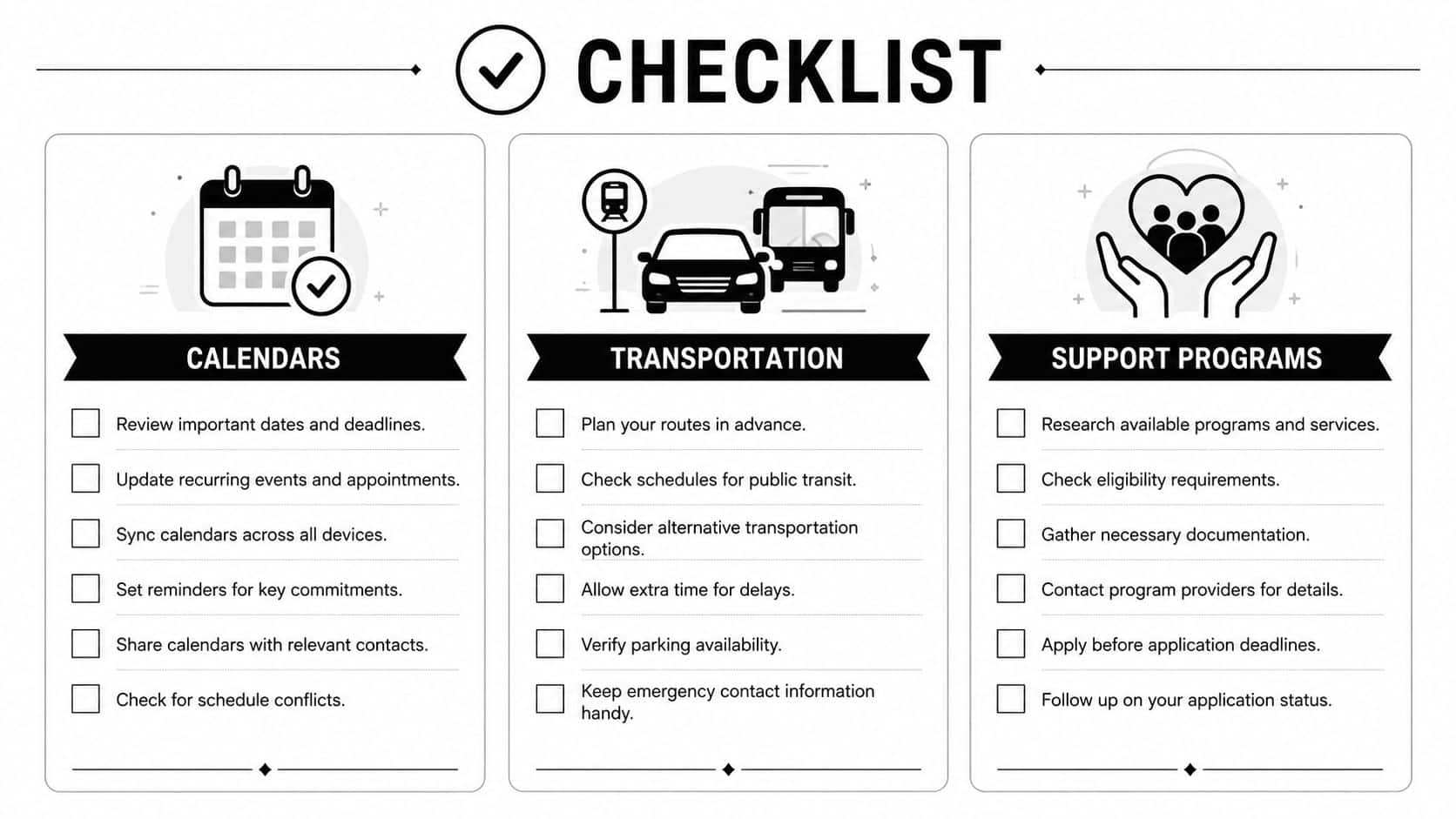
Typical enrollment paperwork usually includes proof of residence, immunization records, a birth certificate, previous transcripts, and IEP or 504 paperwork if applicable. Having those documents ready turns enrollment from a scramble into a checklist.
The Atlanta real estate market affects school planning more than many families expect, because home searches, lease timing, and school calendars often collide in the same season. If you are buying or renting this year, that timing matters when you choose an address you can sustain.
Equity, Attendance, and the Hidden Drivers Behind Outcomes
A family can tour two Atlanta schools with similar test scores and leave with very different impressions. One school may feel settled and predictable, while another is working through higher rates of poverty, disability support, language access, and housing instability. APS's 2022 profile showed 73% economically disadvantaged students, 13% students with disabilities, and 4% English learners (Equity in Education report). Those figures are not background noise. They explain why outcomes can vary so much from one neighborhood to the next, even inside the same district.
Stability shapes achievement
The same equity reporting says closing Black-white gaps at the current pace could take 128 years (Equity in Education report). That is a signal about pace, not a fixed forecast. Families and school leaders need to read it the way they would read a long repair estimate on a house, the work may be underway, but the timeline still affects what you can expect this year.
Attendance sits inside that stability picture. Metro-area reporting found 19,888 APS students missed more than 15 days in 2023 and that APS had the metro area's highest absenteeism rate at 35% (early-grade disenrollment and attendance report). Another local finding said more than 2,000 APS students, over 4%, reported homelessness in 2022-23 (same report).
A school that sees frequent absences needs more than a polished mission statement. It needs family outreach, early intervention, and clear routines that catch problems before they become normal.
For parents, that means looking past labels like “strong school” or “high-performing school” and asking a more practical question. Can this school support a child whose attendance, housing, language, or disability needs may shift during the year? The answer often sits behind the headline data, in the daily systems that keep students coming through the door. Administrators face the same test at the operations level, from enrollment follow-up to secure handling of old equipment, and even decisions such as whether a campus has access to school district fume hood options when science spaces are being updated. Schools that manage those details well usually handle student support with more consistency too.
Families also make better choices when they understand where district services begin and end. If a school struggles with attendance, it may still be the right fit for a child who has strong home support and a predictable routine. If a child needs more school-based help, the same school may require closer follow-up from parents, counselors, and teachers. That is the trade-off hidden inside Atlanta's equity numbers, and it matters just as much as a school's test score row in a spreadsheet.
For districts and campuses handling outdated devices, secure disposal is part of the same responsibility mindset. A local partner such as Beyond Surplus education electronics recycling services can help schools clear out old IT assets without leaving data behind to create another problem later.
Recycling Outdated School IT Assets the Right Way
Atlanta schools refresh devices all the time. Chromebooks age out, desktops get replaced, classroom projectors fail, network gear gets upgraded, and lab equipment changes as curriculum shifts. For a district or campus team, the hard part is not only getting old hardware out of storage. It is making sure the data on it cannot come back later and create a problem for the school.
Security has to come before disposal
The FTC Disposal Rule expects organizations to dispose of consumer information securely, and schools should treat old devices the same way they treat any other record-bearing asset with sensitive data. That means hard drives need documented destruction or certified wiping, not a quick guess that the device is probably empty. Certificates of recycling and data destruction matter because they create a paper trail that shows the district did not hand off risk and hope for the best.
Beyond Surplus provides electronics recycling and IT equipment disposal services for schools and school districts in Atlanta, along with secure data destruction and shredding services for school-related electronics and IT assets. For administrators handling a small pickup or a larger rollout, that kind of service model can fit a pickup or drop-off workflow without forcing the school to manage the logistics alone. Schools that are also planning facility work can use Beyond Surplus education electronics recycling services in Georgia as a starting point for planning what should be removed, what needs documented destruction, and what can leave the building with a clear record.
What to ask before you hand over equipment
A serious recycling partner should be able to show chain-of-custody documentation, downstream vendor auditing, NAID or R2 certifications, and clear destruction records. If a partner cannot explain where the assets go after pickup, the school still owns the risk in practice, even if the equipment is gone physically.
If you are planning science lab upgrades or facility changes, the disposal process may also connect with specialized equipment removal. For that kind of planning, school district fume hood options can help administrators think through broader facility lifecycle issues before old equipment stacks up in storage.
Schools should also separate recoverable value from scrap. Some asset classes have reuse or buyback potential, while others need direct destruction or dismantling. The best process leaves no uncertainty about data, custody, or downstream handling.
Your Atlanta Schools Action Plan
Parents should start with the address, confirm the district, and then check whether the school is zoned, magnet, charter, private, or outside the neighborhood system. After that, line up the calendar, transportation, and support-service questions before deadlines hit. A good school fit is as much about logistics as it is about reputation.
Administrators should treat old IT equipment as a compliance issue, not a storage problem. Inventory the devices, schedule certified pickup, and make sure the file folder includes recycling and data-destruction certificates. That way, the school can move hardware out safely and keep the audit trail intact.
Beyond Surplus helps schools and district teams handle electronics recycling, secure IT asset disposal, and documented data destruction for outdated devices and classroom technology. If you're comparing school logistics, campus compliance, or end-of-life hardware planning in Atlanta, visit Beyond Surplus to see how certified pickup, recycling, and liability transfer can fit your process.


