

Retired switches, routers, handsets, edge devices, and cable plant have a way of piling up in back rooms long after the project is over. Most enterprises don't have a disposal problem first. They have a control problem. Nobody wants to move the gear until they know what still has value, what holds data, what must be documented, and what can leave the site without creating a compliance headache.
That's where green telecom asset recovery becomes useful. It turns a messy equipment retirement cycle into a managed business process with clear decisions, secure handling, and a documented environmental outcome. For organizations with equipment in Atlanta, Smyrna, or distributed locations across the country, the practical question isn't whether old telecom hardware should leave the building. It's how to remove it without losing residual value or chain of custody.
What Is Green Telecom Asset Recovery
A telecom refresh usually leaves behind more than scrap. It leaves racks of gear with mixed value, mixed risk, and no clear disposition path. Green telecom asset recovery is the operating process that sorts those assets correctly so the business can recover resale value, document data handling, and keep unusable equipment out of landfill through approved downstream recycling.
The difference is control. Standard e-waste pickup removes material from the building. A managed recovery program identifies what should be redeployed, what still has secondary market demand, what needs teardown for parts, and what must go through certified recycling after data review and final audit documentation.
The environmental piece starts with reuse. Extending the life of switches, routers, handsets, PBX equipment, and related hardware usually delivers a better outcome than sending everything straight to commodity recycling. Recycling still matters, but it should be the last route after testing, triage, and resale evaluation. Companies that need documented, zero-landfill telecom equipment disposal are usually looking for this type of process, not a one-time haul-away.
Execution matters more than labels.
In practice, green telecom asset recovery usually includes four working controls:
- Asset identification: Record model, part number, serial number, and site location before removal.
- Data and risk review: Flag data-bearing or configurable devices so sanitization and chain of custody are handled correctly.
- Disposition routing: Send each item to reuse, resale, parts harvesting, or recycling based on condition, demand, and compliance requirements.
- Reporting: Produce inventory records, settlement detail, certificates where applicable, and downstream accountability.
There are trade-offs. Holding equipment for too long can reduce resale recovery. Moving too fast can create audit gaps or miss data-bearing components that need sanitization. A good program balances pickup speed, remarketing potential, and documentation discipline, whether the project is a local Atlanta or Smyrna deinstallation or a national multi-site rollout.
Secondary markets also shape the "green" decision. If tested devices can re-enter service through refurbishers and resale channels, they avoid premature destruction and return value to the original owner. That same reuse economy is what supports buyers looking for lower-cost equipment, including markets for cheap iPhones UK, where extending device life reduces waste and lowers replacement cost.
For enterprises, this is an asset disposition program with environmental standards built into the workflow. The goal is to remove retired telecom equipment with documented custody, practical value recovery, and a defensible end-of-life record.
The Business Case for Sustainable Telecom Disposition

Many organizations still treat retired telecom gear like low-priority surplus. That approach creates three predictable problems. Storage areas fill up, data-bearing assets linger without a final disposition, and finance never sees the value that usable hardware could have returned.
A sustainable disposition program fixes that because it treats retirement as an operational process, not an afterthought.
Compliance is one driver
Telecom asset recovery is now a controlled process with measurable outcomes. Standard workflows emphasize secure data sanitization, testing, and detailed reporting to support audits and compliance in regulated sectors, as described in this overview of telecom asset recovery workflows.
That matters because old telecom gear often contains more risk than teams first assume. IP phones, unified communications appliances, firewalls, PBXs, call recording systems, and some network devices may store credentials, configuration files, call data, or user information. If those assets leave the site without controlled handling, the organization keeps the liability.
The financial case is just as strong
Sustainable doesn't mean sacrificing return. In a good program, the highest-value path comes first. Reuse and remarketing generally beat disposal when equipment still has secondary demand. If there isn't a viable resale market, parts harvesting or material recovery may be the better route.
That's the same logic that drives broader refurbishment markets. Buyers looking for cheap iPhones UK are participating in the same reuse economy that enterprise telecom teams can tap when retired hardware is tested and graded properly.
What inaction usually costs
A loose process tends to create avoidable waste:
- Idle inventory: Equipment sits in cages, closets, or storage rooms without an owner.
- Lost recovery value: By the time anyone reviews the gear, the best resale window may be gone.
- Weak audit trails: Teams can't easily prove what was wiped, destroyed, resold, or recycled.
- Poor ESG support: Sustainability teams need records, not assumptions.
For organizations building formal disposal policies, it helps to align telecom retirement with the wider environmental impact of electronic waste. The strongest programs don't separate security, value recovery, and environmental handling. They manage all three together.
If your team can't produce a final disposition record for retired telecom hardware, the equipment isn't really gone. The risk is still on your books.
The Green Asset Recovery Workflow Explained
A good green telecom asset recovery program is methodical. It doesn't begin with a truck at the loading dock. It begins with planning the move so nothing gets damaged, lost, or released without the right data handling.
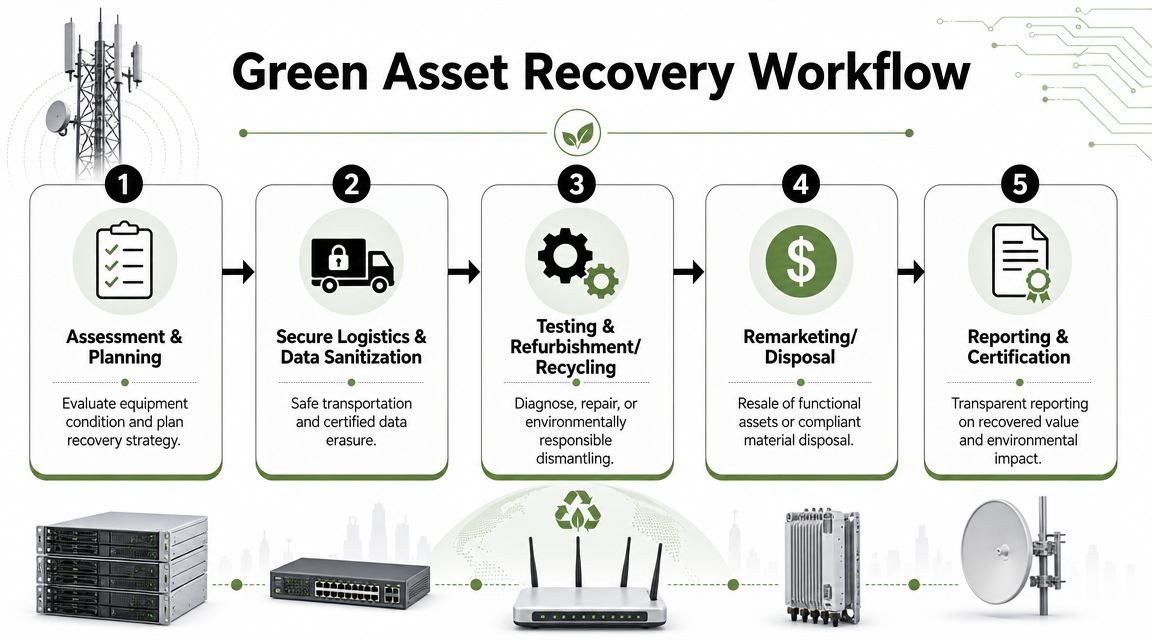
A robust workflow follows a strict sequence of de-install, transport, inventory, data sanitization, testing, and then resale or recycling, with reuse prioritized before recycling, according to TXO's asset and cable recovery process.
On-site removal and packing
The first step is controlled de-installation. That's especially important in telecom rooms and active data environments where cabling, rack order, and access windows matter.
Teams should separate:
- Data-bearing assets: Firewalls, call managers, voice gateways, appliances, storage media.
- Reusable infrastructure: Switches, routers, optics, phones, power units, spares.
- End-of-life material: Damaged units, obsolete boards, mixed cable, and scrap metal.
Packing matters more than people expect. Loose stacking, mixed pallets, and poor labeling reduce resale potential and create inventory errors at receiving.
Transportation and chain of custody
For metro projects, local pickup can shorten the time between decommissioning and intake. For national refreshes, the provider needs a logistics network that can coordinate multiple sites under one reporting structure.
That's one reason enterprises often fold telecom retirement into a broader data center decommissioning process. The same controls apply. Site scheduling, secure loading, serialized records, and documented handoff all protect both value and auditability.
Field note: The fastest way to create downstream confusion is to let one site palletize equipment one way and another site improvise its own method.
Receiving and inventory audit
Once assets arrive, every unit should be catalogued by OEM part number and serial number when available. The informal “pickup” model fails at this point. Without intake discipline, there's no reliable way to tell finance what had value, no way to tell compliance what carried data, and no way to tell sustainability teams what avoided landfill.
A useful receiving audit normally captures:
| Intake element | Why it matters |
|---|---|
| Serial number | Supports traceability and audit defense |
| Part number | Helps determine resale or parts demand |
| Physical condition | Affects grading and repair decisions |
| Asset category | Distinguishes reuse, destruction, or recycling path |
Data sanitization and destruction
Not every telecom asset needs the same treatment. Some can be sanitized with certified wiping. Others require physical destruction because storage is damaged, inaccessible, or policy requires it.
The right choice depends on the hardware and the client's risk profile.
- Software sanitization works when the storage media is functional and the organization accepts certified erasure.
- Physical destruction is used when wiping isn't possible or when policy requires a destructive end state.
- Certificates and logs close the loop and give internal stakeholders something they can file.
Testing, refurbishment, and grading
Once secure handling is complete, the value question becomes practical. Does the equipment function? Is repair economical? Does demand exist in the secondary market? Can it support internal redeployment?
This stage usually separates equipment into several channels:
- Remarketing candidates: Clean, tested, functional assets with resale demand.
- Refurbishment candidates: Equipment worth repairing or reconfiguring.
- Parts harvesting candidates: Units that aren't worth selling whole but contain useful components.
- Recycling candidates: Hardware with no practical reuse path.
Final disposition
The best programs prioritize outcomes in the right order. Reuse first. Resale next if redeployment doesn't fit. Parts harvesting when whole-unit resale doesn't work. Recycling when the asset is at end of life.
That sequence is what makes green telecom asset recovery commercially sound. It protects what can still earn money, responsibly processes what can't, and leaves the client with records instead of guesswork.
Measuring the ROI of Green Asset Recovery
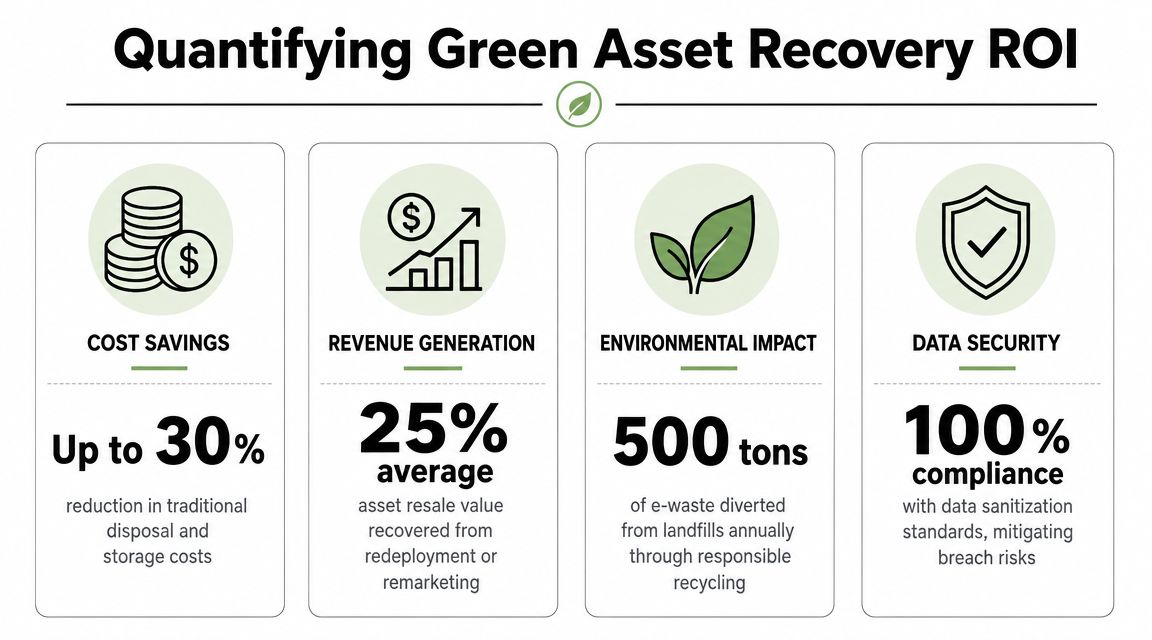
ROI in green telecom asset recovery isn't one number. It comes from a mix of recovered value, avoided operational cost, and reduced liability. If a provider only talks about scrap weights or only talks about resale, the picture is incomplete.
Financial return
The clearest return comes from equipment that can be redeployed, remarketed, or parted out. That can offset refresh costs and remove the burden of storing retired hardware that no one wants to own.
There's also a less obvious gain. When teams move retired telecom gear promptly, they reclaim space in IDFs, warehouses, and staging areas. That reduces clutter and makes future moves easier to manage.
A practical review should ask:
- What was resold or redeployed
- What went to parts recovery
- What required recycling
- What storage or handling costs were avoided
For organizations managing equipment in interim storage before disposition, it also helps to discover essential temperature control when sensitive electronics must be held temporarily without exposing them to unnecessary environmental stress.
Sustainability reporting
Sustainability claims are easy to make and harder to prove. One of the biggest gaps in the market is carbon accounting that compares reuse, refurbishment, transport, and recycling on an end-to-end basis.
Top-tier providers address this by offering Environmental Benefits Reports that quantify sustainability contributions and help clients decide whether to remarket, redeploy, or recycle decommissioned hardware, as outlined by Iron Mountain's IT asset lifecycle services.
That kind of reporting is useful because it gives ESG, procurement, and operations teams a common record. Instead of saying equipment was “handled responsibly,” the business can document the disposition path and environmental contribution for each project. For companies evaluating a program, telecom asset recovery services in the USA often combine value recovery with that reporting layer.
Risk reduction has real value
Some returns don't show up as resale proceeds, but they matter just as much. Certificates of destruction, serialized reporting, and documented recycling reduce uncertainty during audits, legal review, or internal investigations.
A certificate isn't just paperwork. It's evidence that the organization followed its own retirement controls.
When leadership evaluates ROI, the right question is broader than “what did the assets sell for?” It should also include whether the process eliminated storage drift, closed data-security exposure, and produced records that stand up to scrutiny.
Green Asset Recovery in Practice for Enterprises
The process makes more sense when you see how it plays out in real operating environments. Telecom retirement rarely happens in a clean lab setting. It happens during relocations, refreshes, consolidations, and decommissions where time is tight and multiple stakeholders want different outcomes.
Multi-site retail refresh
A national retail chain replacing legacy phones and switches across a large store footprint has a logistics problem first. Equipment leaves many locations in uneven volumes. Some stores have a few handsets and one compact switch. Others have a back room full of networking gear, UPS units, and labeled spares.
A workable program standardizes packing instructions, pickup windows, and intake reporting across all locations. That lets the client compare one site to another and prevents one-off local disposal decisions that break chain of custody.
Atlanta colocation decommission
A colocation operator decommissioning racks in the Atlanta market usually needs a tighter operating window. Work has to happen around live customer environments, building access rules, freight coordination, and cross-connect dependencies.
In that scenario, the priorities change:
- Controlled removal: Avoid disruption to adjacent live equipment.
- On-site security decisions: Determine which assets need wiping and which require destruction.
- Fast inventory reconciliation: Match what left the cage to what reached intake.
- Final routing: Separate remarketing candidates from material recovery quickly.
The green part of the process matters here because data center and telecom projects often produce a mix of high-value reusable equipment and true end-of-life scrap. Treating all of it as generic e-waste is usually the most expensive option.
Healthcare network retirement
A regional healthcare system retiring old network hardware faces a different pressure. Compliance and documentation come before resale value. If a voice gateway, appliance, or communications server might contain sensitive information, the chain of custody has to be defensible from removal through final disposition.
That means the organization will care less about generalized recycling promises and more about whether the provider can show:
| Enterprise scenario | What matters most |
|---|---|
| Retail rollout | Consistent multi-site execution |
| Colocation decommission | Timing, access control, technical coordination |
| Healthcare retirement | Data security records and traceability |
In regulated environments, “we recycled it” is not a sufficient answer. Teams need to know how the asset was identified, sanitized, moved, and closed out.
These examples are different, but the lesson is the same. A single managed program can support local pickup around Atlanta and Smyrna while also coordinating distributed enterprise projects if the workflow, records, and disposition paths stay consistent.
Your Green Telecom Asset Recovery Vendor Checklist
A vendor decision usually determines whether asset recovery produces audit-ready records and usable recovery value, or turns into another disposal project with weak documentation. Procurement teams should treat this step like operational risk review, not a price comparison exercise.
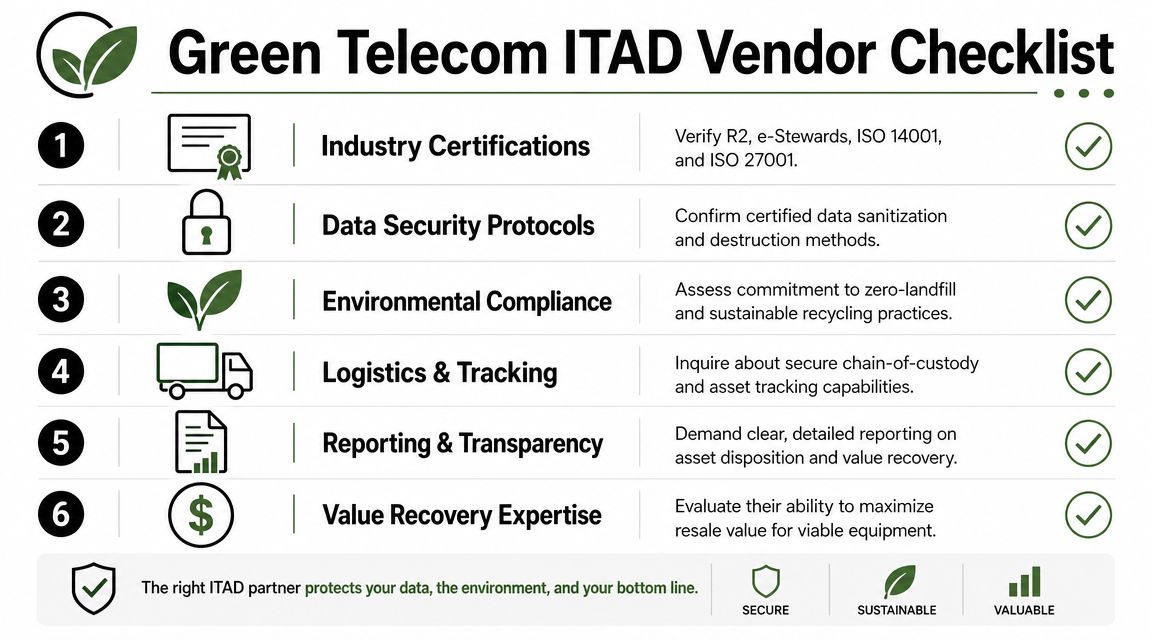
The strongest providers can explain exactly how they will handle a mixed telecom load from pickup through final reporting. That matters whether the job is a local removal in Atlanta or Smyrna, or a multi-site enterprise project spread across several states. Process consistency is what protects the financial outcome, the environmental record, and the compliance file.
Questions worth asking
Start with the controls that affect risk, recovery, and reporting.
- Security controls: Ask how the vendor identifies data-bearing telecom assets, which sanitization standards it follows, and when destruction is used instead of wiping.
- Chain of custody: Confirm how equipment is tagged, logged, transported, received, and reconciled at intake.
- Disposition hierarchy: Ask how the provider decides between resale, parts harvesting, refurbishment, and commodity recycling.
- Documentation: Request sample settlement reports, destruction certificates, downstream recycling records, and exception reporting.
- Geographic coverage: Verify that the vendor can support local pickups and national programs with the same service standards.
What separates a usable partner from a risky one
Good answers are specific. Vague answers create work for your legal, IT, sustainability, and audit teams later.
Ask for details such as:
- How are serial numbers captured if labels are damaged or missing?
- What is the procedure for failed drives, flash media, or embedded storage in telecom gear?
- How are reusable assets kept separate from low-value scrap during packing, transport, and sort?
- What final reports does the client receive, and how quickly are they issued?
- Can the provider support site access restrictions, pickup scheduling windows, and after-hours removals?
For companies formalizing procurement standards, this vendor due diligence checklist for ITAD and asset recovery providers is a useful way to test whether a bidder has documented controls or just polished sales language.
One useful screening standard
A credible vendor will discuss trade-offs without oversimplifying the job. Some retired switches still have resale value. Some chassis are better suited for parts recovery. Some equipment should go straight to material recycling because testing, repair, or remarketing will cost more than the likely return.
That judgment call affects both sustainability and margin.
Beyond Surplus is one example of a provider offering telecom asset recovery, secure data destruction, pickup coordination, and disposition reporting for business clients. That service model can be practical for enterprise projects that combine reusable hardware, storage-bearing devices, and end-of-life equipment in the same load.
Partner with Beyond Surplus for Your Asset Recovery Needs
Green telecom asset recovery works when the business treats retired hardware as an asset stream that needs control, not as leftover clutter that should disappear. The organizations that do this well protect data, recover value where it still exists, and generate records that satisfy operations, finance, and compliance at the same time.
For enterprise teams, the biggest gains usually come from discipline. Move equipment promptly. Keep chain of custody intact. Separate reusable assets from true end-of-life material. Require final reporting that shows what happened to every category of hardware.
That's especially important in telecom environments because one load can contain resale candidates, repairable parts, data-bearing devices, mixed cable, and pure scrap all at once. A managed process handles those differences without forcing your team to improvise at each site.
If your business is planning a network refresh, vacating telecom rooms, consolidating data infrastructure, or cleaning out years of stored equipment in Atlanta or across a national footprint, a structured recovery program will usually outperform ad hoc disposal. It gives you a clearer financial outcome, a better environmental record, and a far stronger compliance position.
Contact Beyond Surplus to discuss a green telecom asset recovery program for your business, including secure pickup coordination, data destruction, value recovery, and documented recycling for enterprise telecom and network equipment.