If you're staring at a cage of retired routers, switches, optics, and line cards after a carrier upgrade, the risk isn't just wasted floor space. It's missed recovery value, weak chain of custody, and network gear leaving your control before it's been properly documented and sanitized. In Atlanta, that problem shows up often in data center consolidations, office closures, and telecom refresh projects where the equipment is still commercially useful but the disposition process is loose.
Telecom network gear resale works when you treat it like an asset recovery project, not a surplus cleanout. Buyers care about exact configuration, test status, documentation quality, and how quickly the lot can move. Your security team cares about stored configs, credentials, and custody records. Finance cares about recovery. Operations cares about speed. A good process aligns all four.
Preparing Your Telecom Assets for Resale
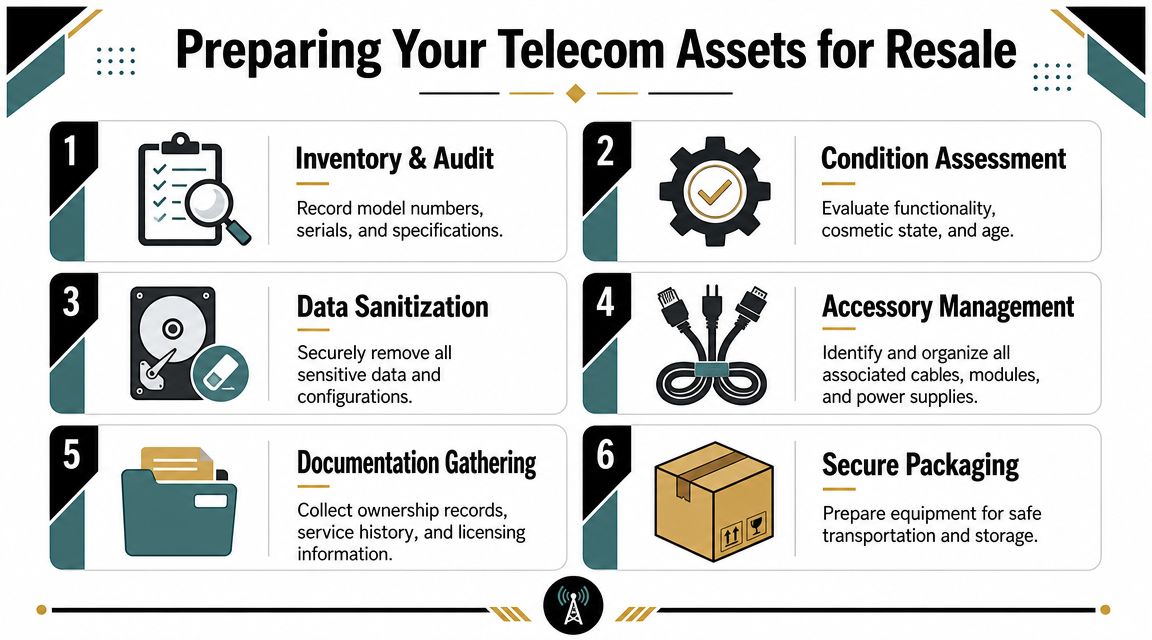
A common error is pricing before inventory. That backwards approach costs money because telecom buyers don't quote from vague descriptions like "Cisco switches, mixed lot" or "Juniper gear, used." They want exact model or SKU, firmware, configuration, and condition. Beyond Surplus notes that a practical workflow starts with triage before any repair spend, then separates inventory into refurbish for resale, sell as-is, or harvest parts/recycle, because buyers price on platform relevance, condition, configuration, quantity, and documentation quality in its telecom equipment resale process.
Capture the data buyers actually need
Start with a structured asset sheet. For each unit, record:
- Manufacturer and model. Cisco, Juniper, Nokia, Ericsson, Arista, Ciena, and exact platform family.
- Part number and serial number. This is what lets a buyer validate authenticity and age.
- Installed configuration. Supervisors, line cards, transceivers, memory, power supplies, fan trays, and any included modules.
- Firmware or software state. Not to advertise features, but to avoid surprises in testing.
- Physical condition. Bent ears, cracked faceplates, missing blanks, corrosion, damaged ports, or rack rash.
- Functional status. Pulled working, powers on, failed test, unknown, or harvested.
- Quantity by identical SKU. Consistent lots move faster than mixed singles.
- Photos. Front, rear, serial labels, and close-ups of damage or installed cards.
If your team skips half of that, the buyer fills the gap with a lower offer. Incomplete manifests slow quoting, trigger more exceptions during receiving, and create room for repricing.
Practical rule: A clean spreadsheet with accurate configurations usually adds more value than spending time trying to cosmetically improve low-demand gear.
Sort into three lanes
Not every device deserves bench time. Triage first.
Refurbish for resale
Use this lane for relevant platforms with complete configurations, good physical condition, and a realistic resale path. Modern enterprise and carrier-grade switches, routers, firewalls, optics, and transport components usually belong here if they test cleanly.Sell as-is
Use this for working pulls, overstock, or deinstalled gear where testing depth doesn't justify the labor. Buyers may still want it if the SKU is in demand and the lot is documented well.Harvest for parts or recycle
Chassis with bad boards, incomplete units, unsupported gear, or equipment with physical damage often produce better recovery as parts or scrap than as a full unit listing.
A mixed pallet should never stay mixed if you're trying to maximize value. Separate complete systems from partials. Separate tested equipment from unknown condition. Separate modern platforms from gear that's obviously aged out.
Batch the work intelligently
High-value gear should be processed individually. Lower-value gear should be grouped by identical SKU and condition. That keeps labor proportional to likely return.
For teams coordinating a broader facility transition, the discipline is similar to planning your laboratory move. Sensitive assets don't travel well under a loose inventory process. The move plan, staging plan, and chain of custody should connect.
If the lot includes network hardware that still has a strong secondary audience, a focused buyer for used routers and switches can help turn that manifest into a practical recovery path.
Ensuring Data Security and Regulatory Compliance
A router isn't an empty metal box. It may contain startup configs, credentials, management settings, VPN details, logs, and customer or operational metadata. That changes the whole resale decision. Secure sanitization has to happen before remarketing, not after the asset leaves your custody.
Future Market Insights frames the issue correctly in its telecom equipment outlook. The question isn't just who buys the gear. It's what disposition path reduces risk and maximizes recovery. That matters in a market projected to reach USD 363.57 billion in 2026 in its telecom equipment market forecast.

Why factory reset isn't enough
A factory reset may clear the obvious settings, but it doesn't automatically satisfy internal policy, customer obligations, or regulated handling requirements. On enterprise-grade network hardware, the primary issue is proof. Your organization needs evidence that configurations and stored data were removed through a documented process.
That means your workflow should include:
- Asset identification before wipe so the certificate maps to the correct serial.
- Controlled handling while the gear is staged, transported, and processed.
- Recorded sanitization steps tied to model type and storage method.
- Exception handling for failed devices that can't be wiped logically and must be destroyed physically.
If you can't prove what happened to a device between rack removal and final disposition, you've kept the risk even if the equipment is gone.
Decide resale versus destruction by risk, not hope
Some telecom gear should be resold. Some should be wiped and remarketed only after testing. Some should be destroyed because the compliance burden or supply-chain concern outweighs resale upside.
Use a simple decision filter:
| Scenario | Better path |
|---|---|
| Standard switch or router with manageable sanitization and clear custody | Resale after wipe and test |
| Device with failed storage, uncertain config state, or broken custody trail | Physical destruction |
| Incomplete unit with little market value but salvageable components | Parts harvest or recycling |
| Highly sensitive network edge or security hardware with policy restrictions | Destruction or tightly controlled remarketing |
A formal ITAD process is essential. A provider offering telecom ITAD services should be able to document sanitization, maintain custody records, and issue the certificates your compliance team will ask for later.
Keep liability from following the asset
The sale itself doesn't transfer operational liability unless your paperwork and handling do. Retain the asset report, custody documentation, and data destruction records. If a regulator, customer, or internal auditor asks what happened to retired telecom hardware months later, those documents are your answer.
Accurately Valuing Your Decommissioned Network Gear
A common enterprise scenario looks like this. The decommission project is done, the hardware is stacked on pallets, finance wants a recovery number, and procurement has three very different bids on the table. The spread usually comes down to one thing. Certainty. Buyers pay more when the lot is easy to identify, easy to test, and easy to resell without surprises.
Carritech makes the buyer-side standard clear in its guidance on selling used telecommunications equipment. A serious quote depends on manufacturer, model, quantity, photos, and evidence of internal condition. Faulty units can still carry parts or recycling value, but they should not be priced like clean, working assets.
Five levers decide most of the number
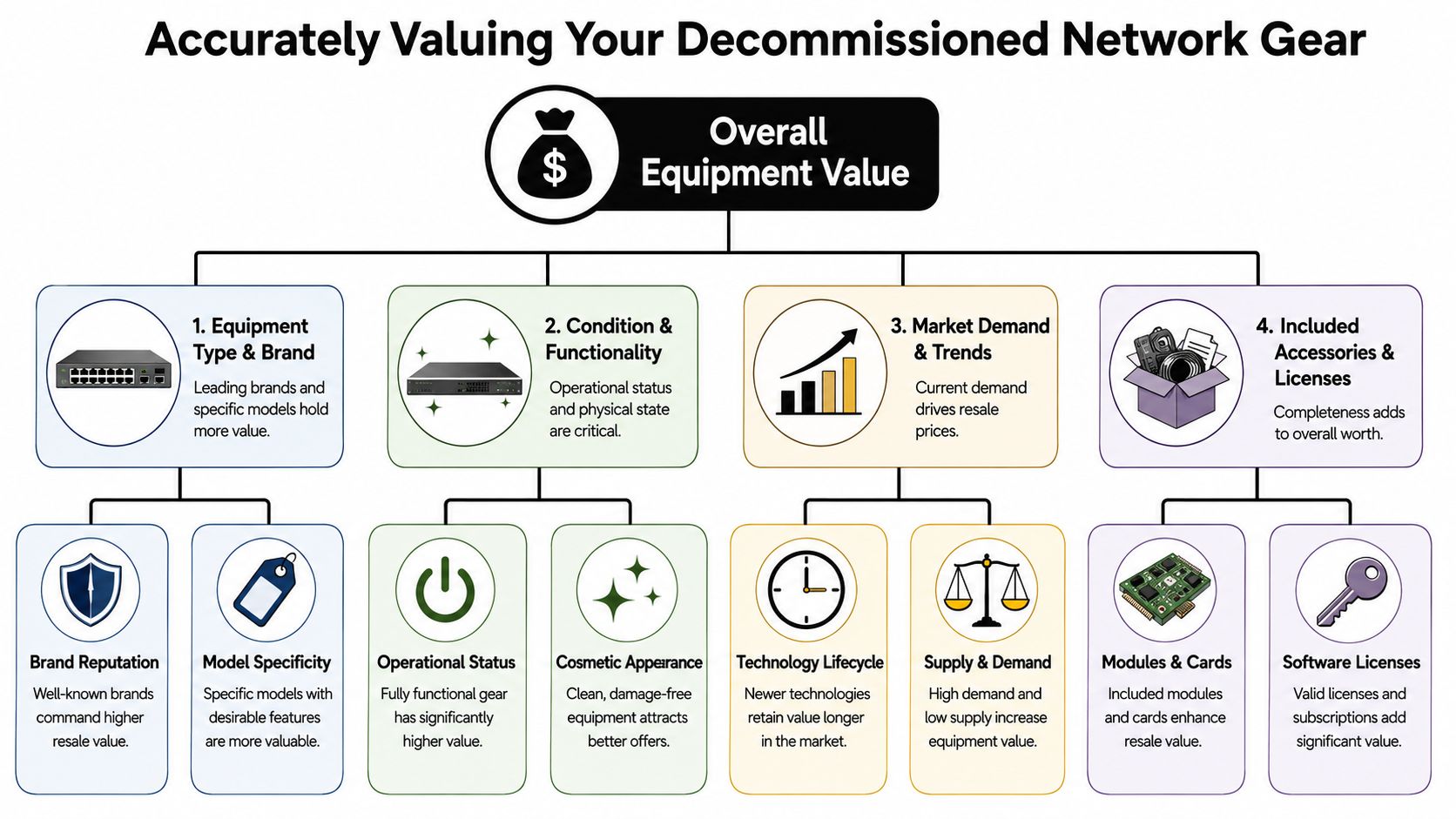
Start with platform relevance. Still-supported Cisco, Arista, Juniper, Ciena, and similar systems usually hold interest longer than older platforms that have already fallen out of expansion plans. Buyers are not just valuing the box. They are valuing how quickly they can place it into a secondary market with known demand.
Then examine the factors that move pricing up or down:
Condition
Clean pulls with intact ports, faceplates, and housings price differently from units with corrosion, impact damage, missing ears, or visible wear from poor storage.Configuration
A chassis can look valuable and still underperform if the supervisors, line cards, power supplies, or licensed modules are missing. In many lots, the primary value sits in the populated components, not the frame.Quantity
Ten matching, tested units are easier to move than a pallet of unrelated SKUs. Standardized lots reduce inspection time, quoting friction, and resale risk.Documentation quality
Good manifests, serial capture, and clear photos reduce buyer assumptions. Weak documentation creates a discount because the buyer has to price in inspection fallout.Remaining support life
Hardware that still fits active maintenance environments usually trades better than equipment already pushed into end-of-support planning.
Mixed, undocumented inventory almost always clears at a discount.
Market timing changes what fair value looks like
Valuation is tied to the replacement cycle. Dell'Oro reported that worldwide telecom equipment revenues declined year over year in 2024 in its market update on worldwide telecom equipment. For sellers, the takeaway is practical. Holding retired gear too long rarely improves the outcome.
I see this often with enterprise telecom closets and regional rollouts around Atlanta. A team finishes a migration, stores the retired equipment for two or three quarters, then asks for pricing after support relevance has slipped and model demand has narrowed. At that point, the same gear may still sell, but the buyer is shopping it as a spares lot instead of a deployment-ready lot. That changes the number fast.
Timing also affects specific components differently. Optics, supervisors, and power supplies can stay liquid after the base chassis loses momentum. If the lot is uneven, value the parts mix carefully instead of treating every unit as a complete system.
Set realistic expectations before you negotiate
Use this framework before requesting bids:
| Value driver | Higher recovery | Lower recovery |
|---|---|---|
| Platform age | Recent, relevant platform | Legacy, unsupported platform |
| Build completeness | Full config with cards, PSUs, optics | Stripped or partial unit |
| Testing confidence | Verified working or clean pull | Unknown or failed |
| Lot makeup | Consistent quantity by SKU | Mixed singles |
| Documentation | Complete manifest and photos | Minimal notes |
For enterprise sellers, especially those coordinating multiple sites in the Atlanta metro area, the best valuation process is controlled and documented. Build the manifest by SKU, identify missing components before the buyer does, separate tested gear from unknown-status gear, and ask for bids on the actual resale path, not a hopeful estimate.
If you want a credible market check, compare offers through a specialist in network equipment buying across the USA. The goal is not the highest headline number. The goal is the highest defensible recovery after testing adjustments, freight, exceptions, and time to close.
Choosing the Right Channel to Sell Your Equipment
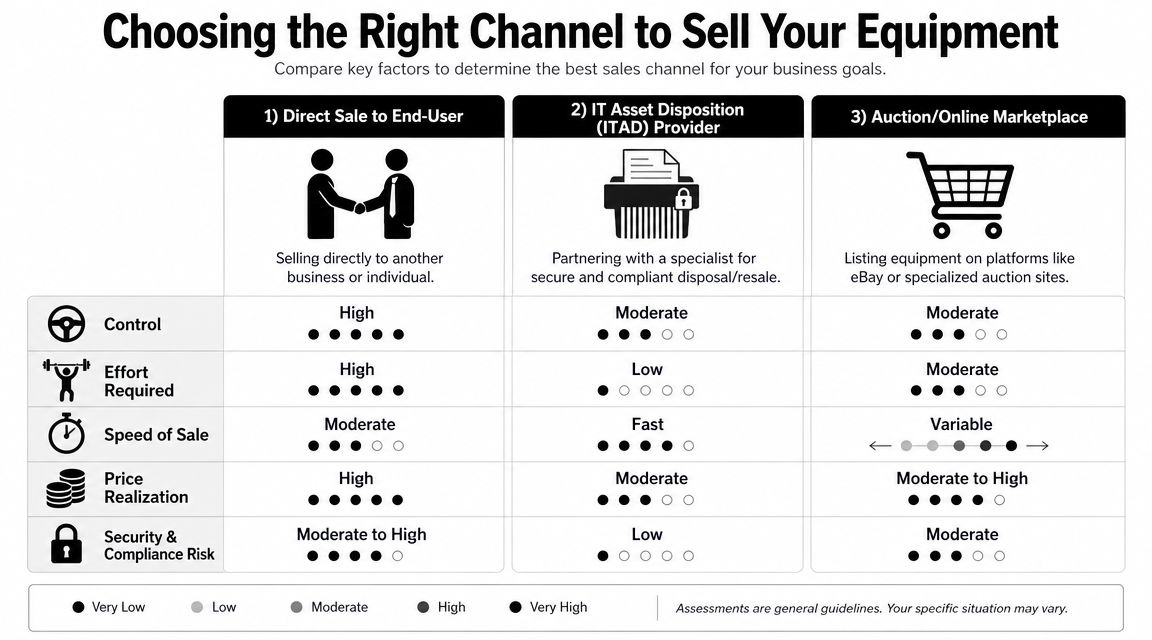
There are three practical paths. Sell it yourself. Use a broker. Or hand the project to a full-service ITAD channel. The right choice depends on your tolerance for labor, your compliance burden, and whether speed matters more than squeezing the last possible dollar out of a few units.
Direct sale gives control and creates work
Selling direct to another business or through your own outbound process gives you the most control over pricing and buyer selection. It also gives you the most operational burden.
You have to build the listing package, answer technical questions, negotiate exceptions, manage freight claims, and deal with returns or dead-on-arrival disputes. This works best when your team already knows the hardware well and the lot is small, clean, and easy to test.
Brokers can widen reach but add another layer
A broker can help if the lot is niche, geographically awkward, or made up of equipment that needs the right buyer rather than a broad marketplace. The trade-off is visibility. You may not know exactly how the gear is being presented or how much margin the intermediary is holding back.
That doesn't mean brokers are a bad fit. It means you should ask hard questions about process, quoting assumptions, exception handling, and who owns the buyer relationship.
Full-service ITAD reduces friction and controls risk
A full-service ITAD route makes sense when the project includes deinstallation, sanitization, testing, resale, recycling, and documentation. That's usually the better fit for enterprise environments, multi-site work, and regulated industries.
Here's a simple comparison:
| Channel | Control | Effort required | Speed | Security and compliance risk |
|---|---|---|---|---|
| Direct sale | High | High | Variable | Higher unless you manage everything tightly |
| Broker | Medium | Medium | Variable | Medium |
| Full-service ITAD | Medium | Lower for your team | Often more predictable | Lower when process is documented |
One practical reason many organizations choose this route is the quoting gap Carritech highlights. Buyers want detailed evidence on manufacturer, model, quantity, and condition, and faulty or incomplete lots carry far lower value. An expert partner that understands those variables can package, test, and route the lot more effectively than a generic liquidation process.
For national rollouts or regional pickups, nationwide telecom equipment buyers can handle the remarketing side while your team stays focused on the network project, not pallet management.
The best sales channel isn't the one with the highest theoretical price. It's the one that closes cleanly, documents every step, and leaves you with fewer exceptions.
Managing Logistics and Finalizing the Sale
A telecom resale project isn't finished when the buyer says yes. It's finished when the gear is packed correctly, the shipment is documented, the custody record is complete, and the settlement matches what was shipped. Problems during these stages frequently cause many deals to go sideways.
Pack for survival, not for storage
Rack ears bend. Faceplates crack. Loose optics disappear. A unit that looked saleable in your cage can arrive downgraded if it wasn't packed for freight handling.
Use a practical packing checklist:
- Remove and bag loose accessories such as power cords, rails, blanking plates, and transceivers if they aren't installed.
- Protect ports and faces with anti-static wrapping, foam, and boxed separation where needed.
- Palletize by SKU or project group so receiving teams can reconcile quickly.
- Label every pallet clearly with project ID, pallet count, and contact information.
- Keep partial and damaged units separate from tested resale candidates.
Build the paperwork before the truck arrives
The bill of lading should match the physical shipment. Your manifest should match the bill of lading. Your internal release should match both. If any of those conflict, the custody trail gets weak and settlement delays start.
Retain these records:
- Final asset manifest with serials where available
- Pickup record showing date, location, and releasing party
- Bill of lading
- Chain-of-custody documentation
- Data destruction certificate, if applicable
- Recycling certificate for non-resale material
- Settlement or reconciliation report
Watch the handoffs
Most losses happen during transitions. Rack to cart. Cart to dock. Dock to truck. Truck to receiving. Every handoff needs accountability.
If the project includes removals from active environments, a provider handling telecom decommissioning services can align deinstall, staging, packing, and shipment under one custody trail. That's especially useful when Atlanta-area facilities are coordinating local pickup while a broader enterprise program spans other sites.
Don't close the project on verbal confirmation. Close it on matched records.
Transform Your Surplus Gear into a Strategic Asset
A common scenario: an IT director finishes a network refresh, the old telecom gear gets stacked in a cage or storage room, and nobody wants to touch it until the next quarter. By then, resale demand has shifted, packaging is incomplete, custody records are harder to verify, and a straightforward recovery project turns into a discounted clearance exercise.
Surplus telecom hardware carries four different outcomes at once. Some units can be resold into the secondary market. Some have parts value only. Some belong in compliant recycling streams. Some create avoidable risk if they sit too long without a disposition decision. The companies that recover the strongest returns treat this as an asset disposition program, not a cleanup task.
As noted earlier, the telecom equipment market is large, and hardware remains a major category inside it. That scale supports steady secondary demand for enterprise and carrier gear, but value is time-sensitive. Market demand changes. Software support sunsets. Optics, line cards, and spares lose value faster when they sit untested and undocumented.
For Atlanta businesses, local execution can make a real difference. Faster site access, coordinated pickups across metro facilities, and tighter custody control reduce delays and limit handling errors. For multi-site organizations, the same standard has to hold in every location. Asset records, data security, test status, freight prep, and final settlement all need to align if the goal is maximum recovery with minimal exposure.
This is the actual shift. Surplus gear should be managed like a balance-sheet event.
If equipment is still sitting in storage under a vague plan to deal with it later, value is already slipping. Beyond Surplus helps organizations turn that backlog into a controlled resale, recycling, and compliance process through secure telecom network gear resale, certified data destruction, compliant decommissioning, and nationwide IT asset recovery support.
Contact Beyond Surplus for secure telecom network gear resale, certified data destruction, compliant decommissioning, and nationwide IT asset recovery support.