

Your new cloud phone platform is live. The old PBX chassis, cards, handsets, and gateway gear are still sitting in a closet or rack, and now someone has to decide what happens next. That decision usually lands on IT, facilities, or procurement, and it's rarely as simple as posting used equipment for sale.
A retired PBX can still hold value, but it can also hold voicemail data, call records, configuration files, and avoidable compliance risk. If you want to sell PBX systems without creating a bigger problem, treat the project as asset disposition, not surplus cleanup.
Preparing to Sell Your Decommissioned PBX System
Most organizations replace PBX hardware for a reason. The business has moved to IP or cloud communications, support has become difficult, or the old platform no longer fits remote work and current operations. Cisco's overview of PBX basics reflects that larger shift from traditional switching to modern IP and cloud-based communication infrastructure, which is why legacy retirement projects are now common in business telecom environments.
Start with ownership and scope
Before anyone disconnects a handset or removes a card, confirm three things:
- Who owns the equipment: Leased gear, carrier-managed systems, and financed hardware need contract review first.
- What's included in the retirement: Main cabinet, voicemail modules, expansion cards, phones, gateways, power supplies, and cabling all affect next steps.
- Who signs off: IT, security, facilities, compliance, and procurement often all have a stake.
If those decisions stay vague, assets get split up, packed poorly, or discarded before they're evaluated.
Treat it as disposition, not cleanup
A used PBX sale has four moving parts. Inventory, data handling, logistics, and resale path. If one breaks, value drops fast.
Practical rule: Don't let your migration team become your disposition team by default.
Internal staff know your environment, but they usually aren't set up to document serials, sanitize storage media, package telecom hardware for transport, and maintain custody records. That's why many companies hand telecom retirements to a specialist handling telecom decommissioning services.
Know where risk hides
The mistake I see most often is assuming old phone gear is harmless because it's “just telecom.” It isn't. PBX systems can store business-sensitive information, and mishandling retired hardware can turn a routine upgrade into a security or audit issue.
Use a simple first pass:
- Separate active from retired gear
- Identify anything with storage or management data
- Freeze disposal until inventory is verified
- Decide whether the goal is resale, recycling, or both
That discipline keeps the project manageable. It also gives you the control needed to recover value instead of losing it through rushed disposal.
Conducting an Initial Inventory and Asset Valuation
The first real valuation step is boring, and that's exactly why it works. Build a precise inventory before you ask what the system is worth.

Build the inventory the right way
At minimum, log:
- Manufacturer and family: Avaya, Cisco, Mitel, NEC, Nortel, Panasonic, Toshiba, and similar enterprise platforms
- Model and part number: Chassis, cabinets, cards, modules, handsets, power units
- Serial number: Especially for controlled pickup, custody, and resale matching
- Quantity and completeness: Missing faceplates, daughter cards, power supplies, or licensing modules can reduce marketability
- Condition notes: Tested, powers on, untested pull, damaged, heavily worn, clean takeout
A photo set helps. Front, rear, labels, and any installed cards. Buyers and ITAD processors use that detail to sort reusable assets from scrap-grade gear.
What drives resale value
A PBX isn't valued like a commodity pallet. Buyers look at whether the system is complete enough to redeploy, harvest for parts, or support installed customer bases still running that platform.
Here's a practical view:
| Factor | Effect on value |
|---|---|
| Complete system | Usually easier to remarket than loose components |
| Known working pull | Stronger than untested surplus |
| Recognizable enterprise brand | Often attracts broader secondary demand |
| Good cosmetic condition | Helps on handsets and user-facing equipment |
| Matched accessories | Preserves saleability and reduces part-outs |
The market backdrop still matters. The hosted PBX market was valued at USD 13.71 billion in 2023 and is projected to reach USD 42.55 billion by 2030, with a 17.6% CAGR, according to Next Move Strategy Consulting's hosted PBX market analysis. The same source also notes the broader PBX market is expected to hit USD 12.4 billion in 2026. For disposition teams, that matters because it signals an active business telecom market rather than a dead category.
Don't price from random listings
Online marketplaces are noisy. Asking prices aren't closed-sale values, and telecom gear often appears incomplete, mislabeled, or condition-free. Internal asset teams do better when they use disciplined records before comparing channels.
If your staff is tightening inventory process more broadly, this guide to IT asset software for Indiana is a useful reference point for structuring asset records and tracking workflows.
A good inventory answers the buyer's first questions before they have to ask them.
For larger telecom retirements, organizations often use large-scale telecom equipment liquidation workflows because value depends on the whole lot, not a guess at per-piece pricing. That approach is slower at the front end, but it usually prevents underpricing, missing components, and disputes later.
Ensuring Secure Data Destruction and Regulatory Compliance
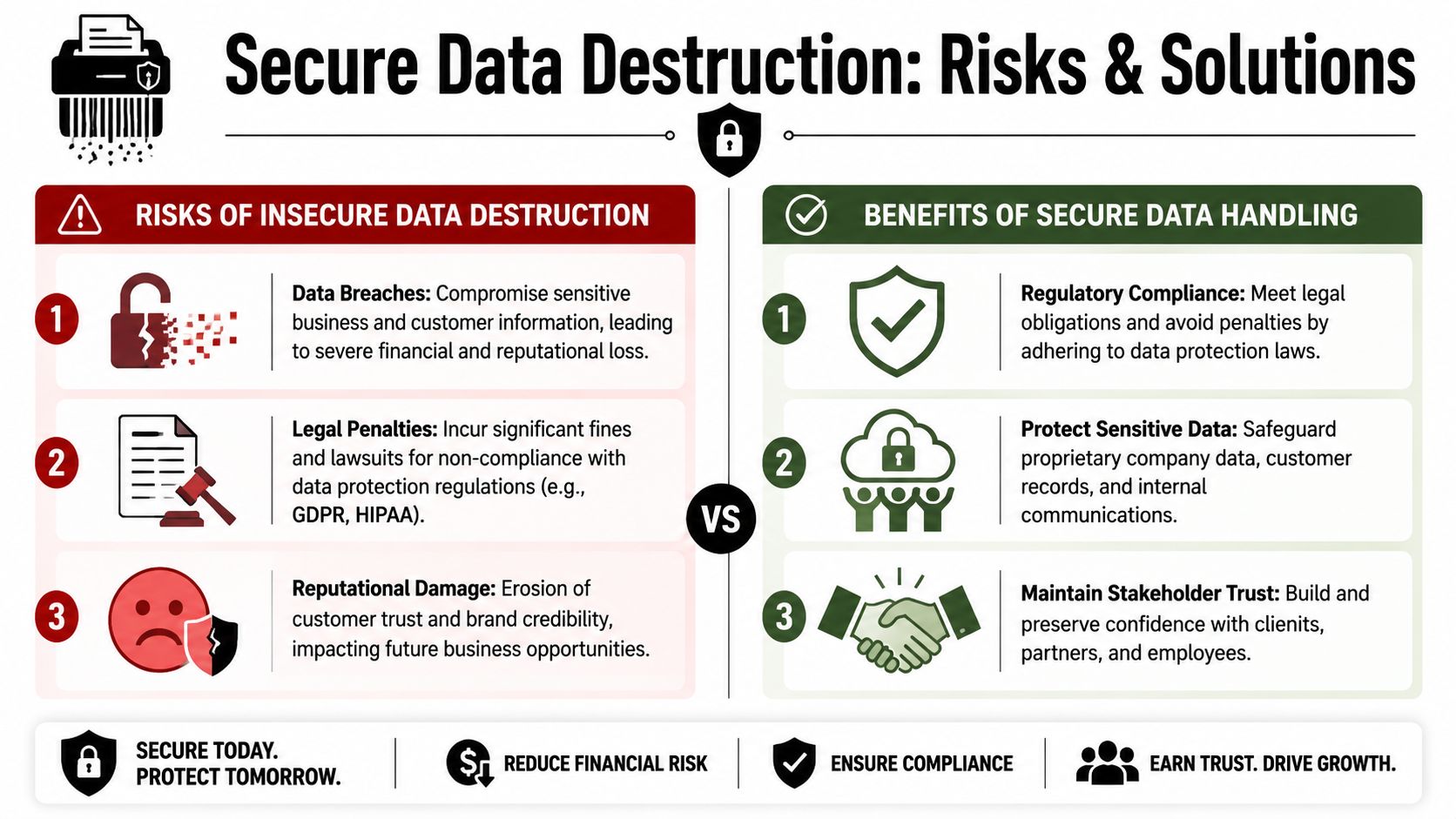
Old PBX hardware often contains more data than the disposal team expects. Voicemail content, call detail records, user directories, admin credentials, and configuration backups can all survive inside retired equipment. A factory reset might make the interface look clean, but it doesn't reliably solve your risk.
Why resets aren't enough
A lot of telecom teams assume there's no meaningful data left once the system is powered down and defaulted. That assumption fails when the platform uses internal storage, removable media, or retained config data.
What matters is the media, not the menu option. If the system stores data locally, sanitization has to address that storage directly.
- Voicemail modules may retain messages and mailbox structures
- Management appliances can hold credentials and network settings
- Call accounting data may remain in exports or local databases
- Removable storage gets missed when teams focus only on the main chassis
Compliance needs proof, not assumptions
If your organization operates under privacy, records, or disposal controls, you need an auditable process. Internal verbal confirmation doesn't help much later if someone asks how the data was destroyed and who handled the device at each stage.
The practical standard is simple. Sanitization should be documented, repeatable, and tied to the specific asset or media removed from it.
If you can't prove how data was destroyed, you're relying on trust instead of process.
Many businesses moving away from legacy voice still underestimate migration and retirement risk. As noted in this discussion of the PSTN switch-off and migration realities, companies often miss hidden costs tied to network readiness, security hardening, and endpoint replacement, and actual ROI depends partly on how well the old-system risks are handled during disposition in this PSTN switch-off discussion.
What a secure workflow looks like
A defensible process usually includes:
- Identify every component with possible storage
- Choose sanitization method based on media type
- Document serials or asset identifiers
- Issue destruction records
- Separate reusable hardware from destroyed media
For organizations that need a recognized framework for sanitization decisions, NIST SP 800-88 guidance is the right benchmark to review.
Where companies get into trouble
The weak points are predictable:
- Shared responsibility confusion: Telecom, network, facilities, and procurement each assume someone else handled the wipe
- Incomplete teardown: Storage-bearing modules stay inside a “phone system” lot
- No records: Equipment leaves the building with no destruction certificate or custody trail
That's why data destruction should be an absolute requirement before resale. If the storage can't be sanitized to your standard, destroy the media and sell the remaining hardware as properly processed equipment.
Managing On-Site Decommissioning and Hardware Preparation
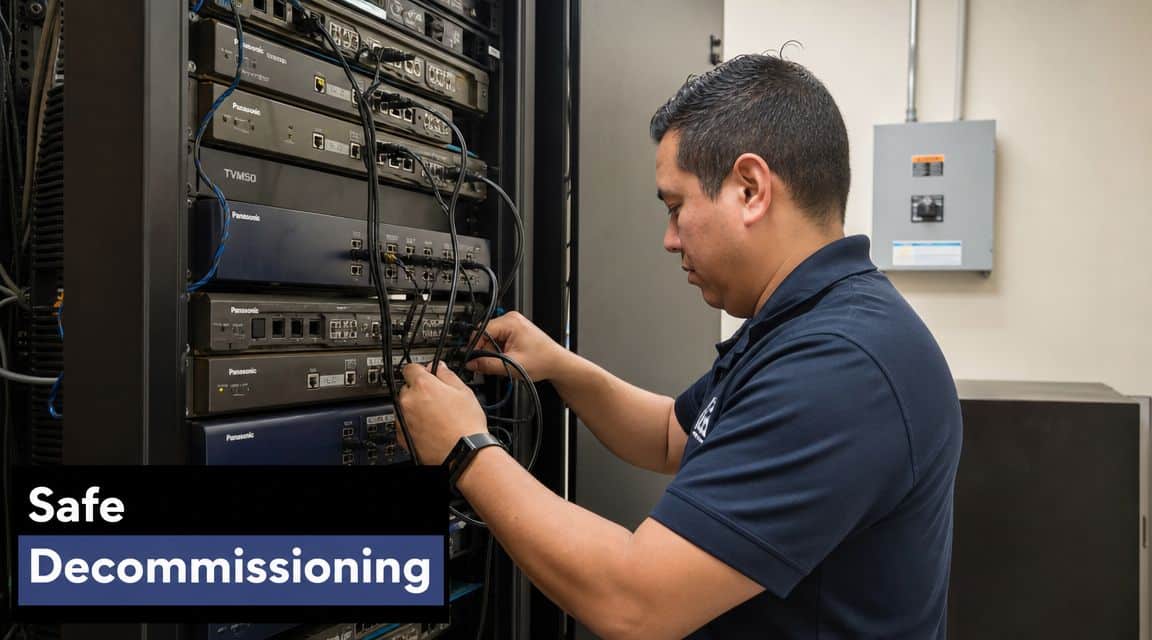
The physical shutdown matters more than many teams expect. PBX retirements usually happen while other network and voice changes are already in motion, and rushed removal causes damage, lost parts, and handoff confusion.
Cisco notes that PBX has evolved from on-premises hardware toward IP and cloud delivery, and that shift is the main reason so many organizations are now retiring legacy telecom gear rather than expanding it. In practice, you're not just removing a phone box. You're retiring part of the old communications stack.
Use a controlled shutdown sequence
A safe pull usually follows this order:
- Confirm cutover is complete: Verify numbers, users, and failover paths are active on the new platform
- Power down intentionally: Don't yank live systems from racks
- Disconnect network and telco interfaces: Label what was attached before removal
- Remove cards and accessories carefully: Keep them with the parent system when possible
Preserve value during teardown
A PBX lot loses value when parts become anonymous. If handsets go in one pile, base units in another, and cards into an unlabeled box, the next buyer sees risk.
Use simple field labeling:
| Item | Labeling approach |
|---|---|
| Main chassis | Asset ID plus rack/site location |
| Expansion cards | Match to chassis or cabinet |
| Phones and consoles | Group by model and quantity |
| Power supplies | Keep with corresponding system |
Field note: The best telecom lots are the ones nobody had to “figure out” after pickup.
There's also a safety issue. Telecom cabinets, UPS-supported gear, and wall-mounted voice equipment can be awkward to remove without the right staff and tools. Teams handling larger server-room exits usually follow a formal data center decommissioning process because it reduces both breakage and confusion.
Coordinating Packaging Logistics and Chain of Custody
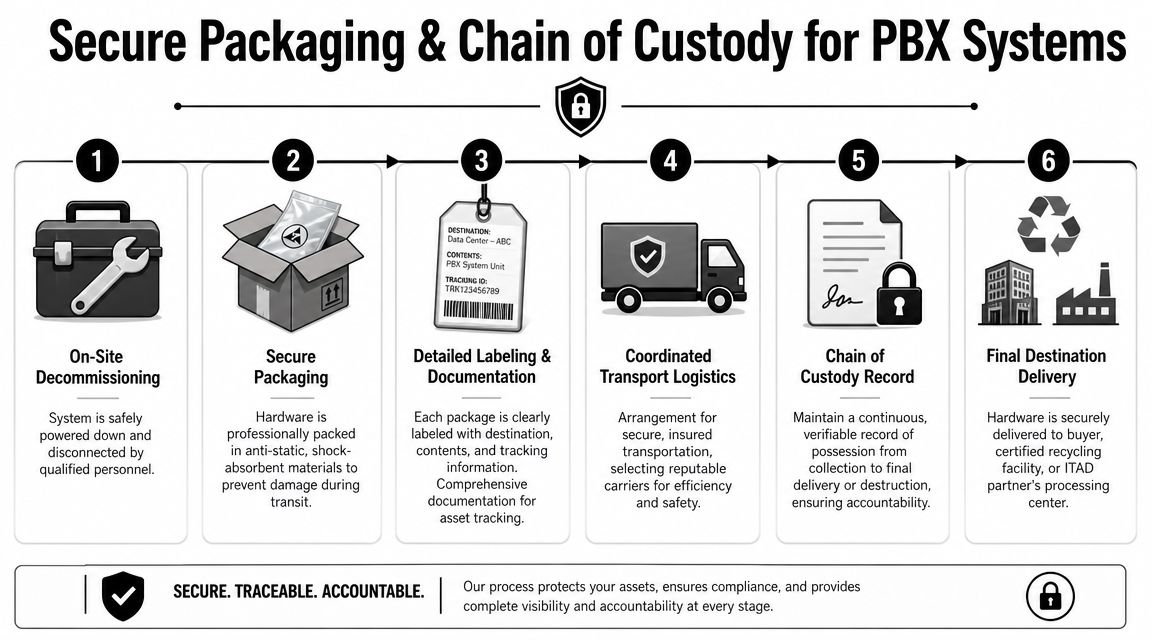
Many internal disposal projects fail at this stage. The inventory may be accurate and the gear may be clean, but once equipment is boxed loosely, mixed across sites, or shipped without custody records, the project becomes hard to defend and harder to reconcile.
Packaging protects value
PBX gear is durable compared with laptops, but it still suffers from impact damage, bent connectors, broken handset mounts, and static exposure. Proper packaging should match the asset type.
- Rack gear: Anti-static wrap, dense cushioning, stable palletization
- Phones and consoles: Box by model, avoid mixed loose loads
- Cards and modules: Anti-static packaging with grouped labels
- Power accessories: Bag and identify separately so they don't disappear into general cabling
Self-managed shipping can work for a tiny lot. It breaks down fast when you're dealing with multiple closets, branch offices, or mixed telecom and IT hardware.
Custody is a documentation problem
A clean chain of custody records who had the equipment, when it changed hands, and what exactly moved. That usually means serialized inventory, pickup documentation, bill of lading details, receiving confirmation, and exception reporting if counts change.
Demodesk cites CSO Insights that reps using a defined sales methodology are 15% more likely to hit targets in this sales methodology summary. The number is about sales, but the principle applies directly here. A defined method improves outcomes. In asset disposition, that shows up as fewer losses, fewer disputes, and cleaner reconciliation.
Compare the two common approaches
| Approach | Strength | Weak point |
|---|---|---|
| Internal packing and freight booking | More direct internal control | Higher risk of damage, missing records, and inconsistent labeling |
| Managed ITAD logistics | Better documentation and handling consistency | Requires upfront coordination and scope definition |
If you're coordinating a move at the same time, this guide to minimizing office IT downtime is worth reviewing because relocation mistakes and disposition mistakes often overlap.
Chain of custody isn't paperwork for its own sake. It's how you prove what left the building and in what condition.
Maximizing Financial Return with an ITAD Partner
The highest nominal sale price isn't always the best outcome. If your team spends weeks identifying parts, cleaning data risk, arranging freight, chasing buyers, and resolving receipt disputes, the internal cost can wipe out the difference.
Think in total recovery, not line-item price
A disciplined resale workflow mirrors a disciplined sales workflow. The useful principle from hosted PBX selling is to map the environment and quantify requirements before presenting a proposal. Applied to retired hardware, that means assessing condition, completeness, and market demand before assigning value, as described in this hosted PBX sales playbook.
That's the right lens for used telecom. A complete tested pull may deserve a different path than mixed handsets, damaged cabinets, and unverified modules.
Choose the channel that fits the lot
Direct sale works best when the equipment is:
- Complete and identifiable
- Cleanly removed
- Properly documented
- Worth the staff time to market
ITAD or buyback programs make more sense when the lot includes mixed value, uncertain reuse potential, security handling requirements, or multi-site coordination.
I've seen teams get better real-world returns by accepting a structured buyback offer instead of trying to maximize every chassis individually. The reason is simple. Process quality preserves value.
That same operational thinking shows up in other industries too. This piece on optimizing solar panel sales operations is about route and workflow discipline, but the lesson transfers well. Better field process usually produces better commercial outcomes.
Where one partner can simplify the project
One practical option is using a buyer that handles valuation, secure processing, and remarketing under one workflow. Beyond Surplus lists used PBX, switches, phones, and related telecom gear among the equipment it buys through its telecom hardware buyers for switches PBX and VoIP service. That model is useful when your team wants one handoff instead of separate vendors for pickup, destruction, and resale.
Bottom line: The best PBX disposition result usually comes from preserving certainty. Buyers pay for gear they can identify, trust, and process quickly.
Conclusion The Smart Path to PBX Asset Recovery
Used PBX equipment still has business value, but only if you handle it like controlled enterprise hardware. That means verified inventory, careful teardown, secure data destruction, documented logistics, and a realistic resale path.
DIY disposal looks cheaper at first because it hides labor, risk, and custody problems inside internal teams. Those costs show up later. Missing cards reduce lot value. Poor packing leads to damage claims. Weak records create audit headaches. Incomplete sanitization creates the worst problem of all.
The smarter path is structured asset recovery. Treat the retired system as a project with technical, security, and financial requirements. When that process is managed well, you can sell PBX systems with far less friction and a much cleaner outcome for IT, facilities, and procurement.
Old telecom gear shouldn't sit in a closet until it becomes scrap by neglect. Evaluate it, control the risk, and move it through a documented disposition process that protects your organization while recovering whatever value remains.
If you need a secure path to retire and monetize legacy telecom equipment, contact Beyond Surplus for certified electronics recycling and secure IT asset disposal.


