

Hard drive shredding is the process of physically demolishing hard drives, solid-state drives (SSDs), and other data storage media, grinding them down into tiny, useless fragments. Think of it like a high-security paper shredder, but for your digital files. This method guarantees that confidential information is permanently and completely unrecoverable, offering the highest level of data security possible.
Why Physical Destruction Is a Non-Negotiable Security Strategy
In the business world, your data isn't just information—it's one of your most valuable assets and, at the same time, a significant liability. Simply deleting files or formatting a drive just doesn't cut it. That data is often still there, and specialized software can easily pull it from retired equipment, creating a data breach just waiting to happen.
Hard drive shredding completely closes that loophole. It’s more than just disposal; it's a vital part of any serious cybersecurity and risk management plan. By physically pulverizing the storage platters and memory chips, you make it absolutely impossible for anyone to reconstruct the original files. This is the only method that guarantees 100% data destruction for every type of drive, especially modern SSDs that can resist other techniques like degaussing.
The True Cost of a Data Breach
Failing to secure your old data can have disastrous results, and the financial hit goes far beyond any initial fines. Just think about the potential fallout:
- Crippling Regulatory Fines: Penalties for not complying with rules like HIPAA, the FTC Disposal Rule, or GLBA can easily run into the millions of dollars.
- Loss of Customer Trust: A public data breach can shatter your company's reputation, leading to lost customers and a steep drop in revenue.
- Legal Liability: Your organization stays legally on the hook for the data on its old devices, even long after they've left your building.
It's no surprise that awareness of these risks is growing. The global market for hard drive shredding services was valued at USD 0.72 billion in 2026 and is expected to climb to USD 1.2 billion by 2033. This trend, analyzed by Business Research Insights, shows just how seriously companies are starting to take secure data destruction.
Transferring Liability Through Certified Destruction
When you work with a certified IT asset disposal (ITAD) vendor like Beyond Surplus for hard drive shredding, you're doing more than just destroying old data. You are legally transferring the liability for that data from your company to ours.
Once the job is done, you’ll receive a Certificate of Data Destruction. This official document is your auditable proof of secure, compliant disposal. You can learn more about how to protect your company from data breaches with secure data destruction practices in our detailed guide. This certificate is your ultimate safeguard against future claims and a cornerstone of responsible corporate governance.
A Look Inside the Hard Drive Shredding Process
So, what actually happens when you book a professional hard drive shredding service? Getting a clear picture of the process gives you the confidence that your data is handled securely from the moment it leaves your hands. The entire system is built on two simple but critical ideas: total data destruction and a documented, unbroken chain of custody.
You generally have two options, depending on your company's security needs and how your operations are set up: on-site shredding and off-site shredding. While they take different logistical routes, both are designed to deliver the exact same outcome—the complete and irreversible elimination of your data.
This diagram shows how professional shredding turns a major data liability into a secure, closed-loop process where nothing is left to chance.
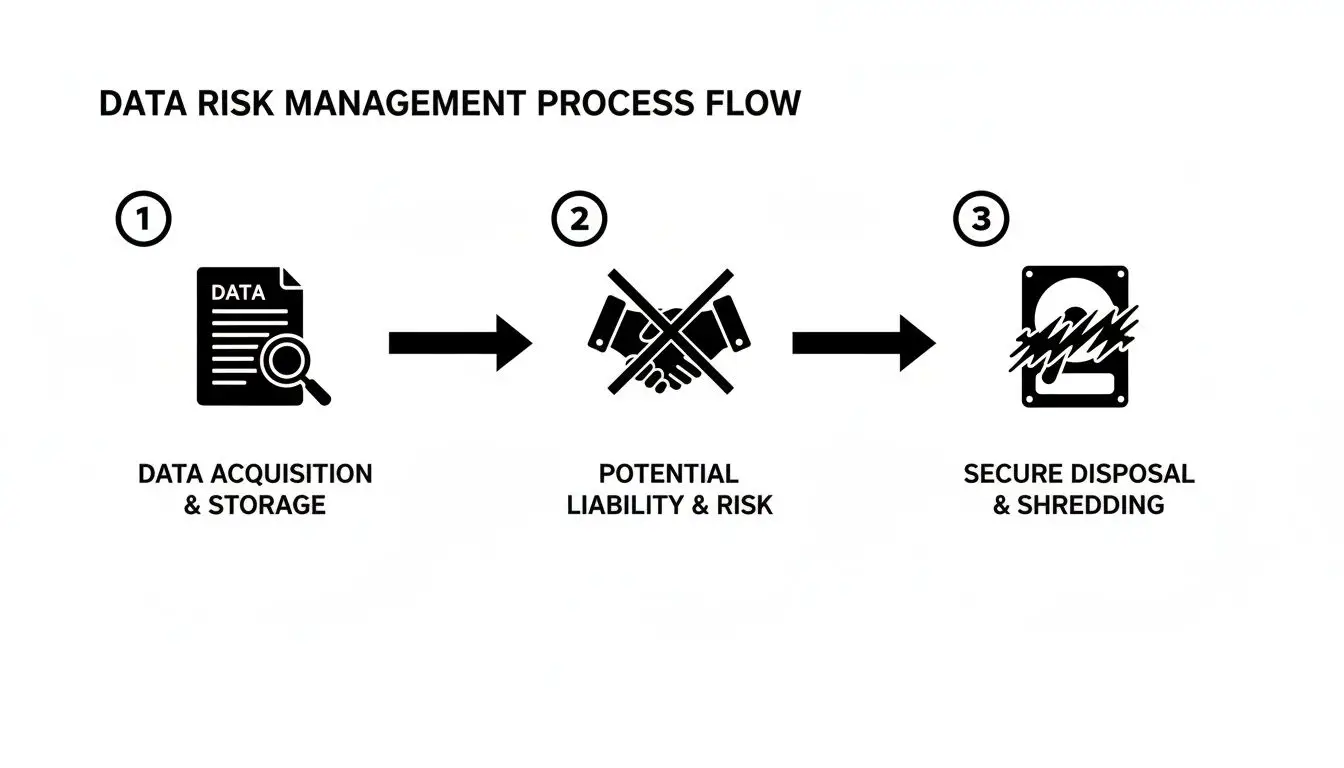
It’s a straightforward visual of how the risk tied to your old hard drives is completely neutralized through physical destruction.
On-Site Hard Drive Shredding: The Witnessed Destruction Model
For organizations that need the absolute highest level of security and want to see the destruction happen with their own eyes, on-site shredding is the way to go. The process is completely transparent and designed for your peace of mind.
Picture a specialized, self-contained shredding truck pulling up right to your office or data center. This isn't just a truck; it's a mobile destruction facility, armed with an industrial-grade shredder that can tear through hundreds of drives per hour.
The workflow is meticulously tracked from start to finish:
- Asset Verification: Before a single drive is touched, our technicians scan the serial number of each device. This creates a detailed inventory, which becomes part of your final report.
- Witnessed Destruction: You and your team are encouraged to watch the entire event. Each drive is fed into the shredder by hand, and you can see it get pulverized into tiny, mangled pieces of metal.
- Immediate Confirmation: Because the destruction happens right there at your location, any worries about data getting lost in transit are completely eliminated. The shredded scraps are then securely contained in the truck and taken to a certified recycling partner.
This method gives you unparalleled assurance because there is literally zero gap between you having the drives and confirming they've been destroyed.
Off-Site Hard Drive Shredding: The Secure Chain of Custody Model
Off-site shredding delivers the exact same level of certified security and compliance but uses a different logistical model built around secure transport. It's often a more practical and cost-effective choice for large-scale projects or when having a giant shredding truck on-site just isn't feasible.
The secret to making off-site destruction work is a rock-solid chain-of-custody protocol. This isn't just about picking up a box of drives. It's about creating a documented, auditable trail that proves your hardware was secure from your door all the way to our destruction facility.
At Beyond Surplus, the chain-of-custody isn’t just a procedure—it’s our guarantee. It provides undeniable proof that your assets are protected from the moment they leave your sight until they are officially and permanently destroyed.
Here’s a breakdown of how the off-site process works:
- Secure Collection: Our trained, background-checked technicians arrive at your site with locked, tamper-evident security containers.
- On-Site Inventory: Just like with on-site shredding, every asset's serial number is scanned and logged before the drives are sealed away.
- GPS-Tracked Transport: The sealed bins are moved in a secure, GPS-tracked vehicle directly to our controlled-access destruction facility.
- Facility Destruction: Once at our facility, the bins are opened in a monitored area, and the drives are destroyed under constant video surveillance.
Whether you opt for the instant gratification of on-site service or the logistical ease of off-site processing, the end result is identical. After destruction, you’ll receive a Certificate of Data Destruction that lists every single serial number, legally transferring liability and giving you the paperwork needed for any compliance audit.
You can explore our specific hard drive destruction services to figure out which model is the right fit for your organization's security needs.
Navigating Compliance and Certifications
For most businesses, shredding old hard drives isn't just a smart move—it's the law. Failing to properly destroy the data on retired equipment can turn that closet full of old hardware into a major liability. Understanding the rules that govern data disposal is absolutely essential for managing risk.
This regulatory pressure is exactly why the data destruction market is growing so fast. With data privacy laws and cyber threats on the rise, the demand for shredding services is expected to surge from USD 1.65 billion in 2026 to USD 5.05 billion by 2035, growing at a rate of 10.7% each year. This boom is directly tied to laws like the FTC Disposal Rule in the U.S. and similar regulations worldwide.
The Regulatory Landscape For Data Destruction
Several powerful federal laws require businesses to protect customer and patient information from creation all the way to final disposal. Certified hard drive shredding is the most reliable way to handle that final, often overlooked, step.
Key regulations you need to know about include:
- HIPAA (Health Insurance Portability and Accountability Act): This law is non-negotiable for healthcare organizations. The HIPAA Security Rule demands clear procedures for disposing of electronic protected health information (ePHI) and the hardware it lives on.
- FTC Disposal Rule: This rule requires businesses to take "reasonable measures" to protect consumer data during disposal. The FTC explicitly names shredding as a reasonable and compliant method for electronic media.
- GLBA (Gramm-Leach-Bliley Act): Aimed at financial institutions, this act mandates that customer records remain secure. The Safeguards Rule requires a formal security plan that must include how customer information is securely destroyed.
Getting this wrong can be financially devastating. For instance, one major financial services firm was hit with a $35 million settlement because it failed to properly decommission its old servers, exposing the personal data of millions of customers.
To help you see how shredding fits into these rules, we've put together a simple table. It breaks down what each regulation requires and how certified shredding helps you stay compliant.
How Shredding Meets Data Security Regulations
| Regulation | Industry Focus | How Shredding Addresses the Requirement |
|---|---|---|
| HIPAA | Healthcare & Associates | Provides a physical, irreversible method to destroy ePHI on end-of-life devices, meeting the "final disposition" requirement. |
| FTC Disposal Rule | All businesses with consumer data | Acts as a "reasonable measure" to prevent unauthorized access, explicitly recommended for electronic media. |
| GLBA | Financial Institutions | Fulfills the Safeguards Rule by ensuring customer information is securely and permanently destroyed as part of a formal security plan. |
| NIST 800-88 | Government & Federal Contractors | Aligns with the "Destroy" method, the highest level of media sanitization, ensuring data is completely irrecoverable. |
Ultimately, physical destruction through shredding offers a clear, auditable, and defensible process that satisfies the stringent demands of these major data protection laws.
NIST 800-88: The Gold Standard For Media Sanitization
When the government talks about data destruction, it turns to one document: The National Institute of Standards and Technology (NIST) Special Publication 800-88. This is the definitive guide for media sanitization, and it outlines three methods: Clear, Purge, and Destroy.
While "Clear" (overwriting data) and "Purge" (degaussing) have their place, only "Destroy" guarantees that data can never be recovered.
NIST 800-88 defines destruction as the process to "disintegrate, pulverize, melt, incinerate, or shred" media to render it completely unusable and its data irrecoverable. Physical destruction via shredding is the ultimate confirmation that the sanitization process was successful.
For any hardware at the end of its life, shredding is the only method that provides that absolute certainty. This is especially true for devices with highly sensitive data or for solid-state drives (SSDs), which can’t be reliably degaussed. As you navigate compliance, understanding frameworks like the ISO 27001 certification process is also key to building a comprehensive security strategy.
The Certificate Of Data Destruction: Your Legal Safeguard
After the shredding is done, you’ll receive what might be the most important document in the entire process: the Certificate of Data Destruction. This isn't just a receipt—it's a legal document that proves you took the right steps and formally transfers liability for the data from your company to your shredding partner, like Beyond Surplus.
Think of it as your official, auditable proof of due diligence. A proper certificate meticulously documents everything:
- A unique serial number for tracking the job.
- The formal transfer of custody to the vendor.
- The exact method of destruction used (e.g., shredding to a specific size).
- A detailed list of the serial numbers of every drive that was destroyed.
- A statement confirming that the destruction meets standards like NIST 800-88.
For any IT manager or executive tasked with managing risk, this certificate is the final piece of the puzzle. It gives you the legal and procedural closure needed to retire IT assets without worrying about lingering data liability.
Choosing a vendor with credentials like R2 certification adds another layer of security, ensuring the entire process—from pickup to the final recycling of the shredded material—is handled responsibly. You can also read more about what is R-2 certification and why it's so important for your business.
Shredding vs. Wiping vs. Degaussing
So, your IT assets have reached the end of their life. Now what? The most important question isn't just about disposal—it's about making sure the sensitive data on them is gone for good.
Choosing the right data destruction method comes down to a careful balance of security, cost, and whether you want to reuse the hardware. The three main players in this space are software-based data wiping, magnetic degaussing, and good old-fashioned physical shredding.
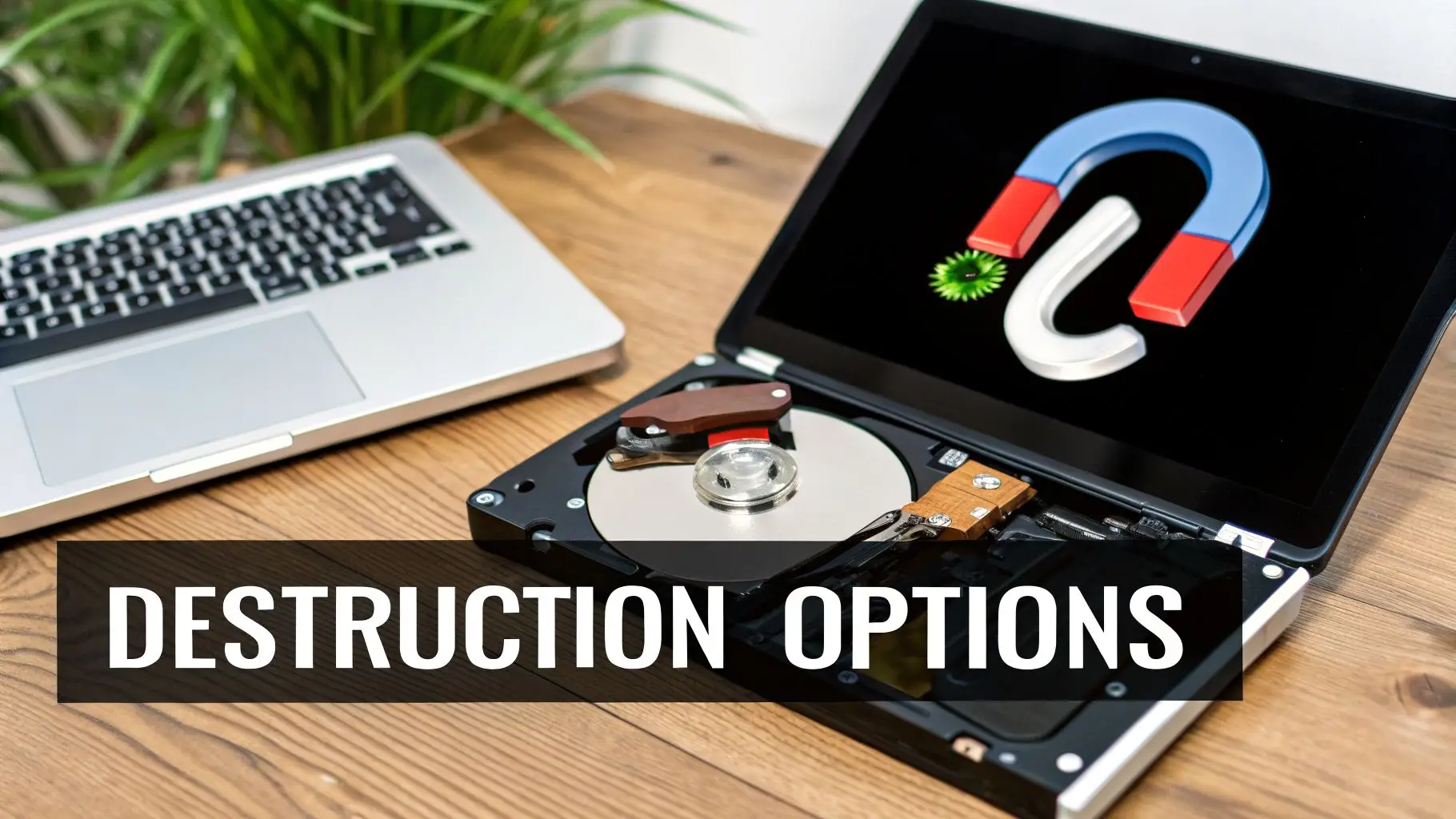
Each of these techniques works in a fundamentally different way. Understanding those differences is what will help you make a smart, compliant choice that protects your business from risk.
Data Wiping (Erasure)
Think of data wiping (or erasure) as scribbling over a message written in pencil. Specialized software overwrites every bit of existing data on a hard drive with random, meaningless characters. This process is often repeated multiple times to make sure the original information is impossible to recover with any software-based tools.
The biggest advantage here is that wiping preserves the hard drive. This is your go-to option if your assets still have value and you plan to resell or redeploy them. It’s a great way to support IT asset recovery and contribute to a circular economy.
But wiping isn't a silver bullet. It has some serious weak spots:
- Doesn't work on damaged drives: A drive has to be fully functional to be wiped. If it's physically broken or just won't power on, the wiping software can't run, and your data stays right where it is.
- It’s a slow process: Wiping just one large-capacity drive can take hours. For a large batch of computers, this quickly becomes impractical.
- Ineffective for SSDs: Solid State Drives (SSDs) are built differently. They use features like over-provisioning and wear-leveling that can hide data in areas the wiping software can't reach, leaving behind recoverable fragments.
Degaussing
Degaussing takes a more brute-force approach. This process blasts magnetic storage media—like traditional spinning hard disk drives (HDDs) and backup tapes—with an incredibly powerful magnetic field. This field instantly and completely scrambles the magnetic platter where your data lives, not only destroying the data but also rendering the drive itself useless.
It's extremely fast, sanitizing a drive in just a few seconds. For old-school HDDs, it provides a very high level of security by destroying both the data and the drive's electronics.
The problem? Degaussing has a fatal flaw in the modern era.
Because it relies on magnetism, degaussing is completely useless on Solid State Drives (SSDs), USB flash drives, and any other flash-based media that doesn't store data magnetically.
As more and more businesses switch to SSDs, degaussing has become a niche solution. If you're still considering it, it’s vital to understand the technology's limits. We cover this in-depth in our guide that explains what is degaussing and how it really works.
Hard Drive Shredding
When you need absolute, undeniable proof that data is gone forever, you shred it. Hard drive shredding is the most definitive method out there. An industrial shredder physically grinds drives, tapes, and other media into a pile of mangled metal and plastic fragments.
This isn't about erasing or scrambling data—it's about destroying the physical medium so completely that no technology on earth can piece it back together.
Shredding is the great equalizer. It’s the only method that works on every single type of storage media, including:
- Traditional Hard Disk Drives (HDDs)
- Solid State Drives (SSDs)
- Magnetic backup tapes
- Flash drives and memory cards
- Optical media like CDs and DVDs
The obvious trade-off is that shredding completely eliminates any chance of reuse or resale. But when you’re dealing with end-of-life assets or devices full of highly sensitive information, the absolute security it provides is priceless.
Choosing the Right Data Destruction Method
Navigating these options can be tough. The table below provides a head-to-head comparison to help you decide which method aligns with your organization’s security policies, budget, and sustainability goals.
| Factor | Hard Drive Shredding | Data Wiping (Erasure) | Degaussing |
|---|---|---|---|
| Security Level | Highest; data is physically impossible to recover. | Good, but can fail on damaged drives and SSDs. | Very High for magnetic media, but useless for SSDs. |
| Asset Reuse | Impossible; drive is destroyed. | Yes; allows for drive reuse and resale. | Impossible; drive is rendered inoperable. |
| Media Compatibility | Works on all media types (HDD, SSD, Tape). | Only effective on functional HDDs. | Only works on magnetic media (HDDs, Tapes). |
| Verification | Visual confirmation and Certificate of Destruction. | Software-generated reports. | Requires specialized tools to verify; drive is unusable. |
| Best For | End-of-life assets, damaged drives, SSDs, maximum security. | Functional drives with resale value. | Retiring large batches of HDDs or magnetic tapes. |
When it comes down to it, if your top priority is eliminating risk for hardware at the end of its useful life, hard drive shredding is the clear winner. It's the only method that guarantees complete, verifiable destruction across all media types, giving you ultimate peace of mind and bulletproof compliance.
Understanding Shredding Logistics and Costs
Once you've settled on hard drive shredding, the next part is figuring out the practical side of things—scheduling the service and getting a handle on the costs. The final price and logistics can shift based on a few key factors. Knowing what to expect helps you plan your budget and ensures everything goes smoothly and securely from start to finish.
The main things that affect the cost of hard drive shredding are how many drives you have, the service model you pick (on-site vs. off-site), and the kind of documentation you need. You'll also need to decide if your team will pull the drives from the computers beforehand or if you'll have your vendor do it as part of the job.
Key Factors Influencing Hard Drive Shredding Costs
The price for professional hard drive shredding isn’t a flat fee. It’s calculated based on what your specific project needs. Understanding these variables will help you budget correctly and select the right service for your company.
Volume of Drives: The biggest factor in your cost is simply quantity. Most vendors use tiered pricing, where the cost per drive decreases as the number of drives goes up. A small job with 20 drives will have a higher per-unit cost than a big data center project with 2,000 drives.
On-Site vs. Off-Site Service: On-site shredding, where a mobile shredding truck comes right to your location, usually costs more. You're paying a premium for the convenience, immediate peace of mind, and the ability to watch the destruction happen yourself. Off-site shredding is often a more budget-friendly choice, especially for larger jobs, since it lets the vendor streamline their work.
Serial Number Reporting: A standard Certificate of Destruction is almost always included. However, if your compliance or audit process requires a detailed report with the scanned serial number of every single drive, this might come with an extra fee. You can get a much clearer picture of what to expect by reading our detailed guide on hard drive shredding cost breakdowns.
Nationwide Logistics and Service Coordination
What happens if your company has offices all over the country? A good ITAD partner can manage nationwide logistics without a hitch. For example, Beyond Surplus can arrange secure pickups from your headquarters in Atlanta, a remote data center, or any other facility across the contiguous U.S. This centralizes your security protocols and makes vendor management much simpler, no matter where your assets are.
This kind of coordination is more important than ever. North America has the largest share of the global hard drive shredding services market, thanks to its high concentration of data centers and tech companies. With U.S. data centers expected to number over 5,000 by 2026, the need for nationwide de-installation and shredding services has grown tremendously.
The Sustainable Side of Destruction
Physically destroying a hard drive doesn't mean it's just waste. In reality, it’s the first step in a very responsible recycling process. After your hard drives are ground down into tiny, unrecognizable pieces, their journey is far from over.
The shredded material—a mix of aluminum, steel, plastics, and precious metals—is not sent to a landfill. Instead, it enters a secure, certified downstream recycling stream where it is melted down and separated into raw commodities.
This process truly closes the loop on your IT asset's lifecycle. Bringing in a hard drive shredding service is a vital step toward a complete total waste management plan for your old electronics, taking care of both data security and environmental duties.
By working with a certified vendor like Beyond Surplus, you can be confident that your old hardware is not only securely destroyed but also sustainably repurposed. It turns potential e-waste into valuable resources for making new products.
Your Hard Drive Shredding Questions, Answered
Even after you get the basics of hard drive shredding, a few practical questions always come up. Let's walk through some of the most common ones we hear from business owners and IT managers, so you can move forward with confidence.
Do I Need to Remove Hard Drives from Computers and Servers Before Shredding?
This is one of the first logistical hurdles people think of, and the good news is, you don't have to. While you can certainly have your own team pull the drives, a full-service provider like Beyond Surplus can handle all the removals for you.
For bigger jobs like a data center cleanout or a company-wide hardware refresh, letting your vendor manage the removals is a huge time-saver. It frees your IT staff from a monotonous task, letting them focus on work that actually drives your business forward instead of unscrewing hundreds of drive caddies.
Better yet, having the vendor pull the drives on-site right before they go into the shredder creates a rock-solid chain of custody. It minimizes handling and gives you a clear line of sight from the server rack to the shred pile, which is perfect for any organization with strict security needs. You can do it yourself, but it's often more efficient and secure to let the experts handle it.
What Is a Certificate of Destruction and Why Does It Matter So Much?
A Certificate of Data Destruction (CoD) is much more than a receipt. Think of it as a formal legal document that serves as your official proof that your media was destroyed following standards like NIST 800-88. It's a cornerstone of your risk management.
The certificate’s most important job is to legally transfer liability for the data from your company to the shredding vendor. Once it’s issued, it confirms you’ve done your part.
This auditable record is essential for a few key reasons:
- Regulatory Compliance: If you're ever audited for rules like HIPAA, the FTC Disposal Rule, or GLBA, a CoD is your undeniable proof that you followed the law.
- Legal Protection: Should a data breach investigation ever point fingers your way, this document is your shield, demonstrating you acted responsibly.
- Internal Governance: It provides the necessary paperwork to satisfy your own internal security policies and prove to stakeholders that you’re retiring assets correctly.
A legitimate certificate will always list the date of destruction, the method used, a compliance statement, and an itemized list of serial numbers for every device destroyed. It’s your ultimate safeguard.
Is Shredding Really Necessary for Solid State Drives (SSDs)?
Yes, absolutely. In fact, shredding is the most reliable and recommended method for destroying Solid State Drives (SSDs). This is a point that’s easy to miss but incredibly important. Unlike old-school magnetic hard drives (HDDs), SSDs store data on a series of flash memory chips, and their design makes other destruction methods unreliable.
Wiping software often can't guarantee a complete erasure on an SSD. Built-in features like wear-leveling and over-provisioning—which are designed to make the drive last longer—can hide pockets of data in memory blocks the software can’t see or overwrite.
Degaussing, which uses powerful magnets to scramble data on HDDs, is 100% ineffective on SSDs. Because SSDs don't use magnetic storage, a degausser does absolutely nothing to the data on the memory chips.
Physically shredding the drive into small pieces is the only way to ensure every single one of those memory chips is shattered. This makes the data completely unrecoverable, giving you the total peace of mind needed when retiring SSDs that once held sensitive information.
What Happens to the Shredded Material After Destruction?
The story doesn't end once your hard drives are turned into a pile of metal confetti. It’s a common misconception that this material just gets thrown away. With a certified and environmentally-focused partner, the opposite is true.
The shredded material isn't trash; it's a valuable stream of commodities. This mix of aluminum, steel, circuit boards, and plastics is securely sent into a downstream recycling process.
Here’s what that typically looks like:
- Secure Transport: The shredded fragments are securely moved from the shredding site to a certified smelting or recycling facility.
- Sorting and Separation: At the facility, specialized machinery separates the different materials—like aluminum, steel, and plastics—from the mix.
- Refining: These separated metals are then melted down and refined back into raw commodities, like aluminum ingots.
- Repurposing: Finally, these raw materials are sold back into the manufacturing supply chain to be used in new products.
This circular economy approach makes sure your old hardware is handled in an environmentally sustainable way. By choosing a certified vendor like Beyond Surplus, you ensure your data is secure and your old assets help the environment instead of harming it.
Ready to implement a secure, compliant, and sustainable data destruction strategy? Beyond Surplus offers certified on-site and off-site hard drive shredding services for businesses nationwide. Contact us today to schedule a pickup and receive your official Certificate of Data Destruction.


