

A server refresh usually starts as a facilities problem. There's a row of retired rack units in a Georgia server room, a project deadline, and pressure to free up space fast. Then the underlying issue shows up. Those systems may still hold customer data, financial records, credentials, logs, backups, or regulated information that no one wants resurfacing later.
That's why server disposal in Georgia isn't a hauling job. It's a risk-management decision with three outcomes attached to it: data security, proof of compliance, and value recovery. If any one of those is handled poorly, the disposal project can create more exposure than the hardware ever did in production.
Your Guide to Server Disposal in Georgia
Georgia IT managers often hit the same turning point. The new infrastructure is installed, the legacy servers are powered down, and now the organization has to decide what happens next. Leave the equipment sitting in storage, and you create an unmanaged asset pool. Move it out too casually, and you lose control of both the data and the paperwork.
The market itself shows how central this process has become. The global IT asset disposition market was valued at $17.5 billion in 2024 and is projected to reach $29.54 billion by 2030, reflecting a 9.2% CAGR. Within that market, data destruction and data sanitization accounted for about 33% of service share in 2024, which tells you secure server disposal is now a core ITAD function, not a side service (IT asset disposition market analysis).
What Georgia teams are actually managing
Most server disposal projects involve more than a few boxes on a pallet. They usually include:
- Mixed media types with HDDs, SSDs, and sometimes self-encrypting drives in the same batch
- Different reuse paths because some assets still have resale value while others are only fit for destruction
- Audit pressure from legal, compliance, procurement, or cybersecurity teams that need evidence after the pickup
A good working model is to treat decommissioned servers like sealed evidence, not scrap metal. Every drive, chassis, and serial number should move through a controlled workflow with a disposition decision attached.
Old servers rarely create problems while they're still bolted in the rack. Problems start when nobody can say who touched them, where they went, or how the data was removed.
If you're building the process now, start with a documented intake and decommissioning plan. A practical reference is this server decommissioning checklist, which helps teams align inventory, data handling, and removal steps before equipment leaves the site.
The standard that actually matters
For most organizations, the disposal question sounds simple: wipe it or shred it. In practice, the better question is whether your chosen method matches the data risk, the hardware type, and the intended downstream path. That's where ITAD stops being cleanup and becomes governance.
Understanding the Business Risks of Improper Disposal
Improper server disposal is usually framed as an e-waste issue. For business equipment, that's too narrow. The bigger risk is that retired infrastructure still contains sensitive information, and once custody breaks, you may not be able to prove what happened to it.
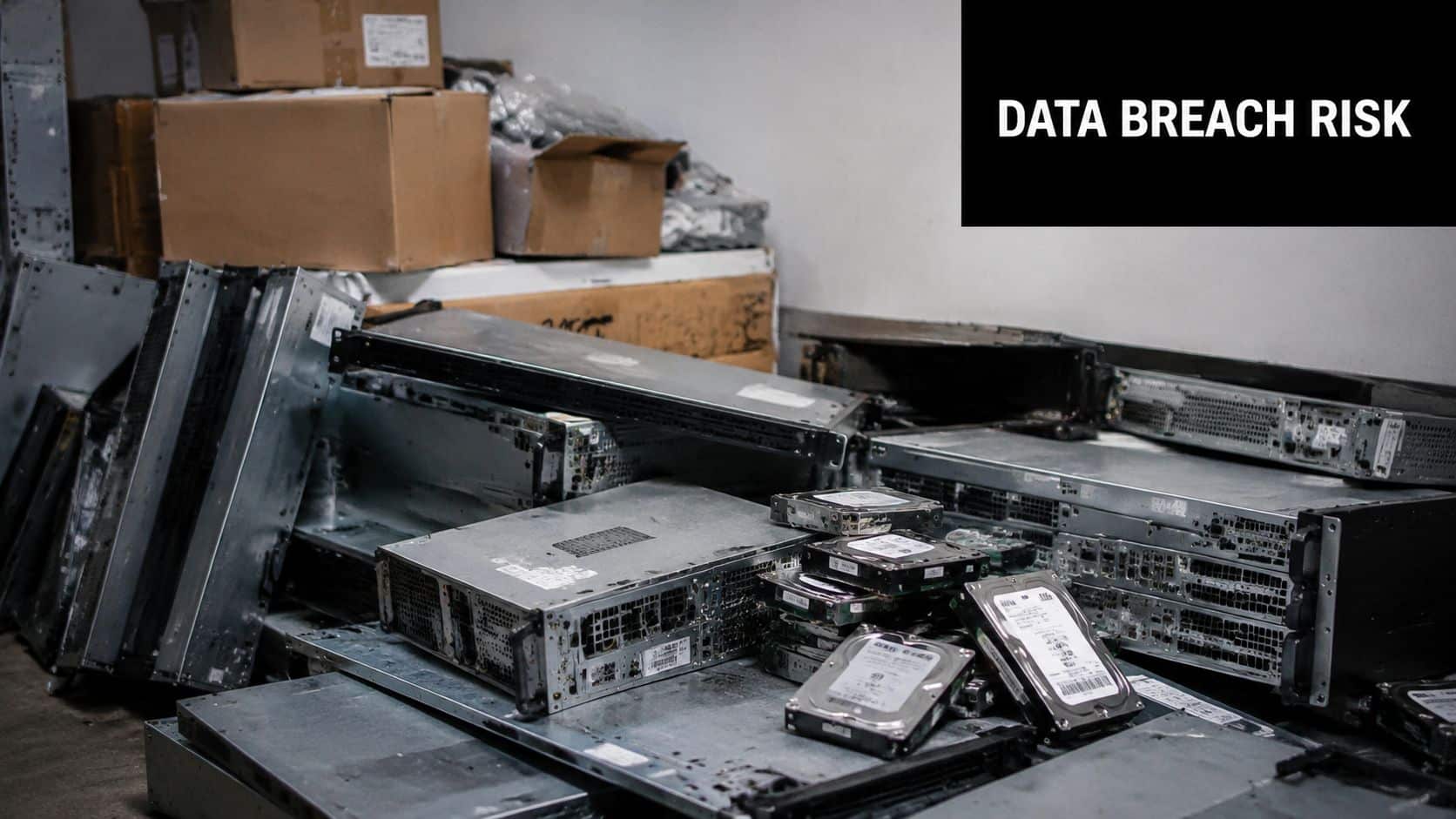
The industry is investing accordingly. The global data center IT asset disposition market was estimated at $13.1 billion in 2025 and is forecast to grow from $14.0 billion in 2026, reflecting continued demand for secure decommissioning, chain-of-custody documentation, and compliant handling of servers, storage arrays, and networking gear (data center ITAD market outlook).
The liability isn't just the drive
A retired server can create exposure in several ways at once:
- Data exposure risk because a drive that wasn't sanitized correctly may still be recoverable
- Process failure risk because undocumented handoffs leave no defensible record
- Brand risk because a disposal incident looks preventable to customers, regulators, and insurers
This is why “we sent it out for recycling” isn't an acceptable answer anymore. Recycling only addresses material handling. It doesn't prove the data was sanitized, destroyed, or tracked at the asset level.
What doesn't work
Some disposal habits look efficient but fail under scrutiny:
- Bulk moves without serial capture leave IT unable to match an asset to its final disposition
- General recycling vendors without ITAD controls may remove equipment but not provide the reporting auditors want
- One-size-fits-all destruction decisions can erase recoverable value or, worse, underprotect sensitive media
Practical rule: If your vendor can't show how a server moved from rack removal to final certificate, you still own the risk.
Georgia organizations handling regulated data should also expect their disposal process to stand up to outside review. That means the paperwork has to be as solid as the physical controls. For a local perspective on why that matters, this overview of why ITAD services matter for Georgia companies in 2026 is useful.
Choosing the Right Data Destruction Method
The main technical control in server disposal isn't transportation. It's media sanitization quality. If the data-bearing components are handled correctly, the rest of the hardware can be routed with much less risk. If they're handled poorly, everything else in the process becomes secondary.
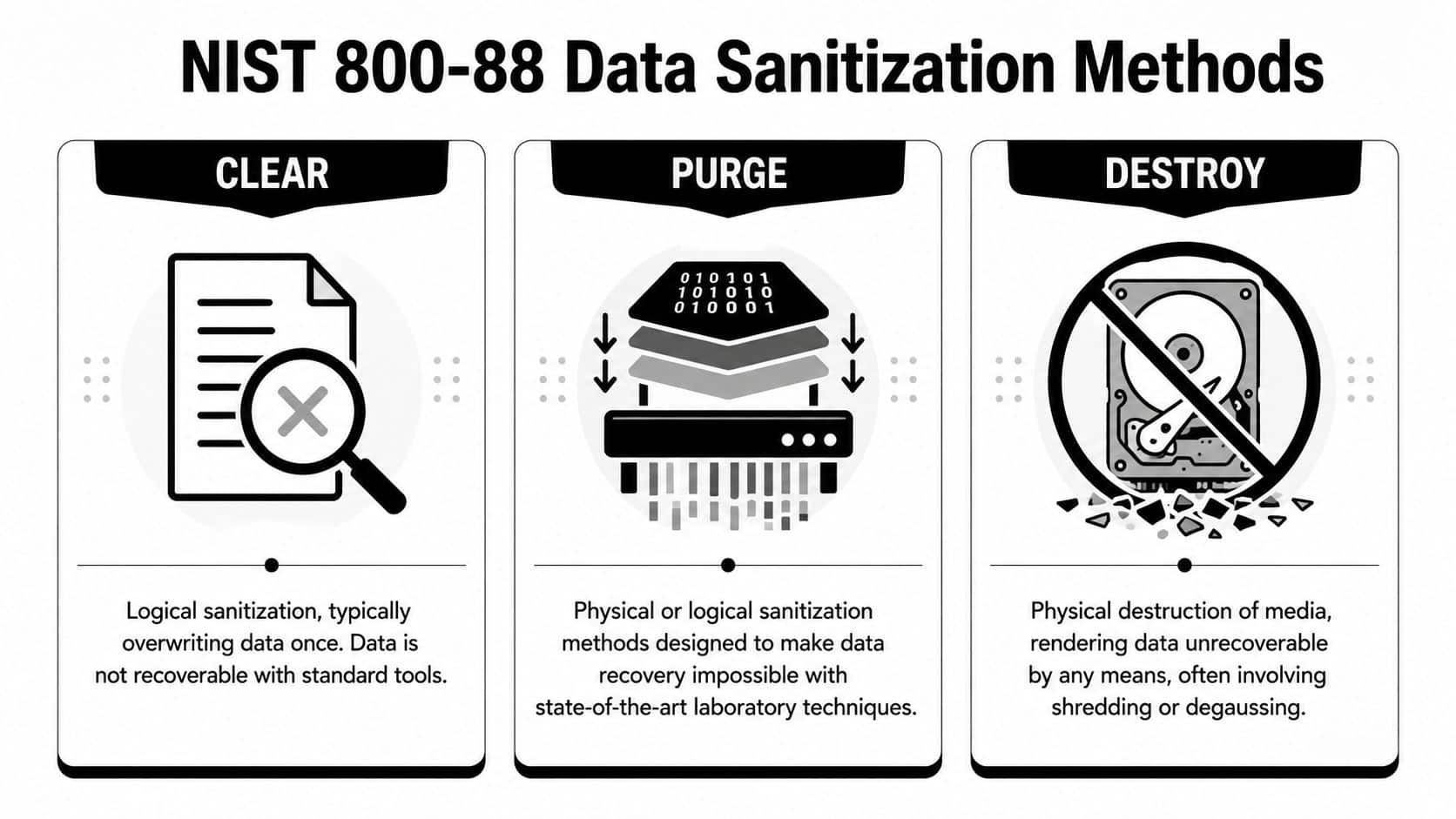
NIST SP 800-88 Rev. 1 defines three outcome-based methods: Clear, Purge, and Destroy. It also stresses that validation and documentation should match the sensitivity of the data. In practical terms, stronger sanitization lowers the probability of recoverable data but may reduce resale value, while destruction maximizes confidentiality and eliminates asset recovery for that media (NIST 800-88 overview for secure disposition).
Clear, Purge, and Destroy in plain language
Think of these options like vacating a building.
| Method | What it means in practice | Best fit |
|---|---|---|
| Clear | You remove data through logical sanitization so standard recovery tools can't bring it back | Reusable drives with lower residual risk |
| Purge | You use stronger logical or physical techniques intended to defeat more advanced recovery efforts | Higher sensitivity media that may still be reusable |
| Destroy | You physically destroy the media so the data can't be recovered by any means | Failed, locked, or highly regulated drives |
Clear is like changing locks, removing files, and documenting who secured the site.
Purge is closer to stripping the interior and sealing every access point.
Destroy is demolition. There's nothing left to re-enter.
How to choose without overcomplicating it
A useful decision framework looks like this:
- Choose wiping or sanitization when the drives are functional, the organization wants resale value, and the selected method can be verified for that media type.
- Choose destruction when the drives have failed, can't be accessed, are cryptographically or operationally locked, or the business has no tolerance for residual recovery risk.
- Review SSDs separately because SSD behavior differs from HDDs. The same command path doesn't always produce the same outcome across technologies.
- Match the evidence to the decision because a wipe with no validation report is weaker than a validated process with serial-level reporting.
A lot of avoidable mistakes happen when teams decide the method before they inventory the media. Start with the drive type and data sensitivity. Then choose the sanitization path.
For Georgia organizations, this is where a provider's technical depth matters. Some offer only shredding. Some offer wiping but weak validation. Some, including NIST SP 800-88 aligned data destruction guidance, support a more nuanced route based on media condition, compliance needs, and reuse goals.
The business trade-off
The right answer isn't always “destroy everything.” That approach protects confidentiality, but it can wipe out recoverable value on reusable drives and complete systems. The better approach is selective. Destroy what can't be trusted. Sanitize and remarket what can be verified.
Ensuring an Unbroken Chain of Custody
Secure server disposal is a process, not a single event. Data destruction can be done correctly at the media level and still leave the organization exposed if custody wasn't controlled from pickup through final disposition.
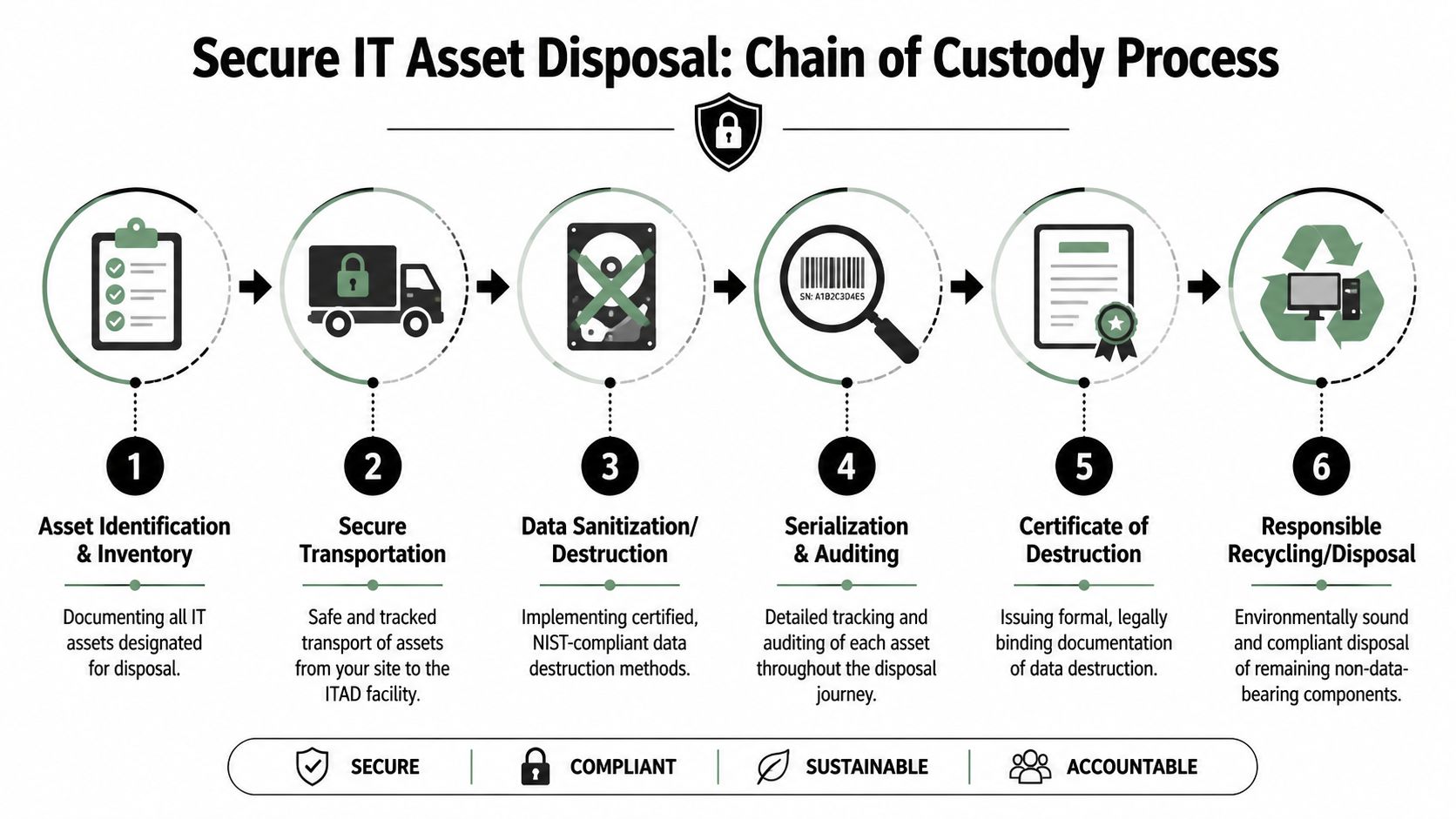
Secure ITAD workflows use serial-level asset tracking, sealed transfer, documented handoffs, and final certificates so organizations can prove control throughout the process. A solid benchmark is to require a documented asset register, an explicit disposition decision for each serial number, and a completion package with data-destruction and recycling records that transfers liability (Georgia ITAD chain-of-custody guidance).
What a defensible custody process looks like
The strongest workflows usually include these controls:
- Asset identification before removal so every server, drive, and component is tied to a serial record
- Sealed and documented transfer so there's a clear handoff from your staff to the transport team
- Controlled intake at the processing site with reconciliation against the original inventory
- Policy-based routing that determines whether each asset is reused, remarked, recycled, or destroyed
- Final reporting that closes the loop with certificates and downstream records
That sequence matters. If the pickup team removes a pallet of servers without serial capture, you can still get a certificate later, but it may not prove what happened to each asset.
The paperwork that actually transfers liability
A lot of companies ask for a certificate and stop there. That's not enough on its own. A certificate is the summary document, not the entire evidentiary record.
Look for a completion package that includes:
- Asset register with serial numbers tied to each item collected
- Custody timestamps showing when responsibility changed hands
- Disposition detail for each server or drive
- Data-destruction evidence tied back to the individual asset
- Recycling records for equipment routed to material recovery
If an insurer, auditor, or legal team asks what happened to one specific drive, your file should answer that without guesswork.
A Georgia provider such as Beyond Surplus can support this kind of workflow through serialized tracking, secure transport coordination, and formal reporting for server disposals. If you're evaluating process maturity, this overview of ITAD chain of custody in Georgia and why it matters outlines the controls worth demanding.
Where custody usually breaks down
Most failures happen during transitions. Assets sit in a staging area too long. Drives get separated from chassis without updated records. Pickup documents list quantities, not serials. None of those problems sound dramatic at the time, but they weaken your proof later.
Maximizing Value Recovery and Sustainability
Once data-bearing risk is contained, server disposal becomes a business optimization problem. The goal shifts from “How do we get rid of this?” to “What should be reused, what should be harvested, and what should be recycled?”
Separate the server from the storage decision
One mistake I see often is treating the whole asset as if every component has the same end-of-life path. That leaves money on the table. The drives might need destruction while the rest of the chassis, memory, CPUs, rails, or power supplies still have recoverable value.
That split matters because resale and recycling don't compete with security when the workflow is designed correctly. They follow it.
Where value usually comes from
A mature ITAD program recovers value in layers:
- System remarketing when complete servers remain viable for secondary use
- Component harvesting when full systems aren't marketable but parts still are
- Materials reclamation when equipment is beyond reuse and should move to responsible recycling
There's also a sustainability upside. Refurbish-or-recycle routing supports internal ESG reporting better than informal disposal because the organization can document what was reused and what was recycled, instead of relying on assumptions.
The most efficient projects don't ask whether to prioritize compliance or recovery. They sequence the work so compliance decisions come first, then extract value from what remains.
What works in practice
For Georgia businesses, the most reliable model is policy-based routing. Sensitive or failed media goes to destruction. Reusable hardware goes through verified sanitization and remarketing. Commodity scrap gets processed through documented recycling channels.
What doesn't work is deciding too early that everything is scrap. That can simplify operations in the short term, but it usually increases cost and reduces reporting quality. A well-run server disposal program should reduce risk, free space, and return some economic value where the hardware condition supports it.
Your ITAD Vetting Checklist and Next Steps
When you're selecting a Georgia ITAD provider, ask questions that force specificity. General promises about secure disposal aren't useful. You need operational detail and records that hold up after the project is over.
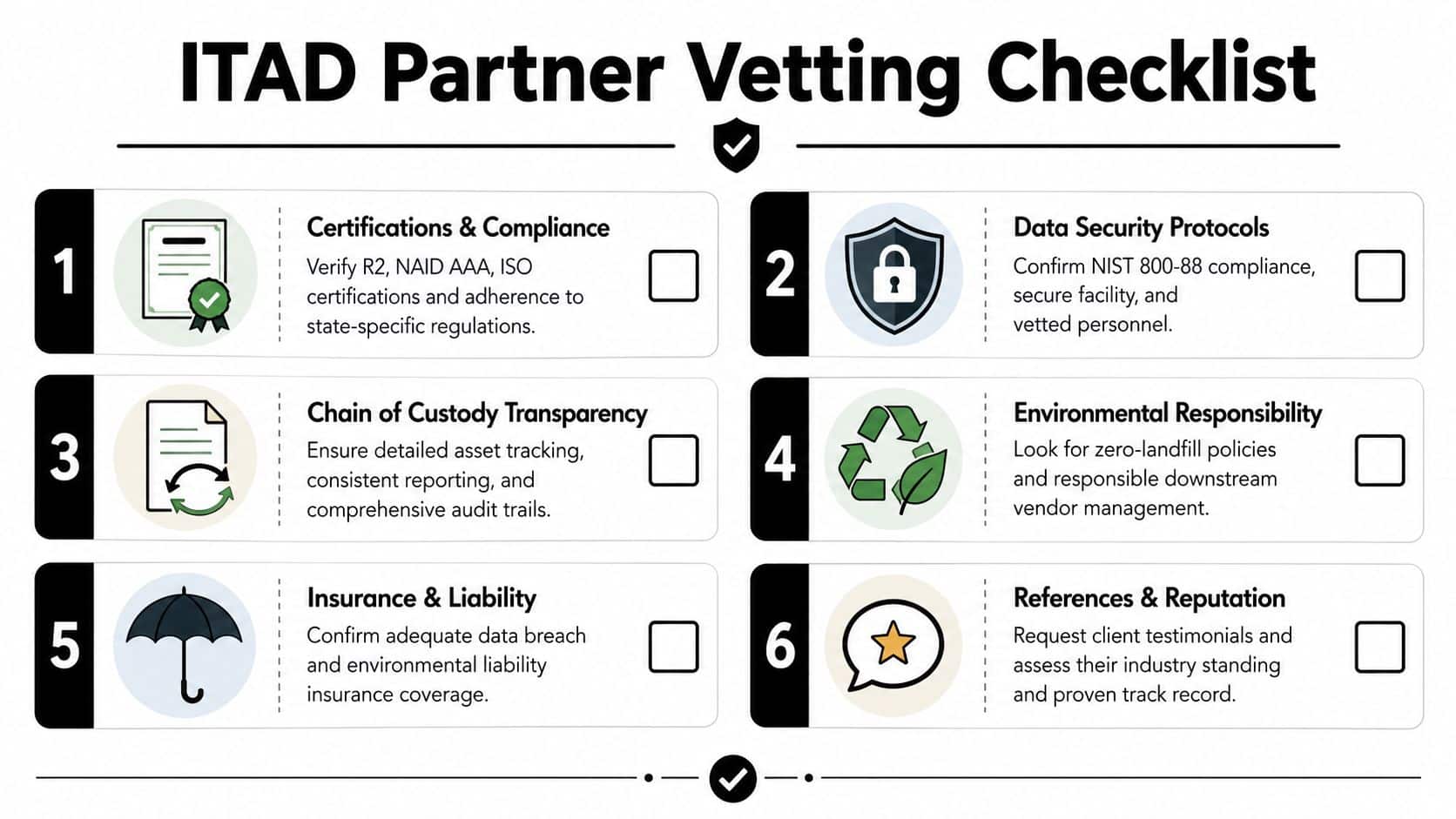
For defensible records, businesses should request serial numbers, custody timestamps, wipe-validation reports, downstream recycler details, and certificate scope from their Georgia ITAD provider. That documentation transfers liability and supports audits. It matters because Verizon's 2025 DBIR reported that the human element was involved in 60% of breaches (documentation expectations for secure data device disposal).
Questions worth asking before pickup day
Use this as a practical screening list:
- How do you inventory assets? Ask whether they capture serial numbers before or at pickup, and how that register is reconciled later.
- Which sanitization paths do you support? The answer should distinguish between wiping, purge-level methods, and physical destruction.
- How do you handle failed or locked drives? You want a clear escalation path, not improvised decisions.
- What does your certificate include? Ask whether the scope ties back to asset-level records or only summarizes a shipment.
- Can you identify downstream recyclers? If they won't discuss downstream processing, your visibility may stop too early.
- How is transport controlled? Sealed transfer and documented handoffs should be standard, not optional.
Red flags to catch early
A provider may not be the right fit if they:
- Quote disposal without discussing media type
- Offer certificates but no serialized reporting
- Treat all assets as scrap without evaluating reuse paths
- Rely on vague language about “industry-standard wiping” without validation evidence
Ask for a sample completion package before you sign anything. If the sample is thin, your audit file will be thin too.
For teams building a vendor review process, this certified data destruction checklist for Georgia ITAD is a strong place to start. It helps turn broad security concerns into a concrete acceptance standard.
If your organization is planning server disposal in Georgia, contact Beyond Surplus for certified electronics recycling and secure IT asset disposition with documented data destruction, chain-of-custody reporting, and value recovery options for business equipment.


